

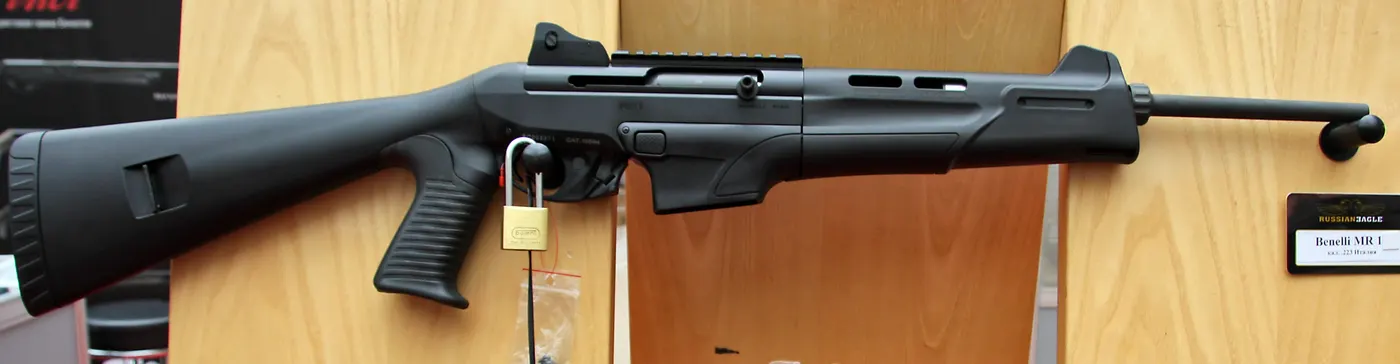

The Benelli MR1 cycles on a gas piston system borrowed from a shotgun, not from any earlier rifle, which makes it one of the more mechanically unusual entries in the crowded AR-15-style rifle field. Chambered in 5.56x45mm NATO and the closely related .223 Remington, the MR1 pairs a standard AR-15 magazine well and receiver architecture with Benelli's patented A.R.G.O. (Auto-Regulating Gas-Operated) piston, a system first developed for the Benelli M4 Super 90 combat shotgun rather than for any rifle.1,6 Beretta designed the rifle in the mid-2000s under the internal name RX4 Storm, then handed production and the eventual civilian branding to its sister company Benelli Armi SpA of Italy, since Benelli has been a Beretta subsidiary since 1983.1,5
- ARGO piston system runs cleaner than direct impingement, less carbon fouling in the action
- noticeably softer recoil impulse than a comparable direct impingement AR-15
- accepts standard AR-15 pattern magazines despite the different gas system
- two-stage, 5.5 lb factory trigger praised in period reviews
- priced well above comparable AR-15 carbines when new
- limited aftermarket support compared to the mainstream AR-15 ecosystem
- trigger guard mounted safety and awkward optics co-witness criticized by reviewers
- discontinued in the United States market by the late 2010s
Benelli MR1 specifications place it close to a conventional semi-automatic rifle in most respects, weighing 3.19 kg (7.03 lb) empty and feeding from STANAG-pattern detachable magazines that hold 5, 10, 20, 25, or 30 rounds.1 What sets the Benelli MR1 apart from a typical Colt- or Ruger-pattern AR-15 is entirely internal, its bolt is driven by a short-stroke piston fed from a gas port cut close to the chamber, rather than by gas routed directly into the bolt carrier through a tube. Benelli MR1 price at launch ran close to 1,299 USD, a real premium over comparable direct impingement carbines of the same era, a gap that later became one of the biggest obstacles to the rifle's commercial success in the United States.4
Beretta originally sold the rifle to law enforcement customers under the RX4 Storm name starting in 2005, only extending Benelli-branded MR1 sales to civilian buyers toward the end of that decade, a branding split that still confuses buyers searching for the two names today.1,2
Beretta conceived the rifle as the tactical member of its X4 Storm family, alongside the pistol-caliber Beretta CX4 Storm carbine and the PX4 Storm pistol.1,7 The rifle never won the wide commercial following its AR-15 rivals enjoyed, and by 2018 firearms press was already describing it as a forgotten design, but its ARGO piston links it directly to a separate, still-active Benelli product line, the Benelli Argo family of bolt-free hunting rifles, which uses the same gas piston principle in a completely different, wood-stocked sporting form.1,3
The ARGO Piston, Borrowed From a Combat Shotgun
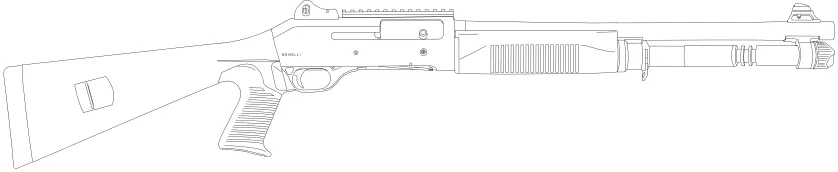
The A.R.G.O. system that drives the Benelli MR1 was not designed for a rifle at all. Benelli developed the Auto-Regulating Gas-Operated piston for the M4 Super 90 twelve-gauge shotgun, the same design later adopted by the United States Marine Corps as the M1014 Joint Service Combat Shotgun, before adapting the same operating principle down to rifle-caliber use for the RX4 Storm and MR1 in the mid-2000s.1,6 The system uses a pair of short-stroke steel pistons mounted below the barrel and hidden under the forend, fed by a gas port drilled close to the chamber where propellant gas is still hot and under high pressure, rather than farther down the barrel where most direct impingement AR-15s tap gas.6 Benelli's own literature describes the arrangement as self-regulating, meaning it cycles reliably across a range of ammunition pressures without the shooter adjusting a gas valve, a claim consistent with reviewer reports of the MR1 running without a single gas-related stoppage across several hundred rounds of mixed ammunition.4
- İlk Üretim Yılı2005
- TasarımcıBeretta (rifle designed in-house by Beretta under the internal name RX4 Storm, production and civilian branding transferred to sister company Benelli Armi)
- Ağırlık (Boş)3,19 kg
That same ARGO principle, refined further as the ARGO E system, now powers Benelli's separate Benelli Argo line of wood- and synthetic-stocked hunting rifles in calibers up to .300 Winchester Magnum, a civilian sporting product with no magazine or furniture in common with the MR1 beyond the shared piston architecture.3 The technical link matters because it means the gas-operated MR1 descends from Benelli's shotgun engineering rather than from any existing AR-15 or battle rifle design, unlike most other manufacturers who built their gas-piston AR-15 variants by retrofitting a piston onto an existing direct impingement upper.
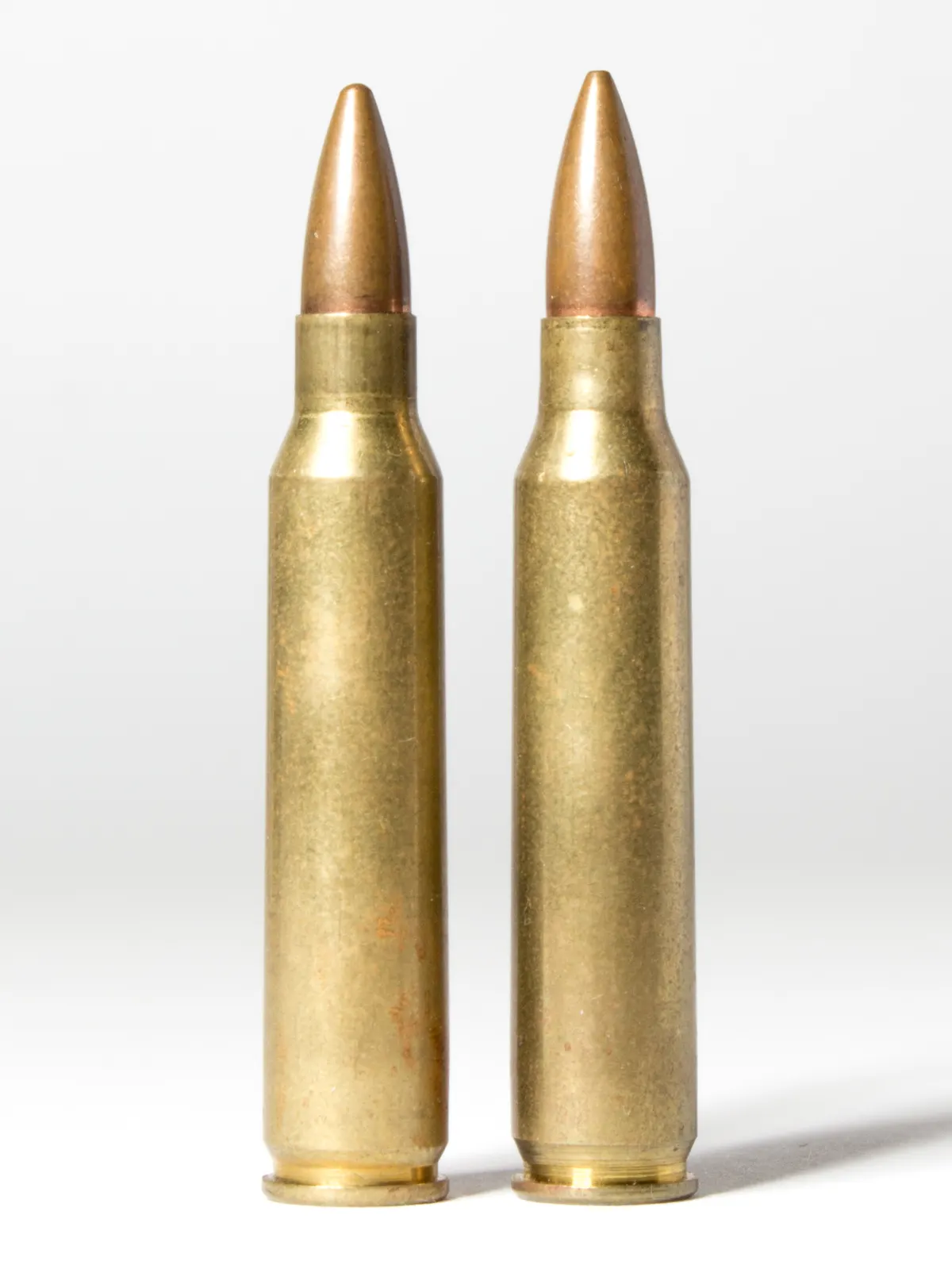
- Fişek5.56mm NATO/.223 Remington
- Çap5,56 mm
- Kovan Uzunluğu45 mm
- Mermi Ağırlığı4 g
Inside the receiver, the Benelli MR1's rotating bolt locks into a barrel extension in the same way as a conventional AR-15, which is the detail that lets it accept unmodified AR-15 pattern magazines and share basic ergonomics with the rest of the category despite its different gas system.1 The barrel itself is hammer-forged steel with a chrome-lined bore and a six-groove, 1 in 9 inch rifling twist, and Benelli offered it in three lengths, a 12.5 inch threaded barrel with a removable muzzle brake, a 16 inch standard rifle barrel, and a 20 inch target-length barrel, giving an overall length between roughly 854mm and 943mm depending on configuration.1,7
- Mekanizma TipiGazlı
- Atış Modlarısadece yarı otomatik
- Seçmeli AtışHayır
- Besleme SistemiÇıkarılabilir Şarjör
- Şarjör Kapasitesi5
Direct Impingement Rivals and the AR-15 Magazine Well
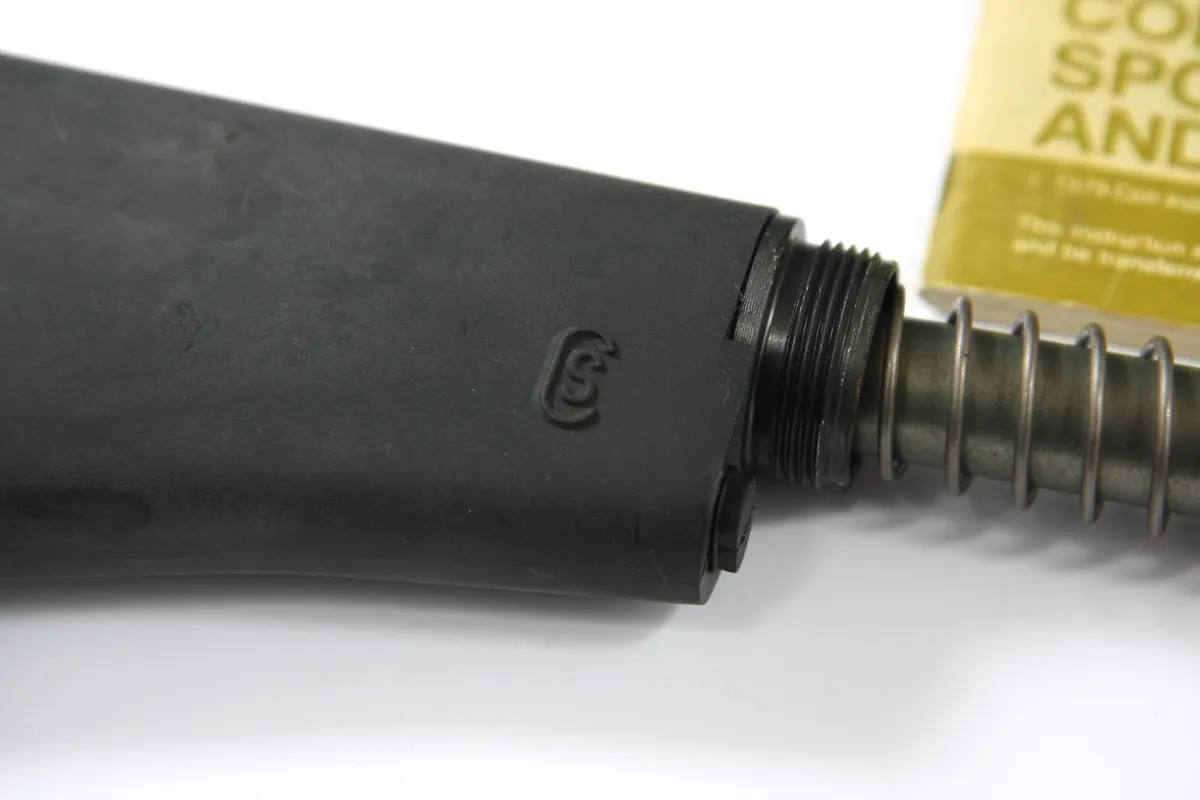
The overwhelming majority of AR-15 pattern rifles on the market, including the Colt AR-15 that gives the whole category its informal name, use direct impingement, routing propellant gas through a tube straight into the bolt carrier rather than through a separate piston.1 Because the Benelli MR1 keeps the standard AR-15 magazine well, buyers can drop in the same 30-round STANAG magazines used across the category, including Magpul PMAGs, though period reviewers noted some magazine models fit more loosely in the MR1's slightly different magazine catch geometry than they do in a mil-spec AR-15 lower.4 Where the two designs diverge most is felt recoil, reviewers consistently described the MR1's gas piston impulse as noticeably softer and flatter shooting than a comparable direct impingement carbine, a difference attributable to how the ARGO piston meters gas pressure rather than dumping the full charge directly against the bolt carrier.4
- Namlu Çıkış Hızı920 m/sn
- Etkili Menzil (nokta)500 m
The Benelli MR1's sights are fixed ghost ring apertures, adjustable for windage and elevation, rather than the folding diopter sights common on many AR-15 rivals, and the rifle ships with a Picatinny rail atop the receiver for optics along with nine sling attachment points across the stock and forend.1 Magazine capacity on the standard included magazine is 5 rounds, a configuration aimed at markets with magazine capacity restrictions, though the same rifle accepts the larger 10-, 20-, 25-, and 30-round STANAG magazines without modification.1 The stock is not foldable, a deliberate design choice, since the ARGO recoil spring is housed inside the stock itself rather than around the buffer tube the way most AR-15s locate it, which rules out a side-folding or telescoping-only stock of the kind common elsewhere in the category.1
- Namlu Uzunluğu317 mm
- Yiv Sayısı6
- Nişangah TipiDemir
- Açık NişangahEvet
- Dişli NamluEvet
- Katlanır / Toplanır DipçikHayır
- ModülerlikDeğiştirilebilir bölümlere sahip modüler dipçik
- Üretim Başlangıcı2005
- Varyantlar3
- Genişlik63,5 mm
- Yükseklik196 mm
From Beretta's RX4 Storm to the Benelli-Branded MR1
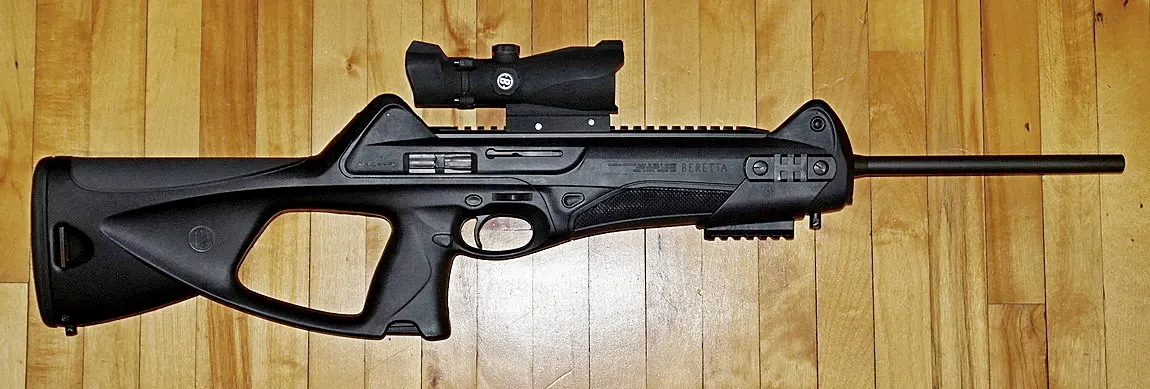
Beretta built the rifle that became the Benelli MR1 as part of its broader X4 Storm family, a line that also included the Beretta CX4 Storm pistol-caliber carbine and the PX4 Storm service pistol, all sharing a common visual language of angular polymer furniture and side-mounted accessory rails even though their internal mechanisms had almost nothing in common.1 Beretta introduced the rifle-caliber member of the family as the RX4 Storm in 2005, marketed primarily to law enforcement agencies as a compact patrol rifle alternative, before deciding the platform fit Benelli's product catalog better than Beretta's own and transferring both branding and manufacturing to its Urbino-based subsidiary.1,2 Benelli formally introduced the civilian-branded MR1 by the end of the decade, built at the same Urbino, Italy plant that produces Benelli's shotguns, while separate MR1 units for the American market were assembled in Accokeek, Maryland from Italian-made components.1
No police department is confirmed to have formally adopted the RX4 Storm or the later MR1 as a standard-issue patrol rifle, despite Beretta's original marketing push toward that customer base, and the rifle instead found its niche among individual civilian buyers and a small number of law enforcement officers purchasing it personally rather than through department contracts.2 Beretta's decision not to push the RX4/MR1 platform toward a military contract reflected a wider corporate strategy, the company already had a dedicated select-fire military rifle program underway that would become the Beretta ARX160, adopted by the Italian Army in 2008 as part of the Soldato Futuro modernization program, leaving the semi-automatic-only MR1 firmly in the civilian and commercial law-enforcement market rather than competing for a service rifle contract.8
A Niche Product in a Crowded, Price-Sensitive Market
Reviewers who tested the Benelli MR1 against the flood of budget AR-15s that entered the American market through the 2010s generally praised its reliability and shooting characteristics while criticizing its price, noting that a buyer could assemble a very capable direct impingement AR-15 from established brands for hundreds of dollars less than the MR1's roughly 1,299 USD list price.4 That price gap, more than any mechanical shortcoming, is what firearms trade press pointed to when explaining why the Benelli MR1 never became a mainstream seller in the United States the way cheaper direct impingement rivals did.3,4 By 2018, coverage of the rifle openly described it as largely forgotten in the American market, and Benelli had by then stopped actively selling new MR1 rifles to U.S. dealers, even though spare parts and used examples continued to circulate through the secondary market and Benelli's international catalog kept variants of the platform available outside the United States longer.3
Whether the Benelli MR1 is still in service anywhere is a question with a simple answer. It was never adopted as a standard service weapon by any military or national police force, so the usual measure of continued service does not really apply the way it would to an issued military rifle. Its story is that of a well-engineered but commercially marginal civilian and small-agency product rather than a fielded service arm.2,3
Benelli sold the MR1 in three barrel lengths built on the identical ARGO action and receiver. The 16 inch barrel was the standard civilian configuration sold through most U.S. dealers, the 20 inch barrel targeted hunters and shooters wanting a longer sight radius and slightly higher velocity, and the compact 12.5 inch barrel, threaded and fitted with a removable muzzle brake, was marketed through Benelli's law enforcement and defense channel as the MR1 12.5, a configuration that in many jurisdictions requires the same short-barreled-rifle regulatory handling as any other sub-16 inch AR-15 pattern rifle.7,1
Stock and furniture options made up the rest of the MR1's variant spread. Benelli offered the rifle with a fixed synthetic stock, a Comfortech recoil-reducing stock borrowed from the company's shotgun line, a pistol-grip configuration with a fixed stock, and a pistol-grip configuration with a telescoping (non-folding) stock, giving buyers roughly three meaningfully different ergonomic packages on top of the barrel-length choice.1 None of these configurations changed the ARGO gas system or the magazine well, the differences were entirely external, aimed at letting individual departments or civilian buyers match the rifle to hunting, home-defense, or patrol roles without Benelli having to engineer a separate action for each.


The Benelli MR1 was never adopted as a standard-issue weapon by any national military or police force, and it functioned throughout its production run primarily as a civilian sporting and personal-defense rifle sold in Italy, the United States, and other markets where Benelli maintained dealer networks.1,2 Some individual law enforcement officers in the United States purchased MR1 rifles personally under agency-approved off-roster programs, the same channel that let officers buy AR-15 rivals like the Ruger AR-556, but no department is documented to have issued the MR1 as standard patrol equipment.2 Benelli Armi, as an Italian manufacturer, remained the sole production source for the rifle across its run, with U.S.-market rifles assembled from Italian-made components rather than built from a separate domestic design.1
Beretta had two very different answers to the same basic engineering question in the mid-2000s, and the choice it made between them defines the Benelli MR1's place in the market more than any single spec does. Rather than scale the RX4 Storm/MR1 platform up into a full military rifle, Beretta developed an entirely separate select-fire design, the Beretta ARX160, for the Italian Army's Soldato Futuro program, adopted in 2008, and left the semi-automatic-only ARGO rifle to compete purely in the civilian and small-agency market.8 The two rifles share a parent company and an Italian design pedigree but almost nothing else mechanically, the ARX160 is a piston-driven, select-fire, quick-change-barrel service rifle built to NATO military specifications, while the Benelli MR1 is a semi-automatic-only civilian carbine that was never submitted for a military trial.
| ÖZELLİK | Benelli MR1 | Colt AR-15 |
|---|---|---|
| Namlu Uzunluğu | 317 mm | 409 mm |
| Ağırlık (Boş) | 3.19 kg | 3.15 kg |
| Şarjör Kapasitesi | 5 adet | 30 adet |
| Mekanizma Tipi | Gazlı | Gazlı |
Against the Colt AR-15, the comparison runs the other direction, both rifles are semi-automatic-only, civilian-legal carbines aimed at the same buyer, but they take opposite approaches to the gas system. The Colt AR-15 uses the direct impingement action that has defined the category since the 1960s, a simpler, lighter mechanism that is cheaper to manufacture but runs dirtier and, according to most independent testing, produces a slightly sharper felt recoil impulse than a comparable piston gun.1,4 The Benelli MR1's ARGO piston trades some of that manufacturing simplicity for a cleaner-running action and softer recoil, at a real cost premium that put it well above Colt's own AR-15 pricing for most of its production run.4 Neither rifle displaced the other commercially, Colt's AR-15 kept its brand-premium position at the top of the direct impingement market while the MR1 never built enough volume to seriously contest it, but the two rifles remain the clearest head-to-head illustration of the direct-impingement-versus-piston tradeoff within a single, shared AR-15 magazine ecosystem.


Is the Benelli MR1 still in production? Benelli stopped actively selling new MR1 rifles to United States dealers by the late 2010s, and firearms press had already described it as a largely forgotten product by 2018, though the ARGO platform itself continues in Benelli's separate Argo hunting rifle line.3,1
What caliber does the Benelli MR1 use? The Benelli MR1 is chambered in 5.56x45mm NATO and the closely related, lower-pressure .223 Remington cartridge, the same chambering used by the great majority of AR-15 pattern rifles.1
How does the Benelli MR1's gas system work? The Benelli MR1 uses Benelli's A.R.G.O. system, a pair of short-stroke steel pistons fed from a gas port near the chamber, rather than the direct impingement system used by most other AR-15 pattern rifles, a design originally developed for the Benelli M4 Super 90 shotgun.1,6
How much does a Benelli MR1 cost? The Benelli MR1 listed at roughly 1,299 USD during its main U.S. sales period, a real premium over comparable direct impingement AR-15 rifles, which contributed to its limited commercial success.4
Is the Benelli MR1 good for law enforcement or home defense use? No police agency is confirmed to have formally adopted the MR1 as standard patrol equipment, though individual officers and civilians purchased it for personal defense use, and reviewers rated its reliability and reduced recoil favorably for that role despite its higher price.2,4
How does the Benelli MR1 compare to a standard AR-15? The Benelli MR1 accepts the same STANAG magazines and shares the same general layout as a Colt-pattern AR-15, but replaces the direct impingement gas system with Benelli's piston-driven ARGO action, trading some mechanical simplicity for a cleaner-running, softer-shooting rifle at a higher price.1,4
- "Benelli MR1", Wikipedia — en.wikipedia.org ↩
- "Rx4 Storm", NamuWiki — en.namu.wiki ↩
- "Forgotten One: The Benelli MR1", The Firearm Blog — thefirearmblog.com ↩
- "Gun Review: Benelli MR1 Tactical Rifle", The Truth About Guns — thetruthaboutguns.com ↩
- "Beretta Rx4 Storm", Wikipedia — en.wikipedia.org ↩
- "A.R.G.O.", Benelli USA — benelliusa.com ↩
- "MR1 12,5 inch", Benelli Defense — benellidefense.com ↩
- "Beretta ARX160", Wikipedia — en.wikipedia.org ↩
- "Rx4 Storm / Ghost Recon: Advanced Warfighter", Ghost Recon Wiki — ghostrecon.fandom.com ↩