


More rifles carrying the Marlin Model 60 name have left factory doors than almost any other sporting firearm made in the United States. Marlin Firearms and its later owners built roughly 11 million of them between 1960 and 2020, a production run that makes the Model 60 one of the best-selling .22 rifles in history and, by unit count, one of the best-selling rifles of any type ever produced.1 The basic formula never changed much across sixty years. A blowback, semi-automatic rimfire rifle chambered only in .22 Long Rifle, fed from a tubular magazine under the barrel, priced low enough that a working family could buy one without much thought.
- extremely low unit cost across its production life
- tubular magazine holds more rounds than most detachable-box rivals
- Micro-Groove rifling reputation for out-of-box accuracy
- simple blowback action, few moving parts to fail
- enormous parts and gunsmith support from the installed base
- tube-fed reload is slower than swapping a detachable magazine
- discontinued since 2020 with no confirmed revival plan
- feed reliability drops noticeably with dirty or bulk-pack ammunition
- fewer aftermarket accessories than the Ruger 10/22 ecosystem
The Marlin Model 60 belongs to the broader family of semi-automatic rifles, though its role sits far from the battlefield weapons that dominate that category. It was built as a plinking, small-game, and first-rifle gun, not a military design, and no army or police force ever adopted it as issued equipment. That civilian orientation is part of what let Marlin Firearms keep the price down and the design simple for six decades. The rifle's blowback action needs no gas system or locking lugs, its cross-bolt safety sits directly behind the trigger guard where a beginner can reach it without looking, and its tubular magazine holds far more rounds than the box magazines used by its main rival, the Ruger 10/22.
Because the Marlin Model 60 specifications stayed close to a fixed template for most of the run (a 19-inch barrel in its final decades, a hardwood stock, open sights, and a 2.5-kilogram empty weight) collectors and new buyers alike can usually recognize a Model 60 at a glance regardless of the decade it came from. The rifle changed hands corporately several times, from Marlin Firearms of North Haven, Connecticut, to Remington Arms after 2007, and finally to Sturm, Ruger & Co. in 2020, and each ownership era left its own mark on where and how the rifle was actually built.
The Marlin Model 60 is built around the simplest self-loading mechanism available for a low-pressure rimfire cartridge, direct blowback. Firing a .22 LR round produces enough case pressure to push the bolt rearward against spring tension alone, cycle the action, and strip the next .22 Long Rifle cartridge from the tubular magazine, all without a gas system, rotating bolt, or locking mechanism of any kind. That simplicity is a large part of why the rifle could be built and sold so cheaply for so long, department stores were advertising Model 60s for around $40 in the 1970s.5
- İlk Üretim Yılı1960
- Hizmete Giriş Yılı1960
- TasarımcıEwald Nichol
- Ağırlık (Boş)2,5 kg
- Halen HizmetteHayır
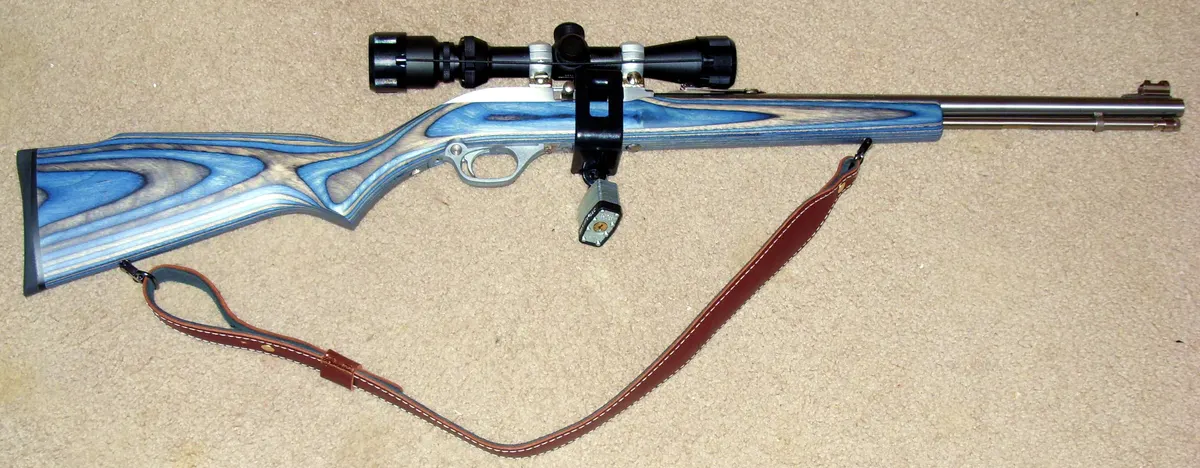
Marlin's own Micro-Groove rifling, developed in 1953 and applied to the Model 60's barrel with 16 shallow grooves rather than the four or six deeper grooves used by most competitors, is the design detail Marlin marketed hardest. The theory behind it holds that a soft lead .22 LR bullet deforms less when engaged by many shallow grooves than by fewer deep ones, which in turn produces tighter, more consistent groups downrange. Whatever the underlying mechanism, the Model 60 built a genuine reputation for out-of-box accuracy that several period reviewers rated above the Ruger 10/22, its closest and longest-running rival.5
- Fişek.22 LR
- Çap5,6 mm
- Kovan Uzunluğu15,11 mm
- Çap Sınıfıkenar ateşlemeli
- Mermi Ağırlığı2,3 g
- Kenar AteşlemeliEvet
- Kovansız MühimmatHayır
The rifle's tubular magazine, Marlin's most distinctive practical feature, is the detail that most separates the Model 60 from box-fed .22 rifles. A tubular magazine running under the barrel cannot fall out, cannot be lost in the field, and historically held more rounds than a detachable box of similar size. Capacity was not fixed across the production run, though. Early Model 60s built with a 22-inch barrel and a longer magazine tube held up to 17 or 18 rounds. During the late 1980s Marlin trimmed maximum capacity to comply with New Jersey's 15-round magazine limit, and when the barrel was shortened to 19 inches in the early 2000s to match a shorter tube, capacity settled at 14 rounds for the rifle's final two decades of production.1
- Mekanizma TipiBlowback (Geri İtmeli)
- Atış Modlarıyarı otomatik
- Seçmeli AtışHayır
- Besleme SistemiTüp Şarjör
- Şarjör Kapasitesi14
- Emniyet Tipiçapraz mandal
Beyond the magazine, the Marlin Model 60's furniture followed the market rather than staying static. The original 1960 rifle used a birch stock specifically to undercut the more expensive walnut used on its direct predecessor, the Model 99, and birch or other hardwood remained the base-model standard for most of the run. Later variants offered walnut, black synthetic, and laminate stocks aimed at hunters and outdoor use where moisture resistance mattered more than cosmetics.1 Sights on the standard Model 60 are a fixed, adjustable open rear notch paired with a ramp front sight, both suitable for the modest ranges a .22 LR rifle is realistically used at, and the receiver comes grooved from the factory to accept scope rings, a cheap and effective substitute for a proper accessory rail on a rifle built to a strict price point.
- Namlu Çıkış Hızı390 m/sn
A round fired from a Model 60 leaves the muzzle at roughly 390 meters per second (1,280 feet per second) with standard-velocity .22 LR ammunition, though actual velocity varies with barrel length, era, and the specific load used, since .22 LR ammunition ranges from lightweight hyper-velocity hollow points around 2.3 grams up to standard 40-grain (2.6-gram) target loads.1 None of those numbers are dramatic by rifle standards, and that is precisely the point. The Marlin Model 60 was never meant to compete on ballistics. It was meant to be affordable, reliable with clean ammunition, and forgiving enough that a first-time shooter could handle it safely, which is exactly why so many American hunters and target shooters learned to shoot on one.
- Namlu Uzunluğu483 mm
- Yiv Sayısı16
- Nişangah TipiAyarlanabilir açık arka gez ve rampa ön
- Optik RayıEvet
- Açık NişangahEvet
- Dişli NamluHayır
- Kabza/Dipçik Malzemesisert ahşap
- Katlanır / Toplanır DipçikHayır
- Bullpup DüzeniHayır
- Çift Yönlü KumandalarHayır
- Susturucuya HazırHayır
- Süngü TakozuHayır
- Entegre BipodHayır
- Bombaatar KabiliyetliHayır
- Gaz PistonluHayır
- Toplam Üretim11.000.000
- Üretim Başlangıcı1960
- Üretim Bitişi2020
- Varyantlar35
Marlin Firearms Company had already spent nearly ninety years building rifles by the time the Model 60 appeared. Founded in 1872 by John Marlin in what became North Haven, Connecticut, the company built lever-action rifles, pump-action shotguns, and single-shot rifles that made it Winchester's main rival through much of the late nineteenth and early twentieth centuries. During the First World War, Marlin's subsidiary became one of the world's largest machine gun manufacturers, building the Colt-Browning M1895 design and aircraft-mounted variants for Allied forces, a period of Marlin's history entirely separate from the sporting rimfire rifles the company is best known for today.2
The direct ancestor of the Model 60 was the Model 99, designed by Marlin engineer Ewald Nichol and introduced in 1959 with a walnut stock and a factory-tapped receiver for scope mounting. Marlin's engineers, Nichol among them, adapted that design into the Model 60 for the 1960 model year, and the single biggest change was material rather than mechanism, birch replaced walnut in the stock, cutting recurring production costs without touching the rifle's function.1,6 That cost discipline set the tone for the Model 60's entire commercial life. It stayed one of the least expensive .22 semi-automatic rifles sold in America for six decades while still earning a reputation as one of the most accurate rimfire rifles available out of the box, a rare combination that helps explain how a single sporting rifle design could sell 11 million units.6
By the 1970s the Model 60 had become a fixture of American hunting and shooting culture, sold through hardware stores and mail-order catalogs (including private-label runs stamped Glenfield, Marlin's own budget sub-brand, and store-exclusive versions for retailers like Montgomery Ward) at prices around $40, well within reach of a family buying a first rifle for a teenager.5 Through the 1980s and 1990s the rifle's reputation only grew, with Marlin's own marketing and outdoor-press coverage repeatedly calling it the most popular .22 rifle in the world, a claim that production numbers from the era do little to contradict.6
Corporate ownership of Marlin Firearms changed twice in the Model 60's later decades, and both changes left marks on the rifle. In December 2007, Cerberus Capital Management's Remington Arms subsidiary, operating under what later became Remington Outdoor Company, acquired Marlin. Manufacturing consolidated onto Remington's own facilities, and Marlin's original North Haven, Connecticut plant, along with a Gardner, Massachusetts plant Marlin had gained through its 2000 acquisition of H&R 1871, closed in 2010. Production of Model 60s shifted to Remington-owned plants in Ilion, New York, and Mayfield, Kentucky, before a further move to Huntsville, Alabama, in 2016 and 2017.2
Remington Outdoor Company's finances deteriorated through the following decade. The parent company filed for bankruptcy in 2018, reorganized, and filed again in 2020. That second bankruptcy put the Marlin brand and its assets up for sale as part of a broader liquidation of Remington's holdings. Sturm, Ruger & Co. announced an agreement to acquire Marlin's assets on September 30, 2020, with the deal contingent on approval from the federal bankruptcy court overseeing Remington Outdoor's case in the Northern District of Alabama.3 The court approved the sale, and Ruger closed the acquisition on November 23, 2020, paying roughly $28.3 million in cash on hand for Marlin's brand, tooling, and remaining inventory.4
Production of the Marlin Model 60 stopped when the Ruger deal closed in November 2020, ending a run that had continued without a real break since 1960. Ruger relaunched the Marlin brand in the fall of 2021, but it prioritized Marlin's lever-action rifles, a revived Model 1895 lever gun and the long-running Marlin Model 336 among them, rather than the rimfire semi-automatics. By January 2022, Ruger had confirmed publicly that it had no plans to resume Model 60 production, leaving the rifle's 60-year run permanently closed even as the broader Marlin brand continued under new ownership.1
The Marlin Model 60's discontinuation left a genuine gap in the entry-level rimfire market that Ruger's own product line has not directly filled. Ruger continued building its own Ruger 10/22 throughout the entire Marlin acquisition and relaunch, and buyers looking for a new tube-fed .22 rifle in the Model 60's mold have had to turn to the used market or to other manufacturers rather than to Ruger's revived Marlin lineup, which stayed focused on lever guns rather than semi-automatic rimfires.1
Across sixty years of production, Marlin and its later owners issued the Model 60 in an unusually large number of factory variants, well over the ten most commonly catalogued today, closer to 35 distinct configurations by the outdoor press's own count.5,6 The core mechanism never changed. What varied was stock material and finish, metal finish, sights, and, in a handful of cases, magazine type.
The Glenfield Model 60, sold under Marlin's own economy sub-brand roughly from 1960 to 1965, is the earliest and most common variant collectors encounter, distinguished mainly by its lower-cost finish and Glenfield roll marks rather than any mechanical change. Later stainless-and-synthetic variants aimed the Model 60 at hunters who needed weather resistance, the Model 60SB with a stainless barrel, the Model 60SS with a nickel-plated stainless barrel and laminate stock, and the Model 60SSK pairing the same stainless finish with a black fiberglass stock. The Model 60DL went the other direction, offering a walnut Monte Carlo stock for buyers who wanted a more traditional sporting rifle. Marlin also produced camouflage-finished Model 60C rifles for hunters and marked commemorative runs, including a 50th-anniversary Model 60DLX with gold roll marks and premium walnut furniture, and an NRA 125th Anniversary edition in 1996 with a gold trigger.1 Retailer-exclusive runs added still more variety, a Model 600 built for Big 5 Sporting Goods between 1986 and 1989, and a blue-and-gray laminate Model 60SSBL sold exclusively through Cabela's.1
Marlin also branched the Model 60's basic tube-fed rimfire concept into distinct spinoff models rather than simple cosmetic variants. The Marlin Model 795 adapted the same blowback rimfire platform to a detachable box magazine instead of a tubular one, aimed at shooters who preferred faster reloads over tube capacity. More significant historically is the Marlin Model 70P, nicknamed the Papoose, a takedown carbine Marlin introduced in 1986 that traced its own mechanical roots back to the Model 99 rather than directly to the Model 60. The Papoose broke into two sections for compact storage in a bright red padded, floatable case, weighed under 1.7 kilograms empty, and was marketed specifically to campers, boaters, and backpackers rather than the Model 60's hunting-and-plinking buyers.7
Introduced at $135.95 in 1986, the Model 70P Papoose stayed in production until 1994, when Marlin discontinued the original wood-stocked version in favor of the polymer-stocked, blue-cased Model 70PSS that succeeded it. Reviewers at the time and since have generally treated the Papoose as Marlin's answer to Armalite's AR-7 survival rifle rather than as a rival to the Ruger 10/22, since its selling point was portability and storage rather than magazine capacity or out-of-box accuracy.7 Unlike the Model 60, the Papoose used a detachable 7-round magazine, a deliberate departure from the tube-fed design that defines the rest of the Model 60 family.
Despite the wide spread of cosmetic and retailer-exclusive variants, Marlin kept internal parts largely interchangeable across most of the Model 60's production life, which is a major reason the rifle still has strong gunsmith and aftermarket support today even though the factory stopped building it in 2020. Feed throats, magazine tubes, firing pins, and hammers changed at specific points in the production run and are not universally interchangeable, but the bulk of a Model 60's action, trigger group, and stock hardware will fit a rifle built decades apart from it, a level of long-term parts commonality few other .22 rifles from the same era can match.1


Reviewers have pitted the Marlin Model 60 against the Ruger 10/22 for as long as both rifles have existed, and the rivalry comes down to one core design choice rather than raw performance. The Ruger 10/22, introduced in 1964 with a 10-round rotary detachable magazine, trades the Model 60's larger tubular magazine for faster reloads and a much larger aftermarket accessory market, since a huge industry of stocks, triggers, and barrels grew up around the 10/22's box-magazine design in a way it never did around the Model 60's tube.7,8 A standard Marlin Model 60 tube holds up to 14 rounds in its final production configuration, four more than a factory Ruger 10-round rotary magazine, though Ruger's own extended 25-round BX-25 magazine reverses that comparison entirely for shooters willing to buy the accessory.8
| Spec | Marlin Model 60 | Ruger 10/22 |
|---|---|---|
| Cartridge | .22 LR | .22 LR |
| Action | Direct blowback | Direct blowback |
| Magazine | Tubular, up to 14 rds (final spec) | 10-round rotary detachable (factory) |
| Empty weight | 2.5 kg (5.5 lb) | approx. 2.2 kg (4.9 lb) |
| Introduced | 1960 | 1964 |
Accuracy claims between the two rifles have gone back and forth for decades in gun-press reviews and owner forums, and the honest answer is that both rifles shoot well with quality ammunition and both can be finicky with cheap bulk-pack rounds. Where the two designs genuinely diverge is reliability under neglect. The Ruger 10/22's box-fed system tends to keep functioning through more fouling and dirt before it starts missing feeds, while the Marlin Model 60's tube-fed system runs just as well as the 10/22 but demands more regular cleaning to stay that way, a maintenance-dependent tradeoff rather than a flat reliability gap.8 The two rifles also diverged sharply after 2020. Ruger's own 10/22 remains in current production, while the Marlin Model 60 does not, a genuine structural difference between two rifles that spent sixty years as each other's closest rimfire competitor.


Is the Marlin Model 60 still in production? No. Production ended in November 2020 when Sturm, Ruger & Co. acquired Marlin's assets out of Remington Outdoor Company's bankruptcy, and as of January 2022 Ruger had confirmed it has no plans to bring the Model 60 back.1
What caliber is the Marlin Model 60? The Marlin Model 60 is chambered exclusively in .22 Long Rifle, never offered in any other rimfire or centerfire caliber across its entire production run.1
How many rounds does a Marlin Model 60 hold? Capacity depended on the era. Early rifles with a 22-inch barrel held up to 17 or 18 rounds, and the final production configuration with a 19-inch barrel holds 14 rounds in the tubular magazine.1
How much does a Marlin Model 60 cost today? Because it has been out of production since 2020, Model 60 pricing now runs through the used market, typically somewhere between roughly $150 and $300 depending on condition, finish, and variant, well above its original department-store price of around $40 in the 1970s once inflation is set aside.5
Is the Marlin Model 60 or the Ruger 10/22 the better .22 rifle? Neither rifle is simply better. The Model 60's tubular magazine holds more rounds and cannot be lost, while the Ruger 10/22's detachable rotary magazine reloads faster and remains in current production with a vastly larger aftermarket, a genuine tradeoff rather than a clear winner.8
- "Marlin Model 60", Wikipedia — en.wikipedia.org ↩
- "Marlin Firearms", Wikipedia — en.wikipedia.org ↩
- "Sturm, Ruger & Company, Inc. to Acquire Marlin Firearms Assets", Business Wire — businesswire.com ↩
- "Sturm, Ruger & Company, Inc. Completes the Acquisition of Marlin Assets", Business Wire — businesswire.com ↩
- "Fudd Friday: Marlin Model 60, Classic Classy Rimfire", TheFirearmBlog — thefirearmblog.com ↩
- "The Marlin Model 60 .22 Rifle Review", Ammunition Depot — ammunitiondepot.com ↩
- "Original Papoose is One Great Gun", Gun Digest — gundigest.com ↩
- "Marlin Model 60 vs. Ruger 10/22, Battle for the Best 22 Rifle", AmmoLand — ammoland.com ↩