

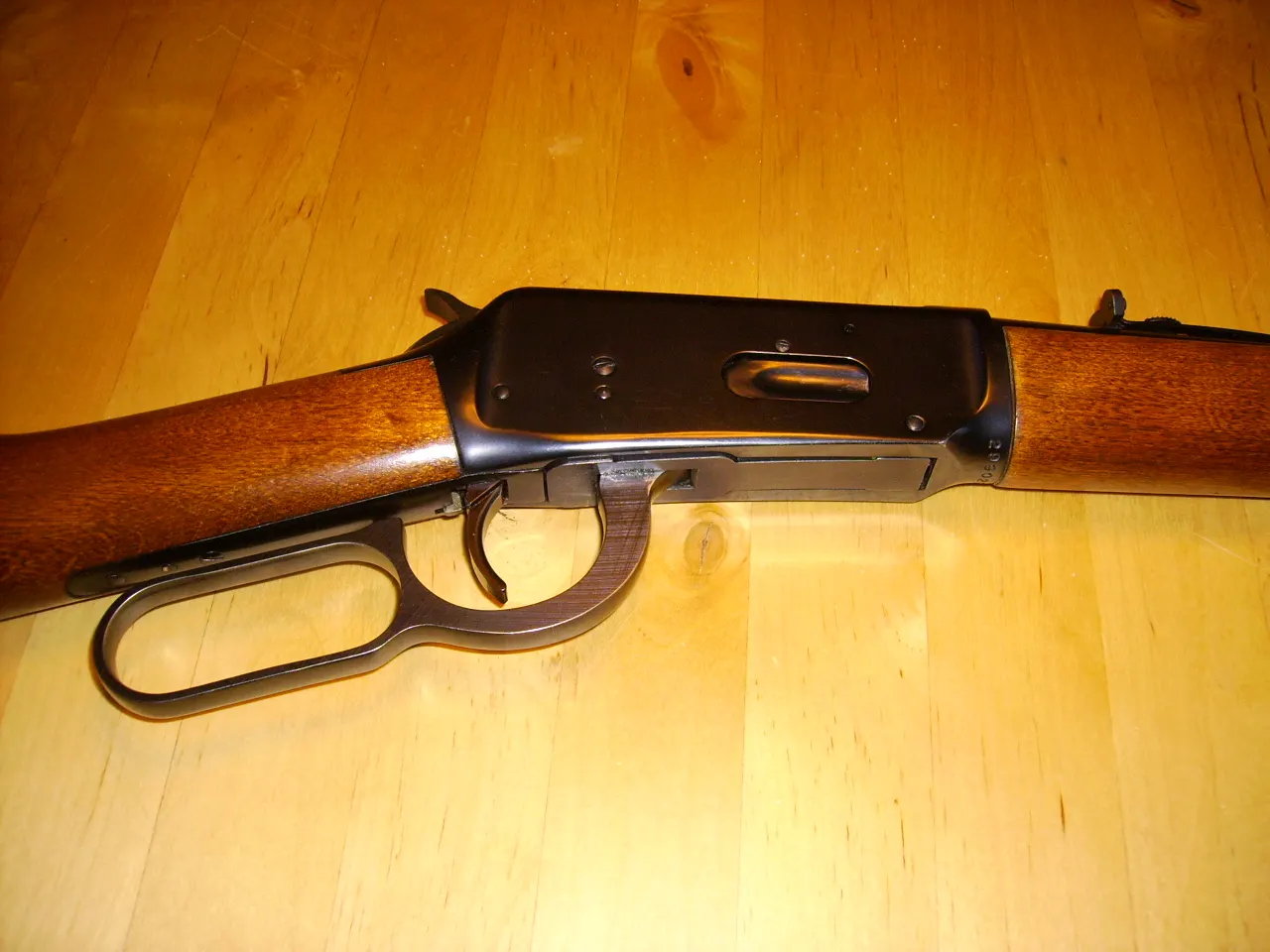
The Winchester model 30, known inside the company as the G30 and to the US Army Ordnance Department in its later forms as the G30M and G30R, was a .30-06 Springfield gas-operated semi-automatic rifle built to challenge the M1 Garand for adoption as the standard US infantry rifle. Winchester Repeating Arms Company never won that contract. What the G30 program did produce, almost as a byproduct, was the short-stroke gas piston mechanism that Winchester scaled down two years later into the M1 Carbine.
- lighter than the Garand (Williams redesign ~3.4 kg / 7.5 lb vs ~4.3 kg / 9.5 lb)
- short-stroke gas piston later proven in the M1 Carbine
- detachable box magazines up to 30 rounds on the G30R
- selective-fire WAR derivative came close to a real contract
- roughly double the Garand's malfunction and parts-breakage rate in trials
- rated least developed of the four rifles in the 1940 Marine Corps tests
- never resolved reliability problems across three redesign cycles
- program ended by V-J Day, not by a resolved technical failure
The rifle began as a private design by **Jonathan Edmund Ed Browning, half-brother of the far more famous John Moses Browning. Ed Browning had already tried and failed once, in 1929, to sell a self-loading rifle to the Army. He kept refining the concept through the 1930s at his own shop in Ogden, Utah, and in 1938 sold the improved design to Winchester, which designated it the Model 30 and put its own engineers on it. Browning died in November 1939, before the rifle ever reached a formal military trial, and Winchester handed the unfinished project to a newly hired designer named David Marshall Williams**, whose short-stroke gas tappet system replaced Browning's original annular gas piston and became the G30M.
Winchester's own engineers argued that the Garand, adopted in 1936, required manufacturing tolerances that would slow wartime production, and pitched the G30 as a cheaper, simpler alternative that could be built fast if the country went to war.1 The pitch did not survive contact with the test range. In the same US Marine Corps trials that confirmed the M1941 Johnson rifle as a distant second choice, the Winchester design finished third of three semi-automatic rifles and was rated the least satisfactory of everything tested, Springfield included.2
Despite losing every formal competition it entered, the Winchester model 30 is a genuine piece of the story of American semi-automatic rifles development in the years around the World War II rearmament push, sitting alongside the Garand and Johnson designs as one of three serious .30-06 self-loaders the US services actually put rounds through before settling on one winner.1 It belongs to the same semi-automatic rifles category the Garand ultimately defined for US service, and its final selective-fire form, the Winchester Automatic Rifle, edges the story into the same carbines and light-machine-gun design space that the M1 Carbine and the Browning Automatic Rifle occupied in the same decade.
Ed Browning's original 1938 design was built around an annular gas piston encircling the barrel and a tilting-bolt locking system he adapted from his half-brother's Colt M1911 pistol, where the bolt drops into the wrist of the stock on unlocking.3 Browning shortened the receiver by moving much of the bolt's rearward travel into the stock's wrist rather than the receiver itself, and the trigger housing was shaped after the French Berthier rifle series.3 Winchester built two hand-made examples of this configuration, one in a military pattern and one styled as a sporting rifle, before Browning's death in late 1939 stalled further work.4
- İlk Üretim Yılı1938
- TasarımcıJonathan Edmund Browning (original design); David Marshall Williams (gas system redesign)
- Ağırlık (Boş)3,4 kg
David Marshall Williams took over the project on July 1, 1939, on the recommendation of Ordnance officer Julian Hatcher, initially to fix a separate Browning-designed .30-06 auto-rifle project Winchester was chasing in parallel.5 Williams discarded Browning's annular gas piston for his own short-stroke gas piston (also called a gas tappet), in which a small piston travels only a fraction of an inch before striking an operating rod, rather than staying attached to it for the full stroke.6 This is the same gas-operated family of action as the Garand, but mechanically distinct from the Garand's long-stroke arrangement, and it let Williams cut the redesigned rifle's weight to roughly 3.4 kg (7.5 lb) by May 1941, a full 0.9 kg (2 lb) lighter than the Garand's 4.3 kg (9.5 lb).7 Winchester designated the finished redesign the G30M.
- Fişek.30-06 Springfield
- Çap7,62 mm
- Kovan Uzunluğu63 mm
- Mermi Ağırlığı9,6 g
The next iteration, the G30R, went further still. The Army's own testers labeled it the T10E1, and period write-ups describe its operating rod, bolt, and short-stroke piston layout as essentially a scaled-up version of the mechanism that would appear in the M1 Carbine a year later.8 The G30R adopted detachable-magazine feed with box magazines fabricated in five-, 10-, 20-, and 30-round capacities, a flexibility the fixed-clip-fed Garand never offered, while its upper barrel band and two-piece handguard were styled after the older M1917 Enfield rifle.8 Chambering throughout the G30 family stayed on the standard .30-06 Springfield (7.62mm bore) service cartridge, the same round the Garand and the M1903 Springfield used, so ammunition compatibility with the rest of the US Army's rifle inventory was never a design obstacle.1
- Mekanizma TipiGazlı
- Seçmeli AtışHayır
- Besleme SistemiÇıkarılabilir Şarjör
- Şarjör Kapasitesi20
- Açık NişangahEvet
- Süngü TakozuEvet
- Gaz PistonluEvet
- Üretim Başlangıcı1938
- Üretim Bitişi1945
Ed Browning's first attempt at a self-loading military rifle dates to 1929, when a version of his design, built under contract by Colt, went before US Army Ordnance and was rejected in 1930.3 Rather than abandon the concept, Browning kept developing it privately in Utah through the 1930s, eventually approaching Winchester in 1938. Winchester, wary of repeating its World War One experience of having no rifle design ready to offer the government, bought the rights and brought Browning onto its own engineering staff.4 The Ordnance Department tested Winchester's improved prototype at Aberdeen Proving Ground in September 1940, shortly after Williams had finished reworking the gas system.9
The decisive trial came that autumn at the Marine Corps base in San Diego, where testers ran the G30M against the M1 Garand, the M1941 Johnson rifle, and a bolt-action M1903 Springfield used as a control, across 37 separate tests and more than 12,000 rounds fired through each rifle.2 The results were lopsided. The Garand logged 1,480 total malfunctions and 49 parts broken, replaced, or repaired. The Johnson rifle logged 1,547 malfunctions and 72 broken parts. The Winchester G30M logged 2,864 malfunctions and 97 broken parts, roughly double the Garand's failure rate.2 Testers concluded the Winchester entry was seriously handicapped by the short period of time it had been under development, and rated it the least satisfactory of the four rifles evaluated, bolt-action Springfield included.9 The Marine Corps formally endorsed the Garand as the most satisfactory semi-automatic rifle available to the services at that time, and the M1 Garand was adopted on March 5, 1941, though widescale Marine issuance of it did not happen until 1943.2
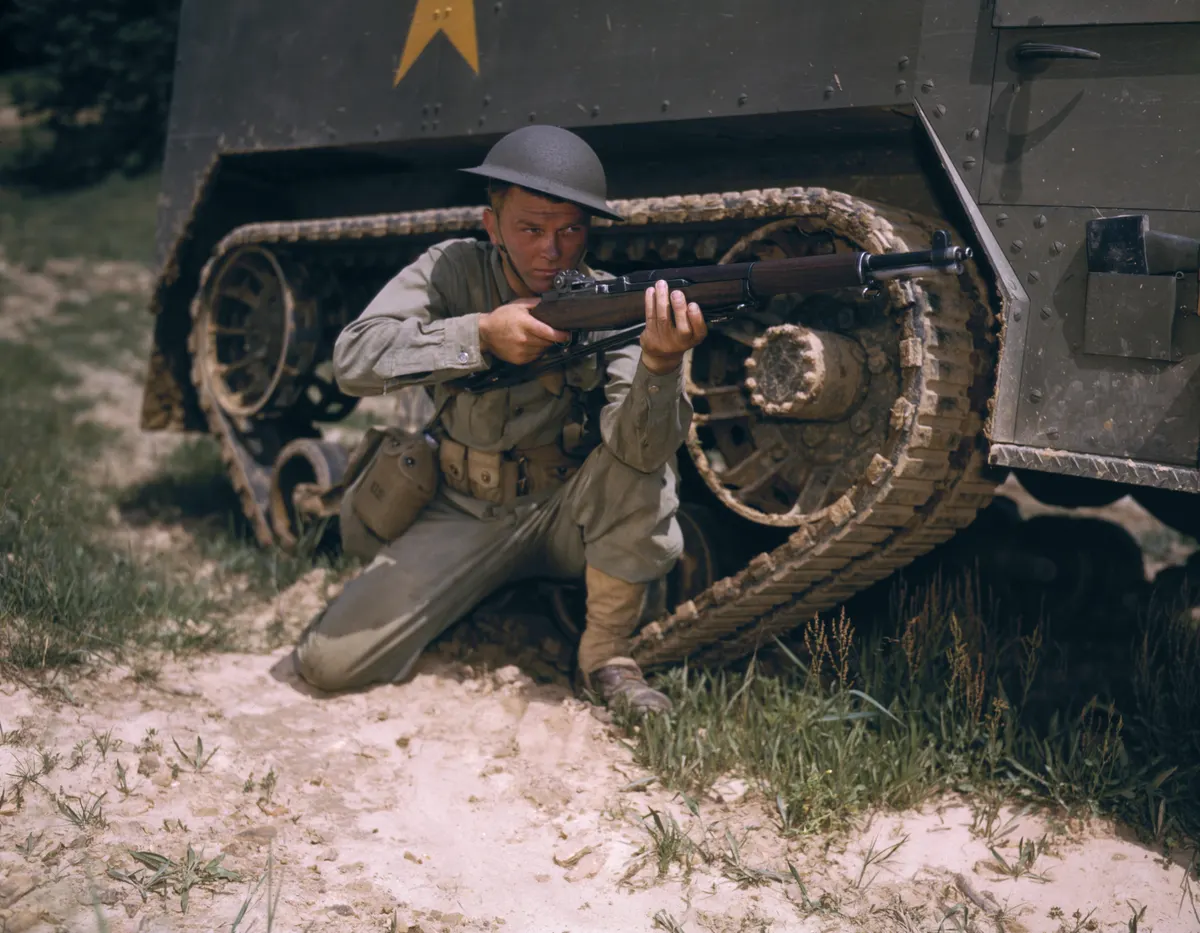
Losing the San Diego trials did not end the program. Army Ordnance remained interested enough to keep testing the improved G30R (T10E1) at Aberdeen, where functioning was again judged unsatisfactory, and the government made clear it had no appetite for adopting any semi-automatic rifle beyond the Garand it had already chosen.9 With the standard rifle role closed off, Ordnance redirected Winchester toward a different, related niche: a selective-fire automatic rifle that might eventually replace the aging Browning Automatic Rifle in the squad role.
That project became the Winchester Automatic Rifle, abbreviated WAR, which combined a two-lug rotating bolt similar to the Garand's with Williams' short-stroke gas tappet action, fed from 20-round magazines, and offered both semi-automatic and roughly 600-rounds-per-minute automatic fire.10 Fitted with a bipod and flash hider, the WAR weighed about 16 lb 3 oz (7.3 kg), some 4 lb (1.8 kg) lighter than a comparably equipped M1918A2 Browning Automatic Rifle.10 Colonel René Studler informally test-fired an early WAR at Aberdeen Proving Ground on November 21, 1944, and liked the results well enough to order 10 production examples for wider evaluation.11 Those 10 rifles went through the US Army Infantry Board and the Marine Corps Equipment Board in June and July 1945, passing initial Ordnance inspection convincingly.11
It never got the chance. Japan's surrender in August 1945 triggered an immediate halt to Ordnance research and development work across the board, and when postwar small-arms testing resumed, the WAR was not on the list of designs carried forward.11 The short-stroke gas piston Williams had built for the G30M project did not disappear with it, though. Winchester had already applied a scaled-down version of that same gas tappet system to the .30 Carbine cartridge, in the light rifle competition that produced the M1 Carbine, built by a Winchester team in a reported 13 days after Ordnance specifically invited the company's participation.12 Winchester ultimately manufactured over 818,000 M1 Carbines and carbine variants, about 13 percent of total wartime production.12

Full credit for the M1 Carbine's actual layout is generally given to Winchester engineers Fred Humiston and William Roemer, with Williams contributing only the gas system rather than the whole design. That distinction gets lost in popular memory, where Williams became a folk figure under the nickname Carbine Williams after a 1952 biographical film of that title, starring James Stewart, dramatized his prison-workshop years and his role at Winchester.13
Humiston and Roemer received no equivalent public recognition despite doing more of the carbine's actual engineering, a gap historians researching the program have pointed out repeatedly.13 The G30 to M1 Carbine connection itself is real and well documented, even if the popular version of the story gives one man credit for what was in practice a team effort inside Winchester's engineering department.5
- G30 the original 1938 to 1939 Ed Browning configuration, using his annular gas piston and 1911-style tilting bolt, built only as two hand-made examples before his death.4
- G30M the 1939 to 1941 Williams-modified version, replacing the annular piston with a short-stroke gas tappet and cutting weight to about 3.4 kg (7.5 lb). This is the version the Marine Corps tested at San Diego.7
- G30R (T10E1) the further-refined late-production model, adopting detachable box magazines in 5, 10, 20, and 30-round capacities and an M1917 Enfield-style handguard and barrel band.8
- Winchester Automatic Rifle (WAR) the 1944 to 1945 selective-fire derivative aimed at the Browning Automatic Rifle's squad role, with a rotating bolt, 20-round magazines, and roughly 600 rpm cyclic rate in automatic fire.10
None of the four configurations ever reached series production. Total output across the whole G30 to WAR development run was confined to hand-built trial and demonstration rifles, likely numbering in the dozens rather than hundreds, which is why surviving examples today are rare enough to draw serious attention at firearms auctions.14

| Yıl | Alıcı | Adet | Tutar | Bugünkü Değer (2025) |
|---|---|---|---|---|
| 1944 |  Amerika Birleşik Devletleri | 10 | — | — |
The United States Army Ordnance Department and the US Marine Corps are the only organizations known to have handled the Winchester model 30 family, and strictly in a testing and evaluation capacity between 1940 and 1945. No unit was ever issued the rifle for service use, and no other country evaluated or purchased it.2
The Winchester model 30's real rival was never really the Johnson rifle, it was the M1 Garand the Army had already chosen before Winchester's rifle was fully developed. Both used a gas-operated action firing the same .30-06 Springfield cartridge, but the Garand's long-stroke piston and rotating bolt had a half-decade head start in engineering maturity by the time the G30M reached San Diego in 1940, and it showed in the numbers.
| M1 Garand | Winchester G30M | |
|---|---|---|
| Weight | ~4.3 kg (9.5 lb) | ~3.4 kg (7.5 lb) |
| Malfunctions (San Diego trial) | 1,480 | 2,8642 |
| Parts broken/repaired | 49 | 972 |
| Adopted for service | Yes (1936/1941) | No |
Weight was the one category where Winchester's design actually won, the Williams-modified G30M coming in roughly 0.9 kg (2 lb) lighter than the Garand, a real advantage for an infantryman carrying it for days at a time. It was not enough to offset a malfunction rate that ran almost double the Garand's across 12,000-plus rounds fired per rifle, and reliability, not weight, was what the Army and Marine Corps actually weighed most heavily in 1940 and 1941.2 Against the M1941 Johnson rifle, the comparison is closer but still unflattering to Winchester, the Johnson's rotary magazine and short-recoil action logged fewer malfunctions and fewer broken parts than the G30M in the same San Diego tests, even though the Johnson also lost out to the Garand in the end.2 Is the Winchester model 30 still relevant today outside of collector circles? Only as design history, its short-stroke gas piston is the direct mechanical ancestor of the one built into every M1 Carbine Winchester and its licensees eventually produced.


Was the Winchester model 30 ever adopted by the US military? No. It was tested repeatedly between 1940 and 1945 in three main configurations (G30, G30M, G30R) plus the selective-fire WAR derivative, and lost every formal competition to the M1 Garand.2,9
Who designed the Winchester G30 rifle? Jonathan Edmund Ed Browning, half-brother of John Moses Browning, designed the original rifle and sold it to Winchester in 1938. After his death in 1939, David Marshall Williams redesigned its gas system, and the same Williams short-stroke piston later went into the M1 Carbine.3,5
What caliber was the Winchester model 30 chambered in? The full G30 family stayed in .30-06 Springfield throughout its development, the same full-power cartridge used by the M1 Garand and M1903 Springfield.1
How much did the Winchester G30M weigh compared to the Garand? Williams' redesigned G30M weighed about 3.4 kg (7.5 lb) by May 1941, roughly 0.9 kg (2 lb) lighter than the M1 Garand's 4.3 kg (9.5 lb).7
Is the Winchester model 30 related to the M1 Carbine? Yes, indirectly. The short-stroke gas piston David Marshall Williams designed for the G30M project was scaled down for the smaller .30 Carbine cartridge and became a core part of the M1 Carbine's action, though the carbine's overall design is credited mainly to Winchester engineers Fred Humiston and William Roemer.12,13
- "Backing Another Horse: The Winchester G30 Semiautomatic Rifle", American Rifleman — americanrifleman.org ↩
- "Winchester G30M – The Forgotten Garand Competitor", The Firearm Blog — thefirearmblog.com ↩
- "Ed Browning's Winchester G30 Prototypes (Video)", Forgotten Weapons — forgottenweapons.com ↩
- "Winchester model 30", Wikipedia — en.wikipedia.org ↩
- "Bootlegger David Marshall Williams Helped Invent the M1 Carbine", War History Online — warhistoryonline.com ↩
- "US Winchester .30 semiauto", Forgotten Weapons — forgottenweapons.com ↩
- "David Marshall 'Carbine' Williams: Myths & Reality", American Rifleman — americanrifleman.org ↩
- "Rare Experimental Prototype Winchester G30M Semi-Automatic Rifle", Rock Island Auction — rockislandauction.com ↩
- "Wartime Winchesters", American Rifleman — americanrifleman.org ↩
- "W.A.R. – the Winchester Automatic Rifle", Forgotten Weapons — forgottenweapons.com ↩
- "WAR: The Winchester Automatic Rifle", American Rifleman — americanrifleman.org ↩
- "The true story of the M1 carbine's creation (it wasn't 'Carbine' Williams)", We Are The Mighty — wearethemighty.com ↩
- "Carbine Williams and Winchester", Forgotten Weapons — forgottenweapons.com ↩
- "Winchester G30 | Gun Wiki", Fandom — guns.fandom.com ↩