


The Armscor AK22 is a semi-automatic .22 LR rimfire rifle built to resemble the AK-47 on the outside while sharing none of its internal mechanism. It went into production in 1987 at Armscor (Arms Corporation of the Philippines), the Philippines' largest firearms manufacturer, based in Marikina near Manila. Unlike a true Kalashnikov, the AK22 fires through a simple blowback action borrowed from an older Armscor rimfire design, wrapped in a cast alloy shell shaped to look like a full-size AK-47 receiver. It belongs to the same broad family of semi-automatic rifles as its own stablemate, the M16-styled Armscor M16-22, both built around the same low-cost rimfire action and both aimed at buyers who wanted a military silhouette without a military rifle's cost, ammunition expense, or paperwork.
- Cheap .22 LR ammunition, low cost per shot
- AK-47 profile popular with plinkers and collectors
- Magazines interchange with related Armscor rimfire rifles
- Reliable blowback action once fed clean, high-velocity ammunition
- Cast alloy clamshell receiver requires a screwdriver to field strip
- Mahogany furniture makes it front-heavy and less balanced than a real AK
- Cannot accept genuine AK-47 parts without heavy modification
- Long out of production, spare parts increasingly scarce
At roughly 3.18 kg unloaded and chambered for a cartridge that costs a fraction of centerfire ammunition, the Armscor AK22 was never intended to fight. It was designed to sell, first in the domestic Philippine market after gun-law restrictions loosened in 1986, then to American and European buyers riding the cultural wave of AK-47 recognition through the late Cold War and early 1990s. That combination, an AK-47 look paired with a .22 LR detachable-magazine feed and a plinking-rifle price tag, made the Armscor AK22 one of the best-known rimfire military-pattern rifles ever imported into the United States, even though it never saw military service anywhere.
The Armscor AK22 is not a licensed Kalashnikov derivative. Armscor never held a manufacturing license from any Soviet or Russian successor design bureau, and the rifle's blowback action has nothing to do with the AK-47's long-stroke gas piston. What buyers were paying for was the shape, the AK-47's world-famous outline, stamped-look magazine housing, front sight post, and pistol grip, built around a rimfire mechanism Armscor had already been making since the 1960s. That distinction matters for anyone researching Armscor AK22 specifications or comparing it against the rifle it imitates, since the AK22 is a plinking rifle wearing an assault rifle's silhouette rather than a scaled-down combat weapon.
The Cast Alloy Clamshell and Why It Looks Like an AK But Isn't One
Armscor's engineers did not design a new rifle for the AK22. They took the receiver and trigger group of the company's existing Model 20 rimfire self-loader and enclosed it inside a two-piece cast alloy clamshell shaped to mimic an AK-47 receiver.1 The clamshell halves are held together by cross pins and screws rather than a stamped or milled steel receiver, which is why field stripping the Armscor AK22 requires a screwdriver instead of the AK-47's tool-free lever-and-pin takedown.1 A non-functional gas tube sits above the barrel purely for appearance, while a genuinely functional one-piece cleaning rod rides underneath it, and the lower half of the magazine is enclosed in a wide cast alloy sleeve designed to simulate the bulk of a full-caliber AK magazine even though the actual .22 LR feed lips inside are far narrower.2
- İlk Üretim Yılı1987
- TasarımcıArmscor (Squires Bingham Manufacturing Inc.)
- Ağırlık (Boş)3,18 kg
- Halen HizmetteHayır
The action itself is a straightforward blowback design, adequate for the modest pressures of .22 Long Rifle ammunition and requiring no gas system at all.1 Feeding comes from a detachable-magazine offered in 10-round, 15-round, and 30-round capacities, and those magazines interchange directly with the Armscor M16-22 and with export versions of the IWI Galil chambered in .22 LR, since all three used magazines built around the same Armscor-pattern feed lips.2 The 15-round magazine was discontinued from the catalog at some point before the mid-2010s, leaving the 10-round and 30-round options as the common survivors on the used market today.2
- Fişek.22 LR
- Çap5,6 mm
- Kovan Uzunluğu15,1 mm
- Çap Sınıfıkenar ateşlemeli
- Mermi Ağırlığı2,59 g
- Kenar AteşlemeliEvet
- Kovansız MühimmatHayır
Furniture on the standard Armscor AK22 is mahogany, a wood native to the Philippines and cheap for Armscor to source locally, used for the buttstock, forend, and pistol grip.1 The wood adds weight relative to the rifle's actual mechanical needs and shifts the balance forward, a complaint common enough among gunsmiths that many replaced the factory furniture on customer rifles.1 Sights are a simple post front sight on an AK-style base with an adjustable rear notch, and the rifle carries no optic rail from the factory, reflecting its role as an inexpensive open-sight plinker rather than a precision arm.3 Overall length runs about 914 mm (36 inches) with an 18.25-inch (463.55 mm) barrel, and the complete rifle weighs roughly 7 lbs (3.18 kg) unloaded, a figure the Armscor AK22's own specification sheet gives and that period reviews confirm.3
- Mekanizma TipiBlowback (Geri İtmeli)
- Atış Modlarıyarı otomatik
- Seçmeli AtışHayır
- Besleme SistemiÇıkarılabilir Şarjör
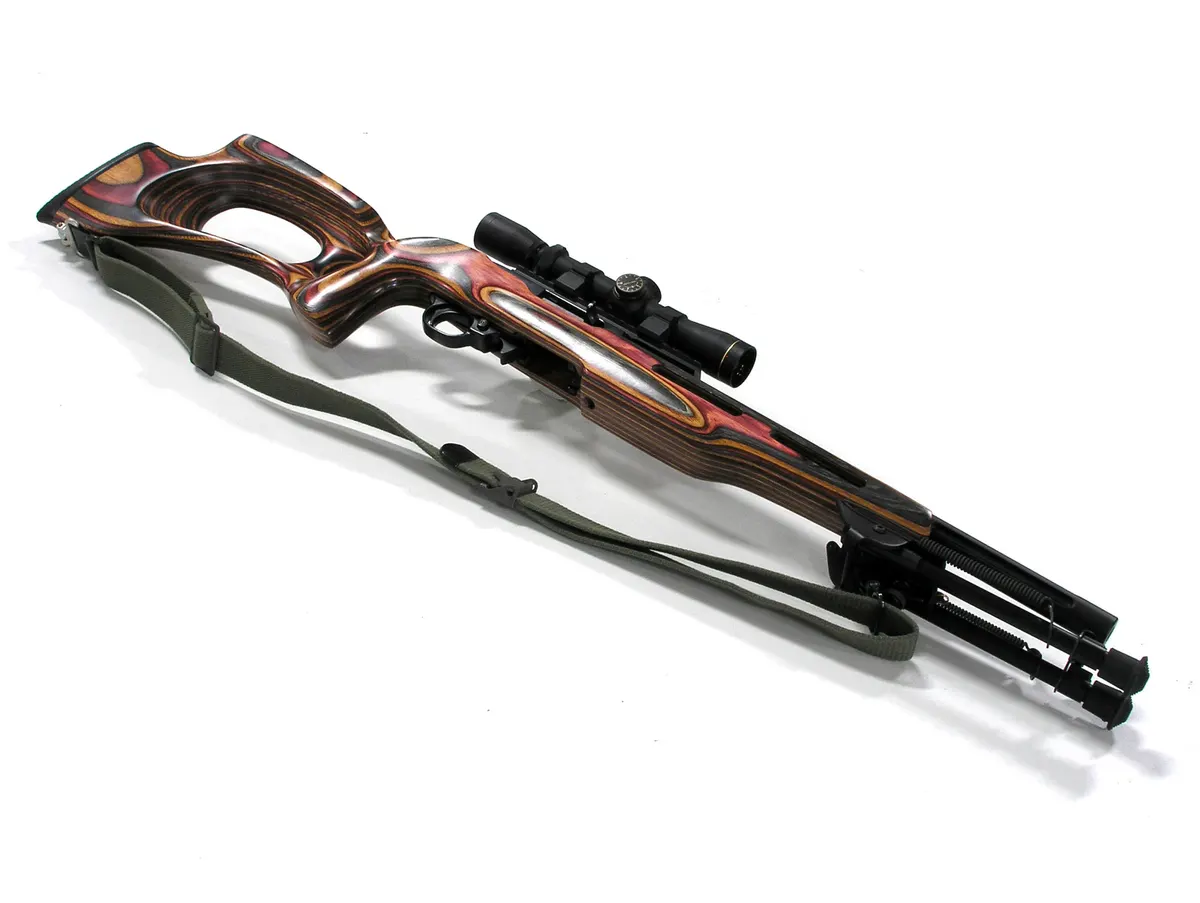
Compared with a mainstream American .22 LR plinker like the Ruger 10/22, the Armscor AK22's design story is really a story of substitution. Ruger engineered a purpose-built rimfire action around a rotary magazine. Armscor instead repackaged an existing rimfire action inside a costume shaped like someone else's rifle. Both approaches solved the same underlying problem, a cheap, low-recoil training and plinking rifle, from opposite directions, and that difference in engineering approach shapes how the two rifles are used, valued, and compared below.
- Namlu Uzunluğu463,55 mm
- Nişangah Tipidemir
- Optik RayıHayır
- Açık NişangahEvet
- Dişli NamluHayır
Collectors researching how the Armscor AK22 works consistently describe it as a reliable plinker once fed consistent, high-velocity .22 LR ammunition, with accuracy good enough for five-to-six-inch groups at fifty yards using its factory iron sights, though owners report that older or mismatched magazines cause more feeding trouble than the action itself.9
- Kabza/Dipçik Malzemesimaun
- Katlanır / Toplanır DipçikHayır
- Bullpup DüzeniHayır
- Çift Yönlü KumandalarHayır
- Susturucuya HazırHayır
- Süngü TakozuHayır
- Entegre BipodHayır
- Bombaatar KabiliyetliHayır
- Gaz PistonluHayır
- Üretim Başlangıcı1987
- Varyantlar1
- Yükseklik203,2 mm
Squires Bingham, Martial Law's End, and the Rise of a Rimfire AK
Armscor's roots go back to 1905, when British expatriates William Bingham and Roy Squires founded Squires Bingham & Co. as a general trading firm in the Philippines, later moving into importing sporting goods, motorcycles, and ammunition.4 Celso Tuason bought the firm in 1941, just months before the Japanese occupation forced it out of the firearms trade entirely.4 After the war, Tuason secured the Philippines' first postwar license to manufacture firearms and ammunition in 1952, renaming the company Squires Bingham Manufacturing Inc., and it built a factory in Parang, a Manila suburb, in 1958.4 In 1980 the firm reorganized under the name Arms Corporation of the Philippines, or Armscor, the name under which the AK22 would later be sold.5
The Armscor AK22 itself was designed in 1987, adapted from the company's existing Model 20 rimfire action rather than engineered from scratch, a deliberate cost-saving choice that let Armscor bring a new-looking product to market quickly.1 Its timing was not an accident. President Ferdinand Marcos's martial law regime, which had tightly restricted civilian firearms ownership, ended in February 1986 after the EDSA People Power Revolution, and the relaxation of Philippine gun laws that followed opened up a domestic market Armscor moved quickly to fill.1 Sales of the AK22 and Armscor's other rimfire rifles were, in the company's own account, very strong in that newly opened local market.1

Outside the Philippines, the Armscor AK22 rode a second wave. The AK-47's own growing fame in Western popular culture through the 1980s made an AK-shaped rifle an easy sell to American plinkers and collectors, and a .22 LR version sidestepped the licensing, cost, and (for later select-fire AK variants) legal complications of a real Kalashnikov clone.1 Armscor's own database entry lists Ruko Products, later KBI, as the designer of the AK22, but that credit is misplaced. Ruko Products Inc. of Buffalo, New York became the exclusive United States importer for Armscor firearms only in 1991, four years after the AK22 was designed and already in production in the Philippines, and KBI Inc. of Harrisburg, Pennsylvania took over that importing role from Ruko in 1995.6 Neither company designed the rifle. Both were successive American distributors who put their own names, alongside Squires Bingham, Kassnar, K-Mart, and Mitchell Arms, on the same Philippine-made rifle as it passed through different corners of the US retail market.2
By 1989, the political climate for AK-pattern imports into the United States had shifted. President George H. W. Bush's administration banned the importation of foreign semi-automatic rifles judged to lack a legitimate sporting use, first as a temporary order in March and then permanently that July, a policy aimed squarely at AK- and AR-pattern centerfire rifles.7 Rimfire plinkers like the Armscor AK22 occupied a gray zone in that debate, marketed as sporting rifles rather than combat weapons, and continued to be imported under the Ruko and later KBI licenses through the 1990s even as centerfire AK imports tightened.7 The AK22F, the folding-stock variant styled after the FN FAL's Para stock and built to compete against other countries' rimfire AK clones out of Italy, France, and Germany, was itself discontinued in 1995.1
The base Armscor AK22 uses a fixed mahogany stock. The AK22F replaced that stock with a side-folding metal design copied from the FAL's Para paratrooper stock, aimed at the compact-rifle segment of the same export market and shipped with the larger 30-round magazine as standard.1 It was discontinued in 1995 after roughly the same run as the standard rifle.1
Armscor built the same clamshell-and-Model-20 formula into two related products sold alongside the AK22. The AK-4722 was the rifle's original, longer factory designation before it was shortened to simply AK22 in later catalogs and price lists.3 The M-50S, introduced in the late 1980s, applied the identical Model 20 action inside a full-length ventilated barrel shroud styled after the Soviet PPSh-41 submachine gun, again chambered in .22 LR with an optional 20-round magazine.3 None of these were mechanically distinct from one another. Each was the same rimfire blowback action wearing a different historical costume, a strategy that let Armscor cover three separate iconic silhouettes (Kalashnikov, the PPSh-41, and, through the related M16-22, the American M16) from a single tooling investment.
The Armscor M16-22 is the AK22's closest sibling rather than a variant of it. Introduced far earlier, in 1970 as the M-1622, nicknamed the Baby Armalite, it applied the same blowback-from-the-Model-20 approach to an M16-shaped exterior, complete with a carrying handle and prong flash hider, and was later renamed the M1600 after Armscor's 1980 reorganization.8 Where the AK22 chased AK-47 recognition, the M16-22 chased M16 recognition, and together the two rifles gave Armscor a rimfire equivalent of both dominant Cold War rifle silhouettes without designing a genuinely new action for either.

The Armscor AK22 was never adopted by any nation's armed forces or police service. It was, from the start, a civilian commercial product, sold through Armscor's own domestic retail network inside the Philippines and exported to the United States and parts of Europe as a sporting and training rifle.2 In the American market specifically, importers sold the identical Philippine-made rifle under a rotating cast of brand names, Squires Bingham, K-Mart, Kassnar, Mitchell Arms, RUKO, KBI, and Rock Island, depending on which distributor held the import contract in a given year, which is why collectors today find nominally different-branded AK22s that are mechanically the same rifle.2 That fragmented labeling has made the AK22 something of a puzzle for American gun-shop identification even decades after most of the importers involved went out of business. KBI itself closed its doors in January 2010.10
Armscor built two rimfire military-silhouette rifles from the same Model 20 action, and on American retail shelves the AK22's real competition was never the AK-47 it visually imitates. It was the Ruger 10/22. Sturm, Ruger & Co. engineered the 10/22 from the ground up in 1964 as a dedicated rimfire design built around a 10-round rotary magazine, a purpose-built blowback action, and a receiver machined to the American civilian market's expectations of fit and finish.2 Armscor instead repurposed an existing action inside a cast alloy AK-47 shell, prioritizing recognizable shape over refined engineering. The result is a real difference in what each rifle is for. Buyers choose the Ruger 10/22 for its accuracy, its enormous aftermarket, and its decades of continuous production. Buyers chose the Armscor AK22 for its look, its low price, and the novelty of a Kalashnikov profile chambered in cheap rimfire ammunition.
| Spec | Armscor AK22 | Ruger 10/22 |
|---|---|---|
| Cartridge | .22 LR | .22 LR |
| Action | Blowback (Model 20 derived) | Blowback (rotary-magazine design) |
| Weight (empty) | ~3.18 kg | ~2.2 kg |
| Magazine | 10/15/30-round detachable box | 10-round rotary (box options available) |
| Status | Discontinued | In continuous production since 1964 |
Against a genuine AK-47, the comparison is really about role rather than raw performance. The AK22 borrows the Kalashnikov's outline but shares none of its 7.62x39mm terminal performance, ruggedness pedigree, or combat history, and it was never meant to. It was built to answer a narrower question, whether a Philippine factory could sell an AK silhouette to buyers who wanted the look of a battle rifle without the cost, recoil, or legal weight of one, and on that narrower question the AK22's decades of export sales say it succeeded.


What caliber is the Armscor AK22? The Armscor AK22 is chambered in .22 Long Rifle (.22 LR), a rimfire cartridge, not the AK-47's 7.62x39mm.3
Is the Armscor AK22 a real AK-47? No. It shares only the external AK-47 silhouette. Internally it uses a simple blowback rimfire action derived from Armscor's older Model 20 rifle, enclosed in a cast alloy clamshell, and it cannot use genuine AK-47 magazines or parts.1
Is the Armscor AK22 still in production? No. Armscor discontinued the standard AK22, and its folding-stock AK22F sibling was pulled from the catalog in 1995. Surviving rifles are sold on the used and collector market today.1
How much does an Armscor AK22 cost today? Because production ended decades ago, there is no current manufacturer price. Used examples circulate through gun shops and auction houses at prices set by collector demand and condition rather than a published MSRP.
Who made the Armscor AK22, and who imported it into the United States? It was designed and manufactured by Armscor (Arms Corporation of the Philippines), formerly Squires Bingham Manufacturing. In the United States it was imported and sold under several brand names over the years, including Squires Bingham, Kassnar, Mitchell Arms, Ruko Products (exclusive importer from 1991), and KBI Inc. (importer from 1995 until KBI closed in 2010).6,10
How does the Armscor AK22 compare to the Ruger 10/22? The Ruger 10/22 is a purpose-built American rimfire rifle with a rotary magazine and a large aftermarket, still in production since 1964. The Armscor AK22 is a repackaged older Armscor action inside an AK-47-shaped shell, valued more for its look than its engineering, and it has been out of production since the 1990s.2
- "Armscor AK22", Wikipedia — en.wikipedia.org ↩
- "Armscor Rimfire Battle Guns", Small Arms Review — smallarmsreview.com ↩
- "Armscor Rimfire Battle Guns", Small Arms Review — smallarmsreview.com ↩
- "Armscor: Three Generations And Counting", American Rifleman — americanrifleman.org ↩
- "Company Heritage", Armscor — armscor.com ↩
- "KBI / Kassnar (Also See Charles Daly) Parts", Numrich Gun Parts — gunpartscorp.com ↩
- "Federal Assault Weapons Ban", Wikipedia — en.wikipedia.org ↩
- "Armscor M16 22", Wikipedia — en.wikipedia.org ↩
- "Armscor AK 22", Rimfire Central Firearm Forum — rimfirecentral.com ↩
- "Charles Daly / KBI gone out of business", The Firearm Blog — thefirearmblog.com ↩