


The Robinson Armament M96 Expeditionary is a 5.56x45mm NATO semi-automatic rifle built by Robinson Armament Co. of North Salt Lake, Utah, the first original firearm the company ever produced.1 Designer Alex Robinson built the M96 openly along the lines of the Vietnam-era Stoner 63 weapon system, which Navy SEALs and Marine reconnaissance units carried in Vietnam, borrowing its stamped-steel receiver and quick-change barrel concept rather than copying the AR-15 pattern that dominated the American civilian market at the time.2
- Quick-change barrel, swappable in the field
- Configurable as rifle, carbine, or top-fed carbine from one receiver
- Adjustable gas regulator tunes for ammunition and conditions
- Compatible with standard AR-15/STANAG magazines
- No bolt-hold-open device on original production
- Expensive to manufacture (hand-welded stamped receiver)
- Never adopted by any military or police force
- No factory optics rail on original-production examples
Robinson Armament had entered the firearms business a few years earlier importing Russian VEPR rifles into the United States, and the M96 Expeditionary rifle, launched in 1999, was the company's first from-scratch design.6 It is gas-operated, running a gas-piston-operated long-stroke system with a six-lug rotating bolt, and it feeds from standard AR-15 pattern detachable magazines rather than the proprietary magazines of the original Stoner design.1
Robinson Armament built the M96 Expeditionary rifle from 1999 until manufacturing costs forced it out of the catalog in the mid-2000s, then revived a limited run of the design in 2020.5 The M96 Expeditionary specifications place it as a 20 inch barreled rifle chambered for 5.56x45mm NATO/.223 Remington, with an effective range of 500 meters and a claimed muzzle velocity near 960 m/s with M855A1 ammunition.1 Unlike the later Robinson Armament XCR, which grew directly out of the M96 platform and did reach military and law enforcement customers, the base M96 Expeditionary rifle stayed a civilian-market semi-automatic rifle for its entire production run, and the M96 Expeditionary price point (originally several times an AR-15's) is a large part of why.3
The Stoner 63 Architecture Behind the M96's Universal Receiver
Robinson Armament's central design choice for the M96 Expeditionary rifle was a single, universal receiver made from welded steel stampings that could accept a quick-detachable barrel and be reconfigured for different roles, the same basic concept Eugene Stoner used for the Stoner 63.2 Where the original Stoner 63 weapon system could be built as a rifle, carbine, top-fed carbine, or belt-fed light machine gun, Robinson Armament simplified the concept for the semi-automatic civilian market, offering the rifle in standard rifle, standard carbine, Recon carbine, and top-fed carbine configurations built around the same receiver.1 Robinson Armament advertised the design as capable of a caliber swap by changing only the barrel and bolt, since the receiver itself does not define the chambering.3
- İlk Üretim Yılı1999
- TasarımcıAlex Robinson
- Halen HizmetteHayır
Building that receiver was expensive. Each M96 required roughly two to three hours of hand welding to assemble the stamped-steel components, a labor cost the AR-15's forged and machined receiver never carried, and it is the reason Robinson Armament eventually discontinued the design.1 The receiver itself is described by the manufacturer as stamped stainless steel with a blackening treatment for finish, paired with a parkerized chromoly steel barrel.1
- Fişek5.56x45mm NATO
- Çap Sınıfı223
Long-Stroke Gas Piston, Six-Lug Bolt, and the Adjustable Gas Regulator
The M96 Expeditionary rifle runs on a fixed gas cylinder with a moving piston connected to the operating rod and a rotating six-lug bolt, the same long-stroke piston layout used across the Stoner-derived family.1 Every variant carries an adjustable gas regulator, letting the shooter tune gas flow for low or high pressure ammunition, suppressor use, or cold weather, a feature Gun Tests magazine compared directly to the gas bleed valve on the FN FAL battle rifle.4 The rifle uses seven detented cross pins throughout the action to allow disassembly and barrel changes without tools.4
- Mekanizma TipiGazlı
- Seçmeli AtışHayır
- Besleme SistemiÇıkarılabilir Şarjör
Barrel length varies by configuration. The original Expeditionary rifle carried a 20 inch barrel (508mm), the Standard Carbine a 17.5 inch barrel, and the Recon Carbine a 16.2 inch barrel, all rifled with a 1 in 9 inch twist and chambered for 5.56x45mm NATO/.223 Remington.1,4 Robinson Armament rated the rifle's effective range at 500 meters and quoted a muzzle velocity of roughly 960 m/s (3,150 ft/s) with M855A1 ball ammunition from the 20 inch barrel.1
- Namlu Çıkış Hızı960 m/sn
- Etkili Menzil (nokta)500 m
Sights, Furniture, and the Inverted Top-Feed Configuration
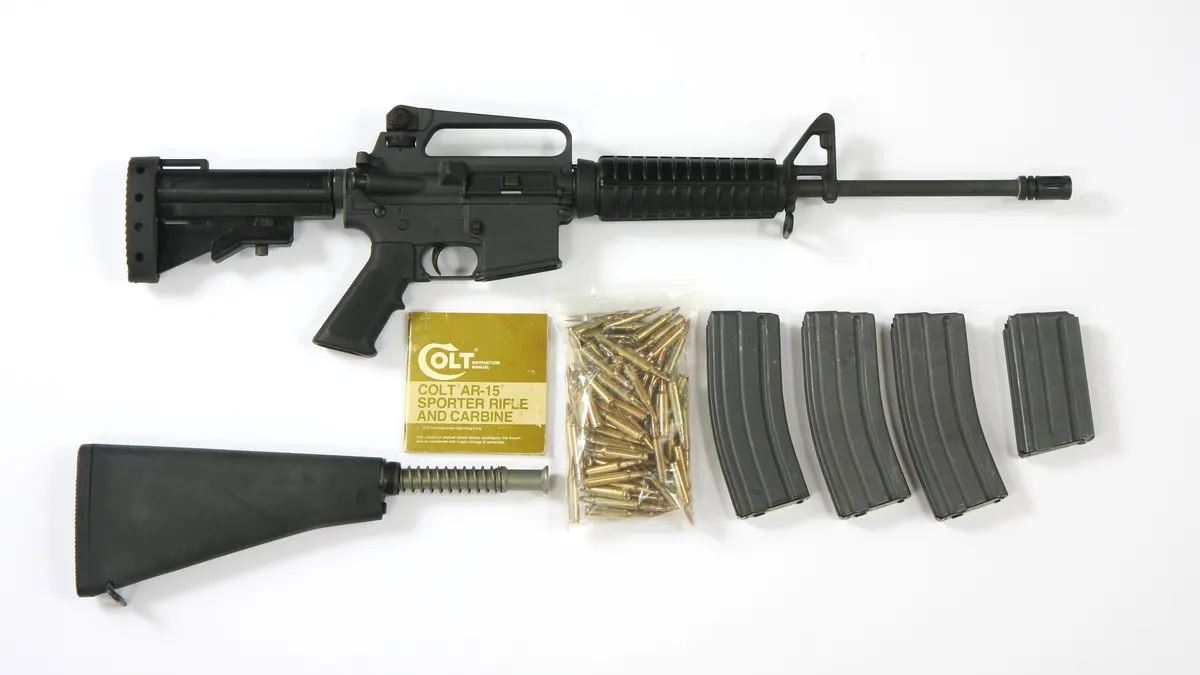
Original-production M96 rifles shipped with adjustable military-pattern iron sights only, a rear aperture with a choice of 0.20 inch or 0.060 inch apertures and a protected front post, and no factory scope mount or Picatinny rail.1,4 The furniture is molded plastic, and the buttstock interchanges directly with the original Stoner 63 stock, a deliberate nod to the design it was based on.1
- Namlu Uzunluğu508 mm
- Yiv Adımı1:9
- Nişangah TipiAyarlanabilir arka halka gez ve korumalı ön arpacık
- Açık NişangahEvet
The top-fed carbine, sometimes called the Bren-type configuration after the Bren light machine gun's top-mounted magazine layout, mounts the receiver inverted so the magazine feeds from above and cases eject downward.1 Robinson Armament never put a true belt-fed M96 into production, unlike the Stoner 63 it drew from, though the option was discussed at the design stage.3
- Gövde Malzemesi (Receiver)presli paslanmaz çelik
- Kabza/Dipçik Malzemesikalıplanmış plastik
- Modülerlikmodüler ve yapılandırılabilir
- Gaz PistonluEvet
- Genişlik60 mm
- Yükseklik200 mm
Alex Robinson founded Robinson Armament Co. in 1994 in North Salt Lake, Utah, after years of studying, collecting, and building firearms on his own.9 The company's early business was importing Russian VEPR rifles into the United States, and the M96 Expeditionary rifle, released in 1999, was Robinson Armament's first original design rather than an import.6 Early reviews were positive on function. Gun Tests fired an Expeditionary rifle and a Recon Carbine conversion without a single failure to feed, fire, or eject, and praised the trigger and sight picture, though the magazine of that era lacked a bolt-hold-open device and the barrel's necessarily loose fit for quick changes cost it some precision, with groups running around three inches at 100 yards.4
The design attracted military interest despite never being adopted. One month after the September 11 attacks, the 5th Special Forces Group invited Alex Robinson to submit a rifle for the Special Purpose Rifle Variant program, which required a weapon able to fire common threat-nation cartridges such as 7.62x39mm and 5.45x39mm alongside 5.56x45mm NATO.7 Robinson Armament built a fully automatic conversion of the M96 within 60 days of the request and had it tested at the Blackwater training facility, where it performed well enough to justify further development.7
That effort produced two separate select-fire branches, neither of which reached regular production. Around 2002 Robinson Armament developed the RAV02, an in-house select-fire carbine chambered in 5.56x45mm, 5.45x39mm, or 7.62x39mm, feeding from AK-pattern magazines and fitted with a quad-rail handguard the company called the Swan Integrated Rail (S.I.R.) system.8 Separately, the Phoenix, Arizona gunsmith Arms-Tech Ltd. offered a third-party selective-fire conversion for the M96 called the Revere M96-A1, convertible into either a 16 inch STANAG-magazine Commando carbine or a 20 inch belt-fed squad automatic weapon, but it never entered regular production because the base M96 was discontinued before the conversion could be marketed at scale.1
Robinson Armament carried the M96 platform's concept forward into the Robinson Armament XCR, a multi-caliber rifle Alex Robinson designed in 2004 and put into production in mid-2006.7 The XCR later competed in the US Special Operations Command's SCAR trials against what became the FN SCAR-L, but was disqualified after its blank-firing adapters reportedly arrived a day late, a detail Robinson Armament has never fully explained publicly.7
Robinson Armament discontinued the original M96 Expeditionary rifle by the mid-2000s as manufacturing costs made it uncompetitive against forged and machined AR-15 receivers, and by 2012 replacement parts for existing rifles were already hard to find.1 The company announced a limited relaunch at the 2020 SHOT Show, going through its remaining parts inventory to determine how many rifles it could still build, and reintroduced the design with a .223 Wylde chamber (compatible with both .223 Remington and 5.56mm NATO), threaded muzzles, and barrel lengths of 14.7, 16, 18.6, and 20 inches, priced at $2,495 for the rifle or carbine and $3,995 for the top-fed version.5
The Standard Rifle carried the original 20 inch barrel and is the configuration the Expeditionary name is most closely associated with.1 The Standard Carbine shortened that to 17.5 inches, and the Recon Carbine shortened it further to 16.2 inches for a handier, close-quarters-oriented package built on the identical receiver.1,4 The Top-Fed Carbine, built in the inverted Bren-type layout with the magazine inserted from above, offered a 17.5 inch barrel and a visually distinct silhouette from the other three.1
The RAV02 select-fire variant, marketed only to military and law enforcement buyers, is best understood as a shortened M96 Recon Carbine fitted with the quad-rail S.I.R. handguard and reworked to accept AK-pattern steel or brass-cased magazines and drums in 5.56x45mm, 5.45x39mm, or 7.62x39mm.8 Robinson Armament pursued a select-fire submission to US Special Operations Command's Special Purpose Receiver-Variant program with a 7.62x39mm RAV02, and while evaluators reportedly rated it well, the wider SPR-V solicitation was cancelled as SOCOM shifted toward the more comprehensive modular rifle systems that eventually became the SCAR program.8
The 2020 relaunch reworked chambering to a .223 Wylde spec accepting both .223 Remington and 5.56mm NATO ammunition, added threaded muzzles absent from Assault Weapons Ban-era production, and expanded barrel options to 14.7, 16, 18.6, and 20 inches across the same rifle, carbine, and top-fed lineup.5 Robinson Armament described the relaunch as a strictly limited run built from remaining parts inventory rather than a return to full production.5

Robinson Armament pitched the M96 Expeditionary rifle directly against Colt-pattern AR-15 rifles on modularity, offering a quick barrel change and multiple configurations the AR-15's fixed upper receiver could not easily match, and lost that argument on price. A base M96 Expeditionary rifle carried a retail price several times that of a contemporary AR-15 because of the two to three hours of hand welding each stamped receiver needed, while the AR-15's forged upper and lower receivers came off a much cheaper production line.1,4 Gun Tests found the M96 more versatile than the Bushmaster AR-15 rifle it tested alongside, but conceded the Bushmaster's rigid, non-swappable barrel gave it a slight edge in raw group size.4
Against its own inspiration, the Stoner 63, the M96 gave up the belt-fed light machine gun configuration and the select-fire capability that made the Stoner 63 a genuine weapon system rather than a single-role rifle, in exchange for being a legally simpler, semi-automatic-only civilian product built on far less exotic materials.1,2 The Stoner 63 saw real combat with Navy SEALs and Marine reconnaissance units in Vietnam, while the M96 Expeditionary rifle never left the civilian and gunsmith-conversion market during its original production run.2
| M96 Expeditionary Rifle | Colt AR-15 (contemporary, 1999) | |
|---|---|---|
| Barrel | 20 in, quick-change | 20 in, fixed |
| Receiver | Stamped stainless steel | Forged aluminum |
| Configurations from one receiver | 4 (rifle/carbine/Recon/top-fed) | 1 |
| Approx. retail price (late 1990s) | Multiple times an AR-15's price1 | Baseline AR-15 pricing |


Is the Robinson Armament M96 Expeditionary still in production? No, not in any ongoing sense. Robinson Armament built the original run from 1999 into the mid-2000s, then produced a strictly limited relaunch batch announced at the 2020 SHOT Show from remaining parts inventory, not a return to regular production.5
What caliber does the M96 Expeditionary use? The M96 Expeditionary is chambered for 5.56x45mm NATO/.223 Remington (relaunch-era rifles use a .223 Wylde chamber that accepts both), feeding from standard AR-15 pattern detachable magazines.1,5
How much does a Robinson Armament M96 cost? Original production M96 rifles cost several times a contemporary AR-15's price due to hand-welded construction. The 2020 relaunch priced the rifle and carbine at $2,495 and the top-fed version at $3,995.5
Is the M96 Expeditionary related to the Stoner 63? Yes. Alex Robinson designed the M96 along the lines of the Stoner 63 weapon system, reusing the concept of a universal, quick-barrel-change receiver and even making the buttstock interchangeable with the original Stoner 63.1,2
Did any military or police force adopt the M96 Expeditionary? No confirmed military or law enforcement sales of the base semi-automatic M96 Expeditionary rifle exist. Select-fire derivatives (the RAV02 and the third-party Revere M96-A1) were built for that market but neither reached regular service.1,8
- "Robinson Armament M96 Expeditionary", Wikipedia — en.wikipedia.org ↩
- "RobArm M96 XCR", Modern Firearms — modernfirearms.net ↩
- "M96", Robinson Armament Co. — robinsonarmament.com ↩
- "Robinson Armament M96 Expeditionary Rifle .223 Rem.", Gun Tests — gun-tests.com ↩
- "Robinson Armament update on M-96 re-launch", Strikehold.net — strikehold.net ↩
- "Robinson Armament XCR-L Rifle Review", Shooting Illustrated (NRA) — shootingillustrated.com ↩
- "Robinson Armament XCR", Wikipedia — en.wikipedia.org ↩
- "Robinson Armament Introduces the RAV02 MC Rifle/Carbine", Defense Review — defensereview.com ↩
- "Robinson Armament Co.", Wikipedia — en.wikipedia.org ↩