

Iron sights are the fixed, unpowered aiming references built directly onto a firearm, pairing a front post or blade with a rear notch or aperture the shooter lines up by eye. No lens, battery or projected reticle sits between shooter and target. The alternative is the optic-rail, a mounting rib carrying a magnified scope or an electronic red dot in place of the fixed sights.
A rifle built entirely around a rail-mounted optic gains magnification and speed at distance, but loses its only aiming reference the instant that optic fogs, cracks or runs dead. Iron sights carry the opposite trade, never failing electronically, but capping practical precision well short of what a magnified scope delivers at range. That trade-off is why so many rifles built for the battle-rifle and DMR roles still ship with folding iron sights even after an optic takes the top rail.
01From V-Notch Blades to Peep Discs
Nineteenth century military rifles mostly carried a simple notch sight, a V-shaped groove cut into a rear blade lined up against a front post or bead. The Cei-Rigotti, one of the earliest self-loading rifle designs, built in Italy around 1900, carried this same notch-and-post pattern rather than any aperture, well before peep sights spread widely across military rifles.
The aperture principle is older than it looks though. Ottoman gunsmiths drilled vertical rows of peep holes into a rear blade, one hole per range, generations before European armies adopted a single peep hole with ramp elevation.1 The idea reached American service in 1884 on the Buffington rear sight fitted to the Trapdoor Springfield, and every US service rifle after kept some form of aperture, from the 1903 Springfield through the M1 Garand.2
Russia's Fyodorov Automat, one of the first select-fire rifles ever issued, fielded during the First World War, used the same plain notch typical of its period, showing how long the older pattern persisted outside armies already standardized on an aperture.
Black powder cartridges arced steeply past a couple hundred meters, so many late nineteenth century military rifles carried a folding ladder sight graduated for exactly that drop rather than a simple ramp. The Trapdoor Springfield's own ladder lay flat against the barrel until raised, and once up its graduated markings compensated for a working range the US Army tested to 1,500 yards, a distance the .45-70 cartridge could reach only with roughly three and a third degrees of built-in elevation dialed into the sight.1 Target shooters of the same period often preferred a tang sight instead, mounted behind the action rather than on the barrel, trading some ruggedness for a longer sight radius and a threaded vernier scale precise to a single minute of arc, though most still kept a stubby open sight on the barrel itself for anything at conversational range.1 The pattern barely changed once the United States entered the First World War. The M1917 Enfield, built in far greater numbers than the 1903 Springfield it served alongside, carried its own aperture mounted mid-receiver rather than at the muzzle, protected from rifle-rack knocks by raised ears on either side.
01Front Post, Rear Notch and the Aperture Trick
Both sight types share the same basic principle, center a front element inside a rear element and hold that alignment on target. A notch demands squaring a flat-topped post inside a rectangular gap. An aperture asks the eye to center a small dark ring around a bright field almost without conscious effort, why aperture sights read faster and work better in dim light. A wide ghost ring aperture goes further, the ring all but disappears and leaves only the front post floating against the target.1
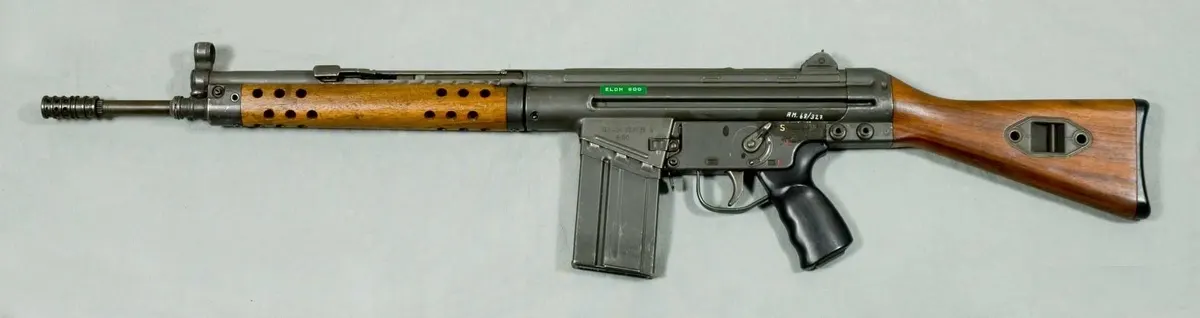
Windage corrects left-right drift by moving the rear sight sideways, screw or drift adjusted. Elevation corrects for range, moving a ramp, a ladder, or a rotating drum with numbered stops. The Heckler & Koch G3, built through the Cold War, carries a rotary diopter drum with an open notch for close range plus three aperture settings for 200, 300 and 400 meters.3 The FG 42, Germany's World War Two paratrooper rifle, mounted its aperture rear sight off to one side to clear its top-mounted magazine, adjustable from 100 to 1000 meters on the same kind of drum.4
The ArmaLite AR-10, designed by Eugene Stoner in the United States in 1956, buried its own adjustable aperture inside a distinctive carrying handle that doubled as a guard for the charging lever, an arrangement the M16 family kept almost unchanged.5 Sight radius, the distance between the front and rear elements, decides how far each click moves the point of impact.6
01Parallax, Sight Radius and the Battle Sight Zero
The reason a small aperture reads faster and forgives sloppier centering than a notch comes down to parallax suppression. Once the ring's own diameter shrinks below the shooter's natural pupil diameter, the aperture itself becomes the limiting opening the eye looks through, so minor side to side drift of the front post inside the ring barely shifts the actual point of aim.1 The same narrow aperture stretches depth of field, holding a blurry front post and a distant target close enough to simultaneous focus that a shooter with imperfect eyesight sees less of the fuzziness an open notch reveals, and the advantage grows in low light since a wider natural pupil there makes a fixed aperture relatively smaller still.1

Sight radius works on a separate axis entirely, geometry rather than optics. The same half a degree of side to side wobble at the rear sight swings the muzzle's actual point of aim by an angle that shrinks as the front and rear elements sit farther apart, which is why target shooters stretched tang sights as far back from the muzzle as the rifle allowed and why a compact carbine with its sights bunched close together forgives far less human error than a full length service rifle for the same physical amount of misalignment.6 Shortening the radius costs more than raw precision too. It also shrinks the angle each individual windage or elevation click actually moves, so two sights built to an identical click specification can walk the bullet's strike by noticeably different amounts once the elements themselves sit closer together or farther apart.
The M16A2 rear sight shows how far a simple ramp had evolved by the 1980s. Its elevation drum carries a large aperture for close range and night shooting plus a smaller precision aperture that doubles as a bullet drop compensator, one full turn spanning 0 to 800 meters in a single mechanism, while a separate knob on the right side dials windage in half inch increments per 100 meters of range.9 Soldiers zero that sight once at a fixed distance, typically 250 to 300 meters depending on service, then leave it alone rather than dialing for every engagement, a compromise called a battle sight zero that trades peak precision at any one range for a strike close enough to a man sized target across most ranges a rifle fight actually happens at.9 The idea descends directly from those old ladder sights. A fixed setting good enough for most of a fight beats a perfect setting for only one range in it.
01Night Sights, Tritium and Contrast Aids
Aperture geometry solves daylight parallax but does nothing once the target itself goes dark. Shooters in the First World War sometimes fitted sights coated in radium paint for a self luminous glow, a fix hazardous enough in practice that it never became standard issue.10 Tritium, a radioactive hydrogen isotope first put to practical use for dating rather than aiming, offered the same glow without the exposure risk, and in 1985 the engineer Glyn Bindon built the first commercially sold tritium iron sight for a handgun, sealing a sliver of tritium gas inside a phosphor coated glass vial that turns the isotope's own decay into visible light.10 The glow fades on its own schedule rather than a battery's. Tritium's half life runs about twelve years, so a sight bright enough to catch a shooter's eye in a dark room on the day it ships will have dimmed to half that brightness by the time it needs replacing.11
Daylight contrast gets a cheaper fix. Many combat handguns and hunting rifles pair a plain black rear notch with a front sight carrying a bright white dot, a colored insert or a sliver of fiber optic rod that gathers ambient light along its length and glows at the tip, letting a shooter's eye find the front element instantly against foliage or a dim doorway without the radioactive vial or the added cost.1 None of these tricks touch the two fundamentals though. A sight still needs a front element and a rear element the eye can align, and it still needs enough separation between the two to keep that alignment forgiving, exactly what the plainest notch and post has offered since the nineteenth century.
02Iron Sights on Rifles Built Around an Optic Rail
The Howa Type 64, Japan's standard battle rifle from the 1960s, used a flip-up aperture disc adjustable between 200 and 400 meters mounted well forward on the receiver, the aperture principle refined into a battle-rifle standard well before optic rails existed.7


Newer designs invert that relationship. The FN SCAR-H and the Heckler & Koch HK417 are built around a full-length optic-rail from the outset, expecting a scope or red dot to do the actual aiming. Both still ship folding iron sights set to the same height as the optic, so the two systems co-witness together.8 If the optic loses zero, fogs or dies, the shooter flips up the irons and keeps firing without resetting anything.
Not every cowitness setup lines up the same way. An absolute cowitness sets the folded sights dead level with the optic's own centerline, so the front post appears right in the middle of a red dot's window the instant the dot goes dark. A lower one third cowitness mounts the optic higher instead, leaving the irons visible only in the bottom third of the sight picture during normal aiming and clear of the reticle entirely once the shooter needs them, a layout many shooters now prefer specifically because it keeps the dot's field of view uncluttered the rest of the time.8
That layout, an optic on the rail with iron sights folded flat beneath it, is now close to universal across modern semi-automatic rifles built for combat use. The century-old notch and post never really left. It just moved to backup duty.
01Notes and Sources
- "Iron sights", Wikipedia — en.wikipedia.org ↩
- "Sights: Iron Sights: Aperture Sights", Firearms History, Technology & Development — firearmshistory.blogspot.com ↩
- "HK G3 Rear Sight", KeepShooting — keepshooting.com ↩
- "The FG42 Paratrooper Rifle", Rock Island Auction — rockislandauction.com ↩
- "The Armalite AR-10 rifle (USA)", Modern Firearms — modernfirearms.net ↩
- "The Complete Guide to Your Iron Sight Zero", The Everyday Marksman — everydaymarksman.co ↩
- "Japanese Howa Type 64 assault rifle", Forgotten Weapons — forgottenweapons.com ↩
- "Back-up Iron Sights Buyer's Guide", RECOIL — recoilweb.com ↩
- "The A2 Sight: How It Works, And How To Use It", The Firearm Blog — thefirearmblog.com ↩
- "Trijicon", Wikipedia — en.wikipedia.org ↩
- "How Long Do Tritium Sights Last?", Lunde Studio — lundestudio.com ↩


