

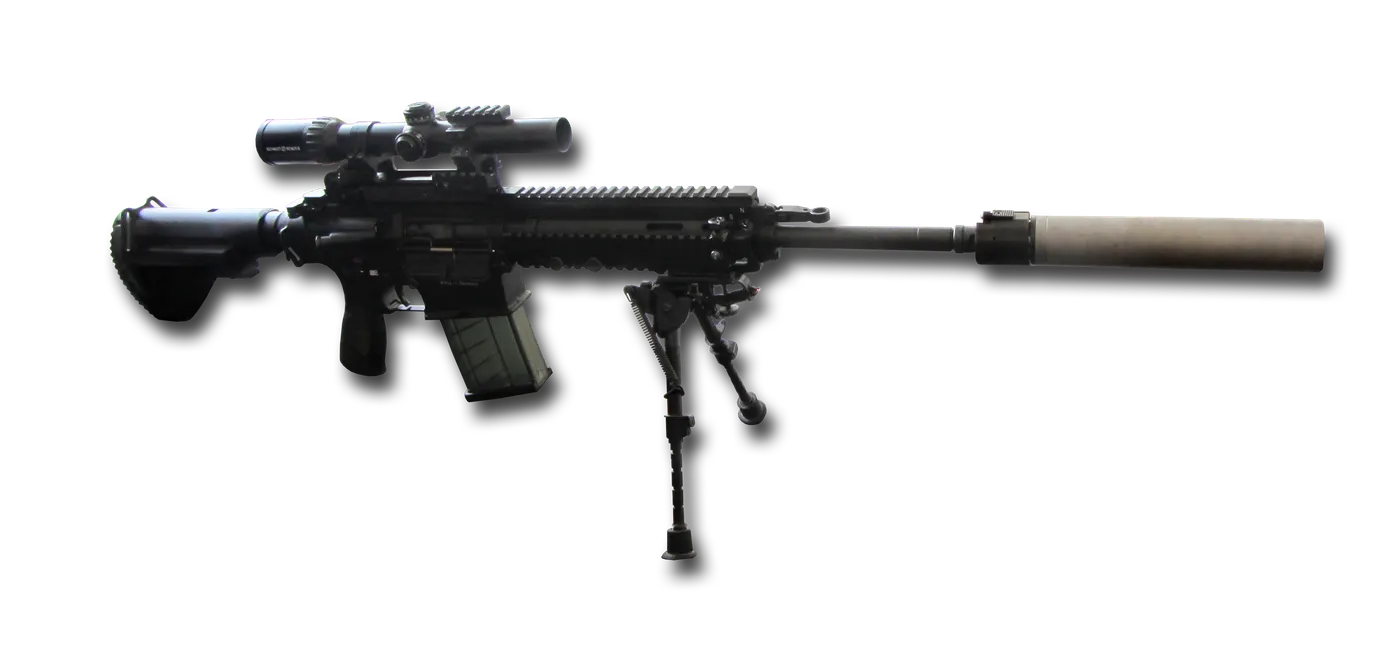

The Heckler & Koch HK417 is a gas-operated battle rifle chambered for the 7.62x51mm NATO cartridge, built by Heckler & Koch of Germany as the full-power complement to the company's 5.56mm HK416.1 Heckler & Koch showed the rifle publicly around 2005, ran prototypes through 2006, and put it into service that same year, funding the development itself rather than waiting on a government contract.1 No individual engineer is publicly credited with the design, and Heckler & Koch is listed as the designer of record in company and reference literature.
- Full-power 7.62x51mm range and penetration in an AR-pattern, ergonomic package
- Barrel swap in under two minutes lets one rifle cover multiple roles
- Short-stroke gas piston avoids direct-impingement fouling in the receiver
- Fully ambidextrous controls with Picatinny rail coverage throughout
- Heavier and harder to control in automatic fire than 5.56mm rifles in the same family
- Failed Germany's own 2010 accuracy trial in its original G27 form
- 20-round magazine capacity is modest next to intermediate-caliber service rifles
- Niche designated-marksman role keeps it out of general infantry issue in most armies
The HK417 shares its short-stroke gas piston system with the HK416, an arrangement adapted from the G36 rifle family rather than the direct-impingement gas system used in the American M4 carbine.1 That piston system traces back to a specific request from Delta Force. In the 1990s, Delta Force research and development non-commissioned officer Larry Vickers asked Heckler & Koch for a piston-driven alternative to the direct-impingement M4, and Delta Force began fielding the resulting rifle, designated HK416D, in operations from March 2005.2 The HK417 scales that same mechanism up to a full-power cartridge. It exists because the smaller HK416 could not deliver the range, penetration and stopping power that special-operations units wanted after early combat experience in Afghanistan and Iraq exposed the limits of 5.56mm carbines at distance and against cover.1,2
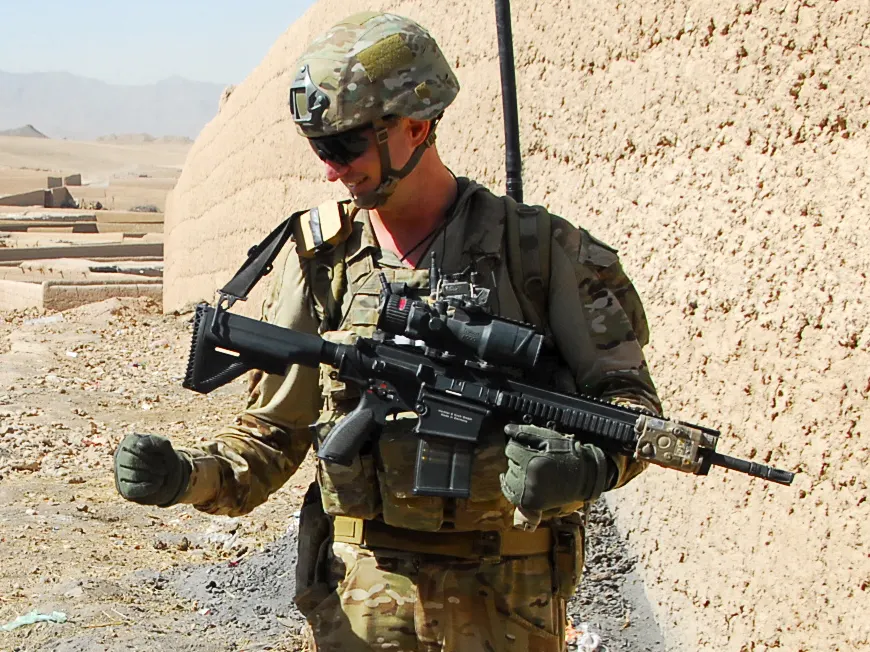
Every serious account of the HK417 stresses the same point. It was designed as a designated marksman rifle for special-operations and squad-support use, and it was never meant for general infantry issue.1 That sets it apart from the older Cold War battle rifles it shares a category with, most of which entered service as standard arms for entire armies. The HK417 instead reached the field mostly through special-forces channels, later through dedicated squad-marksman programs, and that narrower path shaped almost everything about how and where it has actually been used.3
The action is a gas-operated, rotating-bolt design built around a forged aluminum alloy receiver in the AR-10/AR-15/M4 pattern, driven by the same short-stroke piston used in the HK416 and derived from the G36.1 Heckler & Koch's original line offered three fixed barrel lengths, a 12 inch Assaulter, a 16 inch Recce and a 20 inch Sniper configuration, and the barrel can be swapped in under two minutes with simple tools, letting one rifle serve multiple roles depending on the mission.1,3 The improved HK417A2 revises this to 13, 16.5 and 20 inch options with an optimized gas port location and bore axis alignment intended to reduce muzzle rise.4 Barrels are cold hammer forged and chrome lined, with a 1 in 11 inch rifling twist.1
- İlk Üretim Yılı2006
- Hizmete Giriş Yılı2006
- TasarımcıHeckler & Koch
- Ağırlık (Boş)4,4 kg
- Ağırlık (Yüklü)4,74 kg
- Halen HizmetteEvet
- Önemli KullanıcılarBundeswehr, ABD Birleşik Özel Harekat Komutanlığı, ABD Kara Kuvvetleri, FSB Alfa Grubu gibi Rus Spetsnaz kuvvetleri
Muzzle velocity runs from roughly 750 to 817 meters per second depending on which barrel length is fitted, with the 20 inch Sniper configuration producing the higher figure.4 Feeding is by 10 or 20-round detachable box magazines, with early rifles using G3-pattern steel magazines and later production shifting to enlarged, G36-style polymer magazines with a bolt hold-open feature.1 The rifle carries a Picatinny rail across its full length, is fully ambidextrous in its controls, and accepts a suppressor without modification.1
- Fişek7.62×51mm NATO
- Çap7,62 mm
- Kovan Uzunluğu51 mm
- Çap Sınıfıtam boy
- Mermi Ağırlığı9,3 g
- Kenar AteşlemeliHayır
- Kovansız MühimmatHayır
The 419 millimeter barrel length figure often quoted for the HK417 corresponds exactly to the HK417A2's 16.5 inch Recce configuration. It is not a single number that applies across the whole rifle family, since the 12/13, 16/16.5 and 20 inch variants all remain in service and differ meaningfully in weight, handling and effective range.1,4 Reliability across environments, from Afghan dust to European winters, is consistently described as strong in operator and trade-press accounts, a reputation that tracks closely with the HK416's own record for the same gas system.2,3
- Mekanizma TipiGazlı
- Atış Modlarıseçmeli ateş
- Seçmeli AtışEvet
- Besleme SistemiÇıkarılabilir Şarjör
- Şarjör Kapasitesi20
- Teorik Atış Hızı600
- Namlu Çıkış Hızı817 m/sn
- Etkili Menzil (nokta)600 m
- Etkili Menzil (alan)800 m
- İsabet0,3
- Namlu Uzunluğu419 mm
- Yiv Adımı1:279.4 mm
- Nişangah TipiMekanik veya optik nişangah (Picatinny ray)
- Optik RayıEvet
- Açık NişangahEvet
- Dişli NamluEvet
- Gövde Malzemesi (Receiver)alüminyum alaşımı
- Katlanır / Toplanır DipçikHayır
- Bullpup DüzeniHayır
- Çift Yönlü KumandalarEvet
- ModülerlikNamlu, basit aletlerle iki dakikadan kısa sürede değiştirilebilir
- Üretim Başlangıcı2006
- Birim Maliyet8.500 USD
- Genişlik78 mm
- Yükseklik213 mm
The HK417's roots run through the HK416 program of the 1990s, when Delta Force sought a gas-piston alternative to its direct-impingement M4 carbines and worked with Heckler & Koch to develop one, fielding the HK416D operationally from March 2005.2 Heckler & Koch then scaled that same short-stroke piston system up to the full-power 7.62x51mm cartridge, showing prototypes of what became the HK417 around 2005 and 2006 and entering production the same year, well ahead of any single government contract driving the work.1 The rationale was straightforward. Western special-operations forces fighting in Afghanistan and Iraq after 2001 found that 5.56mm carbines like the HK416 sometimes lacked the range, penetration and stopping power needed against distant or covered targets, and wanted a modular, AR-pattern rifle in a full-power caliber to fill that designated-marksman gap.1,2
Germany's own military gave the rifle a rockier start than most accounts of foreign sales suggest. The Bundeswehr trialed the HK417, in 13 and 16 inch form, as a stopgap designated marksman rifle under the designation G27. In October 2010, Lieutenant Colonel Detlef Rausch announced at an Infantry Symposium in Unterlüss that the G27 had failed the German Army's own accuracy trials.5 Heckler & Koch responded by developing a new rifle from its semi-automatic civilian MR308, rather than fixing the G27 directly, and the result entered German service as the G28.6 The G28 guarantees 45 millimeter dispersion at 100 meters with match ammunition, and the Bundeswehr fielded it to support its Afghanistan deployment.6
In the United States, JSOC units, DEVGRU and Army Special Forces adopted the HK417 for designated-marksman work well before any formal conventional-Army program existed.3 That changed in the mid-2010s, when the Army selected an HK417-derived rifle for two related programs, the Compact Semi-Automatic Sniper System (CSASS) and the Squad Designated Marksman Rifle (SDMR), both standardized as the M110A1.7 The SDMR program, funded at $46.2 million for 5,180 rifles, worked out to roughly $9,000 per rifle fully loaded with training and logistics support, and around $8,500 for the bare rifle.8,9 Fielding to conventional infantry squads began in 2018, extending the rifle's reach well beyond the special-operations units that had used it up to that point, and continued for several years afterward.7
The HK417's combat record runs almost entirely through the War in Afghanistan (2001-2021), where it saw wider and more varied use than in any other conflict. German KSK special forces carried the G27 from around 2010, and the Bundeswehr more broadly used the G27 and later the G28 in a designated-marksman and overwatch role supporting ISAF operations through the war's final years.5,6 United Kingdom Special Air Service and Special Forces Support Group units used the HK417 in the same conflict, and American JSOC special-operations forces fielded it there as well, alongside conventional Army units once the SDMR reached the field.3,7

Australia's contribution is among the better documented of any HK417 user in this war. The Australian Army fielded 16 inch Recce-model HK417s fitted with 6x ACOG optics, and Australian soldiers patrolled with the rifle around Tarin Kowt, in Uruzgan Province, in July 2013, in the later stages of Australia's deployment.10,11
The HK417 also surfaces in the Insurgency in the North Caucasus. Russia's FSB Alpha Group commandos were documented in June 2015 carrying a suppressed HK417 alongside a suppressed Accuracy International Arctic Warfare rifle during operations in Dagestan.12 These Russian rifles are generally the civilian-derived MR762 variant rather than a military contract purchase, and the small scale of that use, combined with sanctions imposed on Russia since 2014, makes any ongoing supply relationship between Heckler & Koch and Russian security services doubtful today.12

In the War in the Sahel, France's Foreign Legion marksmen have used the 20 inch HK417A2 since 2020 as an interim replacement for the aging bolt-action FR F2 sniper rifle.13 That interim status did not last long. The French Army's eventual choice for a primary designated marksman rifle was the FN SCAR-H PR, and the Foreign Legion's 2nd Foreign Infantry Regiment began receiving its first SCAR-H PR rifles in January 2022, ending the HK417A2's run as the Legion's marksman rifle after roughly two years.13,14
Small numbers of 7.62mm HK417s have also turned up in Ukrainian unit use since Russia's full-scale invasion began in 2022, in configurations that match rifles previously issued to the Netherlands' special-operations forces.15 Exact quantities and transfer dates have not been confirmed by any government, and the rifles are best understood as part of the wider informal flow of Western small arms into Ukraine during the Russian invasion of Ukraine rather than a formal, publicized transfer.15
Heckler & Koch's original HK417 line covers three barrel lengths built on the same receiver, a 12 inch Assaulter for close-quarters and vehicle work, a 16 inch Recce for general designated-marksman use, and a 20 inch Sniper for maximum range.1 The HK417A2 revises all three lengths to 13, 16.5 and 20 inches, with a relocated gas port and a bore axis change aimed at improving muzzle control under recoil.4
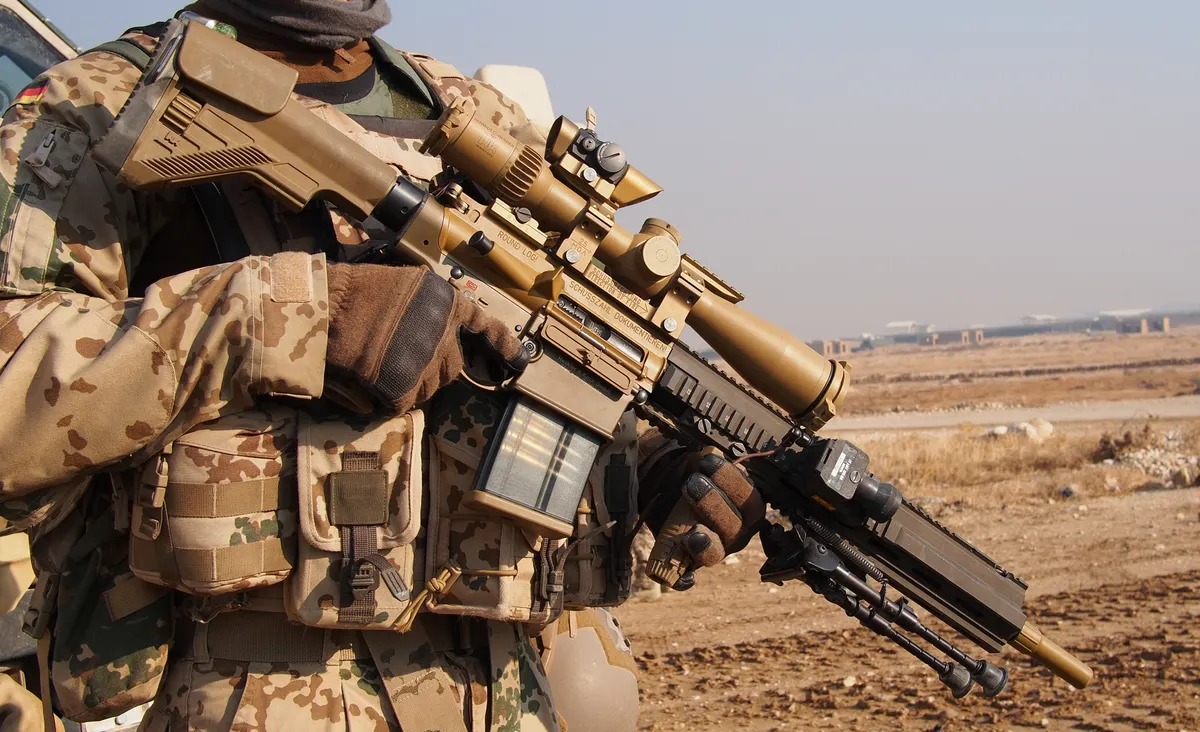
A semi-automatic civilian derivative, the MR308, appeared in 2007 and was later rebranded MR762 for the American commercial market.1 That civilian rifle became the basis for the Bundeswehr's G28, adopted after the G27's 2010 trial failure and built to guarantee 45 millimeter dispersion at 100 meters with match ammunition.6 In the United States, the HK417 architecture underlies the M110A1 family in two forms, the Compact Semi-Automatic Sniper System for special-operations use and the Squad Designated Marksman Rifle fielded to conventional infantry squads from 2018.7

| Yıl | Alıcı | Adet | Tutar | Bugünkü Değer (2025) |
|---|---|---|---|---|
| 2019 |  Amerika Birleşik Devletleri | 5,180 | $46.2 M | $58.2 M |
Germany fields the rifle as the G27 with its KSK special forces and more widely as the G28 within the Bundeswehr, the latter developed specifically after the G27's 2010 trial failure.5,6 The United States runs the deepest HK417-derived inventory of any operator, spanning JSOC and DEVGRU use of the original rifle, Army Special Forces adoption, and the formal M110A1 CSASS and SDMR programs fielded across special-operations and conventional Army units.3,7
The United Kingdom's Special Air Service adopted HK417 models in 12, 16 and 20 inch configurations in 2009, and the Special Forces Support Group also fielded the rifle.3 Australia acquired 16 inch Recce-model rifles with 6x ACOG optics in 2010 for its Afghanistan deployment.10 The Netherlands' Korps Commandotroepen special forces obtained 16 inch Recce-model HK417s as well, a purchase that later put Dutch-configuration rifles into the hands of Ukrainian units.15
Norway's Army and its FSK special forces operate a dedicated HK417N variant, replacing the older NM149 in a combined designated-marksman and sharpshooter role. This is a separate program from Norway's well-documented 2007 contract for 8,200 HK416 rifles in 5.56mm, and no confirmed date for a specific HK417N acquisition has been established in available sourcing.16,17 Austria's Jagdkommando, Ireland's Army Ranger Wing, and Denmark's special forces all field the HK417 in similar special-operations roles.3 Indonesia's Marine Corps units, including Denjaka and Taifib, along with the maritime security agency Bakamla, and Malaysia's Royal Malaysian Navy PASKAL commandos, also operate the rifle.3 Brazil's Federal Police use it in urban anti-narcotics operations, and Poland fields it in police and military service.3
Russia's FSB Alpha Group operates small numbers of the civilian-derived MR762 variant, documented in counterinsurgency operations in Dagestan, though post-2014 sanctions make continued Heckler & Koch supply to Russian services unlikely today.12 Since 2022, small numbers of Dutch-configuration HK417s have appeared in Ukrainian service as well, without official confirmation of the transfer's scale or timing.15
HK417 and HK416, One Piston System at Two Calibers
The HK417 and the HK416 share the same short-stroke gas piston, the same forged receiver pattern and the same ambidextrous control layout, scaled to different cartridges for different jobs.1 The HK416 stays a 5.56mm carbine built for the assault-rifle role, while the HK417 fills a 7.62mm designated-marksman and support role as a deliberate complement rather than a replacement.1,2 Delta Force's operational use of the HK416D from March 2005 gives the smaller rifle its own combat pedigree, and the HK417 inherited that mechanism's reputation for reliability when Heckler & Koch scaled it up.2
HK417 and FN SCAR-H, Rival Answers to the Same Requirement
The HK417's closest direct rival is the FN SCAR-H Mk 17, another modular 7.62mm rifle built for the same modern designated-marksman category. The two competed directly in JSOC's SCAR trials during the 2000s, and in 5.56mm testing neither design suffered a weapon-level jam, with the stoppages both recorded being magazine-related rather than caused by either rifle's own mechanism.18 JSOC ultimately selected the SCAR family from that original program, giving the FN design deeper special-operations penetration in the years since.18 The HK417, by contrast, became the basis for the US Army's conventional M110A1 program, putting a German-designed rifle into a core American infantry role the domestic SR-25-based M110 had held before.7,8
The two rifles differ in day-to-day handling details as much as in procurement history. The SCAR-H's charging handle can be switched to either side and worked without breaking the shooter's cheek weld, while the HK417's charging handle is fixed and requires breaking that position to cycle the action.18 In their short-barrel configurations, the SCAR-H's 13 inch variant runs about 0.8 pounds lighter than the HK417's 12 inch Assaulter.18 Reports on comparative accuracy between the two circulate widely among operators and collectors, but they are largely anecdotal rather than the product of a published, controlled test, and should be read with that caveat.18
| Feature | HK417 (16 inch Recce) | FN SCAR-H Mk 17 (13 inch) |
|---|---|---|
| Cartridge | 7.62x51mm NATO1 | 7.62x51mm NATO18 |
| Charging handle | Fixed side, breaks cheek weld18 | Reversible, no cheek weld break18 |
| Relative weight (short barrel) | Baseline | About 0.8 lb lighter18 |
| Main US adoption path | Conventional Army, M110A1 program7 | Special operations, original JSOC SCAR program18 |


Is the HK417 still in service? Yes. It remains in active use across special-operations and, in the United States, conventional units through the M110A1 program, with no major operator having withdrawn it entirely.7
What is the difference between the HK417 and the HK416? The two rifles share the same short-stroke piston system and general layout, but the HK416 fires the 5.56x45mm NATO cartridge in an assault-rifle role while the HK417 fires the full-power 7.62x51mm NATO round in a designated-marksman role.1,2
How does the HK417 compare to the FN SCAR-H? Both are modular 7.62mm rifles built for the same modern designated-marksman requirement, competed against each other in JSOC's SCAR trials, and ended up on different paths, the SCAR-H toward deeper special-operations use and the HK417 toward the US Army's conventional M110A1 program.7,18
What does the HK417 cost per unit? The US Army's SDMR program worked out to roughly $9,000 per rifle fully loaded with training and logistics, and around $8,500 for the bare rifle, based on a $46.2 million contract for 5,180 rifles.8,9
Can the HK417 mount a grenade launcher? The HK417A2 is compatible with the HK269 single-shot 40x46mm underslung grenade launcher, according to Heckler & Koch's own product literature.4
- "Heckler & Koch HK417", Wikipedia — en.wikipedia.org ↩
- "Heckler & Koch HK416", Wikipedia — en.wikipedia.org ↩
- "Current List of HK416/417 Mil/LE End-Users", HKPRO Forums — hkpro.com ↩
- "M110A1 rifle", Wikipedia — en.wikipedia.org ↩
- "HK417 did not pass German Army DMR tests", The Firearm Blog — thefirearmblog.com ↩
- "Hit by G36 Woes, Bundeswehr Procures HK417 Derivative", Military Technology — miltechmag.com ↩
- "The Army has officially fielded the 7.62mm G28/HK417 rifle as the M110A1 Squad Designated Marksman Rifle", Task and Purpose — taskandpurpose.com ↩
- "US Army funds HK417 as squad marksman rifle", Shephard Media — shephardmedia.com ↩
- "H&K To Supply New US Army Squad Designated Marksman Rifle", The Firearm Blog — thefirearmblog.com ↩
- "Category, Heckler & Koch HK417", Wikimedia Commons — commons.wikimedia.org ↩
- "Multinational Base Tarin Kowt in Uruzgan province", DVIDS — dvidshub.net ↩
- "Russian Special Forces Using HK417, AI AW In Dagestan", The Firearm Blog — thefirearmblog.com ↩
- "Equipment", French Foreign Legion Information — foreignlegion.info ↩
- "French Army Selects SCAR-H PR, S&B Scope and Night/Thermal Vision for Sniper Rifle", The Firearm Blog — thefirearmblog.com ↩
- "Heckler & Koch HK417", Wikipedia (operators section) — en.wikipedia.org ↩
- "Norway to procure Heckler & Koch HK416 assault rifles", Army Technology — army-technology.com ↩
- "Norway's New Boom Stick", Ares (Aviation Week) — aviationweek.typepad.com ↩
- "M110A1 rifle", Wikipedia (comparison with FN SCAR-H) — en.wikipedia.org ↩