

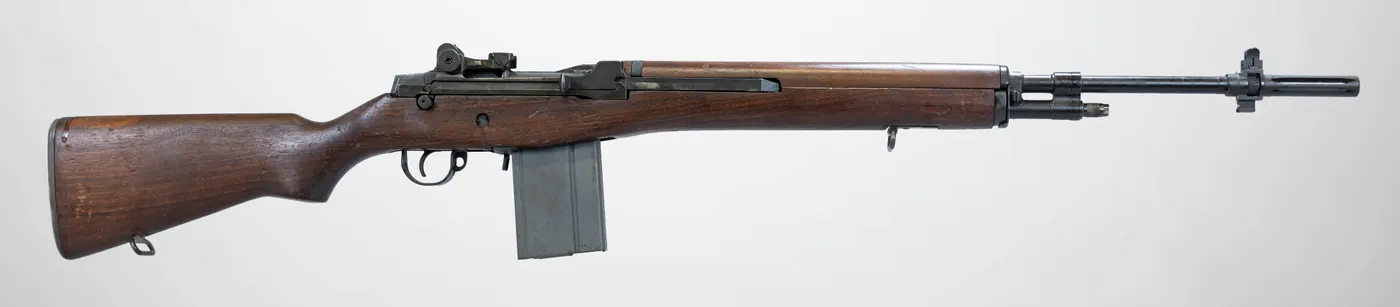

The M14 is a select-fire battle rifle chambered for the 7.62x51mm NATO cartridge, formally adopted by the United States Army on 1 May 1957 as the successor to the M1 Garand.1 It was built at Springfield Armory, the government-owned arsenal in Massachusetts that had made US infantry rifles since 1777, with wartime-scale volume added by three private contractors, Winchester, Harrington & Richardson, and TRW.1,9 On paper the rifle was meant to replace four separate weapons at once, the M1 Garand, the M1 Carbine, the M3 submachine gun, and the Browning Automatic Rifle, folding all four roles into one full-power-cartridge platform.8 That requirement proved difficult to reconcile in a single design, and it shaped much of the M14's short and troubled service life.
- Full-power 7.62x51mm NATO round with genuine long-range stopping power
- Simple, self-regulating gas system needing no manual adjustment
- Roughly a pound lighter than its main rival, the FN FAL
- Fewer parts than the rifle it beat in trials
- Long afterlife as a National Match target rifle, sniper platform, and designated marksman rifle
- Uncontrollable on full-automatic fire, a capability effectively disabled field-wide
- Too long and heavy for jungle and close terrain, a major complaint in Vietnam
- Wood stocks swelled in humid climates, degrading accuracy
- A September 1962 Department of Defense report rated it inferior to the M1 Garand it replaced
- Standard-issue service life of only about a decade, one of the shortest of any US infantry rifle
Production tooling was completed in 1958, and the first rifles reached Army units in July 1959, a full two years after adoption.1,9 Issue then moved slowly. The 101st Airborne Division was the only Army division fully equipped with the M14 by the end of 1960.8 The M14 was the first US standard-issue service rifle capable of fully automatic fire, since the M1 Garand it replaced was semi-automatic only, but the 7.62mm cartridge's recoil made sustained automatic fire nearly uncontrollable in a rifle this light. Most fielded M14s had their selector mechanisms disabled or the auto sear removed, and full-automatic fire was in practice reserved for the heavier M14A1 squad-automatic variant, where it remained only marginally controllable even there.1,7
Production ran from 1959 to 1964, and the four manufacturers delivered 1,376,031 rifles in total for roughly 143 million dollars, an average unit cost near 105 dollars.9,10 Harrington & Richardson built about 537,500 of them, Winchester about 356,500, TRW about 319,000, and Springfield Armory itself the remaining 167,000, making TRW, a late entrant to firearms manufacturing with no prior small-arms record, both the largest private contractor by volume among the three and the cheapest per rifle at roughly 105 dollars each.9,10
The M14 never lived up to its intended role as a universal infantry weapon. Secretary of Defense Robert McNamara ordered the M16 adopted as its replacement in 1964, over the objections of Army officers who had championed the M14, and by 1969 the M16A1 had formally taken over as the standard-issue US service rifle.12,1 Even so, the rifle did not disappear. Accurized and sniper variants kept it in frontline US service far longer than its brief standard-issue run suggests, and a single US Army unit still issues it today as a ceremonial rifle.1,27
The M14 traces its design back to John C. Garand's own postwar effort to adapt his M1 Garand for a detachable box magazine and full-automatic fire. Garand, a civilian engineer at Springfield Armory from 1919 until his 1953 retirement, produced a prototype rifle designated T20 that formed the technical starting point for later trials rifles.3 In a parallel track, engineer Earle Harvey designed the T25 in 1945 for a new .30-caliber cartridge under development by Colonel René Studler, then heading Army Ordnance research, and that design evolved into the T47 after trials at Fort Benning, Georgia, around 1950.2
- İlk Üretim Yılı1957
- Hizmete Giriş Yılı1957
- TasarımcıJohn C. Garand (T20 prototype), Earle Harvey (T25), Lt. Col. Roy E. Rayle (Springfield R&D program lead), Lloyd Corbett (T44 refinements), Dave Mathewson (Mathewson Tool Co., T44E4 production)
- Ağırlık (Boş)4,17 kg
- Ağırlık (Yüklü)4,85 kg
- Halen HizmetteEvet
- Önemli KullanıcılarABD Silahlı Kuvvetleri, Arjantinli askerler, Estonya Savunma Kuvvetleri, Ukrayna Silahlı Kuvvetleri
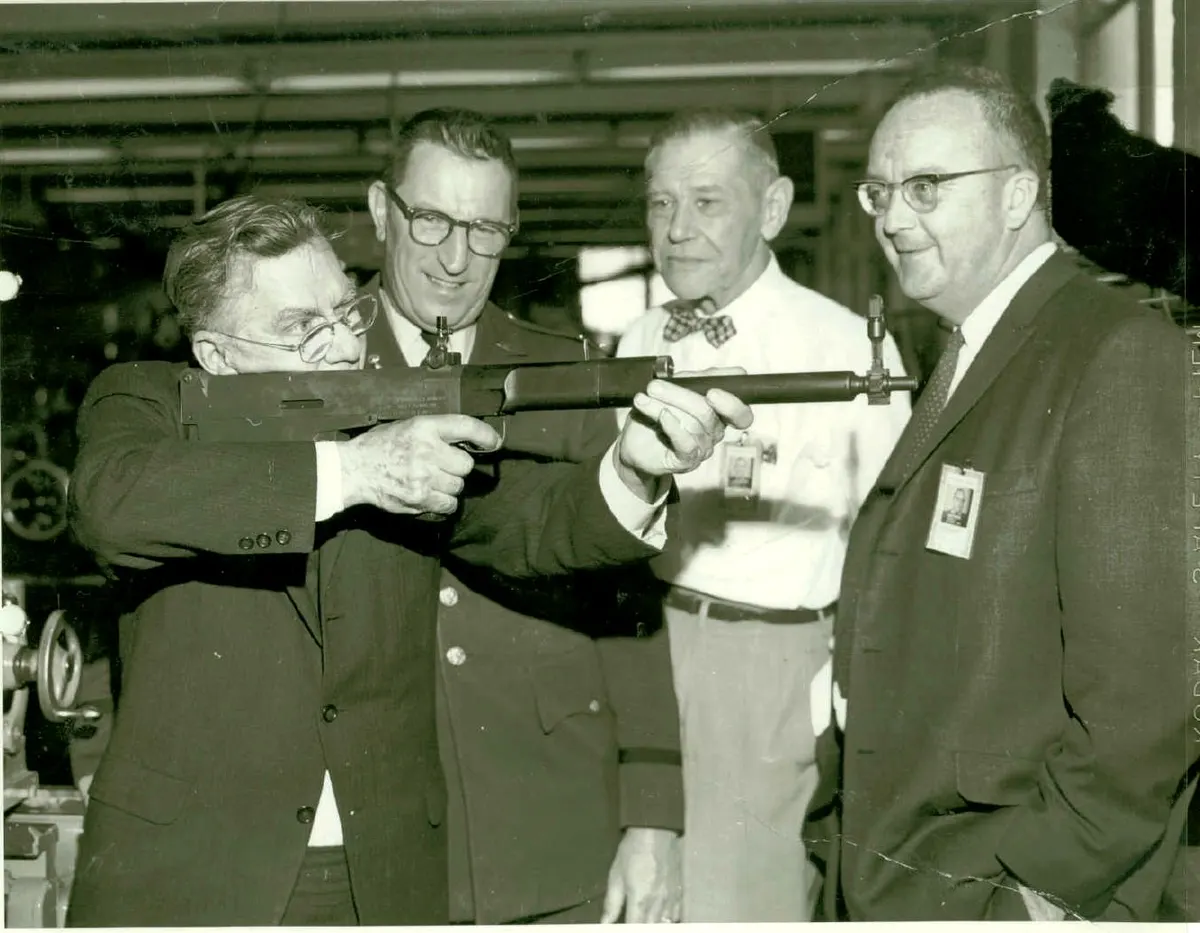
Early T44 prototypes reused T20E2 receivers fitted with magazine filler blocks and simply rebarreled for the new cartridge, a low-budget approach that nearly killed the program. Lieutenant Colonel Roy E. Rayle took over Springfield Armory's research and development division in 1953 and inherited what he later described as a failing effort.4 Because Garand had already retired and could not be rehired without losing his Army pension, Rayle arranged for him to work as a paid consultant through the Mathewson Tool Company, a nearby machine shop owned by Dave Mathewson, letting Garand collect both his pension and a contractor's paycheck.4 Garand and Mathewson delivered the improved T44E4 in June 1954, and engineer Lloyd Corbett is credited with further refinements, including a roller-equipped bolt to cut friction and a straightened operating rod.1
- Fişek7.62×51mm NATO (.308 in)
- Çap7,62 mm
- Kovan Uzunluğu51 mm
- Çap Sınıfı7.62mm
- Mermi Ağırlığı9,7 g
- Kenar AteşlemeliHayır
- Kovansız MühimmatHayır
The T44's chief rival in trials was the Belgian FN FAL, tested by the US Army as the T48.5 The competition ran for years and did not clearly favor the American design. An August to December 1952 trial board rated the T48 the winner, with the T44 second, and a further June 1953 round again found the T44 suffering more malfunctions than the T48.6 Winter trials at Springfield's own cold chamber in 1953 and 1954 turned the tide. Springfield engineers spent weeks specially preparing the T44 test rifles, redesigning the gas regulator and modifying magazines to resist cold-weather seizing, while the T48 entries received no equivalent preparation.7 FN's own engineer, Ernst Vervier, attempted field fixes for the T48's cold-weather stoppages during the same tests, and FN managing director René Laloux later argued publicly that the FAL had in fact demonstrated superiority.6,7 By a 1955 combat-course trial at Fort Benning, the T44E4 was recording a 1.4 percent malfunction rate against 2.4 percent for the T48, a figure adoption proponents cited heavily.7
- Mekanizma TipiGazlı
- Atış Modlarıseçmeli ateş
- Seçmeli AtışEvet
- Besleme SistemiÇıkarılabilir Şarjör
- Şarjör Kapasitesi20
- Teorik Atış Hızı700
- Pratik Atış Hızı15
- Tetik Tipitek kademeli
- Emniyet Tipimanuel emniyet
Beyond the trial results, the Army's case for the T44 rested on it being about a pound lighter than the T48, having fewer parts, and using a self-regulating gas system that needed no manual gas-port adjustment, unlike the FAL's field-adjustable regulator.1 Ordnance officials also argued the M14 could be built largely on existing M1 Garand tooling, a claim that helped sell the decision politically even though it turned out to be untrue once production began.1 Colonel Studler, who had spent years resisting adoption of a foreign rifle design, remained the central figure pushing the shortened .30-caliber cartridge that became 7.62x51mm NATO, and on 1 May 1957 the T44E4 was formally adopted as the M14.3,7
- Namlu Çıkış Hızı853 m/sn
- Namlu Enerjisi3.463
- Etkili Menzil (nokta)500 m
- Etkili Menzil (alan)875 m
- Azami Menzil3.725 m
- Nişan Menzili500 m
- Delme (Penetrasyon)10 mm
- İsabet1
Mechanically, the M14 is a gas-operated, rotating-bolt rifle fed from a 20-round detachable box magazine, firing the 7.62x51mm NATO cartridge at a muzzle velocity of about 853 m/s from a 559 mm barrel.1 Cyclic rate on full-automatic runs 700 to 750 rounds per minute, though as noted above few fielded rifles retained that capability in practice. Sighting is a simple aperture rear sight paired with a front post, adjustable out to 500 yards, with a claimed maximum range near 3,725 yards for the round itself.1 Cited muzzle energy for the round is commonly given as roughly 2,560 foot-pounds, about 3,463 joules, a figure that differs modestly from some published conversions and is worth noting as a minor point of disagreement across sources.1
- Namlu Uzunluğu558,8 mm
- Yiv Adımı1:12
- Yiv Sayısı4
- Nişangah TipiDioptrik arka nişangah, "arpa tanesi" ön nişangah
- Optik RayıEvet
- Açık NişangahEvet
- Dişli NamluEvet
- Gövde Malzemesi (Receiver)Çelik
- Kabza/Dipçik Malzemesiahşap, fiberglas, sentetik
- Katlanır / Toplanır DipçikHayır
- Bullpup DüzeniHayır
- Çift Yönlü KumandalarHayır
- Modülerliksınırlı şasi tabanlı varyantlar
- Susturucuya HazırEvet
- Süngü TakozuEvet
- Entegre BipodEvet
- Bombaatar KabiliyetliHayır
- Gaz PistonluEvet
- Toplam Üretim1.376.031
- Üretim Başlangıcı1959
- Üretim Bitişi1980
- Birim Maliyet105 USD
- Varyantlar10
- Genişlik82 mm
- Yükseklik203 mm
The M14's rollout collided almost immediately with the war it is now most associated with. American advisers and early combat units carried the M14 into Vietnam from the early 1960s, and it remained the primary US infantry rifle there into 1966 and 1967 before the M16 progressively took over.1,22 Soldiers in dense jungle terrain found the M14 too long and too heavy to handle quickly in close engagements, and its wood stocks absorbed humidity and swelled, throwing off the bedding between stock and barreled action and degrading accuracy.22 Uncontrollable recoil in automatic fire and the sheer bulk of 7.62mm ammunition, heavier round for round than the AK-47's 7.62x39mm, meant a rifleman could not carry enough rounds to match the volume of fire coming from Communist forces armed with Kalashnikovs.22 A September 1962 Department of Defense comptroller's report went so far as to rate the M14 inferior to the M1 Garand it had replaced, a striking verdict on a rifle barely three years into full-rate production.13

The M14's Vietnam-era association carried over into film and television long after the war ended. Marine recruits in Full Metal Jacket train and drill with M14 rifles through the Parris Island boot-camp scenes, an accurate detail since the Marine Corps kept issuing the M14 to recruits at Parris Island and San Diego well after the M16 had already displaced it in-country.25 Forrest Gump echoes the same training imagery, showing its lead assembling and disassembling an M14 during boot camp before he is shown carrying an M16 in the film's Vietnam scenes, a deliberate mismatch that mirrors the real transition soldiers experienced at the time.26 Black Hawk Down, set during the 1993 Battle of Mogadishu rather than Vietnam, gives the M14 one of its more prominent modern-era screen appearances, carried by a Delta Force operator defending a downed helicopter crash site.28 The rifle is notably absent from other well-known Vietnam films of the same period, among them The Deer Hunter and Apocalypse Now, both set in years when the M16 had already become the standard rifle on screen as in life.
Secretary of Defense Robert McNamara ordered the M16 adopted as the M14's replacement in 1964, a decision Army leadership resisted, since it was made by civilian Pentagon leadership over the objections of the uniformed officers who had championed the M14 through its long trial process.12 By late 1967 the Army had designated the M16 its Standard A rifle and downgraded the M14 to Limited Standard, and the M16A1 formally replaced it as the standard-issue service rifle by 1969, though the M14 remained the training rifle for Army basic training and for troops stationed in Europe into 1970.1,13

The M14 found a second career once the war it had struggled in exposed a real capability gap. A 2009 US Army study of engagements in Afghanistan found that roughly half occurred beyond 300 meters, a range band the issue M4 and M16 carbines, firing the smaller 5.56mm round, struggled to reach effectively.17 The Army and Navy responded by pulling M14 receivers out of storage and rebuilding them as designated marksman and sniper rifles, a role the platform had in fact already begun filling for the Navy SEALs earlier in the decade.11 By around 2010, Army infantry squads in Afghanistan were commonly issued two Mk 14 rifles per squad specifically to cover that longer engagement distance.11
Today the M14's remaining standard-issue role is almost entirely ceremonial. The 1st Battalion, 3rd US Infantry Regiment, known as the Old Guard, is the sole remaining regular US Army combat field unit still issued the M14 as its standard rifle, using it for funeral honors, parades, and guard duty at the Tomb of the Unknown Soldier at Arlington National Cemetery.27 It also remains a drill rifle at several US service academies and senior military colleges, and it still appears in the hands of the Military Sealift Command, the US Border Patrol, and the National Park Service.1 The result is an unusual double record. Only the Krag-Jørgensen had a shorter run as the official US standard-issue rifle, yet in some ceremonial, sniper, or marksman form the M14 has now remained in American service longer than any other twentieth-century US infantry rifle, including the M1903 Springfield.1,13
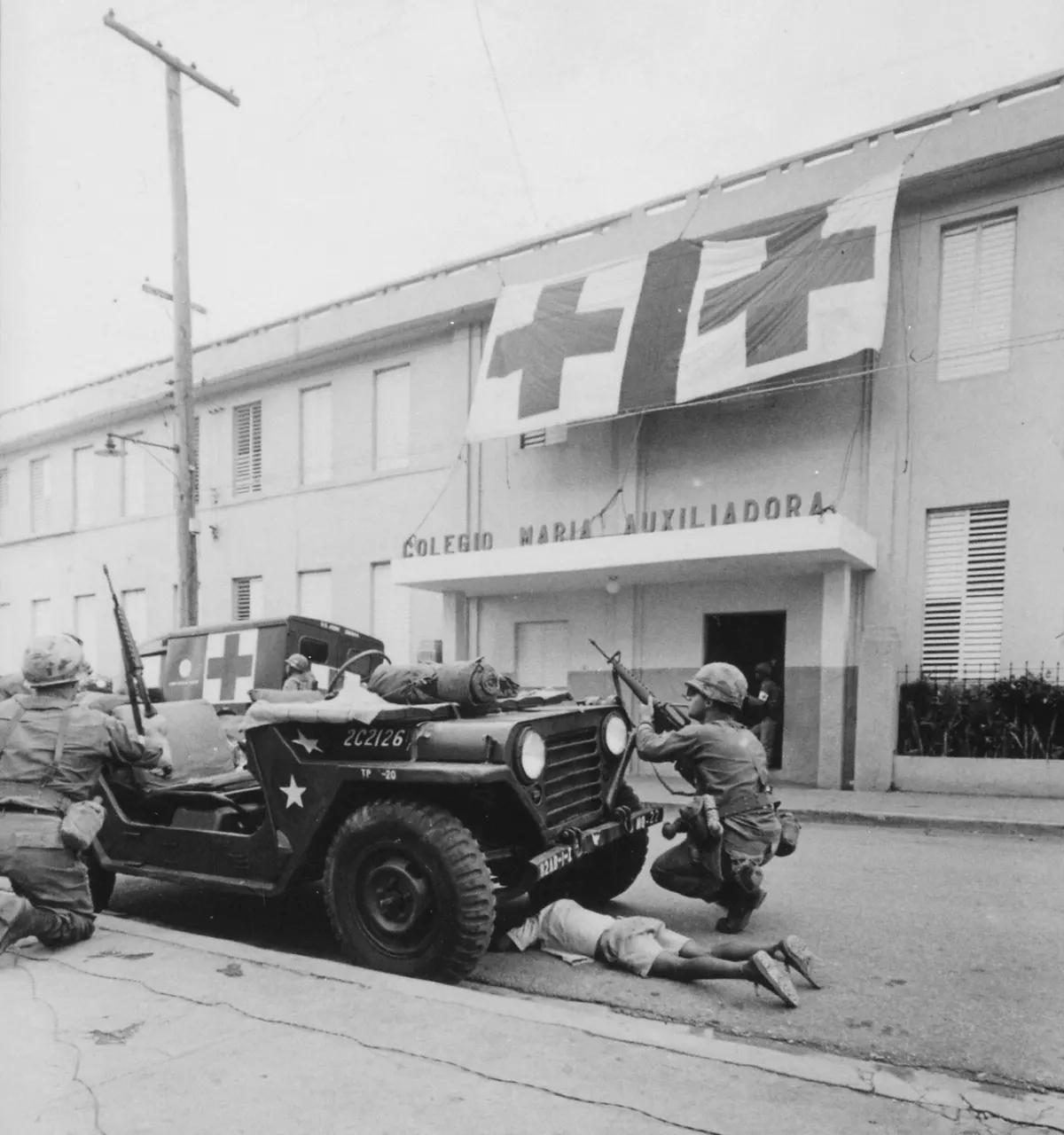
The M14's documented combat use spans several very different wars, each testing a different part of its design. American paratroopers of the 82nd Airborne Division carried the M14 into the Dominican Civil War in April 1965, during the US intervention known as Operation Power Pack, in what several accounts describe as the rifle's first use in actual combat.14,15 The division took its first combat casualties since the Second World War during that deployment, and US Marines landed alongside the paratroopers armed with a mix of M14s and M60 machine guns.14
The Vietnam War remains the M14's largest and most consequential combat use, serving as the primary US infantry rifle from the early buildup through roughly 1966 and 1967 before the M16 took over general issue.1,22 Accurized descendants of the rifle stayed in the war far longer than the standard-issue version. The M21 Sniper Weapon System, a National Match M14 fitted with a Redfield scope, was fielded to Army snipers in Vietnam from 1969 and remained the standard Army sniper rifle until the bolt-action M24 Sniper Weapon System replaced it in 1988.1
Far from Southeast Asia, Argentine infantry carried the M14 during the 1982 Falklands War, most notably soldiers of C Company, Regimiento de Infantería 25, at the Battle of Goose Green and around San Carlos, even though the FN FAL remained Argentina's more widely issued service rifle in that conflict.16

The M14's most recent combat chapters trace back to its Afghanistan and Iraq marksman revival. US units deployed the Mk 14 Enhanced Battle Rifle during the War in Afghanistan and the Iraq War, first with Navy SEALs from 2004 and later more broadly across Army infantry squads seeking longer effective range than the M4 could offer.11,17 Rifles of this general type have also turned up as captured or battlefield-acquired weapons in Islamic State propaganda footage from Iraq and Syria, a reminder of how widely M14-pattern rifles have proliferated well beyond their original US issue.11
Most recently, M14 and Mk 14-pattern rifles have appeared in the hands of Ukraine's Territorial Defence Force since the Russo-Ukrainian War escalated into full-scale invasion in 2022.19 The great majority of these rifles trace to Cold War-era US-donated stockpiles in Estonia, Latvia, and Lithuania, re-transferred to Ukraine as wartime security assistance rather than through any direct US-Ukraine transfer, alongside a separate confirmed US Department of Defense shipment of assorted small arms in the same period.19
The M14A1, developed under the designation M14E2 and issued from 1963, adapted the rifle for a squad-automatic role with a fully in-line pistol-gripped stock, a plastic upper handguard, a muzzle compensator, a Browning Automatic Rifle-style sling, an M2 bipod, a folding front grip, and a rubber recoil pad, and it was formally redesignated M14A1 in 1966.1 More than 8,300 were converted, though only a few hundred reportedly reached Vietnam before the M16 displaced the concept entirely.1
National Match versions were built as accurized target rifles rather than a squad weapon, with Springfield Armory, Rock Island Arsenal, and TRW together delivering 11,130 of them between 1962 and 1967.9 Rock Island later converted 1,435 National Match rifles into the XM21 sniper configuration, fitted with a 3 to 9 power Redfield ART scope and National Match ammunition, for Army snipers deploying to Vietnam from 1969, and the type was formally classified as the M21 Sniper Weapon System in 1975.1 The M21 remained the Army's standard sniper rifle until the bolt-action M24 Sniper Weapon System replaced it in 1988. A related M25 Sniper Weapon System was developed in the late 1980s within the 10th Special Forces Group for continued Special Forces use.1

The most extensive modern rebuild is the Mk 14 Enhanced Battle Rifle, development of which began around 2000 and 2001 in response to a Navy SEAL request for a more compact, modernized M14.11 Sage International supplied an aluminum chassis stock with a telescoping buttstock and four Picatinny rails, paired with a shortened 18-inch barrel and an improved flash hider, and the design was first fielded to Navy SEALs in 2004 before spreading to the Coast Guard and later Army infantry units.11,18 A related Marine Corps variant, the M39 Enhanced Marksman Rifle, served a similar designated marksman role before being phased toward the M110 Semi-Automatic Sniper System.1 Shorter SOCOM-pattern M14 variants, with 16 to 18-inch barrels, followed the same logic of trading the full-length rifle's reach for handling speed in vehicles and close terrain.1
Separately from all of these US variants, Taiwan received a manufacturing license after Springfield Armory sold its assembly tooling in 1967, and built the design domestically as the Type 57, with total production estimated at over one million rifles, a licensed derivative run that may exceed total US-made M14 production even though it is a distinct manufacturing program rather than a continuation of it.24


| Yıl | Alıcı | Adet | Tutar | Bugünkü Değer (2025) |
|---|---|---|---|---|
| 1998 |  Estonya | 40,500 | — | — |
United States forces adopted the M14 in 1959, and it went on to see wide, if often secondhand, distribution among American allies over subsequent decades, including Iraq, Lebanon, and the Philippines, the last of which fielded up to roughly 104,000 M14s at its peak.1
Estonia received 40,500 M14 rifles as a US donation delivered in 1998, not 2002 as sometimes reported, and the Estonian Defence Forces subsequently developed indigenous accurized sniper conversions, the M14 TP in 2000 and the improved M14 TP2 in 2008, built through the domestic firm E-Arsenal.18,20 Estonian troops later carried the TP2 variant on deployment in Afghanistan.20 The original 1998-issue rifles earned an unflattering nickname in Estonian service, translated roughly as fully terrible, reflecting decades of hard use before the TP conversions arrived.21 Lithuania received a comparable shipment of roughly 40,000 rifles from the United States in the late 1990s.19
Ukraine's M14s did not arrive through a direct 2018 US-Ukraine transfer, as sometimes stated. Instead, M14 and Mk 14-pattern rifles began appearing in Ukrainian Territorial Defence Force hands from March and April 2022, the great majority traced to Baltic-state stockpiles, chiefly Estonia's own 1998 shipment, re-donated as wartime security assistance once the full-scale invasion began.19 Argentina remains listed among historical operators from its Falklands-era use, and Taiwan continues to operate both original M14s and its own domestically produced Type 57 derivative.1,24
The M14's defining rivalry is with the Belgian FN FAL, the rifle it beat in a years-long US trial process that several historians describe as closer to a political outcome than a clean technical verdict.1,7 Both rifles solve the same problem, a controllable select-fire infantry weapon built around the new 7.62x51mm NATO cartridge, but they diverge sharply in how widely they were ultimately adopted. FN's design went on to equip roughly 90 countries and earned the nickname the right arm of the free world, becoming the standard rifle of most of NATO's European members, while the United States remained the alliance's one major holdout, fielding its home-grown M14 instead.1
That divergence looks stranger given how close, and at times how favorable to the FAL, the actual trial results were. Formal trial boards in 1952 and 1953 both rated the T48 (the American-tested FAL) ahead of or level with the T44, and the M14's eventual selection rested heavily on a pound of weight saved, a simpler self-regulating gas system, and the now-disproven claim that existing M1 Garand tooling could build it cheaply.1,7 The FAL's own adjustable gas regulator, often cited as a weakness because it demanded manual retuning across climates, could equally be read as a strength, letting a soldier compensate for worn parts or heavy fouling in a way the M14's fixed system could not.1
| Parameter | M14 | FN FAL |
|---|---|---|
| Cartridge | 7.62x51mm NATO1 | 7.62x51mm NATO1 |
| Empty weight | About 4.17 kg1 | About 4.25 kg1 |
| Barrel length | 559 mm1 | 533 mm (standard)1 |
| Gas system | Fixed, self-regulating1 | Manually adjustable regulator1 |
| Countries adopting (original or licensed) | A few dozen, largely through US aid programs1 | Roughly 901 |
| Adopted | 1957 (United States)1 | 1953 (Belgium)1 |
The verdict history eventually delivered was not kind to the winner. A September 1962 Department of Defense report rated the M14 inferior even to the M1 Garand, and by the mid-1960s the US Army itself had moved to the M16 rather than sticking with its own trial winner.13,12 The FAL, recalibrated for the same 7.62x51mm cartridge Studler had championed, went on to a service life of several decades across most of the rest of NATO, a striking contrast to the M14's roughly decade-long run as America's standard rifle.1


What are the M14's specifications? The M14 fires the 7.62x51mm NATO cartridge from a 20-round detachable box magazine, weighs about 4.17 kg empty, and has a 559 mm barrel producing a muzzle velocity near 853 m/s, with a cyclic rate of 700 to 750 rounds per minute on the rare rifles that retain full-automatic capability.1
How does the M14 work? It is a gas-operated, rotating-bolt rifle derived from the M1 Garand's action, using a fixed gas system that self-regulates without the manual adjustment the rival FN FAL required.1
Is the M14 still in service? As a general-issue rifle, no. It was replaced by the M16 by 1969. It survives in narrower roles, as the Old Guard's ceremonial rifle, as the basis for the Mk 14 Enhanced Battle Rifle and M39 Enhanced Marksman Rifle designated marksman platforms, and in the inventories of several foreign militaries.1,27,11
What was the M14's unit cost? The four manufacturers delivered 1,376,031 rifles between 1959 and 1964 for about 143 million dollars, an average unit cost near 105 dollars, with TRW producing the cheapest examples despite entering firearms manufacturing from outside the industry.9,10
How does the M14 compare to the FN FAL? Both are first-generation NATO 7.62mm battle rifles from the same trial era, but the FAL reached far more countries, roughly 90 against the M14's much smaller operator list, largely because the United States kept its own design for itself while the rest of NATO converged on the FAL.1
- "M14 rifle", Wikipedia — en.wikipedia.org ↩
- "FAL Prototype .280/30", Forgotten Weapons — forgottenweapons.com ↩
- "The M14 Rifle, John Garand's Final Legacy", American Rifleman — americanrifleman.org ↩
- "Against All Odds, The Man Behind the M14 Rifle, Lt. Col. Roy E. Rayle", Small Arms Review — smallarmsreview.com ↩
- "T48 rifle", Wikipedia — en.wikipedia.org ↩
- "FN FAL", Wikipedia — en.wikipedia.org ↩
- "M14, America's Worst Service Rifle, What Went Wrong", Forgotten Weapons — forgottenweapons.com ↩
- "M14 Rifle", Army Historical Foundation — armyhistory.org ↩
- "M14 Rifle History and Development", Lee Emerson — miamirifle-pistol.org ↩
- "M14 Rifle History and Development", Milsurps Knowledge Library — milsurps.com) ↩
- "Mk 14 Enhanced Battle Rifle", Wikipedia — en.wikipedia.org ↩
- "Marksmanship, McNamara, and the M16 Rifle, Organizations, Analysis, and Weapons Acquisition", RAND — rand.org ↩
- "The M14 rifle, What you didn't know about its history", Army Times — armytimes.com ↩
- "Operation Power Pack, US Military Intervention in the Dominican Republic", United States Army — army.mil ↩
- "Operation Powerpack", GlobalSecurity.org — globalsecurity.org ↩
- "Guns of the Falklands War", American Rifleman — americanrifleman.org ↩
- "Increasing Small Arms Lethality in Afghanistan, Taking Back the Infantry Half-Kilometer", Defense Technical Information Center — apps.dtic.mil ↩
- "Gift of U.S. Rifles to Estonian Army Due This Week", The Baltic Times — baltictimes.com ↩
- "M14s in Ukraine", The Armourer's Bench — armourersbench.com ↩
- "Estonia's Much Better Sniper, the M14 TP2", Forgotten Weapons — forgottenweapons.com ↩
- "Why the Estonian Military Nickname for America's M14 Rifle Means Fully Terrible", The National Interest — nationalinterest.org ↩
- "American Infantry Weapons of the Vietnam War", Military History Now — militaryhistorynow.com ↩
- "John Garand", Wikipedia — en.wikipedia.org ↩
- "Taiwan Type 57 Rifle", M14 Forum — m14forum.com ↩
- "Full Metal Jacket", Internet Movie Firearms Database — imfdb.org ↩
- "Forrest Gump", Internet Movie Firearms Database — imfdb.org ↩
- "Weapons", Society of the Honor Guard, Tomb of the Unknown Soldier — tombguard.org ↩
- "Black Hawk Down", Internet Movie Firearms Database — imfdb.org ↩