

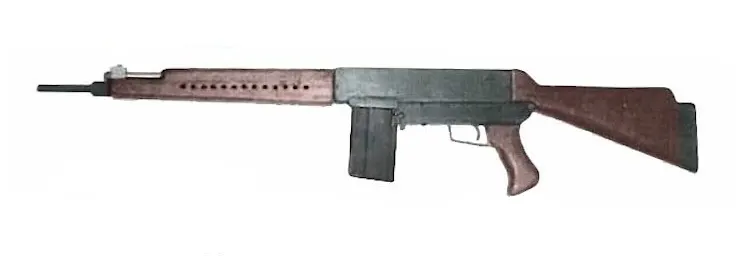
In 1975 the Hellenic Army rejected a homemade battle rifle chambered for the same 7.62x39mm cartridge used in the AK-47, and chose the NATO-standard Heckler & Koch G3 instead1. The rejected design was the Chropi rifle, and it came from an unlikely production line. Chropi (Χρωπεί, short for Χρωματουργεία Πειραιώς, the Piraeus Dye Works) had spent nearly a century making paints, dyes and pharmaceuticals before trying to break into small arms manufacturing in the mid-1970s2,4.
- simple gas-operated mechanism, cheap to build
- magazine choice of 20 or 30 rounds gave some tactical flexibility
- production tooling was actually built and a batch delivered
- chambered in a Warsaw Pact cartridge, not NATO's 7.62x51mm
- Hellenic Army trials judged it outdated against the G3
- never issued to troops, sat in storage after rejection
The design team was led by Sotiris Sofianopoulos2. The same year, Chropi also pitched a submachine gun, the Chropi GP10, to the same evaluators5. The two Wikipedia articles describing the rifle and the GP10 use almost identical language about the trial process and the fate of the hardware, which is worth flagging rather than repeating as two independently confirmed stories. Sourcing on the Chropi rifle overall is thin. Beyond a short English Wikipedia entry, a Greek-language write-up and an early Wikidata record, no Hellenic Army document, factory photograph or contemporary press report has surfaced. The rifle sits in the battle rifles category alongside dozens of other Cold War designs pitched to NATO-aligned armies and never adopted.
A 7.62x39mm Rifle, Not the Dual-Caliber Story Later Sources Repeat
Sourcing on the Chropi's chambering is genuinely split. A Greek-language account states plainly that it was an assault rifle of 7.62x39mm caliber, and adds that the designers skipped NATO's standard 7.62x51mm round for unknown reasons2. Wikidata's earliest recorded entry lists only 7.62x39mm as well3. Current English Wikipedia instead describes two separate caliber variants, a 5.56x45mm NATO version with a 20-round magazine and a 7.62x39mm version with a 30-round magazine, but cites no source for that split1. Given that the better-corroborated Greek account never mentions 5.56mm at all, and ties the 20-or-30-round magazine choice to a single caliber rather than two different chamberings, the single-caliber account is treated here as the more reliable one.
- TasarımcıSotiris Sofianopoulos (team leader)
- Halen HizmetteHayır
- Önemli KullanıcılarYunan Kara Kuvvetleri
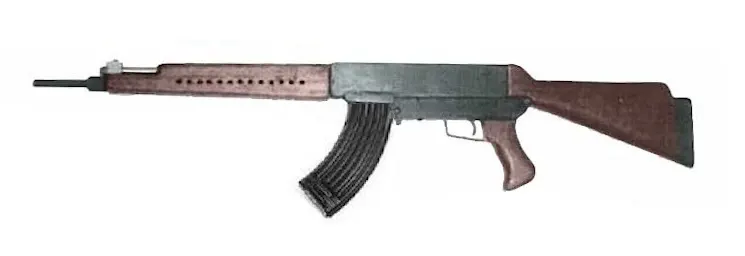
The rifle used a gas-operated action, cocked manually for the first round and then cycled by a spring-returned bolt off gas pressure for follow-up shots, a conventional layout for a mid-1970s design2. Feed was via a detachable magazine holding 20 or 30 rounds1,2. A weaker fandom-tier mirror claims a locking turning bolt enabling select-fire operation, which is plausible for a rifle of this era but is not corroborated by the Greek-language source, which does not discuss fire control at all. That claim is treated here as reported rather than confirmed.
- Fişek7.62x39mm
- Çap7,62 mm
- Çap Sınıfıorta güçlü
- Kenar AteşlemeliHayır
- Kovansız MühimmatHayır
Overall length is given as 1090mm with a 460mm barrel, and iron sights were fitted1. No source states an unloaded weight, cyclic rate, or effective range, so none is given here.
- Mekanizma TipiGazlı
- Atış Modlarıseçmeli ateş
- Seçmeli AtışEvet
- Besleme SistemiÇıkarılabilir Şarjör
- Şarjör Kapasitesi20
Ammunition choice mattered here for reasons beyond ballistics. Greece had been a NATO member since 1952, and by the mid-1970s its infantry rifle needs pointed toward NATO-standard 7.62x51mm and eventually 5.56x45mm ammunition, not the intermediate 7.62x39mm round associated with Warsaw Pact rifles. Building a rifle around that cartridge for a NATO army's adoption trial was an unusual commercial bet even at the time.
- Namlu Uzunluğu460 mm
- Nişangah TipiMekanik nişangah
- Optik RayıHayır
- Açık NişangahEvet
- Dişli NamluHayır
- Toplam Uzunluk1.090 mm
- Katlanır / Toplanır DipçikHayır
- Bullpup DüzeniHayır
- Çift Yönlü KumandalarHayır
- Susturucuya HazırHayır
- Süngü TakozuHayır
- Entegre BipodHayır
- Bombaatar KabiliyetliHayır
- Gaz PistonluEvet
- Üretim Başlangıcı1975
- Varyantlar2
A Dye Company's One and Only Push Into Small Arms
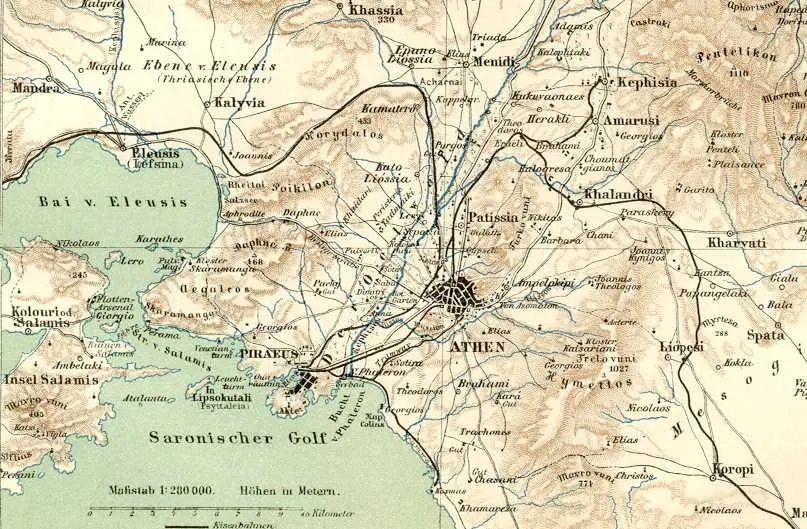
Chropi began in Piraeus in 1883, founded by the chemist Spilios Economides under the name Spilios A. Economides and Company, and grew into a paint and chemical manufacturer known across Greece by the ChropI name4. After Economides died in 1894, his brother Leontios Economides ran the firm until 1922 and became one of the founding figures of Greek chemical industry4.
By the 1970s the company was manufacturing paints and pharmaceuticals with no defense-industry background at all when it decided to diversify into military hardware2. The company's pitch, according to the Greek-language account, emphasized ease of manufacture, low cost, and reliability, aimed at both a Hellenic Army contract and potential export sales2.
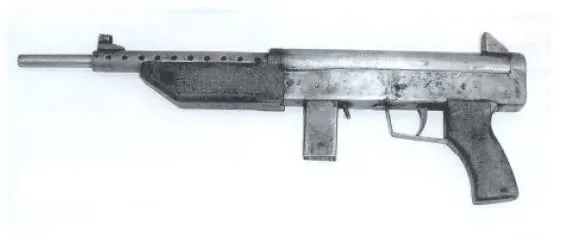
In 1975 Chropi presented two weapons to the Hellenic Army at once, this rifle and the 9x19mm Chropi GP10 submachine gun, both credited to the Sofianopoulos design team2,5. The two Wikipedia entries covering these weapons read almost like templates of each other, which is a reason to treat some of the shared claims (like exact production counts) with some caution rather than as two separately confirmed data points.
Early testing reportedly produced encouraging signs, but the final Hellenic Army evaluation found the rifle fell short of the specifications the army had set, describing it as a simple and rather outdated design, clearly inferior to the Heckler & Koch G31. Greece went on to license-build the G3 domestically instead.
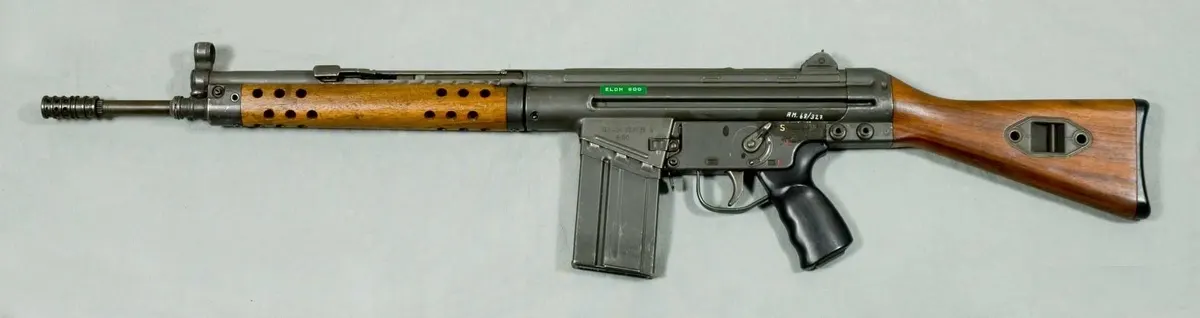
Chropi had already invested in production tooling by that point and had manufactured a small run of rifles, described by English Wikipedia as an unknown number, probably a few dozen (a weaker fandom mirror claims around 100, a figure treated here with less confidence)1. Those completed rifles were delivered to the Hellenic Army anyway and placed into storage rather than issued to troops or destroyed1,2.
Chropi's own defense venture did not survive much longer than the rejected rifle. The company ran into financial trouble in the early 1980s, was nationalized in the late 1980s and reorganized as ELVIPY (Ελληνική Βιομηχανία Προϊόντων Υγείας), and wound down operations by 19954. The rifle and the GP10 remained its only attempt at small arms production. What happened to the stored, undelivered-to-service rifles after Chropi's collapse is not documented in any source found for this article.

| Yıl | Alıcı | Adet | Tutar | Bugünkü Değer (2025) |
|---|---|---|---|---|
| 1975 |  Yunanistan | — | — | — |
The Hellenic Army, representing Greece, is the only recorded party to have handled the Chropi rifle, and even that relationship never reached operational service1. The delivered batch was evaluated, rejected, and put into storage rather than issued to units, so Greece's connection to the rifle is limited to a testing and short-term custody role rather than active use. No other country evaluated or purchased the design. Chropi's stated ambition to also sell the rifle abroad, mentioned in the Greek-language account of its sales pitch, produced no confirmed export customer2.
Chropi and Heckler & Koch approached the same 1975 Hellenic Army rifle trial from opposite directions. The G3 was already a mature, combat-proven design by the mid-1970s, built on a roller-delayed blowback system chambered for NATO's own 7.62x51mm round and produced under license in dozens of countries. The Chropi rifle was a first attempt by a chemical company with no firearms manufacturing history, built around an intermediate cartridge associated with the opposing bloc's rifles. The Hellenic Army's choice reflected more than raw specifications. Adopting the G3 kept Greece's rifle ammunition standardized with NATO allies and bought into an already-proven design with an established production and support ecosystem, while the Chropi offered neither pedigree nor cartridge compatibility.
| Chropi rifle | Heckler & Koch G3 | |
|---|---|---|
| Cartridge | 7.62x39mm2 | 7.62x51mm NATO1 |
| Action | Gas-operated2 | Roller-delayed blowback1 |
| Magazine capacity | 20 or 30 rounds1,2 | 20 rounds1 |
| Adopted by Greece | No, rejected 19751 | Yes, license-built1 |
The magazine-capacity option on the Chropi looks like an advantage on paper, but the underlying rifle never passed the trial that would have let that flexibility matter in service.


Was the Chropi rifle ever adopted by the Hellenic Army? No. It was evaluated in 1975 and rejected as inferior to the Heckler & Koch G3, which Greece adopted and license-built instead1.
What caliber did the Chropi rifle use? The best-attested sources describe a single 7.62x39mm chambering with a choice of 20- or 30-round magazines. A 5.56x45mm variant appears in some later sources but lacks independent corroboration1,2,3.
How many Chropi rifles were built? English Wikipedia gives an unknown number, probably a few dozen, delivered to the Hellenic Army and kept in storage. A weaker source claims around 100, a figure treated with less confidence here1.
Is the Chropi rifle still in service anywhere? No. It was never issued operationally by any military force, and the company that made it, Chropi, ceased operations by the mid-1990s4.
- "Chropi rifle", Wikipedia — en.wikipedia.org ↩
- "Chropi Rifle, a Greek attempt at making a modern portable weapon", Πτήση (Flight) — flight.com.gr ↩
- "Chropi rifle", Wikidata — wikidata.org ↩
- "Η μεγάλη ΧΡΩΠΕΙ και οι Λειβαρτζινοί ιδρυτές της", Καλαβρυτινά Νέα (Kalavryta News) — kalavrytanews.com ↩
- "Chropi GP10 submachine gun", Wikipedia — en.wikipedia.org ↩