


In March 1963 the French Army general staff came within one internal memo of naming the FA-MAS Type 62, not the Belgian FN FAL, as its next standard rifle.1 The Type 62 (French, Fusil Automatique MAS Type 62, also written FA.MAS T62) was the last and most refined design in a run of roughly forty separate 7.62mm prototype rifles built by the French state arsenal Manufacture d'Armes de Saint-Étienne (MAS) between 1952 and 1962, chambered in 7.62x51mm NATO as France weighed dropping its own 7.5x54mm service round to fall in line with the alliance's standard cartridge.2 It is one of many battle rifles built for that same NATO-standardization moment, alongside the FAL itself, the American M14 rifle, and the West German Heckler & Koch G3.
- Exceptionally sophisticated sight package for 1962
- Combined proven MAS-49/56 locking system with a modern FAL-derived gas system
- Retained rifle-grenade launching and telescopic-sight capability of its predecessor
- Came genuinely close to formal adoption
- More parts and harder field maintenance than the rival FAL
- Trigger and practical accuracy rated below the FAL in troop trials
- Vertical shot dispersion noted during testing
- Cancelled for reasons unrelated to its own performance
Despite the shared name, the Type 62 has no mechanical connection to the far more famous bullpup FAMAS rifle adopted by France sixteen years later, in 1978.2 The Type 62 is a conventional-layout rifle with the magazine forward of the trigger and a standard stock behind it, closer in silhouette to a hybrid of the FAL and the MAS-49 rifle it was meant to replace than to any bullpup design. The naming overlap is coincidental, a reused arsenal designation rather than evidence of shared engineering.
No individual designer is credited in the available English-language sources for the Type 62. It is attributed generically to MAS's design bureau, a contrast with the later 5.56mm FAMAS, whose lead designer General Paul Tellié is well documented starting in 1967, on an entirely separate design track.3 By the time of its formal trials in July 1962, the Type 62 represented a decade of accumulated French experimentation with automatic rifles built around the NATO cartridge, condensed into a single design put forward against a single foreign competitor.2
The rifle that ultimately ended the whole program was a completely separate weapon from the FAL it lost to in trials. The American M16 rifle, an early assault rifle chambered in the smaller 5.56x45mm round, was adopted an ocean away in 1964 and made every European 7.62mm NATO rearmament plan look dated almost overnight, the Type 62 included.
A Gas-Operated Hybrid of the FN FAL and MAS-49/56
The Type 62 uses a gas-operated, tilting-bolt action deliberately built as a hybrid of two existing rifles. The bolt and its tilting locking system, the gas cutoff mechanism, and the rifle-grenade-launching hardware were all carried over from the MAS-49/56. The short-stroke gas piston system, the receiver, and the top cover were adapted from the FAL.4
- İlk Üretim Yılı1962
- Ağırlık (Boş)4,53 kg
- Halen HizmetteHayır
Rather than copying the FAL's trigger group outright, MAS engineers fitted a novel striker-type, linear-hammer trigger mechanism of their own design.4 It was one of the few genuinely original components in a rifle otherwise built from borrowed subsystems, though troop trials later judged it inferior to the FAL's own trigger in practice.1
- Fişek7.62x51mm NATO
- Çap7,62 mm
- Kovan Uzunluğu51 mm
- Kovansız MühimmatHayır
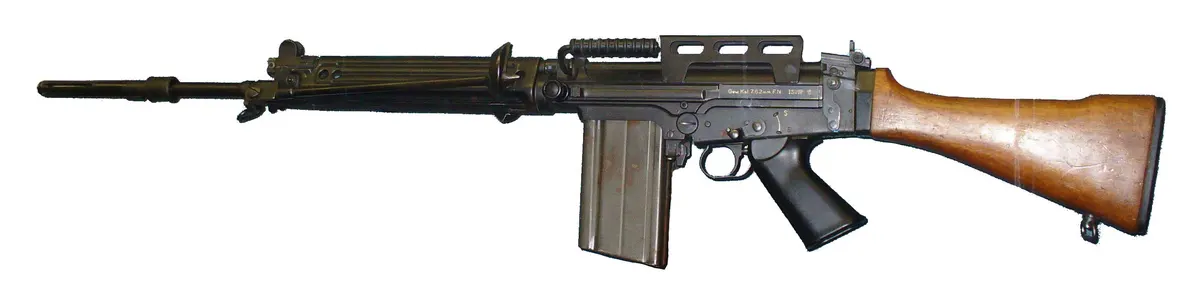
The rifle weighed 4.53 kg (9.9 lb) empty, measured 1,040 mm (40.0 in) overall, and carried a 500 mm barrel.1
- Mekanizma TipiGazlı
- Atış Modlarısemi-automatic, full-automatic
- Seçmeli AtışEvet
- Besleme SistemiÇıkarılabilir Şarjör
- Şarjör Kapasitesi20
- Teorik Atış Hızı600
- Tetik Tipistriker-type, linear hammer
It fed from a 20-round detachable box magazine and offered select-fire capability, semi-automatic and full-automatic, with a cyclic rate cited at roughly 600 rounds per minute.1 Furniture was mixed, a plastic handguard paired with a wooden stock and pistol grip.1 Adopting the 7.62x51mm NATO round rather than France's existing 7.5x54mm cartridge was explicitly about ammunition interoperability with the rest of the alliance, the same reasoning that put the FAL, the M14, and the G3 all in the same caliber during this period.4
- Namlu Uzunluğu500 mm
- Nişangah Tipi200-600m rotating drum sight with folding night sight, peep sight and telescopic sight mount
- Optik RayıEvet
- Açık NişangahEvet
An Elaborate Sight Package for a 1962 Rifle
For a rifle this obscure, the sighting package was unusually ambitious. It combined a rotating drum sight adjustable from 200 to 600 m, a separate close-range peep sight for rapid engagement, a folding U-notch night sight with luminescent inserts, a mount for an optical sight, and a dedicated sight for launching rifle grenades, itself inherited from the MAS-49/56's own grenade-sight system.1,5
- Toplam Uzunluk1.040 mm
- Kabza/Dipçik Malzemesiwood and plastic
- Bullpup DüzeniHayır
It could also mount the same APX L806 telescopic sight already used on the MAS-49/56, and it retained an integral bipod mount, another MAS-49/56 holdover.5
- Süngü TakozuEvet
- Entegre BipodEvet
- Bombaatar KabiliyetliEvet
- Gaz PistonluEvet
That sighting sophistication cut both ways in trials. Evaluators praised its capability while also citing the added parts count as a maintenance burden, the same tension in miniature that shaped the wider verdict against the rifle.1
- Toplam Üretim60
- Üretim Başlangıcı1962
- Üretim Bitişi1962
A Decade of French Prototypes Before the Type 62
France spent ten years experimenting with 7.62mm NATO automatic rifles before settling on the Type 62 as its final candidate. The program included several intermediate prototypes with distinct layouts, discussed in full under Variants below, before converging on the Type 62 as the version judged ready for formal military trials.2

MAS carried forward the parts of the MAS-49/56 it judged proven (locking system, gas cutoff, grenade-launching hardware) while borrowing the FAL's more modern short-stroke gas piston and receiver architecture, betting that the combination would beat a straight FAL purchase on both familiarity and capability.4
None of the interim Type-55, Type-56 or Type-59 prototypes reached formal military trials. Only the final Type 62 did, a distinction that sets it apart from the rest of the family covered under Variants below.2
Trials Against the FN FAL, 1962 to 1963
MAS manufactured 60 rifles (one Forgotten Weapons companion piece gives a figure of approximately 65) for formal troop and technical trials run by the Section Technique de l'Armée de Terre and at the Bourges proving ground, evaluated head to head against the FAL by five French Army field units.1,5
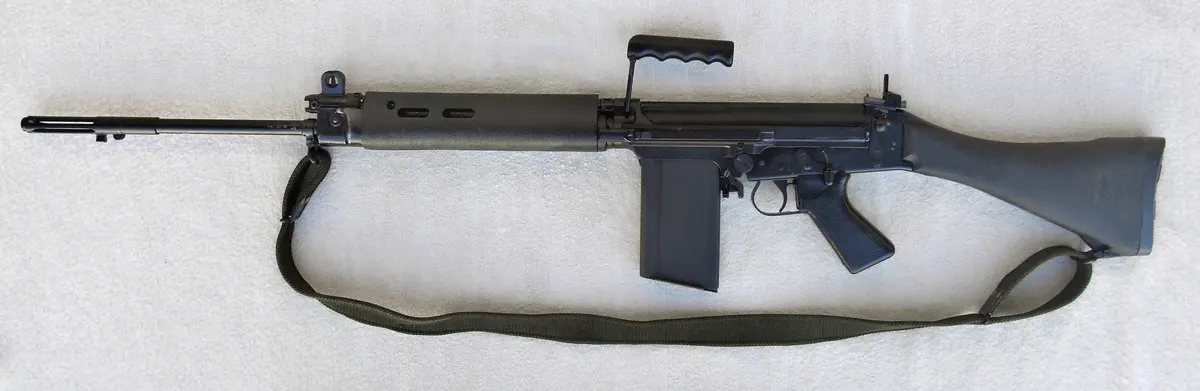
Troops judged the Type 62 serviceable but preferred the FAL overall. The FAL's trigger was rated superior, and the FAL was more accurate in practice. The Type 62 suffered from vertical shot dispersion and was seen as overly complicated relative to the FAL, with more parts that made maintenance and field-stripping harder.1,5
The trial verdict did not go entirely against the Type 62. Its more elaborate sight package remained a genuine point of technical merit, even evaluators who preferred the FAL's handling acknowledged the French rifle's superior optics and night-fighting provisions.1
The FAL's win was not automatic even after the trial results came in. It took until March 1963 for the French general staff to accept the findings and tentatively select the FAL over the Type 62, a preliminary rather than final decision.5,1
Killed by a Caliber, Not by the Trial Result
France then balked at the acquisition cost of re-arming its infantry with either rifle.5 Forgotten Weapons' companion piece adds further budget context, full-automatic rifle fire was judged of limited practical value under French doctrine at the time, the ballistic gain of 7.62mm NATO over the existing 7.5x54mm French round was seen as marginal, and France was prioritizing tank and missile programs over infantry rearmament.4 The institutional choice, in effect, became to do nothing.
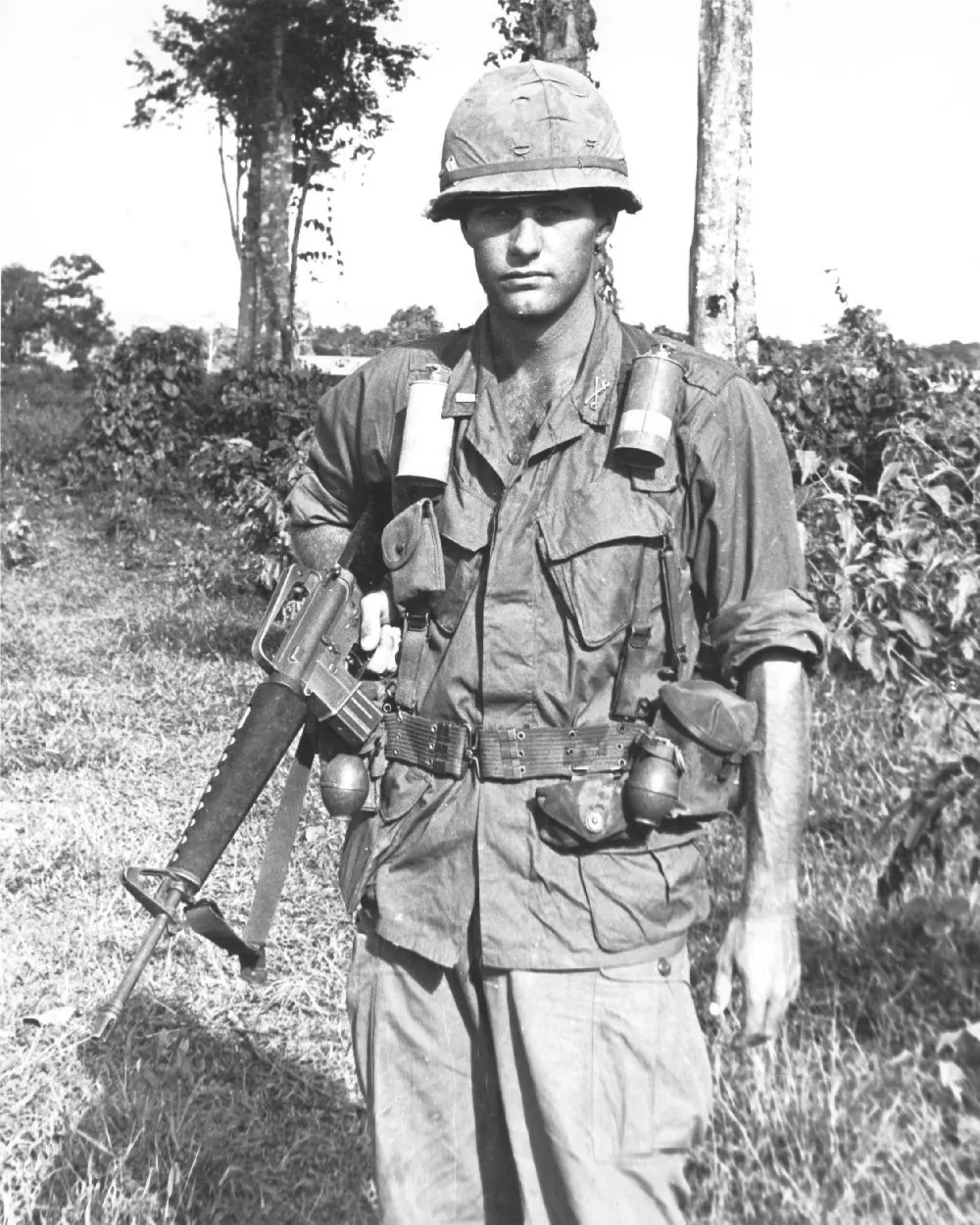
The decisive blow came from outside France entirely. The United States' 1964 adoption of the 5.56x45mm M16 rifle prompted French planners to abandon the whole 7.62mm NATO rifle-replacement effort rather than commit to a caliber that now looked headed for obsolescence within the alliance.5
As a direct consequence, the older MAS-49/56 in 7.5x54mm French stayed in first-line French service far longer than planners had intended, effectively until the FAMAS replaced it in the late 1970s and early 1980s.1,4
The Type 62 name itself did not disappear with the program. It resurfaced sixteen years later, attached to a completely different rifle.
An Unrelated Name, Recycled Sixteen Years Later
The Type 62 program and the later bullpup FAMAS are two distinct, non-continuous MAS design efforts, separated by roughly five years and a caliber change. An entirely new program began in 1967 under General Paul Tellié, explicitly built around the emerging 5.56mm cartridge and a bullpup layout, driven by a doctrinal shift toward compact weapons for troops deploying from armored vehicles and helicopters.3,6 The first functional prototype, designated MAS A1, was completed in 1971, with military evaluation beginning in 1972.6
Development ran through prototypes A1 through A7. The French government paused the program in 1974 to test the foreign HK 33 and the FN CAL as alternatives before resuming, with the A5 and A6 addressing reliability and barrel-wear problems.6 The A7 prototype, tested in 1977, was adopted in 1978 as the FAMAS F1, replacing both the MAS-49/56 rifle and the MAT-49 submachine gun in French service.6,7
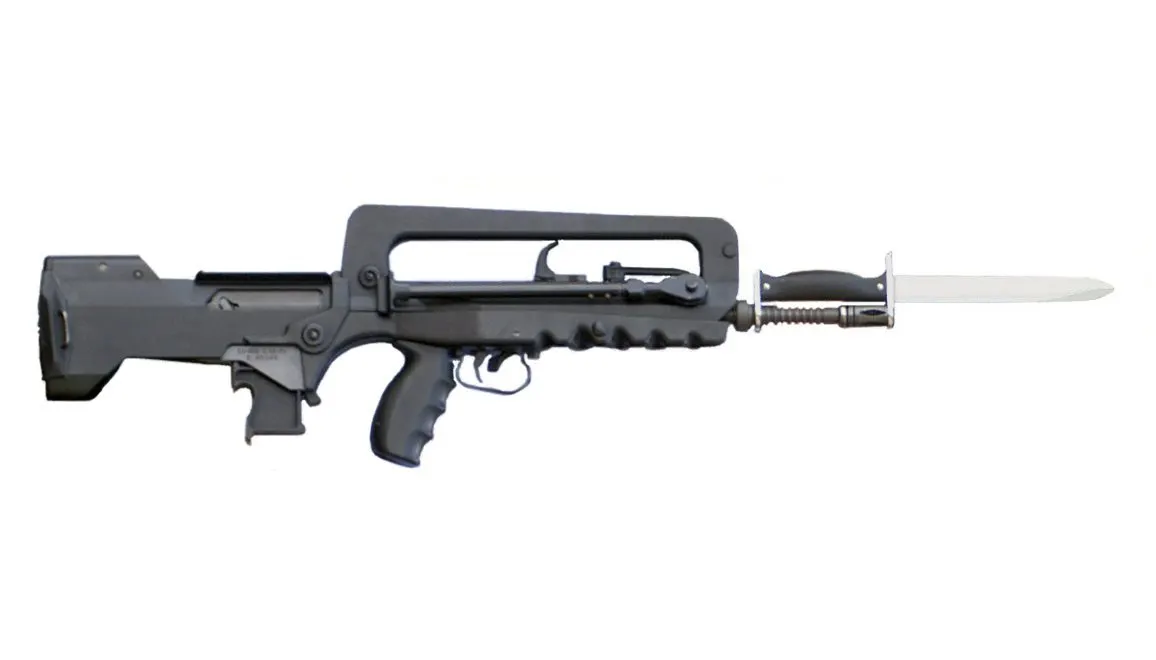
Mechanically the FAMAS F1 has nothing in common with the Type 62. It uses a lever-delayed blowback system in the Pál Király tradition, related to the AA-52 general-purpose machine gun and the San Cristóbal carbine, rather than the Type 62's gas-operated tilting-bolt FAL hybrid.8 The Type 62's name predates the famous bullpup by sixteen years, a rare case of an important arsenal brand name being effectively recycled by an unrelated, far more successful, later system.
The result is a rare case in small-arms history, a name surviving two completely different rifles fielded a generation apart, sharing an arsenal and nothing mechanical.
The Type 62 was the culmination of a family of MAS prototypes, each testing a different configuration on the way to the final design.
- Type-55 (MAS 55). An earlier prototype using an under-barrel gas piston, heavily based on the MAS-49 (gas-operated, tilting bolt, left-side charging handle). It was built in two distinct variants, one conventional and one bullpup, but never reached formal military trials.2 This is the bullpup relative that should not be confused with the Type 62 itself.
- Type-56. A simplified alternative to the Type-55, described as closer in layout to the FN FAL.2
- Type-59 (also referred to as AP61 in one configuration). Added an improved stock and foregrip, a folding-stock option, a bipod, and an infrared night sight.2
- Type-62. The final and most refined iteration, combining the best-regarded elements of the earlier prototypes, the one actually put forward for the 1962 to 1963 trials described above.2

France is the only country associated with the Type 62, and only in a trials capacity. Five French Army field units evaluated the rifle during the 1962 to 1963 troop trials alongside technical testing at the Bourges proving ground.1 It was never issued for general service and no export or licensed-production use is documented.
FA-MAS Type 62 vs FN FAL
The rivalry between these two rifles was not abstract, it was a direct, adjudicated procurement contest that France ran to decide its next standard-issue rifle. The FAL had already been adopted or was being adopted across much of NATO by the early 1960s, spawning national variants like the United Kingdom's L1A1 Self-Loading Rifle, so France's trial was as much about whether a homegrown design could beat an already-proven, widely fielded rival as it was about raw performance. On raw performance the FAL won clearly, judged more accurate with a better trigger, while the Type 62 carried a heavier, more elaborate sight package that came at the cost of more parts and harder field maintenance.1,5
| Spec | FA-MAS Type 62 | FN FAL |
|---|---|---|
| Cartridge | 7.62x51mm NATO | 7.62x51mm NATO |
| Action | Gas-operated, tilting bolt | Gas-operated, tilting bolt |
| Weight (empty) | 4.53 kg | approx. 4.3 to 4.5 kg (variant-dependent) |
| Trials outcome | Passed over, March 1963 | Tentatively selected |
FA-MAS Type 62 vs MAS-49/56
Where the FAL comparison was a competition, the MAS-49/56 comparison is closer to a succession attempt. The Type 62 was meant to eventually replace it, and it shows in the design choices, MAS engineers kept the 49/56's proven locking system, gas cutoff mechanism, and grenade-launching sight, and the Type 62 could still mount the same APX L806 telescopic sight used on the older rifle.5,1 What it added on top were a pistol grip, a detachable 20-round box magazine in place of the 49/56's fixed feed, a bipod mount, and full-automatic fire, none of which the semi-automatic MAS-49/56 offered. The irony is that the Type 62's cancellation left the MAS-49/56 it was meant to replace in first-line service for roughly two more decades.1,4
FA-MAS Type 62 vs FAMAS F1
This is the comparison readers most often arrive looking for, given the shared name, and the honest answer is that the two rifles share almost nothing beyond an arsenal and a naming convention. The Type 62 is a conventional-layout, gas-operated, tilting-bolt 7.62mm rifle from a program that ended in 1964. The FAMAS F1 is a bullpup, lever-delayed-blowback 5.56mm rifle from an unrelated program that began three years later, under a different lead designer, and reached French service in 1978.3,6,8 Treat any claim that the Type 62 was an early FAMAS prototype with suspicion, sourcing does not support a mechanical or program-level connection between them.


What is the FA-MAS Type 62? It was a French 7.62x51mm NATO battle rifle prototype developed by the state arsenal MAS, put forward for formal French Army trials in July 1962 as a possible domestic alternative to the FN FAL.1,2
Is the FA-MAS Type 62 the same weapon as the French FAMAS bullpup rifle? No. Despite the shared FA-MAS name and manufacturer, the Type 62 is a conventional-layout rifle from a 1952 to 1962 program, mechanically and organizationally unrelated to the bullpup FAMAS F1 program that began in 1967 and was adopted in 1978.3,6,8
Why was the FA-MAS Type 62 not adopted by the French Army? Troop trials in 1962 and 1963 favored the FAL's trigger and accuracy, and the French general staff tentatively picked the FAL in March 1963. Even that decision stalled over rearmament cost, and the program was ultimately abandoned outright after the United States adopted the 5.56mm M16 in 1964, which made continued investment in a 7.62mm replacement rifle look obsolete.1,5
What replaced the FA-MAS Type 62 program? Nothing directly. France kept the older MAS-49/56 in first-line service for roughly two more decades, until the unrelated bullpup FAMAS F1 finally replaced it in the late 1970s.1,4
How many FA-MAS Type 62 rifles were built? Sources give 60 rifles built for the 1962 to 1963 trials, with one account citing approximately 65, small numbers consistent with a trials-only prototype that never reached full production.1,5
- "FA.MAS T62, The Fusil Automatique MAS Type 62", Historical Firearms — historicalfirearms.info ↩
- "FA-MAS Type 62", Wikipedia — en.wikipedia.org ↩
- "FAMAS, By the mid-1960s the French military had...", Historical Firearms — historicalfirearms.info ↩
- "MAS Type 62, France Does the FAL, With a Twist", Forgotten Weapons — forgottenweapons.com ↩
- "The Type 62 Almost Became France's Main Battle Rifle", War Is Boring — medium.com ↩
- "French FAMAS F1", Forgotten Weapons — forgottenweapons.com ↩
- "France's Classic Assault Rifle, The FAMAS 1", National Interest — nationalinterest.org ↩
- "FAMAS Commando Prototypes", Forgotten Weapons — forgottenweapons.com ↩