

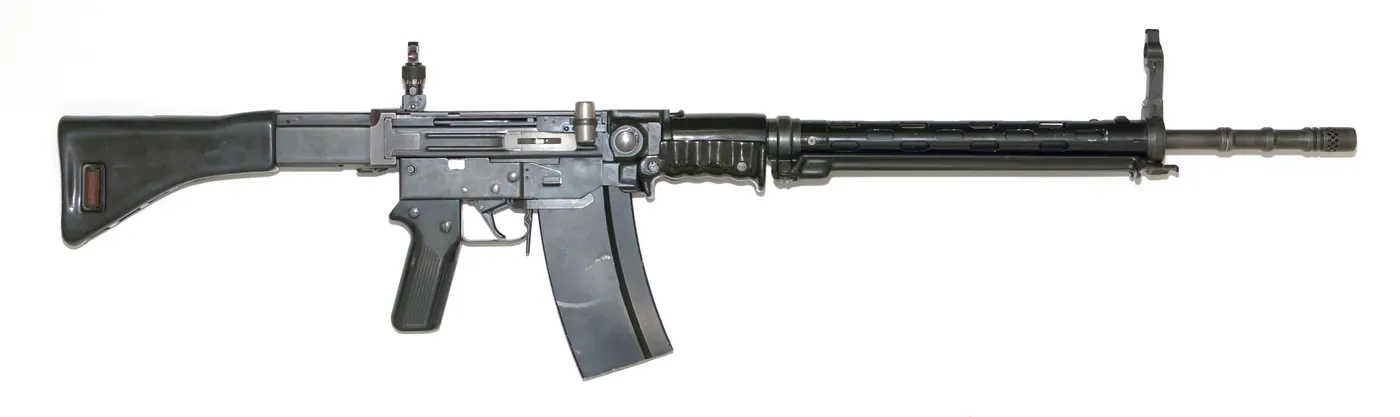

The SIG SG 510, known in Swiss service as the Stgw 57 (Sturmgewehr 57), is a select-fire battle rifle adopted by the Switzerland as its standard infantry weapon in 1957.1 It fires the indigenous 7.5x55mm GP11 cartridge from a roller-delayed blowback action and replaced the bolt-action K31 after roughly a decade of Swiss development effort that began with a failed semi-automatic design, the SK46, and continued through an unrelated prototype dead end before the final mechanism was settled.2 An export line, the SG 510-1 through SG 510-4, rechambered the rifle for foreign cartridges and customers, most notably a 7.62x51mm NATO version sold to Bolivia and Chile.3
- roller-delayed action needs no gas system to adjust or foul
- fluted chamber solves extraction without a gas port
- integral bipod and folding winter trigger built into the rifle
- milled-steel construction to exacting Swiss tolerances
- among the most expensive automatic rifles ever issued to any army
- heavier than contemporary NATO battle rifles
- limited export success outside two South American customers
- production cost directly forced its own replacement
The rifle shares its underlying operating principle with two rifles it never competed against directly in combat, the Spanish CETME and the German Heckler & Koch G3. All three trace back to the same wartime German engineering effort, though engineers at SIG in Neuhausen am Rheinfall reached a similar solution largely on their own and built a chamber that eases extraction in a visibly different way from the CETME and G3 pattern, a genuine technical divergence covered in Specs and Design below.4
What set the Stgw 57 apart from nearly every other Cold War service rifle was not a tactical feature but its price. Each rifle cost the Swiss government roughly 1,000 Swiss francs to procure in 1957, a figure repeatedly cited as making it one of the finest and most expensive automatic rifles ever issued to a national army.5 That cost eventually became the rifle's defining historical fact, driving Switzerland to replace it with the far cheaper SIG SG 550 in 1990, a story told in full in History below.
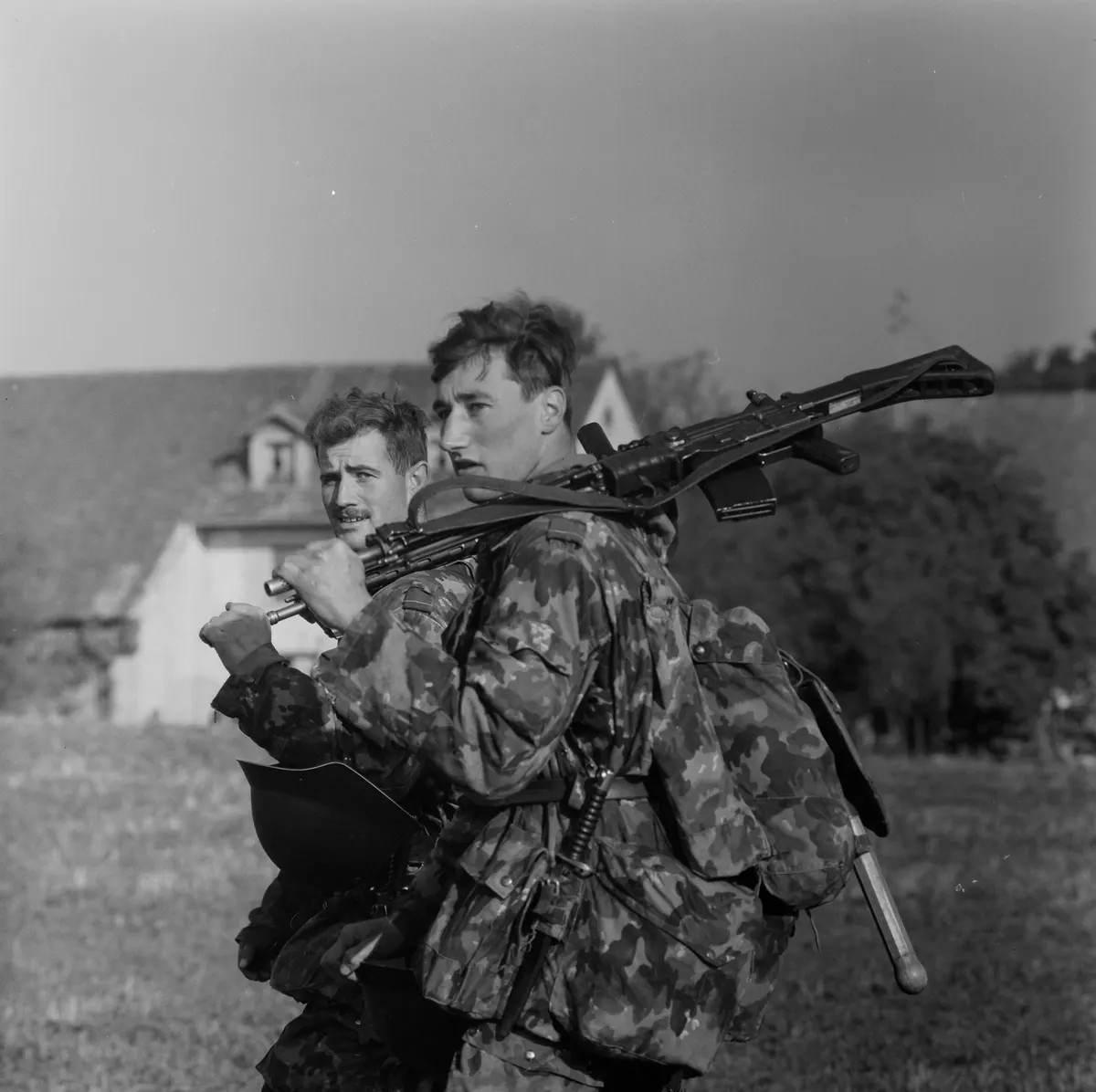
Switzerland's citizen-militia structure also shaped how the rifle was used at home. Conscripts trained on the Stgw 57 as part of the country's mandatory annual marksmanship program, kept personal service rifles at home between refresher courses, and could buy a semi-automatic civilian version once discharged, details covered in Operators and Variants.6
The AM55 Roller-Delayed Action and Its Fluted Chamber
The Stgw 57 fires from a roller-delayed blowback action, in which a two-part bolt, a light bolt head and a heavier bolt carrier, is braced during firing by two rollers seated in recesses machined into the barrel extension.7 Chamber pressure forces the rollers inward and drives the bolt carrier rearward well ahead of the bolt head, delaying the moment the chamber opens until pressure has already dropped. Like every rifle built on this operating principle, the Stgw 57 needs no gas port, gas piston, or adjustable regulator, which is the design's main selling point over a gas-operated rival such as the FN FAL.
- İlk Üretim Yılı1957
- Hizmete Giriş Yılı1957
- TasarımcıRudolf Amsler
- Ağırlık (Boş)5,6 kg
- Ağırlık (Yüklü)5,7 kg
- Halen HizmetteEvet
- Önemli Kullanıcılarİsviçre Ordusu, Bolivya, Şili, Monako, Ukrayna, Zaire
A stepped, fluted chamber compensates for the mechanism's less positive extraction. SIG's version cuts four sets of two flutes into the chamber wall, extending slightly into the rifling itself, a distinctly different geometry from the CETME and G3's own longitudinal fluting.8 Both approaches let a thin layer of propellant gas float the fired case away from the chamber surface, and both leave visible marks on every spent case the rifle fires, but SIG arrived at its own version of the solution rather than copying the German pattern directly.
- Fişek7.5×55mm GP 11 (Stgw. 57); 7.62×51mm NATO (SG 510-4)
- Çap7,5 mm
- Kovan Uzunluğu55 mm
- Çap Sınıfı7.5mm
- Mermi Ağırlığı12,3 g
- Kenar AteşlemeliHayır
- Kovansız MühimmatHayır
The stock sits nearly in line with the bore axis rather than dropping below it, a straight-line layout that reduces muzzle climb during automatic fire compared with a conventionally angled stock. Combined with a cyclic rate most sources place between 450 and 600 rounds per minute, this made the rifle comparatively controllable in bursts for its weight class, though independent sources disagree on the exact figure and some list rates as high as 650 rounds per minute.10
- Mekanizma TipiGeciktirmeli Blowback
- Atış Modlarıseçmeli ateş
- Seçmeli AtışEvet
- Besleme SistemiÇıkarılabilir Şarjör
- Şarjör Kapasitesi24
- Teorik Atış Hızı600
- Pratik Atış Hızı40
- Tetik Tipitek kademeli
- Emniyet Tipimanuel emniyet
Integral Bipod, Folding Winter Trigger, and an Indigenous Cartridge
Two features distinguish the Stgw 57 from most of its contemporaries at a glance. A folding bipod is built directly into the perforated tubular barrel jacket, attached at two spring-detent points, one near the muzzle to reduce dispersion in automatic fire and one nearer the receiver's balance point, and it folds forward under the barrel when not deployed.11 Below the trigger guard, a fold-down secondary trigger extension, commonly called the winter trigger, lets a soldier fire the rifle while wearing thick arctic mittens, a feature suited to Alpine winter service that few contemporary NATO rifles bothered to include.
- Namlu Çıkış Hızı750 m/sn
- Etkili Menzil (nokta)640 m
- Etkili Menzil (alan)800 m
- Azami Menzil3.000 m
- Nişan Menzili800 m
- Delme (Penetrasyon)300 mm
- İsabet2
The cartridge choice was itself a political decision. Switzerland selected the 7.5x55mm GP11 round it already used in earlier service rifles rather than adopting 7.62x51mm NATO or the Soviet 7.62x39mm, avoiding entanglement with either Cold War bloc's standard caliber for a country outside both alliances.12 The base rifle fires a 12.3 gram bullet at roughly 750 meters per second from a 24-round curved detachable box magazine, reaching an effective range of about 640 meters with iron sights and around 800 meters when fitted with the optional Kern 4x24 telescopic sight.13
- Namlu Uzunluğu609 mm
- Yiv Adımı1:10.6
- Yiv Sayısı4
- Nişangah TipiÖn post, arka dioptrik
- Nişangah Mesafesi520 mm
- Optik RayıHayır
- Açık NişangahEvet
- Dişli NamluHayır
Swiss manufacturing tolerances were tight by the standards of any era, with a milled steel receiver machined to a level of precision more typical of a target rifle than a mass-issue service weapon. That precision is exactly what made the Stgw 57 so expensive to build, a connection returned to in History below.
- Gövde Malzemesi (Receiver)Çelik
- Kabza/Dipçik Malzemesineopren kauçuk, ahşap
- Katlanır / Toplanır DipçikHayır
- Bullpup DüzeniHayır
- Çift Yönlü KumandalarHayır
- Modülerliksınırlı
- Susturucuya HazırHayır
- Süngü TakozuEvet
- Entegre BipodEvet
- Bombaatar KabiliyetliEvet
- Gaz PistonluHayır
- Toplam Üretim700.000
- Üretim Başlangıcı1957
- Üretim Bitişi1985
- Varyantlar7
From the AK-53 Dead End to the AM55
Switzerland began looking for a self-loading replacement for the bolt-action K31 shortly after the Second World War, and the effort took roughly a decade to reach a fielded rifle.15 SIG's first attempt at a semi-automatic service rifle, the SK46, failed to win a government contract. The company's next design, the AK-53 of 1953, used an entirely different operating system, a blow-forward mechanism in which gas bled from the barrel pushed the barrel itself forward before it recoiled back to chamber the next round, fed from modified LMG 25 machine-gun magazines.16 The AK-53 was never adopted and represents a genuine mechanical dead end.
SIG's next prototype, the AM55 of 1955, abandoned the blow-forward system entirely in favor of roller-delayed blowback, and this design became the basis for the finalized rifle adopted by the Swiss Army in 1957 as the Stgw 57.18 Engineer Rudolf Amsler is credited as the principal designer of the AM55 and the production rifle that followed it.
A Wartime German Engineering Root Shared With CETME and the G3
The roller-delayed blowback principle did not originate with SIG. It traces to the Gerät 06H and StG 45(M) prototype rifles developed in the last months of the Second World War at Mauser's Abteilung 37 in Oberndorf, where engineers Wilhelm Stähle and Ludwig Vorgrimler adapted the roller-locked breech of the MG42 machine gun into a half-locked, delayed-blowback rifle action.19 Germany's surrender ended that program before it reached production.
Vorgrimler and colleague Theodor Löffler continued refining the same principle in France between 1946 and 1949, working under Allied administrative control at the CEAM research center. Vorgrimler then moved to Spain in 1950, where the concept matured into the CETME rifle at Spain's state design institute, and CETME's design was later licensed to West Germany as the Heckler & Koch G3.20 SIG's own engineers in Switzerland arrived at essentially the same roller-delayed principle independently and in parallel with this Franco-Spanish-German path, producing a rifle described by multiple sources as built around the wartime concept but altered substantially in its details, including the distinctive stepped chamber fluting described in Specs and Design.21 The result is an unusual case of three rifles from three different countries, eventual commercial and political rivals, sharing one wartime origin point without ever having been the same weapon.
Rejected in Bonn and Stockholm
The Stgw 57's closest brush with wider NATO adoption came in 1956, when West Germany's newly reconstituted Bundeswehr trialed 400 CETME rifles against the SIG SG 510, entered under the internal designation G2, and the American AR-10, entered as G4.22 The CETME design, redesignated G3 after further modification, was judged more durable and was adopted in January 1959. Sweden ran its own comparative trial in 1964, testing the Belgian FN FAL, the SIG SG 510, the domestic Carl Gustaf GRAM 63, the American M14, and the Heckler & Koch G3 side by side. The FAL and the G3 passed the trial, and Sweden selected the G3 for license production as the Ak 4, citing durability and lower manufacturing cost as the deciding factors. The SIG SG 510 and the M14 were both rejected on cost grounds, with Swedish evaluators specifically citing the SIG rifle's limited modularity and its high production expense.23
One of the Costliest Automatic Rifles Ever Issued
Contemporary sources put the Stgw 57's unit cost to the Swiss government at approximately 1,000 Swiss francs in 1957, against a pure production cost closer to 495 francs, a gap reflecting Switzerland's precision manufacturing standards and its position outside any alliance's shared procurement economies of scale.27 That figure, worth roughly 4,000 modern US dollars by rough approximation, is repeatedly cited as making the Stgw 57 one of the most expensive automatic rifles any army has ever issued in bulk.
That single fact frames almost everything else about the Stgw 57's career. It never lost a war, was never outclassed technically by a rival during its own service life, and still could not survive the economics of Cold War small-arms procurement once a cheaper Swiss-designed alternative existed.
The Stgw 57's own story is overwhelmingly one of Swiss militia service and export sales rather than combat. Switzerland itself has not fought a war during the rifle's service life, and the clearest combat-adjacent chapter concerns the export SG 510-4 variant in Chilean service.

Chile's SG 510-4 rifles remained in front-line and reserve use through the Pinochet government's rule from 1973 to 1990, reportedly alongside the FN FAL and the Heckler & Koch G3 in Chilean inventories.29 Some accounts describe the rifle being valued for desert and mountain service in the Atacama region, but this detail rests on a single source and should be treated as color rather than established fact. Reporting connecting the rifle specifically to combat during the 1973 coup itself is similarly thin, resting on a single account, and is noted here only as an unresolved claim rather than a documented event.
No credible, independently verifiable record connects the Stgw 57 or SG 510-4 to conflicts in Ukraine, the Democratic Republic of the Congo, Northern Ireland, or Brazil, despite these appearing in some secondary summaries. Those claims trace to a single unverified source each and are omitted here rather than repeated without corroboration.
The Export Numbering, SG 510-1 Through SG 510-4
SIG marketed four main export variants under the SG 510 designation, alongside two more obscure and less well documented later numbers. The SG 510-1 was essentially the Swiss Stgw 57 itself, chambered in the same 7.5x55mm GP11 round and offered for export unchanged.30 The SG 510-2 was a lightened variant, still built around the Swiss cartridge. The SG 510-3 rechambered the rifle for the Soviet 7.62x39mm cartridge with shortened components and was submitted to Finnish Army trials in the late 1950s, where it was rejected and never reached mass production.31
The SG 510-4 became SIG's only genuine commercial success in the line. Rechambered for 7.62x51mm NATO, it used a shorter 505mm barrel, wood furniture in place of the Swiss rifle's rubber and plastic, straight 20-round magazines rather than the curved 24-round Swiss pattern, and weighed roughly 4.25 to 4.37 kilograms empty against the Swiss rifle's 5.56 to 5.7 kilograms.32
Two further variants appear only once each in the available sourcing and cannot be independently confirmed. The SG 510-5 is reportedly a .30-06 prototype submitted for Mexican Army trials, and the SG 510-6 a further prototype in the original 7.5x55mm chambering.33
| Stgw 57 (Swiss, 7.5x55mm) | SG 510-4 (export, 7.62x51mm NATO) | |
|---|---|---|
| Weight (empty) | 5.56 to 5.7 kg34 | 4.25 to 4.37 kg35 |
| Overall length | approx. 1,100 mm36 | approx. 1,015 mm37 |
| Barrel length | 609 mm38 | 505 mm39 |
| Magazine | 24-round curved box | 20-round straight box |
Chile's Contested Production Story
The SG 510-4's route into Chilean service is not settled in the available sourcing, and three separate narratives appear across different accounts. One holds that Beretta manufactured a substantial share of Chile's rifles under subcontract at its Gardone Val Trompia plant in Italy, with cited figures ranging from roughly 15,000 to 30,000 units, reportedly because Swiss export law barred SIG from shipping complete automatic rifles directly to Chile.40 A second account holds that SIG instead supplied plans and tooling for Chilean domestic assembly rather than exporting finished rifles. A third ties later Chilean production to FAMAE, the state arms manufacturer, though FAMAE's confirmed licensed production is of the later SIG SG 540 family beginning in the mid-1980s, not the SG 510-4 itself, which suggests some accounts may be conflating Chile's two separate SIG production stories.41
Chile issued the rifle beyond the Army, reportedly reaching the Navy, Air Force, Carabineros, and even the Investigations Police, with the Navy the first branch to retire it in favor of a 5.56x45mm rifle.43 Bolivia's adoption of the SG 510-4 is documented even more thinly. Sources agree Bolivia acquired the rifle but do not give a reliable quantity or adoption date, and no specific figure should be treated as confirmed.44
Civilian and Semi-Automatic Spinoffs
SIG also sold semi-automatic-only versions of its own rifle. The PE-57, built in the original 7.5x55mm GP11 chambering, was marketed to discharged Swiss conscripts and to some export civilian buyers.45 In the United States, an importer sold a semi-automatic 510-4 pattern rifle under the name SIG AMT, for American Match Target, built in 7.62x51mm NATO, with roughly 4,000 units imported before changing US regulations ended the program.46


| Yıl | Alıcı | Adet | Tutar | Bugünkü Değer (2025) |
|---|---|---|---|---|
| — |  Şili | — | — | — |
Switzerland's Standard Rifle for Three Decades
The Stgw 57 was Switzerland's standard-issue militia and army rifle from 1957 until its replacement by the SIG SG 550 in 1990, a run of roughly 33 years.47
Total production across the Swiss and export lines exceeded 700,000 rifles, produced between 1957 and either 1983 or 1985 depending on the source consulted.48
Switzerland's conscription system requires reservists to complete an annual program known as the Obligatorisches Schiessen, firing a fixed course of 20 rounds at 300 meters on locally run civilian ranges, a practice that predates and outlasted the Stgw 57 itself.49 That program, not any particular firing technique, is the institutional root of Switzerland's broader rifle marksmanship culture and of conscripts historically keeping personal service rifles at home between refresher courses.
Export Customers in Bolivia, Chile, and a Ceremonial Guard in Monaco
Beyond Switzerland, the confirmed operators of the SG 510-4 export variant are Bolivia and Chile, covered in Conflicts and Variants above.50 A single source also places the rifle with Monaco's Compagnie des Carabiniers du Prince, the principality's ceremonial and palace guard unit, though this claim is not independently corroborated and should be read as plausible rather than confirmed.51 Other operator claims that surface in some secondary summaries, including Ukraine and the Democratic Republic of the Congo, could not be verified against independent sourcing and are not treated as established here.
The SIG SG 510 Against the FN FAL
The Stgw 57 and the FN FAL never fought on opposite sides of a war, but they were direct rivals on paper throughout the 1950s and 1960s, competing in the same international rifle trials, most concretely Sweden's 1964 evaluation described in History. Both are full-power 7.62mm class rifles built for the same battle-rifle role, and both were judged reliable by their respective evaluators, but they solve the same problem in nearly opposite ways. The FAL uses a conventional gas-operated tilting-bolt system with a machined receiver, while the Stgw 57 dispenses with a gas system entirely in favor of the roller-delayed blowback action described in Specs and Design.52
Cost is where the two rifles diverge most sharply, and in opposite directions from what each country's later reputation might suggest. Belgium's FAL, produced across many licensed lines with varying tolerances, was consistently the cheaper rifle to manufacture at scale, while Switzerland's insistence on tight, target-rifle-grade tolerances made the Stgw 57 one of the most expensive rifles either side of the Cold War fielded in any quantity. Sweden's 1964 trial captured this contrast directly, rejecting the SIG rifle explicitly on cost and modularity grounds while the FAL passed technical evaluation, even though the trial ultimately chose neither rifle and licensed the cheaper Heckler & Koch G3 instead.53
| Stgw 57 | FN FAL | |
|---|---|---|
| Action | Roller-delayed blowback, fixed barrel | Gas-operated, tilting bolt |
| Cartridge | 7.5x55mm GP11 (7.62x51mm NATO export) | 7.62x51mm NATO |
| Weight (empty) | 5.56 to 5.7 kg54 | approx. 4.3 kg55 |
| Adoption | Switzerland, 1957 | Belgium and dozens of licensees, from 1953 |
The FAL went on to arm more than 90 countries and became one of the most widely fielded rifles of the entire Cold War, while the Stgw 57 stayed almost entirely within Switzerland's own militia system and two South American export customers. That gap has less to do with either rifle's mechanical merit than with export policy and price, Switzerland's neutrality laws and precision manufacturing costs limiting the Stgw 57's reach in ways that never constrained Belgium's far more aggressively marketed rifle.


What are the SIG SG 510's specifications? The Swiss Stgw 57 fires the 7.5x55mm GP11 cartridge from a 24-round curved detachable box magazine, weighs 5.56 to 5.7 kilograms empty, uses a 609mm barrel, and has a cyclic rate most commonly cited between 450 and 600 rounds per minute. The export SG 510-4 is chambered in 7.62x51mm NATO, uses a shorter 505mm barrel and a 20-round straight magazine, and weighs 4.25 to 4.37 kilograms empty.56
How does the SIG SG 510 work? It fires from a roller-delayed blowback action rather than a gas system. A two-piece bolt braced by rollers delays the bolt's rearward movement just long enough for chamber pressure to drop, and a fluted, stepped chamber floats the spent case away from the chamber wall to ease extraction, the same underlying principle later refined into the CETME and Heckler & Koch G3.57
How does the SIG SG 510 compare to the FN FAL? Both are full-power 7.62mm class battle rifles from the same era, and both were tested against each other in international trials during the 1950s and 1960s. The FAL's gas-operated system proved cheaper to mass-produce and won it far wider export adoption, while the Stgw 57's roller-delayed action and Swiss manufacturing precision made it reliable but expensive, limiting it mostly to Switzerland's own army and two South American customers.58
What did the SIG SG 510 cost? Switzerland paid roughly 1,000 Swiss francs per rifle in 1957, a figure widely cited as making it one of the most expensive automatic rifles ever issued to any national army in bulk. That cost was the primary reason Switzerland replaced it with the cheaper SIG SG 550 in 1990.59
Is the SIG SG 510 still in service? No Swiss unit fields the Stgw 57 today, since Switzerland fully retired it in favor of the SG 550 by 1990. Some SG 510-4 rifles reportedly remained in Chilean and Bolivian inventories for a longer period, though current active status in either country is not well documented in available sourcing.60
- "SIG SG 510", Wikipedia — en.wikipedia.org ↩
- "SIG 510 / Stgw.57", Modern Firearms — modernfirearms.net ↩
- "SIG SG 510", Wikipedia — en.wikipedia.org ↩
- "Sturmgewehr 45", Wikipedia — en.wikipedia.org ↩
- "SIG SG 510 / Sturmgewehr 57, The World's Deadliest Swiss Watch", The Kommando Blog — kommandoblog.com ↩
- "Conscription in Switzerland", Wikipedia — en.wikipedia.org ↩
- "SIG 510 / Stgw.57", Modern Firearms — modernfirearms.net ↩
- "SIG SG 510", Wikipedia — en.wikipedia.org ↩
- "Swiss SIG 510 / Stgw 57 Review, Switzerland's Battle Rifle", Forgotten Weapons — youtube.com ↩
- "SIG SG 510", Wikipedia — en.wikipedia.org ↩
- "SIG 510 / Stgw.57", Modern Firearms — modernfirearms.net ↩
- "SIG SG 510 / Sturmgewehr 57, The World's Deadliest Swiss Watch", The Kommando Blog — kommandoblog.com ↩
- "SIG SG 510", Wikipedia — en.wikipedia.org ↩
- "Conscription in Switzerland", Wikipedia — en.wikipedia.org ↩
- "SIG SG 510 / Sturmgewehr 57, The World's Deadliest Swiss Watch", The Kommando Blog — kommandoblog.com ↩
- "SIG SG 510", Wikipedia — en.wikipedia.org ↩
- "SIG SG 510", Wikipedia — en.wikipedia.org ↩
- "SIG 510 / Stgw.57", Modern Firearms — modernfirearms.net ↩
- "Sturmgewehr 45", Wikipedia — en.wikipedia.org ↩
- "CETME rifle", Wikipedia — en.wikipedia.org ↩
- "Sturmgewehr 45", Wikipedia — en.wikipedia.org ↩
- "Heckler & Koch G3", Wikipedia — en.wikipedia.org ↩
- "Automatkarbin 4", Wikipedia — en.wikipedia.org ↩
- "SIG SG 510", Wikipedia — en.wikipedia.org ↩
- "Automatkarbin 4", Wikipedia — en.wikipedia.org ↩
- "SIG SG 510 / Sturmgewehr 57, The World's Deadliest Swiss Watch", The Kommando Blog — kommandoblog.com ↩
- "SIG SG 510 / Sturmgewehr 57, The World's Deadliest Swiss Watch", The Kommando Blog — kommandoblog.com ↩
- "SIG SG 550", Wikipedia — en.wikipedia.org ↩
- "Chile, El inmortal fusil SIG 510-4", Defensa Chilena — chiledefensa.blogspot.com ↩
- "SIG SG 510", Wikipedia — en.wikipedia.org ↩
- "SIG SG 510", Wikipedia — en.wikipedia.org ↩
- "SIG SG 510", Wikipedia — en.wikipedia.org ↩
- "SIG SG 510 (Sturmgewehr Model 510)", Military Factory — militaryfactory.com ↩
- "SIG SG 510", Wikipedia — en.wikipedia.org ↩
- "SIG SG 510", Wikipedia — en.wikipedia.org ↩
- "SIG 510 / Stgw.57", Modern Firearms — modernfirearms.net ↩
- "SIG SG 510", Wikipedia — en.wikipedia.org ↩
- "SIG SG 510", Wikipedia — en.wikipedia.org ↩
- "SIG SG 510", Wikipedia — en.wikipedia.org ↩
- "SIG AMT / 510-4 Chilean .308 rifle", TTE Precision Metalwerks — ttepmw.com ↩
- "SIG SG 540", Wikipedia — en.wikipedia.org ↩
- "FAMAE", Gun Wiki — guns.fandom.com ↩
- "Chile, El inmortal fusil SIG 510-4", Defensa Chilena — chiledefensa.blogspot.com ↩
- "SIG SG 510", Wikipedia — en.wikipedia.org ↩
- "SIG SG 510 / Sturmgewehr 57, The World's Deadliest Swiss Watch", The Kommando Blog — kommandoblog.com ↩
- "Swiss SIG 510 / Stgw 57 Review, Switzerland's Battle Rifle", Forgotten Weapons — youtube.com ↩
- "SIG SG 510", Wikipedia — en.wikipedia.org ↩
- "SIG SG 510", Wikipedia — en.wikipedia.org ↩
- "Conscription in Switzerland", Wikipedia — en.wikipedia.org ↩
- "SIG SG 510", Wikipedia — en.wikipedia.org ↩
- "SIG SG 510", Wikipedia — en.wikipedia.org ↩
- "Automatkarbin 4", Wikipedia — en.wikipedia.org ↩
- "Automatkarbin 4", Wikipedia — en.wikipedia.org ↩
- "SIG SG 510", Wikipedia — en.wikipedia.org ↩
- "FN FAL", Wikipedia — en.wikipedia.org ↩
- "SIG SG 510", Wikipedia — en.wikipedia.org ↩
- "SIG 510 / Stgw.57", Modern Firearms — modernfirearms.net ↩
- "Automatkarbin 4", Wikipedia — en.wikipedia.org ↩
- "SIG SG 510 / Sturmgewehr 57, The World's Deadliest Swiss Watch", The Kommando Blog — kommandoblog.com ↩
- "SIG SG 550", Wikipedia — en.wikipedia.org ↩