

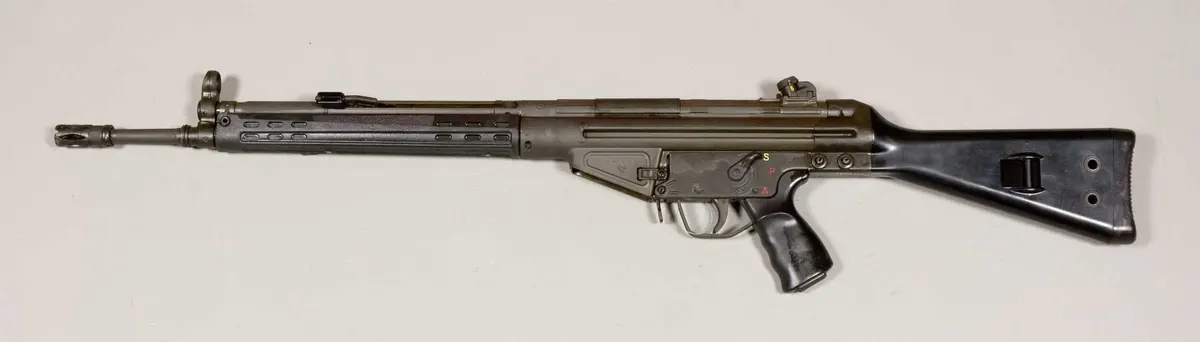
Sweden calls its licensed Heckler & Koch G3 the Automatkarbin 4, shortened to Ak 4, and the designation covers a rifle that has now been in Swedish inventory for six decades. The Swedish Armed Forces formally adopted the G3 pattern in 1964 after a four year trial process, then signed a manufacturing license with Heckler & Koch in 1965 to build the rifle at home rather than keep importing it. That two step sequence, decision first, domestic tooling second, explains why sources sometimes cite 1964 and sometimes 1965 as the Ak 4's starting point. Both are correct, they just mark different milestones.1
- Roller delayed blowback reliability in Nordic cold weather
- Reinforced buffer rated to roughly 15,000 rounds
- Decades of sustained Home Guard modernization (Ak4B/C/D)
- Simple, well understood maintenance across generations of conscripts
- Long and heavy compared to later 5.56mm service rifles
- Heavier 7.62mm recoil made it slower to train new conscripts on
- Fixed 1960s stock geometry needed a third party retrofit for modern optics
- No indigenous cartridge or major export program beyond retired Baltic transfers
The choice was tied to Sweden's Cold War defense posture. Formally non-aligned but militarily prepared for isolation, Sweden wanted to standardize on the emerging NATO 7.62x51mm cartridge to simplify logistics and keep resupply options open in a crisis, while still manufacturing the weapon itself on Swedish soil under Sweden's broader total defense doctrine of domestic arms self sufficiency.1,2 The rifle that resulted is a battle rifle, select fire, magazine fed, chambered for a full power rifle cartridge, in the mould of the era's NATO service rifles rather than the shorter intermediate cartridge designs that came later.
What sets the Ak 4 apart from a simple badge swapped G3 is that Sweden treated the license purchase as an engineering project, not a straight import. Carl Gustafs stads gevärsfaktori and Husqvarna Vapenfabrik built a reinforced, Sweden specific variant with a longer stock, a stronger buffer, and a different sighting system, and the rifle remains in active Home Guard issue today, still being rebuilt and modernized well into the 21st century.
Fully license built domestically from 1965 to 1985, first at Husqvarna Vapenfabrik (Huskvarna, 1965-c.1970) then at Carl Gustafs stads gevarsfaktori (Eskilstuna, through 1985), the institutional predecessor of today's Saab Bofors Dynamics, which still runs the Ak4B/Ak4C rail and optics rebuild program. Sweden also re-engineered the design beyond a straight license copy: longer buttstock, reinforced recoil buffer rated for roughly 15,000 rounds versus about 6,000 on a standard German G3, finer rotary diopter rear sight, and a rubber case deflector.
The Ak 4 uses the G3's delayed blowback roller system, in which two rollers in the bolt head briefly retard the bolt carrier's rearward travel under chamber pressure rather than relying on a gas piston. It is select fire, feeding from a curved 20 round detachable magazine, chambered for 7.62x51mm NATO, and fires from a closed bolt at a cyclic rate that sources place between 500 and 600 rounds per minute (500 is the commonly cited baseline figure). Muzzle velocity is around 800 meters per second from a 450mm barrel, and the rifle weighs 4.1kg empty.1,3
- İlk Üretim Yılı1965
- Hizmete Giriş Yılı1964
- TasarımcıHeckler & Koch
- Ağırlık (Boş)4,1 kg
- Halen HizmetteEvet
- Önemli Kullanıcılarİsveç Silahlı Kuvvetleri, İsveç Yurt Muhafızları, Estonya Savunma Birliği, Letonya Ulusal Muhafızları, Litvanya Silahlı Kuvvetleri, Litvanya Ulusal Savunma Gönüllü Kuvvetleri, Litvanya Tüfekçiler Birliği, Ürdün
The Swedish modifications that make an Ak 4 more than a rebadged G3
Multiple independent sources describe the Ak 4 as a deliberately reinforced adaptation of the G3, not a straight import with a new serial number.1,4,5 The changes were practical and soldier driven, as the list below shows.
- Fişek7.62x51mm NATO
- Çap7,62 mm
- Kovan Uzunluğu51 mm
- Çap Sınıfı7.62mm
- Kenar AteşlemeliHayır
- Kovansız MühimmatHayır
- A buttstock roughly 20mm longer than the German pattern, likely sized for Swedish conscripts in winter clothing.1,4
- A serrated thumb groove machined into the bolt carrier, letting a soldier ease the bolt closed silently by hand instead of releasing the charging handle with an audible snap, useful for an observation post or ambush position.1,4
- A heavier recoil buffer. Forgotten Weapons states the standard G3 buffer is rated to roughly 6,000 rounds of service life, while the Swedish buffer extends that to about 15,000 rounds, a contractual reliability target Sweden negotiated with H&K rather than a minor tweak.4
- A rotary diopter rear sight with four apertures, click adjustable in 100 meter increments from 200 to 500 meters, more granular than the base German drum sight.1,4
- Modified bayonet lug attachment points and a clip on rubber case deflector, added because standard G3s ejected spent cases with considerable velocity, a real hazard to soldiers standing nearby during group live fire training.4
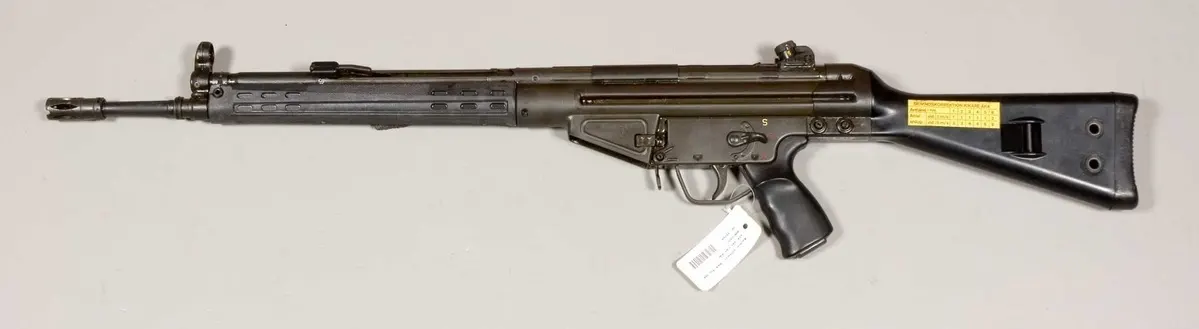
Firearms writers have summarized the result as a battle rifle by any other name, recognizably a G3 mechanically, but purpose hardened for a specific army's climate and training needs rather than a simple badge change.5 Production ran from 1965 to 1985, split between Husqvarna Vapenfabrik in Huskvarna from 1965 to around 1970, and Carl Gustafs stads gevärsfaktori in Eskilstuna, which carried production through to the end of the run in 1985. No public total production figure has surfaced for the Ak 4 specifically, despite checks across Wikipedia, Wikidata, Forgotten Weapons, Small Arms Review and Firearms News.1,4,5
- Mekanizma TipiGeciktirmeli Blowback
- Atış Modlarıseçmeli ateş
- Seçmeli AtışEvet
- Besleme SistemiÇıkarılabilir Şarjör
- Şarjör Kapasitesi20
- Teorik Atış Hızı500
Sweden's own naming, Automatkarbin, meaning automatic carbine, mirrors the sequence of Swedish service rifle designations, with the number climbing as each new pattern was adopted, from the Ak 4 through to the Ak 5 that eventually replaced it.
- Namlu Çıkış Hızı800 m/sn
- Etkili Menzil (nokta)500 m
- Etkili Menzil (alan)500 m
- Azami Menzil3.700 m
- Nişan Menzili600 m
- Namlu Uzunluğu450 mm
- Nişangah TipiArka: döner dioptrik; ön: kapaklı post
- Optik RayıEvet
- Açık NişangahEvet
- Katlanır / Toplanır DipçikHayır
- Bullpup DüzeniHayır
- ModülerlikPicatinny rayı, ayarlanabilir dipçik, optik nişangahlar
- Süngü TakozuEvet
- Entegre BipodEvet
- Bombaatar KabiliyetliEvet
- Gaz PistonluHayır
- Üretim Başlangıcı1965
- Üretim Bitişi1985
- Varyantlar4
- Genişlik45 mm
- Yükseklik220 mm
Sweden's homegrown rifle lost on reliability, not politics
Sweden's postwar service rifles were a mixed bag by the late 1950s, the bolt action m/96 Mauser, the semi-automatic Ag m/42 Ljungman, and the automatic Kg m/21 and Kg m/40 all still in the inventory. Rather than simply buy a foreign replacement outright, Sweden first tried to field a modernized domestic design, the GRAM 63, built by Bofors Carl Gustaf as a descendant of the Ljungman's gas operated tilting bolt system, tested in both 6.5x55mm Swedish and 7.62mm NATO chamberings.1,6
The GRAM 63 never solved its feeding and ejection problems through its final AK FM/63 iteration, and Sweden's ordnance authority, KATF, killed the project on its technical merits.6 That failure, not any political preference, is what narrowed the real competition to two imports.
Why the G3 beat the FN FAL in Sweden's trials
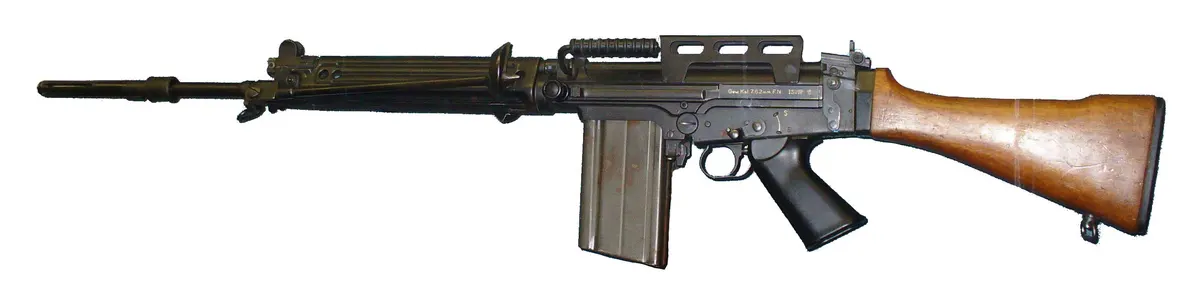
With the GRAM 63 eliminated, Sweden tested the FN FAL (trialed as the Ak/fm 60 and Ak/fm 62), the Swiss SIG SG 510, the American M14, and the West German G3 against each other, with Arctic cold weather performance weighted heavily given Sweden's own terrain.1 Both the FAL and the G3 passed Sweden's reliability, accuracy, and ergonomics testing. The G3 pattern won on cost and manufacturing method rather than outright performance. H&K's stamped sheet steel receiver and roller delayed blowback action were cheaper to mass produce than the FAL's more heavily machined action, and that unit cost advantage tipped the decision.1,5
Sweden was far from the only country to reach that same cost conclusion. Pakistan, Iran, Turkey, Portugal, Norway, Greece, and Saudi Arabia all license built or imported the G3 pattern in the following decades, each running its own version of the trial Sweden had just finished.9
A design that detoured through wartime Germany, France, and Franco's Spain
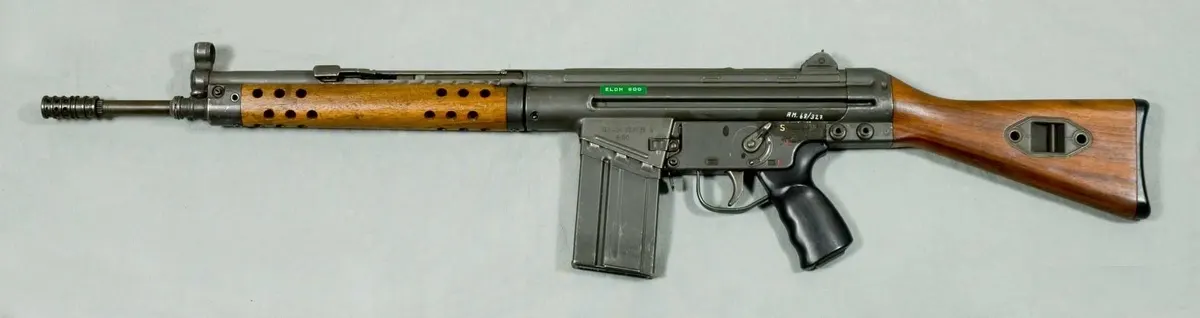
The G3's roller delayed blowback mechanism did not originate at Heckler & Koch. It descends from the StG 45(M), a late World War II Mauser works project developed in 1944 and 1945 by engineers Ludwig Vorgrimler, Wilhelm Stahle, and Theodor Löffler as a cheaper successor to the StG 44. After the war, Vorgrimler carried the roller delayed concept to Mulhouse, France, and then to Spain, refining it into the CETME Model 58 for the Spanish state arms concern. Heckler & Koch, founded in 1949 by three former Mauser engineers out of the shuttered Oberndorf factory, won West Germany's 1956 rifle tender by adapting the CETME design, and the Bundeswehr adopted the result as the G3 in 1959.8,9 The rifle Sweden bought in 1964 is, mechanically, a lineal descendant of a wartime German small arms project that had to pass through occupied France and Franco's Spain before returning to German production.
Sweden was one buyer among roughly forty countries that eventually fielded some version of the G3 family, but the research for this article found no evidence that Sweden's specific Ak 4 production ever fed exports beyond the three Baltic states covered later in this article.
License production, then a demotion instead of retirement
Manufacturing shifted from imported German rifles to domestic production in 1965, first at Husqvarna, then consolidating at Carl Gustafs stads gevärsfaktori, the same institution that later became part of what is now Saab Bofors Dynamics.1,10 Production continued for twenty years, ending in 1985, the same year the Ak 4 stepped down from general front line issue. It was not scrapped. Sweden kept it for the Home Guard and for specialist designated marksman roles in the regular Army, which is why it was still being actively modernized four decades after losing its front line role.1,4
Sweden's policy of avoiding war since 1814 means the Ak 4 has no domestic battle history, and no combat incident, defect controversy, or recall was found in researching this rifle. Its story is one of readiness and training rather than documented firefights, which is a genuinely different profile from most of its Cold War rifle contemporaries.11
Sweden did contribute battalions to United Nations operations during the Ak 4's front line years, including the UN Operation in the Congo from 1960 to 1964, but that predates the rifle's adoption, so those troops carried the older Ag m/42 or Mauser, not the Ak 4.11 Later Swedish peacekeeping deployments to Cyprus, Lebanon, Bosnia, Kosovo, and Afghanistan fall inside or after the Ak 4's service window, but the rifle documented as standard issue on those missions is the Ak 5, which had already replaced the Ak 4 as Sweden's front line rifle by 1985 and 1986, well before Sweden's major Balkan and Afghan troop contributions.12,13
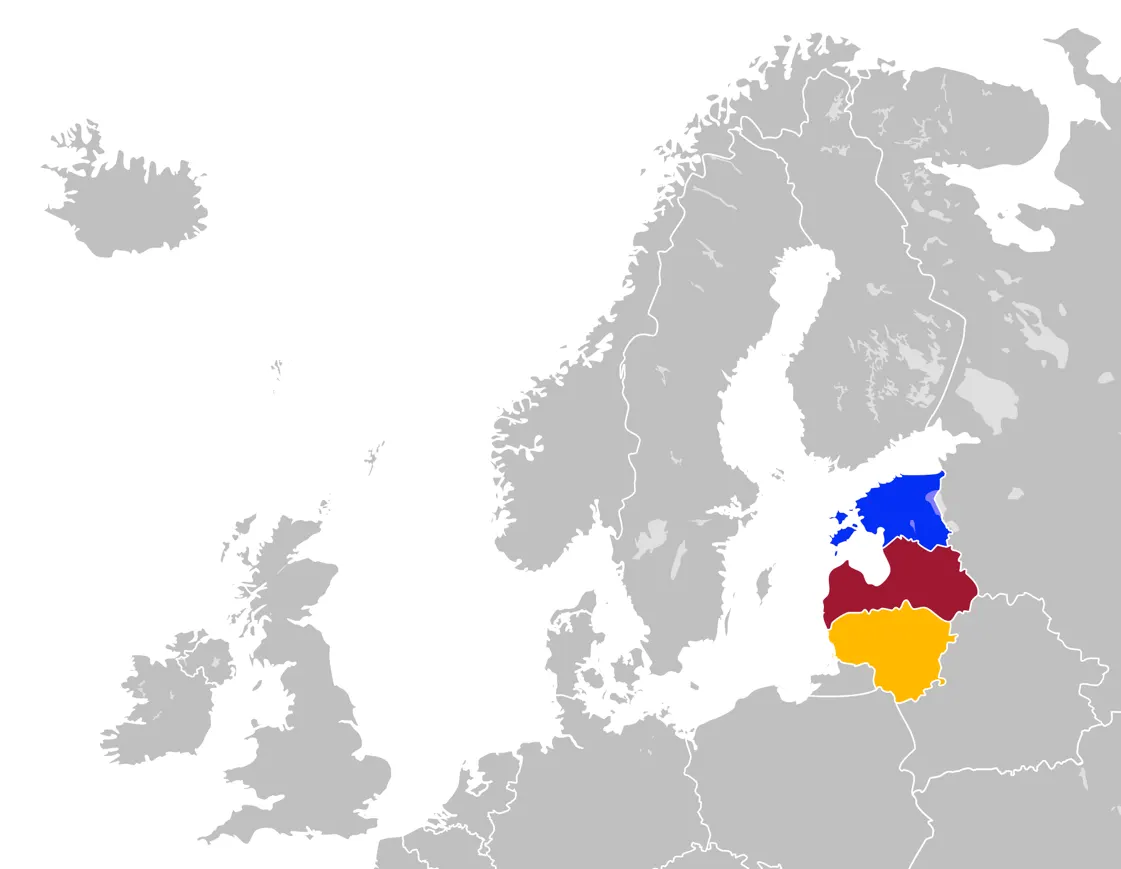
The most notable recent Ak 4 story involves the Baltic states rather than Sweden itself. In November 2023, social media images circulated showing what looked like Swedish pattern Ak4B rifles, fitted with optics and bipods, in the hands of people identified online as Ukrainian personnel. The investigative outlet The Armourers Bench traced the photographs and found the rifles were not in Ukraine at all. They were Latvian National Guard issue Ak 4s, photographed at a training range in Latvia, where Latvia was hosting roughly 3,000 Ukrainian trainees, including personnel from Ukraine's 3rd Shock Brigade, as part of allied training programs. Lithuania and Estonia were reported running similar training programs with their own Ak 4 stocks.14 Later reporting through 2024 suggested that actual operational use of Ak4 pattern rifles inside Ukraine had become more plausible, though exact deployment details remain unconfirmed.14 Separately, Sweden's own January 2023 Ukraine aid package included unspecified rifles, but nothing in the sourcing checked ties that donation specifically to the Ak 4 rather than the newer Ak 5.14
Whatever the exact status of Ak4 pattern rifles inside Ukraine itself, the episode shows that a rifle Sweden designed for its own Cold War Arctic defense is now, sixty years later, operationally relevant to training programs supporting an active European war on NATO's eastern flank.
- Ak 4OR (Optiskt Riktmedel, optical sighting device) is fitted with a Hensoldt Fero Z24 4x24 telescopic sight for a designated marksman role, predating the later rail based upgrades.1
- Ak 4B was the first major rail conversion, beginning around 2002. Selected rifles had their factory iron sight bases CNC milled off entirely and a Picatinny rail welded directly onto the receiver, typically mounting an Aimpoint red dot reflex sight. The rebuild program itself, run through Saab Bofors Dynamics in Eskilstuna, took rifles that had already had a mid to late 1970s arsenal refinish and fully remanufactured them. Sight bases were milled off, a rail was added, the rifle got a complete manganese phosphate or black oxide refinish, small parts were replaced, and dual laser bore sighting quality control checked each one, with accuracy accepted within 3 to 4 milliradians and rejects sent back to the start of the line.1,7
- Ak 4C adds a 6 position adjustable length buttstock with an optics optimized cheek support comb, designed and built by the Swedish company Spuhr i Dalby, fixing the ergonomic limits of the 1960s fixed stock now that soldiers were mounting red dot optics. Roughly 5,000 units were fielded from 2016 and 2017, a further 5,000 were ordered in 2019, and 1,000 more were ordered by December 2020, with the Home Guard's own publication stating a goal of an Ak 4C for every Home Guard soldier by the end of 2022.1,15
- Ak 4D adds the Ak 4C's adjustable stock, a modular fore end, a bipod, and the Hensoldt Fero Z24 4x24 scope on a Picatinny rail, fielded as a stop gap designated marksman rifle with roughly 400 units issued to the regular Army pending a purpose built DMR program.1
An additional designation, Ak 4HV, appears in some fan reference sources as a further or parallel Home Guard variant, but nothing beyond that single listing could be independently confirmed, so it is best treated as unverified rather than described in detail here.
Collectors and armorers distinguish the variants mainly by sight system and stock. An unmodified Cold War era Ak 4 keeps its fixed stock and rotary diopter sight, an Ak4B swaps that sight for a Picatinny rail and red dot, and an Ak4C or Ak4D adds the adjustable Spuhr stock on top of the rail. The external changes track a straightforward optics modernization story rather than any change to the underlying action or cartridge.


| Yıl | Alıcı | Adet | Tutar | Bugünkü Değer (2025) |
|---|---|---|---|---|
| 1965 |  İsveç | — | — | — |
Sweden is the primary and originating operator, with the Ak 4 (in Ak4B and Ak4C form, plus the Ak4D marksman variant) still fielded by the Home Guard and, in a smaller specialist role, the regular Army, more than six decades after adoption.1,15
Three Baltic states received retired, unmodified Ak 4s from Swedish stocks, generally described in secondary sourcing as tied to the period around their NATO accession in 2004, as Sweden passed down Cold War surplus to newly allied neighbors rebuilding post-Soviet territorial defense forces.1
- Estonia lists the AK-4 as active issue equipment on the Estonian Defence Forces' own official site, used in particular by the Estonian Defence League, Estonia's volunteer territorial defense organization, occupying a similar reserve and territorial defense niche there as in Sweden itself.16
- Latvia uses it through the National Guard, the Zemessardze, though multiple sources note it is being gradually phased out in favor of the H&K G36. These were the specific rifles photographed training Ukrainian personnel in 2023.1,14
- Lithuania uses it through the Lithuanian Armed Forces as reserve equipment, through the Lithuanian National Defence Volunteer Forces, and through the civilian adjacent Lithuanian Riflemen's Union.1
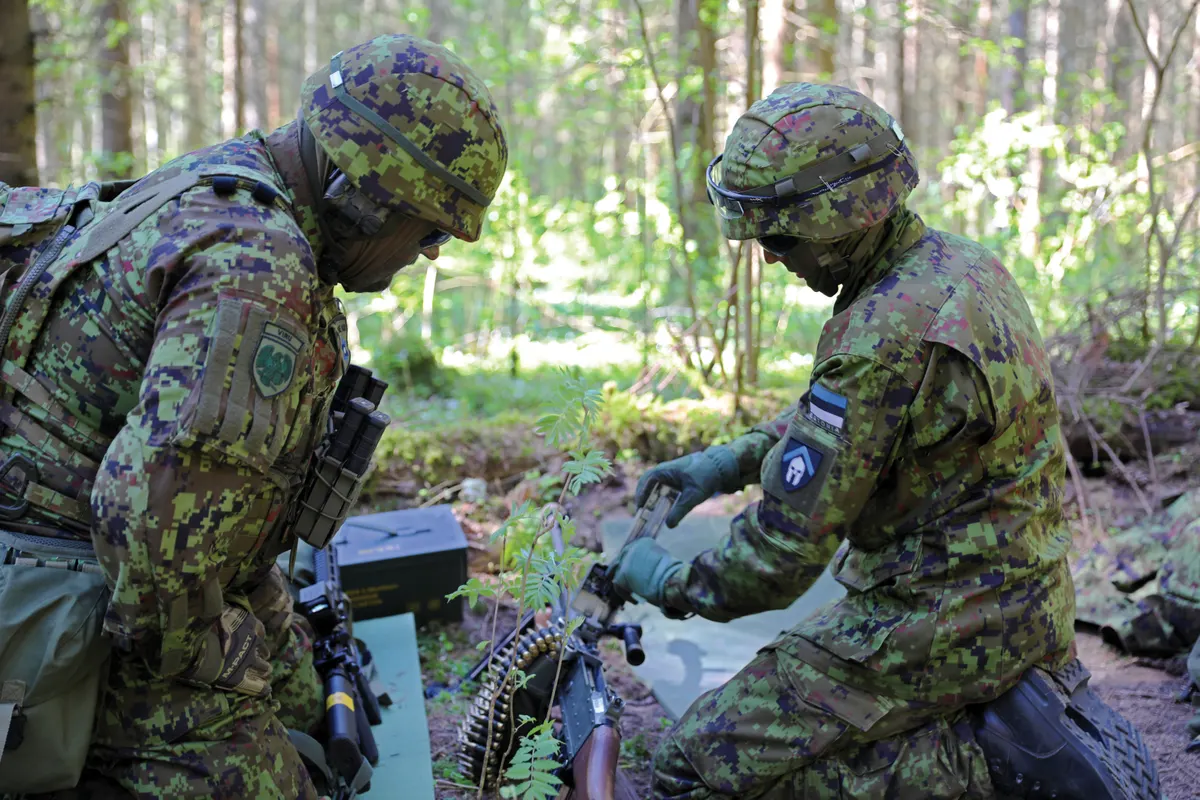
No other confirmed export or user countries surfaced in current sourcing. Wikidata's own records list only Sweden and Estonia as users, which understates Wikipedia's own prose coverage of Latvia and Lithuania rather than contradicting it.17
A wider list sometimes attached to the broader G3 family, which includes Jordan among roughly forty countries, applies to G3 pattern rifles in general rather than to Sweden's specific Ak 4 production. No source found in researching this article ties Jordan to Swedish, Husqvarna, or Carl Gustafs manufactured rifles specifically, so that association is treated here as unconfirmed.
Sweden ran its G3 decision as a genuine bake off against the FN FAL rather than a foregone conclusion, and the two rifles' trial outcome says more about Cold War small arms manufacturing than any performance gap. Both passed Sweden's reliability and cold weather testing. The G3 won because H&K's stamped sheet steel receiver and roller delayed action were cheaper to produce at scale than the FAL's more heavily machined receiver, not because it shot flatter or ran more reliably.1,5 That cost logic repeated itself worldwide through the 1960s and 1970s, which is a large part of why the G3 pattern ended up in production across roughly forty countries while the FAL, despite comparable battlefield reputation, saw fewer license manufacturing arrangements of this specific kind.
| Ak 4 (Heckler & Koch G3 pattern) | FN FAL (Sweden trial, Ak/fm 60/62) | |
|---|---|---|
| Action | Roller delayed blowback | Gas operated, tilting bolt |
| Receiver construction | Stamped sheet steel | Machined forging |
| Cartridge | 7.62x51mm NATO | 7.62x51mm NATO |
| Weight (empty) | 4.1kg | Comparable, slightly heavier as tested |
| Sweden trial outcome | Adopted 1964, license built from 19651 | Passed reliability testing, lost on unit cost1 |
A second, more direct comparison runs within the G3 family itself, the Ak 4 against its own parent. The two are mechanically the same rifle, but Sweden's engineering changes, the longer stock, the reinforced buffer rated for roughly 2.5 times the round count, the finer rear sight graduations, and the case deflector, reflect a military that treated a foreign design as a starting point to re-engineer for its own conscript army and Arctic operating environment rather than a fixed export product to accept as delivered.1,4
Sweden's own replacement decision, two decades later, followed a similar pattern in reverse. When the Ak 5, a 5.56mm assault rifle based on the Belgian FN FNC, replaced the Ak 4 from 1986, Sweden again tested a domestic contender, the FFV-890, and again passed it over in favor of a foreign design built under domestic license. The driver that time was the global shift to 5.56mm intermediate cartridges. Heavier 7.62mm recoil measurably slowed conscript marksmanship training, and the Ak 4's length was a poor fit for vehicle crews, artillery crews, and combat medics who needed a shorter weapon.12


Is the Ak 4 still in service? Yes. It was replaced as Sweden's standard issue rifle by the Ak 5 in 1985 and 1986, but it remains active with the Swedish Home Guard, in a smaller designated marksman role in the regular Army, and with reserve and territorial defense forces in Estonia, Latvia, and Lithuania.1,15,16
How does the Ak 4 differ from a standard Heckler & Koch G3? The Ak 4 shares the G3's roller delayed blowback mechanism and 7.62x51mm NATO chambering, but Sweden specified a longer buttstock, a heavier recoil buffer rated for roughly 15,000 rounds instead of about 6,000, a more finely adjustable rotary diopter rear sight, and a rubber case deflector, among other changes.1,4
What replaced the Ak 4 in Swedish service? The Ak 5, a license built version of the Belgian FN FNC chambered in 5.56x45mm, replaced the Ak 4 as Sweden's standard issue rifle starting in 1986, after trials that ran from 1981 to 1985.12
Did Sweden send Ak 4 rifles to Ukraine? No confirmed direct transfer has been documented. The Ak4B rifles photographed near Ukrainian trainees in November 2023 were traced to Latvian National Guard stocks used at a training range inside Latvia, not to a Swedish transfer.14
- "Automatkarbin 4", Wikipedia — en.wikipedia.org ↩
- "Swedish neutrality", Wikipedia — en.wikipedia.org ↩
- "AK-4 Automatic Rifle", Estonian Defence Forces — mil.ee ↩
- "AK4: Sweden's Beefed-Up Take on the G3", Forgotten Weapons — forgottenweapons.com ↩
- "The Swedish AK4: A Battle Rifle by Any Other Name?", Firearms News — firearmsnews.com ↩
- "Swedish AK GRAM", Forgotten Weapons — forgottenweapons.com ↩
- "Economy of Arms: The Swedish Reclamation Project for the Ak4 Rifle", Small Arms Review — smallarmsreview.com ↩
- "Heckler & Koch", Wikipedia — en.wikipedia.org ↩
- "Heckler & Koch G3", Wikipedia — en.wikipedia.org ↩
- "The Swedish Arms Industry", Bismarck Analysis — brief.bismarckanalysis.com ↩
- "Swedish Armed Forces", Wikipedia — en.wikipedia.org ↩
- "Automatkarbin 5", Wikipedia — en.wikipedia.org ↩
- "Peacekeeper's Secret Weapon: The Swedish AK5 Rifle", Small Arms Review — smallarmsreview.com ↩
- "Swedish G3s in Ukraine?", The Armourers Bench — armourersbench.com ↩
- "The Swedish AK4 Built for Reliability, Modernized with the AK4C", 3D Milprint — 3dmilprint.com ↩
- "List of equipment of the Estonian Defence Forces", Wikipedia — en.wikipedia.org ↩
- "Ak 4 rifle", Wikidata — wikidata.org ↩