


The AK-308 chambers 7.62x51mm NATO, a cartridge Russia's own army does not issue. Russian forces run 5.45x39mm in the AK-12 and 7.62x39mm in the AK-15, so Kalashnikov Concern built the AK-308 for one purpose, giving the company a NATO-caliber product to offer foreign militaries that already stock that round.1,2 Kalashnikov Concern, based in Russia, unveiled the rifle as a prototype at the Army-2018 international forum at Kubinka's Patriot Park on August 20, 2018.3,4
- Familiar Kalashnikov manual of arms for 7.62x39/5.45x39 operators retraining onto NATO caliber
- Chrome-lined barrel and stamped-steel receiver keep production and maintenance costs low
- Compatible accessory rail and grenade-launcher mount carried over from the AK-12 generation
- No confirmed foreign government contract as of the most recent reporting
- Proprietary 20-round magazine, not interchangeable with any existing 7.62x51 or AK-pattern magazine
- Sanctioned manufacturer limits the pool of buyers who can legally import it
Kalashnikov's own marketing has pointed at Pakistan, India, and Brazil, three countries whose armed forces still field 7.62x51mm weapons.5 None of that amounts to a purchase. Every account of country interest in the AK-308 uses hedged language, expressed interest, a country designers had in mind, a potential buyer, never a signed contract or a fielded unit.5,6 Pakistani officers reportedly showed the strongest interest at the original 2018 forum, a detail that has been repeated in coverage ever since without ever firming into an order.4,5
The rifle sits in the same general category as older Cold War-era 7.62x51 designs like the FN FAL and Heckler & Koch G3, full-power select-fire rifles built around the round NATO standardized in the 1950s, but arrives decades after most of those forces re-armed with 5.56mm service rifles. That timing gap, more than any single spec, defines who the AK-308 can realistically be sold to.
The AK-308 is built on the modern AK-12 generation platform, scaled up from the 7.62x39mm AK-15 to handle the higher pressure and bolt thrust of full-power 7.62x51mm NATO.7,8 The Kalashnikov receiver and bolt, sized from the start for intermediate cartridges, had to be lengthened and reinforced rather than redesigned from a clean sheet.8 It keeps the classic gas-operated long-stroke piston with a rotating bolt, the same operating principle as the AK-12, and fires in semi-automatic or full-automatic through a standard select-fire selector.7,9
- Ağırlık (Boş)4,3 kg
Reported dimensions vary slightly by source, most commonly 945mm overall with the stock extended and around 690 to 705mm folded, on a 415mm chrome-lined barrel.7,9 Weight is cited most often at 4.3kg empty, with one source giving a lower 4.1kg.7 Rate of fire is consistently reported at 700 rounds per minute.9 Muzzle velocity is harder to pin down, only one source gives a clear figure (a minimum of 760 meters per second) and it is not independently corroborated elsewhere, so treat it as approximate rather than a confirmed manufacturer spec.9
- Fişek7.62x51mm NATO
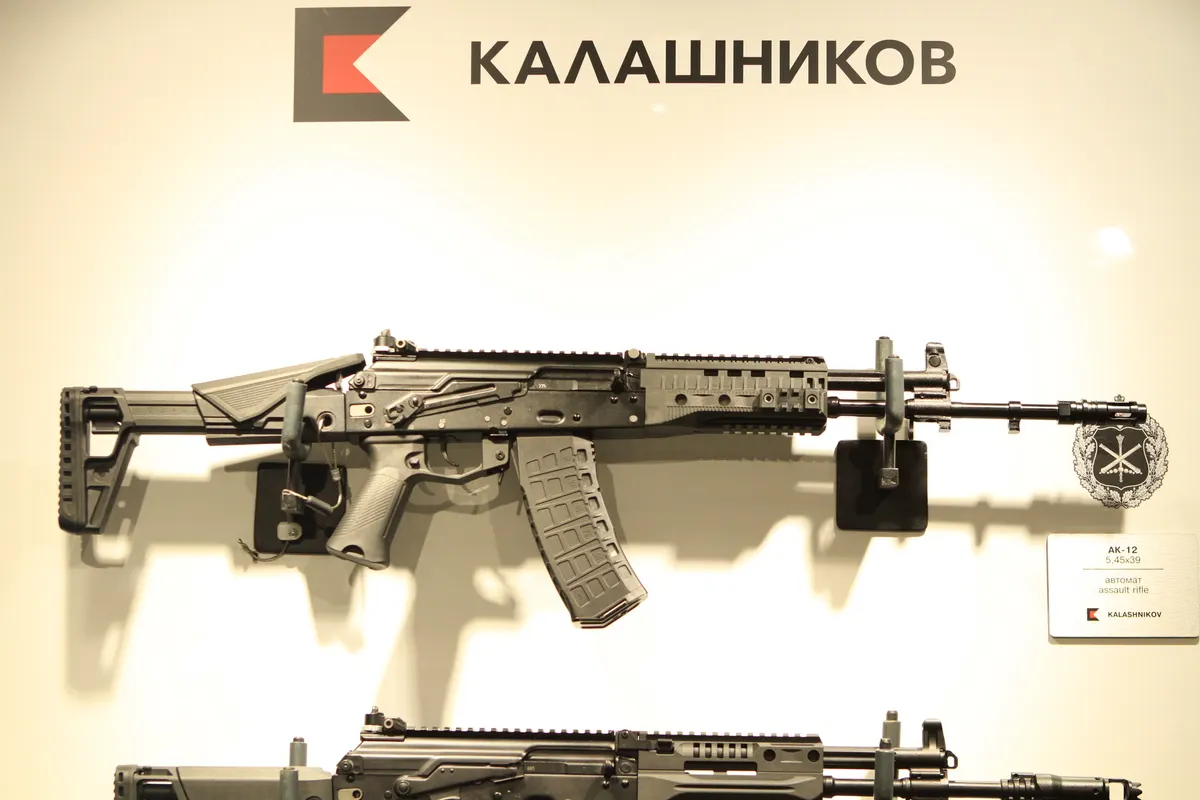
The rifle feeds from a proprietary 20-round box magazine that will not interchange with any 7.62x39 or 5.45x39 AK magazine, or with other 7.62x51 rifle magazines.9 One source alone mentions a 30-round option, unconfirmed elsewhere. Furniture borrows directly from the AK-12, a four-position folding, collapsing stock, a Picatinny-rail handguard for optics, an adjustable diopter rear sight graduated to 800m, plus a bayonet lug and a mount for 40mm underbarrel grenade launchers.7,9 The 800m sight graduation is best read as the maximum sight setting, not a claimed effective range in any terminal-ballistics sense.9
- Mekanizma TipiGazlı
- Atış Modlarısemi_auto_full_auto
- Besleme SistemiÇıkarılabilir Şarjör
- Şarjör Kapasitesi20
- Teorik Atış Hızı700
A modernized version, unofficially called the AK-308M, was announced in June 2025, carrying over changes proven on the AK-12M1 (a 2023 update informed by the AK-12's combat use in Russia's war in Ukraine), even though the AK-308 itself has never been fielded in that or any other conflict.10,11 That is an unusual path for a weapon, design lessons from a completely different caliber and a war Russia is fighting with a rifle it does not export, folded into an export-only product Russia does not use domestically.
- Namlu Çıkış Hızı760 m/sn
- Nişan Menzili800 m
| Feature | AK-308 (2018) | AK-308M (2025) |
|---|---|---|
| Handguard | Fixed, touches barrel | Free-floating |
| Top rail | Handguard only | Full-length upper receiver |
| Front sight | Separate housing | Relocated to gas block |
| Safety selector | Standard AK notch lock | Blocks bolt carrier directly |
| Magazine | 20-round, no witness window | 20-round, 5-round witness windows |
- Namlu Uzunluğu415 mm
- Toplam Uzunluk945 mm
- Gövde Malzemesi (Receiver)stamped_steel
- Katlanır / Toplanır DipçikEvet
- Süngü TakozuEvet
- Bombaatar KabiliyetliEvet
- Gaz PistonluEvet
Kalashnikov's press service framed the 2018 reveal as a response to requests from foreign customers rather than a Russian domestic requirement.1,6 Coverage at the time was openly skeptical. Military Times ran its report on the unveiling under a headline that all but asked why the rifle existed, capturing a broader unease among Western defense writers about who would actually buy a NATO-caliber Kalashnikov.3
That skepticism has roots in Kalashnikov's own track record. The company's earlier attempt to sell a NATO-caliber Kalashnikov abroad, the 1990s AK-100 series in 5.56mm and 7.62x51mm, drew little foreign interest, and the 7.62x51mm AK-108 variant in particular was criticized for recoil and handling problems.5 Analysts have also pointed to India as a country that passed over Kalashnikov products in an earlier 7.62x51 rifle search, part of the backstory Western commentators use to explain why the AK-308 targets that market, though this is analyst inference about Kalashnikov's motives, not a company statement.5
Kalashnikov Concern has operated under United States sanctions since July 16, 2014, imposed over Russia's actions in Ukraine and Crimea, and is separately sanctioned by the EU, Canada, and Australia.12,13 Those sanctions block direct import of Kalashnikov Concern products, AK-308 included, into the United States and other sanctioning states, which is why the company's stated target list for the rifle, Pakistan, India, Brazil, consists of countries outside that sanctions regime rather than the NATO members whose standard round the rifle fires.5,12 A separate US brand, Kalashnikov USA, licenses the name for domestically manufactured civilian firearms made in Florida and has no ownership tie to the Russian parent company, a distinct business line unrelated to any AK-308 sale.13
In June 2025, Kalashnikov Concern announced it would begin serial production of the modernized AK-308M once qualification trials were complete, with an initial batch hoped to be ready for delivery later that year.10,11,14 No 2026 report has surfaced confirming that any deliveries actually took place or that a foreign customer signed on. The most accurate current status line is that the rifle is in production readiness, still seeking export buyers, with no confirmed customer.
Russia's own armed forces remain outside this picture entirely. Domestic units continue re-equipping with the 5.45mm AK-12 and 7.62x39mm AK-15 rather than any 7.62x51mm rifle, confirming that the AK-308 line exists solely for a foreign buyer that, so far, has not materialized.8
The original 2018 AK-308 was explicitly labeled a prototype by Kalashnikov itself, built to gauge foreign interest rather than as a finished product ready for sale.3,6 The AK-308M, announced in June 2025, is the modernized production-intent version, carrying the free-floating handguard, full-length top rail, relocated front sight, redesigned safety selector, and witness-window magazine described above, all changes traced to lessons from the AK-12M1 update.10,11
No other variant beyond these two has been reported. Unlike the AK-100 series, which spawned multiple export calibers and barrel-length variants over years of production, the AK-308 line remains a single rifle updated once, not a family.
No country has confirmed adoption, a formal trial, or a purchase of the AK-308 as of the most recent available reporting.5,10 Kalashnikov has pointed toward Pakistan, India, and Brazil as markets where 7.62x51mm remains in service, and Pakistani representatives reportedly showed the most interest of any country at the 2018 forum.5

Pakistan's own case illustrates why interest has not turned into contracts. Pakistan already produces a domestic 7.62x51mm battle rifle, the POF G3, built under license at state-owned Pakistan Ordnance Factories, which reduces the incentive to import a foreign rifle in the same caliber and role.5
India's case is the most speculative of the three. Western defense commentary treats India as a likely target because its military had previously searched for a 7.62x51 infantry rifle and had passed over Kalashnikov products in that process, but this is analyst inference about strategic intent, not evidence of any Indian trial or procurement action tied to the AK-308 specifically.5 Brazil appears in reporting only as a named target market, with no further detail available on any Brazilian evaluation.5
The IWI Tavor-7, a bullpup 7.62x51mm rifle from Israel's IWI, was developed and marketed on almost the same premise, a NATO-caliber rifle built specifically because foreign military and law enforcement customers asked for one.15 IWI exhibited the Tavor-7 at defense shows in Thailand, Milipol in France, and Expodefensa in Colombia from 2017 onward, casting a wider international marketing net than Kalashnikov managed with the AK-308.15 Neither rifle has a clearly documented list of confirmed military government buyers in the 7.62x51 configuration specifically, so the two occupy a similar commercial position, full-power export rifles chasing a market that mostly already re-armed decades ago.
Where they differ is reputation and layout. The Tavor-7 carries the broader Tavor family's established combat record in Israeli service, even though that record was built on the 5.56mm variants, while the AK-308 carries no combat record of any kind and inherits both Kalashnikov's global brand recognition and the baggage of its parent company's sanctions status. Layout differs too, the Tavor-7 places the action behind the trigger for a shorter overall length at a given barrel length, while the AK-308 keeps the conventional Kalashnikov layout that its target buyers, already trained on AK-pattern rifles, would find immediately familiar.


What are the AK-308's specifications? 7.62x51mm NATO, gas-operated with a long-stroke piston and rotating bolt, select-fire, roughly 945mm overall length extended and 415mm barrel, about 4.3kg empty, 20-round proprietary magazine, cited cyclic rate of 700 rounds per minute.7,9
How does the AK-308 work? It uses the same gas-piston, rotating-bolt operating system as the AK-12 and AK-15, simply scaled up and reinforced to handle the more powerful 7.62x51mm NATO cartridge instead of an intermediate round.7,8
Is the AK-308 in service anywhere? No. As of the most recent reporting, no country has confirmed adopting, trialing, or purchasing the AK-308. It remains in production readiness at Kalashnikov Concern, marketed toward Pakistan, India, and Brazil without a named customer.5,10
How does the AK-308 compare to the IWI Tavor-7? Both are 7.62x51mm rifles built explicitly for export at foreign customers' request, and neither has a clearly documented list of confirmed military buyers in that caliber. They differ mainly in layout (conventional versus bullpup) and in the Tavor family's established combat record in Israeli service.15
What does the AK-308 cost? No official unit price has been published by Kalashnikov Concern or any Russian government source. Prices quoted for unrelated Western semi-automatic rifles that share similar model numbers or the .308 chambering do not apply to this weapon.
- "AK-308", Kalashnikov Group — en.kalashnikovgroup.ru ↩
- "AK-308", Modern Firearms — modernfirearms.net ↩
- "Kalashnikov unveils new AK that fires .308 rounds, and we're not sure why", Military Times — militarytimes.com ↩
- "Kontsern Kalashnikov predstavil novyy opytnyy avtomat AK-308", Kalashnikov Group — en.kalashnikovgroup.ru ↩
- "Russia Wants To Sell Its AK-308 Assault Rifle, But Just How Good Is It?", The National Interest — nationalinterest.org ↩
- "Kalashnikov Concern Unveil The AK-308 Assault Rifle At The Army-2018", Popular Airsoft — popularairsoft.com ↩
- "AK-308, the new Kalashnikov in 7.62x51mm", all4shooters — all4shooters.com ↩
- "AK-12", Wikipedia — en.wikipedia.org ↩
- "AK-308", Military Factory — militaryfactory.com ↩
- "Russia to start production of new AK-308 automatic rifle in NATO caliber to improve accuracy", Army Recognition — armyrecognition.com ↩
- "Kalashnikov Concern Introduces The Modernized AK-308", The Firearm Blog — thefirearmblog.com ↩
- "Sanctions have not significantly affected civilian arms export, Kalashnikov concern", TASS — tass.com ↩
- "Kalashnikov USA", Wikipedia — en.wikipedia.org ↩
- "Kalashnikov Launches AK-308M Battle Rifle for Export", TURDEF — turdef.com ↩
- "IWI Tavor 7", Wikipedia — en.wikipedia.org ↩