


Sweden ran an Army ordnance trial in the early 1960s to find a replacement for its aging semi-automatic infantry rifle, testing four rival designs side by side under sequential internal designations, AK1, AK2, AK3 and AK4.1 The GRAM filled the first two slots itself, developed in parallel chamberings of 6.5x55mm Swedish (AK1) and 7.62x51mm NATO (AK2), while Belgium's FN FAL took AK3 and West Germany's Heckler & Koch G3 took AK4.1 Sweden picked AK4. The GRAM, developed in-house at Sweden's state-owned Carl Gustafs stads gevärsfaktori in Eskilstuna, lost the trial to reliability problems in automatic fire and never reached production.2
- dual-caliber development, hedged between Swedish 6.5mm tradition and NATO 7.62mm
- folding stock suited to Sweden's mobile-infantry and paratrooper doctrine
- built domestically at an established state arsenal with in-house engineering talent
- persistent feeding and ejection failures in automatic fire during trials
- lost to more mature, already-fielded foreign designs on reliability and cost
- never reached production, only a handful of prototypes survive
The rifle was a select-fire, gas-operated carbine built to replace the Ag m/42 (Ljungman), the semi-automatic rifle Sweden had fielded since the Second World War.2 Development traces through a chain of prototypes designed by engineer E.W. Wallberg with locking-mechanism work by Nils Lundin, from an early design known as AK m/W, through the folding-stock AK FM/57, to the definitive AK FM/63, popularly called GRAM.2 It is one of several failed Cold War era battle rifles programs that lost out to an established foreign design rather than reaching service.
Only a handful of hand-built examples remain of the program, most of them documented today through a Forgotten Weapons examination of surviving reference-collection rifles rather than any military archive.2
A Gas-Operated Tilting Bolt Built for Two Calibers
The GRAM used a gas-operated action with a short-stroke piston and a tilting (tipping) breech block, rather than the roller-delayed blowback system used by its eventual rival, the G3.2 It fed from a detachable-magazine 20-round box magazine and was capable of semi-automatic and fully automatic fire at a cyclic rate of roughly 650 rounds per minute, figures consistent across every source that documents the rifle.2,3
- Ağırlık (Boş)4,5 kg
- Ağırlık (Yüklü)5,2 kg
- Halen HizmetteHayır
Sweden tested the design in both of its candidate chamberings at once. The AK1 trial rifle used the country's own 6.5x55mm Swedish cartridge, in service since the 1890s, while the AK2 variant used the newer 7.62x51mm NATO round that the FN and Heckler & Koch rifles were already built around.1 Running both calibers in parallel let the program hedge between continuity with Swedish ammunition stocks and interoperability with the emerging NATO standard, even though Sweden itself remained militarily non-aligned throughout the Cold War.1
- Fişek7_62_51mm_nato
- Çap7,62 mm
- Çap Sınıfı7_62mm
A folding-collapsing-stock, added at the AK FM/57 prototype stage and carried into the GRAM 63, reflected an intended role in Sweden's Total Defence doctrine, which called for a compact rifle suited to mobile infantry and paratroopers as well as conventional line units.2 Reported dimensions vary by source. Forgotten Weapons, drawing on handling of surviving reference examples, gives an unloaded weight around 4.35 to 4.6 kg, an overall length of 1,060mm extended and 800mm with the stock folded, and a 520mm barrel.2 Other summaries broadly agree on the length figures but diverge on weight, and at least one AI-generated source gives a notably lower weight and shorter length that is not corroborated elsewhere and should be treated as unreliable.
- Mekanizma TipiGazlı
- Seçmeli AtışEvet
- Besleme SistemiÇıkarılabilir Şarjör
- Şarjör Kapasitesi20
- Teorik Atış Hızı650
- Pratik Atış Hızı40
The rifle used fixed iron sights, a plausible standard fit for a 1960s prototype, though no source describes its sight picture or adjustment mechanism in detail.
- Namlu Uzunluğu520 mm
- Nişangah TipiDemir
- Açık NişangahEvet
Replacing the Ag m/42 at Carl Gustafs stads gevärsfaktori
By the late 1950s Sweden wanted to replace the Ag m/42, a semi-automatic rifle adopted in the early 1940s and built in roughly 32,000 examples through 1964, with a fully modern select-fire automatic rifle.2

The work fell to Carl Gustafs stads gevärsfaktori, the state rifle factory in Eskilstuna operated under the Bofors Carl Gustaf arms concern, which had built the Ag m/42 in the first place.2 Engineer E.W. Wallberg developed the initial design, internally designated AK m/W after his own initials, by reworking the Ag m/42 action toward select-fire operation.
Wallberg's design went through a folding-stock revision, the AK FM/57, with a detachable box magazine replacing earlier fixed-magazine arrangements, before engineer Nils Lundin refined the locking mechanism into the definitive AK FM/63, the rifle now generally known as GRAM.2 The name itself has no confirmed origin. A popular theory ties it to Gram, the mythological sword of the Norse hero Sigurd, but at least one well-informed Swedish collector has explicitly cautioned that this is unconfirmed folk etymology rather than a documented fact.1
The AK1 to AK4 Trials and a Loss on Reliability
Sweden's ordnance trials tested the GRAM in both calibers, AK1 and AK2, against the FN FAL as AK3 and the G3 as AK4, reportedly including cold-weather range testing consistent with Sweden's climate-driven approach to small arms procurement.1 The program had only about five years allotted for the whole rifle-replacement effort, pressure that favored designs already mature and fielded elsewhere over Sweden's less proven in-house rifle.2
Both GRAM chamberings suffered persistent feeding and ejection malfunctions in automatic fire during testing, and the design failed to meet the trial's reliability requirements, leaving the FAL and the G3 as the only two candidates that passed.2
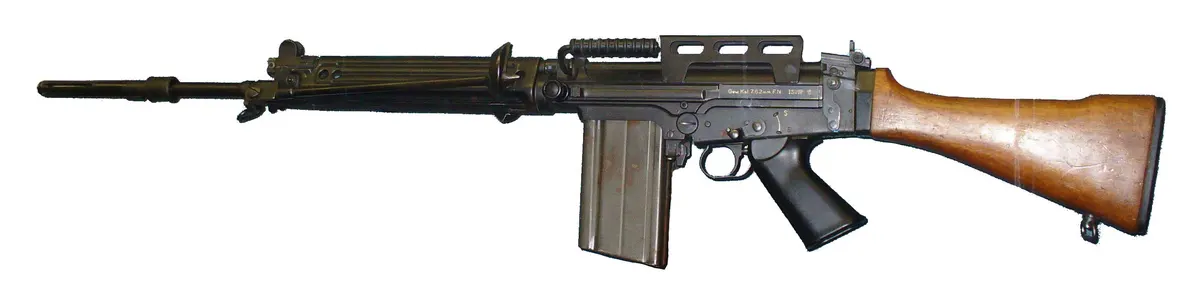
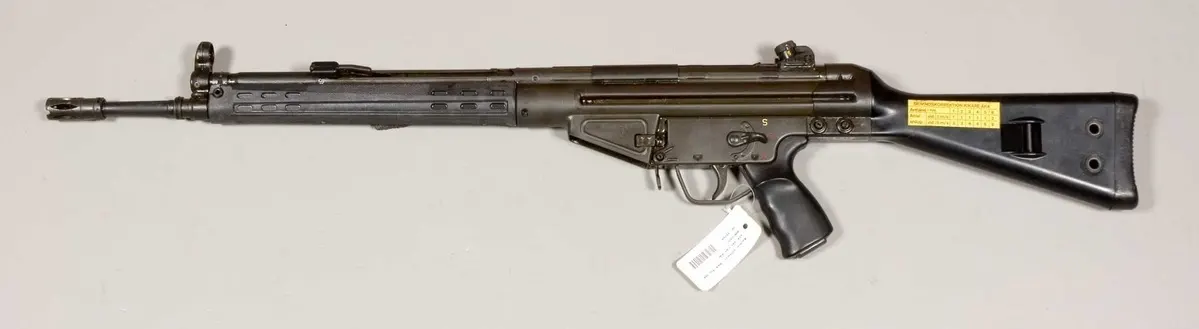
Between the FAL and the G3, the G3 won primarily on durability and lower production cost, a result of Heckler & Koch's stamped-sheet-metal receiver against the FAL's machined construction.4 West Germany's rifle entered Swedish service as the Automatkarbin 4 (Ak 4) around 1964 to 1965, license-built by Husqvarna Group from 1965 to 1970 and by Carl Gustafs stads gevärsfaktori itself from 1965 to 1980.4
The GRAM project was terminated around 1963 once the technical trials concluded. It never progressed beyond prototype and testing status, and no production run of any kind followed.2 Only a handful of physical examples are known to survive, held in reference and museum collections. The two most-documented surviving rifles, photographed for Wikimedia Commons as GRAM 63 battle rifle 1 and 2, along with an earlier GRAM 61 example, form most of the visual record available today.6
The GRAM existed in parallel-caliber trial configurations rather than distinct production variants, since the rifle was never built beyond prototype quantities. The AK1 chambered the traditional 6.5x55mm Swedish cartridge, while the AK2 used the NATO-standard 7.62x51mm round that ultimately went forward as the trial-decisive caliber.1

The sequential development-stage prototypes, the AK m/W, the folding-stock AK FM/57, and the definitive AK FM/63, represent design refinement steps rather than fielded variants. The Wikimedia Commons photo record separately catalogues an earlier GRAM 61 example distinct from the definitive GRAM 63 rifle used in the final trials.2,6
None of these iterations reached series production or carried a distinct service designation of their own.

The GRAM was never adopted by Sweden or any other country. It never entered military service, was never exported, and saw no combat use of any kind, consistent with its status as an unadopted domestic trials prototype.2
The GRAM's whole historical significance runs through a single comparison, the rifle it lost to. Sweden's decision came down to reliability and manufacturing cost rather than any single spec sheet advantage. The GRAM's gas-operated tilting bolt suffered feeding and ejection failures that the G3's roller-delayed blowback system did not, and Heckler & Koch's stamped-sheet-metal receiver was markedly cheaper to mass-produce than a machined design like the GRAM's.2,4
| Spec | GRAM 63 (AK2) | Ak 4 / G3 |
|---|---|---|
| Action | Gas-operated, tilting bolt | Roller-delayed blowback |
| Cartridge | 7.62x51mm NATO | 7.62x51mm NATO |
| Magazine | 20-round detachable | 20-round detachable |
| Cyclic rate | About 650 rpm | About 500 to 600 rpm |
| Trial result | Eliminated, reliability failures | Adopted 1964 to 1965 |
The FN FAL, trialed alongside both as AK3, tells a different part of the story. It passed the reliability testing the GRAM failed, but lost the final round to the Heckler & Koch G3 on cost and durability rather than raw performance, underscoring that Sweden's trial rewarded manufacturing maturity over an even contest of battlefield features.4 The GRAM's legacy is a domestic design bureau that lost its own in-house program to two foreign rivals, then helped manufacture the winner on its own factory floor.


Was the GRAM 63 ever adopted by the Swedish military? No. It was eliminated during ordnance trials in the early 1960s and never entered production or service.2
What does GRAM stand for? It has no confirmed official meaning. A popular but unverified theory links it to Gram, the mythological sword of the Norse hero Sigurd.1
How does the GRAM compare to the Ak 4? Both used the 7.62x51mm NATO cartridge and a 20-round detachable magazine, but the GRAM's gas-operated action suffered automatic-fire reliability failures that the roller-delayed Ak 4 did not, and the Ak 4 was cheaper to mass-produce.2,4
Why was the GRAM developed in two different calibers? Sweden trialed it as the AK1 in the traditional 6.5x55mm Swedish cartridge and as the AK2 in the newer 7.62x51mm NATO round, hedging between domestic ammunition continuity and NATO interoperability even though Sweden remained non-aligned.1
- "Före AK4?", Skalman.nu Forum — forum.skalman.nu ↩
- "Swedish AK GRAM", Forgotten Weapons — forgottenweapons.com ↩
- "GRAM 63 battle rifle", Wikipedia — en.wikipedia.org ↩
- "Automatkarbin 4", Wikipedia — en.wikipedia.org ↩
- "GRAM 63 - 3D model by aeternal11", Sketchfab — sketchfab.com ↩
- "Category:GRAM (battle rifle)", Wikimedia Commons — commons.wikimedia.org) ↩