

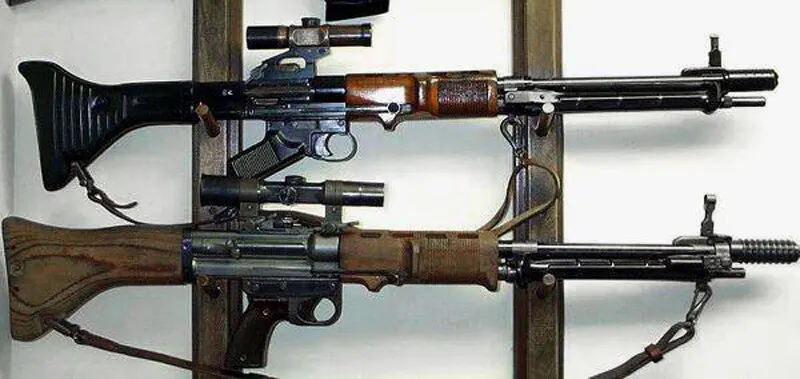

The FG 42 (Fallschirmjägergewehr 42, paratrooper rifle 42) is a select-fire automatic rifle chambered in 7.92x57mm Mauser, developed for Germany's Fallschirmjäger airborne infantry and put into limited production by Heinrich Krieghoff Waffenfabrik in Suhl from 1943 onward.1,2 Only around 7,000 were ever completed across two distinct production models before manganese-steel shortages and the collapsing German war economy shut the line down, some estimates put the true figure as low as 5,000, making it one of the rarest small arms fielded by any major power in World War II in more than token numbers.1,3
- Combined rifle range, submachine-gun rate of fire, and light-machine-gun bipod suppression in one weapon
- Side-mounted magazine kept the stock in line with the bore, cutting muzzle climb on automatic fire
- Open-bolt/closed-bolt switching balanced cooling on full-auto against accuracy on semi-auto
- Integral bipod and folding bayonet needed no separate accessories
- Extremely limited production, never available in numbers beyond a handful of elite units
- Full-power 7.92x57mm cartridge made automatic fire difficult to control from a rifle this light
- Complex machining and tight tolerances made it expensive and slow to build
- Overheating and reliability issues in early Model I examples required a mid-production redesign
The rifle grew directly out of a battlefield failure. During the German airborne invasion of Crete in May 1941, paratroopers jumped armed with only pistols, grenades, and knives, while their rifles and machine guns descended separately in weapons canisters. Long-range fire from dug-in Commonwealth defenders inflicted heavy losses on Fallschirmjäger as they scrambled across open ground to retrieve those containers before they could fight back.1,4 Luftwaffe leadership concluded that paratroopers needed one weapon they could jump with directly, combining the rate of fire of the MP40 submachine gun, the range and accuracy of the Karabiner 98k, and the suppressive volume of an MG 34, all in something light and compact enough to carry on a parachute harness.2
Six German firms submitted prototypes for the requirement, but Rheinmetall-Borsig's design, developed under chief small-arms designer Louis Stange, won the trials at the Luftwaffe's Tarnewitz test station in 1942.1,5 Rheinmetall lacked the factory capacity to build the rifle at scale, so serial production went to Krieghoff instead, a hunting-arms maker in Suhl with no prior record of large-scale military production.1,2 Reportedly, Luftwaffe commander-in-chief Hermann Göring pushed the whole program through as a Luftwaffe-only project, sidestepping the Army's own ordnance office out of long-running inter-service rivalry over who controlled paratrooper equipment.6
Two models reached troops in meaningful numbers, generally called the Model I (First Model) and Model II (Second Model), the second incorporating a wood stock, relocated bipod, and a slower cyclic rate to fix problems that surfaced in early combat use.1,7 Neither model ever equipped more than a fraction of the Fallschirmjäger force, and by 1944 the StG 44 had already begun taking over as Germany's answer to mass-produced automatic infantry firepower, a role the far more expensive FG 42 was never built to fill at scale.1
An Open Bolt for Cooling, a Closed Bolt for Accuracy
Most automatic rifles pick one firing cycle and live with its tradeoffs. The FG 42 switches between two. On semi-automatic, the bolt sits forward and closed before each shot, the same arrangement used in bolt-action and most self-loading rifles, which keeps the receiver rigid at the instant of firing and helps single-shot accuracy.2,8 Selecting full-automatic instead cycles the bolt to the rear between shots, so the chamber stays open and air-cooled until the trigger is pulled again, reducing the risk of a round cooking off in an overheated chamber during sustained bursts.2 In effect, two different firing cycles were built into one trigger group, and that duality explains a large share of the FG 42's internal mechanical complexity relative to a simpler contemporary like the Karabiner 98k.8
- İlk Üretim Yılı1943
- Hizmete Giriş Yılı1943
- TasarımcıLouis Stange (Rheinmetall-Borsig)
- Ağırlık (Boş)4,2 kg
- Ağırlık (Yüklü)4,95 kg
- Halen HizmetteEvet
The action is gas-operated, drawing propellant gas from a port under the barrel to drive a long-stroke piston rearward, which unlocks a rotating, two-lug bolt.1,9 That bolt and its rotating-lug locking arrangement would go on to have a long postwar career, discussed further below.9 Cyclic rate ran around 900 rounds per minute on Model I rifles, high enough to be difficult to control and prone to parts breakage, and Krieghoff responded on the Model II with a heavier bolt and revised recoil spring that brought the rate down to roughly 750 rounds per minute, with a four-position gas regulator added to tune the system for fouling or cold weather.1,7
- Fişek7.92×57mm Mauser
- Çap7,92 mm
- Kovan Uzunluğu57 mm
- Mermi Ağırlığı12,8 g
A Side-Mounted Magazine to Keep the Sights in Line
Feeding comes from a detachable box magazine, normally holding 20 rounds, mounted on the left side of the receiver rather than underneath it, with a rarer 10-round magazine also documented and 5-round stripper clips usable for reloading fixed rifles in the field.1,9 The side-mount kept the stock in a straight line with the bore axis instead of offsetting it below a bottom-feeding magazine, which reduced muzzle climb on automatic fire and let a prone shooter fire from a lower profile, both useful traits for a rifle meant to double as a squad automatic weapon.1,2 The tradeoff was a rifle that balanced awkwardly to one side when the magazine was loaded, a complaint noted in period accounts of the weapon.2
- Mekanizma TipiGazlı
- Atış Modlarıopen-bolt automatic, closed-bolt semi-automatic
- Seçmeli AtışEvet
- Besleme SistemiÇıkarılabilir Şarjör
- Şarjör Kapasitesi20
- Teorik Atış Hızı750
- Pratik Atış Hızı250
An integral, forward-folding bipod and a spike bayonet that folded flush under the barrel rounded out the package, letting the rifle serve as an improvised light machine gun on its bipod or a close-quarters weapon with the bayonet extended, without carrying separate attachments.1,9 An integral optical rail accepted scope mounts, and at least one photographed example carried a ZF4 telescopic sight during a well-documented 1943 mission described further below.10 Sighted effective range against a point target is generally put at around 600 meters, with a muzzle velocity near 740 meters per second from the roughly 500mm barrel.1,9
- Namlu Çıkış Hızı740 m/sn
- Etkili Menzil (nokta)600 m
- Namlu Uzunluğu500 mm
- Optik RayıEvet
- Açık NişangahEvet
- Toplam Uzunluk937 mm
- Süngü TakozuEvet
- Entegre BipodEvet
- Bombaatar KabiliyetliEvet
- Gaz PistonluEvet
- Toplam Üretim7.000
- Üretim Başlangıcı1943
- Üretim Bitişi1945
- Varyantlar2
Origins in the Chaos of Crete

Before the FG 42 existed, the Battle of Crete had already exposed the flaw it was built to fix. German Fallschirmjäger doctrine dropped rifles, light machine guns, and ammunition in separate canisters from the paratroopers themselves, a practice meant to reduce jump injuries but one that left men effectively unarmed in the seconds after landing.1,4 British, Australian, New Zealand, and Greek defenders inflicted disproportionate casualties on paratroopers who were still scrambling toward those canisters, and German airborne forces never again attempted a divisional-scale opposed drop for the rest of the war.4 Luftwaffe leadership drew a direct lesson from the experience, a paratrooper needed a single weapon he could jump with and fight with immediately, rather than a rifle and a machine gun waiting separately on the ground.1,2
Six Firms, One Rheinmetall Design
The Luftwaffe's technical office invited six manufacturers to submit prototypes for the new requirement, Gustloff-Werke, Mauser, Johannes Großfuß, C.G. Hänel, Rheinmetall-Borsig, and Heinrich Krieghoff Waffenfabrik.1 Rheinmetall's submission, internally designated LC-6 and developed by Louis Stange, the firm's chief small-arms designer at its Sömmerda works and a veteran of the earlier MG 34 program, won out after trials at the GL/C E-6 test station at Tarnewitz in the middle of 1942.1,5 The design went through several iterations, from an early LC-6 through LC-6/II after testers flagged shortcomings, to the accepted LC-6/III.5
An early hand-built prototype, sometimes referred to by the cover designation Gerät 450, used a sheet-metal handguard and never reached mass production, followed by further test batches as the design matured toward what troops eventually received.11 Collectors and technical writers still argue over how to label these intermediate stages, some sources apply a full alphabetic sequence from Type A through Type G to track every prototype revision, while most general references collapse the whole progression into the two rifles that actually reached troops in numbers, generally known simply as the First Model and Second Model, or Model I and Model II.11,7 That two-model framing is the more useful one for understanding what Fallschirmjäger units actually carried, and the letter sequence is best treated as prototype-stage trivia rather than a production naming scheme.
From Rheinmetall's Drawing Board to Krieghoff's Production Line
Rheinmetall had designed the winning rifle but could not spare production capacity for it, so the contract for serial manufacture went to Krieghoff, based in Suhl, a firm previously known for sporting shotguns rather than military small arms.1,2 A secondary manufacturer, L.O. Dietrich, is sometimes cited for later production runs, though sourcing on its exact output is thin enough that it should be treated as a minor contributor rather than a confirmed second production line.1 Serial production began in 1943, and Fallschirmjäger units started receiving the rifle that year, with the improved Model II following as combat feedback exposed problems with the original stamped-steel stock and forward bipod mount.1,7
The FG 42 never came close to universal issue. Its cost and the precision machining it demanded meant Krieghoff could only turn out a few thousand rifles a year even at full effort, and by the time meaningful numbers reached the front, elite Fallschirmjäger formations absorbed most of what existed. Broader combat use across specific campaigns, from the raid that gave the rifle its first operational outing to the fighting in Italy and on the Western Front, is covered in the Conflicts section below.
A Postwar Afterlife Inside an American Machine Gun
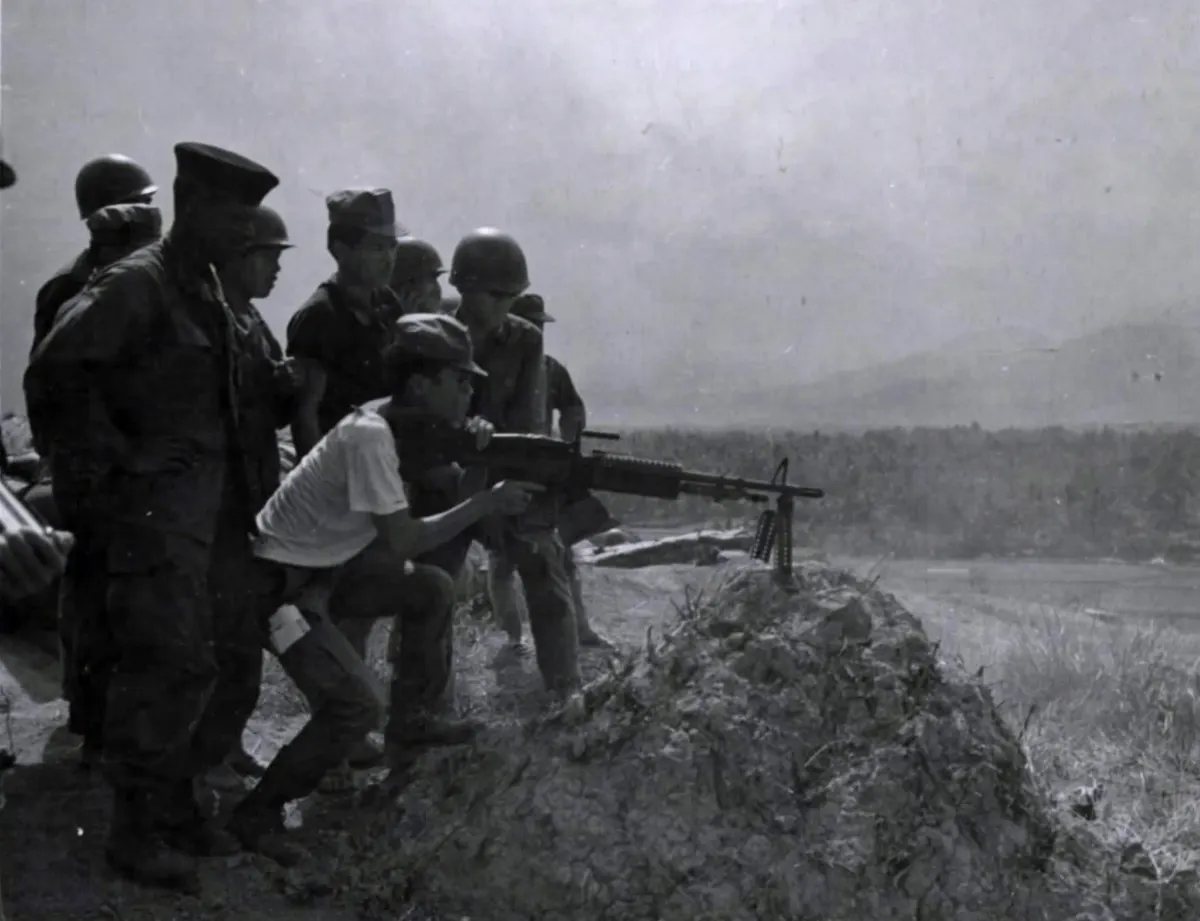
The FG 42's most durable legacy has nothing to do with Germany. In 1946, engineers at the Bridge Tool & Die Company in the United States modified a captured FG 42, reinforcing its receiver and grafting on a belt-feed mechanism borrowed from the MG 42, to build a prototype rifle designated the T44.9 That prototype fed directly into the development chain that produced the M60 machine gun, adopted by the US Army in 1957.9
The inheritance is specific rather than general. The M60's gas-operated, two-lug rotating bolt derives from the FG 42's action, which was itself influenced by the earlier Lewis gun, while the M60's belt-feed and quick-change barrel came from the MG 42 side of the hybrid design, not from the FG 42.9 Separately, Switzerland's Sturmgewehr 52 is also described as drawing on the same general FG 42 approach to a gas-operated, in-line automatic rifle.9
Extreme Rarity and a Six-Figure Collector Market
Wartime production totaling somewhere between 5,000 and 7,000 rifles, followed by decades of postwar destruction and attrition, left the FG 42 as one of the scarcest World War II small arms still in private hands. Firearms historian Ian McCollum has documented only about 26 select-fire, legally transferable examples registered in United States collections under federal machine-gun law, a number small enough that most collectors will never handle one outside a museum case.12 Rock Island Auction Company sold a Krieghoff-made Model I example for 411,250 dollars at its May 2023 Premier Auction, its highest price ever realized for a machine gun and a record among publicly documented FG 42 sales, while earlier sales at other houses, including a roughly 100,000-dollar result at a Cowan's Auctions sale, show how sharply prices have risen even within the past decade.13,14
That rarity has created a parallel market for faithful semi-automatic reproductions. SMG Guns, a small American manufacturer, has built reproduction FG 42s using roughly 90 percent original-pattern parts, offered in both the original 7.92x57mm Mauser chambering and a .308 Winchester version that accepts standard M14 magazines, with retail pricing around 5,000 dollars for the .308 variant, itself a small fraction of an original's auction value.15 The gap between a several-thousand-dollar faithful copy and a six-figure original is itself a measure of how completely wartime production failed to keep pace with the rifle's ambitious design.
The Gran Sasso Raid, a Combat Debut With No Combat
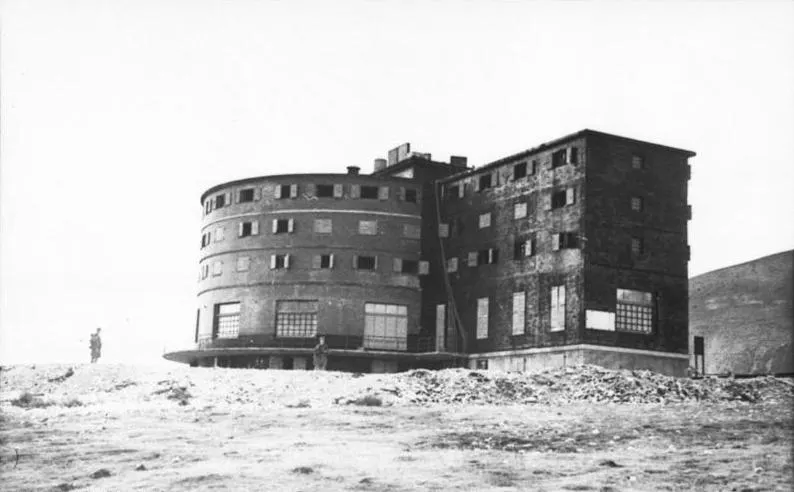
The FG 42's first documented appearance in an active operation came on 12 September 1943, during the Gran Sasso raid, the glider-borne mission that freed Italy's deposed dictator Benito Mussolini from captivity at the Campo Imperatore hotel high in the Gran Sasso massif.16 Fallschirmjäger under Major Harald Mors carried out the operation under the overall command of Generalleutnant Kurt Student, with an SS detachment led by Otto Skorzeny attached and, despite receiving outsized public and postwar credit for the mission, playing a smaller operational role than Mors's own paratroopers.16 Ten DFS 230 gliders delivered the assault force, and at least one participant's FG 42 was fitted with a ZF4 telescopic sight, visible in period photographs.10
American Rifleman has called Gran Sasso the FG 42's combat debut, but the description needs a caveat, firearms historians at Forgotten Weapons note that not a single shot was fired during the entire operation, since Italian guards surrendered the moment the raiders landed.10,16 The FG 42 was present and carried into a real operation for the first time, but its actual combat proof came later, in Italy's mountains and on the Western Front.
Monte Cassino's Ruins
From January to May 1944, Fallschirmjäger nicknamed the Green Devils by Allied troops defended the ruined monastery and surrounding high ground at Monte Cassino, and FG 42-armed paratroopers were among the defenders fighting through the rubble.17 The rifle's short overall length and light weight suited the close, awkward angles of ruined buildings and stairwells better than a full-length Karabiner 98k, and its bipod let it double as a section support weapon in defensive positions dug into the wreckage.17 Wikipedia's own FG 42 entry does not confirm the Monte Cassino connection directly, so it rests on secondary military-history sources rather than a single authoritative account, though the broader deployment of Fallschirmjäger units to that front is not in question.1,17
Concentrated on the Western Front After Normandy
The heaviest documented concentration of FG 42s came after the Normandy landings in June 1944. Nearly a quarter of all FG 42s ever produced were held by the 2nd Fallschirmjäger-Division alone, a striking figure given how thin overall production was, and that division fought through the bocage country and the fortified port of Brest before the campaign's final stages.1 Fallschirmjäger units equipped with the rifle also fought at the Battle of Carentan in June 1944, one of the campaign's earliest and most costly small-unit engagements, and later in the encirclement fighting of the Falaise Pocket in August 1944, as German forces attempted to escape a closing Allied ring.1
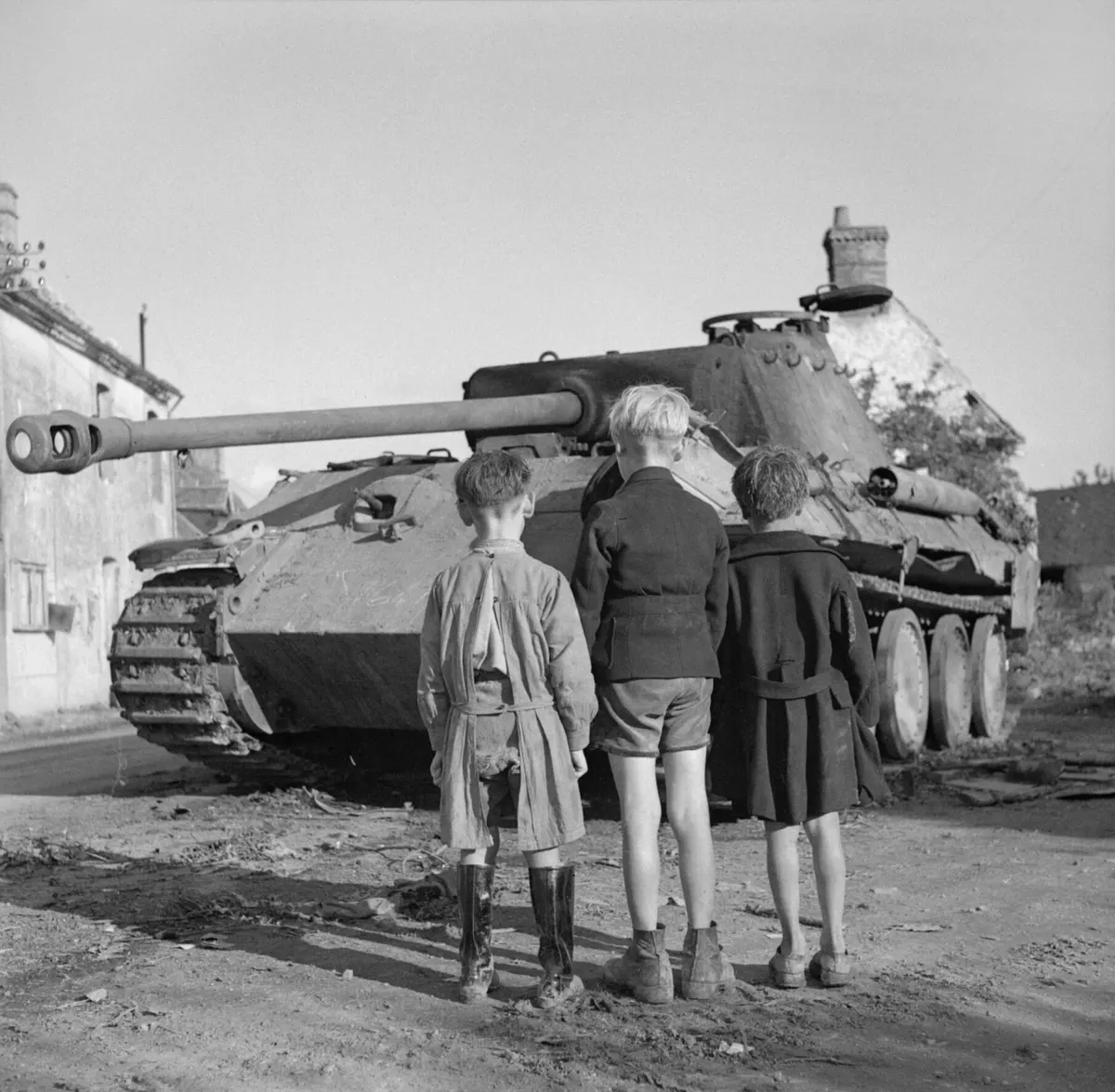
By the final year of the war, the FG 42 had settled into a narrow niche, issued mainly to elite or specialist Fallschirmjäger sub-units rather than general infantry, while the cheaper, mass-producible StG 44 took over the Wehrmacht's broader push toward automatic infantry firepower.1 No credible source ties the rifle specifically to the December 1944 Ardennes offensive, despite German paratroopers under Colonel Friedrich von der Heydte jumping in that operation's opening hours, and that gap in the documentation is worth stating plainly rather than assuming a connection that current sourcing does not support.
The Prototype Letter Series, From Gerät 450 to Accepted Production
Collector and technical literature sometimes tracks the FG 42's development through a full Type A to Type G sequence, starting with the sheet-metal-handguard Gerät 450 prototype and running through several endurance-test revisions before reaching what troops actually received.11 Only two of those stages amounted to real production runs, so the simpler, more widely used framing of a First Model and Second Model is the more useful one here, with the earlier letter designations treated as background on how the design evolved rather than as separate fielded variants.11,7
Model I and Model II, the Two Rifles That Reached Troops
The two production models differ enough to be visually distinguishable at a glance, and the changes were driven by real problems reported from the field rather than cosmetic revision.
| Feature | Model I (First Model) | Model II (Second Model) |
|---|---|---|
| Buttstock | Stamped, ribbed steel | Solid wood, to reduce heat transfer to the shooter |
| Pistol grip | Steeply raked angle | Near-vertical angle |
| Bipod mount | Front of handguard, near the barrel collar | Relocated to the muzzle, improving dispersion |
| Bayonet | Roughly 10-inch folding spike | Shortened to roughly 6 inches |
| Cyclic rate | About 900 rounds per minute | About 750 rounds per minute |
| Unloaded weight | About 4.2 kg | About 4.95 kg |
Sources differ slightly on exact weights and overall lengths for each model, a common problem with a rifle this rare and undocumented in factory records, and the figures above represent the most consistently cited values across specialist references.1,9 Moving the bipod to the muzzle on the Second Model reduced barrel whip and improved grouping when firing supported, while the switch to a wood buttstock addressed complaints that the earlier stamped-steel stock transferred uncomfortable amounts of heat to a shooter's cheek during sustained automatic fire.7 The redesigned muzzle brake and a shortened bayonet, now folding forward under the barrel where the relocated bipod largely hid it, rounded out the changes that defined the more common Second Model most surviving rifles and reproductions are based on today.7


Germany's Fallschirmjäger, administratively a Luftwaffe formation rather than an Army one, were the FG 42's only wartime operator, receiving the rifle from 1943 and never in numbers sufficient to displace the Karabiner 98k as the paratrooper corps' primary individual weapon.1,2 That Luftwaffe ownership was itself unusual, since German infantry small arms procurement normally ran through the Army's own ordnance bureaucracy, and it reflects the same inter-service rivalry that reportedly helped get the program approved in the first place.6
The United States never fielded the FG 42 operationally, but captured examples entered US Army Ordnance testing after the war, feeding directly into the postwar development work described above that eventually produced the M60 machine gun.9 In that narrow sense, American ordnance engineers were meaningful evaluators of the design even though no US unit ever carried one into the field, and surviving examples today sit almost entirely in private American collections and a handful of museums rather than in any operational inventory.12
The FG 42's closest conceptual rival is Germany's own StG 44, and comparing the two says more about diverging requirements than about which rifle worked better. The FG 42 tried to give a small number of elite paratroopers a single weapon spanning rifle, submachine gun, and light machine gun roles, built to a demanding specification with expensive machining and a full-power 7.92x57mm Mauser cartridge that made automatic fire genuinely hard to control.1,2 The StG 44 solved a different, larger problem, giving ordinary Wehrmacht infantry controllable automatic firepower at a rifle's normal engagement range, using the shorter 7.92x33mm Kurz intermediate cartridge specifically chosen to tame recoil and enable an entirely new weapon category.1
Production numbers make the contrast concrete. Krieghoff and its associated contractors built roughly 7,000 FG 42s across the entire war, while StG 44 production reached somewhere around 425,000 rifles, a gap of nearly two orders of magnitude that reflects manufacturing method as much as demand.1 The FG 42 relied on machined steel components and tight tolerances throughout, while the StG 44 embraced stamped-steel construction specifically to reach the volumes Germany's war economy needed.1 Historically, the two rifles also left very different technical legacies, the StG 44's intermediate-cartridge, selective-fire concept is widely credited as the direct conceptual ancestor of the postwar assault rifle, most famously the Soviet AK-47, while the FG 42's contribution flowed in a narrower, more specific channel into the general-purpose machine gun world through the American M60 program described above.1,9
| Parameter | FG 42 | StG 44 |
|---|---|---|
| Cartridge | 7.92x57mm Mauser (full power)1 | 7.92x33mm Kurz (intermediate)1 |
| Total production | About 5,000 to 7,0001 | About 425,0001 |
| Primary user | Fallschirmjäger paratroopers only1 | General Wehrmacht infantry1 |
| Construction | Machined steel, high labor cost1 | Stamped steel, mass-production focused1 |
| Postwar technical influence | M60 machine gun bolt and locking system9 | Conceptual ancestor of the modern assault rifle1 |
Neither rifle can be called a straightforward winner over the other, because they were never really solving the same problem. The FG 42 is better understood as a hybrid squad weapon built for a specific airborne niche that Germany could never resource at scale, while the StG 44 is the weapon that actually reshaped postwar infantry doctrine.


What are the FG 42's specifications? It fires the 7.92x57mm Mauser cartridge from a 20-round side-mounted detachable magazine, weighs about 4.2 kg empty on the Model I and about 4.95 kg on the heavier Model II, and has a roughly 500mm barrel producing a muzzle velocity near 740 meters per second, with a cyclic rate around 900 rounds per minute on the Model I and about 750 on the Model II.1,9
How does the FG 42's firing mechanism work? It fires from a closed bolt on semi-automatic for accuracy and from an open bolt on full-automatic to keep the chamber cooler during sustained fire, an unusual dual-mode design combined with a gas-operated, rotating two-lug bolt.2,8
Was the FG 42 used in actual combat? It first appeared in an operational role during the September 1943 Gran Sasso raid, though no shots were fired there. Its clearer combat record runs through the Battle of Monte Cassino in 1944 and the fighting that followed the Normandy landings, including at Carentan and the Falaise Pocket, where the 2nd Fallschirmjäger-Division alone held nearly a quarter of all FG 42s ever made.1,16,17
How much does an FG 42 cost today? Original transferable examples are extremely rare, with only about 26 legally registered in United States collections, and Rock Island Auction Company sold one for 411,250 dollars in May 2023. Faithful semi-automatic reproductions from SMG Guns run around 5,000 dollars in .308 Winchester, a fraction of an original's value.12,13,15
How does the FG 42 compare to the StG 44? Both are World War II German attempts to reshape infantry firepower, but the FG 42 targeted a small elite airborne force with an expensive, hybrid rifle-and-machine-gun design in a full-power cartridge, while the StG 44 armed ordinary infantry at massive scale with an intermediate cartridge that went on to define the postwar assault rifle.1
- "FG 42", Wikipedia — en.wikipedia.org ↩
- "German FG-42", Forgotten Weapons — forgottenweapons.com ↩
- "FG 42 Automatic Rifle", War History Online — warhistoryonline.com ↩
- "Battle of Crete", Wikipedia — en.wikipedia.org ↩
- "FG 42", Grokipedia — grokipedia.com ↩
- "The FG42 Paratrooper Rifle", Rock Island Auction Company — rockislandauction.com ↩
- "FG42 Types, Simplified by a Simpleton", K98k Forum — k98kforum.com ↩
- "FG 42", Military Factory — militaryfactory.com ↩
- "The First M60 Prototype, FG42 + MG42 = T44", Forgotten Weapons — forgottenweapons.com ↩
- "The Audacious Gran Sasso Raid, the Combat Debut of the FG42", American Rifleman — americanrifleman.org ↩
- "FG42 Types, Simplified by a Simpleton", K98k Forum — k98kforum.com ↩
- "Transferable FG-42 at RIA", Forgotten Weapons — forgottenweapons.com ↩
- "Krieghoff FG42 Type I Paratrooper Rifle/Machine Gun", Rock Island Auction Company — rockislandauction.com ↩
- "FG42 German Machine Gun to Sell for 100,000 Dollars at Cowan's Auction", Paul Fraser Collectibles — paulfrasercollectibles.com ↩
- "SMG Guns FG 42 Reproduction Review", Firearms News — firearmsnews.com ↩
- "Gran Sasso Raid", Wikipedia — en.wikipedia.org ↩
- "FG42, Ahead of Its Time and Forgotten", SOFREP — sofrep.com ↩