


The FN C1 rifle is Canada's licensed, dimensionally modified production version of the Belgian FN FAL battle rifle, built domestically rather than imported from Belgium. Canadian Arsenals Limited manufactured it at the former Small Arms Limited plant in Long Branch, Ontario. Canada adopted the design as the C1 in 1955, refined it soon after into the C1A1 with an improved gas regulator, and continued issuing later-production rifles with further internal changes while keeping them marked and catalogued as C1A1s. The rifle served as Canada's standard infantry weapon from 1955 until the Colt Canada C7 began replacing it in the mid-1980s.1
- Extremely robust gas-operated action, tolerant of neglect
- Domestic Long Branch production, independent of Belgian supply
- Semi-auto-only fire control suited disciplined marksmanship
- Arctic trigger guard usable with heavy mittens
- Heavier and harder-recoiling than the 5.56mm rifle that replaced it
- Failures tended to be sudden and severe rather than minor
- Inch-pattern magazines do not fit metric FN FAL rifles
- No organic full-automatic option in the standard infantry rifle
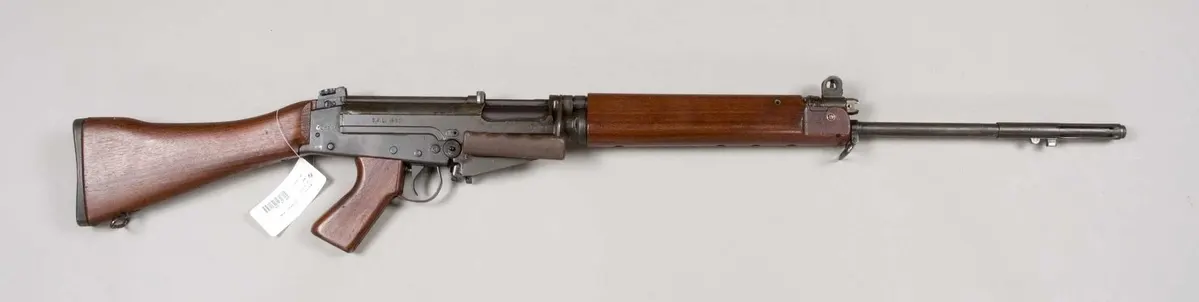
Canada moved on the FAL earlier and faster than any other NATO government. It ordered 2,000 trial rifles in 1954, while the alliance was still arguing over a standard cartridge, and had a production line running at Long Branch before Britain fielded its own L1A1 Self-Loading Rifle or the United States settled on the M14.1,2 Unlike the Belgian original, which was commonly built select-fire, the standard-issue C1 and C1A1 fired semi-automatic only, the same choice Britain and Australia made for their own FAL derivatives.3 The full-automatic option Canada wanted came instead from a separate heavy-barrel squad weapon, the C2, covered below in Variants.
Total production ran to roughly 80,000 to 90,000 rifles, of which about 72,470 were built under a single Department of National Defence contract, with that batch recognizable by 8L-prefixed serial numbers.4 Canada sold surplus C1A1s to civilians without restriction as early as 1972, then reclassified them as restricted in 1985 and prohibited in 1993, because the C1A1's internal sear design cannot reliably be modified to rule out automatic fire. Reserve war stocks were finally destroyed in 2009, and only around 1,100 Canadian-made FN rifles are believed to survive today in any form.4
Converting FN's Metric Drawings to Inch Pattern
The C1 is a gas-operated rifle with a tilting breechblock, feeding 7.62x51mm NATO from a 20-round detachable box magazine, weighing about 4.3 kg empty and roughly 1,143 mm overall with a 533 mm barrel, figures that vary slightly between sources by a centimeter or two depending on stock length and measurement method.12 The mechanism itself is unchanged from the Belgian original. What sets the C1 apart is the drawings behind it. Canada obtained full production rights and FN's technical package, then converted the metric dimensions to first-angle inch-pattern drawings for Commonwealth manufacture, building 20 toolroom prototypes before committing to full-scale production.4 Those Canadian inch-pattern master drawings were later used by Britain and Australia for their own FAL-derived rifles, so the Commonwealth-pattern FAL family effectively traces back to Long Branch rather than to Belgium's own metric-pattern documentation. Inch-pattern and metric-pattern magazines are not interchangeable, a detail that still confuses buyers in the surplus-parts market today.
- İlk Üretim Yılı1955
- Hizmete Giriş Yılı1955
- Ağırlık (Boş)4,337 kg
- Halen HizmetteHayır
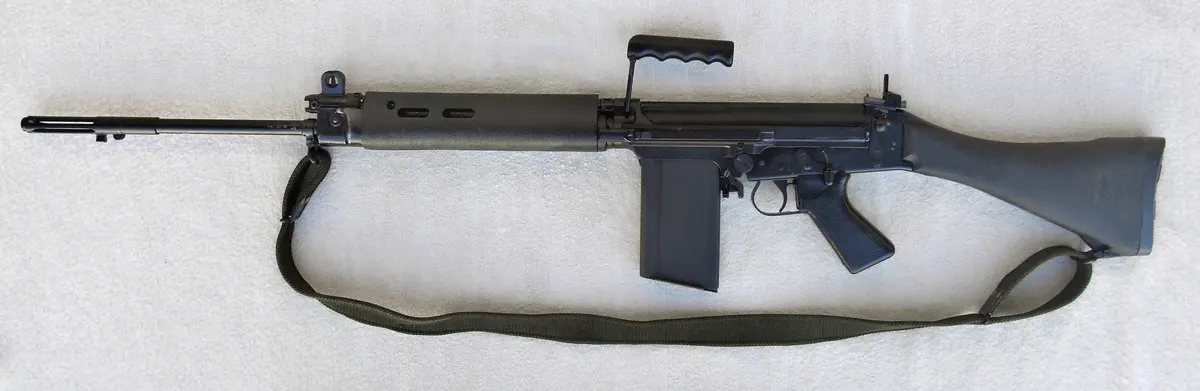
Canada made several further changes of its own on top of the metric-to-inch conversion. Early C1 rifles held their ejector block with two closely fitted pins, a depot-level repair job, while later production in the 8L serial range used a screw-retained ejector a unit armourer could swap in the field.4 The handguard lost the ventilation holes seen on Belgian-pattern FALs, a known weak point where cracks would form between the holes, and Canada used solid wood handguards before eventually moving to solid, non-perforated polymer ones. Later rifles also adopted a separate, stamped protective-wing front sight borrowed from the C2 automatic rifle, again easier to replace in the field than the earlier gas-block-mounted sight. The C1A1 designation itself marks the point where Canada added an adjustable gas regulator the original 1955 C1 lacked, letting a soldier tune the action for adverse conditions or rifle-grenade launching.4
- Fişek7.62x51mm NATO
The Arctic Trigger Guard

The most distinctly Canadian design touch has nothing to do with the action at all. The C1's trigger guard could be rotated rearward and folded out of the way, or removed entirely and stowed in a recess behind the pistol grip, so a soldier wearing thick arctic mittens could still reach the trigger.4 No other FAL-family rifle in NATO service bothered with the feature, a small but telling sign of how much Canada's own operating environment, rather than Belgian or British doctrine, shaped the rifle's final form.
- Mekanizma TipiGazlı
- Seçmeli AtışHayır
- Besleme SistemiÇıkarılabilir Şarjör
- Şarjör Kapasitesi20
Rear-sight geometry also changed during the toolroom-prototype phase, though surviving records do not spell out the exact mechanical difference from the Belgian original in the same detail as the ejector, handguard, and front sight changes above. Combined, these modifications mean a Canadian C1A1 and a Belgian-pattern FAL share almost no small parts despite firing the same cartridge from visually similar rifles.
- Namlu Çıkış Hızı823 m/sn
- Etkili Menzil (nokta)800 m
- Namlu Uzunluğu533 mm
- Açık NişangahEvet
- Toplam Uzunluk1.143 mm
- Kabza/Dipçik Malzemesiwood (later solid polymer handguard)
- Süngü TakozuEvet
- Gaz PistonluEvet
- Toplam Üretim85.000
- Üretim Başlangıcı1955
- Üretim Bitişi1985
- Birim Maliyet143 USD
From the 1954 Ottawa Conference to an Early Canadian Order
Postwar NATO planners spent much of the early 1950s arguing over a single rifle cartridge for the alliance, a debate settled at a 1954 Ottawa conference that fixed 7.62x51mm NATO as the standard round. Britain's own candidate, the bullpup EM2 chambered for a smaller intermediate cartridge, was abandoned under American pressure once the full-power round was agreed, and FN's FAL, itself redesigned from an original intermediate-cartridge concept specifically to win American approval, became the Commonwealth's front-runner.3 The United States tested the FAL under the designation T48 against Springfield Armory's own T44, an improved M1 Garand derivative with a detachable magazine, judged the two roughly comparable, and picked the T44 anyway, adopting it as the M14 in 1957. The United States remained the one major NATO country that never adopted the FAL.2
Canada did not wait for that American decision. It ordered 2,000 experimental rifles in 1954 to help finalize the design, then formally adopted the finished rifle as the C1 in 1955, well ahead of Britain's own L1A1 program.1,4
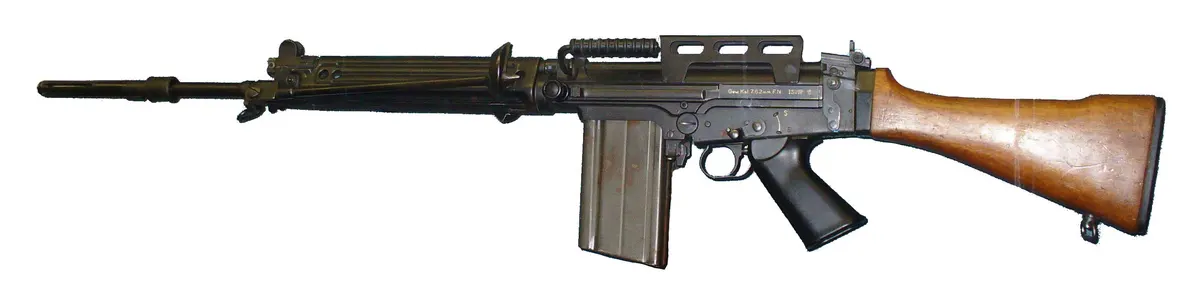
The rifle's designer, Dieudonné Saive, had spent decades at Fabrique Nationale refining John Browning's prewar rifle patents into the postwar FAL, and his original metric-pattern design remained the basis every licensed producer, Canadian included, worked from.3
Canada's early order and its own inch-pattern conversion work, described above in Specs and Design, meant Long Branch was tooling up to build the rifle almost as soon as Saive's design was finalized in Belgium.
Long Branch, From Lee-Enfields to Self-Loading Rifles
The factory that built the C1 had produced Canadian military rifles through two world wars already. Small Arms Limited, a Crown-owned firm, built its 212,000-square-foot Long Branch plant near Toronto in 1940 and by the war's end had produced close to a million Lee-Enfield No.4 rifles along with Sten submachine guns, largely with a female wartime workforce.6 Small Arms Limited wound down in early 1946 once wartime rifle orders evaporated, and its Long Branch assets passed to a newly formed federal Crown corporation, Canadian Arsenals Limited, which initially operated the site mainly as a repair and rebuild depot.5,6
That changed in August 1955, when Canada's Department of Defence Production awarded Canadian Arsenals Limited a contract to manufacture the new FN-pattern rifle, with full-rate production scheduled to begin in 1956.5 A 1963 Canadian Army supply manual priced a long-stock FN C1A1 at 193.77 Canadian dollars under National Stock Number 1005-21-150-5294, a rare period cost figure for a rifle whose production run otherwise left little in the way of public pricing data.7 Canadian Arsenals Limited kept building C1 and C1A1 rifles, along with the heavy-barrel C2 and a Canadian-built Sterling submachine gun, at Long Branch into the mid-1970s before winding down small-arms manufacturing there entirely.5,11
Service, Reputation, and Retirement
Canadian veterans generally describe the C1A1 as extremely dependable, with one common comparison putting its reliability on par with the AK-47, but with a distinctive failure pattern. When a C1A1 did finally break under heavy wear, it tended to fail hard rather than gradually, often needing rear-echelon armourer repair rather than a field fix.4 The rifle's 7.62mm cartridge also gave it a reach and stopping power some veterans still argue the lighter 5.56mm C7 never matched, even though the C7 offered lower weight, better ergonomics for smaller-stature soldiers, a 30-round magazine, and select-fire capability the C1A1 lacked.1
The Canadian Forces began replacing the C1A1 with the C7 around 1984, completing the changeover through 1985, though reserve units kept older stocks in service well beyond that, with at least one Militia regiment still drawing on C1A1s as late as 1994.4 The reserve war stocks were finally destroyed in 2009, closing out a service life that had run for more than half a century from first adoption.4
The C1 and C1A1 were Canada's sole standard-issue rifles throughout the country's busiest Cold War overseas commitments, including the United Nations Operation in the Congo in the early 1960s, the long-running UN peacekeeping force in Cyprus, and NATO garrison duty in West Germany.1 Direct combat accounts naming the C1 rifle specifically are thin, since peacekeeping-era reporting rarely singled out individual weapons, but the rifle's service window covers Canada's best-documented Cold War firefight.
In July 1974, the Canadian Airborne Regiment, serving with the United Nations Force in Cyprus, was deployed at Nicosia International Airport when Turkey launched its invasion of the island.9 Canadian troops held the airport perimeter through the following weeks of fighting between Turkish and Greek Cypriot forces as part of the wider military operations of the Turkish invasion of Cyprus, exchanging fire with both sides while defending UN positions. Two Canadian soldiers of No.1 Commando were killed, Lionel Gilbert Perron on 6 August 1974 and Claude Joseph Berger on 10 September 1974, with roughly 30 more Canadians wounded across the crisis.9,10 The C7 was still a decade away from adoption at that point, so Canadian infantry at Nicosia would have carried the C1A1 as their standard rifle, though no source specifically names the weapon in accounts of the fighting itself.
Canada's earlier Congo deployment and its decades of NATO garrison duty in West Germany left far less documentary detail tying specific engagements to the C1 rifle by name, beyond the basic fact that it was the only rifle Canadian infantry carried in either theater for the relevant years.1
The core rifle went through three recognized states without ever changing its outward Canadian Forces nomenclature past C1A1. The original 1955 C1 lacked an adjustable gas regulator, added in the C1A1. Later production, sometimes informally called C1A2 by collectors, brought the screw-retained ejector, C2-pattern front sight, and refined gas block described above, but Canada never issued a distinct C1A2 designation, so every one of these later rifles is still marked and serialed as a C1A1.4
Canada's answer to full-automatic squad firepower was a separate rifle, the C2 and its refined C2A1 version, a heavy-barrel, selective-fire variant that replaced the wartime Bren light machine gun as the standard section support weapon. The C2A1 shared the C1's 823 m/s muzzle velocity and 800 m effective range but added a folding bipod built into the handguard, a squared front sight instead of the semi-auto rifle's V-notch post, a tangent rear sight graduated from 200 to 1,000 meters, and a cyclic rate of 675 to 750 rounds per minute, usually fed from a 30-round magazine though it could also take the standard 20-rounder. Only about 2,700 C2A1s were built, and Canada retired them during the 1980s in favor of the FN Minimi, which offered better practical accuracy and a higher-capacity belt feed for the same support role.
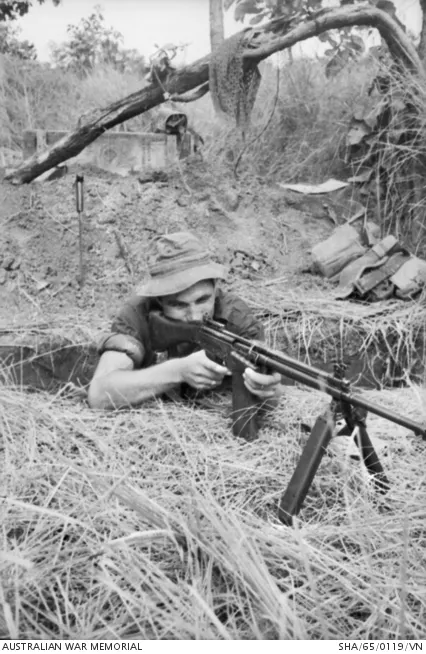
Any standard C1A1 could also be converted, without tools, in about 15 seconds, into a sniper configuration by fitting the Sniper Scope C1, a 4x28 telescope built by Ernst Leitz Canada under the model designation ELC1088 at a purpose-built plant in Midland, Ontario.7 Its reticle combined a vertical tapered post with a dashed horizontal stadia line, adjustable in half-mil clicks, with a range drum graduated to 1,000 yards in 100-yard steps. Canada ordered only 305 of these scopes in 1959 under the same contract that covered the 72,470-rifle batch, issued mainly to Regular Force units rather than the Militia, and documented in training use at Camp Ipperwash, Ontario, around 1970. The scopes were withdrawn from regular service in March 1976 and the last examples were disposed of, largely to cadet units, in 1994, making a genuine Sniper Scope C1 today far rarer than the rifle it was built for.7
A further variant, the C1D (also seen as C1A1D), gave the Royal Canadian Navy a selective-fire rifle in the standard C1's light, slim-barrel package rather than the bulkier C2. Navy boarding and shore parties needed occasional automatic fire for short, close engagements but found the heavier, bipod-equipped C2 impractical aboard ship, so the C1D borrowed the C2's trigger mechanism and change lever without its heavy barrel or bipod.4
Long Branch's small-arms output during this period was not limited to rifles. The same Canadian Arsenals Limited production lines also turned out a Canadian-built Sterling submachine gun, cataloged as the C1 submachine gun, a separate weapon from the C1 rifle that shared only its manufacturer and its numeral.11

Canada was, for practical purposes, the C1's only operator. The Canadian Army and, after 1968's unification of the armed forces, the Canadian Forces issued it as the standard infantry rifle from 1955 until the C7 changeover in the mid-1980s, with reserve units carrying it years longer.1 The Royal Canadian Navy fielded the C1D variant for shipboard boarding and security parties, a role distinct from the infantry's standard-issue C1A1.4 Unlike the Belgian FN FAL, which FN Herstal exported to dozens of countries directly or through other licensees, the Canadian-pattern C1 was built almost entirely for Canada's own forces, with the remainder of the roughly 80,000 to 90,000 total production run going to Canadian police agencies and civilian shooters rather than foreign militaries.4
C1A1 vs M14, Two Rivals from the Same Trial
The C1A1 and the American M14 descend from opposite results of the same NATO rifle trial. Both rifles chamber the 7.62x51mm NATO round the alliance settled on in 1954, and both trace their fire-control layout to a gas-operated tilting or rotating action rather than the FAL's rivals of the era. Where they differ is fire control and philosophy of automatic fire. Canada issued the C1A1 as semi-automatic only from the outset, accepting a dedicated separate C2 squad automatic for full-auto fire, while the United States built the M14 select-fire and only later restricted most rifles in service to semi-automatic fire once uncontrollable recoil in automatic mode became an obvious problem in practice. The M14 was also produced on a far larger scale, at roughly 1.5 million rifles against the C1 family's low tens of thousands, reflecting the difference between arming a single mid-sized NATO military and an entire US Army during the Vietnam War buildup.
| ÖZELLİK | FN C1 rifle | M14 |
|---|---|---|
| Ağırlık (Boş) | 4.337 kg | 4.17 kg |
| Şarjör Kapasitesi | 20 adet | 20 adet |
| Seçmeli Atış | — | ✓ |
| Namlu Çıkış Hızı | 823 m/sn | 853 m/sn |
C1A1 vs L1A1, Parallel Commonwealth Conversions
Britain's L1A1 is the closer sibling. Both rifles started from the same Canadian inch-pattern conversion of FN's metric drawings, both fire semi-automatic only, and both use nearly identical 20-round magazines within their own inch-pattern family.8 The practical difference is manufacturing detail rather than doctrine. Canada's own running changes, the arctic trigger guard, the screw-retained ejector, and the solid handguard among them, mean a Canadian C1A1 and a British L1A1 are not fully parts-interchangeable despite looking almost identical and sharing the same underlying dimensions.


What are the FN C1 rifle's basic specifications? The C1 and C1A1 fire 7.62x51mm NATO from a 20-round detachable box magazine, weigh about 4.3 kg empty, and use a gas-operated, tilting-breechblock action derived directly from the Belgian FN FAL, built to Canadian inch-pattern rather than metric dimensions.4,12
How does the FN C1A1 differ from the standard FN FAL? The mechanism is the same, but Canada converted FN's metric drawings to inch-pattern dimensions, changed the ejector retention method, removed the handguard's ventilation holes, adopted a different front sight, and added a removable trigger guard for use with arctic mittens, none of which appear on the Belgian-pattern rifle.4
Is the FN C1 rifle still in service? No. The Canadian Forces replaced it with the Colt Canada C7 through the mid-1980s, reserve units retired their remaining stocks by the mid-1990s, and Canada destroyed its last reserve war stocks of the rifle in 2009.4
What was the FN C1A1's unit cost? A 1963 Canadian Army supply manual lists a long-stock FN C1A1 at 193.77 Canadian dollars under National Stock Number 1005-21-150-5294, one of the few surviving period price references for the rifle.7
How does the C1A1 compare to the M14? Both fire the same 7.62mm NATO cartridge from a similar-era gas-operated action, but the C1A1 was semi-automatic only in standard infantry configuration while the M14 was built select-fire, and the M14 was produced on a vastly larger scale to arm the entire US Army rather than a single mid-sized force.2
- "FN C1 Self-Loading Rifle", The Canadian Encyclopedia — thecanadianencyclopedia.ca ↩
- "T48 rifle", Wikipedia — en.wikipedia.org ↩
- "FN FAL", Wikipedia — en.wikipedia.org ↩
- "FAL in the North, The Canadian C1A1", Forgotten Weapons — forgottenweapons.com ↩
- "Canadian Arsenals Limited, Canada's Post-War Small Arms Experience (Part 1)", Calibre Magazine — calibremag.ca ↩
- "The History of Small Arms Limited", Ontario Out of Doors — oodmag.com ↩
- "FN C1A1 Sniper Rifle", Captain Stevens — captainstevens.com ↩
- "L1A1 Self-Loading Rifle", Wikipedia — en.wikipedia.org ↩
- "Canadian Airborne Regiment and the Defence of Nicosia Airport, July 1974", LER Museum — lermuseum.org ↩
- "Perron-Berger Park", Veterans Affairs Canada — veterans.gc.ca ↩
- "C1 Submachine Gun", The Canadian Encyclopedia — thecanadianencyclopedia.ca ↩
- "FN FAL / L1A1 / C1 / SLR", Modern Firearms — modernfirearms.net ↩