


No factory built the Model 45A, no ordnance office assigned it a formal development number, and no test range ever fired it under controlled conditions. Everything known about it comes from two United States Army Signal Corps photo sessions shot in Manila, the Philippines, in October 1945, weeks after fighting in the islands had ended.1 The weapon in those photographs is a bullpup-configured .30 caliber rifle, built around a standard 20-round magazine from the M1918 Browning Automatic Rifle and fitted with an integral scope housed in its carry handle.2 Chambered for .30-06 Springfield, the same round used across the U.S. Army's Battle Rifles inventory of the period, it is described in surviving records only in vague terms, alternately as an experimental light machine gun and as a field-expedient .30 caliber weapon.1
- Compact bullpup layout decades ahead of its era
- Reused standard BAR magazines, no bespoke parts to source
- Integral scope eliminated the need for iron sights
- Dual role as rifle and grenade launcher, if genuinely functional
- No confirmed working action in any surviving photograph
- Zero documentation, no test report, no designer credited
- Unusually long barrel undercut the bullpup's compactness advantage
- Never trialled, never adopted, no surviving example known
No designer has ever been identified. Historical Firearms has floated Roman Korsak and Melvin Johnson as speculative possibilities, given each man's separate work on postwar U.S. small arms, but stresses the connection is tenuous at best and unsupported by any documentary evidence.3 The rifle was built by an unnamed group of U.S. Army Ordnance personnel stationed in Manila, at a moment and in a place that several researchers have called an unlikely setting for an ambitious weapons project.2
Forgotten Weapons has suggested the photo sessions themselves look like an internal marketing effort, an attempt to pitch the concept up the Army chain rather than a documented test program, though this too is inference rather than established fact.2 The most consequential fact about the Model 45A concerns what it may never have been able to do at all. Examining the surviving photographs, historian Bruce Canfield concluded that no bolt, bolt carrier, cocking handle, or ejection port is visible anywhere on the weapon, and that the barrel appears to sit in the stock without any mechanism behind it capable of cycling.4
Forgotten Weapons independently reached the same reading, noting that every surviving image is a static, posed shot and that none show the rifle being fired.2 The working assumption among researchers is that the Model 45A was most likely a non-functional mock-up, built to sell an idea on paper rather than to fire a round. An unnamed team, an undocumented build, and photographs that undercut the weapon's own core claim of being a firearm at all make this an unusual case even by the standards of failed prototype rifles.
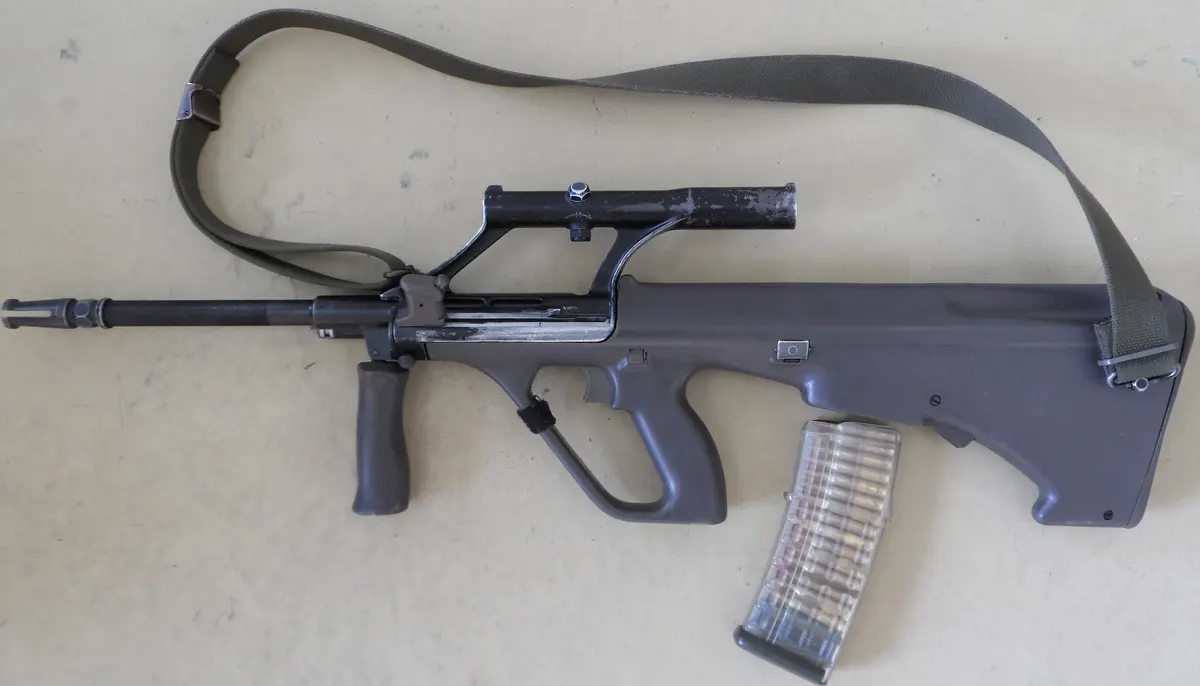
Every dimension and feature attributed to the Model 45A is drawn from the same handful of Signal Corps prints, not from a data sheet, so figures below should be read as photographic estimates rather than measured specifications.2 The rifle used a true bullpup layout, with its action and 20-round detachable magazine sitting behind the pistol grip and trigger group, well before the format became common in service rifles such as the Steyr AUG (1977), the FAMAS (1978), and the SA80 decades later.3 Despite the compact bullpup format, researchers estimate an overall length of roughly 30 inches, unusually long for the layout and suggesting the barrel was kept at close to full rifle length rather than trimmed to exploit the bullpup's space savings.3
- Fişek.30-06 Springfield
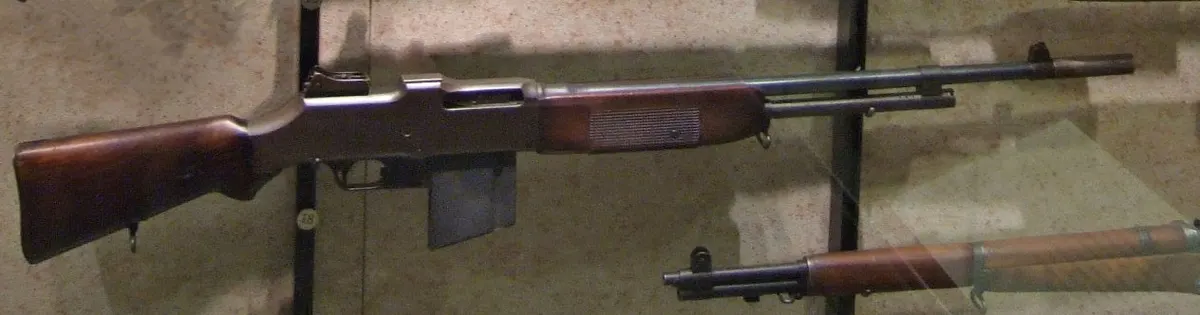
Rather than design a bespoke magazine, the builders fed the rifle from a standard 20-round Browning Automatic Rifle box magazine, a pragmatic choice consistent with a scratch-built project assembled from parts already sitting in an Ordnance depot rather than a funded arsenal program.1 In place of iron sights, the rifle carried an integral optical scope built into its carry handle, a detail that gives it a strong resemblance to the Steyr AUG despite predating it by more than 30 years, an observation multiple independent researchers have made about the photographs.3,5 The scope itself has never been identified, no maker or model has been determined from the images. A wooden buttstock that does not match any standard U.S. ordnance pattern of the period, along with a receiver cover that Historical Firearms describes as crudely stamped from sheet steel, both point toward local, improvised construction rather than an arsenal-built prototype.3
- Mekanizma TipiGazlı
- Seçmeli AtışEvet
- Besleme SistemiÇıkarılabilir Şarjör
- Şarjör Kapasitesi20
The rifle was fitted with a multi-port muzzle brake and was reportedly built to launch the M9A1 anti-tank rifle grenade, giving it a secondary anti-armor role stacked on top of its small arms function, an ambitious combination for a single 1945 design.2 Whether the gas-operated action and select-fire capability recorded for it were ever real is the open question running through the whole design. Wikipedia and most secondary sources repeat the gas-operated label as fact, most likely inferred from the .30-06 chambering shared with the gas-operated M1 Garand and BAR rather than from any bolt or gas system actually visible in a photograph.1 Given Canfield's conclusion that no bolt or bolt carrier appears anywhere in the images, both the operating mechanism and the automatic-fire capability implied by light-machine-gun descriptions are better treated as assumptions than confirmed features.4
- Nişangah TipiOptik
- Optik RayıEvet
- Açık NişangahHayır
Every other spec value associated with the Model 45A, the .30-06 chambering, the 20-round feed, the optical sighting system, and the bullpup layout itself, is consistent across every independent source that has examined the photographs. Only the action type and fire-control capability remain genuinely contested.
- Bullpup DüzeniEvet
Whether the design was intended as a rifle, a light machine gun, or a hybrid of the two remains unresolved, since no requirements document or design brief has ever surfaced to state its intended role.
- Toplam Üretim0
- Varyantlar0
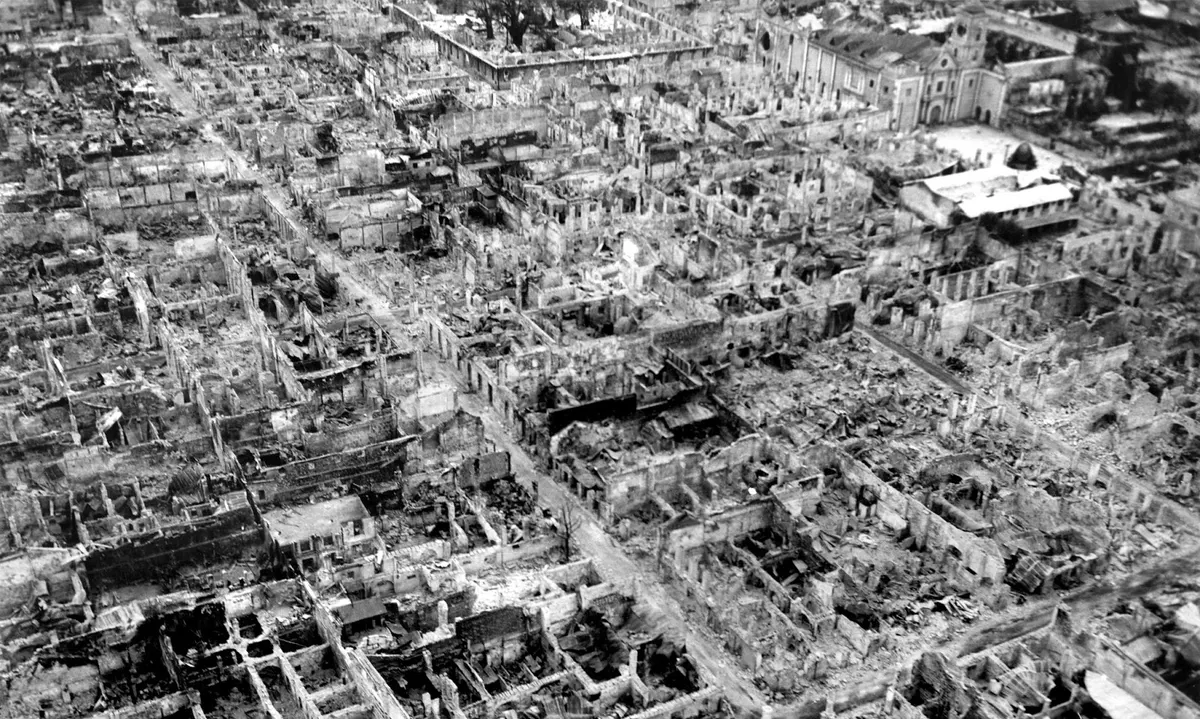
The Philippines had only just been cleared of Japanese forces when a group of U.S. Army Ordnance personnel in Manila apparently turned their attention to postwar small-arms design.2 Fighting in the islands had ended months earlier, and Manila itself was still recovering from the destruction of the battle for the city earlier in 1945, making the choice of location and timing stand out to later researchers as an unusual place for an advanced weapons effort to be underway.4
The only record of the rifle's existence is two separate photo sessions, shot by Army Signal Corps photographers in October 1945 and associated with the AFWES-PAG technical office covering the Western Pacific theater.2 Those prints sat essentially uncatalogued in the U.S. National Archives for decades before researchers rediscovered and began publishing them. No Ordnance Department test report, program file, or contemporary written description has ever surfaced alongside the images, and the unit responsible for the design, along with what became of the rifle afterward, remains unknown.1 It effectively disappears from the record the moment the photo sessions ended.
At almost exactly the same time, roughly 6,700 miles away at Springfield Armory, John Garand was independently developing his own bullpup rifle for the Army's postwar light rifle program.6 That design, the T31, shared the Model 45A's general layout and 20-round magazine capacity but arrived through the Army's official Ordnance Department channel, with proper documentation behind it, rather than through an anonymous field workshop.6
The rifle stayed almost entirely unknown outside a small circle of Ordnance historians until firearms researchers began republishing the Signal Corps prints more widely from the 2010s onward, pairing them with the Canfield and Forgotten Weapons photographic analyses that first raised doubts about whether the gun could fire.2,4 That renewed attention has not produced any new documentation, only closer readings of the same handful of images.
That distance underscores how far outside the Army's ordinary small-arms development channel the Model 45A sat, built in a recovering combat zone rather than a dedicated arsenal. Decades later, the rifle survives mainly as a curiosity among firearms historians and collectors, discussed for how much about it remains unknown rather than for anything it achieved in service.

The Model 45A was never adopted, never trialled by any Army board, and never produced beyond the single example, or possibly a small handful of examples, captured in the October 1945 photographs.1 No operational or service use of any kind is documented. No surviving example is known to exist today, and its whereabouts after 1945, if it still exists at all, have never been traced.2
One account has framed its absence from Army service as proof that the bullpup concept was simply too radical for the service to accept in 1945, requiring training and doctrinal changes the Army was not ready to make.7 Given the real doubt over whether the rifle could even fire, it may never have reached a formal adoption decision at all, rather than being rejected after serious consideration.
The Model 45A and the Garand T31 are the same idea, arrived at twice, independently, within the same few postwar months. Both took the Army's standard .30-06 cartridge and a 20-round magazine and folded them into a bullpup layout. Where they diverge is institutional weight. The T31 came out of Springfield Armory under John Garand's name, with an official Ordnance Department program behind it, select-fire operation, and a gas-trap system borrowed conceptually from Garand's original M1 gas-trap design, one that suffered persistent cooling and carbon-fouling problems in testing.6 The Model 45A carries none of that institutional backing. No test data exists for it because no formal test appears to have happened, and the deeper question of whether it could fire at all separates it from the T31 in a way no spec sheet captures.
| Model 45A | Garand T31 | |
|---|---|---|
| Origin | Anonymous Ordnance personnel, Manila | John Garand, Springfield Armory |
| Documentation | None, photographs only | Official Ordnance Department program |
| Action | Unconfirmed, no visible bolt in photos | Gas-trap, select-fire, documented |
| Magazine | 20-round BAR magazine | 20-round detachable magazine |
| Outcome | Never trialled, never adopted | Tested and rejected |
Both designs sit within a much broader wave of failed immediate postwar bullpup and select-fire universal rifle experiments across the Allied powers. Britain's EM-2 is the best remembered of that generation, briefly adopted in 1951 before cancellation. None of these designs succeeded commercially or militarily until the format was mainstreamed more than 30 years later by the Steyr AUG, the FAMAS, and the SA80. Set against that longer arc, the Model 45A looks less like a failed rifle and more like an early, unfinished sketch of an idea the rest of the industry would not take seriously for another generation.


What is the Model 45A? It is a one-off bullpup rifle photographed in Manila in October 1945, built by unidentified U.S. Army Ordnance personnel and chambered for .30-06 Springfield using a 20-round BAR magazine.1
Did the Model 45A actually work? Firearms historians who have examined the surviving photographs, including Bruce Canfield, have found no visible bolt, bolt carrier, cocking handle, or ejection port on the weapon, and no photograph shows it being fired. Most researchers now treat it as a probable non-functional mock-up rather than a working prototype.4
Who designed the Model 45A? No designer has ever been confirmed. Historical Firearms has raised Roman Korsak and Melvin Johnson as speculative possibilities, but stresses there is no documentary evidence tying either man to the project.3
How does the Model 45A compare to the Garand T31? Both were American bullpup .30-06 rifles built within months of each other in late 1945, but the T31 came from an official Springfield Armory program under John Garand while the Model 45A came from an anonymous field workshop with no paper trail at all.6
Does a Model 45A still exist? No surviving example is known. Its fate after the October 1945 photo sessions has never been traced.2
- "Model 45A", Wikipedia — en.wikipedia.org ↩
- "US Model 45A", Forgotten Weapons — forgottenweapons.com ↩
- "Model 45A Bullpup Battle Rifle Chambered in the .30-06", Historical Firearms — historicalfirearms.info ↩
- "The Incredible U.S. Model 45A, A Study in Photographs", Small Arms Review — smallarmsreview.com ↩
- "Attempting to Keep the Historic BAR Relevant by Turning It into a Bullpup Rifle", Sandboxx — sandboxx.us ↩
- "Mystery Bullpups and the M14", The Armory Life — thearmorylife.com ↩
- "Model 45A, The Rifle-Machine Gun the Army Said 'No' To", 19FortyFive — 19fortyfive.com ↩