


The Ishapore 1A1 is a semi-automatic 7.62x51mm NATO battle rifle built in India after FN Herstal and India's Ordnance Factories could not agree production terms for a licensed FN FAL family rifle.1 Rather than walk away, India's Armament Research and Development Establishment took apart sample L1A1 and FAL rifles from Britain and Belgium and drew its own manufacturing pattern from what it found.2 The result, formally inducted by the Indian Army as the 7.62mm Rifle 1A1 in 1963, mixes British and Belgian dimensions into a pattern that fits neither parent rifle's parts.2 Production ran, in some form, from 1960 until the line finally closed in 2012, with total output across the 1A1 family reaching roughly one million rifles.1
- Full-power 7.62mm NATO cartridge with real range and penetration
- Wholly Indian-tooled production chain, immune to any foreign licensing leverage
- Simple gas-piston action, proven reliable across three wars and decades of police service
- Wood stock and Lee-Enfield-pattern buttplate familiar to troops raised on the SMLE
- Heavier and slower-firing than the AK-47 and AKM its opponents carried in Sri Lanka
- Rougher machining than Commonwealth-built L1A1s, per collector and armorer reports
- Parts do not reliably interchange with either the British L1A1 or the Belgian FAL
- Semi-automatic-only standard rifle, inherited by default rather than by any stated Indian doctrine
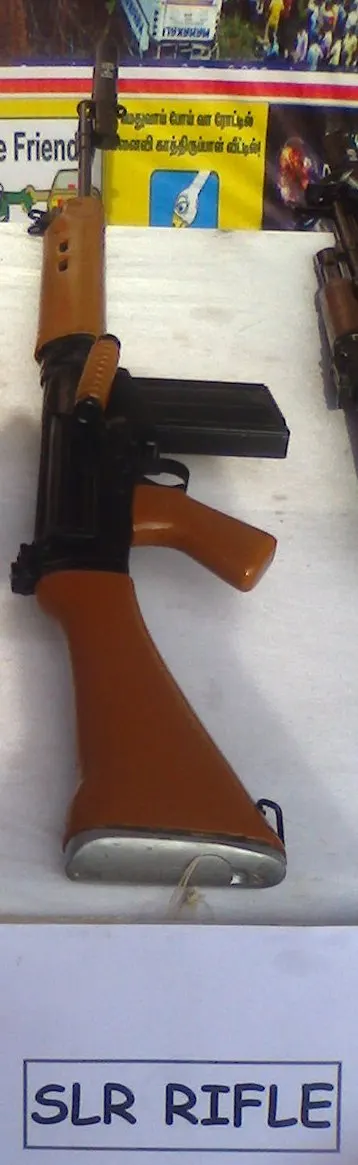
Sources describe the rifle's origin two different ways. Some call it a licensed FN FAL derivative. Others, drawing on more specific reporting from collectors and armorers, describe it as reverse-engineered without a completed license, a distinction with real consequences since FN threatened legal action once the Indian rifle appeared.2 The reverse-engineered account is better documented, and it fits the plain fact that the finished Ishapore drawings do not match either the metric FAL or the inch-pattern British L1A1 closely enough to swap parts.2 Prime Minister Jawaharlal Nehru personally closed the dispute, not by paying FN damages, but by having India buy additional Belgian-made FN rifles, FALO light-support versions, and FN MAG machine guns.3
Like the British L1A1 it was drawn from, the standard 1A1 fires semi-automatic only, even though its receiver is machined to the same dimensions as a select-fire FAL.2 India did field a full-automatic sibling, the 1A, alongside it, so the semi-auto restriction applied to the standard-issue rifle rather than to every gun India built on the pattern.2 The Indian Army retired the 1A1 from front-line use after 1998, once the INSAS 5.56mm rifle reached units, but the rifle's actual service life ran much longer than that date suggests. Retired Army stocks moved to the Central Reserve Police Force, assorted state police forces and the National Cadet Corps, and Uttar Pradesh Police was still issuing freshly delivered 1A1-pattern rifles to constables as late as January 2020, nearly six decades after the Army first adopted the design.7,8
Entirely India-built after FN licensing talks collapsed; ARDE reverse-engineered manufacturing drawings from sample rifles and no royalty-bearing license with FN Herstal was ever completed, making this a genuine indigenous-production story rather than licensed foreign production.
An Inch and Metric Hybrid That Matches Neither Parent Pattern
Collectors and armorers who have compared the three rifles side by side describe a long list of small, deliberate differences. The Ishapore bolt release copies the Belgian metric FAL design rather than the British inch-pattern part, while the wood buttstock instead carries a Lee-Enfield-pattern buttplate, complete with a trapdoor for an oil bottle and cleaning pull-through, a holdover from decades of SMLE manufacture at the same factory.2 The bolt itself uses a single locking cam rather than the L1A1's double, and lacks the sand cuts machined into Commonwealth-made bolts.2 The gas tube runs shorter than the L1A1's, the charging handle uses a straight-taper knob instead of a stepped one, and the fire-control group's sear spring pocket is rounded where the standard FAL's is angular.2 None of these differences change how the rifle works. Together, though, they add up to a genuine third manufacturing pattern, one where a part built for a British L1A1 or a Belgian FAL often will not drop into an Ishapore receiver.2
- İlk Üretim Yılı1960
- Hizmete Giriş Yılı1963
- TasarımcıArmament Research and Development Establishment (ARDE), India
- Ağırlık (Boş)4,337 kg
- Halen HizmetteEvet
- Önemli KullanıcılarIndian Army (retired 1998); Central Reserve Police Force, state police forces, National Cadet Corps (active/reserve)
Semi-Automatic Fire Inherited From a British Decision, Not an Indian One
No source records an India-specific policy debate over automatic fire. India adopted the semi-auto-only pattern because it copied the L1A1, which Britain, Australia, Canada and New Zealand had already built that way on the theory that aimed single shots from a full-power rifle round served infantry better than uncontrollable automatic bursts.1 The fire-control group is deliberately limited rather than mechanically incapable, since the receiver is cut to full FAL dimensions and a small number of missing internal parts is all that separates a semi-auto 1A1 from a select-fire FAL.2 India later built the full-automatic 1A on the same basic action, confirming that the semi-auto limit was a choice inherited from copying the L1A1 pattern rather than a fixed Indian design constraint.2
- Fişek7.62x51mm NATO
- Çap7,62 mm
- Kovan Uzunluğu51 mm
- Çap Sınıfıfull-power rifle cartridge
- Kenar AteşlemeliHayır
- Kovansız MühimmatHayır
The rifle feeds from a 20-round detachable box magazine, fires the 7.62x51mm NATO cartridge through a gas-operated, tilting-bolt action, and reaches an effective range cited at roughly 800 m in Ishapore-specific reporting, though that figure carries lower confidence than the weight and length figures above.1 Furniture across the standard 1A1 stayed entirely wood, in the wood-handguard, wood-stock, wood-pistol-grip configuration common to FAL-pattern rifles of its generation, with no optic rail fitted as issued.2
- Mekanizma TipiGazlı
- Atış ModlarıSemi-automatic only (1A1); select-fire on 1A and 1C variants
- Seçmeli AtışHayır
- Besleme SistemiÇıkarılabilir Şarjör
- Şarjör Kapasitesi20
A Steel and Pressure Question Still Open for the 1A1
One detail that would matter a great deal to a working armorer remains unconfirmed for the 1A1 specifically. For the related bolt-action Ishapore 2A1, built at the same factory in the same period, sources describe stronger steel than the older British No.1 Enfield action needed to handle 7.62mm NATO pressures, paired with ammunition loaded slightly below full NATO spec because the underlying receiver design still traced back to a rifle meant for the older, lower-pressure .303 British round.10 Whether the same steel and pressure story applies to the gas-operated 1A1 self-loader could not be confirmed from available sourcing, since the 1A1's action has little in common mechanically with the 2A1's bolt-action conversion. The parallel is worth noting as a plausible extension of the same domestic-manufacturing caution rather than a documented fact.
- Namlu Çıkış Hızı823 m/sn
- Etkili Menzil (nokta)800 m
- Namlu Uzunluğu554,4 mm
- Nişangah TipiIron aperture sights
- Optik RayıHayır
- Açık NişangahEvet
- Dişli NamluHayır
- Toplam Uzunluk1.143 mm
- Gövde Malzemesi (Receiver)Machined steel
- Kabza/Dipçik MalzemesiWood
- Katlanır / Toplanır DipçikHayır
- Bullpup DüzeniHayır
- Çift Yönlü KumandalarHayır
- Susturucuya HazırHayır
- Süngü TakozuEvet
- Entegre BipodHayır
- Gaz PistonluEvet
- Toplam Üretim1.000.000
- Üretim Başlangıcı1960
- Üretim Bitişi2012
- Varyantlar3
A War Exposes the Rifle Gap
The case for a new Indian battle rifle was made in the Himalayas, not in a design office. During the Sino-Indian War of 1962, Indian infantry fought with SMLE bolt-action rifles dating to the First and Second World Wars against Chinese troops carrying self-loading SKS carbines and AK-47 assault rifles.5 India chose the 7.62x51mm NATO cartridge for its own answer to that gap, a choice that lined India up with the Commonwealth and Western pattern rather than the Soviet one, reportedly for political reasons tied to India's wider alignment at the time.2 The Indian Army inducted the finished rifle as the 7.62mm Rifle 1A1 in 1963, in the direct aftermath of that war, ending decades of bolt-action standard infantry service.5
Refusing FN's Terms and Building the Rifle Anyway
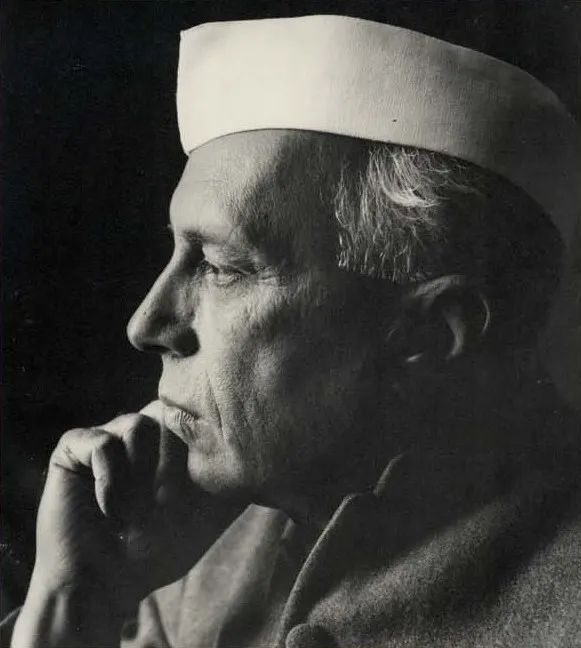
India's first choice was a straightforward license from FN Herstal in Belgium. That deal broke down over FN's condition that India buy Belgian tooling and machinery to build the rifle, a requirement India was unwilling to accept.2 Rather than abandon the project, the Armament Research and Development Establishment gathered sample FAL and L1A1 rifles sourced from Australia, Belgium and Britain, stripped each one down, and drafted a full set of Indian manufacturing drawings from what its engineers found.2 When FN learned of the finished, unlicensed rifle, the company threatened to sue.2 Nehru, once briefed on the dispute, resolved it commercially rather than in court, agreeing to have India purchase additional Belgian-made FN FALs, FALO light-support rifles and FN MAG 60.20 general-purpose machine guns in place of any damages payment.3 The episode left India with a rifle pattern that owed real technical debts to FN's design without ever completing a paid license for it.
From a Gunpowder Works to the Enfield of India
Rifle Factory Ishapore did not start out building rifles at all. The site at Ichapore, West Bengal, began as a gunpowder works on land the East India Company acquired from Maharaja Nobkissen Bahadur under a deed dated 28 April 1778, with construction starting in 1787 and gunpowder production running from 1 January 1791 until 1 June 1902.4 The factory converted to small-arms manufacture starting in 1901, modeled on the Sparkbrook works in Birmingham, and began building rifles on 20 September 1904 under its new name, Rifle Factory Ishapore, earning the nickname the Enfield of India.4 Over the following century it built Lee-Enfield rifles, the Vickers-Berthier light machine gun, kukris, bayonets, revolvers, pistols and even bazooka rockets, long before the 1A1 program began.4 Weapons made before 1949 carry a GRI stamp, for George Regis Imperator, while post-1948 production switched to RFI, for Rifle Factory Ishapore.4 The factory remained under the government's Ordnance Factory Board until 2021, when it was corporatized into Advanced Weapons and Equipment India Limited as part of a wider restructuring of India's state ordnance factories.4
Not every 1A1 came from Ishapore itself despite the name. Production of the rifle was shared with Ordnance Factory Tiruchirappalli in Tamil Nadu, also under the Ordnance Factory Board, so the Ishapore name marks the design's origin rather than every unit's birthplace.5
One Million Rifles Over Half a Century
Output peaked at roughly 750 rifles a week, and cumulative Ishapore-pattern production reached approximately one million units by the time reporting caught up with it around 2019.1 The pace slowed considerably through the 1980s as INSAS development absorbed India's small-arms attention, and by 2012, the final year of production, output had fallen to roughly 6,000 rifles annually before the line closed for good.2 Half a century of near-continuous manufacture, spanning three major wars and a long tail of police re-issue, makes the 1A1 one of the longest-running rifle programs to come out of any single Indian ordnance factory.
The 1965 and 1971 Wars
The 1A1 saw confirmed combat use in both the Indo-Pakistani War of 1965 and the Indo-Pakistani War of 1971, by which point it had fully replaced the bolt-action Lee-Enfield as India's standard infantry rifle.1 Indian Army units also carried the 1A1 into the Bangladesh Liberation War of December 1971, fought on the eastern front of that same broader conflict as Indian forces intervened alongside the Mukti Bahini against Pakistan.1 Across all three campaigns the rifle performed the role it had been built for, giving Indian infantry a full-power semi-automatic answer to the older bolt-action rifles it replaced and rough parity with the self-loading rifles fielded by Pakistan's own Commonwealth-descended arsenal.
The IPKF, Sri Lanka and an Embarrassing Gap
The rifle's most consequential conflict, in terms of what it changed about Indian small-arms policy, was not a war against Pakistan or China at all. During the Indian intervention in the Sri Lankan Civil War (the Indian Peace Keeping Force deployment, 1987 to 1990, inside the wider Sri Lankan Civil War), Indian infantry, including elite parachute commando battalions, deployed to Sri Lanka still carrying 7.62mm SLRs that were by then roughly twenty years old, while the Liberation Tigers of Tamil Eelam carried modern AK-47 assault rifles.6 In close-quarters jungle and urban fighting, the SLR's semi-automatic fire and greater bulk left Indian troops at a real disadvantage against the AK-47's fully automatic fire and lighter handling, a gap that also extended to webbing, light machine guns and radios.6 The Army's own response was to import roughly 100,000 AK-47 rifles, at around $300 apiece, and issue about 100 per infantry battalion within the IPKF, a stopgap fix that ran alongside, rather than in place of, the standard-issue SLR.6
That capability gap fed directly into a longer overhaul. India tested seventeen different 5.56mm rifles from eleven countries before handing development to its own defence establishment, a process that took what one account calls fifteen difficult years and produced the INSAS rifle, adopted in 1998.5 The Ishapore 1A1, the full-automatic 1A and the firing-port-adapted 1C were gradually withdrawn from Indian Army front-line service after that date as INSAS reached units.5
The transition, in other words, moved in both directions at once. India retired the 1A1 because a full-power semi-automatic rifle had proven too heavy and too slow-firing against the AK-47 in Sri Lanka, then discovered that its lighter, faster-firing replacement carried reliability problems of its own during the very next war it fought.
The 1A Full-Automatic Version
India built a full-automatic sibling to the standard 1A1, designated the 1A, closer in its fire-control layout to the Belgian metric FAL pattern than to the semi-auto-only British L1A1.2 Fielding a select-fire version alongside the standard semi-automatic rifle shows that India's own small-arms planners were willing to depart from the L1A1 pattern when a role called for it, even while keeping the 1A1 as the primary infantry rifle.
The 1C, Built for the BMP-2's Firing Ports
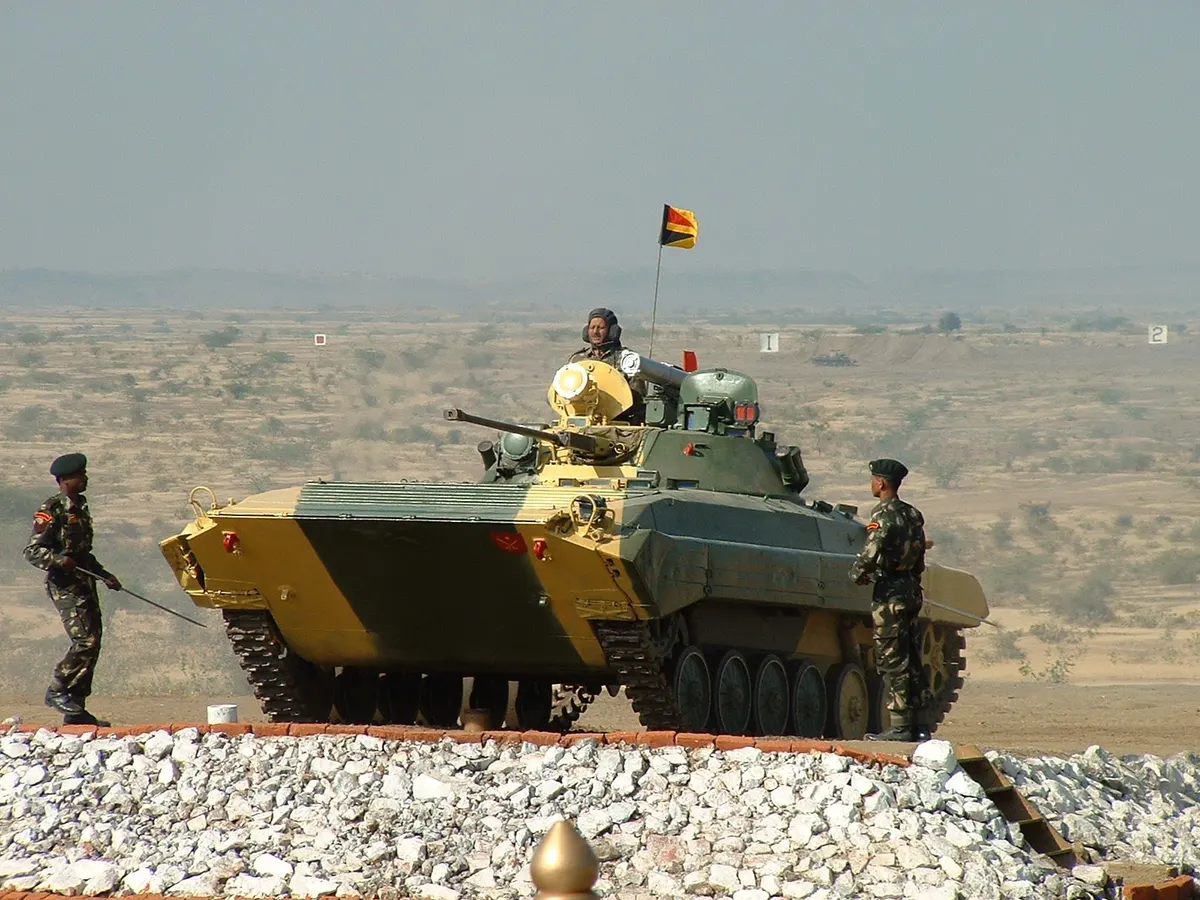
The 1C, introduced in the mid-1980s, shortened the standard rifle's barrel and added selective fire plus a firing-port adapter sized for the BMP-2 infantry fighting vehicles India was then importing from the Soviet Union.2 The adaptation solved a specific complaint. Mechanized infantry crews found the Romanian-built AKM firing-port weapon unsatisfying, did not want to give up the harder-hitting, longer-ranged 1A1 for dismounted work, and faced a shortage of 7.62x39mm tracer ammunition for the AKM in Indian stocks, so India adapted its own rifle rather than lean further on the imported one.2 The 1C weighs approximately 4.5 kg and, like the 1A1, feeds from a 20-round magazine.2
A Different Rifle Entirely, the Bolt-Action 2A1
The Ishapore 2A1, built at the same factory in the same period, is not a member of the 1A1 family at all. It is a bolt-action conversion of the Lee-Enfield No.1 Mk III* rechambered for 7.62x51mm NATO, adopted in 1963 and produced into the mid-1970s as a reserve and police arm.10 The two rifles share only a buttplate design carried over from Ishapore's decades of Lee-Enfield manufacture. Mechanically, one is a bolt-action conversion of a nineteenth-century action and the other a gas-operated self-loader built from FAL drawings, and conflating the two misrepresents both.10

India stands as the only solidly confirmed operator of the Ishapore 1A1, though its service inside India ran across several distinct institutions over six decades.1 The Indian Army fielded it as the standard infantry rifle from 1963 until frontline withdrawal after 1998, when the INSAS took over. Retired Army rifles then passed down to the Central Reserve Police Force, other Central Armed Police Forces, assorted state police forces and the National Cadet Corps, where the 1A1 and 1C remained in active or ceremonial use well past 2018.1

The clearest example of that long tail came from Uttar Pradesh. The state government announced in November 2019 that it would equip its police with 63,000 INSAS rifles and 23,000 SLR rifles of the Ishapore pattern, replacing the force's remaining .303 Lee-Enfields.7 On Republic Day, 26 January 2020, Uttar Pradesh Police formally retired those Lee-Enfields after roughly 75 years of service, ending a bolt-action rifle's run that had begun in 1945.8,9 The rifle handed to a large share of those constables in its place was not a brand-new design at all. It was the Ishapore 1A1 pattern, freshly issued to a major Indian state police force nearly sixty years after the Army first inducted it, and more than two decades after the Army itself had moved on.
Export use beyond India is thin and largely unconfirmed. A handful of secondary sources mention Indian-made SLRs reaching Bangladesh's forces during the 1971 war and Brunei holding the pattern as standard issue, but the Bangladesh claim rests on a single weak citation and the Brunei claim more likely reflects confusion with the wider British and Commonwealth L1A1 family rather than the Indian-built rifle specifically.1 General industry assessment describes Indian FAL-family exports as limited and commercially unattractive, since the Indian rifles were seen as the budget end of the FAL family with little profit margin for a buyer to recoup.2 Treat India as the confirmed operator and any foreign use as unverified.
The most direct comparison is with the rifle's own closest relative, the British L1A1. Both share the same basic gas-operated, tilting-bolt FAL action and the same semi-automatic-only fire-control decision, and both trace their dimensions to the same family of FN drawings. Where they diverge is manufacturing standard and small-parts geometry rather than overall concept. The L1A1 holds to a single inch-pattern standard throughout, built and kept in spec across Royal Small Arms Factory Enfield, Australia's Lithgow works and Canada's own C1A1 line.1 The Ishapore 1A1 mixes British and Belgian dimensions into a pattern unique to India, a byproduct of building from disassembled sample rifles rather than licensed drawings, and that mixed origin is exactly why Ishapore parts do not reliably interchange with either standard L1A1 or standard FAL components.2
| Feature | Ishapore 1A1 (India) | L1A1 (Commonwealth) |
|---|---|---|
| Origin route | Reverse-engineered from sample rifles2 | Licensed FN FAL production1 |
| Measurement standard | Mixed inch and metric2 | Inch pattern throughout1 |
| Fire modes | Semi-automatic only on the 1A1, full-auto on the 1A sibling2 | Semi-automatic only1 |
| Parts interchange | Not compatible with L1A1 or FAL parts2 | Not fully compatible with metric FAL parts1 |
Against the rifle it actually lost ground to in the field, the Soviet-pattern AK-47 and its AKM derivative, the comparison is less about shared ancestry and more about doctrine colliding with reality. The 1A1's full-power 7.62x51mm cartridge outranges and outpenetrates the AK-47's intermediate 7.62x39mm round at distance, but that advantage mattered far less in the close, fast engagements that defined the IPKF's fighting in Sri Lanka, where the AK-47's fully automatic fire and lighter weight gave the LTTE a real edge over semi-automatic-only Indian infantry.6 The SKS carbine that Chinese troops carried in 1962 sits somewhere between the two, a self-loading but non-select-fire rifle in an intermediate caliber, and it was seeing Indian troops outmatched by SKS-armed opponents that first justified moving away from the bolt-action Lee-Enfield toward a self-loader in the first place.5
The rifle's own eventual Indian replacement, the INSAS, makes for a more pointed comparison than either foreign design. INSAS traded the 1A1's full-power 7.62mm cartridge for the lighter 5.56mm round, cut weight, and added select-fire capability the standard 1A1 never had, addressing the exact automatic-fire gap that had hurt Indian infantry against the AK-47 in Sri Lanka.5,6 What INSAS did not immediately deliver was the older rifle's reputation for mechanical simplicity. Units in the field during the 1999 Kargil War reported jamming, cold-weather magazine cracks and unintended slips into automatic fire, problems the 1A1's simpler semi-automatic action had not shared.5 The net result reads less as a clean upgrade than as a genuine trade, lighter ammunition and real automatic fire in exchange for a rifle that took years longer than planned to iron out reliability issues the 1A1 never had to solve in the same way.


What are the Ishapore 1A1's specifications? The Ishapore 1A1 fires 7.62x51mm NATO from a 20-round detachable box magazine through a gas-operated, tilting-bolt action. The well-established L1A1-family baseline figures, which the Ishapore rifle closely follows, list an empty weight of 4.337 kg, an overall length of 1,143 mm, a 554.4 mm barrel and a muzzle velocity near 823 m/s, with an effective range cited around 800 m in Ishapore-specific reporting.1
Is the Ishapore 1A1 licensed from FN or reverse-engineered? Reporting is split. The better-documented account holds that FN Herstal's licensing terms, which required India to buy Belgian tooling, fell through, and that India's own engineers reverse-engineered the rifle from disassembled sample FAL and L1A1 rifles instead, prompting FN to threaten legal action before Prime Minister Nehru settled the dispute commercially.2,3 Some general references still describe the rifle simply as licensed production, a framing this history does not fully support.
How does the Ishapore 1A1 differ from the FN FAL and the L1A1? It mixes British inch-pattern and Belgian metric dimensions into its own hybrid, drawn from sample rifles rather than a single licensed pattern, so its parts, from the bolt release to the gas tube, do not reliably interchange with either the British L1A1 or the Belgian FN FAL.2
Is the Ishapore 1A1 still in service? The Indian Army retired it from front-line use after 1998 in favor of the INSAS, but it remains in reserve, police and ceremonial use well beyond that date. Uttar Pradesh Police issued a fresh batch of roughly 23,000 Ishapore-pattern SLRs in early 2020, and Kerala's state police reportedly took delivery of units as recently as 2018.1,7
What is the Ishapore 1A1's unit cost? No confirmed unit-cost figure for the Ishapore 1A1 itself appears in available sourcing. For comparison, India's later emergency purchase of AK-47s for the Indian Peace Keeping Force cost roughly $300 per rifle at the time, though that figure reflects a different weapon bought under different, wartime circumstances rather than the 1A1's own production cost.6
How does the Ishapore 1A1 compare to the INSAS rifle that replaced it? INSAS replaced the 1A1's full-power 7.62mm cartridge with the lighter 5.56mm round and added select-fire capability the standard 1A1 lacked, directly answering the automatic-fire gap that had hurt Indian troops against AK-47-armed LTTE fighters in Sri Lanka. INSAS itself then drew reliability complaints during the 1999 Kargil War that the mechanically simpler 1A1 had not shared, so the switch traded one set of tradeoffs for another rather than delivering an unambiguous upgrade.5,6
- "L1A1 Self-Loading Rifle", Wikipedia — en.wikipedia.org ↩
- "India's FAL, The 1A1 Inch/Metric Hybrid", Forgotten Weapons — forgottenweapons.com ↩
- "Ishapore Rifle (3 June 1963)", The Nehru Archive — nehruarchive.in ↩
- "Rifle Factory Ishapore", Wikipedia — en.wikipedia.org ↩
- "Service Rifles of Indian Army, 1947-Present", DefenceXP — defencexp.com ↩
- "The Indigenous Rifle Saga", SP's Land Forces — spslandforces.com ↩
- "UP police to get INSAS, SLR rifles in place of .303", Business Standard — business-standard.com ↩
- "Republic Day, UP police bids adieu to British-era .303 rifles after 75 yrs", Business Standard — business-standard.com ↩
- "Curtains for British-era .303 rifles in Uttar Pradesh after Republic Day", India.com — india.com ↩
- "Ishapore 2A1 rifle", Wikipedia — en.wikipedia.org ↩