


Switzerland ran two separate, competing state programs after the Second World War to replace the bolt-action Karabiner 1931 (K31), and the Sturmgewehr 52 was the losing entry. It came from Waffenfabrik Bern (W+F Bern), the government-owned arsenal in Switzerland, and it amounted to a Swiss reworking of the German FG 42 paratrooper rifle rather than an original design.1 The rifle kept the FG 42's gas-operated action and its selective fire capability, but swapped in a tilting bolt in place of the German rotating bolt and a Swiss-designed intermediate cartridge, the 7.5x38mm Kurzpatrone. It is one of the more obscure entries among postwar battle rifles, a category it never formally joined.2
- FG 42-proven gas system, well understood by Bern's designers
- Selective fire from a Swiss-made intermediate cartridge, ahead of the trend elsewhere
- Rifle-grenade launching muzzle built in from the start
- Detachable box magazine (30 or 40 rounds)
- Never adopted, no confirmed production total
- Lost decisively to a rival system in the 1956 trials
- Cartridge choice reversed mid-program, wasting earlier tooling
- Almost no factory documentation survives publicly
By the end of 1956 the Swiss army had tested this rifle's final form, the Stgw-54, against SIG's roller-delayed AM55 and against the Belgian FN FAL. SIG won and its design became the SIG SG 510, adopted as the Stgw 57.3 Bern's whole FG 42-derived effort, including this rifle, was shelved.
The Tilting-Bolt Gas System Adapted From the FG 42
The Sturmgewehr 52 used a gas-piston operated long-stroke system copied almost directly from the FG 42, firing from an open bolt on full automatic and a closed bolt on semi-automatic, the same arrangement the German rifle used.1 The main mechanical change from the FG 42 was the locking method. Where the German rifle rotated its bolt to lock, the Bern engineers used a tilting bolt instead, a simpler machining job better suited to the smaller Swiss cartridge.2
- TasarımcıAttributed to Adolf Furrer, longtime head of W+F Bern's design bureau (unconfirmed for this specific program)
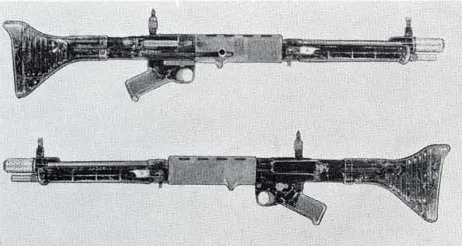
Feed came from a detachable magazine holding 30 or 40 rounds, mounted to one side of the receiver in the same style as the FG 42's side-feed layout, though sources disagree on which side and the exact figure may vary between prototype batches.1
- Fişek7.5x38mm Kurzpatrone
- Çap7,5 mm
- Kovan Uzunluğu38 mm
- Çap Sınıfı7.5mm
Sighting was a plain set of iron sights, and the muzzle carried a fitting for launching rifle grenades, a standard requirement for Swiss infantry rifles of the period.1
- Mekanizma TipiGazlı
- Atış Modlarıseçmeli ateş
- Seçmeli AtışEvet
- Besleme SistemiÇıkarılabilir Şarjör
- Şarjör Kapasitesi30
- Tambur / Şerit Kapasitesi40
From the 7.5x38mm Kurzpatrone to the Full-Power GP11
The 52 designation marks the intermediate-cartridge branch of the program, chambered in 7.5x38mm Kurzpatrone, a reduced-power round Bern had been experimenting with since the interwar years.2 Later in the same program, under the designation StG-54, Bern abandoned the intermediate round and rechambered the design for the full-power 7.5x55mm GP11, the Swiss army's standard rifle cartridge, in an attempt to match SIG's rival design on paper.4
- Nişangah TipiDemir
- Açık NişangahEvet
- Üretim Başlangıcı1952
- Varyantlar2
Two Rival Programs to Replace the Karabiner 1931
Switzerland's postwar infantry rifle program split into two independent tracks. Waffenfabrik Bern, the state arsenal, pursued a gas-operated rifle descended from the FG 42. SIG, a private company in Neuhausen, pursued a roller-delayed system under engineer Rudolf Amsler.3 Bern's track began in 1951 and moved through roughly half a dozen major prototype iterations, from the StG-51 through this StG-52 to the StG-54, before the program ended in 1956, all while the Karabiner 1931 remained the standard-issue Swiss infantry rifle.2
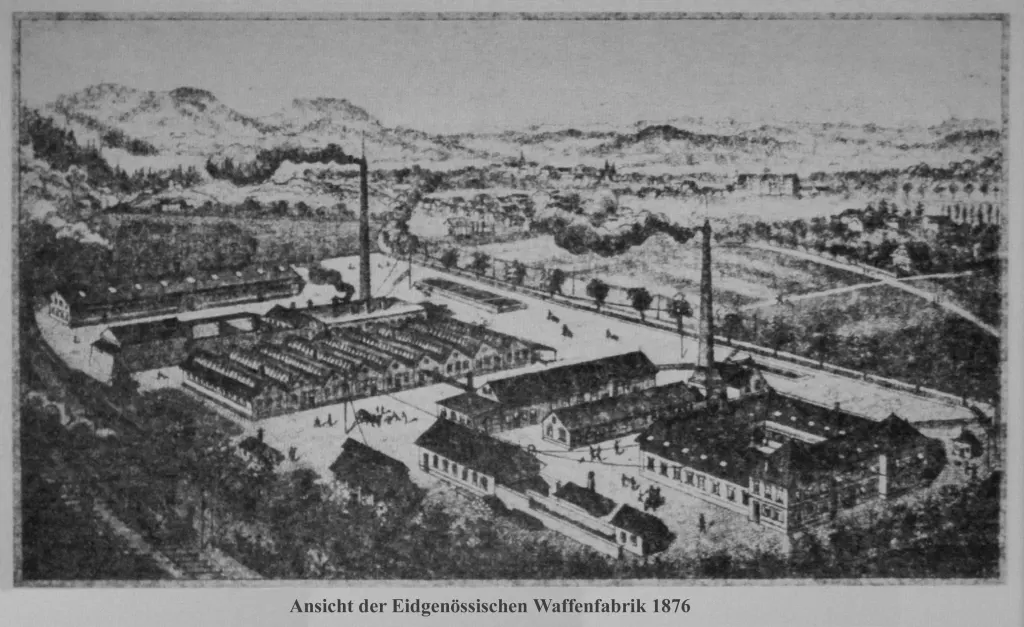
The program is often credited to Adolf Furrer, the longtime head of Bern's design bureau and the figure behind earlier Swiss designs like the Lmg 25 and the Pistole 06/29.5 The attribution is not fully settled. Furrer directed Bern's decades-long research into intermediate cartridges, but he had already resigned from the arsenal's leadership after the Second World War, so his personal hand in the StG-51 through StG-54 prototypes specifically is uncertain rather than confirmed.5
Bern kept revising the design through the early 1950s without ever settling on one final configuration, which is part of why the StG-51, this StG-52 and the later StG-54 are so often blurred together in modern references.
Small batches went to Swiss troop trials starting in 1953. No factory-confirmed total production figure for the whole program has surfaced, and the DB's inherited figure of 52 units looks more like a mistaken echo of the model's own name than a real count.
By the mid-1950s the intermediate 7.5x38mm cartridge had been dropped in favor of the full-power 7.5x55mm GP11, partly because that round was already in Swiss army stock and already used in the newly adopted MG 51 machine gun.3
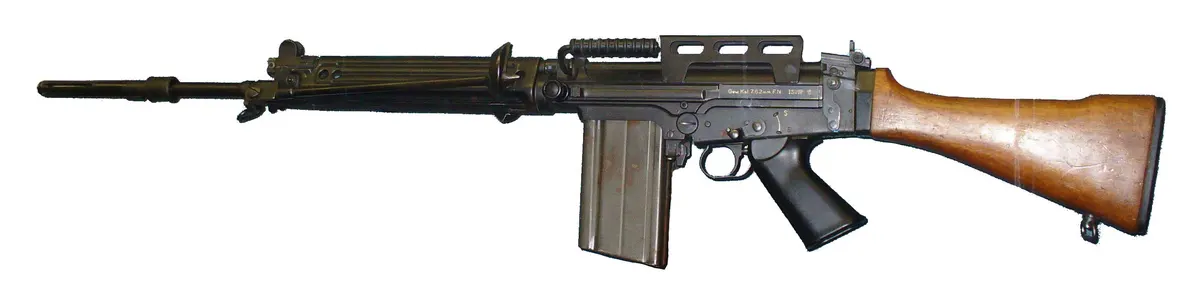
At the end of 1956 the Swiss army ran a final comparative trial between three rifles, SIG's AM55, Bern's StGw-54, and FN's FAL.3
The Decisive Loss and What Came After
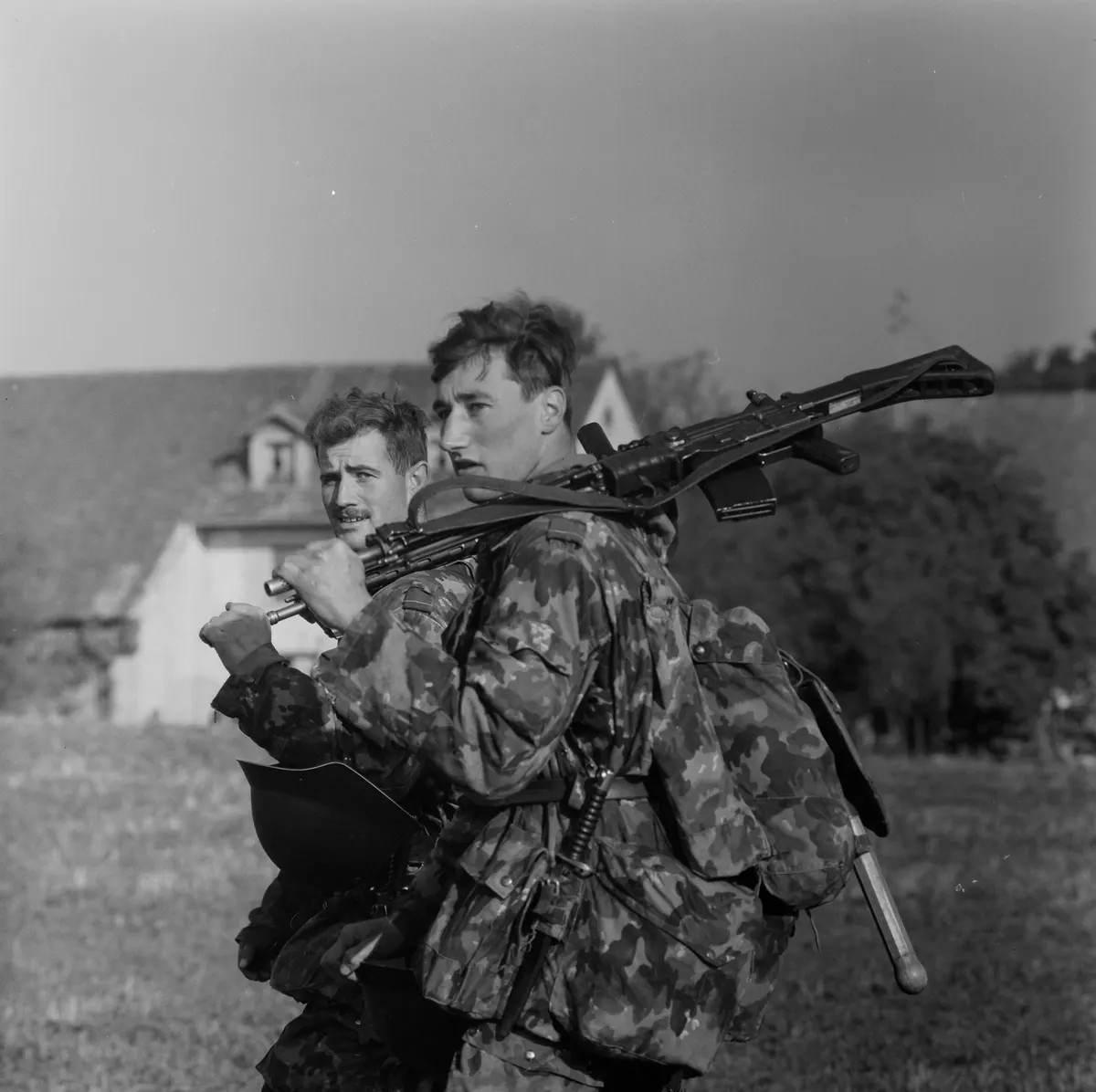
SIG's AM55 won. It entered Swiss service as the Stgw 57, built by SIG as the SIG SG 510.3 Bern's FG 42-derived rifle, including every prototype from the StG-51 to the StG-54, was rejected outright and never entered production.
Waffenfabrik Bern itself did not long outlast the loss as an independent gunmaker. It kept producing other Swiss military equipment for decades afterward but was folded into RUAG in 1999, ending its run as a standalone state arms factory.5
Today the surviving Sturmgewehr 52 prototypes exist only in museum and private collections, alongside the small number of parallel StG-51 and StG-54 examples from the same rejected program.2
From StG-51 to StG-54, Where One Prototype Ends and the Next Begins
The Sturmgewehr 52 sits in the middle of a short, badly documented prototype series rather than standing as a single fixed design. The earliest version, the StG-51, established the FG 42-derived tilting-bolt action in 7.5x38mm Kurzpatrone starting in 1951, the same year Bern's program began.2
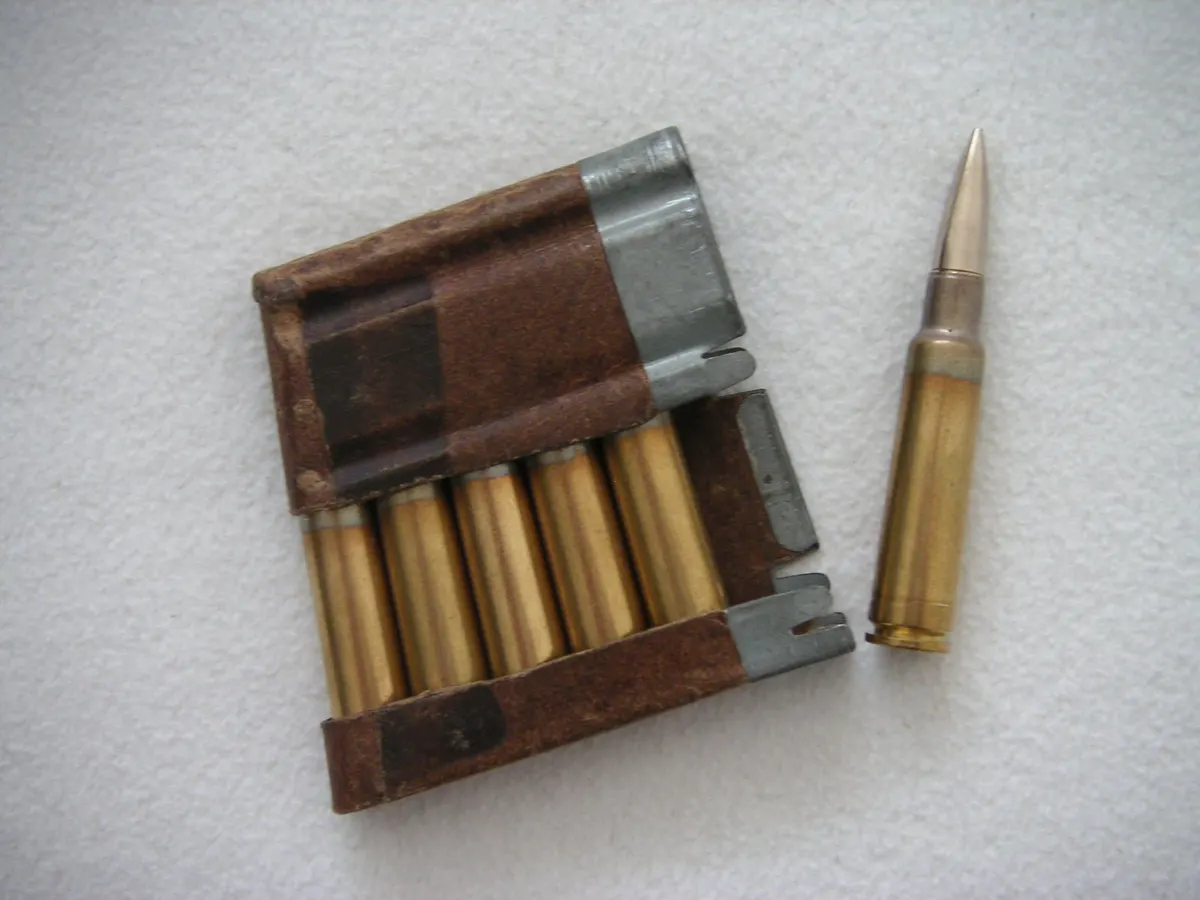
This StG-52 represents the program in its original intermediate-cartridge form, the version that reached the 1953 troop trials described above.
The final version, the StG-54, kept most of the same mechanism but was rechambered for the full-power 7.5x55mm GP11 and simplified in detail before losing the 1956 trial.4 Bern's own internal boundaries between these iterations were never made public, so exactly which prototypes count as distinct variants and which are simply incremental changes to the same rifle is not something outside sources can settle with confidence.

The Sturmgewehr 52 and the SIG SG 510 answer the same postwar requirement with opposite mechanisms. Bern bet on a gas piston and tilting bolt directly descended from the FG 42, a system already proven in wartime combat. SIG bet on a delayed blowback roller-locking system, unproven in Swiss service yet simpler to manufacture and easier to scale for full-power ammunition.3 That manufacturing simplicity is generally credited as the deciding factor in the 1956 trial, well ahead of any raw difference in accuracy or reliability.3
The cartridge story reinforces the same point. SIG never wavered from the existing 7.5x55mm GP11 round, which was already stocked for other Swiss weapons including the MG 51. Bern spent years developing an intermediate 7.5x38mm round for the StG-51 and StG-52 before abandoning it for the StG-54, a costly reversal that cost the program time SIG did not lose.3
| Sturmgewehr 52 (W+F Bern) | SIG SG 510 / Stgw 57 | |
|---|---|---|
| Maker | State arsenal (Waffenfabrik Bern) | Private company (SIG Neuhausen) |
| Action | Gas-operated, tilting bolt | Roller-delayed blowback |
| Cartridge | 7.5x38mm Kurzpatrone, later 7.5x55mm | 7.5x55mm GP11 throughout |
| 1956 trial result | Rejected | Selected, adopted as Stgw 57 |
Against the FN FAL, the comparison is really about state ambitions rather than mechanism. The FAL by the mid-1950s was already becoming a NATO-adjacent standard, adopted or trialed across dozens of armies. Bern's rifle, by contrast, existed only to serve Switzerland's own famously self-sufficient small-arms tradition and was never offered for export or wider adoption at any point in its short life.4


Was the Sturmgewehr 52 ever adopted by the Swiss army? No. It was rejected at the end of 1956 in favor of the SIG AM55, adopted as the SIG SG 510 (Stgw 57).3
What cartridge did the Sturmgewehr 52 use? The StG-52 designation specifically covers the intermediate 7.5x38mm Kurzpatrone chambering. A later version of the same program, the StG-54, was rechambered for the full-power 7.5x55mm GP11.2,4
How many Sturmgewehr 52 rifles were built? No confirmed factory total exists. A collector account citing serial numbers from one 1953 troop-trial batch suggests as few as three dozen for that batch, but it may not represent the whole program.2
How does the Sturmgewehr 52 compare to the SIG SG 510? Both were built to replace the Karabiner 1931, but the Sturmgewehr 52 used a gas-operated tilting-bolt system descended from the FG 42, while the SIG SG 510 used a roller-delayed blowback action that proved cheaper to manufacture and ultimately won the 1956 Swiss trials.3
- "Sturmgewehr 52", Wikipedia — en.wikipedia.org ↩
- "WF-51, A Swiss Intermediate-Cartridge Copy of the FG-42", Forgotten Weapons — forgottenweapons.com ↩
- "Swiss assault rifles (Sturmgewehr)", Safar Publishing — safar-publishing.com ↩
- "WF-54, The Swiss FG-42 Scaled Up to 7.5x55", Forgotten Weapons — forgottenweapons.com ↩
- "Waffenfabrik Bern", Wikipedia — en.wikipedia.org ↩