

A gas-operated action cycles a firearm by tapping a small portion of the propellant gas from a fired cartridge and using it to drive the bolt rearward, extracting the case and chambering the next round automatically. That separates a self-loading rifle from one worked by hand. A bolt-action needs the bolt lifted, pulled, pushed, and locked for every shot, a lever-action needs a full stroke of an underlever, a pump-action needs the forend racked, a break-action needs the barrel hinged open, and a revolver needs its cylinder indexed by hand. Gas operation removes that manual step.
Gas is also only one of several ways to build a self-loading rifle. A blowback design skips the barrel port and lets the case push the bolt back under raw chamber pressure, workable only with lower-pressure rounds. A delayed-blowback design adds a mechanical or gas brake to that same principle. A recoil-operated gun instead lets the whole barrel and bolt travel backward together before unlocking, in either a short-recoil or long-recoil stroke. Gas-operated rifles route gas forward of the chamber instead, scaling from a rifle cartridge up to a machine gun without recoil operation's reciprocating mass.
01John Browning's 1889 Patents and the First Gas-Operated Machine Guns
Gas operation itself predates Browning by decades. German engineer Edward Lindner patented a gas piston fitted to a single-shot breech-loading rifle in 1856, and English engineer William Curtis patented the first fully gas-operated repeating rifle in 1866.1 Hiram Maxim covered a gas-operated variant among his 1883-1885 blowback and recoil patents, English engineer Richard Paulson patented his own gas-piston rifle and pistol in 1885 before adding a gas-operated revolver the following year, and American Henry Pitcher patented a gas-operated conversion system in 1887.1 None of these reached a mass-produced firearm, and the French Clair brothers came closest with a gas-piston pistol and rifle in the 1880s and a semi-automatic shotgun in the early 1890s that never left the workshop.1
John Browning patented his own gas-operated actions in 1889, after noticing muzzle blast carried enough force to do useful mechanical work.2 He drilled a gas port into a lever-action barrel and hooked an oscillating arm onto it, and Colt built the design as the Model 1895 machine gun, nicknamed the potato digger because its swinging arm would gouge soft ground if the tripod sat low enough.3 It proved gas operation could cycle a full-power cartridge, and the US Navy adopted it in 1895 as the first gas-operated machine gun in military service.2

A parallel invention emerged the same year on the other side of Europe. Austro-Hungarian artillery officer Adolf Odkolek von Ujezd filed his own gas-operated machine gun patent in July 1889, and the French arms firm Hotchkiss et Cie bought his design in 1894 and 1895 and handed it to engineers Laurence Benet and Henri Mercie to refine.4 Their finished gun reached export markets by 1898, arming Brazil, Chile, Japan, Mexico, Norway, and Venezuela in a single year, giving gas operation its first genuinely international spread barely a decade after Lindner's 1856 patent.4

The same principle reached rifle scale in Czechoslovakia during the 1920s. Designer Vaclav Holek at Ceska Zbrojovka built the ZH-29 around a long-stroke gas piston driving a tilting bolt locked sideways into the receiver wall.5 It is remembered as one of the first practical semi-automatic rifles, and its layout, a fixed port, a full-length piston, a locking bolt, became the template most later self-loading rifles copied.6
By the early 1940s the same idea reached full infantry service. Germany's FG 42 paired a gas-operated tilting bolt with a full-power 7.92x57mm cartridge for Fallschirmjager paratroopers.7 US Army trials also weighed a gas-operated M1 Garand prototype against John Pedersen's delayed-blowback entry, and gas operation won partly because it needed no lubricated ammunition.8 Early production Garands used a gas trap clamped over the muzzle instead of a drilled port, a fragile complication designer John Garand dropped in 1940 for the simpler fixed-port layout every later gas-operated rifle would copy.9
01Piston Stroke and Direct Impingement, How the Gas Actually Cycles the Action
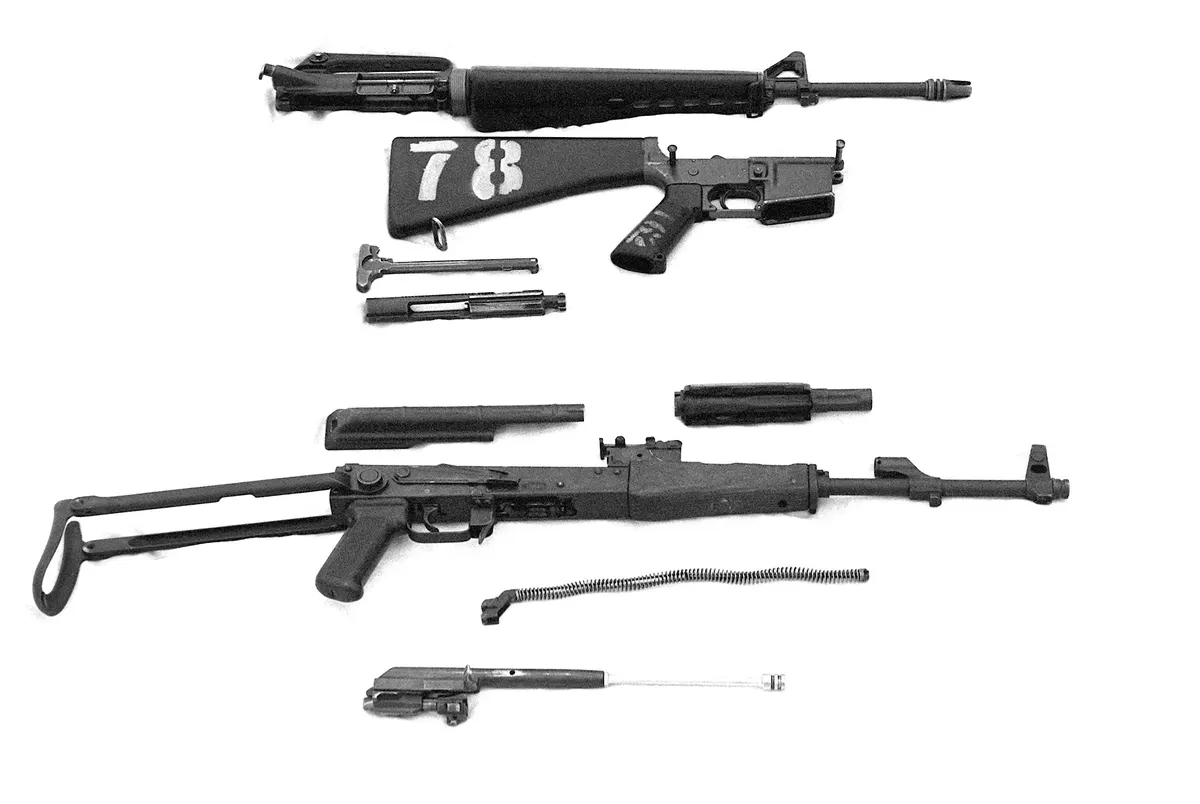
Every gas-operated action starts the same way. A port is drilled through the barrel at a fixed distance from the chamber, timed so the bullet has already passed before pressure bleeds off. Designers then split into two branches, routing the gas straight into the bolt carrier itself, a method called direct impingement,10 or against a piston that pushes the carrier rearward, the gas-piston-operated design most service rifles use today.
Piston systems split further by stroke length. A long-stroke piston stays attached to the carrier for its full travel, reliable in mud and sand but heavier. Mikhail Kalashnikov's AK-47, adopted by the Soviet Union in 1949 and lightened into the AKM a decade later in 1959, popularized the long-stroke layout worldwide by pinning the piston rigidly to the bolt carrier and leaving generous clearance between moving parts so the action keeps cycling under heavy fouling.11 A short-stroke piston only taps the carrier briefly before disconnecting, the approach ArmaLite tried on the AR-16 before it matured into later piston rifles. David Marshall Williams built an earlier short-stroke tappet while serving a prison sentence in the 1920s, then adapted it at the Winchester Repeating Arms Company for the M1 carbine adopted in September 1941, a lightweight piston layout that predates ArmaLite's own short-stroke work by more than a decade.12 Direct impingement itself traces to a Swedish gas system Eugene Stoner adapted for the AR-10.10
Not every gas-operated rifle uses a fixed port. Japan's Howa Type 64 built in an adjustable regulator so its downloaded 7.62mm round could cycle reliably for smaller soldiers. Regulators like it also bleed off gas for rifle grenades, or add gas back when fouling slows the action.
Most regulators work the same basic way, rotating a sleeve or dial over the gas port to expose a smaller or larger hole and change how much pressure reaches the piston. FN Herstal's FAL carries its own multi-position regulator for the same reason as the Howa Type 64, and Steyr-Daimler-Puch's Steyr AUG, built in Austria, uses a three-position gas plug marked normal, adverse, and grenade to bleed off extra gas in dirty conditions or shut the port entirely for a rifle-grenade launch.13 The M14 rifle and the M60 machine gun regulate gas a different way, called a gas expansion and cutoff system, where an enlarged cylinder lets the gas expand and push the piston with a longer softer shove instead of a single sharp blow, then mechanically seals the port once the piston has moved only a short distance.14
01From the FAL to the HK417, Gas Operation Across Battle Rifles and DMRs
Gas operation became the default once self-loading rifles reached general issue after the Second World War. Belgium's FAL used a tilting-bolt long-stroke piston with its own gas regulator and armed dozens of NATO states. The US Mk 14 Enhanced Battle Rifle kept the long-stroke operating rod inherited from the M1 Garand inside a modernized M14 chassis, both inside the battle rifle category.

The pattern held as rifles specialized into precision roles. Germany's HK417 runs a short-stroke piston adapted from the HK416, and Finland's Sako M23 applies the same principle to a purpose-built designated marksman rifle, scaling the same mechanism down to precision work.
Licensed and derivative programs carried it further afield. Serbia's Zastava M05N runs the same long-stroke Kalashnikov piston found on millions of rifles worldwide, and Turkey's MPT-76 uses a short-stroke piston of its own design as the country's current service rifle.
01Beyond the Rifle, Gas Operation in Shotguns, Pistols, and Machine Guns
Gas operation scales past the rifle in both directions. Belt-fed general-purpose machine guns like the M60 machine gun and Belgium's FN MAG feed from a disintegrating belt instead of a box or drum magazine, but the same barrel-mounted gas port and long-stroke piston drive the action, proof the mechanism handles sustained automatic fire from a tripod as readily as semi-automatic fire from a shoulder rifle.
Shotguns adopted gas operation more slowly than rifles did. Remington Arms engineers Wayne Leek and Robert Kelley replaced the older recoil-operated Model 58 with the gas-operated Remington Model 1100 in 1963, a shotgun credited with taming felt recoil and cycling light target loads well enough to defeat the reliability complaints of earlier semi-automatic shotguns and sell its millionth unit by 1972.15 Pistols use gas even more rarely, since a pistol barrel is usually too short to bleed off a useful amount of gas before the bullet leaves the muzzle.
A handful of pistols split the difference instead of picking one principle outright. Helmut Weldle's Heckler & Koch P7, introduced by Heckler & Koch in 1976, vents gas into a cylinder under the barrel that only delays the slide's rearward travel rather than fully driving it, a system traced back to the Barnitzke mechanism first used on Germany's wartime Volkssturmgewehr 1-5.16 Rifle-length barrels rarely need that compromise. A rifle cartridge already bleeds enough surplus gas at the port to drive a full-power piston or direct impingement system outright, which is why gas-delayed blowback stayed a pistol solution and never displaced gas operation in a service rifle.
02Notes and Sources
- "Gas-operated reloading", Wikipedia — en.wikipedia.org ↩
- "M1895 Colt-Browning machine gun", Wikipedia — en.wikipedia.org ↩
- "Colt 1895 Potato Digger", Forgotten Weapons — forgottenweapons.com ↩
- "Hotchkiss Mle 1914 machine gun", Wikipedia — en.wikipedia.org ↩
- "ZH-29", Wikipedia — en.wikipedia.org ↩
- "The ZH-29 Selfloading Rifle, A Forgotten Turning Point", The Firearm Blog — thefirearmblog.com ↩
- "FG 42", Wikipedia — en.wikipedia.org ↩
- "Pedersen rifle", Wikipedia — en.wikipedia.org ↩
- "M1 Garand", Wikipedia — en.wikipedia.org ↩
- "Direct impingement", Wikipedia — en.wikipedia.org ↩
- "AK-47", Wikipedia — en.wikipedia.org ↩
- "David Marshall Williams", Wikipedia — en.wikipedia.org ↩
- "A Short (Stroke) History of Tappet Operation, Part IV, Post-War Tappets", The Firearm Blog — thefirearmblog.com ↩
- "Why is the M14/M1A Gas System Superior?", Perfect Union — perfectunion.com ↩
- "Remington Model 1100", Wikipedia — en.wikipedia.org ↩
- "Heckler & Koch P7", Wikipedia — en.wikipedia.org ↩


