

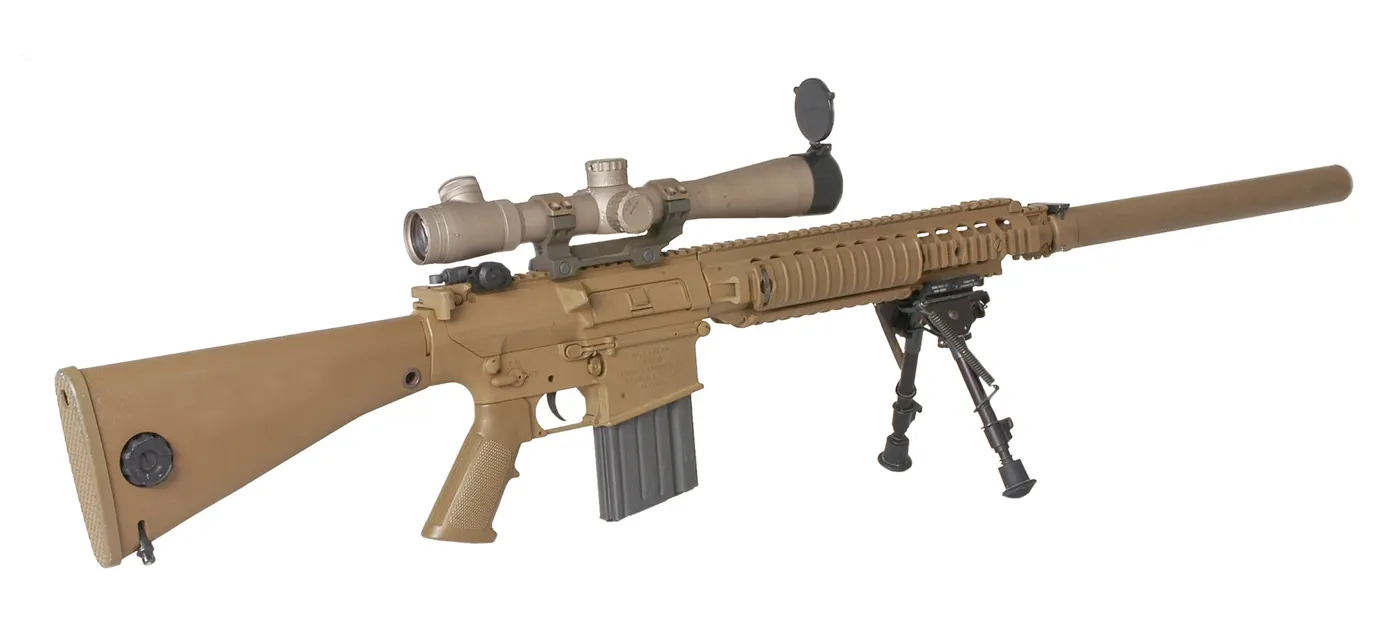
Urban combat in the Iraq War exposed a real gap in the U.S. Army sniper toolbox in the early 2000s. Snipers found themselves in close, fast-moving firefights that the bolt-action M24 Sniper Weapon System was never designed for, where a missed first shot or a moving target meant working a bolt handle while losing the sight picture.3 The M110 Semi-Automatic Sniper System (M110 SASS) was the Army's answer, a gas-operated, semi-automatic 7.62x51mm NATO designated marksman rifle built by Knight's Armament Company (KAC) of Titusville, Florida. It shares its core operating system with the KAC SR-25, the rifle Eugene Stoner and C. Reed Knight Jr. developed together in the 1990s to marry AR-15 ergonomics with AR-10 style 7.62mm power.4,5
- Semi-automatic follow-up shots without breaking cheek weld
- Fully ambidextrous controls
- Quick-detach integral suppressor
- Variable 3.5-10x optic for both close and long engagements
- Heavier and longer than a comparable bolt gun
- Reported field maintenance burden drove a later replacement competition
- Effective range trails a re-barreled M24 at extreme distance
Knight's Armament originally entered the rifle as the XM110 in the Army's Semi-Automatic Sniper Rifle competition and won the contract on September 28, 2005, drawing on years of experience already supplying the related Mk 11 Mod 0 to U.S. Special Operations Command.1,2 After operational testing at Fort Drum in 2007, the M110 SASS reached Afghanistan in April 2008, the first rifle of its kind fielded in a combat zone.1,8 The Army fielded it as a companion to the M24 rather than a wholesale replacement, and the two rifles served side by side for years before the M24's own production ended in February 2010.2
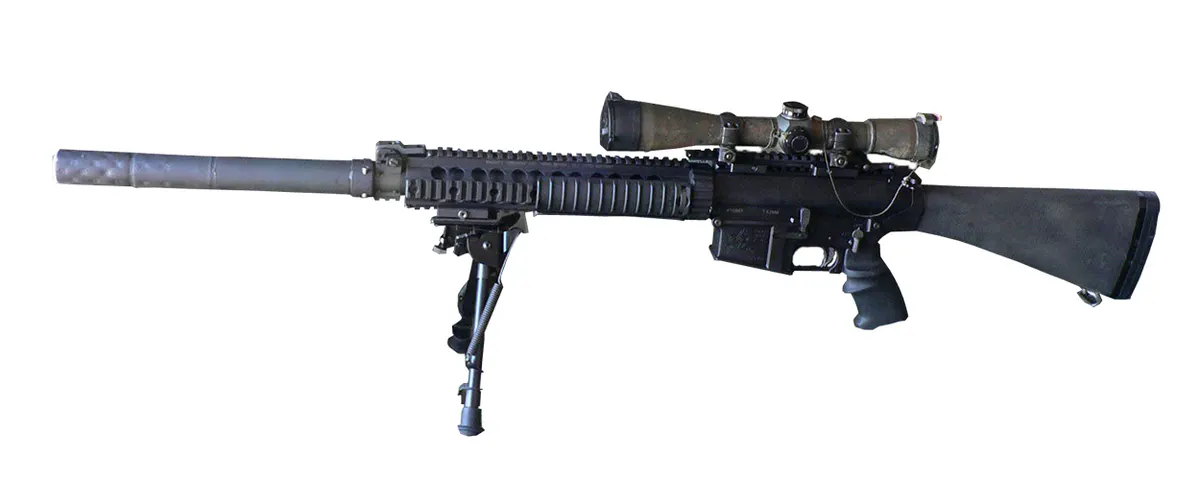
Today the M110 SASS remains in Army and Marine Corps sniper team inventories, and Knight's Armament has kept producing it well past the rifle's original fielding, with contract awards running through 2022.12 Reported unit cost from Army FY2013 budget documents sits at roughly $11,214 per rifle.2 More than 30 countries have fielded the M110 SASS or a licensed equivalent in special operations and sniper roles, including Brazil, Georgia, Poland, Singapore, and, since 2022, Ukraine.1 Among the broader class of DMR rifles it stands alongside its direct KAC-built successor, the M110A2 Semi-Automatic Sniper System, and it replaced the older bolt-action M21 Sniper Weapon System in the roles where a semi-automatic follow-up shot mattered more than raw long-range precision.
The M110 name has caused genuine confusion because the Army and Heckler & Koch later reused it for an unrelated rifle family. The base M110 Semi-Automatic Sniper System covered here is a Knight's Armament product built on the SR-25 action, while the M110A1 designation that followed in 2016 through 2020 belongs to a completely separate H&K rifle built on the G28 and HK417 platform. Anyone searching M110 sniper rifle specifications or comparing the M110 versus the M110A1 should treat them as two different weapons that happen to share part of a name rather than one weapon and its direct upgrade.
The Gas System, Barrel and the SR-25 Foundation Shared With the Sniper Rifle
The M110 Semi-Automatic Sniper System uses the same gas-operated, rotating-bolt action Eugene Stoner designed for the AR-10 and refined into the SR-25, firing semi-automatic only from a 20 inch barrel with a 1 in 11 inch, 5R rifling twist.2 Muzzle velocity with 175 grain M118LR match ammunition runs 2,570 to 2,571 feet per second (783-784 m/s).1,2 The Army lists an 800 meter maximum effective range on point targets, extending to roughly 1,000 meters with M118LR ammunition in a skilled shooter's hands.2,1 Formal acceptance testing required a mean point of impact dispersion no greater than 1.1 inches at 300 feet across five round groups, suppressed or unsuppressed, and typical field accuracy has run 0.5 to 1.0 MOA.2
- İlk Üretim Yılı2007
- Hizmete Giriş Yılı2008
- Tasarımcıknight_s_armament_company_based_on_eugene_stoner_sr_25_design
- Halen HizmetteEvet
- Önemli Kullanıcılarunited_states_army_united_states_marine_corps_brazil_georgia_poland_singapore_ukraine

Ammunition compatibility runs across standard 7.62x51mm NATO loads, with M118, M118LR (175 grain), and M852 (168 grain) all approved for service use.2 The rifle feeds from an SR-25-pattern detachable box magazine in 10 or 20 round capacities, and a 2-stage match trigger backs up the accuracy specification.2
- Fişek7_62x51mm_nato
- Çap7,62 mm
- Kovan Uzunluğu51 mm
- Çap Sınıfıfull_power_rifle_cartridge
Compared to the militarized SR-25 already fielded by SOCOM as the Mk 11 Mod 0, the Army specified several changes for its own version, a URX modular rail handguard with an integral folding rear sight good to 600 meters, an adjustable length of pull buttstock, quick-detach sling swivel sockets, and a fixed one-piece 30mm scope mount that replaced the Mk 11's separate ring pair.2,1 Those additions turned a special operations carbine variant into a rifle built around a rail system that could carry lights, lasers, and optics interchangeably in the field.2
- Mekanizma TipiGazlı
- Seçmeli AtışHayır
- Besleme SistemiÇıkarılabilir Şarjör
- Şarjör Kapasitesi20
- Tetik Tipitwo_stage_match_trigger
Optics, the Integral Suppressor and Ambidextrous Controls Added Over the SOCOM Mk 11
Standard issue optics on the M110 SASS are a Leupold Mark 4 3.5-10x40mm scope with an illuminated TMR reticle in earth-brown finish and 0.5 MOA click adjustments, compatible with the AN/PVS-10 sniper night sight and AN/PVS-26 clip-on night vision device without breaking a daytime zero, and backed up by co-witnessed iron sights.2
- Namlu Çıkış Hızı784 m/sn
- Etkili Menzil (nokta)800 m
- Azami Menzil1.000 m
- İsabet0,75
A quick-detach, integral stainless-steel suppressor roughly 14.25 inches long cuts report by an estimated 30 decibels.2 Army guidance caps sustained suppressed fire at around 20 rounds (5 rounds per minute for 4 minutes) to protect the suppressor's quick-detach mechanism, and attaching or removing it shifts point of impact enough that shooters need to re-zero or consciously account for the change.2 Every control on the rifle is duplicated for both hands, the magazine release, safety selector, and bolt catch are all ambidextrous.1
- Namlu Uzunluğu508 mm
- Yiv Adımı1_in_11_inches_5r_rifling
- Optik RayıEvet
- Açık NişangahEvet
- Dişli NamluEvet
The 7.62x51mm NATO chamber also accepts commercial .308 Winchester ammunition without modification, which is part of why the M110 SASS crossed over into competitive civilian shooting once the rules allowed it. Service loads like M118LR use a heavier, more consistently made 175 grain bullet than most off-the-shelf hunting ammunition, which is part of why the Army's accuracy specification calls out M118LR by name rather than any generic 7.62mm load.2
- Toplam Uzunluk1.105 mm
- Gövde Malzemesi (Receiver)aircraft_grade_aluminum_alloy_ar_10_pattern_upper_and_lower
- Kabza/Dipçik Malzemesiurx_modular_rail_handguard_adjustable_length_of_pull_stock
- Çift Yönlü KumandalarEvet
- Modülerlikhigh_urx_rail_system_interchangeable_optics_and_rear_sight
- Susturucuya HazırEvet
- Süngü TakozuHayır
- Bombaatar KabiliyetliHayır
- Gaz PistonluHayır
- Üretim Başlangıcı2007
- Birim Maliyet11.214 USD
- Varyantlar2
From the AR-10 to the SR-25, a Design Eugene Stoner Never Saw Fielded as the M110
The M110 Semi-Automatic Sniper System is built on a design that runs back to the AR-10, which Eugene Stoner designed at ArmaLite in the late 1950s.6 In the 1990s Stoner partnered with C. Reed Knight Jr., who had founded Knight's Armament Company in Titusville, Florida in 1974, to combine AR-15 handling and parts commonality with the AR-10's 7.62mm power.4,5 The result was the SR-25, its name reportedly derived from adding the 10 of AR-10 to the 15 of AR-15.5
Stoner died of cancer before the rifle reached its fullest success, first as the SOCOM Mk 11 Mod 0 adopted in May 2000, and later as the Army's own M110.5,4 Special operations units carried the Mk 11 Mod 0 for years before the Army ran its own program, giving Knight's Armament a combat track record it could point to once the Army went looking for a semi-automatic sniper rifle of its own.1,2
That Army search grew directly out of Iraq War urban combat, where snipers found themselves in close, reactive firefights the bolt-action doctrine built around the M24 Sniper Weapon System never anticipated, and it set up the formal competition described below.3
The XM110 Competition, Fort Drum Testing and First Combat Use in Afghanistan
Knight's Armament entered the Army's XM110 Semi-Automatic Sniper Rifle competition leaning on its established Mk 11 track record with special operations units, and won the contract on September 28, 2005.1,2
Final operational testing ran in May and June 2007 at Fort Drum, New York, with Special Forces soldiers and 10th Mountain Division sniper teams putting the rifle through its paces.1 In April 2008, soldiers of Task Force Fury carried the M110 into Afghanistan, the rifle's first combat deployment.1,8 Troops rated it highly against the M24, particularly valuing the ability to fire a fast follow-up shot without losing the target picture across urban, mountainous, and mixed terrain.8,3
Two months later, on June 12, 2008, the Army ranked the M110 SASS #2 on its list of the Top Ten Greatest Inventions of 2007, and in 2009 the rifle and its commercial equivalents were cleared for competitive civilian use under NRA High Power Rifle Rule 3.1.6.1
Maintenance Complaints, the 2016 CSASS Competition and Why Knight's Armament Kept Building It
In April 2011, reports surfaced that the Army had asked for the M110 to be reconfigured or replaced over field maintenance burden, though the Army's own public response was contradictory, citing a 100 percent approval rating from the 173rd Airborne Brigade and framing the request as wanting a smaller, lighter rifle for designated marksman use rather than evidence of a functional failure.1 That size and weight complaint, an unloaded rifle north of 13.7 lb even collapsed, is what drove the Army toward a 2016 Compact Semi-Automatic Sniper System (CSASS) competition specifying a lighter, shorter successor.1
H&K's winning design, ordered at 3,643 rifles under a roughly $44.5 million contract ceiling, became the basis for both the SOCOM CSASS and the Army's own M110A1 Squad Designated Marksman Rifle, fielded to infantry squads from around 2018 to 2020.9,11,14 The M110A1 Compact Semi-Automatic Sniper System is the SOCOM-facing version of that same H&K rifle, and neither one is a Knight's Armament product despite the name overlap.10 Knight's Armament, for its part, kept producing and supplying the original M110 for dedicated Army sniper teams throughout this period, winning a $16,550,140 order in 2019, a further three-year modification worth $14,998,849, and a five-year, $13 million contract in 2020 that was amended in 2022 to add production of the upgraded M110A2 Semi-Automatic Sniper System.13,12
The M110 Semi-Automatic Sniper System's very existence traces back to the Iraq War, whose close, fast-tempo urban engagements exposed the limits of bolt-action sniping doctrine and pushed the Army toward a semi-automatic solution in the first place.3 By the time it reached the field, U.S. forces were already using it in the War in Afghanistan (2001-2021), starting with Task Force Fury's April 2008 deployment.1
The same Iraq War fighting drew in Marine Corps snipers as well, picking up the M110 in the same deployment window as the Army and using it to replace the M39 Enhanced Marksman Rifle and Mk 11 Mod 0 in Marine sniper platoons rather than waiting for a service-specific program.1
Wikipedia's weapon-use tracking also credits the M110 in the Iraq War, the Syrian Civil War, the Kurdish-Turkish conflict, and, since 2022, the Russo-Ukrainian War, where Ukraine's GUR, SBU, SSO, and International Legion units have fielded it.1
The rifle's spread into so many separate conflicts says as much about its wide export footprint among partner nations' special operations and sniper units as it does about continued American use, and it remains one of the most broadly distributed semi-automatic sniper rifles in service anywhere.1 Despite nearly two decades of documented combat use, no single, well-documented named-sniper story has attached itself to the M110 the way some other service rifles carry one signature engagement, its reputation rests on broad unit-level adoption rather than one famous shot.
Knight's Armament has kept the base M110 airframe evolving well beyond its original 2008 form. In October 2019, Naval Surface Warfare Center Crane ordered M110K1 conversion kits for U.S. Special Operations Command, rechambering existing rifles to fire 6.5mm Creedmoor with new 14.5 inch and 22 inch barrel options, a new muzzle brake, and B5 Systems collapsible precision buttstocks, marketed by some outlets as one of the best sniper rifle conversions available for SOCOM's specific needs.15
The M110A2 Semi-Automatic Sniper System is the direct Knight's Armament upgrade of this rifle, shown publicly at AUSA 2021 and still built on the same 20 inch barrel and operating system, but adding an M-LOK rail, a revised gas system, a new suppressor, and an adjustable stock while cutting unloaded weight to around 10.5 lb (4.8 kg) versus the original's 13.7-plus lb.1 A 101st Airborne Division team used the M110A2 at the 2022 Best Ranger Competition, one of the rifle's first quasi-operational appearances.1
The M110A1 Squad Designated Marksman Rifle and M110A1 Compact Semi-Automatic Sniper System sit in a separate branch entirely. Both are built on Heckler & Koch's G28/HK417 platform rather than the KAC SR-25, and both should be read as related-but-distinct rifles that happen to share the M110 family name rather than direct variants of the original M110 SASS covered here.9,10
 Amerika Birleşik DevletleriAKTİF
 BelizeAKTİF
 BeninAKTİF
 BrezilyaAKTİF
 ButanAKTİF
 ÇadAKTİF
 ÇekyaAKTİF
 GürcistanAKTİF
 IrakAKTİF
 İtalyaAKTİF
 KamerunAKTİF
 KenyaAKTİF
 LetonyaAKTİF
 MacaristanAKTİF
 MalezyaAKTİF
 MeksikaAKTİF
 MısırAKTİF
 MoldovaAKTİF
 PeruAKTİF
 PolonyaAKTİF
 RomanyaAKTİF
 SenegalAKTİF
 SingapurAKTİF
 SlovakyaAKTİF
 TaylandAKTİF
 TunusAKTİF
 TürkiyeAKTİF
 UkraynaAKTİF
 YunanistanAKTİF
| Yıl | Alıcı | Adet | Tutar | Bugünkü Değer (2025) |
|---|---|---|---|---|
| 2022 |  Amerika Birleşik Devletleri | — | $15.0 M | $16.5 M |
| 2019 | Amerika Birleşik Devletleri | — | $16.6 M | $20.8 M |
The U.S. Army remains the primary operator of the M110 Semi-Automatic Sniper System, issuing it to dedicated sniper teams even after the M110A1 SDMR took over the squad-level designated marksman role.12,1 The U.S. Marine Corps also adopted the rifle, using it to replace the M39 Enhanced Marksman Rifle and the Mk 11 Mod 0 in some units.1
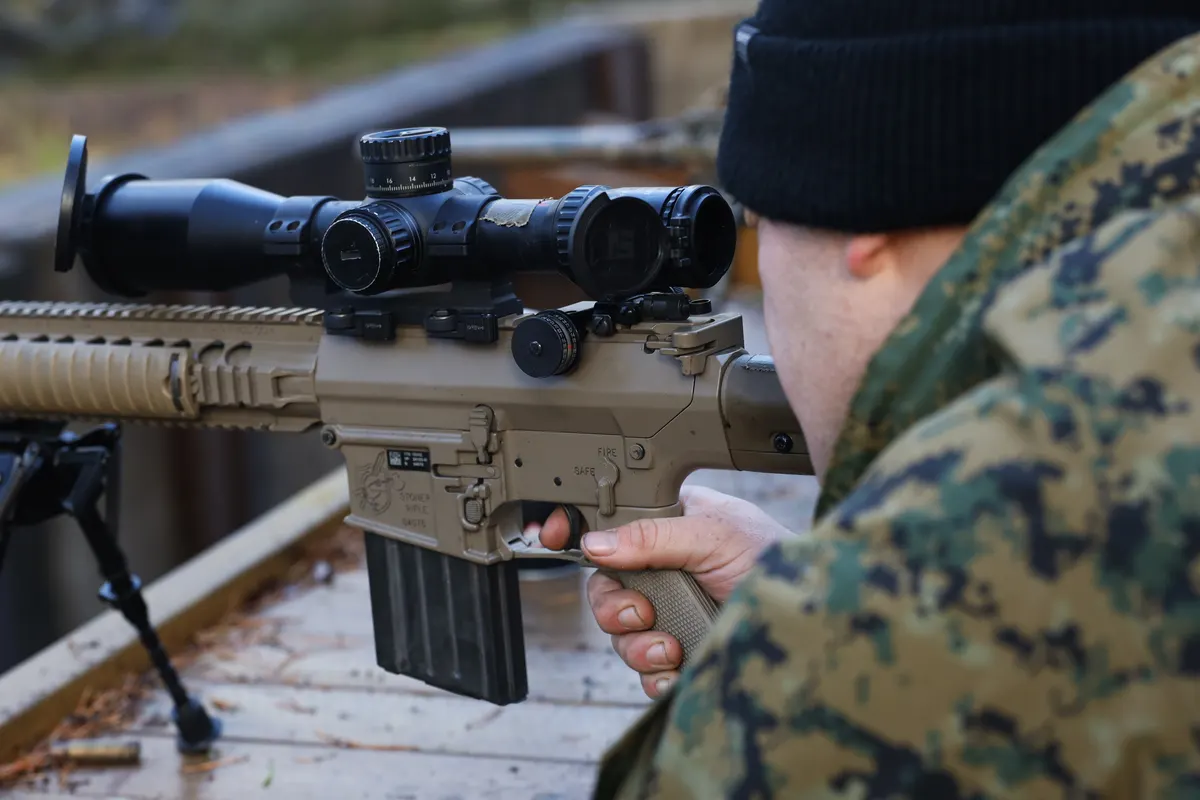
Beyond U.S. service, more than 30 nations' special operations and sniper units field the M110 SASS or a licensed derivative, with Brazil, Georgia, Poland, Singapore, and, since 2022, Ukraine among the confirmed operators.1 Civilian shooters gained a path to the platform in 2009, when the M110 and its commercial equivalents were cleared for competitive use under NRA High Power Rifle Rule 3.1.6, putting a rifle built for Army snipers into the same competitive circuit as bolt-action match guns.1
The M110 Semi-Automatic Sniper System has also crossed into popular culture as a modeled weapon in military shooter video games.
The M110 Semi-Automatic Sniper System and the M24 Sniper Weapon System were never meant to fully replace one another, and the Army deliberately ran them as a pair for years. The core difference is mechanical. The M110 cycles semi-automatically off the same gas system as the SR-25, letting a shooter fire a corrective follow-up round without lifting off the stock or losing sight of the target, while the bolt-action M24 demands the shooter break cheek weld to work the bolt between shots.3,2 That difference mattered most in the specific tactical problem the M110 was built to solve, the close, reactive urban engagements of the Iraq War, where a missed first shot in a fast-moving firefight carried real consequences.3
Range tells the opposite story. The M24, especially once re-barreled to .300 Winchester Magnum, kept a real edge at extreme distance, out past 1,000 to 1,500 meters, well beyond where the M110's 800 to 1,000 meter effective range with M118LR tapers off.2 Optics reflect the same split in priorities. The M110's variable 3.5-10x Leupold Mark 4 lets a shooter dial down for a wider field of view at closer range, useful for the reactive shooting the program was built around, while the M24's fixed 10x scope stayed optimized for pure long-range precision.2 Ergonomically the M110 also brought a modular rail system and fully ambidextrous controls that the M24's more traditional bolt-gun furniture never offered.2
| Spec | M110 SASS | M24 Sniper Weapon System |
|---|---|---|
| Action | Semi-automatic, gas-operated | Bolt-action |
| Caliber | 7.62x51mm NATO | 7.62x51mm NATO (later .300 Win Mag) |
| Effective range | ~800-1,000 m | 800 m (~1,100+ m with .300 Win Mag) |
| Magazine | 10/20-round detachable box | 5-round internal box |
Neither rifle made the other obsolete. The Army kept fielding both because the mission split cleanly between fast, semi-automatic engagement at moderate range and slow, deliberate shots at the ragged edge of what a cartridge can reach, and the M110's own successor generation, the M110A2 and the separately-built M110A1 family, grew out of trying to shrink and lighten that first role rather than extend its range.1


What caliber does the M110 SASS use? The M110 Semi-Automatic Sniper System fires standard 7.62x51mm NATO ammunition, including M118, M118LR (175 grain), and M852 match loads, and is compatible with commercial .308 Winchester.2
Is the M110 SASS still in service? Yes. The U.S. Army and Marine Corps still field the KAC-built M110, and Knight's Armament has continued winning production contracts as recently as 2022, when a contract was amended to add the upgraded M110A2.12,13
How much does the M110 SASS cost? Army FY2013 budget documents listed a unit cost of roughly $11,214 per rifle, though later Knight's Armament production contracts (running into the tens of millions of dollars across thousands of units and support) reflect higher blended per-unit costs once support and spares are included.2,12
What is the difference between the M110 and the M110A1? The original M110 SASS is a Knight's Armament rifle built on the SR-25 platform. The M110A1 name covers two later, unrelated Heckler & Koch rifles built on the G28/HK417 platform, the Squad Designated Marksman Rifle and the Compact Semi-Automatic Sniper System, adopted through a separate 2016 competition.9,10
Who makes the M110 sniper rifle? Knight's Armament Company of Titusville, Florida designed and builds the M110 Semi-Automatic Sniper System, and continues to build its M110A2 successor.1,12
- "M110 Semi-Automatic Sniper System", Wikipedia — en.wikipedia.org ↩
- "U.S. Army M110 SASS", Sniper Central — snipercentral.com ↩
- "M110 SASS, A Successor to the SR-25 Rifle", combatoperators.com — combatoperators.com ↩
- "Knight's Armament SR-25, The AR-10 Refined", American Rifleman — americanrifleman.org ↩
- "The SR-25, Birth of a Legend", Firearms Friday — firearmsfriday.com ↩
- "Eugene Stoner", Wikipedia — en.wikipedia.org ↩
- "M110 SASS detail page", Military Factory — militaryfactory.com ↩
- "M110 Sniper System in Afghanistan", Military.com — military.com ↩
- "H&K Confirms, This Is the Army's New and Improved Sniper Rifle", Army Times — armytimes.com ↩
- "BREAKING, H&K Wins CSASS Competition With G28E", TheFirearmBlog — thefirearmblog.com ↩
- "Heckler & Koch Grabs $33 Million Army Sniper, Marksman Rifle Award", Guns.com — guns.com ↩
- "Knight's Armament Secures $15M Army M110 Contract", Guns.com — guns.com ↩
- "Knight's Armament Awarded $16.5 Million Contract for M110s", TheFirearmBlog — thefirearmblog.com ↩
- "Army Officially Fielded G28/HK417 as M110A1 SDMR", Task & Purpose — taskandpurpose.com ↩
- "The U.S. Special Forces' New M110K1 Sniper Rifle", The National Interest — nationalinterest.org ↩
- "M110", Battlefield Wiki — battlefield.fandom.com ↩
- "M110 SASS", Official Squad Wiki — squad.fandom.com ↩