


The SWD-M is Poland's own modernization of the Soviet-designed SVD Dragunov, a 7.62x54mmR designated marksman rifle rebuilt in the 1990s to squeeze more accuracy out of a rifle inventory Poland had already fielded for three decades.1 The full name, Snajperski Wybór Dalekosiężny Modernizowany, translates roughly as modernized long-range sniper's choice, and the program itself carried the internal code name Baryt.2 Poland had received around 1,300 standard SVD rifles from the Soviet Union between 1965 and 1966, issuing them down to squad level as the SWD, the Polish transliteration of the Russian designation.1,3 By the early 1990s those rifles were three decades old, and the Polish military wanted a way to extend their working life without buying an entirely new rifle.
- Heavier, more accurate barrel than the base SVD Dragunov
- LD-6 6x42 scope with better magnification and field of view than the PSO-1
- Reused existing Soviet-made SVD receivers, keeping the program cheap
- Genuine domestic engineering effort, an early Polish CAD-designed small arm
- Program never reached its planned scale, only a small fraction of the fleet converted
- Still chambered in the increasingly orphaned 7.62x54mmR round, not NATO 7.62x51mm
- No folding stock or modular furniture compared to newer NATO-caliber rivals
- Production halted in 2007 with the exact final rifle count disputed in public sources
The modernization program was led by the Military Institute of Armament Technology (Wojskowy Instytut Techniczny Uzbrojenia, WITU), working with Zakłady Metalowe Łucznik in Radom, the Military Industrial Electronic Works in Zielonka, and the Industrial Optics Center in Warsaw.2 Tactical and technical requirements were set in 1992, and the first prototype followed in 1993.2 Production conversions ran through the mid-1990s at what is now the Łucznik Arms Factory in Poland, and the SWD-M was formally adopted in 1998.1,3 Compared with the base SVD Dragunov, the SWD-M is a designated marksman rifle project built entirely around upgrading an existing service weapon rather than designing one from scratch, which is also what makes its sourcing thinner than a mainstream Cold War rifle with a full production run behind it.
A Heavier Barrel Built to Beat the Original SVD's Accuracy
The single biggest change in the SWD-M is the barrel. Engineers tested two manufacturing routes side by side, an electrochemical broaching process at the Cegielski works in Poznań and cold hammer forging at Radom, in two candidate lengths of 620mm and 700mm.4 The Cegielski electrochemical barrel proved superior after extensive live-fire testing, reportedly out to 5,000 rounds, and that heavier, chrome-plated barrel became the production standard.4
- İlk Üretim Yılı1993
- Hizmete Giriş Yılı1998
- Ağırlık (Boş)5,02 kg
- Halen HizmetteEvet
- Önemli KullanıcılarPoland's Land Forces, issued at squad level; a limited number reportedly saw use during Polish Military Contingent deployments to Iraq and Afghanistan
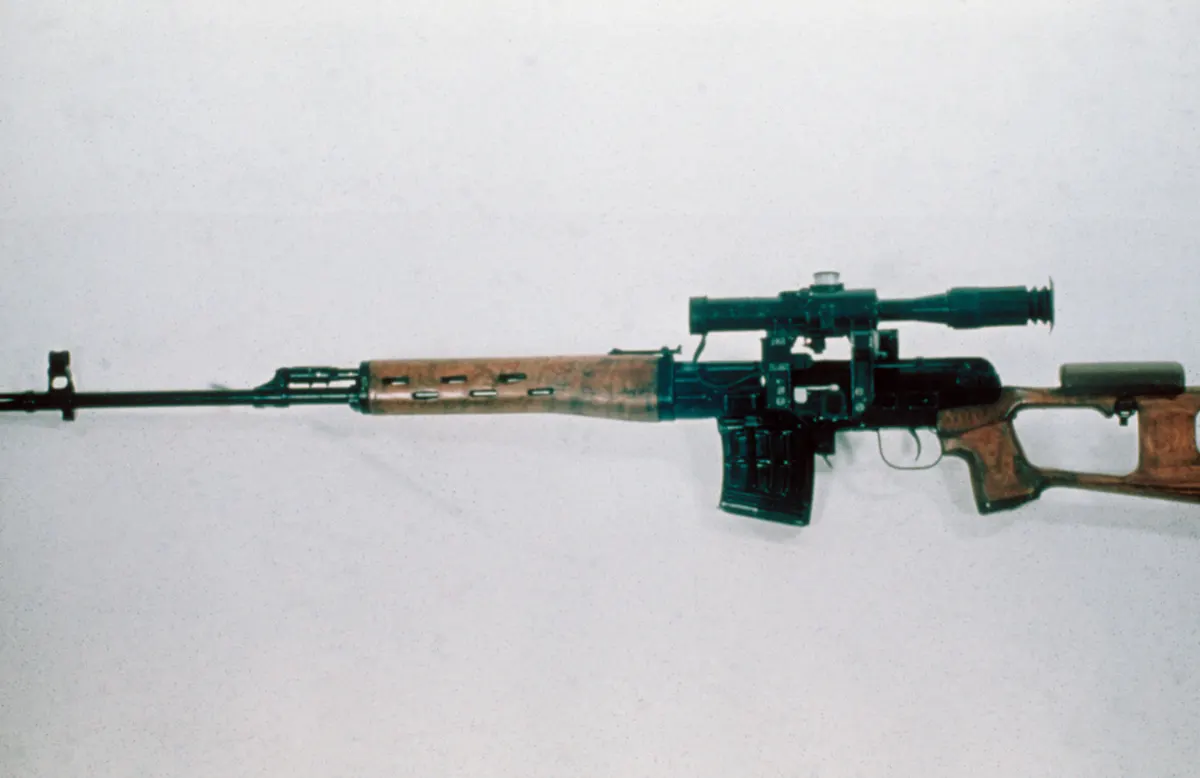
The finished SWD-M kept the same 620mm barrel length as the standard SVD Dragunov, but the increased wall thickness measurably tightened group sizes over the original Soviet-made barrel.1 Overall length dropped slightly to 1,135mm and unloaded weight rose to 5.02kg, both changes coming from the heavier barrel and the new bipod mount rather than any change to the receiver or bolt group inherited from the base rifle.1 The rifle is still gas-operated, using the same short-stroke gas piston and rotating three-lug bolt as every other SVD-pattern rifle, unchanged from the donor SVD rifles that were converted.1 It remains semi-automatic only and feeds from the same 10-round detachable box magazine.1
- Fişek7.62x54mmR
- Çap7,62 mm
- Kovan Uzunluğu53,72 mm
- Çap SınıfıFull-power rifle cartridge
What did change was the sighting package. The original PSO-1 4x24 scope was replaced with the LD-6 6x42 optic, designed by the Industrial Optics Center (Przemysłowe Centrum Optyki, PCO) in Warsaw specifically for this program, offering higher magnification and a wider field of view than the PSO-1 it replaced.2 A new scope mount was fitted to carry it, and a detachable, height-adjustable bipod built by the Zielonka electronics works was attached to the lower handguard, a feature the base SVD Dragunov never had.2,4
- Mekanizma TipiGazlı
- Atış ModlarıSemi-automatic only
- Seçmeli AtışHayır
- Besleme SistemiÇıkarılabilir Şarjör
- Şarjör Kapasitesi10
Everything else on the SWD-M, the iron sights, the fire control group, the detachable magazine interface, and the skeletonized stock, carried over unchanged from whichever donor SVD rifle went into the conversion line, since the program modified existing Polish-held rifles rather than building new ones from raw components.1,2 Poland's own testing credited the combined barrel and optics package with a real accuracy gain over the standard-issue SVD Dragunov, the entire stated purpose of the Baryt program from its 1992 requirements onward.2,4
- Namlu Uzunluğu620 mm
- Optik RayıEvet
- Açık NişangahEvet
Poland's modernization anticipated by two decades a problem Russia itself only addressed in 2018 with its own SVDM upgrade to the base SVD Dragunov, adding a shorter barrel, a full-length rail, and a modern telescopic sight of its own. The two programs share no direct connection, and Poland's version, built on 1990s components and a Warsaw Pact-style scope mount rather than a Picatinny rail, arrived at a considerably more modest solution to the same aging-rifle problem.1,2
- Toplam Uzunluk1.135 mm
- Katlanır / Toplanır DipçikHayır
- Bullpup DüzeniHayır
- Entegre BipodEvet
- Gaz PistonluEvet
- Toplam Üretim158
- Üretim Başlangıcı1996
- Üretim Bitişi2007
From a 1965 Soviet Delivery to a 1998 Adoption
Poland's relationship with the Dragunov design goes back to the mid-1960s, when roughly 1,300 SVD rifles arrived from the Soviet Union and were issued as the SWD to mechanized infantry squads.1,3 By the early 1990s, with those rifles aging and Poland reorienting its defense industry after the end of the Warsaw Pact, WITU set out the technical requirements for a modernization in 1992 and had a working prototype under the Baryt project by 1993.2
That production discrepancy is one of the genuinely unresolved facts about the SWD-M. Public reporting on how many rifles were converted ranges from around 50 to 158 depending on the source and the year the figure was published, and no single authoritative production count has surfaced to settle it.3,4 What is consistent across sources is that the program never reached its original target of 160 rifles and was formally halted in 2007, well short of replacing the bulk of Poland's Dragunov-pattern inventory.3
Poland's Dragunov-family rifles, including whatever share of the fleet had already been converted to SWD-M standard, remained the Land Forces' standard designated marksman weapon through the country's later deployments, including the Iraq War in Iraq from 2003 and the War in Afghanistan (2001-2021), where Polish contingents held responsibility for Ghazni province in Afghanistan from 2008.2,5 Those deployments are widely credited with pushing Poland toward introducing a dedicated sniper specialty within the Land Forces, rather than treating marksmanship purely as a squad-level add-on, and eventually toward seeking a NATO-caliber replacement altogether.2,5
Poland's 1999 entry into NATO added long-term pressure toward standardizing on NATO-caliber ammunition, a pressure the SWD-M's Soviet-pattern 7.62x54mmR chambering could never fully escape.5,6 That pressure first produced the domestically designed, NATO-caliber Bor rifle, a bolt-action design from OBR SM Tarnów intended from 1999 onward to eventually replace all SVD-pattern precision rifles in Polish service.9 The Bor entered testing in 2005 and production in 2006, but as a specialist bolt-action sniper rifle rather than a semi-automatic squad-level weapon, it filled a different tactical niche and never fully displaced the semi-automatic SWD-M from designated marksman duty.9
An Uncertain Combat Record Behind a Confirmed Deployment History
The Polish Military Contingent (PKW) rotations to Iraq between 2003 and 2008, and to Afghanistan between 2007 and 2014, are well documented as periods when Poland's Land Forces fielded Dragunov-pattern rifles, including converted SWD-M examples, as their principal squad-level precision weapon.2,5
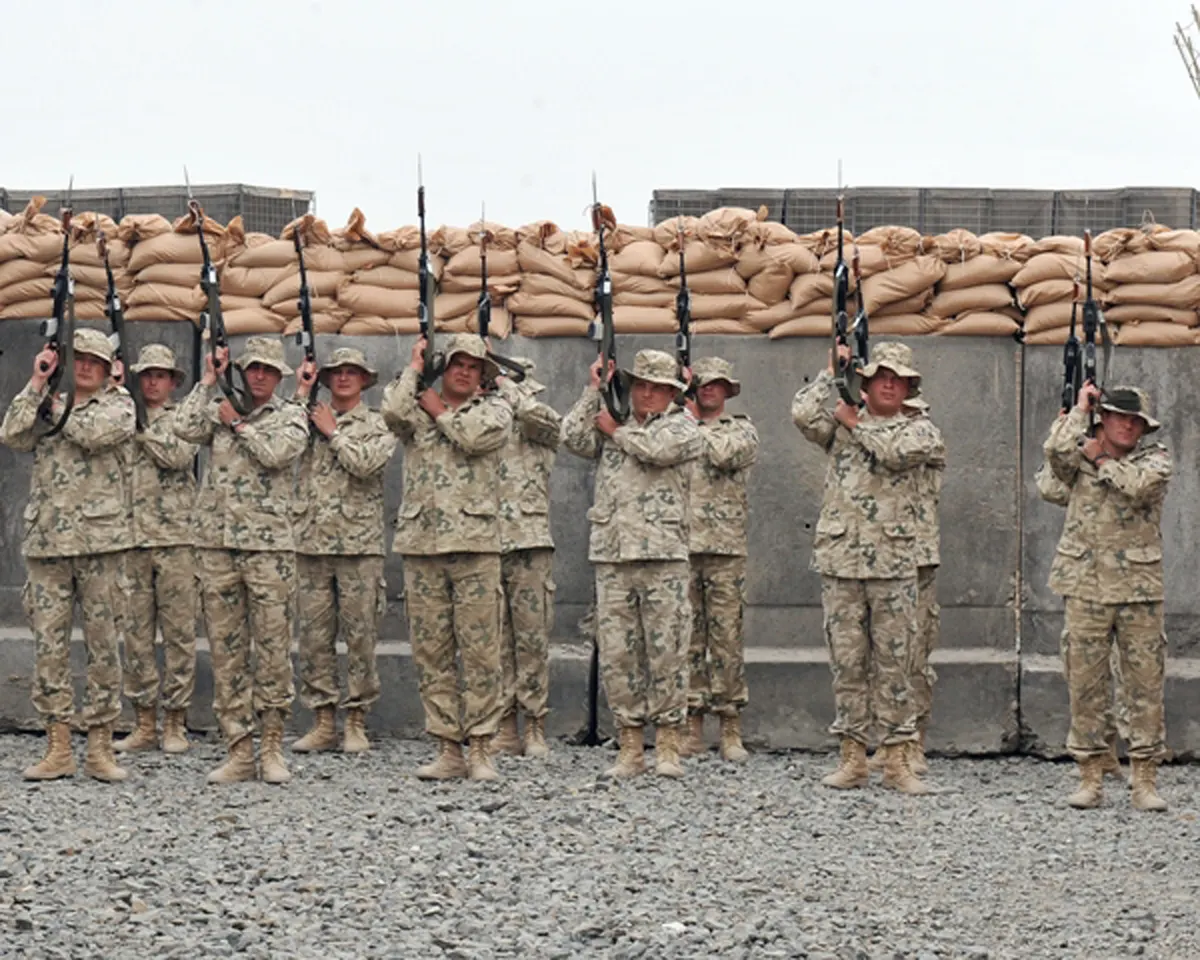
What is less well documented is any specific, individually attributed combat action involving an SWD-M rather than an unmodified SWD or another rifle in the Polish arsenal of the period. Sourcing does not clearly separate operational accounts of the older, unmodified SWD from the smaller number of upgraded SWD-M rifles in the field during this period, so the specific combat record of the modernized variant by itself is thinner than the record of Poland's Dragunov-pattern rifles as a whole.
Reporting on Poland's operational experience in both theaters is consistent in describing the broader effect, a recognized gap in precision-fire capability that fed directly into the decision to create dedicated sniper billets and to pursue a NATO-caliber replacement, first with the Bor rifle and later with a semi-automatic successor.2,5 Readers should treat the SWD-M's specific combat record with more caution than its documented adoption and technical history, since the available sourcing speaks mostly to the Dragunov family in Polish service as a whole rather than to the modernized variant in isolation.
Typ I, and a Program That Stopped Before a Typ II Could Follow
Collectors and Polish sources refer to the production SWD-M as the Typ I modernization, the only version of the program that reached even limited-series production before the effort was halted in 2007.3 No confirmed second-generation SWD-M variant reached service, unlike the SVD Dragunov's parent lineage in Russia, which went on to spawn the folding-stock SVDS and the heavily revised SVDM decades later.
The rifle that eventually did replace the SWD-M is the MSBS Grot family's dedicated marksman variant, marketed as the Grot 762N, chambered in 7.62x51mm NATO and developed by the same Łucznik Arms Factory that had built the SWD-M decades earlier.6 The Polish Ministry of National Defense opened the search for a Dragunov replacement in 2015, and after a seven-year procurement process the Grot 762N beat a rival bid from Zakłady Mechaniczne Tarnów's MWS-25 rifle, with the winning design credited to engineer Joanna Romanowska.7,8
The Ministry ordered 250 Grot 762N rifles under a contract worth more than 11 million złoty, with deliveries completing by July 2024, explicitly framed in Polish reporting as the beginning of the SWD and SWD-M's retirement from service.7 No Typ II SWD-M ever followed the Typ I conversion, and the Grot 762N rather than a further Dragunov modernization is now the rifle Poland is betting its designated marksman capability on going forward.6,7

The Łucznik Arms Factory built the SWD-M exclusively for Poland's own armed forces, and Poland remains the only confirmed operator of the type.1,3 The rifle was never offered for export, unlike the base SVD Dragunov, which spread to dozens of countries through Soviet and licensed production. As of the Grot 762N's 2024 delivery milestone, Poland's SWD-M inventory is formally being phased toward retirement, though full replacement of the modernized fleet, alongside the larger stock of unmodified SWD rifles, was still in progress rather than complete.7
Is the SWD-M just an accurized SVD Dragunov, or something closer to a genuinely separate rifle? The honest answer sits in between. The SWD-M kept every part of the parent SVD Dragunov's action, its short-stroke gas piston, rotating bolt, fire control group, and 10-round magazine, unchanged, while replacing only the barrel, scope, and bipod.1 That makes the comparison less a story of two different rifles and more a story of how far a barrel and optics upgrade alone can push an existing semi-automatic action's practical accuracy, without touching the mechanism the shooter actually feels.
| Spec | SWD-M | Base SVD Dragunov |
|---|---|---|
| Cartridge | 7.62x54mmR | 7.62x54mmR |
| Weight (unloaded) | 5.02 kg | 4.3 kg |
| Overall length | 1,135 mm | 1,225 mm |
| Barrel length | 620 mm (heavier profile) | 620 mm |
| Scope | LD-6 6x42 | PSO-1 4x24 |
| Bipod | Yes, handguard-mounted | No |
Against its actual replacement, the picture changes completely. The MSBS Grot's marksman variant, the Grot 762N, abandons the SVD-pattern gas system entirely for a short-stroke piston action of its own design, built around SR-25-pattern 20-round magazines and a modular, folding stock rather than the SWD-M's fixed, skeletonized furniture.6 The Grot 762N's chambering in 7.62x51mm NATO rather than the SWD-M's 7.62x54mmR is the more consequential change. It ends Poland's decades-long logistics dependency on a Soviet-legacy cartridge for its designated marksman rifles and finally lines the country's precision small arms up with standard NATO ammunition stocks, a shift the SWD-M's 1990s modernization never attempted and could not have delivered without abandoning the whole point of reusing existing SVD hardware.6,7


What is the SWD-M rifle? The SWD-M is a Polish modernization of the Soviet SVD Dragunov, fitted with a heavier barrel, an LD-6 6x42 scope, and a handguard-mounted bipod. It was adopted by the Polish Armed Forces in 1998.1,2
How does the SWD-M differ from the standard SVD Dragunov? The SWD-M keeps the base SVD Dragunov's gas-operated action, bolt, and magazine unchanged. It differs in barrel construction, in its LD-6 6x42 optical sight versus the standard PSO-1, and in adding a bipod the original rifle never had.1,2
Is the SWD-M still in service with the Polish Army? Poland began formally replacing the SWD and SWD-M with the NATO-caliber Grot 762N starting with deliveries completing in July 2024, but the transition was still underway rather than finished, so some SWD-M rifles likely remain in Polish inventory.7
What caliber does the SWD-M use? The SWD-M is chambered in 7.62x54mmR, the same Soviet-pattern rimmed cartridge as the base SVD Dragunov, not the 7.62x51mm NATO round used by its Grot 762N successor.1,6
How many SWD-M rifles were built? Sources disagree. Some report 158 modernized rifles in Polish service after 2010, while others describe a 2007 program halt after only around 50 conversions against an original 160-rifle target, and no single figure has been authoritatively confirmed.3,4
Who manufactures the SWD-M? The SWD-M was modernized and produced by what is now the Łucznik Arms Factory in Radom, Poland, working with the Military Institute of Armament Technology and other domestic partners on the barrel, bipod, and optics.1,2
- "SVD (rifle)", Wikipedia — en.wikipedia.org) ↩
- "The Dragunov Replacement for Poland, New 7.62x51mm Marksman Rifle", MILMAG — milmag.pl ↩
- "SWD", Opisy Broni — opisybroni.pl ↩
- "SWD-M, zapomniana modernizacja", Broń i Amunicja / Altair — altair.com.pl ↩
- "List of equipment of the Polish Land Forces", Wikipedia — en.wikipedia.org ↩
- "Grot 762N", Wikipedia — en.wikipedia.org ↩
- "Wojsko Polskie wysyła karabiny SWD na emeryturę, zastąpi je Grot 762N", WP Tech — tech.wp.pl ↩
- "Poland's Designated Marksman Rifles", The Firearm Blog — thefirearmblog.com ↩
- "Bor rifle", Wikipedia — en.wikipedia.org ↩