

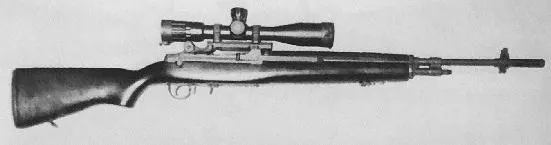

The M25 Sniper Weapon System is a 7.62x51mm NATO semi-automatic rifle built for US Army Special Forces sniper teams starting in the late 1980s. It is not a new design. It is a 10th Special Forces Group rework of the standing M21 Sniper Weapon System, itself already an accurized derivative of the M14, the standard American battle rifle of the era.1 The M25 kept the M14 action almost untouched and instead solved the M21's biggest field problem, a bedding arrangement that lost accuracy every time the rifle was pulled from its stock for cleaning.2
- Repeatable steel bedding, no accuracy loss after disassembly
- Semi-automatic follow-up shots, no bolt-cycling between rounds
- Built on a mature, well-understood M14 action
- Modern fixed-power optics (Bausch and Lomb, Leupold) vs the M21's older ART scope
- Scope-mount and zero retention weaker than a flat-top AR-10 pattern rifle
- Extremely low production run, roughly 250 units
- Heavier and less modular than the SR-25/Mk 11 rifles that replaced it
- Effective range shorter than a bolt-action rival like the M24
Two named 10th SFG armorers, Sergeant First Class Tom Kapp and Master Sergeant Bill Amelung, worked the project between 1986 and 1988 alongside a civilian machinist, Mitch Mateiko, owner of a small precision shop called Brookfield Precision Tool (BPT).2,4 Their fix was a steel liner, epoxy-bedded permanently into a McMillan fiberglass stock, so the M14 receiver mated to steel instead of resin every time it went back in. Roughly 250 of these BPT stock liners were ever made, which is why the M25 stayed a rare, special-operations-only rifle rather than a general-issue one.2,4
The M25 sniper rifle is sometimes called the Light Sniper Rifle in SOCOM documents, and also the Sniper Security System or the Product Improved M21, all names for the same rifle rather than separate programs.1,2 It reached formal designation around 1991, in time for the Persian Gulf War, and the US Navy SEALs fielded a closely related version through the 1990s.1,2 As one of the smaller-production entries in the wider American DMR family that runs from the M14 through the SR-25-pattern rifles, the M25 sits at the point where the US military first tried to fix the M21's weaknesses without abandoning the M14 action entirely.
The M25 sniper rifle's specifications describe a modified M14, not a clean-sheet rifle. It fires the same 7.62x51mm NATO (.308 Winchester) cartridge as the M14 and M21, through a 22 in (559 mm) National Match grade barrel with a 1 in 11 in twist on the military-issue rifle.1,2 Muzzle velocity with M118 Special Ball ammunition runs about 850 m/s (2,800 ft/s), and the Army's own figures put effective range at roughly 900 m.1 Overall length is 44.3 in (1,125 mm).1,2
- İlk Üretim Yılı1988
- Hizmete Giriş Yılı1991
- TasarımcıSFC Tom Kapp and MSG Bill Amelung (10th Special Forces Group) with Mitch Mateiko of Brookfield Precision Tool
- Ağırlık (Boş)4,9 kg
- Halen HizmetteHayır
- Önemli KullanıcılarUS Army Special Forces (10th Special Forces Group), US Navy SEALs/Naval Special Warfare, US Secret Service
Weight is one of the few places the sources genuinely disagree. Wikipedia lists 4.9 kg (11 lb) unscoped, Sniper Central lists 10.8 lb, and the civilian Springfield Armory White Feather clone (built with a heavier Krieger barrel) runs 12.8 lb empty.1,2,6 The military-issue M25 sits closer to 11 lb, and the heavier commercial number should not be read back onto the service rifle.
- Fişek7.62x51mm NATO
- Çap7,62 mm
- Kovan Uzunluğu51 mm
- Çap Sınıfıfull_power_rifle_cartridge
The action is the gas-operated, rotating bolt M14 mechanism, hand-selected and built to National Match tolerances, feeding from a detachable magazine in 5, 10, or 20-round M14 capacities.1,2 What actually changed from the M21 Sniper Weapon System is the stock and mount, not the receiver. The M21 used a walnut stock on early Vietnam-era rifles and a fiberglass stock from 1972, in both cases bedded with conventional glass bedding that could crack or shift after repeated cleaning cycles.3 The M25's McMillan A3-pattern fiberglass stock instead carries a BPT-made steel liner, set permanently in place with Bisonite or Marine-Tex epoxy, giving a steel-to-steel mating surface between action and stock that survives being pulled apart far more often than the M21's bedding could.2,4
- Mekanizma TipiGazlı
- Seçmeli AtışHayır
- Besleme SistemiÇıkarılabilir Şarjör
- Şarjör Kapasitesi20
- Tetik Tipitwo-stage National Match trigger, approximately 4.5 lb pull
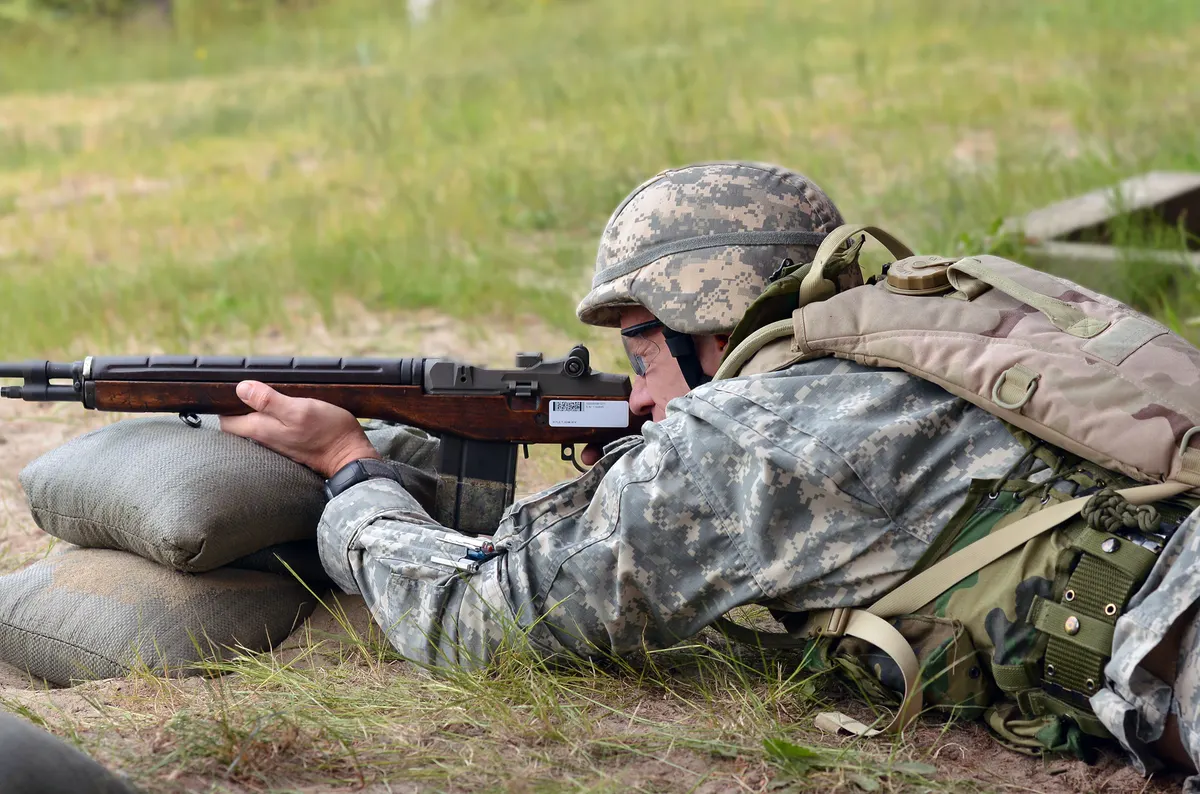
Optics also moved on from the M21. Where the M21 paired with the Vietnam-era Leatherwood Adjustable Ranging Telescope (ART), a rangefinding, bullet-drop-compensating scope, the M25 sniper rifle most commonly carried a fixed-power Bausch and Lomb 10x40 Tactical scope, with some Army rifles instead using a Leupold Ultra Mark 4 M1 or M3, and Navy rifles commonly running a Leupold Vari-X III LR M3.2 All of them mounted through Brookfield Precision Tool's own Advanced Scope Mounting System (ASMS) rather than the M21's standard mount.2 A specially tuned two-stage National Match trigger, pulling around 4.5 lb, rounded out the package, and some rifles were fielded with Ops Inc sound suppressors for close-range special-operations work.2
- Namlu Çıkış Hızı850 m/sn
- Etkili Menzil (nokta)900 m
| Feature | M21 SWS | M25 SWS |
|---|---|---|
| Stock | Walnut, later fiberglass from 1972 | McMillan fiberglass with BPT steel liner |
| Bedding | Conventional glass, breaks down over time | Steel-to-steel, epoxy-bonded, durable |
| Optics | Leatherwood ART rangefinding scope | Bausch and Lomb 10x40 Tactical, Leupold M1/M3 |
| Users | General Army sniper school graduates | Special Forces and Navy SEAL sniper teams |
The result is a rifle whose specifications look almost identical to the M21 on paper (same caliber, same barrel length, same action) but whose actual field reliability improved specifically because of the stock, not the ballistics.
- Namlu Uzunluğu559 mm
- Yiv Adımı1 in 11 in (military); 1 in 10 in on the commercial Krieger-barreled White Feather clone
- Toplam Uzunluk1.125 mm
- Gövde Malzemesi (Receiver)steel (M14 pattern)
- Kabza/Dipçik MalzemesiMcMillan fiberglass stock (M1A/A3 pattern) with Brookfield Precision Tool steel liner, epoxy-bedded with Bisonite or Marine-Tex
- Modülerliklow, fixed commercial parts bolted onto an existing M14 action
- Susturucuya HazırEvet
- Gaz PistonluEvet
- Üretim Başlangıcı1988
- Varyantlar4
The M25 sniper rifle's origin sits with the 10th Special Forces Group, which moved its headquarters to Fort Devens, Massachusetts in 1968 and stayed there until relocating to Fort Carson in 1995.8,9 It was during that Massachusetts posting, between 1986 and 1988, that 10th SFG armorers Kapp and Amelung began working with Mateiko's Brookfield Precision Tool to build what they called the XM25, a Product Improved M21.2,9 The unit had spent years fielding the M21 and knew exactly where it failed in the field, and the fix they wanted did not require a new rifle, only a stock that would not need re-bedding every time a sniper broke the action down for cleaning.2
By 1991 the rifle carried its formal M25 designation, and it saw its first significant combat use that same year in the Persian Gulf War, where Sniper Central describes it as having served extremely well with Army Special Forces sniper and designated-marksman teams.2 The US Navy fielded a closely related M14-in-fiberglass-stock rifle for SEAL and Naval Special Warfare teams from roughly 1996 through 2000, before switching to the SR-25-based Mk 11 Mod 0.2,7


Through the 2000s the M25 sniper rifle continued in limited Special Forces and SEAL use in Afghanistan and Iraq, though open sources describe general theater service rather than specific named engagements, unlike some of its M40 and M24 contemporaries.2 By the mid-2000s it was being progressively supplanted by AR-10/SR-25-pattern Enhanced Battle Rifles (EBRs), whose flat-top rail mounting held zero far better than the M14/M25 scope arrangement under the stress of vehicle transport and dynamic urban operations.2,7 Sniper Central describes the rifle by the mid-2000s as not officially in use though it may still be seen with some of the Groups and Teams, a status that has stayed largely the same since.2
By 2011 SOCOM had begun divesting even the Mk 11 Mod 0 itself in favor of the FN SCAR-based Mk 20 SSR, completing a broader move away from M14-derived sniper rifles across special operations, well after the M25 had already fallen out of front-line use.2
The Persian Gulf War of 1991 is the M25 sniper rifle's best-documented combat use, with Army Special Forces sniper teams fielding it against Iraqi forces in Kuwait and southern Iraq during Operation Desert Storm.2
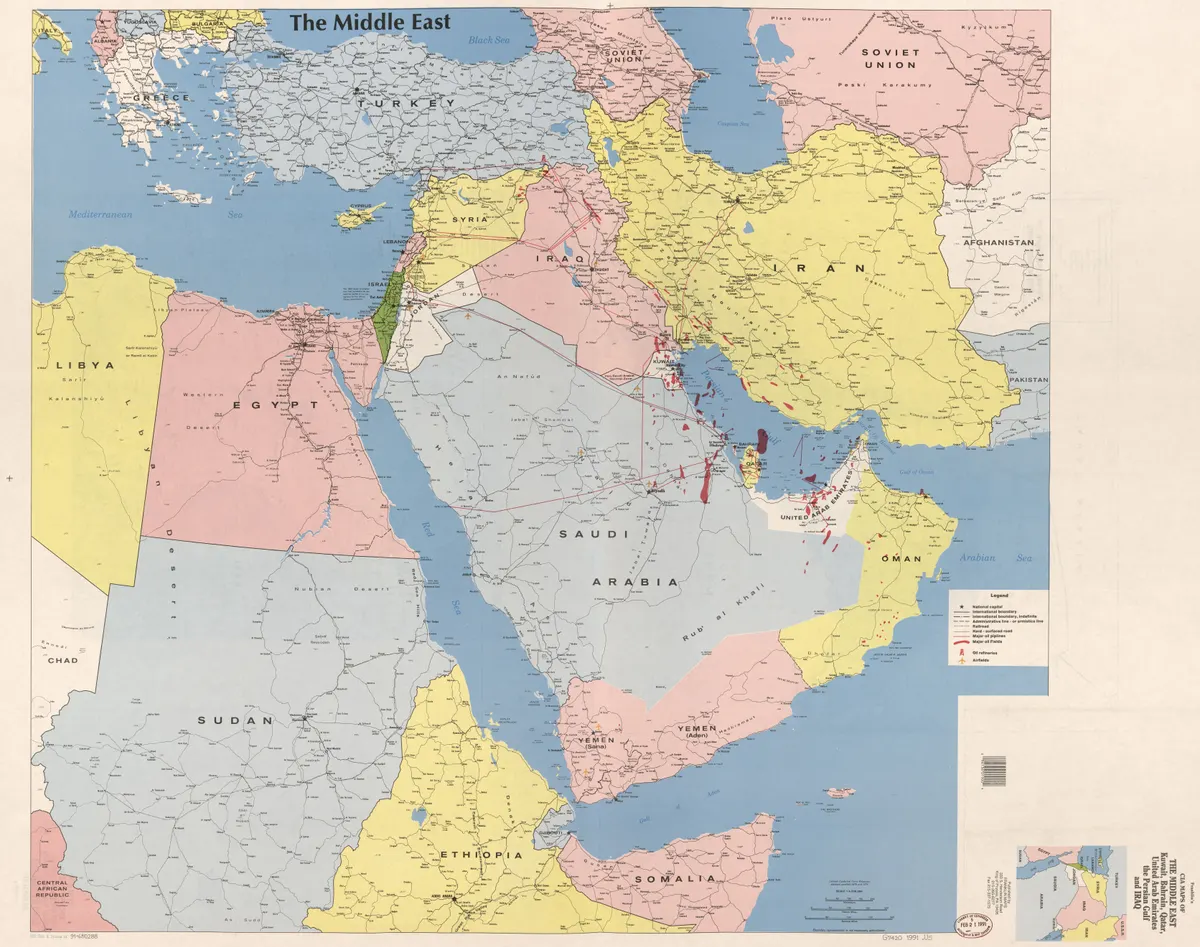
Later use in the war in Afghanistan and the Iraq War that followed the 2001 and 2003 invasions is documented in general terms, Special Operations designated marksmen continued carrying M25-pattern rifles into the Global War on Terror era, sometimes with individually added rail or chassis modifications, but open sources do not name specific units, snipers, or engagements the way they do for the later EBR-generation rifles.2 That gap is worth stating plainly rather than filled with invented detail.
Reports also describe the US Secret Service fielding some M25-pattern rifles for counter-sniper and protective duties, a use case outside conventional combat but consistent with the rifle's semi-automatic, fast-follow-up design intent.2
The pattern across all three conflicts is the same. The M25 sniper rifle shows up in unit-level accounts and equipment lists rather than in individually documented engagements, a direct consequence of its tiny production run and its confinement to small Special Forces and SEAL sniper cells rather than a general-issue rifle carried by whole units.2,4
The XM25 was the 1988 prototype/pre-production designation for the 10th SFG and Brookfield Precision Tool collaboration, before the rifle received its formal M25 designation around 1991.2 A closely related Navy variant, sometimes referenced alongside the parallel Sniper Security Rifle (SSR) and Port Security Rifle programs, followed the same principle of an M14 action bedded into a steel-lined fiberglass stock for SEAL and Naval Special Warfare use.2
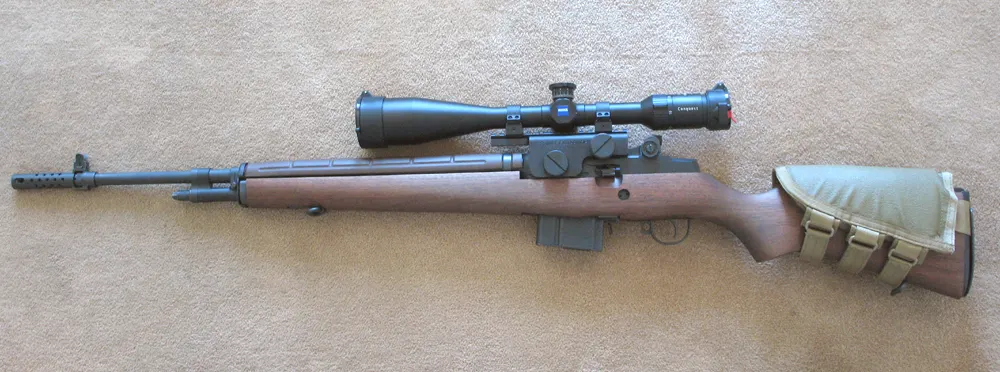
The best-known civilian offshoot is the Springfield Armory White Feather, a semi-automatic clone of the M25 built for civilian and law-enforcement precision shooters. It uses a heavier Krieger match barrel with a 1 in 10 in twist, a McMillan A3/M3A stock, a 10-round magazine (compatible with 20-round M14 magazines), and weighs about 12.8 lb empty, noticeably more than the military rifle.5,6 The name honors Marine sniper Carlos Hathcock's Vietnam-era nickname White Feather, a naming choice rather than a claim that Hathcock used the M25 itself, since Hathcock's own service and his M40 rifle predate the M25 by roughly two decades.5,6
A related but distinct rifle, the M21A5 Crazy Horse, is a later Army rail-chassis M14 sniper conversion that belongs to the same broader M14/M21 sniper-rifle family without being a direct M25 variant itself.2

The M25 sniper rifle's service has stayed almost entirely within United States special operations. US Army Special Forces, principally the 10th Special Forces Group that developed it, fielded the rifle from around 1991 into the 2000s, and the US Navy SEALs/Naval Special Warfare community used a closely related version through the 1990s before moving to the SR-25-based Mk 11 Mod 0 in 2000.2,7 The US Secret Service also reportedly fielded some M25-pattern rifles for counter-sniper protective work.2
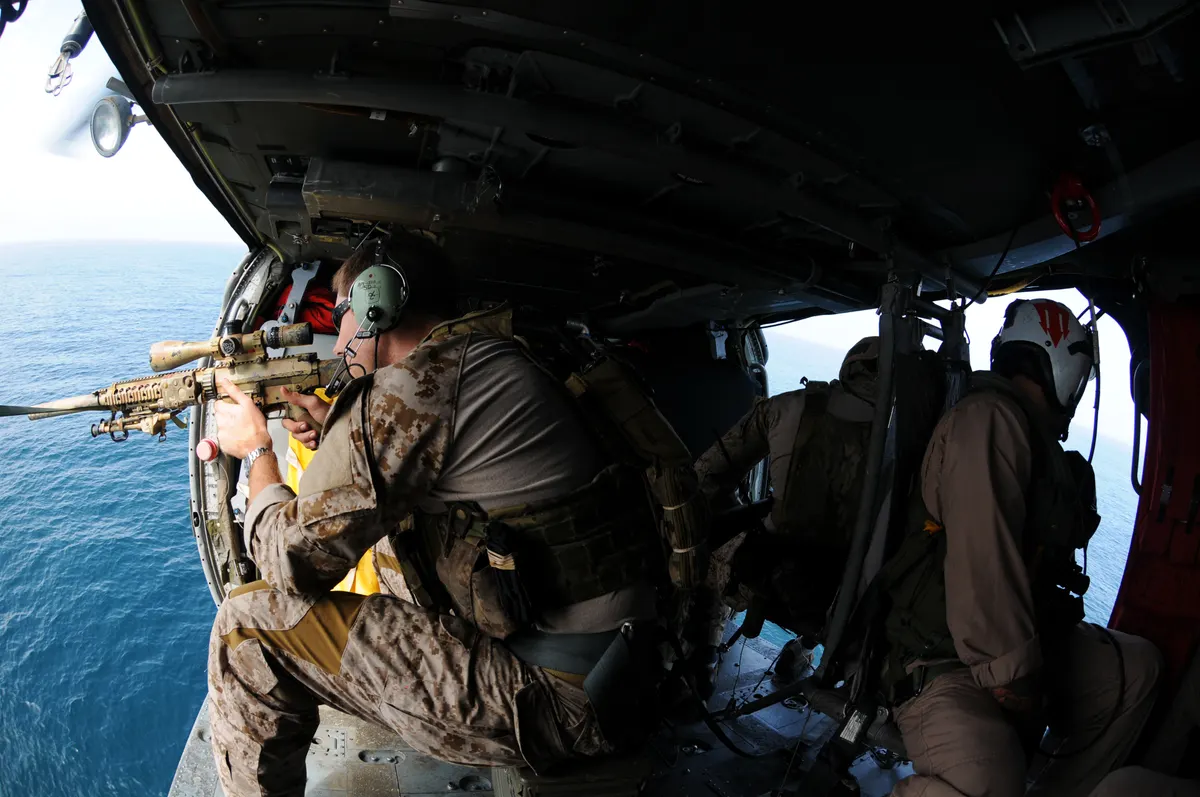
No foreign military is documented as an M25 sniper rifle operator. Unlike the M14 itself, which spread widely through licensed and surplus use abroad, the M25's tiny production run of roughly 250 units kept it a US-only, special-operations-only rifle throughout its service life.2,4
Current status among these operators is best described as informal rather than fully retired. Sniper Central's assessment, that the rifle is no longer officially fielded but may still turn up with individual Groups and Teams, matches how a low-volume, unit-procured rifle typically fades out of service, gradually and unevenly rather than through a single fleet-wide retirement order.2
The M25 sniper rifle and the bolt-action M24 Sniper Weapon System entered US service within a few years of each other but were never meant to replace one another. The Army adopted the Remington 700-based M24 from 1988 as its general-issue sniper rifle, trained through the conventional Army sniper school pipeline, while the M25 stayed a Special Forces and SEAL rifle built around semi-automatic follow-up shots rather than bolt-action precision.1,2 A bolt-action rifle like the M24 trades rate of fire for a marginally longer effective range and typically tighter group sizes, while the M25's semi-automatic action let a designated marksman put a second round on target without breaking cheek weld or losing sight picture, a real advantage in the close, fast-moving engagements Special Forces teams more often faced.2
| Feature | M25 SWS | M24 SWS |
|---|---|---|
| Action | Semi-automatic, gas-operated | Bolt-action |
| Caliber | 7.62x51mm NATO | 7.62x51mm NATO |
| Effective range | ~900 m | ~800-1000 m depending on load |
| Primary user | Special Forces / Navy SEALs | Conventional Army snipers |
Set against the SR-25-pattern rifles that eventually replaced it in special operations service, the M25's real weakness was never the cartridge or the barrel, it was the M14 platform's scope-mounting geometry. The Navy's own experience bears this out directly, moving its SEAL teams from an M25-type rifle to the SR-25-based Mk 11 Mod 0 in 2000 specifically because the AR-10 pattern's flat-top rail held a scope zero through vehicle transport and dynamic operations far better than the M14 mount ever could.2,7 The wider Army eventually followed the same logic fleet-wide, replacing M14-pattern sniper rifles with the M110 Semi-Automatic Sniper System and its later derivatives, the M110A1 Squad Designated Marksman Rifle, the M110A1 Compact Semi-Automatic Sniper System, the M110A2 Semi-Automatic Sniper System, and the squad-level M38 Designated Marksman Rifle, all built on the same SR-25 heritage rather than the M14 action the M25 shared with the M21.


What is the M25 Sniper Weapon System? The M25 sniper rifle is a 7.62x51mm NATO semi-automatic rifle developed by the US Army's 10th Special Forces Group between 1986 and 1988, based on the M14 action and formally designated around 1991.1,2
How is the M25 different from the M21 sniper rifle? The M25 sniper rifle keeps the same M14 action as the M21 Sniper Weapon System but replaces the M21's stock and bedding with a McMillan fiberglass stock carrying a permanently epoxy-bedded steel liner, and swaps the M21's Leatherwood ART scope for fixed-power Bausch and Lomb or Leupold optics.2,3
Is the M25 sniper rifle still in service? Not officially. Sniper Central describes it as no longer officially fielded as of its most recent write-up, though it notes the rifle may still turn up in some Special Forces Groups and Teams inventories.2 It was progressively replaced from the 2000s onward by AR-10/SR-25-pattern rifles.
What caliber does the M25 sniper rifle use? 7.62x51mm NATO (.308 Winchester), the same cartridge as the M14 and M21, fired from 5, 10, or 20-round detachable magazines.1,2
How much does an M25 sniper rifle cost? No confirmed original Army unit cost has surfaced in open sources. Commercial White Feather civilian clones and surplus M25-pattern rifles have sold at auction and on the collector market in the roughly $1,900 to $5,700 range depending on condition, which is not the same figure as the original government procurement cost.
Who used the M25 sniper rifle? US Army Special Forces (principally the 10th Special Forces Group), US Navy SEALs and Naval Special Warfare, and reportedly the US Secret Service for counter-sniper duty.2
- "M25 Sniper Weapon System", Wikipedia — en.wikipedia.org ↩
- "U.S. M25 & XM25 Sniper Weapon System", Sniper Central — snipercentral.com ↩
- "M21 Sniper Weapon System", Wikipedia — en.wikipedia.org ↩
- "M25 Sniper Weapon System", Grokipedia — grokipedia.com ↩
- "Springfield Armory M25 White Feather Semi-Automatic Rifle", Rock Island Auction — rockislandauction.com ↩
- "Gun Test, Springfield Armory M25 Whitefeather .308", Tactical-Life — tactical-life.com ↩
- "SR-25", Wikipedia — en.wikipedia.org ↩
- "10th Special Forces Group (United States)", Wikipedia — en.wikipedia.org) ↩
- "10SFG History", Fort Carson Army Garrison — home.army.mil ↩