


The Squad Designated Marksman Rifle, usually shortened to SDM-R, is a 5.56x45mm NATO accurized rifle built by the United States Army Marksmanship Unit at Fort Benning, Georgia. It entered service in 2004 as a squad-level answer to a problem American infantry ran into early in the Iraq War, the standard M16A4 and M4 Carbine were reliably accurate only out to roughly 300 meters, well short of what insurgents in open terrain could exploit.1 Rather than adopt a new rifle platform, the Marksmanship Unit reworked existing M16A2/M16A4 lowers into a semi-automatic-only precision rifle, one of several designated marksman rifles fielded by NATO armies in the 2000s alongside the Soviet-derived SVD Dragunov and the Marine Corps' own SAM-R.
- Built from existing M16A2/A4 lowers, fast and cheap to field
- KAC two-stage match trigger improves precision without a new platform
- Familiar manual of arms for M16/M4-trained soldiers
- Fluted stainless barrel cuts weight while holding accuracy
- Fixed A2 stock, no length-of-pull adjustment
- No extended feed ramps, unlike the Mk 12 SPR
- 5.56mm chambering caps terminal effect and range next to 7.62mm rivals
- Semi-auto-only trigger group removes the M16A4's burst option
Roughly 240 SDM-Rs were built for the Army's 3rd Infantry Division, the unit that originated the program and later received the SDM-R's eventual replacement as well. The rifle is not a clean-sheet design. It is a converted service rifle, and that origin shapes almost everything about how it looks, handles, and performs compared with a purpose-built designated marksman rifle.
The Squad Designated Marksman Rifle keeps the gas-operated, rotating-bolt mechanism of the M16 family and feeds from a detachable STANAG box magazine, typically a 20 or 30-round magazine loaded to 30 rounds in the field. What changes is everything around that action. The Knight's Armament Company two-stage match trigger replaces the M16A4's stock select-fire trigger group, and because the KAC unit is built for target-grade let-off, it also physically restricts the SDM-R to semi-automatic fire only. A rifle built on an M16A4-pattern lower, a design that normally offers three-round burst, ends up unable to fire anything but single shots.
- Hizmete Giriş Yılı2004
- TasarımcıUnited States Army Marksmanship Unit
- Ağırlık (Yüklü)4,5 kg
Barrel work is where most of the accuracy comes from. The Marksmanship Unit swaps the M16A4's standard 20-inch, 1:7-twist barrel for a stainless steel Douglas Barrels match barrel of the same 508mm (20in) length but a slower 1:8 twist, fluted with 12 flutes cut along its length. The fluting removes mass without giving up the stiffness of a heavier bull barrel, a standard precision-rifle trade-off applied here to a barrel that started life on a service rifle rather than a bolt-action platform. Muzzle velocity runs around 930 m/s (3,050 ft/s) with standard 5.56mm ball ammunition, and the SDM-R holds an effective range near 600 meters in Army documentation, roughly double a rack-grade M4.
- Fişek5.56x45mm NATO
Sitting over that barrel is a Daniel Defense DDM4 Rail 12.0, a free-floating Picatinny handguard that isolates the barrel from handguard pressure and lets the primary optic hold zero under field handling. The primary optic is a 4x32 Trijicon ACOG, issued in several model variants across units (TA31F, TA31RCO, TA01, TA01B, TA01NSN), backed up by a Matech Industries flip-up iron sight set for 600m. Some SDM-R configurations added a Harris S-L bipod on an ARMS #32 throw-lever mount for a quick-detach prone or supported firing position. The stock is a fixed A2 buttstock, not the collapsible stock found on the M4 Carbine, a choice that trades carbine-style compactness for a longer, more stable length of pull suited to precision fire.
- Mekanizma TipiGazlı
- Besleme SistemiÇıkarılabilir Şarjör
Loaded with a magazine and optic, the rifle weighs about 10lb (4.5kg) and measures 39.5in (1,000mm) overall, a few inches longer than a standard M16A4 due to the fixed A2 stock and full-length free-float rail. Total weight and length sit close to the Marine Corps' SAM-R and the Navy's Mk 12 Special Purpose Rifle, both of which pursued the same basic idea, take a service rifle's action and accurize the parts around it, though each program made different barrel-length and feed-ramp choices.
- Namlu Çıkış Hızı930 m/sn
- Etkili Menzil (nokta)600 m
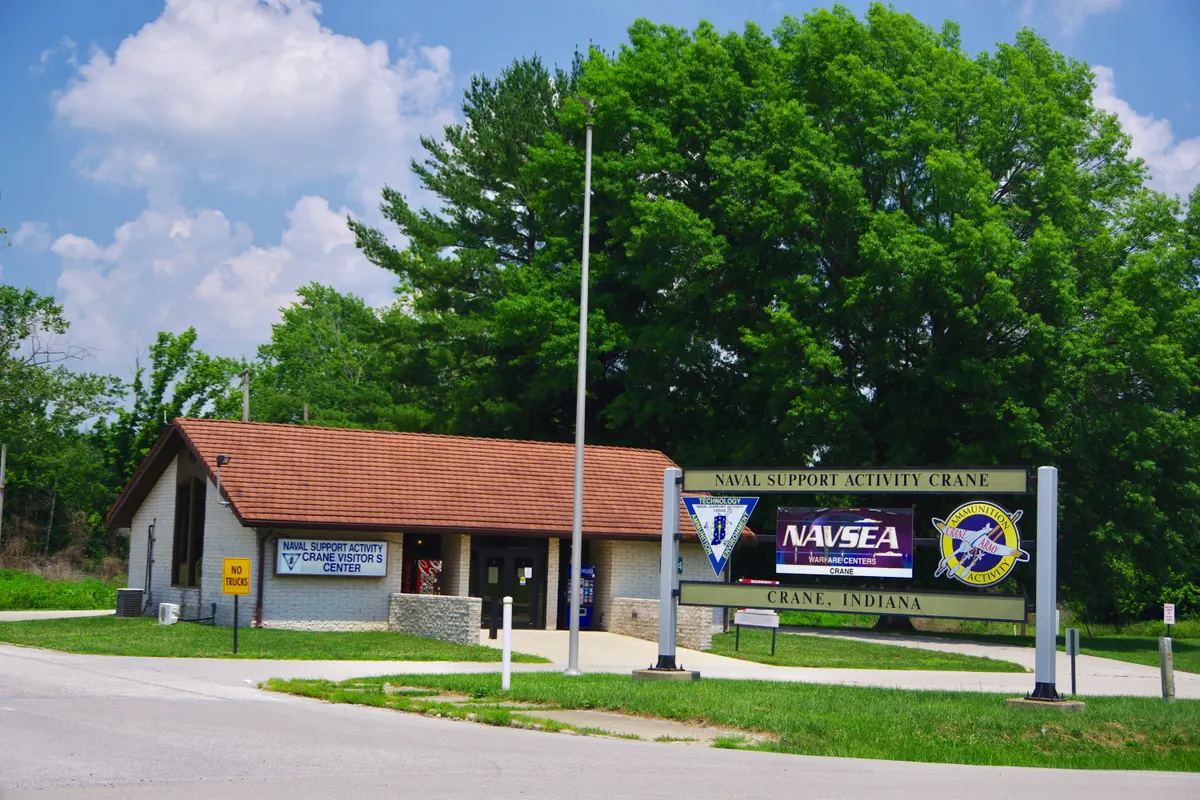
One recurring point of confusion is worth clearing up directly. The SDM-R was designed in-house by the United States Army Marksmanship Unit, not by the Navy's warfare center at Crane, Indiana. NSWC Crane's real contribution to designated-marksman rifles was to the separate Mk 12 Special Purpose Rifle program for special operations forces, a rifle that shares the same basic converted-AR-15-pattern concept but was developed through a different organization for a different customer. The two programs are frequently mixed up because both started from M16-family parts and both trace back to Army Marksmanship Unit input, but the SDM-R itself had no Crane involvement.
- Namlu Uzunluğu508 mm
- Yiv Adımı1:8
The confusion is compounded by how similar the two rifles look on an armory rack. Both the SDM-R and the Mk 12 use a 4x ACOG on an M16-pattern upper, reflecting a broader mid-2000s push across the Army and special operations community to put a fixed-power optic on every extended-range rifle rather than rely on iron sights alone. The lower receiver origin, and the feed ramps cut into it, are the detail that actually separates the two programs. The SDM-R lacks the extended feed ramps found on the Mk 12 SPR and the Marine Corps' SAM-R, a hardware difference tied to which lower receivers each program started from rather than a deliberate accuracy choice.
- Toplam Uzunluk1.000 mm
- Üretim Başlangıcı2004
The idea of a rifle-squad marksman with an accurized weapon originated with the United States Marine Corps, whose Precision Weapons Section had already built the SAM-R for that role. The Army followed roughly three years later. Around 2001, the 3rd Infantry Division began planning a training program to place one designated marksman per rifle squad, and tasked the United States Army Marksmanship Unit at Fort Benning with building the rifles.2
Instead of buying a new weapon system, the Marksmanship Unit built the SDM-R from existing parts. Lower receivers came from in-service M16A2 and M16A4 rifles manufactured by Colt and FN Herstal, accurized with a new Douglas Barrels barrel, a Knight's Armament trigger group, a Daniel Defense free-float rail, and a Trijicon ACOG optic. That approach was driven directly by combat experience in Iraq, where the M4 Carbine and M16A4's practical accuracy fell off well short of the ranges insurgents were engaging American patrols from, and the Army wanted a fix it could field in months rather than the years a formal program of record would take.3
The Squad Designated Marksman Rifle entered service in 2004, with roughly 240 rifles built and fielded to the 3rd Infantry Division ahead of and during its Iraq deployment.4 Soldiers selected for the role went through a designated marksman course built around the SDM-R and the standard M16A4, firing more than 1,500 rounds under cadre supervision before being certified.5 The program stayed entirely inside existing Army logistics, since the SDM-R used the same 5.56x45mm ammunition, magazines, and cleaning equipment as every other M16/M4 in the squad, with only the optic and a handful of accurized parts differing.
The SDM-R remained in Army use through the 2000s and 2010s, spreading beyond its originating division. A gradual transition away from the platform began around 2020, when Heckler & Koch started delivering the 7.62mm M110A1 Squad Designated Marksman Rifle, built on the HK417 action, as its formal replacement.7 The first M110A1 shipment arrived in April 2020, with deliveries continuing through mid-2021, and the first unit to receive the new rifle was the 1st Armored Brigade Combat Team, 3rd Infantry Division, the same parent division that had stood up the SDM-R program almost two decades earlier.8
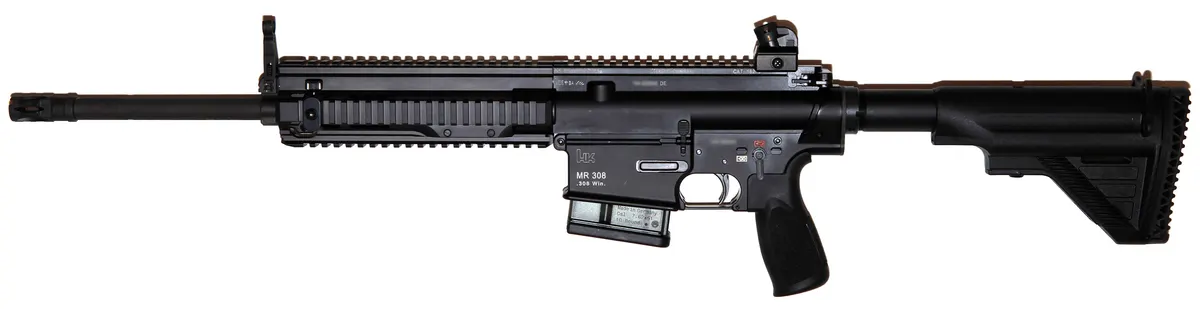
That transition was slow and uneven rather than a single cutover date. Army training documentation from October 2023 shows soldiers of the 32nd Infantry Brigade Combat Team training with the SDM-R at Fort McCoy, Wisconsin, nearly three years after the M110A1 began fielding.9
Is the SDM-R still in service anywhere in the Army as of the mid-2020s? The most accurate answer is that it was being phased out gradually rather than retired on a fixed date, with some National Guard and reserve-component units still equipped well after active-duty brigades transitioned to the M110A1.
The Squad Designated Marksman Rifle deployed with the 3rd Infantry Division and later units during Operation Iraqi Freedom and Operation Enduring Freedom in Afghanistan.4 Sourcing on the SDM-R does not surface specific named engagements or unit-level after-action accounts tied to the rifle by name, which is typical for a squad support weapon whose use blends into the broader small-arms record of both campaigns rather than generating its own combat narrative.

The SDM-R's role in both campaigns stayed at the squad level rather than a headline weapon system, which is exactly what its designers intended. It gave one trained soldier per squad a longer effective reach than the rest of the fireteam without changing how the squad organized, moved, or supplied itself in the field, since every part of the rifle's feeding and ammunition chain matched the M16A4 and M4 Carbine already in service around it.3
Only one alternate configuration reached even the study stage. The 82nd Airborne Division examined an M4 Carbine-based version of the concept, built around an 18-inch fluted barrel rather than the SDM-R's 20-inch barrel on an M16A4 lower, as a more compact option for units that valued the M4's shorter length. That configuration never went past internal staffing, and no fielded rifles resulted from it.1
Separately, the commercial firearms maker DPMS Panther Arms sells a civilian semi-automatic rifle marketed explicitly as a legal replica of the Army's semi-auto-only SDM-R. That product is a commercial reproduction built for civilian sale, not a military weapon, and it has no connection to the actual rifles fielded by the 3rd Infantry Division beyond copying the external configuration.10

The Squad Designated Marksman Rifle has been used exclusively by the United States Army. The 3rd Infantry Division fielded the first rifles in 2004, and the program later spread to other formations, including the 32nd Infantry Brigade Combat Team of the Wisconsin Army National Guard, documented training with the SDM-R as late as 2023.9 No foreign military has been documented operating the SDM-R, which is consistent with its origin as an in-house Army fix rather than an exported weapon system.
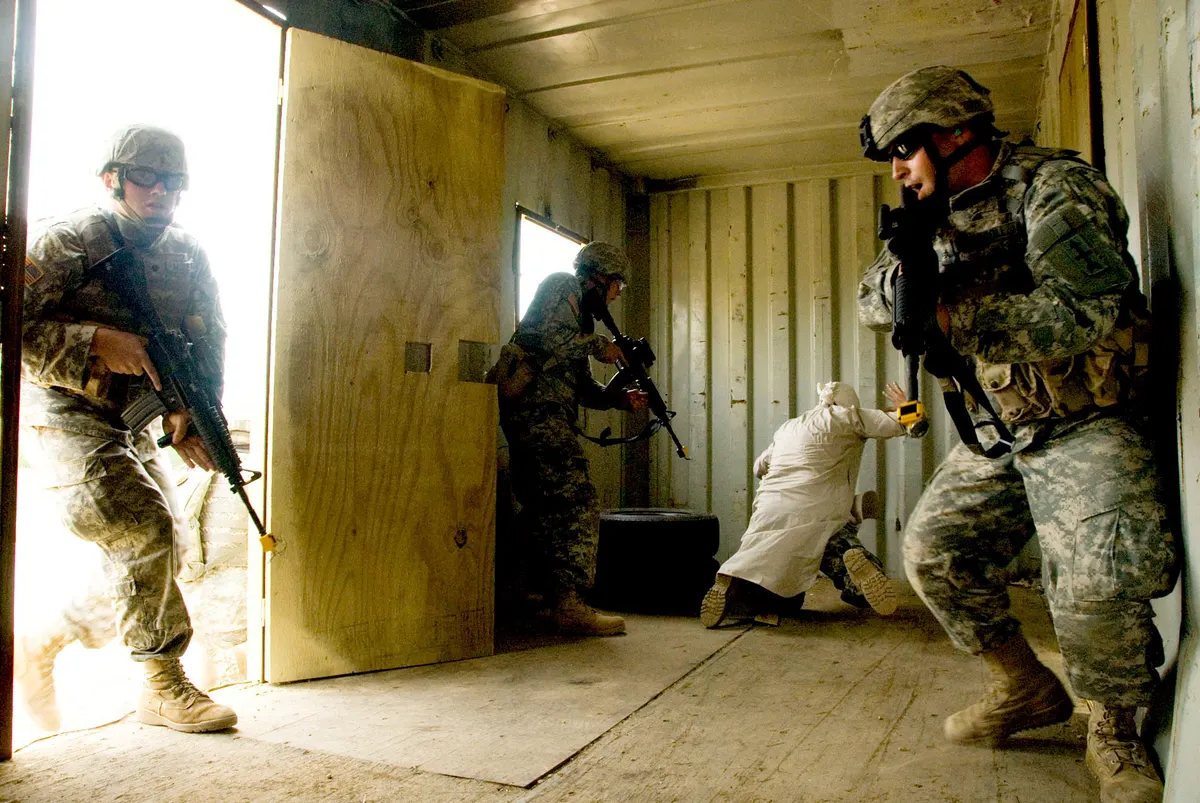
As active-duty brigades converted to the 7.62mm M110A1 through the early 2020s, the SDM-R concentrated increasingly in National Guard and reserve-component formations like the 32nd Infantry Brigade Combat Team, a reversal of its start as a rifle built specifically for one active-duty division's Iraq deployment. That shift mirrors a common pattern in US small-arms transitions, where older equipment migrates to reserve units well after front-line formations receive a replacement.
The rifle the Squad Designated Marksman Rifle is most often confused with is not a rival at all but a sibling program in a different service. The Marine Corps' Squad Advanced Marksman Rifle, or SAM-R, predates the SDM-R by about three years, entering service around 2001 through the Marine Corps' Precision Weapons Section at Quantico rather than the Army's Marksmanship Unit at Fort Benning.6 Both rifles share the same 5.56mm gas-operated rotating-bolt action and a similar 600-yard class effective range, and both weigh close to 10lb, but they belong to different services and followed different replacement paths. The SAM-R was retired around 2015 in favor of the M27 Infantry Automatic Rifle-based M38 Designated Marksman Rifle, years before the Army's SDM-R began its own transition to the M110A1 in 2020.6 Only about 100 SAM-Rs were built, against roughly 240 SDM-Rs, and the SAM-R's faster 1:7 barrel twist (versus the SDM-R's 1:8) reflects small differences in what ammunition and bullet weight each service prioritized.6
| Feature | SDM-R | SAM-R |
|---|---|---|
| Service | US Army | US Marine Corps |
| Entered service | 2004 | ~2001 |
| Barrel twist | 1:8 | 1:7 |
| Units built | ~240 | ~100 |
| Replaced by | M110A1 SDMR (2020-) | M38 DMR (~2015) |
The second natural comparison is the Mk 12 Special Purpose Rifle, developed through NSWC Crane with Marksmanship Unit input for Navy SEALs and other special operations units. The Mk 12 is built for a special-operations sniper-adjacent role rather than a conventional infantry squad, uses a shorter 18-inch barrel, and includes extended feed ramps the SDM-R does not have. Where the SDM-R is a squad-level fix meant to put one accurized rifle in every rifle squad at scale, the Mk 12 is a smaller-run special-operations tool optimized for a different mission profile entirely, and the two are easy to conflate only because both started from the same M16-family parts bin.
Against its eventual replacement, the M110A1 Squad Designated Marksman Rifle, the caliber difference matters less than how each rifle came to be procured. The SDM-R was a gunsmithed conversion of parts already in Army inventory, built quickly and cheaply once the operational need in Iraq became clear. The M110A1 is a formal program of record, chambered in 7.62x51mm NATO for more range and terminal effect, purpose-built by Heckler & Koch rather than assembled from existing service-rifle lowers. The SDM-R's low-cost, fast-turnaround model solved an urgent problem in 2004. The M110A1's multi-year formal procurement solved the longer-term question of what a designated marksman rifle should be when it isn't built under wartime time pressure.

What is the Squad Designated Marksman Rifle? The Squad Designated Marksman Rifle (SDM-R) is a 5.56x45mm NATO accurized rifle built by the US Army Marksmanship Unit from M16A2/M16A4 parts, fielded from 2004 to give one soldier per infantry squad extended-range precision fire.1
Is the SDM-R still in service? Its replacement, the M110A1 SDMR, began fielding in 2020, but the transition was gradual. National Guard units such as the 32nd Infantry Brigade Combat Team were still training with the SDM-R as of October 2023.9
What caliber is the SDM-R? It fires 5.56x45mm NATO, the same cartridge as the M16A4 and M4 Carbine it was built from, rather than a larger sniper-class caliber.
What replaced the SDM-R? The 7.62x51mm NATO M110A1 Squad Designated Marksman Rifle, based on the Heckler & Koch HK417, began replacing the SDM-R starting in 2020.7
What optic does the SDM-R use? A 4x32 Trijicon ACOG, issued in several model variants (TA31F, TA31RCO, TA01, TA01B, TA01NSN) depending on unit, backed up by a Matech flip-up iron sight set for 600 meters.
Who manufactures the SDM-R? It was not built by a commercial arms company. The US Army Marksmanship Unit at Fort Benning assembled it in-house from Colt- and FN Herstal-made M16A2/A4 lowers combined with parts from Daniel Defense, Knight's Armament Company, Trijicon, and Douglas Barrels.
- "Squad Designated Marksman Rifle", Wikipedia — en.wikipedia.org ↩
- "United States Army Squad Designated Marksman Rifle", Military History Fandom — military-history.fandom.com ↩
- "Squad Designated Marksman Rifle (SDM-R)", en.Academic — en-academic.com ↩
- "Army: Squad Designated Marksman Rifle Fielding", Task and Purpose — taskandpurpose.com ↩
- "DPMS Squad Designated Marksman Rifle (SDM-R) Punches Targets At 600 Yards", Defense Review — defensereview.com ↩
- "Squad Advanced Marksman Rifle", Wikipedia — en.wikipedia.org ↩
- "New Heckler and Koch M110A1 Squad Designated Marksman Rifle for US Army", Army Recognition — armyrecognition.com ↩
- "First shipment of H&K M110A1 Squad Designated Marksman Rifles to US Army", Army Recognition — armyrecognition.com ↩
- "Squad Designated Marksman Rifle (SDM-R), Fort McCoy", DVIDS — dvidshub.net ↩
- "Army combat units now getting new 7.62mm squad marksman rifles", Military.com — military.com ↩