


The United States Marine Corps Designated Marksman Rifle, almost always shortened to USMC DMR, is a 7.62x51mm NATO rifle built by hand-modifying existing M14 rifles rather than manufacturing a new one from scratch. Its official military designation reads United States Rifle, Caliber 7.62mm, M14, DMR, carried under NSN 1005-01-458-6235, and it entered Marine Corps service in 20011,4. Every USMC DMR was built by the Precision Weapons Section (PWS), the Marine Corps' own in-house gunsmith shop at Marine Corps Base Quantico, rather than by a commercial arms company under a program-of-record contract2,5.
- Semi-automatic follow-up shots at ranges beyond a service rifle's reach
- Match-grade Krieger barrel on a proven M14 action, no new logistics tail for the cartridge
- Picatinny rail accepts day and night optics without altering the base rifle
- Built from existing depot-stock M14 receivers, no new manufacturing line required
- Individually hand-fitted at Quantico, not factory-interchangeable between rifles
- Heavier and longer than the M16A4 rifles carried by the rest of a Marine squad
- Small production run limited how widely it could be issued
- Superseded within a decade by a chassis-stocked successor
The USMC DMR filled a gap the Marine Corps had identified between its bolt-action M40 sniper rifle, effective at long range but slow to reload, and the standard-issue M16A4 rifle carried by ordinary riflemen, which lacked the accuracy and range for a squad-level marksman role3,5. As a gas-operated, rotating-bolt, semi-automatic rifle fed from a detachable-magazine, it let a single Marine engage multiple targets at distance without the bolt-cycling delay of a dedicated sniper rifle. It belongs to the broader family of designated marksman rifles fielded by armies worldwide from the 1960s onward, a category defined by exactly this compromise between a sniper rifle's precision and a service rifle's rate of fire.
Only about 400 rifles were ever built, with roughly 381 recorded in Marine Corps inventory as of mid-2007, a genuinely small, hand-fitted production run rather than a mass-manufactured service rifle4,2. That scale sets the USMC DMR apart from most mass-issued service rifles. It was never meant to equip every infantry squad, only Marine security, anti-terrorism, and reconnaissance elements that needed an intermediate-range capability the M16A4 could not provide. The Marine Corps replaced it starting in 2008 with the M39 Enhanced Marksman Rifle, built by the same Quantico shop on the same rifle action, on a one-for-one basis1.
The Krieger Match Barrel and the M14 Action Underneath
The USMC DMR kept the M14 rifle's gas-operated, rotating-bolt action entirely intact and rebuilt everything around it. Krieger Barrels Inc, a specialist rifle-barrel maker, supplied a 22 inch (559mm) stainless-steel, match-grade barrel with a 1 in 12 inch rifling twist, fitted in place of the standard-issue M14 barrel3,4. The finished rifle weighed roughly 11 lb (5.0kg) unloaded and measured about 44 in (1,118mm) overall, close to the base M14's own dimensions since the conversion changed the barrel, stock, and optics mount rather than the receiver itself1,4.
- İlk Üretim Yılı2000
- Hizmete Giriş Yılı2001
- TasarımcıUSMC Precision Weapons Section, Marine Corps Base Quantico
- Ağırlık (Boş)5 kg
- Önemli KullanıcılarUSMC FAST companies, 4th Marine Expeditionary Brigade (Anti-Terrorism), EOD teams, Scout Sniper teams
Chambered for the same 7.62x51mm NATO cartridge as the parent M14, the USMC DMR fed primarily from M118LR 175 grain match ammunition, with M80 147 grain ball as an alternate load3. Muzzle velocity is cited at roughly 790 m/s (2,580 ft/s) with M118LR and closer to 840 m/s (2,750 ft/s) with the lighter M80 round, figures that vary slightly between sources but agree the M118LR load was the rifle's primary precision ammunition1. Effective range in service ran 600 to 800m, extending to a maximum accurate range of 1,000 yards (914m) with M118LR under favorable conditions3,1. A Harris S-L folding bipod and, in some configurations, an OPS Inc two-port muzzle brake compatible with a sound suppressor rounded out the package3.
- Fişek7.62×51mm NATO
- Çap7,62 mm
- Kovan Uzunluğu51 mm
- Çap SınıfıFull-power rifle cartridge
The McMillan Stock and the GG&G Picatinny Rail
Where the standard M14 wears a wood or synthetic service stock, the USMC DMR was rebuilt into a McMillan Tactical M2A fiberglass stock with a pistol grip and an adjustable saddle cheekpiece, giving the shooter a more consistent cheek weld for precision shooting than the original M14 furniture allowed3. A Picatinny optics rail, built by GG&G Armament, replaced the M14's fixed iron-sight mount and let the rifle carry a modern day scope or night-vision device without further gunsmithing3.
- Mekanizma TipiGazlı
- Seçmeli AtışHayır
- Besleme SistemiÇıkarılabilir Şarjör
- Şarjör Kapasitesi20
That rail most often carried a Leupold Mark 4 10x LR/T M3 fixed-power scope, though some rifles instead used a Leupold Mark 4 3.5-10x variable scope with an M3 turret and mil-dot reticle3. This modularity, a rail that accepts whichever day optic the mission calls for rather than a fixed sight fitted at the factory, was one of the USMC DMR's genuine design advances over the M14 it was built from.
- Namlu Çıkış Hızı790 m/sn
- Etkili Menzil (nokta)700 m
- Azami Menzil914 m

For night operations, the same rail could mount an AN/PVS-10 day/night sight or an AN/PVS-17 mini night-vision sight, and Wikipedia additionally lists compatibility with the older AN/PVS-4 starlight scope1,3. That optics flexibility fell well short of the fully modular chassis systems that replaced the USMC DMR (see Comparison), but it was a genuine improvement over the fixed-mount sights of the base M14 rifle, and it let a Marine designated marksman switch between day and night roles without sending the rifle back to an armorer.
- Namlu Uzunluğu559 mm
- Yiv Adımı1 in 12 inches (305mm), right-hand
- Nişangah TipiPicatinny rail (GG&G Armament) with Leupold Mark 4 10x LR/T M3 fixed-power scope (also seen with Leupold Mark 4 3.5-10x variable, M3 turret, mil-dot reticle); night optics AN/PVS-10 or AN/PVS-17
Taken together, the Krieger barrel, McMillan stock, and Picatinny optics rail turned a standard-issue service rifle into a purpose-built designated-marksman weapon without touching the underlying M14 action at all. That approach, modifying an existing rifle rather than designing a new one, shaped everything about how the USMC DMR was built, fielded, and eventually replaced.
- Toplam Uzunluk1.118 mm
- Gövde Malzemesi (Receiver)Forged steel M14-pattern receiver
- Kabza/Dipçik MalzemesiMcMillan Tactical M2A fiberglass stock, pistol grip, adjustable saddle cheekpiece
- Toplam Üretim400
- Üretim Başlangıcı2000

The USMC DMR's roots trace to the aftermath of the 1991 Gulf War, when Marine units identified a real gap between the bolt-action M40A1 sniper rifle and the M16A4 rifles carried by ordinary Marines, with nothing available for a squad-level marksman at intermediate range2. In November 1992, Marine Corps Systems Command drafted a formal mission needs statement calling for an enhanced sniper support team weapon, intended to support a scout sniper team at closer range and provide rapid semi-automatic suppressive fire the bolt-action M40A1 could not2. The M14 was initially judged unsuitable for the role, but Marine Corps precision-rifle gunsmiths (military occupational specialty 2112) kept refining M14 conversions through the 1990s as informal interim measures rather than waiting for a new program of record2.
A technical package for the resulting rifle was finalized by the late 1990s, and the Precision Weapons Section began production at Quantico around 2000, with the USMC DMR formally entering Marine Corps service in 20012,4. Building the rifle in-house, from M14 receivers already sitting in Marine Corps depot stock, let the Corps field a designated-marksman capability without competing for funding as a full acquisition program, a pattern the Marine Corps had already used repeatedly with M14 conversions and would use again for the M392,5. The Marine Corps Association's own account of the Precision Weapons Section describes the M14 as having been resurrected early in the Global War on Terror specifically to fill this gap, giving Marine designated marksmen a cost-effective, hard-hitting semi-automatic answer to multiple targets at ranges the M16A4 struggled with5.

Once fielded, the USMC DMR went to Marine Fleet Anti-terrorism Security Team (FAST) companies, the 4th Marine Expeditionary Brigade (Anti-Terrorism), Explosive Ordnance Disposal (EOD) teams, and Marine Scout Sniper teams, issued as a designated-marksman weapon distinct in role from the bolt-action M40 sniper rifle those same scout sniper teams also carried3,1.
It remained in front-line Marine Corps use through roughly the 2000s and into the early-to-mid 2010s in some units, with sources varying slightly on the exact end date1. The Marine Corps began replacing it with the M39 Enhanced Marksman Rifle starting in 2008, one rifle for one rifle, and the M39 was in turn built by the very same Precision Weapons Section that had built the USMC DMR, using the same M14 action, just fitted to a new aluminum chassis stock1,5.

The USMC DMR saw extensive use across both major American ground wars of the 2000s and 2010s, the Iraq War and the War in Afghanistan3,1. In both conflicts it equipped Marine FAST companies, EOD teams, and scout sniper elements rather than serving as a general-issue infantry rifle, consistent with its original design purpose as a squad-level marksman weapon rather than a mass-issued service rifle3.
No specific named operation or individual battalion account of USMC DMR use has surfaced with enough sourcing to state as fact here, and it should be treated as thinly documented at that level of detail, unlike the extensive named-unit and named-marksman record that exists for the earlier Army M21 Sniper Weapon System in Vietnam. What is well established is the rifle's role, a stopgap precision weapon carried by Marine security, anti-terrorism, and EOD elements operating in both theaters through the 2000s, bridging the gap until the M39 Enhanced Marksman Rifle arrived from 2008 onward1,3.
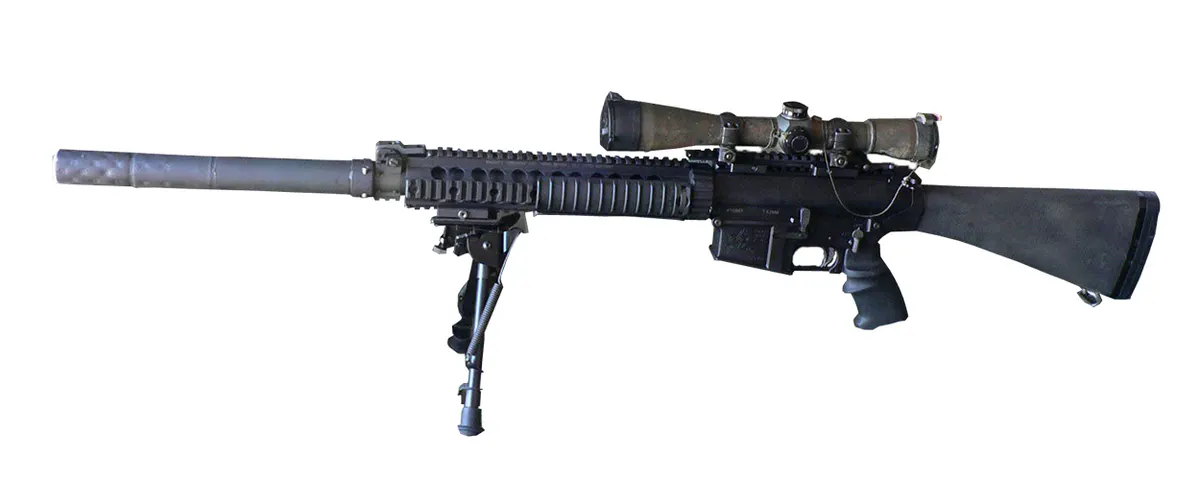
The USMC DMR was fielded in a single base configuration, without distinct named sub-variants beyond minor optic substitutions (fixed 10x versus variable 3.5-10x Leupold scopes, or the addition of the OPS Inc muzzle brake)3. It sits at the start of a three-rifle succession inside the Marine Corps' own M14-based designated-marksman programs. The USMC DMR (2001) was replaced by the M39 Enhanced Marksman Rifle from 2008, which kept the same M14 action and the same Quantico builder but swapped the McMillan fiberglass stock for a Sage International M14ALCS aluminum chassis and standardized on the M8541 SSDS Schmidt & Bender scope1,5. The Marine Corps then moved further downstream to the M110 Semi-Automatic Sniper System family from around 2012, an entirely different rifle built on the AR-10 pattern rather than the M14 (see Comparison).
The USMC DMR should not be confused with the later M38 Designated Marksman Rifle, a Marine Corps program from 2017 built on the M27 rifle in 5.56mm, a different caliber, a different action, and a program with no direct technical connection to the M14-based USMC DMR beyond sharing the same generic designated marksman rifle label1. It is also a genuinely separate program from the Crazy Horse rifle (formally the M21A5), an M14-based precision rifle built for Navy and special operations use rather than for the Marine Corps at large, and from any commercial rifle sold under a similar DMR marketing name by other gunmakers, none of which built this specific Quantico-produced weapon.

The United States was the USMC DMR's only confirmed operator, fielded exclusively by the US Marine Corps from 2001 onward through FAST companies, the 4th Marine Expeditionary Brigade (Anti-Terrorism), EOD teams, and scout sniper elements3,1. No other country's use of this specific Quantico-built rifle is supported in available sourcing.
The USMC DMR and its direct successor, the M39 Enhanced Marksman Rifle, share the same 7.62x51mm M14 action and the same builder, the Marine Corps' own Precision Weapons Section at Quantico. What changed between them was the furniture and the optic, not the underlying rifle. The USMC DMR's McMillan Tactical M2A fiberglass stock gave way to a Sage International M14ALCS aluminum chassis on the M39, a stiffer, more modular platform that holds zero better and mounts night-vision equipment forward of the day optic without disturbing it, and the USMC DMR's Leupold Mark 4 scope options gave way to a single standardized M8541 SSDS Schmidt & Bender scope on the M391,5. It is an evolution of the same Quantico rebuild program rather than a new rifle design.
| USMC DMR | M39 Enhanced Marksman Rifle | |
|---|---|---|
| Action | Gas-operated M14, semi-automatic | Gas-operated M14, semi-automatic |
| Stock | McMillan Tactical M2A fiberglass | Sage International M14ALCS aluminum chassis |
| Primary optic | Leupold Mark 4 10x LR/T (or 3.5-10x) | M8541 SSDS Schmidt & Bender |
| Entered service | 20011 | 20081 |
The comparison with the M110 Semi-Automatic Sniper System family, which eventually replaced the M39 from around 2012, is a comparison across two entirely different rifle actions rather than a stock-and-optic upgrade. The M110 descends from the Knight's Armament SR-25, an AR-10-pattern design, not the M14, so the Marine Corps switch to it was not primarily about accuracy. Both platforms deliver comparable practical precision at designated-marksman ranges. The real driver was logistics and modularity, an AR-10-pattern rifle shares its manual of arms and many small parts with the M16/M4-family rifles the rest of a Marine squad already carries, and its receiver accepts a quick-attach suppressor and modern optics mounting more readily than an M14 action built around a fixed-length gas system1. The USMC DMR, in other words, sat at the M14 end of that eventual transition, the platform the Marine Corps built from existing inventory before committing to a wholly new rifle family for the role.


What is the USMC DMR? The USMC DMR (United States Marine Corps Designated Marksman Rifle) is a 7.62x51mm NATO semi-automatic rifle built by hand-modifying M14 rifles at the Marine Corps' own Precision Weapons Section, fielded from 2001 to give Marine squads a designated-marksman capability between the bolt-action M40 sniper rifle and the standard M16A41,3.
What replaced the USMC Designated Marksman Rifle? The M39 Enhanced Marksman Rifle began replacing the USMC DMR on a one-for-one basis from 2008, built by the same Quantico shop on the same M14 action but fitted to a new aluminum chassis stock1.
How many USMC DMR rifles were built? Only around 400 rifles were built in total, with roughly 381 recorded in Marine Corps inventory as of mid-2007, a small, hand-fitted production run rather than a mass-manufactured service rifle4,2.
What caliber and ammunition does the USMC DMR use? The USMC DMR is chambered in 7.62x51mm NATO, firing M118LR 175 grain match ammunition as its primary load and M80 147 grain ball as an alternate3.
Is the USMC DMR still in service? No. The Marine Corps replaced it with the M39 Enhanced Marksman Rifle starting in 2008 and had largely retired the USMC DMR by the early-to-mid 2010s1.
What optic does the USMC DMR use? Most USMC DMR rifles carried a Leupold Mark 4 10x LR/T fixed-power scope on a GG&G-built Picatinny rail, with some rifles instead fitted with a Leupold Mark 4 3.5-10x variable scope, and night-vision devices such as the AN/PVS-10 or AN/PVS-17 could be mounted on the same rail3,1.
- "United States Marine Corps Designated Marksman Rifle", Wikipedia — en.wikipedia.org ↩
- "Post-M21 Sniper Rifle Development History, XM25, M25 Navy Port Security and SSR, USMC DMR, and M21A5 Crazy Horse", M14 Forum — m14forum.com ↩
- "Designated Marksman Rifle (DMR)", American Special Ops — americanspecialops.com ↩
- "United States Marine Corps Designated Marksman Rifle", Military Wiki — military-history.fandom.com ↩
- "USMC Precision Weapons Section", Small Arms Defense Journal — sadefensejournal.com ↩