

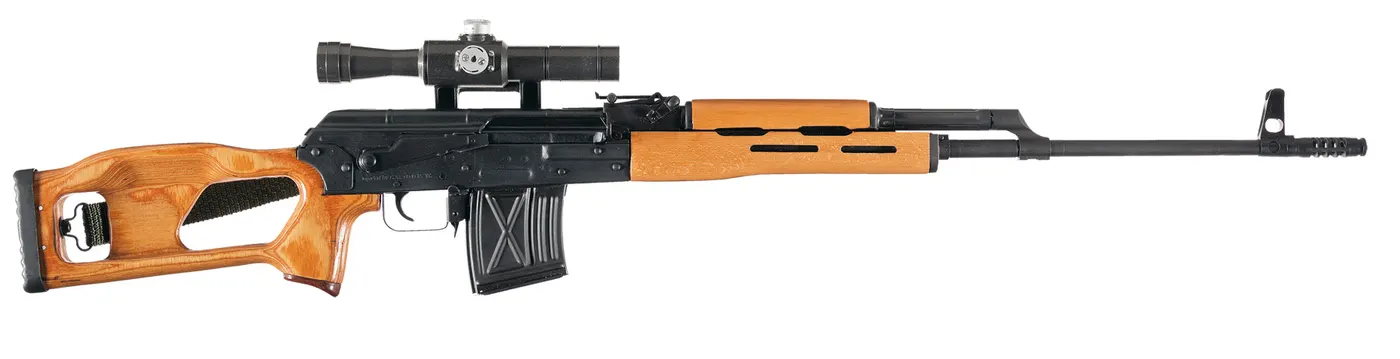

Romania's army has fielded the PSL as its standard designated marksman rifle since 1974, a program that only exists because Cold War politics closed off Bucharest's original plan to build the Soviet SVD Dragunov under license.1 The rifle's full name, Puşcă Semiautomată cu Lunetă, translates plainly from Romanian as scoped semi-automatic rifle, a description that says nothing about any connection to the SVD and everything about what the weapon actually is, a scoped, semi-automatic-only support rifle chambered for the rimmed 7.62x54mmR cartridge.2 Manufactured at Cugir in central Romania since 1974 and still built there today under the state arms holding company Romarm, the PSL is one of the most widely exported small arms to come out of Communist-era Romania.1,5
- Robust Kalashnikov-pattern action, easy to maintain in austere conditions
- Cheap to produce and export compared to genuine SVD-pattern rifles
- Automatic bolt hold-open on an empty magazine, unusual for its era
- Still in active new-manufacture production, decades after most Cold War rivals ended
- Widely proliferated, easy to find spare parts and accessories for
- Practical accuracy well behind the SVD Dragunov it is confused with
- Fixed, non-adjustable gas system stresses the bolt carrier under heavy ammunition
- Stamped receiver and thinner barrel profile heat and lose accuracy faster in sustained fire
- Ten-round magazines are not interchangeable with genuine SVD magazines despite the shared cartridge
Gun literature has spent decades calling the PSL a Romanian Dragunov, and that label is wrong.1 The PSL's operating system is a scaled-up RPK light machine gun action, built by a factory that was already tooled for AKM-pattern rifles, rather than a reverse-engineered copy of Dragunov's own purpose-built short-stroke design.1 That distinction runs through nearly every part of the rifle, the receiver, the bolt carrier, the gas system, and the practical accuracy each design achieves, and it is the central fact any accurate description of the Puşcă Semiautomată cu Lunetă has to get right.
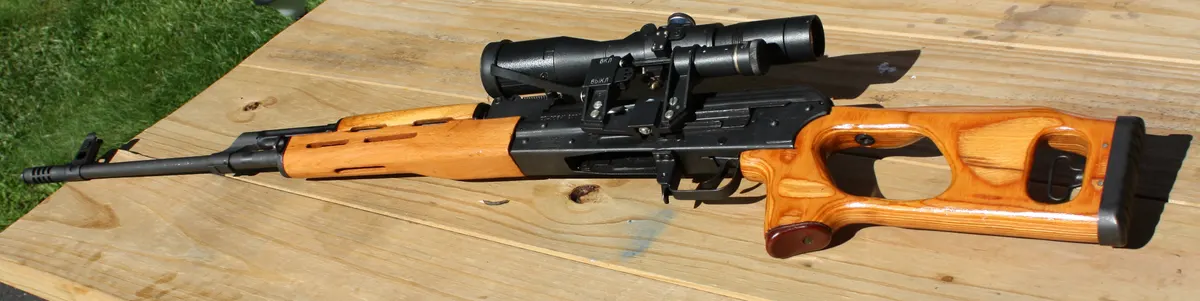
The Romanian PSL rifle remains in Romanian Armed Forces service today as the country's standard designated marksman weapon, and Cugir has continued exporting new-production PSL rifles into the American commercial market since 2019, priced well under genuine SVD imports.5,6 Questions about whether the PSL is still in production, what the PSL rifle's specifications are, and how the PSL compares to the SVD Dragunov all trace back to the same starting point, an independent Romanian design that shares a cartridge with the SVD and almost nothing else.1,2 The rifle sits within the broader DMR category alongside semi-automatic support rifles built for accurate long-range fire without the weight and cost of a purpose-built sniper rifle, a role the PSL has filled cheaply and in large numbers since the mid-1970s.
No official Romanian military unit cost figure for the PSL rifle survives in available sourcing, but the rifle's civilian retail price gives a useful proxy for how cheaply Cugir has always been able to build it. A complete new-manufacture PSL rifle with its issue scope currently retails in the United States for roughly $2,000 to $2,700, a fraction of the $8,000 to $12,000 or more a genuine Russian-made SVD Dragunov commands on the same market.5,2 That price gap has stayed roughly constant for decades and explains much of why the Romanian PSL rifle proliferated so widely into militaries and militias that could never have afforded the actual Soviet rifle it is so often mistaken for.
Not a licensed foreign design. The PSL is Cugir's own independent scale-up of its existing AKM/RPK production tooling to the 7.62x54mmR cartridge, built entirely at Cugir with no foreign license after Soviet-Romanian cooperation on licensing the SVD Dragunov itself collapsed in 1968.
A Long-Stroke Piston Action Scaled Up From the RPK
Cugir's engineers did not attempt to reverse-engineer the SVD Dragunov when Soviet cooperation collapsed in the late 1960s. Instead, they took the RPK light machine gun's action, already in mass production alongside the AKM rifle at the same factory, and scaled it up to handle the more powerful 7.62x54mmR rimmed cartridge.1 The result is a gas-operated, long-stroke piston rifle with a rotating bolt and dual locking lugs, the same basic operating principle as any Kalashnikov-pattern weapon, just built larger and chambered for a cartridge the original AK design was never meant to fire.1 The trigger group, safety lever, and general fire-control layout all follow standard AK-family practice, familiar to anyone who has handled an AK-47 or a member of its family.
- İlk Üretim Yılı1974
- Ağırlık (Boş)4,31 kg
The fire control group allows semi-automatic fire only, unlike the RPK it derives from, and feeds from a distinctive 10-round detachable magazine box with an X-pattern stamped side, a magazine that is not interchangeable with the SVD's own waffle-patterned magazine despite the two rifles sharing the same 7.62x54mmR chambering.1 One genuinely unusual feature the PSL does carry is an automatic bolt hold-open on an empty magazine, a feature shared with very few other rifles of its era, the early Yugoslav Zastava M64 being the only other commonly cited example.1
- Fişek7.62x54mmR
- Çap7,62 mm
A Stamped Steel Receiver, Not a Milled One
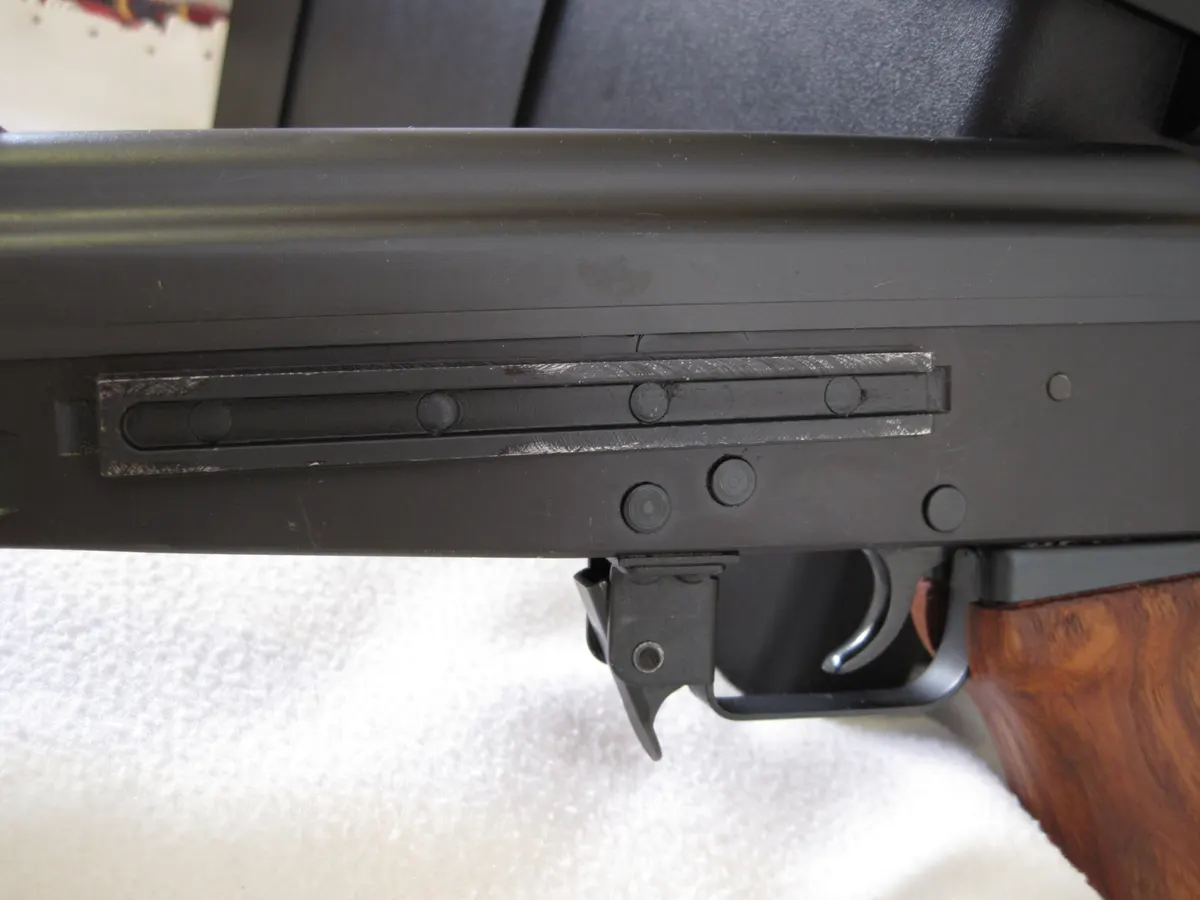
Where the SVD Dragunov uses a receiver milled from a solid block of steel, the PSL inherits the RPK's stamped sheet steel receiver, reinforced around the front trunnion with raised ribs to handle the heavier cartridge's pressure.1 Stamped construction is cheaper and faster to produce than milling, one reason Cugir could scale the RPK action up rather than design and tool an entirely new receiver from scratch. The bolt carrier assembly is a single-piece AK-pattern part, unlike the SVD's separate carrier and operating rod, which is the single biggest mechanical difference between the two rifles once the receiver difference is accounted for.1
- Mekanizma TipiGazlı
- Atış Modlarısemi-automatic only
- Seçmeli AtışHayır
- Besleme SistemiÇıkarılabilir Şarjör
- Şarjör Kapasitesi10
- Tetik Tipitwo-stage, pull weight varies by import batch, approx 4lb12oz to 7lb on commercial guns
| Feature | PSL | SVD Dragunov |
|---|---|---|
| Gas system | Long-stroke piston, AKM/RPK pattern1 | Short-stroke piston, a design unique to the SVD1 |
| Receiver | Stamped sheet steel1 | Milled from solid steel1 |
| Bolt carrier | Single-piece AK-pattern1 | Separate carrier and operating rod1 |
| Gas regulation | Fixed, non-adjustable on military rifles1 | Two-position adjustable gas regulator1 |
| Typical practical accuracy | Roughly 2 to 3 MOA3 | Sub-1 MOA to about 0.7 MOA factory spec1 |
| Magazines | X-pattern stamped, not SVD compatible1 | Waffle pattern, not PSL compatible1 |
The IOR LPS Scope and a Warsaw Pact Rail Mount
The issue optic is an LPS 4x6 degree scope with a 24mm objective, produced by the Romanian optics firm I.O.R. in Bucharest and mounted on the rifle's left side rail using the same Warsaw Pact side-mount standard the SVD uses for its own PSO-1 scope.1,2 The reticle is tritium-illuminated for low-light use and includes a stadiametric rangefinder together with a bullet-drop compensator graduated in 50-meter increments from 100 out to 1,000 meters.2 Forgotten Weapons describes the PSL's scope as functionally comparable to a tritium-lit version of the Soviet PSO-1 used on the SVD, underlining how closely the two systems converge on optics even while their underlying rifle mechanisms remain entirely different.1 Iron sights remain fitted and usable even with the scope mounted, an adjustable post front sight paired with a notch rear sight graduated out to 1,100 to 1,200 meters depending on the specific production batch.2
- Namlu Çıkış Hızı830 m/sn
- Etkili Menzil (nokta)800 m
- Azami Menzil3.000 m
- İsabet2,5
- Namlu Uzunluğu620 mm
- Yiv Adımıapprox 1 turn in 254-320mm (1 in 10 to 12.6in), right-hand
- Yiv Sayısı4
- Nişangah TipiTrityumla aydınlatılan retikülü LPS-4 dürbün + mekanik tanjant nişangah
- Optik RayıEvet
- Açık NişangahEvet
- Toplam Uzunluk1.150 mm
- Gövde Malzemesi (Receiver)stamped steel
- Gaz PistonluEvet
- Birim Maliyet2.599 USD
- Genişlik88 mm
A Licensing Deal That Ceaușescu's Politics Killed
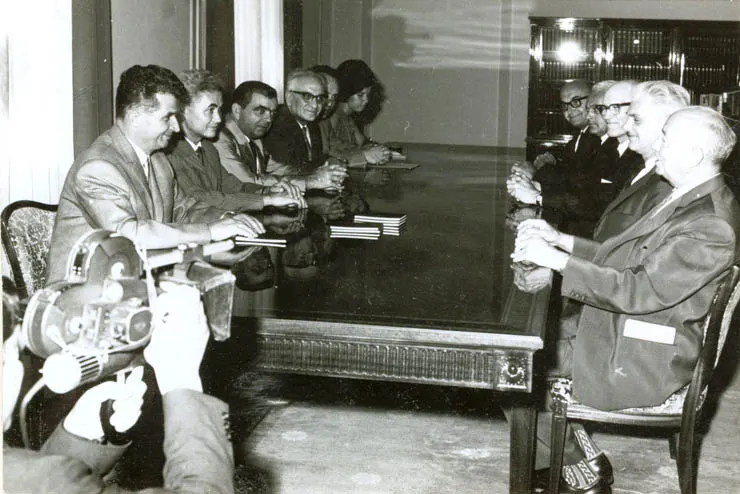
The Soviet Union initially considered letting Romania build the newly adopted SVD Dragunov domestically after 1963, part of the normal pattern of licensing Soviet small arms designs to Warsaw Pact members.1 That changed in 1968. Romania's leadership under Nicolae Ceaușescu publicly condemned the Soviet-led invasion of Czechoslovakia that year, a break with Moscow that froze Soviet-Romanian military-technical cooperation across multiple programs, including the prior understanding on SVD licensing.1 Forced to develop its own answer without Soviet technical assistance, Romania turned the problem over to Uzina Mecanică Cugir, the state arms factory in the town of Cugir, and its associated army technical directorate, the Direcţia Tehnică a Armatei.1
Trials on the resulting rifle ran through the early 1970s, and the PSL entered Romanian service in 1974, with mass production beginning the same year at Cugir.2 No individually credited chief designer or engineer appears in the available English-language sourcing for the program. The rifle is attributed to Cugir's engineering staff collectively rather than to any single named figure, and later gun-press accounts should be read carefully when they attach an individual name to the design.
Scaling Up an Already-Tooled Kalashnikov Line
Forgotten Weapons summarizes Cugir's actual design logic plainly. The factory already ran a very successful production complex building Kalashnikov-pattern rifles, so rather than build an entirely new rifle from a blank sheet, Romania's engineers took that existing design and scaled it up to the more powerful 7.62x54mmR cartridge.1 That decision explains almost everything distinctive about the PSL, the stamped receiver, the long-stroke piston, the single-piece bolt carrier, all direct carryovers from RPK and AKM tooling Cugir already owned, and all mechanically unrelated to the SVD Dragunov the finished rifle superficially resembles.1

Romania stayed formally inside the Warsaw Pact for the rest of the Cold War even after the 1968 rupture, but its arms industry increasingly built its own designs rather than importing finished Soviet weapons, a pattern the PSL program exemplifies.1 The rifle's Romanian export designation, FPK, sometimes rendered as FPK Dragunov in period export catalogs (a naming choice that itself helped cement the mistaken Dragunov association abroad), carried the same rifle into dozens of foreign arsenals from the late 1970s onward.2
Standard Issue Since 1974, Still Cugir's Best-Selling Export
Production continued past the fall of the Warsaw Pact in 1989, and Cugir began selling the PSL widely on the open international arms market during the 1990s, a major driver of the rifle's spread into conflict zones with no direct connection to Romania itself.2 Multiple 2024 and 2025 sources confirm the PSL remains in active production at Cugir, both for the Romanian military, where it is still standard issue, and for civilian export, where it has been described as Cugir's most popular export product.5,6
The Romanian Revolution of 1989
The best-documented use of the PSL rifle inside Romania itself came during the December 1989 revolution that overthrew Ceaușescu, when PSL rifles were present and used amid the fighting in Bucharest and other cities as the Communist government collapsed.1 It is a fitting bookend to the rifle's origin story, a weapon born from Romania's break with Moscow in 1968 that was still in Romanian hands twenty-one years later when the Ceaușescu regime itself fell.

Beyond Romania's own borders, the PSL's post-1989 export boom sent large numbers of rifles into Middle Eastern and African conflicts through the 1990s and 2000s, valued there for low cost, ruggedness, and wide availability rather than for any particular technical edge.2 Iraq is the most firmly documented foreign user in combat. Romanian-exported PSL and FPK rifles have been photographed and reported in Iraqi hands across the Gulf War of 1990 and 1991, the Iraq War that began with the 2003 invasion, and the Iraqi civil war of 2014 to 2017 fought against Islamic State forces.2

Afghanistan is a confirmed operator through the Afghan National Army, which fielded the PSL through the War in Afghanistan that ran from 2001 until the government's 2021 collapse, after which surviving stocks passed into Taliban hands along with the rest of the army's abandoned equipment.2 Ethiopia is likewise a confirmed operator, and Ethiopian forces are reported to have fielded the rifle during the Eritrean-Ethiopian War of 1998 to 2000, though this specific claim rests on weaker, aggregated sourcing rather than a single photo-documented instance.2 Reported use during Libya's post-2011 civil conflicts is similarly plausible, given Libya's status as a confirmed operator, but should be read the same way, a general characterization rather than an incident-by-incident confirmed record.2
Reported but Unconfirmed Fronts
Aggregated small-arms references also list the PSL as present in the Lebanese Civil War, the First Chechen War, the Syrian Civil War, the war in Yemen, and the Donbas fighting in Ukraine, all plausible given how widely Romanian small arms proliferated after 1989, but none of these specific claims could be independently verified against a primary, photo-documented source during this research.2 The honest position is that Romanian small arms including the PSL have almost certainly turned up in most of the post-Cold-War conflict zones where cheap, rugged, Kalashnikov-pattern weapons circulate freely, while treating any single named conflict beyond Iraq, Afghanistan, Ethiopia, and Romania's own 1989 revolution as confirmed would overstate the available sourcing.
FPK, the Export Name for the Same Rifle
Romania sold the PSL abroad under the export designation FPK, occasionally marketed as FPK Dragunov, a name choice that did the rifle no favors when it came to correcting the mistaken SVD association overseas.2 Mechanically the FPK is the same rifle as the domestic-issue PSL, with no meaningful internal differences reported between export and Romanian military-issue guns.
PSL-54, PSL-54C, PSL-54M, Romak III, and SSG-97 on the Commercial Market
American importers have sold the same basic rifle under a string of commercial names over the decades, PSL-54, PSL-54C, PSL-54M, Romak III (also seen as ROMAK-3), and SSG-97 among them, reflecting different import periods and dealer branding rather than distinct engineering variants.2 The 54C designation typically denotes an ATF-compliant civilian configuration, with the bayonet lug removed and the auto-sear provision eliminated to satisfy US semi-automatic import rules.2 A shortened variant with a 16-inch barrel, marketed as the FPK Paratrooper, has also circulated on the commercial market, and some import runs have been chambered in 7.62x51mm NATO (.308 Winchester) rather than the native 7.62x54mmR.2
Import quality varied significantly across eras. Guns assembled from surplus parts kits during the 1990s and 2000s carried inconsistent fit and finish, a real problem for anyone shopping the used market from that period.2 North Korea is sometimes claimed to produce a PSL-derived rifle, but the strongest available sourcing on North Korean small arms instead attributes the country's Kalashnikov-pattern designated marksman rifle to an unlicensed copy of the Zastava M76 rather than the PSL. That specific PSL-derivation claim should not be repeated as fact without a better source.9
New-Manufacture Imports Since 2019
Century Arms began importing entirely new-manufacture PSL rifles built at Cugir around 2019, rather than parts-kit rebuilds, sold complete with the IOR optic and accessories.6 Current Century Arms listings price the complete PSL 54 package with optic at roughly $2,700, with an unscoped version priced lower, positioning the rifle well under genuine SVD import prices, which commonly run from $8,000 to $12,000 or more for an authentic Russian-made rifle.5,2 Trigger pull varies by import batch. American Rifleman's testing of a Century Arms PSL 54 fitted with the newer RAK-1 Enhanced Trigger Group measured roughly 4 pounds 12 ounces, noticeably lighter than the roughly 7-pound two-stage pull Athlon Outdoors recorded on a separately tested example.4,3 Independent gun-press testing of the PSL-54C has found the rifle reliable over several hundred rounds, with practical accuracy around 2.5 inches at 100 yards using quality ammunition, well short of true sniper-rifle precision but adequate for the designated marksman role it was built for.3


Confirmed State Users
Romania remains the PSL's primary and original operator, with the rifle still standard issue in the Romanian Armed Forces today.2 Beyond Romania, credibly sourced operators include Iraq, Afghanistan (through the now-dissolved Afghan National Army), Ethiopia, Libya, Azerbaijan, and Bangladesh, alongside historical use by East Germany before German reunification.2

Less firmly sourced reports place the PSL in the hands of forces in Congo-Kinshasa, Moldova, Nicaragua, North Korea, Pakistan, and Somalia, reflecting the general proliferation pattern of a cheap, widely exported Kalashnikov-pattern rifle rather than confirmed government-to-government transfers with a documented paper trail.2 Given how thinly some of these secondary claims are sourced, they are worth flagging clearly as reported rather than confirmed.
Two Names That Do Not Hold Up
Some published small-arms operator lists include Turkey and Eritrea among PSL users. Neither claim is corroborated by any independent source found during this research, and both should be treated as unconfirmed pending stronger evidence, a genuine gap distinct from the more firmly sourced operator list above.
Why the PSL Is Not the Romanian Dragunov
The PSL and the SVD Dragunov share a cartridge and a superficial silhouette, and almost nothing else that actually matters mechanically. The SVD's short-stroke gas system, milled receiver, and separate operating rod were purpose-built by Yevgeny Dragunov specifically to deliver sub-1 MOA accuracy from a semi-automatic service rifle, a genuinely difficult engineering target for the 1960s.1 Cugir's engineers solved a completely different problem in the 1970s. They needed a scoped rifle firing the same powerful cartridge, built quickly and cheaply on tooling the factory already owned for the RPK and AKM, and they accepted a real accuracy penalty, roughly 2 to 3 MOA in practical use against the SVD's sub-1 MOA factory specification, in exchange for that speed and cost advantage.1,3 Both rifles do the same job for their respective armies. They arrive at that job through entirely different engineering decisions, and describing one as a copy of the other misrepresents the actual history of both programs.
The Zastava M76, a Closer Cousin
The Zastava M76 from the former Yugoslavia solved a strikingly similar problem to Cugir's, and makes a far more honest comparison than the SVD does. Like the PSL, the M76 is an AK and RPK derived, long-stroke piston rifle rather than a copy of the SVD.1 The M76 differs from the PSL in chambering the larger 7.92x57mm Mauser cartridge rather than 7.62x54mmR, and in using a receiver milled from solid steel rather than the PSL's stamped sheet construction, a reversal of the two rifles' relative positions on cost versus material.1 The M76 uses a broadly comparable ZRAK ON-M76 4x scope in the same functional role as the PSL's own IOR LPS optic, and independent testing generally credits the M76 with somewhat better practical accuracy, around 1.5 MOA, than the PSL typically achieves.1 Where the SVD Dragunov is the rifle the PSL gets wrongly compared to, the Zastava M76, a fellow battle-rifles family descendant of the same Kalashnikov architecture, is the rifle it should actually be compared to.


What is the PSL rifle? The PSL, short for Puşcă Semiautomată cu Lunetă, is a Romanian designated marksman rifle chambered in 7.62x54mmR, built by Cugir since 1974 on a scaled-up Kalashnikov action rather than as a copy of the Soviet SVD Dragunov.1,2
How does the PSL rifle work? It uses a gas-operated, long-stroke piston action with a rotating bolt, the same basic operating principle as the RPK light machine gun it was scaled up from, feeding from a 10-round detachable box magazine and firing semi-automatically only.1
Is the PSL the same as the SVD Dragunov? No. The two rifles share the 7.62x54mmR cartridge and a similar profile, but the PSL's long-stroke piston action, stamped receiver, and single-piece bolt carrier are mechanically unrelated to the SVD's short-stroke system and milled receiver.1
Is the PSL rifle still in production? Yes. Cugir continues producing the PSL for the Romanian military and for export, including new-manufacture rifles imported into the United States by Century Arms since around 2019.5,6
What is the PSL rifle's price? Current new-manufacture commercial imports sell for roughly $2,000 to $2,700 with the issue optic included, well under the $8,000 to $12,000 or more commonly asked for a genuine Russian-made SVD Dragunov.5,2
What caliber does the PSL rifle use? The native chambering is 7.62x54mmR, the same rimmed cartridge used in the SVD Dragunov, though some commercial export variants have also been chambered in 7.62x51mm NATO (.308 Winchester).2
Who manufactures the PSL rifle? Cugir, formally Uzina Mecanică Cugir and today part of the Romarm state arms holding company, has manufactured the PSL continuously since 1974.2,5
- "Romania Doesn't Make the Dragunov, It Makes the PSL", Forgotten Weapons — forgottenweapons.com ↩
- "PSL (rifle)", Wikipedia — en.wikipedia.org) ↩
- "Gun Review, Romanian PSL-54C Rifle in 7.62x54R", Athlon Outdoors — athlonoutdoors.com ↩
- "Review, Century Arms PSL 54", American Rifleman — americanrifleman.org ↩
- "PSL 54", Century Arms — centuryarms.com ↩
- "New for 2019, Century Arms PSL 54", Shooting Illustrated — shootingillustrated.com ↩
- "KNS Precision Adjustable Gas Piston System, AGP-A-13L", Primary Arms — primaryarms.com ↩
- "PSL Minor Damage from Heavy Ball Ammo, With Pics", Gunboards Forums — gunboards.com ↩
- "North Korean Small Arms", Small Arms Defense Journal — sadefensejournal.com ↩
- "PSL", Internet Movie Firearms Database — imfdb.org ↩