

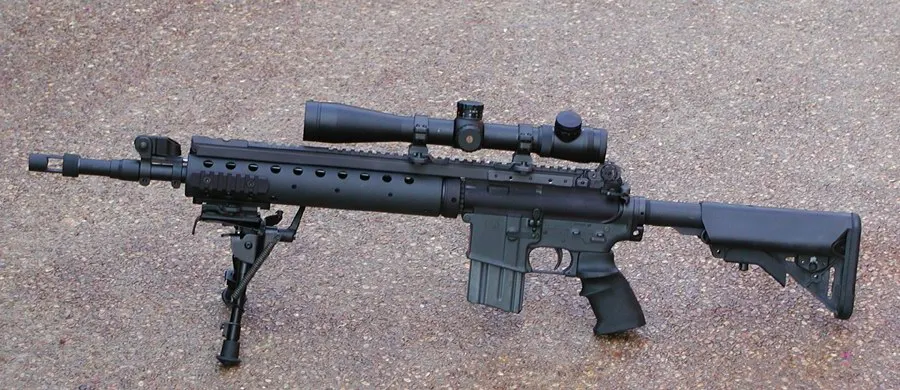

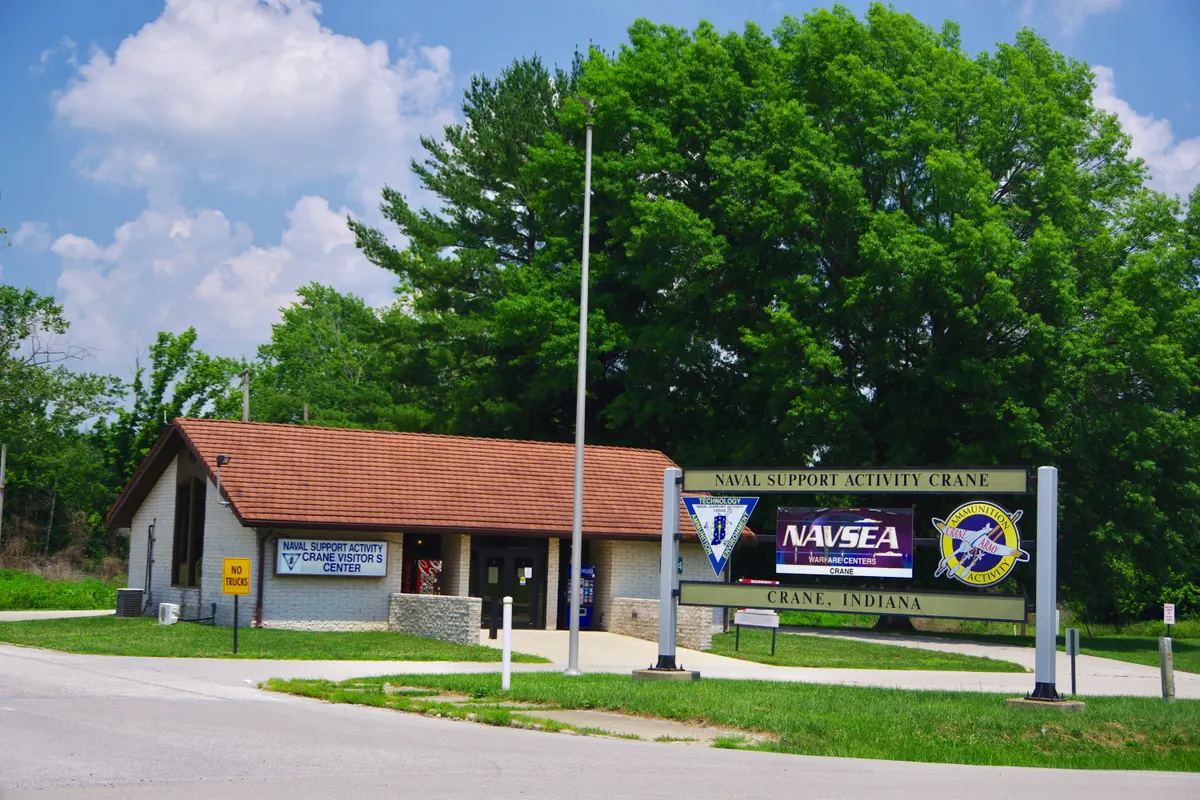
The Mk 12 Special Purpose Rifle (Mk 12 SPR) is a 5.56x45mm NATO semi-automatic designated marksman rifle built around the AR-15/M16 action for United States special operations forces. It was assembled and fielded through the Naval Surface Warfare Center Crane Division, the U.S. Navy's ordnance engineering facility in Crane, Indiana, rather than through a single commercial small-arms manufacturer.1 The Mk 12 sits inside the broader DMR category, a class of accurized service rifles designed to extend a rifle squad's precision reach without the weight and dedicated logistics of a full sniper rifle. Its core requirement was straightforward, hitting man-sized targets well beyond the practical range of the M4 carbine without carrying the bulk of a bolt-action sniper system.4
- Rifle-length gas system improves cycling consistency for precision fire
- Purpose-matched Mk 262 77-grain ammunition extends practical hit range well past a standard carbine
- Lighter and more maneuverable than 7.62mm designated marksman rifles like the SR-25
- Modular free-float rail accepts optics, lights, and the OPS Inc suppressor without disturbing zero
- 5.56mm terminal performance falls short of 7.62mm designated marksman rifles at longer ranges
- No single original manufacturer, complicating spare-parts standardization across Mod 0/Mod 1/Mod H batches
- Effectively retired from front-line SOF service since 2017
- Never had an official unit acquisition cost, since it was assembled in-house rather than purchased as a line item
The Mk 12 Special Purpose Rifle's roots trace to the Navy SEALs' informal Recon/Recce Rifle, a set of accurized 16-inch flat-top M16 carbines that SEAL platoons built in the field and refined from lessons learned during operations in Somalia in 1993.1,4 SOCOM's SOPMOD Programs Office at NSWC Crane formalized that ad hoc concept into a standardized weapon between 1998 and 2002, working with the U.S. Army Marksmanship Unit at Fort Benning during early prototyping.3 The result filled a deliberate capability gap. It reached further than the M4 carbine on one side, and stayed lighter and shorter than the SR-25 (fielded by the Navy as the Mk 11 Mod 0) on the other.4,5
Unlike most rifles carrying a Mk designation, the Mk 12 was never bought under a single manufacturer's contract. Its upper receivers came primarily from Colt's Manufacturing Company and the Canadian firm Diemaco (renamed Colt Canada in 2005), with some later production drawing on ArmaLite uppers, while its lowers were surplus M16A1-pattern receivers.3 That assemble-from-parts approach is one reason the Mk 12 Special Purpose Rifle reads, in its own service record, more like a kit standard than a single commercial rifle model, and it is also why NSWC Crane, not a private arms maker, is the entity credited with developing it.
The Mk 12 Special Purpose Rifle uses the same gas-operated, direct-impingement, rotating-bolt action found in the M16 and M4 family, with no fundamentally new operating mechanism.4 What sets it apart from a standard carbine is a rifle-length gas system, longer than the M4's carbine-length system, which bleeds gas pressure more gradually and reduces cycling stress on the bolt carrier. That change alone measurably improves shot-to-shot consistency, which matters more for a precision rifle than for a close-quarters carbine.3
- İlk Üretim Yılı2002
- Hizmete Giriş Yılı2002
- TasarımcıMark Westrom (concept); John Noveske and Steve Holland (design group); Vince Jiga and John Miller (Crane assembly); David Dunlap, Lamont LeClair, Jeff Hoffman (component credits)
- Ağırlık (Boş)4,9 kg
- Halen HizmetteHayır
- Önemli KullanıcılarU.S. Navy SEALs (incl. DEVGRU), U.S. Army Special Forces (5th SFG), 75th Ranger Regiment, U.S. Air Force Special Tactics, U.S. Marine Corps designated marksmen
The barrel is a free-floating, match-grade, heavy-profile stainless steel barrel in a distinctive SPR profile, cut with a 1-in-7-inch (178mm) rifling twist to stabilize the heavier 77-grain bullet used in its dedicated ammunition.3,4 Barrel length was 18 inches (457mm) on the Mod 0 and Mod 1 uppers, with some sources citing 18.5 inches, and a shorter 16-inch (406mm) barrel on the later Mod H variant.5 Overall length runs about 37.5 inches (952mm).4,5
- Fişek5.56x45mm NATO (Mk 262 Mod 0/Mod 1, 77-grain Sierra MatchKing Open-Tip-Match)
- Çap5,56 mm
- Kovan Uzunluğu45 mm
- Çap Sınıfıintermediate
- Mermi Ağırlığı77 g
- Kenar AteşlemeliHayır
- Kovansız MühimmatHayır
Sighting equipment sits on a optic-rail-equipped flat-top upper, originally a Leupold Mark 4 MR/T 3-9x36mm TS-30A2, with some late-production Mod 1 rifles switching to a Nightforce 2.5-10x24 NXS. Backup iron-sights fold flush against the rail when not needed.3 Fire control started with a Knight's Armament Company (KAC) two-stage trigger, though many rifles were later retrofitted with Geissele SSA-E triggers as those became available.3 The Mk 12 Special Purpose Rifle is not select-fire in practice. Its M16-pattern lowers retain a full-auto-capable trigger group, but every fielded unit runs the rifle semi-automatic only.4
- Mekanizma TipiGazlı
- Atış ModlarıSemi-automatic only in service (full-auto-capable M16-pattern lower retained but disabled)
- Seçmeli AtışHayır
- Besleme SistemiÇıkarılabilir Şarjör
- Şarjör Kapasitesi30
- Tetik TipiKnight's Armament Company (KAC) two-stage; later retrofits with Geissele SSA-E
A threaded muzzle carries an OPS Inc muzzle brake/collar built specifically to mount the OPS Inc 12th Model SPR suppressor, making the Mk 12 Special Purpose Rifle suppressor-ready from the factory rather than as an add-on modification.3 Feeding is via a detachable-magazine, standard 20- or 30-round STANAG box magazines shared with the M4 and M16 family.4
- Namlu Çıkış Hızı838 m/sn
- Etkili Menzil (nokta)700 m
- İsabet1
The rifle's accuracy depends heavily on its purpose-built Mk 262 cartridge, a 77-grain Sierra MatchKing Open-Tip-Match bullet loaded by Black Hills Ammunition specifically to pair with the Mk 12's fast twist rate.3 The original Mod 0 load lacked a cannelure, and the later Mod 1 load added one to prevent bullet setback under repeated chambering.3 Neither load is interchangeable with standard M855A1, M193, or M856 5.56mm ammunition, which is a real logistics complication for units carrying both a Mk 12 and a standard carbine. Reported accuracy runs about 0.75 MOA for Mod 0 uppers and a consistent 1 MOA for Mod 1 uppers firing Mk 262 Mod 1 ammunition, tight enough that the rifle in practice can put hits on man-sized targets out to 700 meters (770 yards), with field accounts describing confirmed hits at 800 to 850 yards.3,1
- Namlu Uzunluğu457 mm
- Yiv Adımı1-in-7-inch (178mm)
- Nişangah TipiDetachable optic rail, originally Leupold Mark 4 MR/T 3-9x36mm TS-30A2, later some Nightforce 2.5-10x24 NXS; KAC/ARMS flip-up iron sights as backup
- Optik RayıEvet
- Açık NişangahEvet
- Dişli NamluEvet
- Toplam Uzunluk952 mm
- Gövde Malzemesi (Receiver)Forged aluminum (M16A1-pattern lower, flat-top upper)
- Kabza/Dipçik MalzemesiFree-float carbon-fiber handguard (Mod 0, PRI Gen III) or aluminum quad rail (Mod 1, KAC RAS)
- Katlanır / Toplanır DipçikHayır
- Bullpup DüzeniHayır
- Çift Yönlü KumandalarHayır
- ModülerlikModular free-float rail/handguard permitting optic, light, and accessory attachment; interchangeable Mod 0/Mod 1/Mod H upper receiver groups on a common lower
- Susturucuya HazırEvet
- Bombaatar KabiliyetliHayır
- Gaz PistonluHayır
- Üretim Başlangıcı2002
- Üretim Bitişi2017
The Mk 12 Special Purpose Rifle's concept originated with Mark Westrom, later president of ArmaLite, while he worked at Rock Island Arsenal around 1998 to 2000.1,2 SOCOM's SOPMOD Programs Office at NSWC Crane formalized the requirement into a program, and the U.S. Army Marksmanship Unit at Fort Benning collaborated on early prototyping through 1998 and 1999.3 Formal testing ran from October 1999 into 2000, followed by trials at Thunder Ranch, Texas, in October 2000, with corrections made through 2001.3
The first standardized Mk 12 rifles were fielded in 2002, timed to the parallel adoption of Mk 262 Mod 0 ammunition, with the refined Mk 262 Mod 1 load finalized in 2003.3 Multiple designers are credited across different components of the program. Wikipedia names John Noveske and Steve Holland as the core design group, Athlon Outdoors separately credits Vince Jiga and John Miller as the Crane contractors who assembled the first rifles, and Small Arms Defense Journal credits David Dunlap of Precision Reflex Inc. with the Mod 0 upper, Lamont LeClair of Centurion Arms with the Mod 1 upper, and Jeff Hoffman of Black Hills Ammunition with the Mk 262 cartridge itself.2,3 MSG (Ret.) Steve Holland of the 5th Special Forces Group is separately credited as designer of the later Mod H variant.2
By 2017, the Mk 12 Special Purpose Rifle had been officially phased out of frontline U.S. special operations service, succeeded by the SCAR/Mk 16-17 rifle family and by the M110 Semi-Automatic Sniper System.4 Its production run of roughly fifteen years is short for a rifle with the reputation it built among the operators who carried it.
The Mk 12 Special Purpose Rifle saw its earliest and most sustained combat use in the War in Afghanistan as part of Operation Enduring Freedom, fielded from the earliest stages of that conflict as the primary designated-marksman weapon for U.S. special operations units.4 Its most documented use, however, came in the Iraq War.
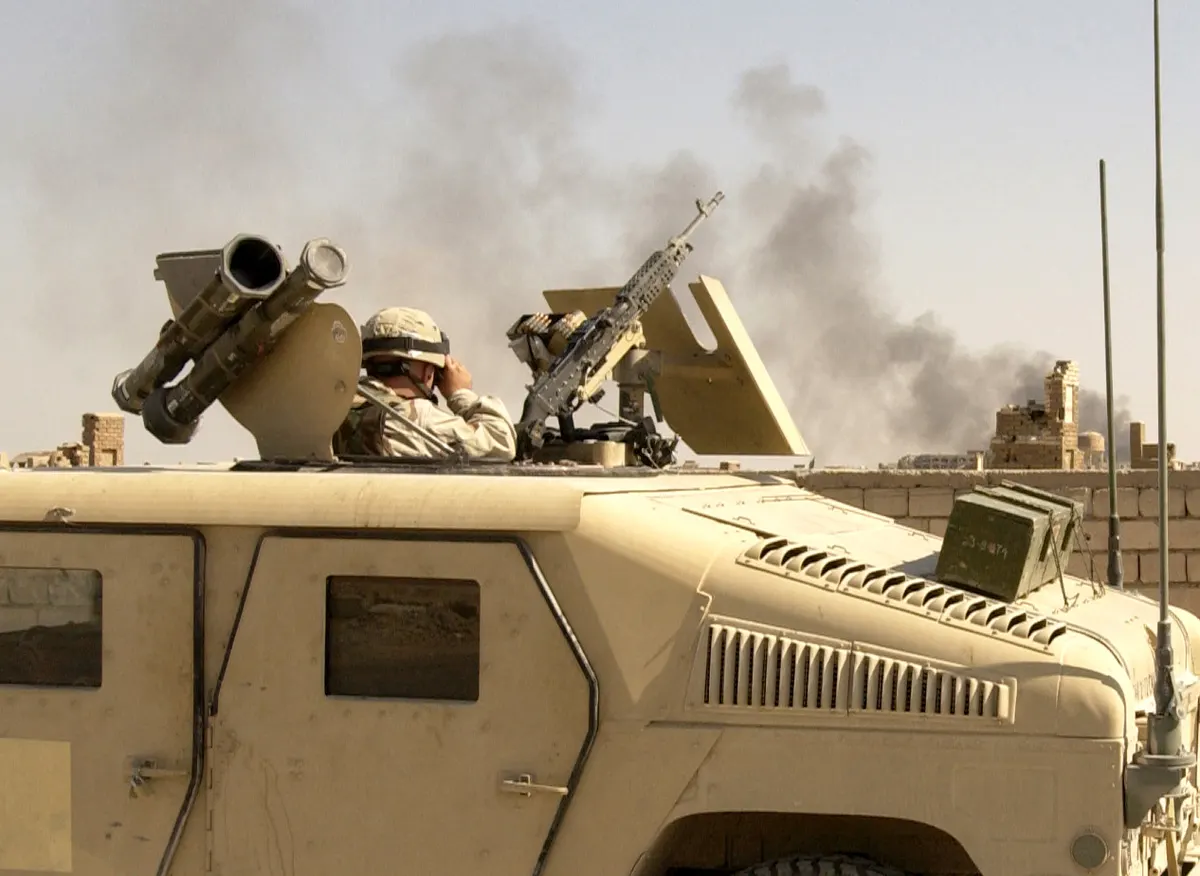
In Najaf during the summer of 2004, Navy SEAL and author Jack Carr deployed both the Mk 11 and the Mk 12 while clearing the city building-by-building against Mahdi Army militia fighters. Carr ran his Mk 12 with a Nightforce 2.5-10x24 optic and later described it as effective out to roughly 500 meters or more in that fighting.6 The Mk 12 Special Purpose Rifle's role in Najaf illustrates exactly the gap it was built to fill. It offered more precision and range than a carbine in a dense urban fight, without forcing a sniper team to carry a heavier 7.62mm rifle through the same close terrain.

In Ramadi in 2006, Navy SEAL Chris Kyle carried a customized Mk 12 Special Purpose Rifle, built with an M4 lower for full-auto capability and a collapsible stock, during house-to-house clearing operations near a hospital on the Euphrates river.7 Kyle used the rifle on point while entering buildings and then switched to rooftop overwatch, but he found the 5.56mm round underpowered compared to the .308-caliber Mk 11 he also carried, a recurring theme in operator accounts of the Mk 12 Special Purpose Rifle's caliber tradeoff against 7.62mm designated marksman rifles.7
U.S. Marine Corps scout snipers also used the Mk 12 Special Purpose Rifle during house-to-house fighting around Fallujah in 2004.4 Some records associate the Mk 12 with the Cold War and the Arab Spring, but neither holds up against the sourcing. The Mk 12 was not fielded until 2002, over a decade after the Cold War's conventional end in 1991, and no source documents Mk 12 use in Libya, Syria, or any other Arab Spring theater. Both appear to be data errors rather than real service history (see DATA REPORT below).
The rifle's documented reach beyond Iraq and Afghanistan runs through Operation Enduring Freedom – Philippines, where U.S. Army Special Forces conducted joint operations against Abu Sayyaf militants alongside the Armed Forces of the Philippines. That is a materially different claim than the Philippines fielding the Mk 12 Special Purpose Rifle itself. Listing the Philippines as an operator is best read as U.S. forces carrying the rifle on Philippine soil, not as an AFP-owned weapon, since no source documents the Philippine military issuing it directly.
The Mk 12 Special Purpose Rifle went through several distinct configurations before its predecessor prototypes settled into a standardized production model.
- SPR / SPR-A / SPR-B, pre-Mk 12 prototype designations. The SPR/A used a 3.5-10x40mm Leupold LR/M3 scope, while the SPR/B used a 2.5-8x36mm TS-30.3
- Mk 12 Mod 0, the first standardized production configuration, fielded from around 2002, built with a Precision Reflex Inc. Gen III free-float carbon-fiber handguard, an A.R.M.S. #38 SPR Swan Sleeve, and a 3-9x36mm Leupold TS-30A2 optic. Used primarily by U.S. Army Special Forces.3
- Mk 12 Mod 1, which replaced the tube handguard with a Knight's Armament Company M4 Match Free-Floating RAS quad rail and KAC flip-up sights, with some late runs switching to the Nightforce NXS optic. Fielded across Navy SEALs, Army Rangers, Air Force Special Tactics, and Marine Corps designated marksmen.3
- Mk 12 Mod H, nicknamed Holland, a 16-inch-barrel configuration designed by MSG Steve Holland of the 5th Special Forces Group, combining the Mod 0's PRI Gen III handguard with a shorter RECCE rail, used primarily by Army special operations and special mission units. A 2007 upgrade program at Fort Campbell converted twelve Mod 0 rifles to this configuration.2
A related but distinct program is the U.S. Marine Corps' Squad Advanced Marksman Rifle (SAM-R), built on a 20-inch-barrel M16A4 rather than a Mk 12 upper, and sharing only the same Leupold TS-30A2 optic. The SAM-R was never an official Mk 12 variant and should be treated as a parallel Marine Corps development rather than a branch of the Mk 12 Special Purpose Rifle's own family.4

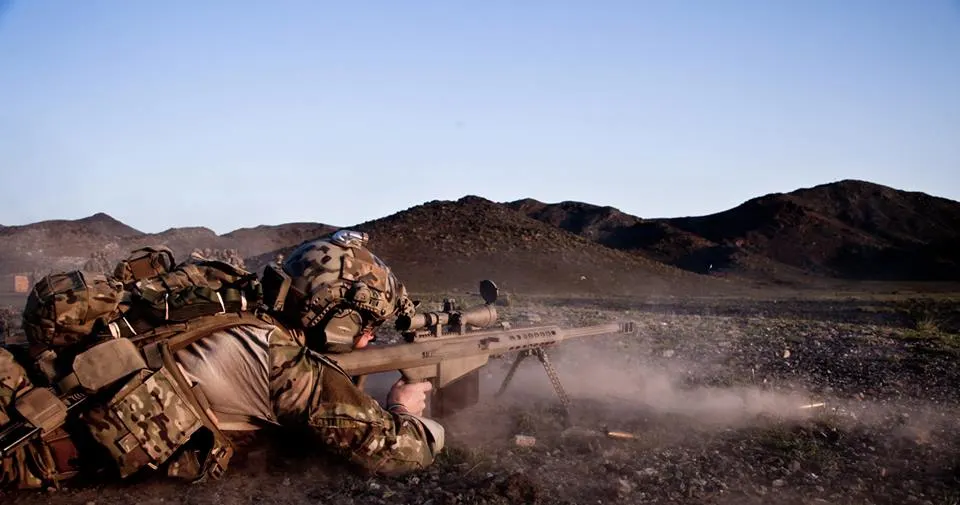
The United States is the only confirmed operator of the Mk 12 Special Purpose Rifle. Within U.S. special operations, it was fielded by Navy SEALs (including the Naval Special Warfare Development Group), Army Special Forces (notably the 5th Special Forces Group), the 75th Ranger Regiment, Air Force Special Tactics units, and U.S. Marine Corps designated marksmen during the later stages of the Iraq War and in Afghanistan.1,4 The Philippines is sometimes listed as a second operator, but that entry is unverified as direct Philippine ownership. The documented record instead shows U.S. forces carrying the Mk 12 Special Purpose Rifle during joint operations on Philippine soil, not the Armed Forces of the Philippines fielding the rifle itself.
The Mk 12 Special Purpose Rifle and the SR-25 (fielded by the Navy as the Mk 11 Mod 0) were designed as a matched pair rather than as competitors. SOF units routinely carried both, choosing the Mk 12 for its lighter weight and faster handling and the SR-25 for its heavier 7.62x51mm round and longer reach.1 Chris Kyle's own account of Ramadi captures that division directly. He carried the Mk 11 for its stopping power and switched to the customized Mk 12 for maneuverability in tighter spaces, finding the 5.56mm round comparatively underpowered but the rifle itself easier to move with.7
| Spec | Mk 12 SPR (Mod 1) | SR-25 / Mk 11 Mod 0 |
|---|---|---|
| Caliber | 5.56x45mm NATO | 7.62x51mm NATO |
| Barrel length | 18 in (457mm) | 20 in (508mm) |
| Weight (empty) | ~10.8 lb (4.9 kg) | ~10.75 lb (4.9 kg, without optic) |
| Effective range | ~700 m | ~800 m |
The Mk 12 Special Purpose Rifle's later successor, the M110 Semi-Automatic Sniper System, replaced both the SR-25/Mk 11 and, eventually, the Mk 12 itself in front-line SOF inventories after 2017. That transition was not universally welcomed. Multiple SOF operators reportedly preferred the older Mk 12 over the newer M110 despite its smaller cartridge, citing the Mk 12's build quality and reliability record built up over fifteen years of combat use.4 The M110A1 Compact Semi-Automatic Sniper System and its later derivatives, the M110A1 Squad Designated Marksman Rifle and M110A2 Semi-Automatic Sniper System, extended that succession further, but none of them directly reused the Mk 12's own 5.56mm platform. They instead continued the 7.62mm branch that the SR-25 established.

What caliber is the Mk 12 Special Purpose Rifle? The Mk 12 Special Purpose Rifle is chambered in 5.56x45mm NATO, firing the purpose-built Mk 262 77-grain Open-Tip-Match load rather than standard M855 or M855A1 ball ammunition.3,4
Who makes the Mk 12 Special Purpose Rifle? No single commercial manufacturer built the Mk 12. It was developed and assembled by the Naval Surface Warfare Center Crane Division, using upper receivers primarily from Colt's Manufacturing Company and Diemaco/Colt Canada, with triggers, rails, and sights from Knight's Armament Company.1,3
Is the Mk 12 Special Purpose Rifle still in service? No. The Mk 12 was officially phased out of U.S. special operations service by 2017, succeeded by the SCAR/Mk 16-17 family and the M110 Semi-Automatic Sniper System, though some operators reportedly preferred it over its 7.62mm successor.4
What is the Mk 12 Special Purpose Rifle's effective range? Around 700 meters (770 yards) under typical service conditions, with some field accounts describing confirmed hits at 800 to 850 yards using Mk 262 ammunition.3,1
How much does the Mk 12 Special Purpose Rifle cost? There is no official U.S. military unit acquisition cost, since the rifle was assembled and issued through NSWC Crane rather than purchased as a discrete commercial line item. Civilian clone uppers built to the same pattern have sold in the $1,200 to $2,200 range, which is not a historical military figure.3
What is the difference between the Mk 12 SPR and the SR-25 / Mk 11? The Mk 12 Special Purpose Rifle is a lighter, shorter 5.56mm rifle built to outrange the M4 carbine, while the SR-25/Mk 11 Mod 0 is a heavier 7.62mm rifle built for longer range and greater stopping power. SOF teams frequently carried both rather than choosing one over the other.1,7
- "Mk12 SPR History", Sniper Central — snipercentral.com ↩
- "MK12 SPR History", Athlon Outdoors — athlonoutdoors.com ↩
- "The MK12 SPR (Special Purpose Rifle)", Small Arms Defense Journal — sadefensejournal.com ↩
- "Mk 12 Special Purpose Rifle", Wikipedia — en.wikipedia.org ↩
- "Mk12 SPR (Special Purpose Rifle)", Military Factory — militaryfactory.com ↩
- "MK11/12, An Urban Sniper's Best Friend", Jack Carr — officialjackcarr.com ↩
- "Chris Kyle's Precision Rifles", Warfare History Network — warfarehistorynetwork.com ↩