

A designated marksman rifle is a semi-automatic rifle issued to one soldier in an infantry squad to reach targets beyond the effective range of the standard-issue rifle carried by everyone else. The role sits between two others covered on this site. The assault rifle that arms the rest of the squad fires a lighter intermediate cartridge optimized for close and medium range, typically under three hundred meters. The dedicated sniper rifle that a trained sniper team carries trades rate of fire away entirely in exchange for the best possible accuracy at extreme distance, often from a bolt-action platform. A designated marksman rifle fills the gap, giving one soldier per squad the ability to fire fast, accurate follow-up shots out past five hundred or six hundred meters without slowing the squad down or requiring a two-man sniper team's separate tactical footing.
The category descends directly from the full-power battle rifle, the self-loading infantry rifle built around 7.62x51mm NATO or an equivalent cartridge that most NATO and Warsaw Pact armies issued through the 1950s and 1960s before switching their standard infantry weapon to a lighter assault rifle. When that switch happened, the range and penetration a full-power cartridge provided did not disappear from the battlefield, it simply moved from the entire squad down to a single rifle. Nearly every designated marksman rifle covered in this article is either a rebuilt or lightly modified version of an older battle rifle, or a new design built specifically to recreate that older rifle's reach in a smaller, more precise package. A handful break from that pattern entirely, built instead on an accurized assault rifle or semi-automatic rifle chambered for a lighter cartridge, trading raw power for weight and ammunition commonality with the rest of the squad. Where a designated marksman rifle sits against a carbine or a bolt-action rifle is often a matter of exact tactical role rather than a hard technical line, and several rifles in this article have been classified differently by different armies and different sources over the decades.
01Vietnam and the Birth of the Squad Marksman
Two armies arrived at the designated marksman idea independently and almost simultaneously in the 1960s, for opposite reasons and by opposite methods. The Soviet Union had just re-armed its infantry with the intermediate-cartridge AK-47 and its shortened 7.62x39mm round, a deliberate tradeoff of range for controllability and ammunition weight. That tradeoff left Soviet squads without the long-range punch their old bolt-action rifles once carried, and Soviet ordnance planners set out to restore it in a single specialist rifle rather than across the whole squad. Designer Yevgeny Dragunov, working at the Izhevsk Machine-Building Plant later known as Kalashnikov Concern, won a 1958 competition against rival submissions from Sergei Simonov and Aleksandr Konstantinov with a purpose-built, gas-operated rifle chambered for the older 7.62x54mmR round still held in vast Soviet stockpiles. The resulting SVD Dragunov entered a 200-unit trial batch in 1963 and reached full serial production in 1964, issued one per squad to a trained marksman rather than to a dedicated sniper team.1

The SVD's mechanism was new from the ground up, a short-stroke gas-piston operated system paired with a separate three-lug rotating bolt that isolated the barrel from the moving action for better accuracy, fed from a curved ten-round detachable magazine and topped with the purpose-built PSO-1 4x24 scope. It kept traditional wood furniture and a bayonet lug, reflecting its origin as a general-issue rifle rather than a specialist tool built only for optics work, and it retained iron sights as a backup to the scope. Factory accuracy specification was roughly 0.7 minutes of angle, tight enough that the SVD outperformed most rifles built for the same squad-support role for decades afterward.
The United States reached the same conclusion from the opposite direction and by a completely different method. Rather than design a new rifle, the US Army converted existing hardware. In February 1967, an Army research effort tasked ACTIV, the Army Concept Team in Vietnam, with finding an answer to Viet Cong and North Vietnamese snipers operating past the effective range of scoped M16 rifles. Rock Island Arsenal hand-accurized selected National Match M14 rifles, glass-bedding and individually fitting each receiver, and fielded the result to the 9th Infantry Division in the Mekong Delta from 1969 onward as the XM21, standardized as the M21 Sniper Weapon System in 1972.1 Where the SVD was purpose-built from a clean sheet, the M21 was a careful rework of an already-obsolete infantry rifle, and that split between purpose-built and converted defines the entire category that follows.
The M21 mounted a distinctive Leatherwood Automatic Ranging Telescope, a scope whose ranging cam mechanically compensated for bullet drop as the shooter adjusted focus on a target of known size. Army marksman Adelbert Waldron III used the rifle to record 109 confirmed kills in Vietnam, often firing from a moving riverine patrol boat at night, a total that stood as the American record for decades. More than 1,200 XM21 and M21 rifles were eventually built, though because each one was hand-fitted to its own individually bedded stock, no two were fully interchangeable, a maintenance problem that would eventually push the Army toward a different rifle entirely.
01The Dragunov Pattern and Its Global Descendants
No designated marksman rifle spread further outside its country of origin than the SVD. More than forty-five countries have fielded it or a close derivative, and its influence produced an entire family of rifles across three continents that are frequently, and often incorrectly, described as Dragunov copies. China captured intact SVDs from forces of Vietnam during the brief 1979 Sino-Vietnamese War and reverse-engineered them almost immediately, adopting the result the same year as the Type 79 Sniper Rifle. A refined second-generation version followed in the mid-1980s as the Type 85 Sniper Rifle, lighter and mechanically cleaner than the first Chinese copy, both built by state arsenals now consolidated under Norinco and later exported commercially as the NDM-86.2
Romania's PSL is commonly called a Romanian Dragunov and is nothing of the sort. The Soviet Union initially offered to license the SVD to Romania, but Nicolae Ceaușescu's public condemnation of the 1968 invasion of Czechoslovakia froze that cooperation before production could begin. Left without a license, engineers at the Cugir Arms Factory, now part of ROMARM, simply scaled up the RPK light machine gun action already tooled at the plant into a new rifle chambered for the same 7.62x54mmR round, adopted in 1974. The PSL uses a long-stroke piston and a stamped sheet-steel receiver where the SVD uses a short-stroke system and a milled receiver, and its practical accuracy of two to three minutes of angle trails the SVD by a wide margin. Its own name, Puşcă Semiautomată cu Lunetă, simply means scoped semi-automatic rifle, with no reference to Dragunov at all, though its export designation FPK helped cement the mistaken association abroad.2
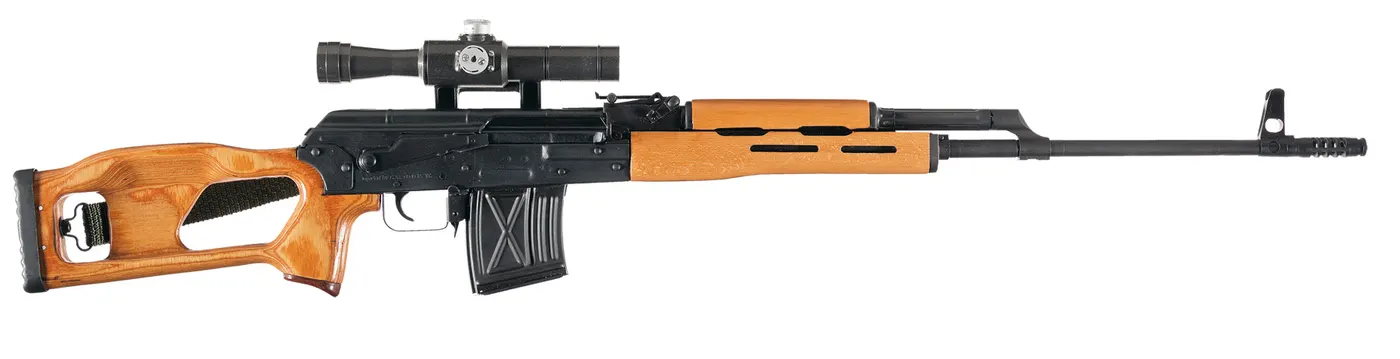
Yugoslavia's Zastava Arms, based in what is now Serbia, followed a path closer to Romania's than to the Soviet original. The Zastava M76, adopted in 1976, is another AK and RPK-derived design rather than a true SVD copy, distinguished by its milled receiver and its unusual chambering for the 7.92x57mm Mauser round still in Yugoslav ordnance stocks. Zastava followed it in 1991 with the Zastava M91, a rifle built closer to the true Dragunov pattern and aimed more directly at export customers. Both saw extensive combat in the Yugoslav Wars of the 1990s, including the Kosovo War, and the M91 later turned up among factions in the Syrian Civil War through onward export.2
Poland took a third approach, modernizing genuine Soviet-supplied SVDs rather than building a new design. In the 1990s the state arsenal at Radom, working with barrel maker H. Cegielski of Poznań, replaced the worn factory barrels on 158 Polish Army SVDs with heavier, locally produced barrels and new scope mounts, redesignating the result the SWD-M. The underlying action and layout stayed pure Dragunov, only the barrel and optics mount changed, making the SWD-M less a new rifle in its own right than a maintenance-driven upgrade of existing stock.2
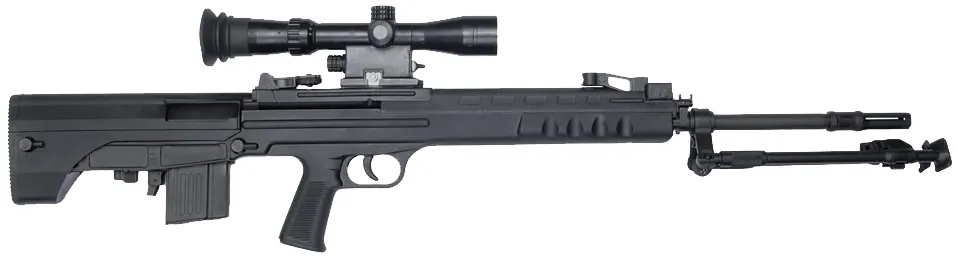
China eventually broke from its own SVD-derived line of rifles entirely. The QBU-88, adopted by the People's Liberation Army in 1997 specifically to arm the garrison taking over Hong Kong that year, replaced the Type 85 with a fully indigenous design built by Norinco around a proprietary 5.8x42mm cartridge unrelated to either the NATO or Soviet standards. It adopted a bullpup layout, placing the action and magazine behind the trigger group to shorten the overall rifle without shortening the barrel, a configuration almost no other rifle in this article shares. The QBU-88 has no confirmed major combat record, since the People's Liberation Army has not fought a large war since its adoption, and it functions mainly as a garrison, training, and police sharpshooting rifle, already being phased out of some PLA units in favor of the newer QBU-191.3
01America Rebuilds the M14
The United States spent the following three decades returning again and again to the same rifle the M21 had already proven, the M14, rather than replacing the concept outright. The M21's individually hand-fitted stocks proved to be its downfall in the field. Repeated cleaning and handling cracked or shifted the glass bedding compound holding each barreled action in its stock, and because no two rifles were built to the same tolerance, a broken M21 could not simply be swapped for another. In the mid-1980s, armorers Tom Kapp and Bill Amelung of the Army's 10th Special Forces Group, working with civilian machinist Mitch Mateiko of Brookfield Precision Tool, solved the problem with a steel liner epoxy-bonded into a McMillan fiberglass stock, giving the rifle a repeatable zero that survived routine cleaning. The result reached formal designation as the M25 Sniper Rifle around 1991, in time to serve with Army Special Forces sniper and marksman teams in Iraq during the Gulf War, and it never left US Army Special Forces and Navy SEAL service before its own eventual retirement.4
The Marine Corps built its own M14 conversion independently. A Mission Needs Statement drafted in November 1992, after the 1991 Gulf War exposed the same accuracy gap the Army had already found, led the Corps' own Precision Weapons Section at Marine Corps Base Quantico to rebuild M14 receivers with Krieger match barrels and McMillan Tactical stocks, fielding roughly 400 rifles from 2001 as the United States Marine Corps Designated Marksman Rifle. Marine Corps units carried it through the Iraq War and the early years of the War in Afghanistan, including with explosive ordnance disposal teams and Fleet Anti-Terrorism Support teams.4 The Corps replaced it directly from 2008 with the M39 Enhanced Marksman Rifle, the same M14 action rebuilt again by the same Precision Weapons Section, now fitted into a Sage International aluminum chassis and paired with the Schmidt & Bender scope already standard on the Corps' M40 sniper rifles.4
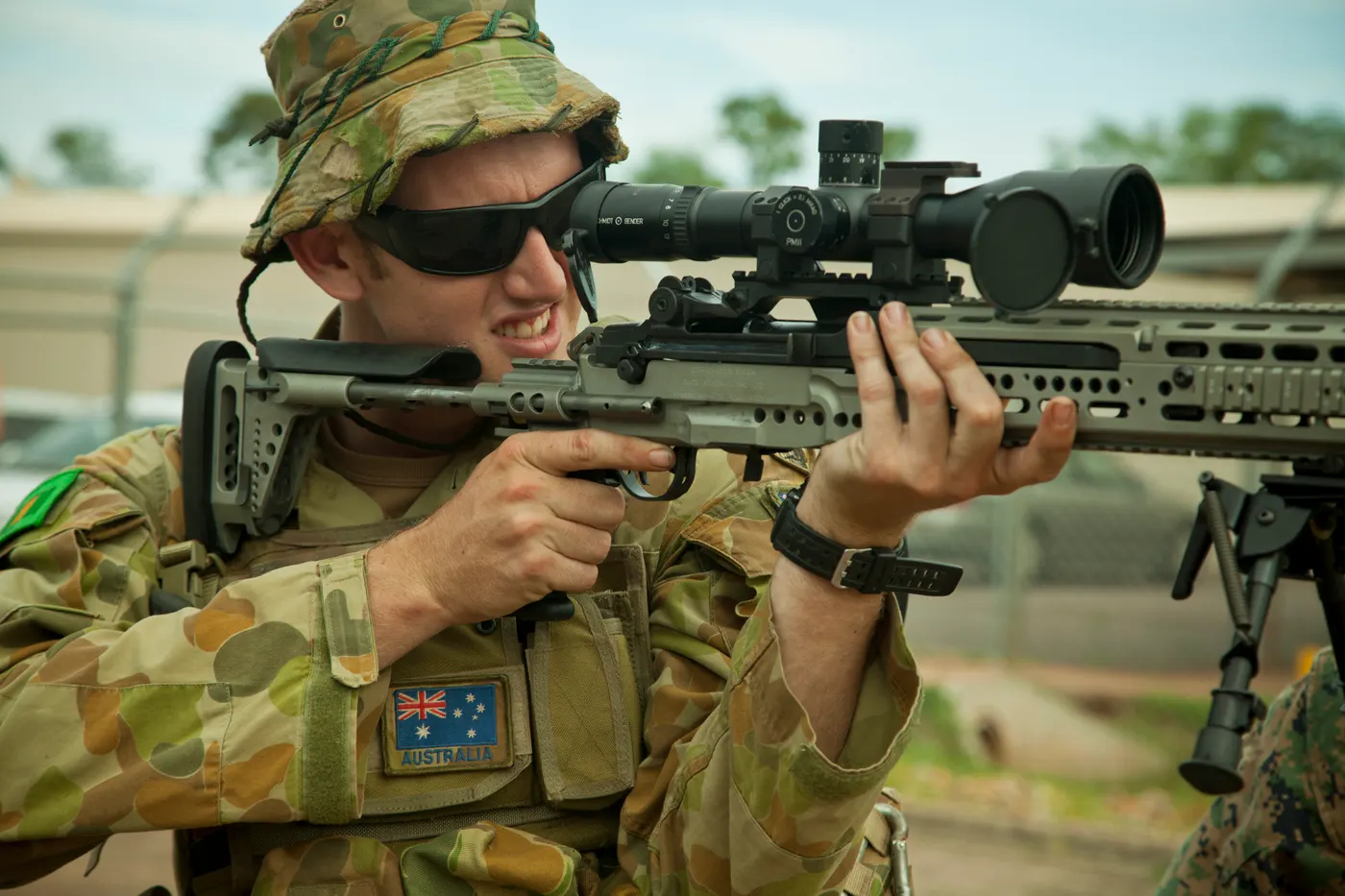
A parallel, commercial version of the same idea reached Army units in the 2000s through Smith Enterprise, an Arizona gunmaker that built hundreds of accurized M14 rifles for units including the 2nd Infantry Division, 10th Mountain Division, 25th Infantry Division, and 503rd Parachute Infantry Regiment. Developed with input from Picatinny Arsenal and the Army Infantry School, the Crazy Horse rifle used cryogenically treated metal components to eliminate the need for the fragile glass bedding that had plagued the original M21, alongside a fully adjustable trigger, and it saw heavy field use in Afghanistan from 2003 onward.4
01Stoner's Second Rifle and the AR-10 Pattern
Eugene Stoner, designer of the AR-15 that became the M16, had also designed the original AR-10 battle rifle in the 1950s, a design that lost the trials that produced the M14 and saw only modest overseas production. Roughly three decades later, Stoner revived his own earlier design at Knight's Armament Company, the Florida manufacturer founded by C. Reed Knight Jr., producing the SR-25 from 1990. Rather than reviving the AR-10's operating system directly, the SR-25 combined a 7.62x51mm NATO barrel and bolt with roughly sixty percent parts commonality with the AR-15 and M16 already in US service, a deliberate logistics decision that let armorers trained on one rifle maintain the other. Its name simply combines the 10 from AR-10 with the 15 from AR-15. The rifle sold commercially for years before any military adoption, and the US Navy formally adopted a shortened version as the Mk 11 Mod 0 in May 2000 after a five-year evaluation.5
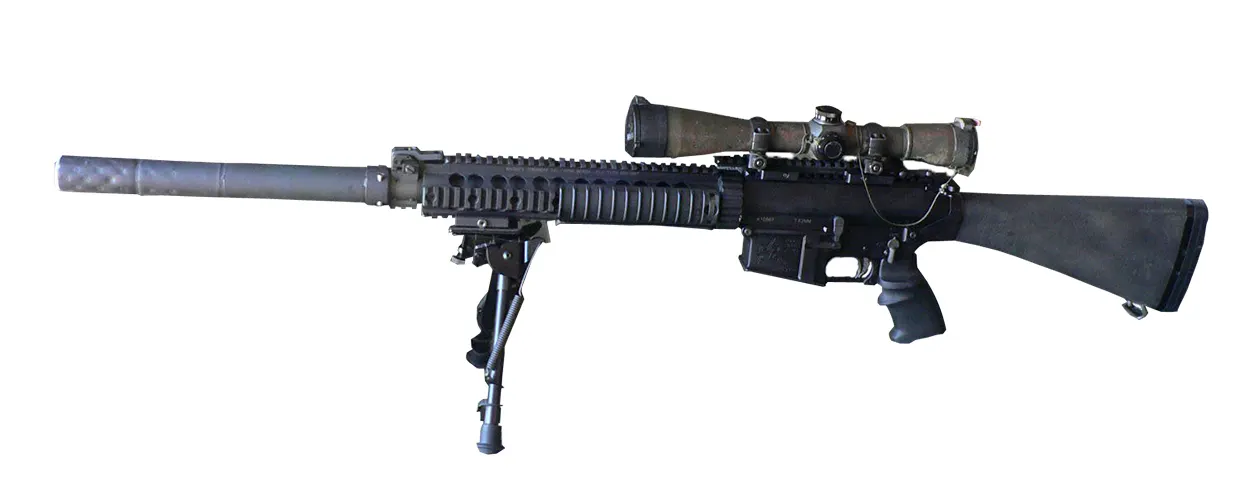
Navy SEALs and other special operations units had already been building their own accurized rifles around the same direct-impingement system Stoner used in the M16, working from lessons learned after the 1993 fighting in Somalia. Formalized between 1998 and 2002 through Rock Island Arsenal veteran Mark Westrom, later president of ArmaLite, and the Naval Surface Warfare Center's Crane Division in Indiana, the resulting Mk 12 Special Purpose Rifle used a rifle-length gas system on an 18-inch barrel for more consistent cycling than a standard M4 carbine, paired with dedicated 77-grain Mk262 match ammunition. Its designer credit remains genuinely disputed between several accounts, an unresolved attribution rather than a settled fact. SEALs carried it through the earliest stages of the War in Afghanistan, and author and SEAL Jack Carr used one during fighting in Najaf, Iraq, in 2004. The Mk 12 was officially phased out of frontline special operations service by 2017 in favor of the SCAR rifle family and the M110, though some operators reportedly preferred it even after its replacement arrived.5
Both the Army and Marine Corps separately built their own squad-level rifles on the standard M16 platform rather than the heavier 7.62mm SR-25 pattern, arriving at nearly identical solutions without coordinating. The Marine Corps' Precision Weapons Section built roughly 100 rifles from 2001 on the M16A4 receiver, fitted with a 20-inch barrel and a rifling twist tuned for the 77-grain Mk262 load, designating the result the Squad Advanced Marksman Rifle and issuing it heavily during the Iraq War. The Army's own program, run by the US Army Marksmanship Unit at Fort Benning three years later in 2004, converted existing M16A2 and M16A4 lowers with Douglas Barrels fluted barrels, a Knight's Armament two-stage trigger, and a Trijicon ACOG sight, fielding roughly 240 rifles to the 3rd Infantry Division as the Squad Designated Marksman Rifle. Troops nicknamed it the AMU rifle, and it is often mistakenly conflated with the Navy's Crane-built Mk 12 despite having no organizational connection to it.5

01The M110 Family and the Army's Semi-Automatic Sniper System
Urban combat in Iraq exposed a specific weakness in the Army's bolt-action M24 sniper rifle, its slow cycling made a fast, reactive second shot difficult in a firefight where a target might move or take cover before the bolt could be worked. The Army opened the XM110 competition to solve that problem with a semi-automatic rifle, and Knight's Armament Company won it on September 28, 2005 with a scaled-up, 20-inch-barreled version of the SR-25 action fitted with fully ambidextrous controls and an integral quick-detach suppressor-ready system. The resulting M110 Semi-Automatic Sniper System deployed to Afghanistan in April 2008 with Task Force Fury, the first rifle of its kind fielded in a combat zone, and went on to see service in the Iraq War, the Syrian Civil War, and the Kurdish-Turkish conflict. More than thirty countries now field the M110 or a closely licensed equivalent, and it ranked second on the Army's own list of the ten greatest inventions of 2007.6
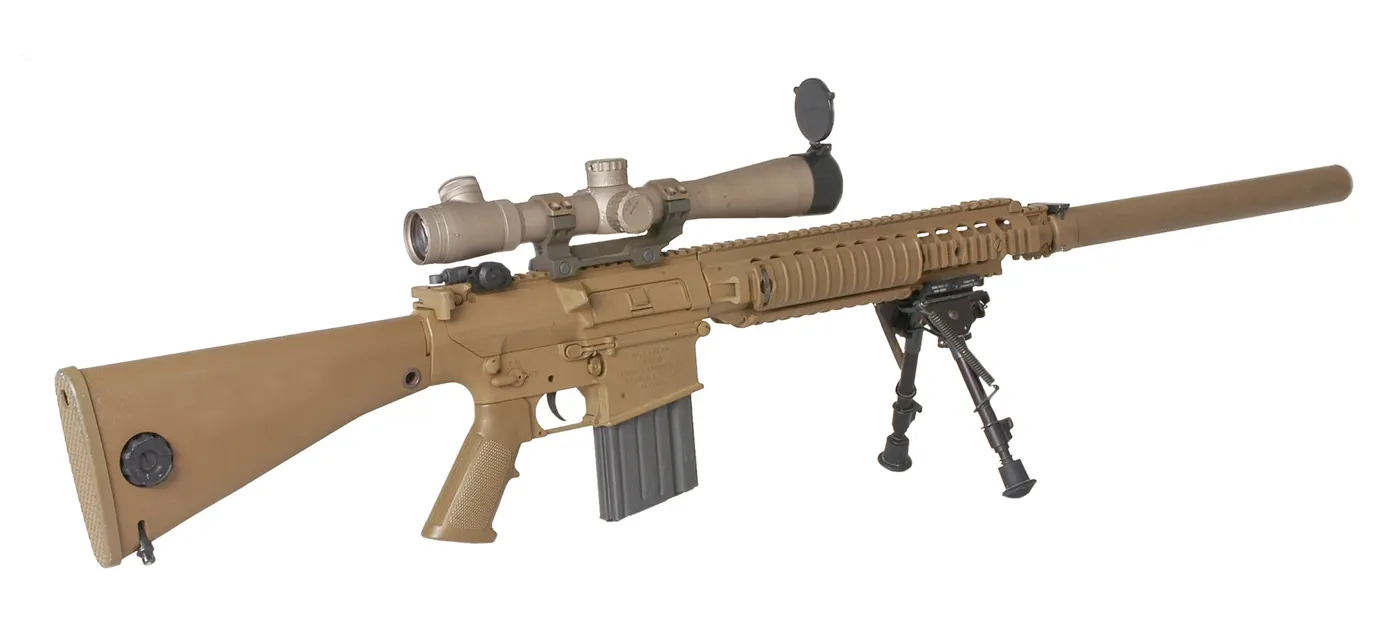
The Army tried to replace the M110 outright in 2016 through a new Compact Semi-Automatic Sniper System competition, won by Heckler & Koch with a lightened, aluminum-upper version of its German G28 rifle rather than by Knight's Armament's own competing entry. That contract produced the M110A1 Compact Semi-Automatic Sniper System, built for the dedicated sniper role with a shorter 16.3-inch barrel and a high-magnification Schmidt & Bender scope, and a second, optically different configuration, the M110A1 Squad Designated Marksman Rifle, built for ordinary infantry squads with a lower-magnification SIG Sauer optic instead. By 2022, nearly all of the rifles delivered under the 2016 contract had been built in the squad configuration rather than the sniper configuration the competition had originally been written to replace, effectively leaving the Army's dedicated sniper teams still equipped with the aging original M110.6
That gap left an opening for Knight's Armament to upgrade its own original design rather than lose the sniper role entirely. First shown publicly at the Association of the US Army's October 2021 annual meeting, the M110A2 Semi-Automatic Sniper System kept the same 20-inch barrel, action, and ballistics as the 2008 original but cut roughly three to four pounds of weight through a new folding stock and an M-LOK rail, alongside a redesigned integral suppressor. It has yet to see confirmed combat deployment, its most public appearance so far being the 101st Airborne Division's entry in the 2022 Best Ranger Competition.6
01Commercial AR-10 Pattern Rifles Join Military and Police Service
The SR-25's success spawned an entire secondary market of AR-10 pattern rifles built by other manufacturers for military and law enforcement designated marksman contracts, each competing on the same basic architecture Stoner had originated. Remington Arms entered the field with the Remington Semi-Automatic Sniper System, built around Stoner's direct-impingement rotary-bolt system in 7.62x51mm and marketed as a complete package with a Leupold scope, quick-detach suppressor, and Harris bipod, sold exclusively to military and law enforcement buyers.7
Switzerland's SIG Sauer built its own AR-10 pattern entry as the SIG SAPR from 2004, a gas-piston-driven rifle with an 18-inch match barrel and threaded muzzle for suppressor use, developed alongside the company's broader SIG716 rifle family. Belgium's FN Herstal offered two separate answers to the same market. The FN SCAR SSR, a semi-automatic-only Sniper Support Rifle built on the heavier SCAR-H receiver with a strengthened barrel extension and a modular trigger, targeted the same designated marksman and sniper-spotter role the SR-25 and M110 already filled. Separately, the FN FNAR, introduced in 2008, took an unrelated approach by adapting the civilian Browning BAR hunting rifle into a tactical platform with a gas-operated short-stroke piston and a rotary bolt, aimed squarely at law enforcement buyers who wanted a semi-automatic precision rifle without the cost of a dedicated sniper system.7

01Germany's Piston-Driven Answer
Not every modern designated marksman rifle uses Stoner's direct-impingement system. Heckler & Koch built its answer around a short-stroke gas-piston operated mechanism instead, adapted from the company's own HK417 battle rifle. The German Bundeswehr's 5.56mm G36 rifle had proven outranged by opposing 7.62mm-class weapons during operations in Afghanistan, and some units had already dug out older accurized G3-based rifles or interim HK417s as stopgaps before Heckler & Koch delivered a purpose-built solution. The first production order for 560 rifles arrived in August 2011, fielded to the Bundeswehr as the Heckler & Koch G28, distinguished from the HK417 it derives from by a steel upper receiver for tighter tolerances, a two-position gas regulator for suppressed and unsuppressed fire, and a contractually guaranteed accuracy standard of 1.5 minutes of angle with match ammunition. It saw service in the War in Afghanistan from around 2011 onward with German Fallschirmjäger units, though it postdates and should not be confused with the well-known 2010 Karfreitagsgefecht battle, which German troops fought with older G3-derived rifles instead.8
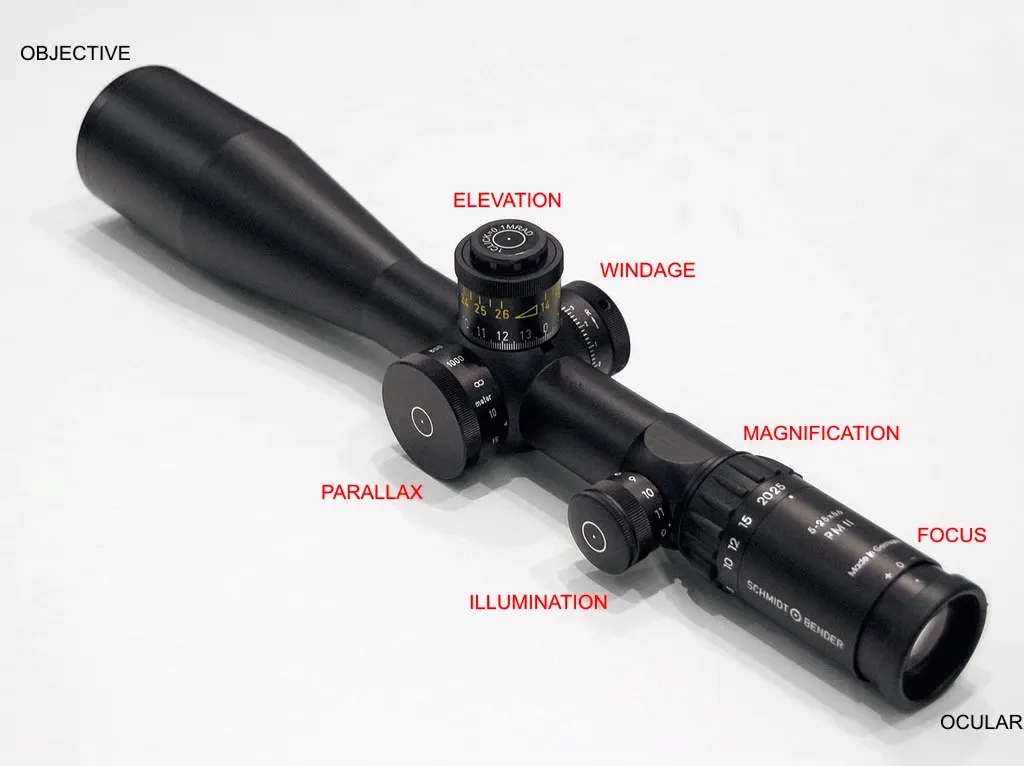
Heckler & Koch's civilian arm sells a semi-automatic-only version of the same HK417 platform as the HK MR308, introduced in 2007 and marketed in Europe under that name and in the United States as the MR762, offered in barrel lengths from 13 to 20 inches for hunting and sport shooters. The lightened, export-configured version of the G28 itself went on to win the US Army's 2016 Compact Semi-Automatic Sniper System competition, becoming the technical basis for both the M110A1 CSASS and the M110A1 SDMR described above, a direct case of a German military rifle reshaping American squad-level doctrine.8
01The Roller-Delayed MSG90 Family
A separate strand of Heckler & Koch's own history runs not through the piston-driven HK417 but through the older roller-delayed blowback system the company inherited from the Spanish CETME rifle and built into its G3 battle rifle. Introduced in 1987 as a lighter, cheaper export version of the company's police-oriented PSG1, the HK MSG90 is a heavily modified G3 fitted with a cold hammer-forged heavy barrel, a semi-automatic-only match trigger, and a fixed 12x scope with a built-in range adjuster effective from 100 to 800 meters.9
An improved HK MSG-90A1 followed, adding backup iron sights borrowed from the HK21 machine gun and, distinctively for the roller-delayed family, a threaded barrel built to accept a suppressor. Both rifles equip Germany's Bundeswehr and GSG9 counter-terrorism units alongside various special forces and law enforcement agencies across Europe, Asia, and South America, offering a lighter, more portable alternative to the earlier PSG1 without abandoning the roller-delayed mechanism that has defined Heckler & Koch's full-power rifles since the 1950s.9
02Britain, Turkey and Other National Programs
Britain arrived at its own designated marksman rifle through urgent operational necessity rather than a peacetime competition. British infantry deployed to Helmand province from 2006 were being engaged by Taliban fighters at 500 to 800 meters, well beyond the effective reach of the 5.56mm SA80A2 rifle standard across the United Kingdom's armed forces. A 2009 trial pushed through as an Urgent Operational Requirement selected an American-made rifle, Lewis Machine and Tool Company's commercial LM308MWS, over both the piston-driven Heckler & Koch HK417 and the FN SCAR-H, a notable result since direct impingement was widely assumed to be the wrong choice for Helmand's dust and sand. Adopted in 2010 as the L129A1, it deployed first with 40 Commando Royal Marines and remained the standard British sharpshooter rifle throughout the remainder of Operation Herrick, and it is still being upgraded rather than retired, with a further conversion program announced in 2024. New Zealand's Defence Force adopted a modified version of the same rifle in 2011.10
Turkey's state arms manufacturer MKE developed the MKE KNT-76 as a designated marksman variant of its standard-issue MPT-76 service rifle, extending the barrel to 508 millimeters and refining the trigger and stock for precision work while keeping the same gas-operated rotating-bolt action. Introduced to Turkish forces in 2017, it now equips Turkish combat units, the General Command of Gendarmerie, and special operations units, and it has since been exported to several African militaries. Israel took an earlier and different route, adapting its own Galil assault rifle family to the 7.62x51mm NATO cartridge to create the Galil Sniper, known domestically as the Galatz, fitted with a heavier barrel, an adjustable integral bipod, and the Nimrod 6x40 telescopic sight, developed originally by state-owned Israel Military Industries and later modernized into the SR-99.10
01The Marine Corps Returns to 5.56mm
When Marine Corps Commandant General Robert Neller ordered the M27 Infantry Automatic Rifle to replace the M4 and M16A4 as the standard rifle across the entire squad in 2017, adding a designated marksman capability became a matter of scoping an existing rifle rather than fielding a separate weapon and a separate cartridge. The M27 was already Heckler & Koch's HK416, itself adopted by the Marine Corps in 2010 to replace the M249 squad automatic weapon. Fitted with a Leupold TS-30A2 variable scope, a Knight's Armament suppressor, and a folding bipod, but with its receiver, barrel, and gas-piston action left completely unmodified, the M38 Designated Marksman Rifle first reached 3rd Battalion, 8th Marine Regiment on December 8, 2017, and fielding across all three active Marine Expeditionary Forces was complete by April 2018.11
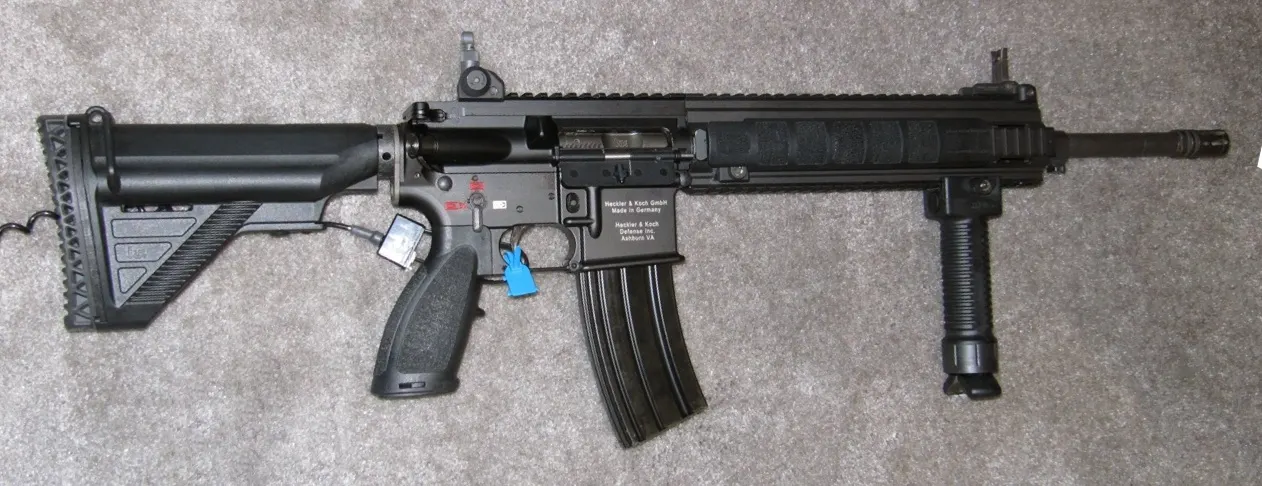
The M38 stands apart from almost every other rifle in this article's modern section by staying chambered in 5.56mm rather than switching to 7.62mm, and by retaining full select fire capability inherited unchanged from the standard M27, where nearly every other designated marksman rifle covered here is semi-automatic only. That choice prioritizes ammunition and parts commonality with the rest of a squad already carrying M27s over the extra range and penetration a full-power cartridge would provide, the opposite tradeoff the Army's 7.62mm M110A1 SDMR made for the same doctrinal problem around the same time. Some Marine Corps small-arms specialists have already suggested the M38 could prove an interim solution, since ordinary M27 riflemen are increasingly issued the same suppressors and optics as standard equipment.11
01New Wars and New Rifles
Russia's full-scale invasion of Ukraine in 2022 renewed global interest in the designated marksman role, and Ukraine's own defense industry had already begun building toward that renewed demand years earlier. Ukrainian manufacturer Zbroyar developed the Zbroyar Z-10, an AR-10 pattern rifle chambered for 7.62x51mm NATO with a free-floating barrel and a fully modular rail system, adopted by the Armed Forces of Ukraine in 2018 under the designation UAR-10 specifically to begin replacing the country's aging stock of Soviet-era SVD rifles. In combat during the ongoing Russo-Ukrainian War, Ukrainian snipers have favored the Z-10 for its extended range compared to the SVD it is gradually replacing, alongside continued heavy Ukrainian and Russian use of the SVD itself, whose Russian production reportedly increased roughly thirteenfold after 2022 to meet renewed frontline demand.12
That renewed demand runs in both directions across the conflict. Forces from Russia have kept the seven-decade-old SVD in frontline service throughout the war even as Ukraine works to replace its own remaining Dragunov-pattern rifles, and both the M110 and its more recent M110A2 successor described earlier in this article have reached Ukrainian government forces and international volunteers through Western military assistance, placing several designated marksman rifle families from opposite sides of the Cold War's original rifle competition into the same trench lines at once.
01The Category Today
The designated marksman rifle exists because the assault rifle transition of the 1960s and 1970s solved one problem while creating another. Lighter intermediate cartridges gave ordinary infantry squads more ammunition and more controllable automatic fire, but they gave up the reach a full-power cartridge had always provided. Every rifle in this article represents a different attempt to put that reach back into the hands of one soldier per squad without returning the entire squad to the weight and recoil of a full battle rifle. The Soviet Union and the United States solved that problem within a few years of each other and by opposite methods in the 1960s, one building a new rifle from a clean sheet, the other rebuilding an already-obsolete one, and that same fork keeps reappearing in every decade since.
What has changed most since Yevgeny Dragunov and Rock Island Arsenal's armorers first solved the problem is how many different architectures now compete for the same role. The AR-10 pattern that Eugene Stoner revived in the SR-25 spread into the entire M110 family and a wide field of commercial rivals from Remington, SIG Sauer, and FN Herstal. Heckler & Koch's piston-driven HK417 and G28 reshaped American squad doctrine through the M110A1 program despite originating as a German rifle for a German army. China, Turkey, Israel, Poland, Ukraine, and a dozen other countries built or adapted their own rifles rather than import an American or German one, and the ongoing war in Ukraine has put SVD-pattern rifles from the 1960s back in frontline use alongside AR-10 pattern rifles built within the last five years. The category's underlying tradeoff, giving one soldier per squad the reach a full-power rifle provides without weighing the whole squad down, has produced more distinct technical solutions in the past two decades than in the rifle's first thirty years of existence.
02Notes and Sources
- DMR archive, SVD Dragunov, M21 Sniper Weapon System, Military Archive, /en/weapons/svd-dragunov, /en/weapons/m21-sniper-weapon-system ↩
- DMR archive, Type 79 Sniper Rifle, Type 85 Sniper Rifle, PSL, Zastava M76, Zastava M91, SWD-M, Military Archive, /en/weapons/type-79-sniper-rifle, /en/weapons/type-85-sniper-rifle, /en/weapons/psl, /en/weapons/zastava-m76, /en/weapons/zastava-m91, /en/weapons/swd-m ↩
- DMR archive, QBU-88, Military Archive, /en/weapons/qbu-88 ↩
- DMR archive, M25 Sniper Rifle, United States Marine Corps Designated Marksman Rifle, M39 Enhanced Marksman Rifle, Crazy Horse rifle, Military Archive, /en/weapons/m25-sniper-rifle, /en/weapons/united-states-marine-corps-designated-marksman-rifle, /en/weapons/m39-enhanced-marksman-rifle, /en/weapons/crazy-horse-rifle ↩
- DMR archive, SR-25, Mk 12 Special Purpose Rifle, Squad Advanced Marksman Rifle, Squad Designated Marksman Rifle, Military Archive, /en/weapons/sr-25, /en/weapons/mk-12-special-purpose-rifle, /en/weapons/squad-advanced-marksman-rifle, /en/weapons/squad-designated-marksman-rifle ↩
- DMR archive, M110 Semi-Automatic Sniper System, M110A1 Compact Semi-Automatic Sniper System, M110A1 Squad Designated Marksman Rifle, M110A2 Semi-Automatic Sniper System, Military Archive, /en/weapons/m110-semi-automatic-sniper-system, /en/weapons/m110a1-compact-semi-automatic-sniper-system, /en/weapons/m110a1-squad-designated-marksman-rifle, /en/weapons/m110a2-semi-automatic-sniper-system ↩
- DMR archive, Remington Semi-Automatic Sniper System, SIG SAPR, FN SCAR SSR, FN FNAR, Military Archive, /en/weapons/remington-semi-automatic-sniper-system, /en/weapons/sig-sapr, /en/weapons/scar-ssr, /en/weapons/fn-fnar ↩
- DMR archive, Heckler & Koch G28, HK MR308, Military Archive, /en/weapons/heckler-koch-g28, /en/weapons/hk-mr308 ↩
- DMR archive, HK MSG90, HK MSG-90A1, Military Archive, /en/weapons/hk-msg90, /en/weapons/hk-msg-90-1 ↩
- DMR archive, L129A1, MKE KNT-76, Galil Sniper, Military Archive, /en/weapons/l129a1, /en/weapons/mke-knt-76, /en/weapons/galil-sniper ↩
- DMR archive, M38 Designated Marksman Rifle, Military Archive, /en/weapons/m38-designated-marksman-rifle ↩
- DMR archive, Zbroyar Z-10, Military Archive, /en/weapons/zbroyar-z-10 ↩


