


The SVD Dragunov entered Soviet service in July 1963 as the winning submission to a 1958 ordnance specification for a semi-automatic precision rifle chambered in the full-power 7.62x54mmR cartridge.1 Three separate design teams competed for the contract. Sergei Simonov offered an enlarged version of his own SKS carbine, Aleksandr Konstantinov submitted a prototype called the 2B-W-10, and Yevgeny Dragunov, a project engineer at the Izhevsk Machine-Building Plant, produced the design that won.1,2 Simonov's scaled-up SKS was rejected in April 1960, and testing found Konstantinov's entry simpler and cheaper but less accurate and less durable than Dragunov's.2 The rifle that carries his name has stayed in first-line production for more than sixty years, making it one of the longest continuously manufactured designated marksman rifles in the world.
- Full-power 7.62x54mmR reach far beyond intermediate-cartridge rifles
- Gas-piston system isolates barrel harmonics from the reciprocating mass
- Decades of combat-proven reliability across dozens of armies
- Simple enough for squad-level marksmen, not just trained snipers
- Only semi-automatic, no long-range precision-bolt-action accuracy ceiling
- No bipod or adjustable stock on the base model
- 10-round magazine is small next to some Western DMR designs
- Free-floating firing pin carries a documented slam-fire risk
Dragunov was the youngest of the three competing engineers and came from a family of gunsmiths in Izhevsk.3 Before the SVD, he had built civilian target rifles used by Soviet shooters to win Olympic medals, and that competitive-shooting background is widely credited with shaping the SVD's specific balance of accuracy against battlefield reliability.3 The result was not a sniper rifle in the Western sense. Soviet doctrine had just shifted infantry squads onto intermediate-cartridge weapons like the AK-47 and its successor the AKM, and those rifles could not reliably reach out to the ranges where enemy machine-gun and anti-tank crews operated.1,5 The SVD Dragunov was built to restore that reach, issued one per squad to a trained marksman rather than to a dedicated sniper cadre, a role some sources describe as a sniper support rifle rather than a precision sniper system proper.5
The rifle is manufactured by Izhmash, renamed Kalashnikov Concern in 2013, at its plant in Izhevsk.1 Full serial production began in 1964, after an initial 200-unit experimental batch entered service the year before.1 China reverse-engineered its own line from captured samples during the 1979 Sino-Vietnamese War, producing it domestically at Norinco as the Type 79 and Type 85.1,14 The SVD Dragunov is frequently, and incorrectly, treated as the ancestor of every Cold War era semi-automatic 7.62mm marksman rifle. Two of its closest visual look-alikes, the Romanian PSL and the Yugoslav Zastava M76, are both scaled-up Kalashnikov-pattern rifles with unrelated internal mechanisms, a point covered in more depth in Comparison below.10,12
Short-Stroke Gas Piston and a Rotating Bolt, Not a Tilting One
The SVD Dragunov is gas-operated, using a short-stroke gas piston with a two-position gas regulator.1 The piston travels only about 10 mm, just far enough to strike a separate, heavier bolt carrier rearward. The piston and its pusher rod are not mechanically linked to the bolt carrier and each part has its own return spring, a deliberate accuracy feature that isolates barrel harmonics from the reciprocating mass, unlike the long-stroke system in a standard AK-47.1 Locking is handled by a rotating, three-lug bolt that turns left into recesses cut in the barrel extension. Some general firearms writing has loosely described this as a tilting-bolt action, which is incorrect, the SVD locks with a genuine rotating bolt.1,4 The recoil spring itself is housed inside the pressed sheet-metal dust cover rather than the receiver, and the fire control group is a conventional hammer-type mechanism with a manual lever safety selector. The SVD Dragunov fires semi-automatic only, it has no full-auto setting.1
- İlk Üretim Yılı1963
- Hizmete Giriş Yılı1963
- TasarımcıYevgeny Dragunov
- Ağırlık (Boş)4,3 kg
- Halen HizmetteEvet
- Önemli KullanıcılarRussia, Ukraine, China (Type 79/85/CS-LR19), and over 45 other countries
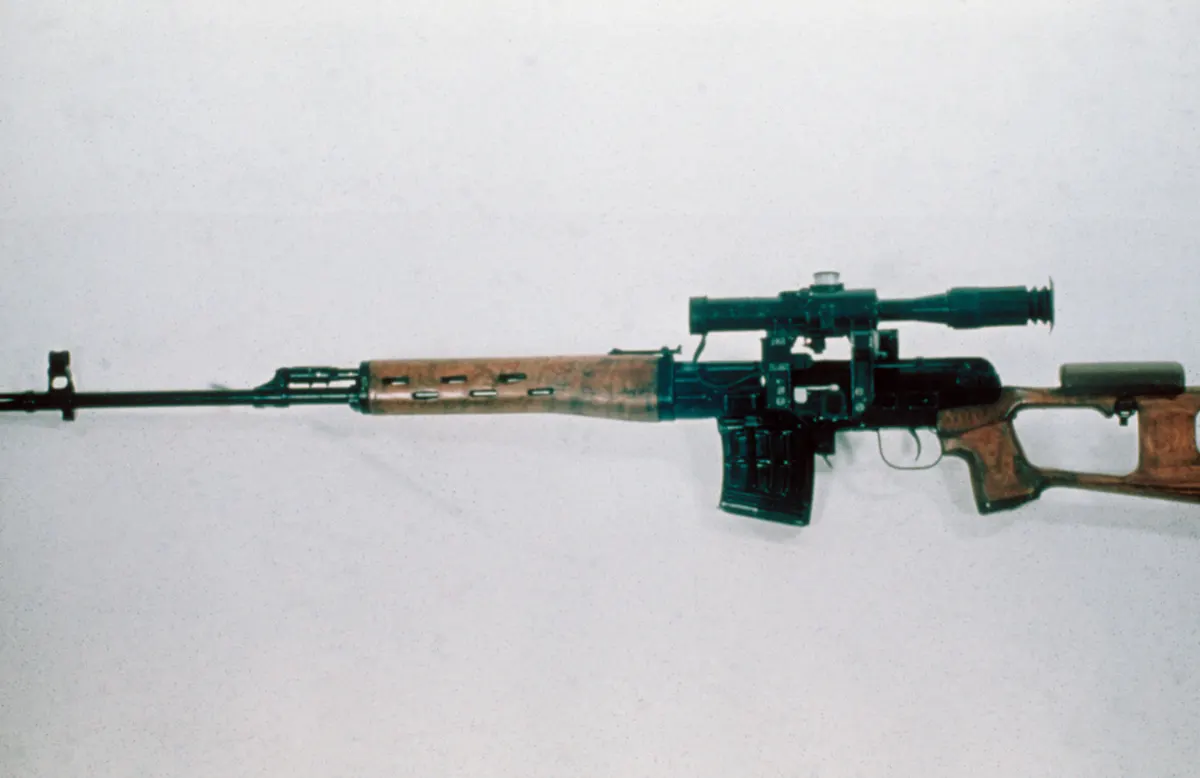
The firing pin is free-floating rather than spring-retracted, a design choice documented as carrying a minor slam-fire and accidental-discharge risk under certain conditions.1 Furniture on the original SVD Dragunov is a skeletonized thumbhole stock with a removable, clamp-on cheekpiece that folds down so the shooter can still use iron sights with the PSO-1 mounted. Early rifles used a birch plywood laminate two-piece handguard and gas-tube cover with ventilation slots, and from the 1980s onward Izhmash progressively replaced these wood components with black polymer furniture.1,6 The barrel ends in a long slotted flash suppressor that doubles as a bayonet lug on the standard SVD (the folding-stock SVDS variant uses a shorter conical suppressor instead).1
- Fişek7.62x54mmR
- Çap7,62 mm
- Kovan Uzunluğu53,72 mm
- Çap Sınıfıfull-power rifle cartridge
- Kenar AteşlemeliHayır
- Kovansız MühimmatHayır
The PSO-1 Optical Sight and 7N1 Cartridge
The standard optic is the PSO-1, a 4x24mm scope built by the Novosibirsk Instrument-Making Plant.1,4 It carries a battery-illuminated reticle, a stadiametric rangefinder for estimating range to a man-sized target, bullet-drop compensation adjustable in 50 to 100 meter increments out to 1,000 meters, and a passive detection capability for spotting infrared light sources such as enemy night-vision illuminators.1 It mounts to an optic rail machined into the left side of the receiver. Night-fighting variants used the NSPU sight, later replaced by the 1PN51 on the SVDN-1 and 1PN58 on the SVDN2.1
- Mekanizma TipiGazlı
- Atış Modlarısemi-automatic only
- Seçmeli AtışHayır
- Besleme SistemiÇıkarılabilir Şarjör
- Şarjör Kapasitesi10
- Tetik Tipihammer-fired, single-action
- Emniyet Tipimanual lever safety/selector
The dedicated 7N1 cartridge was developed in 1966 specifically for the SVD Dragunov by engineers V.M. Sabelnikov, P.P. Sazonov, and V.M. Dvorianinov. It uses a bimetal bullet with a lead core and mild-steel jacket tip, with a small internal void engineered to fine-tune accuracy.1 The 7N14, adopted in 1999, replaced the mild-steel penetrator with hardened steel to defeat body armor.1 Factory accuracy specification for the base rifle with 7N1 ammunition is 0.7 MOA or better median group deviation across three ten-shot groups, a genuinely tight standard for a semi-automatic combat rifle of its era.1
- Namlu Çıkış Hızı830 m/sn
- Etkili Menzil (nokta)800 m
- Nişan Menzili1.300 m
- İsabet0,7
The base-model SVD Dragunov weighs 4.3 kg unloaded with the PSO-1 scope fitted, measures 1,225 mm overall, and carries a 620 mm barrel. Muzzle velocity is 830 m/s, the magazine is a 10-round detachable box, and the tangent iron sight is graduated from 100 to 1,200 meters in 100-meter steps.1 Effective range against a standing, unarmored personnel target is cited at 800 meters, distinct from the PSO-1's maximum drop-compensation graduation of 1,000 to 1,300 meters, two figures that are frequently and incorrectly conflated in casual references to the rifle's range.1 Documented hit-probability estimates run around 80 percent at 500 meters against a standing man-sized target, falling to roughly 50 percent at 800 meters.1,2
- Namlu Uzunluğu620 mm
- Yiv Adımı240mm (1:9.4in) since 1975, originally 320mm
- Nişangah TipiTangent iron sight (100-1200m) plus PSO-1 4x24 optical sight
- Optik RayıEvet
- Açık NişangahEvet
- Toplam Uzunluk1.225 mm
- Kabza/Dipçik MalzemesiBirch plywood laminate (pre-1980s), black polymer (from 1980s onward)
- Katlanır / Toplanır DipçikHayır
- Bullpup DüzeniHayır
- Çift Yönlü KumandalarHayır
- Susturucuya HazırHayır
- Süngü TakozuEvet
- Entegre BipodHayır
- Bombaatar KabiliyetliHayır
- Gaz PistonluEvet
- Üretim Başlangıcı1964
- Varyantlar10
From a 1958 Ordnance Program to a 1963 Adoption
The design that became the SVD Dragunov began as one of three competing answers to a Soviet Army requirement issued in 1958.1 Yevgeny Dragunov's prototype won out over Simonov's and Konstantinov's submissions and was formally adopted in July 1963.1 The first 200-unit experimental production batch entered service that same year, with full serial manufacture starting in 1964 at Izhmash. Some references, including Wikipedia's infobox, list 1967 as the SVD Dragunov's Soviet in-service date, which most likely reflects when the rifle had been distributed widely enough to reach ordinary motorized-rifle units, rather than a separate adoption event.1
The SVD Dragunov's first confirmed combat use came with PAVN (North Vietnamese) forces around 1972, during the Vietnam War.9 Its arrival on that battlefield was significant enough that American intelligence reportedly offered a $25,000 bounty for a captured, functioning example, an unusually high figure for a single infantry weapon of the period.9
Afghanistan, Chechnya, and a Long Cold War Service Record
The SVD Dragunov saw extensive use with Soviet forces during the Soviet-Afghan War (1979 to 1989). The longest documented sniping shot credited to a Dragunov from that conflict, 1,350 meters, is attributed to Sergeant Vladimir Ilyin in 1985, though that figure comes from secondary reporting rather than an official record.
The rifle also saw use in the Lebanese Civil War, the Iran-Iraq War, the Gulf War, and Kashmir-related fighting through the 1980s and 1990s. In the First Chechen War and Second Chechen War, the SVD Dragunov effectively replaced the aging bolt-action Mosin-Nagant in the Russian marksman role, a transition that closed out that older rifle's front-line service.1 It was also fielded in the Tajikistani Civil War and the Yugoslav Wars, where Serbia was among the fielding forces.1
Twenty-First Century Service in Iraq, Syria, and Ukraine
The SVD Dragunov remained in front-line use through the War in Afghanistan (2001-2021), the Iraq War, and subsequent fighting in the region. During the Iraq War it was fielded on multiple sides of the conflict, alongside forces including the United States and Poland operating against Iraqi-issued rifles of the same pattern.1
In the Syrian Civil War, the SVD Dragunov and its licensed derivatives have been documented in the hands of multiple factions and outside intervening forces.1 The ongoing Russo-Ukrainian War has become the SVD Dragunov's largest and most closely watched deployment in decades. Both Russian and Ukrainian units field SVD and SVDS pattern rifles at the squad level, and Russian production of the type has reportedly surged as much as thirteenfold year-on-year since the full-scale invasion began in 2022, driven by wartime demand rather than any change in doctrine.7
More recent fighting connected to the SVD Dragunov and its pattern includes the Second Nagorno-Karabakh War between Azerbaijan and Armenia, the Yemeni Civil War, and reported appearances in Gaza-area fighting, though sourcing for the last of these is thinner than for the other conflicts listed here and should be read with more caution.
SVDS, SVDM, and the Bullpup OTs-03 SVU
Russia has fielded several service variants beyond the base SVD Dragunov. The SVDS (GRAU designation 6V3), adopted in 1995, adds a right-folding metal stock and a heavier barrel profile with a shortened conical flash suppressor, intended for airborne and other mobile troops.1 The SVDM, a 2018 modernization, shortens the barrel to 550mm, adds a full-length Picatinny rail, a detachable bipod and suppressor mount, and the improved 1P88-4 telescopic sight, at a folded length of 975mm and a weight of 5.3 kg.1 The OTs-03 SVU is a bullpup conversion in production since 1991 for Russian internal-security and MVD use, a design distinct enough from the base rifle that the archive tracks it as its own designated marksman rifle, the Dragunov SVU, which sits in the site's sniper rifles category rather than under this entry.1
An experimental variant, the SVDK, is chambered in the heavier 9.3x64mm 7N33 cartridge and based on the civilian Tigr-9, but it never became a mainstream service rifle.1 Several unadopted 1970s prototypes are also on record, including the SVDG smoothbore 10mm APFSDS experiment, the SSV-6 chambered for an experimental 6mm cartridge, and automatic-fire prototypes designated AF and V-70, none of which reached production.1
Civilian production runs alongside the military line. The Tigr (Tiger), in production since 1992, drops the bayonet lug and is offered in 520mm or 620mm barrel lengths and multiple stock configurations, chambered in 7.62x54mmR, .308 Winchester, .30-06 Springfield, or 9.3x64mm Brenneke depending on the market.1 The Kalashnikov TG3 is a further civilian variant chambered in 9.6x53mm Lancaster, classified as a shotgun under Russian law, weighing 3.9 kg with a 5-round magazine.1
Foreign Production, and Two Rifles Wrongly Called Dragunov Clones
China reverse-engineered its own line from SVD samples captured during the 1979 Sino-Vietnamese War, producing the Type 79 and later Type 85 at Norinco. These are dimensionally close enough to look nearly identical to the Russian original but not close enough for parts interchange, and are exported under designations including the Type 79 sniper rifle, the Type 85 sniper rifle, and the export names NDM-86 and NDM-86 .308.1,14 A modernized descendant, the CS/LR19, was adopted by the Chinese military in 2014.1 Iran's Nakhjir 3 is in turn a direct copy of the Chinese Type 79, making it a copy of a copy rather than a direct descendant of the Russian SVD Dragunov.1 Iraq produced its own unlicensed version, the Al-Kadesih, built with an unmilled receiver and a pinned rather than threaded barrel, some examples finished with ornamental palm-tree relief on the magazine, and gold-plated examples used as VIP gifts under the Ba'athist government.1 Poland's SWD-M, adopted in 1998, adds a heavier barrel, a forearm-mounted bipod and an LD-6 (6x42) scope.1 Egypt, Bulgaria, and Hungary are also reported to have undertaken Dragunov-pattern production, though no confirmed model designation has surfaced for any of the three.
 AfganistanAKTİF
 AlmanyaAKTİF
 ArnavutlukAKTİF
 AvusturyaAKTİF
 AzerbaycanAKTİF
 BangladeşAKTİF
 BelarusAKTİF
 BolivyaAKTİF
 BulgaristanAKTİF
 BurundiAKTİF
 ÇekyaAKTİF
 CezayirAKTİF
 Çin Halk CumhuriyetiAKTİF
 Fildişi SahiliAKTİF
 FilipinlerAKTİF
 FinlandiyaAKTİF
 GürcistanAKTİF
 HindistanAKTİF
 IrakAKTİF
 İranAKTİF
 KazakistanAKTİF
 KırgızistanAKTİF
 Kosta RikaAKTİF
 Kuzey KoreAKTİF
 LesothoAKTİF
 LetonyaAKTİF
 LibyaAKTİF
 MacaristanAKTİF
 MaliAKTİF
 MısırAKTİF
 MoldovaAKTİF
 NijerAKTİF
 NikaraguaAKTİF
 Orta Afrika CumhuriyetiAKTİF
 ÖzbekistanAKTİF
 PakistanAKTİF
 PanamaAKTİF
 PolonyaAKTİF
 RusyaAKTİF
 SenegalAKTİF
 SırbistanAKTİF
 SlovakyaAKTİF
 SomaliAKTİF
 SudanAKTİF
 SuriyeAKTİF
 TacikistanAKTİF
 TürkiyeAKTİF
 TürkmenistanAKTİF
 UkraynaAKTİF
 VenezuelaAKTİF
 VietnamAKTİF
 YemenAKTİF
 ZimbabveAKTİF
 Amerika Birleşik DevletleriEMEKLİ
Wikipedia's operator list for the SVD Dragunov runs to more than 45 states, including Russia, Ukraine, China, Vietnam, India, Pakistan, Poland, Iran, Iraq, and dozens more across Africa, Asia, Eastern Europe, and Latin America, alongside non-state groups including Islamic State, the Kurdistan Workers' Party (PKK) and the Lord's Resistance Army.1 Former users include the Soviet Union, East Germany (fielded as the SWD), Czechoslovakia, and the Panama Defense Forces.1
Russia has developed a would-be successor, the Chukavin sniper rifle (SVCh), mass-produced from February 2023 and compatible with SVD magazines in its 7.62x54mmR chambering.7,8 In practice Russia has pulled back from replacing the SVD Dragunov outright. The Chukavin saw only limited special-forces trials in 2023, while SVD and SVDS production has instead been ramped up sharply to meet wartime demand from the war in Ukraine.7 Ukraine has shifted most of its dedicated sniping capability to Western and domestic rifles, but the SVD Dragunov remains in Ukrainian service in the designated marksman role.1
The SVD Dragunov's most instructive comparison is not against a rival so much as against two rifles wrongly assumed to be its relatives. The Romanian PSL and the Yugoslav Zastava M76 were both built to fill the identical doctrinal gap, a squad-level marksman rifle chambered heavier than a standard assault rifle, but both nations solved that problem by scaling up an existing Kalashnikov-pattern action rather than adopting the SVD Dragunov's purpose-built short-stroke system.10,12 Romania's PSL, sold commercially as the PSL-54C, Romak III, FPK, or SSG-97, uses a long-stroke gas piston directly derived from the RPK light machine gun, chambered in the same 7.62x54mmR round as the SVD Dragunov but sharing no parts with it.10,11 The Zastava M76 goes a step further from the Russian design, built around the M70 (AK-pattern) action and chambered in 7.92x57mm Mauser, a cartridge choice tied to Yugoslavia's own wartime-legacy ammunition stocks rather than any Soviet standard.12,13
| Spec | SVD Dragunov | Zastava M76 |
|---|---|---|
| Cartridge | 7.62x54mmR | 7.92x57mm Mauser |
| Action | Short-stroke gas piston, rotating bolt | Long-stroke gas piston, AK-pattern (M70) action |
| Effective range | 800 m | Roughly comparable, doctrine-matched |
| Magazine | 10-round detachable | 10-round detachable |
Against Western designated marksman rifles the comparison runs differently. The American M110 semi-automatic sniper system is built on an AR-10 pattern action rather than a gas-piston system purpose-designed for the role, reflecting a NATO-side design tradition that grew out of a different rifle family entirely. The Mk 12 Special Purpose Rifle takes the opposite approach from the SVD Dragunov, trading the Russian rifle's full-power 7.62x54mmR reach for a 5.56mm cartridge optimized for a flatter trajectory at closer engagement distances rather than raw stopping power at range. The M21 sniper weapon system, built on the M14 action, is arguably the closest era-matched Western contemporary to the SVD Dragunov, a Cold War era semi-automatic conversion of an existing service rifle rather than a clean-sheet design, though the M21 predates the Russian rifle's general fielding by several years.


Is the SVD Dragunov still in service? Yes. The SVD Dragunov remains in active service with Russia, Ukraine, and dozens of other countries, and it is seeing heavy renewed use in the ongoing Russo-Ukrainian War, where Russian production has reportedly surged to meet wartime demand.1,7
What caliber does the SVD Dragunov use? The SVD Dragunov is chambered in 7.62x54mmR, a full-power rimmed rifle cartridge, not the 7.62x51mm NATO round used by some civilian .308-chambered Tigr variants or the 7.62x39mm used in Soviet assault rifles.1
How does the SVD Dragunov's action work? It is gas-operated with a short-stroke gas piston and a separate rotating three-lug bolt, a system designed specifically to isolate barrel harmonics from the reciprocating bolt carrier for better accuracy, not the long-stroke Kalashnikov-pattern action often mistakenly assumed from its visual resemblance to other Soviet rifles.1
What is the SVD Dragunov's effective range? Its documented effective range against personnel targets is 800 meters, while its PSO-1 scope's drop-compensation graduation extends to 1,000 to 1,300 meters, a maximum sight setting rather than a realistic engagement distance.1
How much does an SVD Dragunov cost? No credible military unit-procurement price has been published for the SVD Dragunov. Civilian Izhmash-made Tiger semi-automatics, which are not legally importable into the United States, have fetched over $10,000 on the collector market, a price driven by rarity rather than reflecting any military contract figure.17,18
Is the PSL or Zastava M76 a Dragunov clone? No. Both are commonly mislabeled that way because they fill the same doctrinal role, but both use scaled-up Kalashnikov-pattern actions rather than the SVD Dragunov's own short-stroke gas system, and neither shares parts with the Russian rifle.10,12
- "SVD (rifle)", Wikipedia — en.wikipedia.org) ↩
- "SVD Dragunov, The First Purpose-Built DMR", Forgotten Weapons — forgottenweapons.com ↩
- "The SVD Dragunov, The World's Most Prolific Sniper Rifle, and Its Olympic Roots", Gun Digest — gundigest.com ↩
- "Arsenal Blog 003, Dragunov SVD", SilencerCo — silencerco.com ↩
- "The Dragunov, Don't Call It a Sniper Rifle", SOFREP — sofrep.com ↩
- "The SVD Dragunov Rifle", Shooting Illustrated — shootingillustrated.com ↩
- "Russia Chooses 60-Year-Old SVD Rifle Instead of the Latest SVCh", Militarnyi — militarnyi.com ↩
- "Russia's Kalashnikov Group Building Modernized Dragunov Sniper Rifle", The National Interest — nationalinterest.org ↩
- "SVD Dragunov in Vietnam", HistoryNet — historynet.com ↩
- "PSL (rifle)", Wikipedia — en.wikipedia.org) ↩
- "PSL/FPK", Modern Firearms — modernfirearms.net ↩
- "Zastava M76", Wikipedia — en.wikipedia.org ↩
- "Zastava's Heavy Hitter, The Yugoslav M76 DMR", Forgotten Weapons — forgottenweapons.com ↩
- "NDM-86, The Chinese Dragon of Dragunovs", Recoil Web — recoilweb.com ↩
- "Dragunov Price and Historical Value", TrueGunValue — truegunvalue.com ↩
- "SVD Dragunov", GunCritic — guncritic.com ↩