

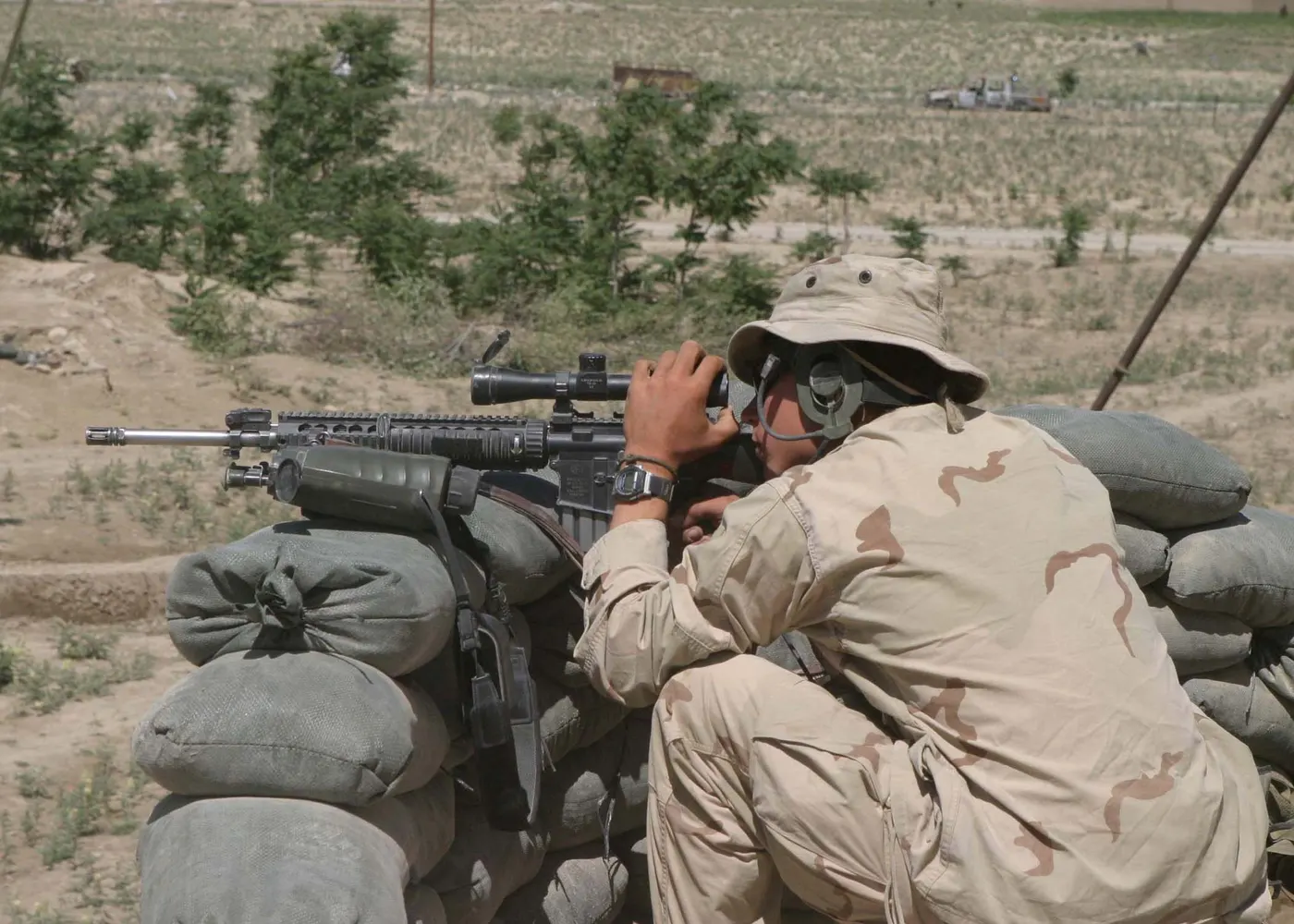

The Squad Advanced Marksman Rifle (SAM-R) is a 5.56x45mm NATO semi-automatic designated marksman rifle built for the United States Marine Corps rather than purchased from a commercial arms maker. It was assembled in-house by the Precision Weapons Section of the Weapons Training Battalion at Marine Corps Base Quantico, the same small Marine gunsmith shop that later built the M39 Enhanced Marksman Rifle and the United States Marine Corps Designated Marksman Rifle.1 Roughly 100 rifles were built in the initial run, starting around 2001, making the SAM-R a genuinely small-production, hand-fitted rifle rather than a mass-issue service weapon.1,2
- Shares ammunition, magazines, and armorer skills with the standard M16A4
- 20-inch barrel and 1-in-7-inch twist extract more from Mk262 77gr match ammunition than a carbine-length gas system
- Leupold Mark 4 variable-power optic gives squads genuine positive target identification at distance
- Built and fitted in-house, avoiding a lengthy commercial acquisition program
- Many rifles retained the standard M16A1-pattern single-stage trigger, which measurably hurts precision compared to a proper match trigger
- Small production run of roughly 100 rifles limited fielding to a handful of units
- 5.56mm terminal performance still falls short of 7.62mm designated marksman rifles at longer range
- No hard retirement date is documented, only a general phase-out by the mid-2010s
The Marine Corps Warfighting Laboratory (MCWL) conceived and refined the program, drawing on informal accurized-rifle practices already used inside the 4th Marine Expeditionary Brigade (Anti-Terrorism) and the Marine Security Force Battalion.1 Rather than adopting a wholly separate rifle, MCWL built the SAM-R on an M16A4-pattern receiver (some rifles trace to earlier M16A2/A3-generation lowers, and sources are not perfectly consistent on the exact receiver generation used across the run). The choice kept ammunition, spare parts, and armorer training in common with the standard-issue M16A4 carried by the rest of a Marine rifle squad, instead of introducing a second, unrelated logistics chain.1
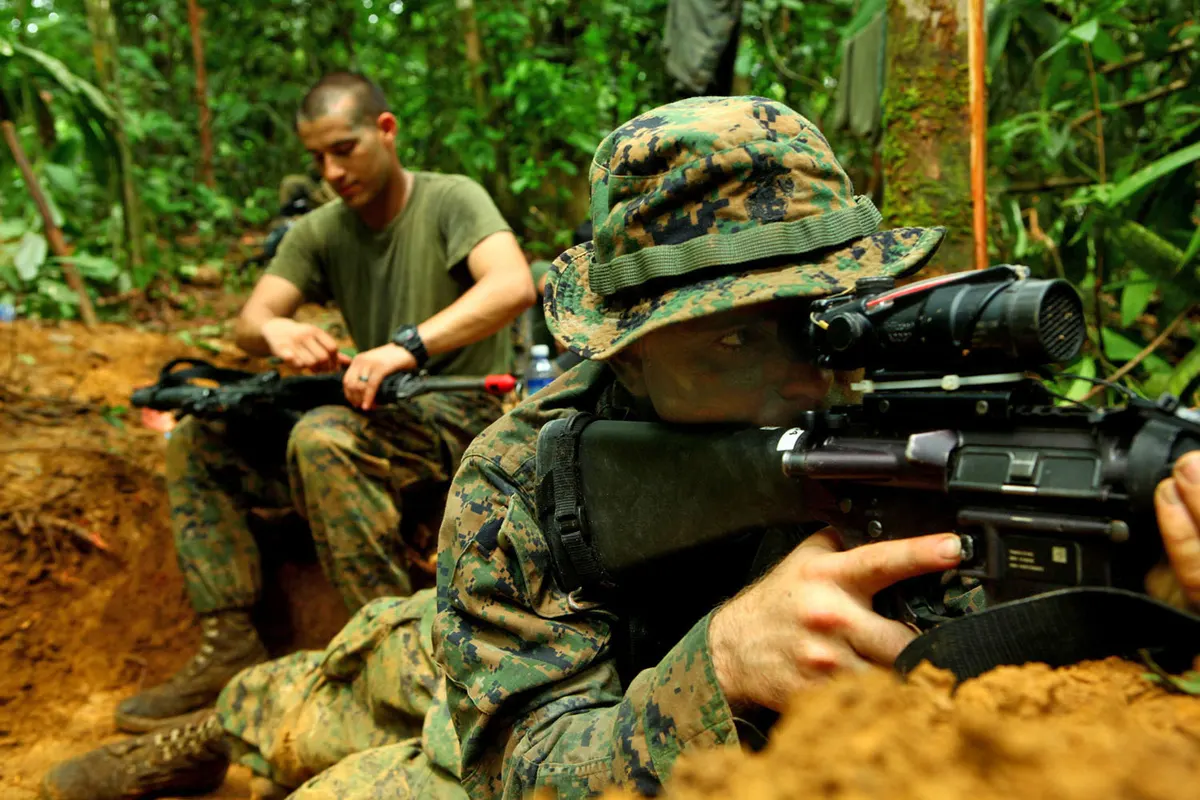
The tactical logic behind the SAM-R was straightforward. A rifle squad without a dedicated sniper still needed someone who could reliably hit at ranges beyond a standard M16A4's practical zero, identify targets earlier, and help walk in supporting machine-gun or mortar fire onto a position.1 Assigning one accurized rifle and one specially qualified marksman to each squad, rather than waiting on a scout sniper team, filled that gap organically. The SAM-R sits alongside other early-2000s DMR-class rifles built to solve the same problem for different services, including the Army's Squad Designated Marksman Rifle (SDM-R) and the Navy/SOCOM Mk 12 Special Purpose Rifle, both discussed further below.
Because the SAM-R was never bought under a formal program of record, its history is pieced together mostly from unit accounts, enthusiast research, and gunsmith records rather than a single official Marine Corps history document. That gap in the paper trail is itself part of what makes the rifle a distinctive, somewhat under-documented chapter in Marine Corps small-arms history.2
The Squad Advanced Marksman Rifle is chambered in 5.56x45mm NATO, and its accuracy depends heavily on firing Mk262 Mod 0/1 ammunition, a 77-grain open-tip match bullet rather than standard M855 ball.1 Its action is gas-operated with a rotating-bolt, the same basic direct-impingement mechanism used across the whole M16/M4 family, running semi-automatic only in practice even though many donor lowers retained a limited-burst-capable fire control group.1 Feeding is through standard detachable-magazine 20 or 30-round STANAG box magazines, released by an ambidextrous Norgon magazine catch rather than the standard one-sided M16 button.2
- İlk Üretim Yılı2001
- Hizmete Giriş Yılı2001
- TasarımcıMarine Corps Warfighting Laboratory (MCWL), built by the Precision Weapons Section, Weapons Training Battalion, Marine Corps Base Quantico
- Halen HizmetteHayır
- Önemli KullanıcılarUnited States Marine Corps (22nd, 24th, and 26th Marine Expeditionary Units, II MEF)
The barrel is a 20-inch (510mm), match-grade stainless steel blank cut with a 1-in-7-inch (178mm) rifling twist, machined by Compass Lake Engineering, chosen specifically to stabilize the heavier 77-grain Mk262 bullet at extended range.1,2 That barrel length is longer than the 18-inch upper used on the Mk 12 Special Purpose Rifle and gives the SAM-R noticeably more velocity out of the same cartridge, a real practical advantage even though the two rifles share almost nothing else in their build.6 Reported muzzle velocity runs around 3,050 feet per second (930 m/s), with an effective range on man-sized targets of roughly 600 yards (550m).1,6 Loaded weight with optic and a 30-round magazine runs close to 10 pounds (4.5kg), and overall length is about 39.5 inches (1,003mm).1
- Fişek5.56x45mm NATO, Mk262 Mod 0/1 77gr open-tip match
- Çap5,56 mm
- Kovan Uzunluğu45 mm
- Çap SınıfıIntermediate
- Mermi Ağırlığı77 g
- Kenar AteşlemeliHayır
- Kovansız MühimmatHayır
Handguard and rail duties fall to a Knight's Armament Company M4 RAS Sniper-Match free-floating rail, giving the barrel a clean, unstressed bedding surface and a mounting surface for the optic, bipod, and light.1 A PRI M84 Gas Buster charging handle replaced the standard M16 handle, addressing a known tendency for hot gas to blow back into a shooter's face on a rifle fired more deliberately and more often at the extended ranges a designated marksman works at.2 A folding Harris swivel bipod mounts through ARMS #22/#32 quick-detach throw levers, letting the marksman brace for a precise shot and then break the bipod free quickly if the squad needs to move.
- Mekanizma TipiGazlı
- Atış ModlarıSemi-automatic in service; some donor lowers retained full-auto-capable fire control groups
- Seçmeli AtışHayır
- Besleme SistemiÇıkarılabilir Şarjör
- Şarjör Kapasitesi30
- Tetik TipiM16A1-pattern single-stage trigger on many rifles, Knight's Armament two-stage match trigger on others
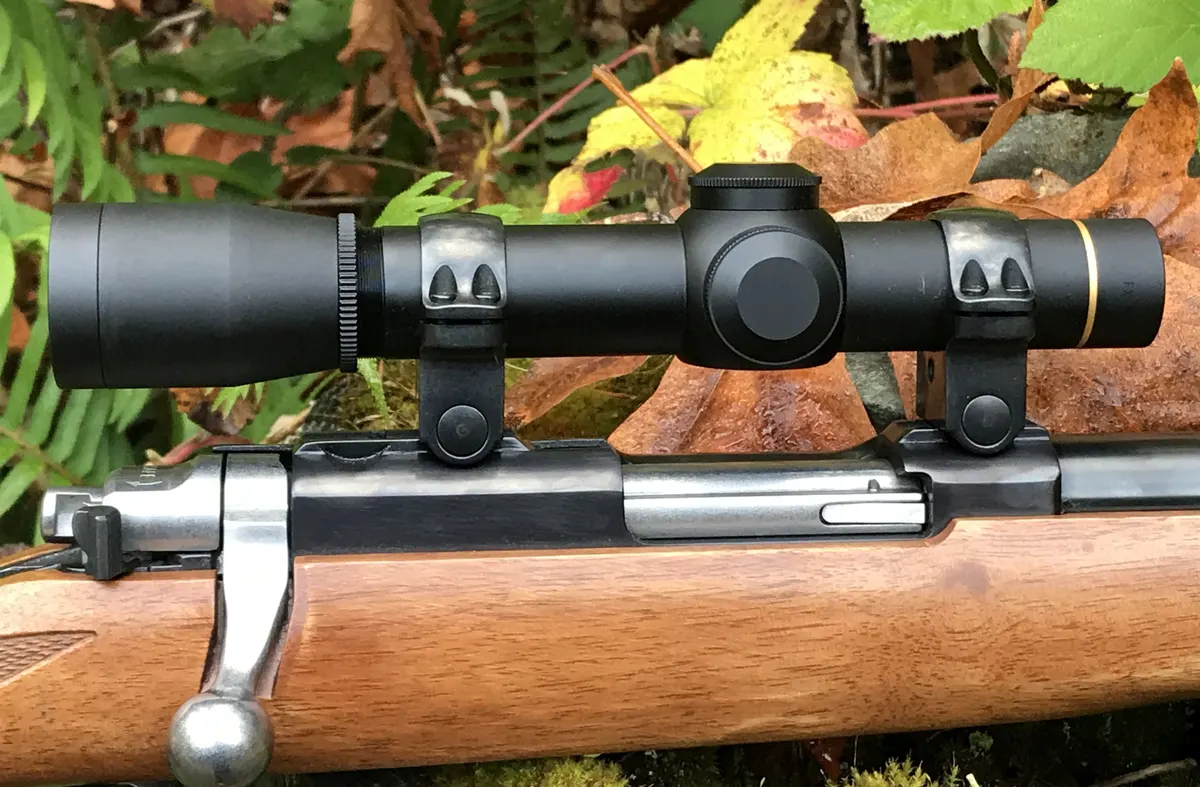
Sighting equipment centered on a variable-power Leupold Mark 4 M3, military designated the TS-30A2, most reliably documented at 2.5-8x36mm magnification (some sources cite 3-9x36mm, and the two figures are not fully reconciled across published accounts).1,7 Earlier and alternate day optics fitted before the TS-30A2 became the standard included the Hensoldt Blitz, the Leupold CQ/T, an ACOG, and the Leupold TS-30A1.2 For night fighting, Marine units preferred the AN/PVS-22 Universal Night Sight, a clip-on image intensifier that mounts in front of the day optic, over the alternative AN/PVS-17B, which was tested but not favored for the role.1
- Namlu Çıkış Hızı930 m/sn
- Etkili Menzil (nokta)550 m
Backup iron sights are a Knight's Armament 600m flip-up rear sight, and some, though not all, rifles carry a chipped flash suppressor compatible with suppressor-ready KAC M4 quick-detach suppressors.2 That inconsistency, a trigger that varies by rifle, an optic magnification that varies by source, and a flash suppressor that varies by build, is a recurring theme across the whole SAM-R program. It was a hand-built, continuously tweaked shop product, not a fixed factory specification, which is also why exact figures differ between accounts more than they would for a commercially contracted rifle.
- Namlu Uzunluğu508 mm
- Yiv Adımı1-in-7-inch (178mm)
- Nişangah TipiLeupold Mark 4 M3 (TS-30A2), 2.5-8x36mm variable, AN/PVS-22 Universal Night Sight, KAC 600m flip-up rear sight
- Optik RayıEvet
- Açık NişangahEvet
The table below sets the SAM-R's core numbers against the Army's parallel Squad Designated Marksman Rifle, developed independently for the same tactical gap.
- Toplam Uzunluk1.003 mm
- Gövde Malzemesi (Receiver)Forged aluminum M16A4-pattern receiver
- Kabza/Dipçik MalzemesiKnight's Armament M4 RAS Sniper-Match free-floating rail
- Katlanır / Toplanır DipçikHayır
- Bullpup DüzeniHayır
- Çift Yönlü KumandalarHayır
- ModülerlikKAC free-float rail accepts optic, light, and Harris bipod via ARMS quick-detach throw levers
| Spec | SAM-R | SDM-R |
|---|---|---|
| Barrel twist | 1-in-7-inch | 1-in-8-inch |
| Day optic | Leupold Mark 4 TS-30A2 (variable) | ACOG (fixed) |
| Extended feed ramps | Yes | No |
| Approximate rifles built | ~100 | ~240 |
- Bombaatar KabiliyetliHayır
- Gaz PistonluHayır
- Üretim Başlangıcı2001
- Üretim Bitişi2015
Marine designated-marksman practice did not start with a formal program. Marines in the 4th Marine Expeditionary Brigade (Anti-Terrorism) and the Marine Security Force Battalion were already building accurized service rifles informally before the Marine Corps Warfighting Laboratory stepped in to formalize and scale the idea into a repeatable rifle build.1 MCWL's stated goal was to give an ordinary rifle squad organic precision fire without waiting on a scout sniper team, extending engagement range, improving target identification, and helping a squad walk supporting machine-gun or mortar fire onto a target.1
Before settling on an in-house, M16A4-based build, MCWL reportedly evaluated and rejected the Mk 11 Mod 0, the semi-automatic SR-25-based rifle already fielded by the Navy, as a ready-made alternative.3 Choosing to build its own rifle instead of adopting the Mk 11 kept parts, ammunition, and training aligned with the M16A4 already in every Marine's hands, at the cost of a smaller, less standardized production run than a program-of-record purchase would have produced.
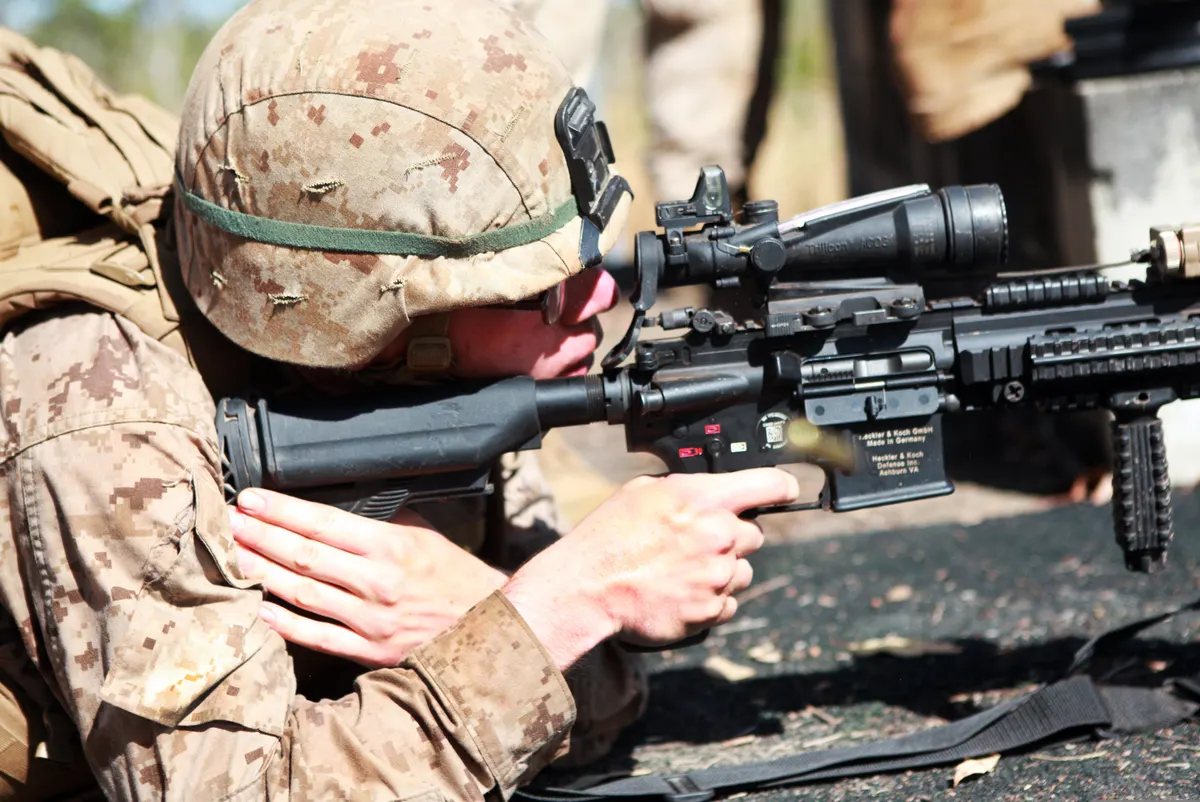
Roughly 100 rifles were built and distributed to the 22nd, 24th, and 26th Marine Expeditionary Units, all under II Marine Expeditionary Force and based at Camp Lejeune.1 The Marine Corps never issued the SAM-R as a program of record the way it later did with the M38 Designated Marksman Rifle, and no single order document marking its retirement has surfaced. The rifle appears to have faded out of front-line use by the mid-2010s as the Corps' precision-fire needs shifted toward the newer M27 Infantry Automatic Rifle platform.4
The War Zone frames the succession as evolutionary rather than a single formal replacement decision, arguing the SAM-R's relative success inside Marine rifle squads helped shape the case for the M38 Designated Marksman Rifle, an HK416-derived M27 fitted with the same Leupold TS-30A2 optic family the SAM-R used, plus a suppressor and a load tuned for Mk262, adopted service-wide from 2018.4 That is a continuity of concept and optics, not a direct one-for-one program handover with a fixed cutover date.
The Squad Advanced Marksman Rifle saw its heaviest use in the Iraq War, roughly between 2004 and 2008, and it was also carried during the War in Afghanistan.1,2 With only about 100 rifles built and distributed to three East Coast Marine Expeditionary Units, its combat footprint was always going to be narrower than a program-of-record rifle fielded across the whole Corps.
One specific, lower-confidence account holds that 3rd Battalion, 8th Marines used the SAM-R during the Second Battle of Fallujah in November 2004, employing it for rooftop and building-clearing precision fire against insurgent positions during that urban fight.2 That claim traces back to a single secondary source rather than multiple independent accounts, so it is best read as reported rather than firmly established, though it fits the broader pattern of Marine designated marksmen supporting infantry in dense Iraqi cities during that period.
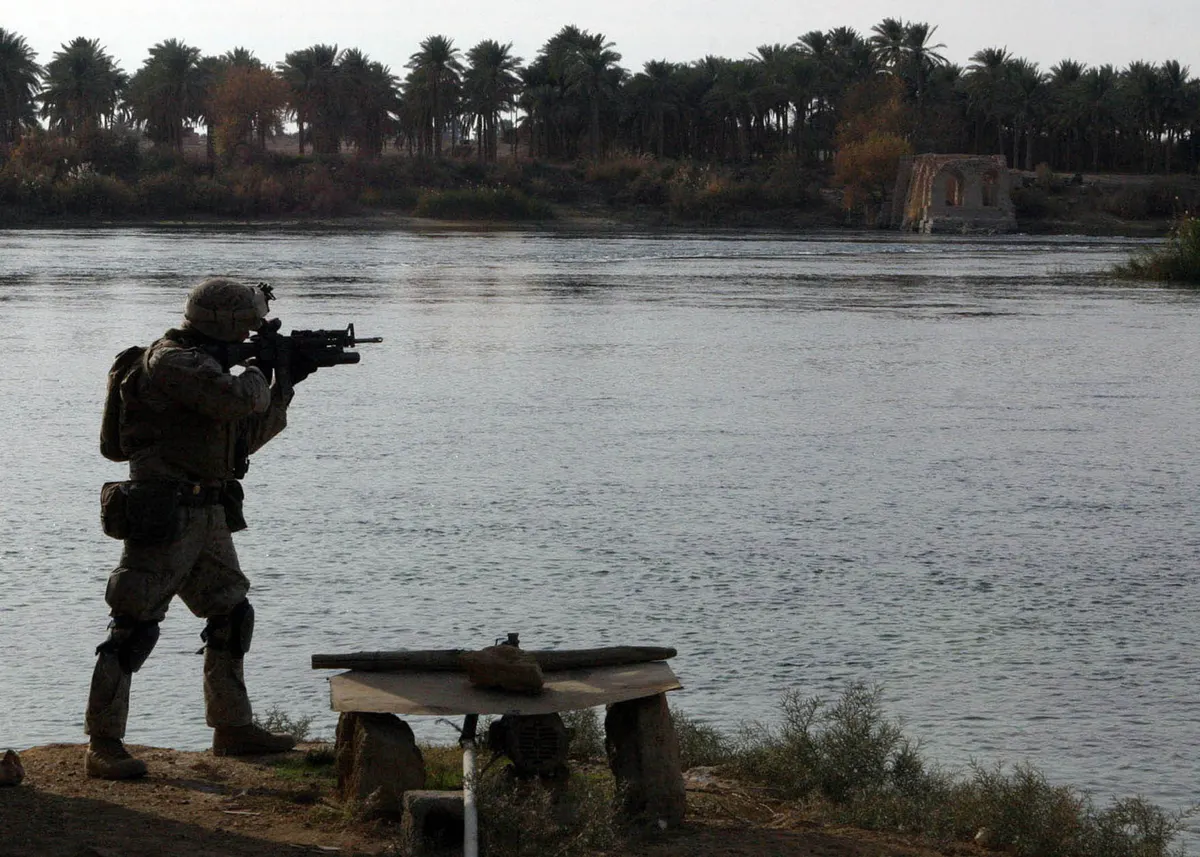
Employment doctrine called for one SAM-R per rifle squad, issued to a Marine selected as the squad's designated marksman through an internal marksmanship qualification rather than a dedicated sniper school.1 That kept the precision-fire role embedded directly inside the maneuvering squad instead of attaching a separate sniper team, mirroring the same organic-marksman concept the Army pursued in parallel with its own Squad Designated Marksman Rifle.
The SAM-R designation covers two meaningfully different builds, and treating them as identical overstates how standardized the rifle actually was.
- II MEF (East Coast) SAM-R, the fully accurized configuration described above, built by the Precision Weapons Section with a Krieger blank, KAC rail, Leupold TS-30A2, and the other refinements covered in Specs and Design. This is the build most sources mean by the name SAM-R.1,2
- I MEF (West Coast) SAM-R, an informally named, less-accurized configuration that shared the SAM-R nickname without sharing the full build spec. These were closer to standard M16A4 rifles fitted with a Knight's Armament M5 RAS forearm and a fixed 4x Trijicon TA31F ACOG, rather than the free-floated, match-barreled East Coast build.2
Confusing the two builds is an easy mistake, since both circulated informally under the same SAM-R name inside the Marine Corps at roughly the same time, and only the East Coast II MEF version received the fuller custom treatment covered above.

The United States is the sole confirmed operator of the Squad Advanced Marksman Rifle, fielded specifically by the Marine Corps rather than the Army or another U.S. service.1 Documented users include the 22nd, 24th, and 26th Marine Expeditionary Units under II Marine Expeditionary Force, and reportedly 3rd Battalion, 8th Marines during the Second Battle of Fallujah.1,2
That leaves the Marine Corps as the only service with a solidly documented claim to the Squad Advanced Marksman Rifle, a small, hand-built rifle that never had a confirmed export or foreign-service history beyond that single unverified British mention.
Two other early-2000s American designated marksman rifles are easy to confuse with the SAM-R, and the differences matter more than the surface similarity of a 5.56mm rifle carrying a bigger scope.
The Squad Designated Marksman Rifle (SDM-R) was developed independently by the U.S. Army Marksmanship Unit for the 3rd Infantry Division, entering service around 2004 and remaining in Army use into the early 2020s.5 The SAM-R and the SDM-R were not one program feeding the other. They were two separate services solving the identical tactical problem, in the identical era, using the identical M16/M4 receiver family, without either program growing out of the other.5,6 The practical differences are real. The SDM-R uses a fixed-power ACOG rather than the SAM-R's variable Leupold optic, a 1-in-8-inch twist rather than the SAM-R's 1-in-7-inch, and it lacks the SAM-R's extended feed ramps.5,6 Roughly 240 SDM-R rifles were built against the SAM-R's roughly 100, reflecting the Army's larger single-division fielding against the Marine Corps' three-MEU distribution.5
The Mk 12 Special Purpose Rifle is a third, separately sourced rifle that is sometimes lumped in with the SAM-R simply because Marine units used both. The Mk 12 was developed through the Naval Surface Warfare Center Crane Division originally for Navy SEALs and SOCOM, built as a complete standalone upper on an 18-inch barrel with its own extended feed ramps, and only later picked up piecemeal by some Marine units alongside or instead of the SAM-R.6 It shares a caliber and a family of optics with the SAM-R, and even the same Leupold TS-30A2 scope model, but it has no organizational connection to the Marine Corps Warfighting Laboratory or the Precision Weapons Section that built the SAM-R.6


What caliber does the Squad Advanced Marksman Rifle use? The SAM-R is chambered in 5.56x45mm NATO, firing Mk262 77-grain open-tip match ammunition rather than standard M855 ball, matched to its 1-in-7-inch barrel twist.1
Who makes the SAM-R rifle? No commercial manufacturer built the SAM-R. It was assembled in-house by the Precision Weapons Section of the Weapons Training Battalion at Marine Corps Base Quantico, using a Krieger barrel blank machined by Compass Lake Engineering and a Knight's Armament rail and sights.1,2
Is the SAM-R still in service with the Marine Corps? No confirmed order retired the SAM-R on a specific date, but it appears to have faded out of front-line Marine Corps use by the mid-2010s as the M27-based M38 Designated Marksman Rifle took over the squad-level precision role.4
What is the SAM-R's effective range? Around 600 yards (550m) on man-sized targets using Mk262 ammunition out of its 20-inch barrel.1,6
How does the SAM-R compare to the SDM-R and Mk 12 SPR? The SAM-R is the Marine Corps' own in-house designated marksman rifle, the SDM-R is the Army's independently developed parallel rifle for the 3rd Infantry Division, and the Mk 12 SPR is a Navy/SOCOM rifle built through NSWC Crane that some Marine units adopted alongside the SAM-R. All three are 5.56mm, M16/M4-family designated marksman rifles from roughly the same era, but none of them was developed from either of the others.5,6
How much did the SAM-R cost the Marine Corps? No official unit acquisition cost is documented, since the rifle was built in-house from existing M16A4 receivers and components rather than purchased as a discrete commercial line item.2
- "United States Marine Corps Squad Advanced Marksman Rifle", Wikipedia — en.wikipedia.org ↩
- "Squad Advanced Marksman Rifle", en.Academic (Wikipedia mirror) — en-academic.com ↩
- "Five Unique Rifles of the USMC", GAT Daily — gatdaily.com ↩
- "The USMC's Beloved M27 Automatic Rifle Gets Another Job As The M38 Marksman Rifle", The War Zone — twz.com ↩
- "Squad Designated Marksman Rifle", Wikipedia — en.wikipedia.org ↩
- "MK12 mod 1 SPR vs SDM/SAM-R", M4Carbine.net forum — m4carbine.net ↩
- "United States Marine Corps Selects Leupold TS-30A2 Mark 4 MR/T for M38, Squad-Designated Marksman Rifle", Leupold — leupold.com ↩