

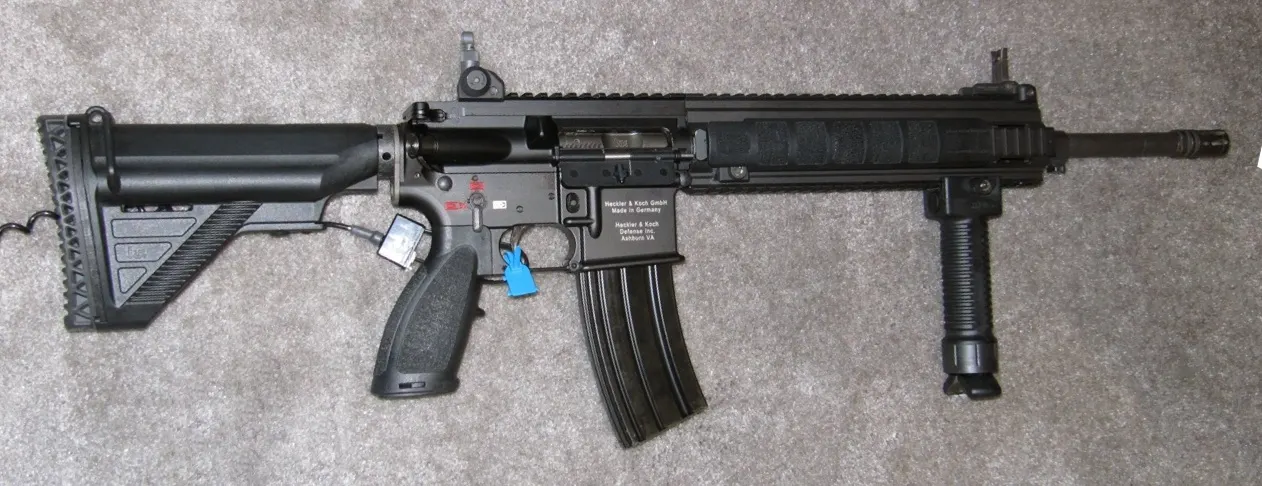

The M38 Squad Designated Marksman Rifle (M38 SDMR) is not a separate rifle design. It is the standard-issue M27 Infantry Automatic Rifle, the Heckler & Koch HK416 derivative that replaced the M249 SAW in every US Marine Corps rifle squad, fitted with a variable-power scope, a suppressor, and a folding bipod and reissued under a new model number for the marksman role.1 Chambered in 5.56x45mm NATO, it is the odd one out among American designated marksman rifles fielded in the same era, since almost every other DMR adopted by the US military and its NATO partners in the 2010s, including the Army's own answer to the same requirement, stayed in 7.62x51mm. The M38's receiver, gas system, and fire-control group are physically identical to the M27 Infantry Automatic Rifle already carried by every other Marine in the squad, meaning a specific serial-numbered M38 could plausibly have been an ordinary M27 the week before it was issued a scope.2
- Full parts, magazine, and training commonality with the M27-armed rifle squad
- Retains select-fire capability, unlike most dedicated semi-auto-only DMRs
- Leupold TS-30A2 variable scope adds real precision over the M27's fixed 3.5x ACOG
- Integrated suppressor reduces muzzle signature and recoil for sustained precision fire
- 5.56mm terminal performance and range trail behind 7.62mm designated marksman rifles
- Requires a second, non-standard 5.56mm load (Mk 262 match) distinct from the squad's M855A1
- Not a distinct weapon, so its own combat and service record is hard to separate from the M27's
- Widely described by Marine small-arms specialists as an interim rather than final solution
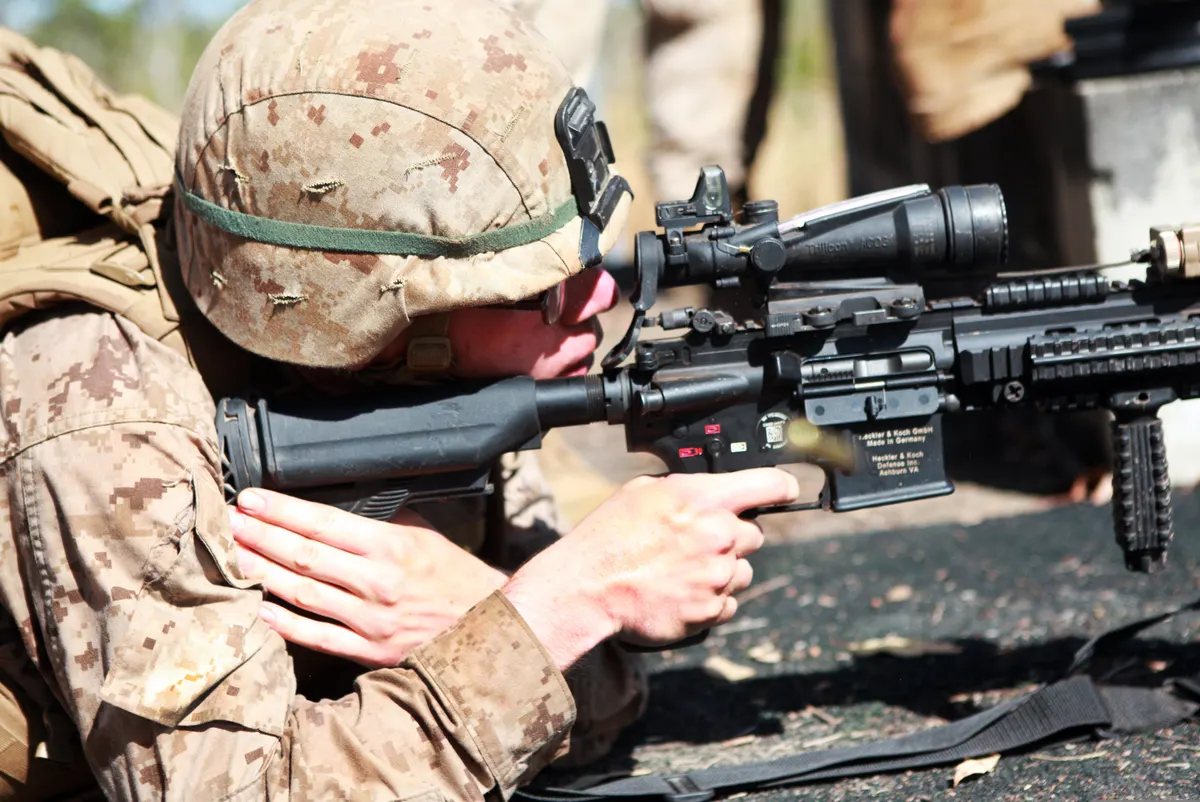
The Marine Corps announced the concept in May 2017 and ran its first live-fire fielding test on December 8, 2017, at Camp Lejeune, North Carolina, with Marines of 3rd Battalion, 8th Marine Regiment, the unit that gave the rifle its designation.3 Full fielding across all three active Marine Expeditionary Forces followed by April 2018, with full operational capability targeted for that September.4 One M38 is issued per twelve-Marine infantry rifle squad, carried by the squad's designated marksman and intended to engage point and area targets out to roughly 600 meters in support of riflemen still armed with the standard M27.4
The M38 sits alongside a wider family of American squad-level marksman rifles built to solve the same doctrinal problem, from the Army's M21 Sniper Weapon System and M25 Sniper Rifle of the Vietnam and post-Vietnam era to the more recent M110 Semi-Automatic Sniper System family. Every one of those, and every other weapon in this same DMR line-up, descends from a 7.62mm battle rifle design. The M38 instead descends from an assault-rifle-pattern automatic rifle, which is the single fact that separates it from the rest of the category.
The M38 Squad Designated Marksman Rifle uses the same operating system as the base M27 Infantry Automatic Rifle, a gas-piston-operated short-stroke system with a rotating bolt, adapted by Heckler & Koch from the HK G36, running in place of the direct-impingement gas system found on the M4 and M16.5 The piston system keeps combustion gas out of the receiver, which HK and the Marine Corps credit with cleaner, more reliable running with less carbon fouling in sand and dust environments. Both weapons share the same 16.5 inch (419mm) heavy, free-floating barrel, so the M38 is not a heavier-profile barrel variant, contrary to a common assumption, since that barrel is already standard on every M27.5
- İlk Üretim Yılı2017
- Hizmete Giriş Yılı2018
- Ağırlık (Boş)3,6 kg
- Ağırlık (Yüklü)4,4 kg
- Halen HizmetteEvet
- Önemli KullanıcılarUnited States Marine Corps
What actually distinguishes the M38 from a plain M27 is a three-piece accessory kit rather than any change to the gun itself. In place of the M27's fixed 3.5x Trijicon ACOG, the M38 mounts a Leupold TS-30A2 Mark 4 MR/T, a 2.5-8x36mm variable-power daytime scope, the same rifle scope model used on the Army and Marine Mk 12 Special Purpose Rifle.2 A Knight's Armament Company quick-detach sound suppressor (QDSS) fits over the muzzle, and a lightweight folding bipod clips to the rail for stable prone or supported fire.3 All three pieces bolt onto an unmodified M27, which is the entire conversion. The rifle keeps its STANAG 30-round detachable magazines, interchangeable with every other magazine in the squad, and it keeps its full select-fire trigger group, meaning the M38, unlike almost every purpose-built DMR, can still fire fully automatic at a cyclic rate of 700 to 900 rounds per minute.5
- Fişek5.56x45mm NATO (Mk 262 Mod 1, 77-grain OTM match)
- Çap5,56 mm
- Kovan Uzunluğu45 mm
- Mermi Ağırlığı5 g
- Kenar AteşlemeliHayır
- Kovansız MühimmatHayır
That ammunition detail matters more than it first appears. Muzzle velocity for the base M27 firing standard ball ammunition runs around 884 m/s (2,900 ft/s), but the heavier 77-grain Mk 262 match load used on the M38 leaves the muzzle at roughly 818 m/s, trading a little velocity for the tighter grouping and more consistent long-range behavior that makes the round popular with American precision shooters.2 At 600 meters, ModernFirearms estimates roughly 435 joules of retained energy for Mk 262, against roughly 270 joules for the lighter 62-grain Mk 318 round the rest of the squad fires, illustrating why 5.56mm designated marksmen lean on heavier match bullets rather than standard ball ammunition for range work.2 Effective range for the base M27 is rated at 550 meters against point targets and 700 meters against area targets, while the M38 configuration is specifically rated and issued to engage out to about 600 meters, the working distance the Corps set for its squad marksman role.6,4
- Mekanizma TipiGazlı
- Atış Modlarısafe, semi-automatic, automatic
- Seçmeli AtışEvet
- Besleme SistemiÇıkarılabilir Şarjör
- Şarjör Kapasitesi30
- Teorik Atış Hızı900
- Pratik Atış Hızı36
Weight is where the M38's 5.56mm heritage shows most clearly. The base M27 weighs 3.6 kg (7.9 lb) empty and about 4.4 kg (9.8 lb) loaded with a sling, figures the M38 adds to only modestly with its scope, suppressor, and bipod.5 Overall length runs from 840 to 940mm depending on where the adjustable stock is set.5 That is a meaningfully lighter package than a 7.62mm rifle built for the same squad-marksman role, a difference explored further in the Comparison section below.
- Namlu Çıkış Hızı818 m/sn
- Etkili Menzil (nokta)600 m
- Etkili Menzil (alan)700 m
- Namlu Uzunluğu419 mm
- Nişangah TipiLeupold TS-30A2 Mark 4 MR/T 2.5-8x36mm variable-power telescopic
- Optik RayıEvet
- Açık NişangahEvet
- Dişli NamluEvet
- Toplam Uzunluk940 mm
- Gövde Malzemesi (Receiver)aluminum alloy
- Kabza/Dipçik Malzemesipolymer
- Katlanır / Toplanır DipçikHayır
- Bullpup DüzeniHayır
- Çift Yönlü KumandalarEvet
- ModülerlikAccessory kit conversion, optic, suppressor, and bipod added to an unmodified M27 receiver, no separate receiver or model
- Susturucuya HazırEvet
- Süngü TakozuEvet
- Entegre BipodEvet
- Bombaatar KabiliyetliHayır
- Gaz PistonluEvet
- Toplam Üretim864
- Üretim Başlangıcı2017
- Varyantlar0
Marine Corps interest in a squad-level marksman capability is not new. The service first pursued formal requirements for a specialized marksman weapon in 1992, originally intended for scout-sniper team spotters who at the time carried standard M16A2 rifles with iron sights.5 The requirement went nowhere as a program for over a decade, but combat in Iraq and Afghanistan in the mid-2000s gave it new urgency. Dense urban patrolling in Iraq demanded fast but precise rifle fire against fleeting targets in close city terrain, while in Afghanistan, insurgents frequently opened fire from beyond the practical range of the M16 and M4's iron sights or fixed low-power optics, leaving ordinary riflemen outranged.5
The M27 itself grew out of a parallel and better-documented program. The Marine Corps began looking for a lighter, more accurate replacement for the M249 SAW around 2000, issued a formal industry request in 2005, and selected the HK416 in 2010, designating it the M27 Infantry Automatic Rifle.7 It first saw combat with 1st Battalion, 3rd Marines, in Garmser, Helmand province, Afghanistan, in April 2011, and became the Corps' standard squad automatic weapon that year, replacing the M249 in front-line rifle squads.5
That decision set up the M38. In 2017, Commandant Gen. Robert Neller announced the Corps would replace the M4 and M16A4 in every infantry squad, aside from the squad leader's weapon, with the M27, ordering roughly 11,000 to 15,000 additional rifles on top of the ones already in service.8 With the entire squad converging on one rifle family, adding a marksman capability by scoping an existing M27 rather than fielding and training on a separate rifle and cartridge became the obvious path, and the Marine Corps presented the scoped M38 concept publicly at the NDIA Armament Systems Forum in May 2017.9
First live-fire testing and fielding took place on December 8, 2017, at Range F-18, Camp Lejeune, with Marines of 3rd Battalion, 8th Marine Regiment, the event that gave the rifle its name.3 By April 2018, fielding was reported complete across all three active Marine Expeditionary Forces, with I MEF receiving 324 M38s, II MEF 243, and III MEF 81, plus 216 more requested for Marine Forces Reserve, a total of roughly 864 rifles converted to the configuration.4 Full operational capability was targeted for September 2018.4
The M27 program's cost drew unusually public scrutiny along the way. A March 2018 House Armed Services Committee hearing focused on a roughly $3,000 per-rifle figure cited for the August 2017 order of up to 50,000 M27-family rifles, with lawmakers questioning why the contract went sole-source to a German manufacturer rather than being competed domestically.10 A separate, later order for 5,650 M27s was reported at about $1,300 per rifle, a marked drop from the earlier figure, though that pricing covers the base M27 buy rather than any distinct M38 kit cost.11 The M38 itself was never bought as new-production rifles. It is an accessory kit, scope, suppressor, and bipod, applied to M27s already in Marine Corps inventory, so no separate M38 unit price for the receiver exists in public reporting, only the added cost of the Leupold optic and the Knight's Armament suppressor on top of an M27 the Corps already owned.5
No dedicated reporting describing a named M38 combat deployment turned up in open sources during research for this article. That is a genuinely different situation from the parent M27, which has documented Afghanistan combat history stretching back to 2011, and it should be read as a gap in public reporting rather than proof the rifle has never left the armory. Marine squads carrying the M38 in later deployments would not necessarily generate weapon-specific press coverage the way the M27's original fielding did.
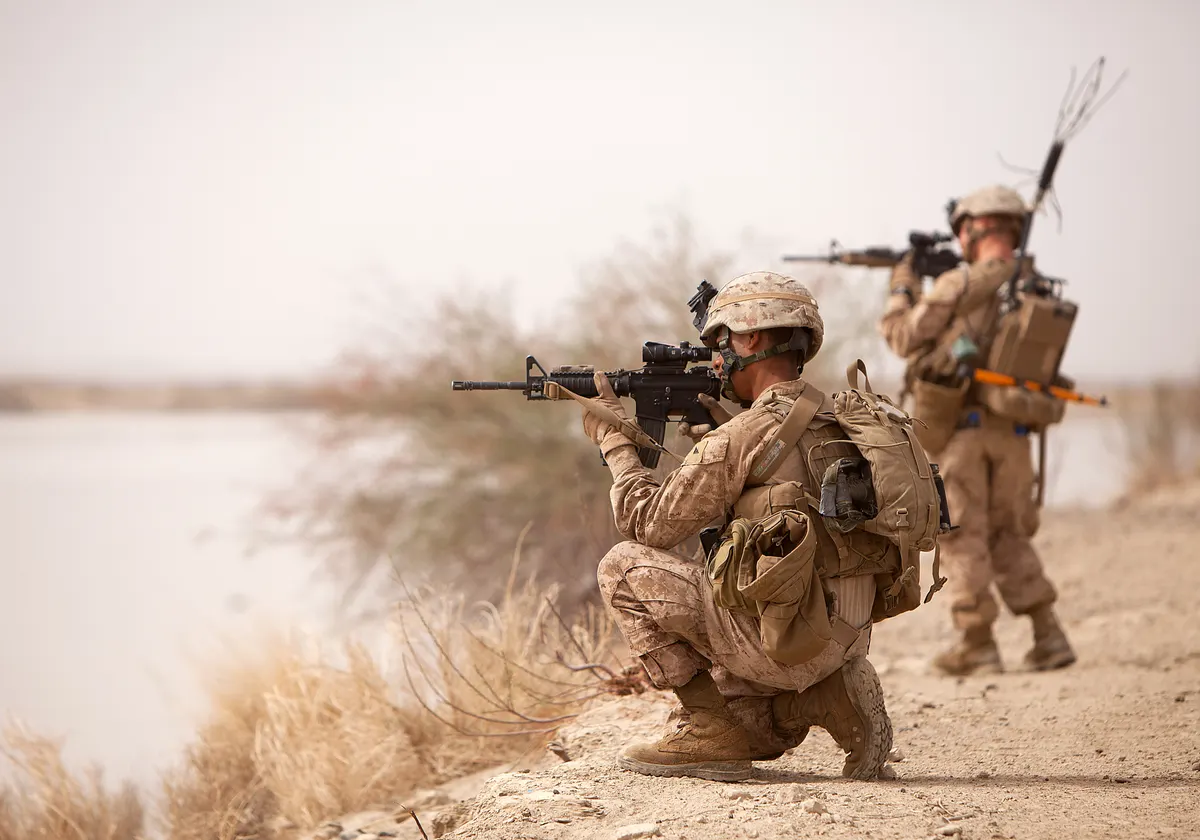
The M38 does not have a confirmed, named combat deployment in open-source reporting, which is worth stating plainly rather than papering over. What can be documented is the conflict experience that created the requirement the M38 eventually filled. Urban fighting during the Iraq War exposed the need for fast, precise rifle fire in close city terrain, and the War in Afghanistan exposed the opposite problem, insurgents opening fire from ranges beyond what iron sights and fixed low-power optics on the M16 and M4 could effectively answer.5 Both experiences predate the M38 configuration itself by roughly a decade, since the scoped kit was not tested until December 2017.
The base M27 platform the M38 is built on has its own documented record in Afghanistan, first deploying in combat with 1st Battalion, 3rd Marines, around Garmser, Helmand province, in April 2011, several years before any Marine carried a scoped M38 configuration of the same rifle.5 By the time the M38 kit reached Marine Expeditionary Forces in 2018, the broader Afghanistan and Iraq conflicts that had driven the original requirement were well into their later phases, and American infantry doctrine had already shifted significantly from the mid-2000s conditions that first identified the marksman gap.
There is effectively one M38 configuration, and no further M38 sub-variants (an M38A1 or similar) turned up in research for this article.3 The meaningful comparison runs between the M38 and the standard M27 it is drawn from, rather than between separate M38 variants. Both share an identical receiver, barrel, gas system, and fire-control group. The M38 differs only in its Leupold TS-30A2 2.5-8x36mm variable scope in place of the M27's fixed 3.5x ACOG, its Knight's Armament QDSS suppressor, and its folding bipod.2 Because the underlying rifle is unchanged, any M27 in Marine Corps inventory is a candidate for conversion to M38 configuration and back, which is not something possible with a purpose-built DMR built on a distinct receiver.
| Configuration | Optic | Suppressor | Bipod | Fire control |
|---|---|---|---|---|
| M27 IAR (standard) | Fixed 3.5x Trijicon ACOG | Not standard-issue | Not standard-issue | Select-fire |
| M38 SDMR | Leupold TS-30A2 2.5-8x36mm variable | Knight's Armament QDSS | Folding bipod | Select-fire (unchanged) |
Marine Corps Chief Warrant Officer Christian Wade's public comment that the M38 could become obsolete points toward where this may be heading. As variable optics and suppressors become standard issue across the wider M27 fleet, the line separating a rifleman's M27 from a marksman's M38 gets thinner, and the case for a separate model designation gets correspondingly weaker.4

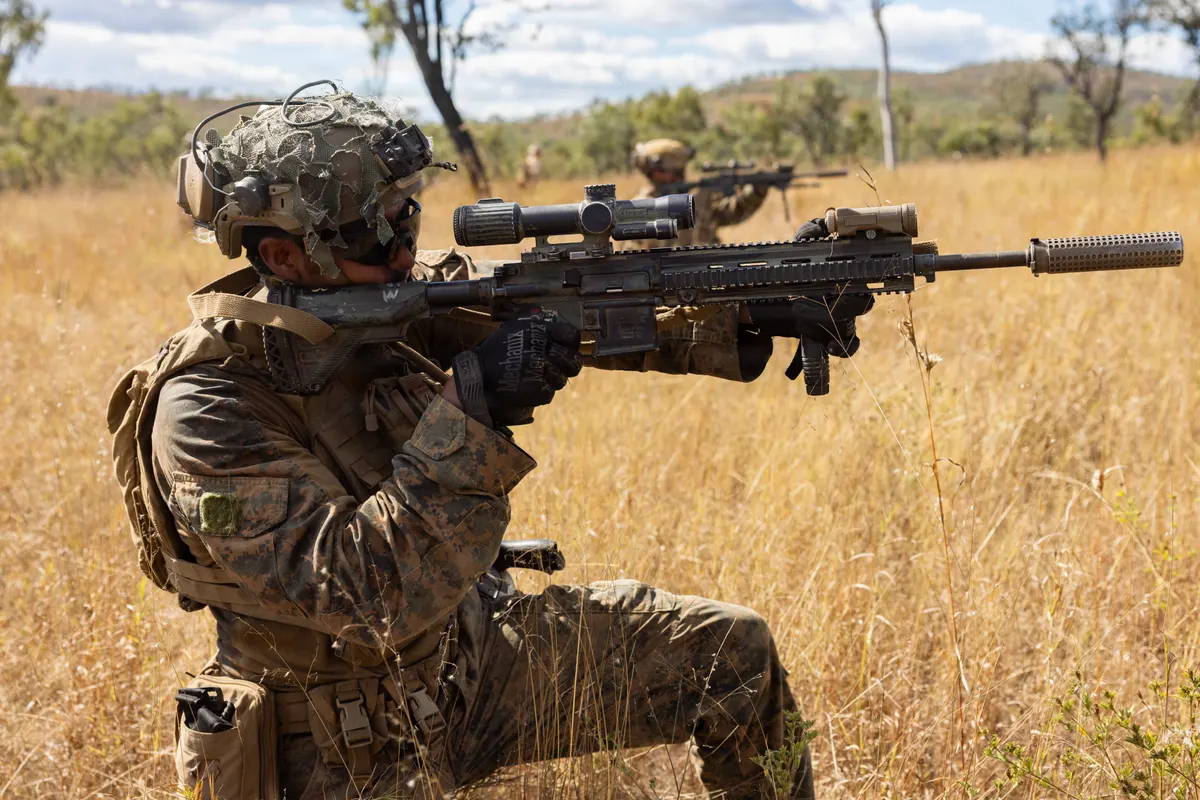
The United States Marine Corps is the only confirmed operator of the M38 Squad Designated Marksman Rifle.4 Fielding was completed across all three active Marine Expeditionary Forces by April 2018, with unit totals of 324 rifles for I MEF, 243 for II MEF, and 81 for III MEF, plus a further 216 requested for Marine Forces Reserve, putting total fielding at roughly 864 rifles.4 One M38 is issued per twelve-Marine infantry rifle squad, carried by the Marine filling the squad's designated marksman role.6
The M38's fielding rode on the back of the much larger M27 program. After the M27 replaced the M249 in 2011, the Corps in 2017 ordered roughly 11,000 to 15,000 additional M27s to replace the M4 and M16A4 as the general-issue rifle in every infantry squad except the squad leader, formally becoming the Corps' standard infantry rifle by 2018 and putting an M27-pattern rifle in the hands of nearly every deployed Marine rifleman.8,12 No export sale or foreign adoption of the M38 configuration specifically has been reported, and it remains a US Marine Corps-only designation layered onto a rifle the Army separately buys and issues in its unscoped M27-family form as a squad automatic weapon rather than a marksman rifle.
The M110A1 Squad Designated Marksman Rifle makes the cleanest comparison for the M38, because both rifles answer the identical squad-marksman requirement for a different US service using rifles from the same German manufacturer. Where the Marine Corps scoped an existing 5.56mm rifle already in squad service, the Army fielded a dedicated 7.62x51mm NATO rifle built by Heckler & Koch and derived from the HK417, closely related to the Bundeswehr's G28 designated marksman rifle.13 Two branches of the same military solved the same doctrinal gap with opposite caliber philosophies, and both ended up buying from Heckler & Koch to do it.
The weight difference is the most tangible expression of that split. The M38's M27 base weighs 3.6 kg (7.9 lb) empty, while the M110A1 weighs about 3.8 kg (8.4 lb) unloaded and roughly 6.8 kg (15 lb) loaded with its optic, suppressor, and other accessories, reflecting the heavier cartridge and larger action a 7.62mm rifle requires.14 The M110A1 mounts a SIG Sauer TANGO6 1-6x24 low-power variable optic, a notably lower magnification range than the M38's 2.5-8x Leupold, alongside a Geissele M-LOK handguard, a Geissele adjustable two-stage trigger, and an OSS SRM6 suppressor.14
| Spec | M38 SDMR | M110A1 SDMR |
|---|---|---|
| Caliber | 5.56x45mm NATO | 7.62x51mm NATO |
| Weight (empty) | 3.6 kg | 3.8 kg |
| Weight (loaded) | 4.4 kg | ~6.8 kg |
| Optic | Leupold TS-30A2 2.5-8x36mm | SIG TANGO6 1-6x24 |
| Fire control | Select-fire | Semi-automatic only |
The 5.56mm versus 7.62mm designated marksman question the M38 and M110A1 embody is not settled doctrine anywhere in NATO, and defense analysts frame it as a genuine, still-unresolved trade-off rather than a case where one caliber is simply correct. A 7.62mm rifle hits harder and carries more energy at typical infantry engagement distances, extending effective squad range well past 500 yards, while a 5.56mm system like the M38 stays lighter, lets the marksman carry more rounds, and keeps ammunition compatible with the rest of the rifle squad, at least in theory.15,16 In the M38's case that theoretical ammunition commonality was never fully realized, since the rifle is zeroed for Mk 262 match ammunition the rest of the squad does not carry, a wrinkle that weakens the strongest argument for staying in 5.56mm in the first place.
The M38 is still in service. It remains the US Marine Corps' standard squad designated marksman rifle as of this writing, with no announced replacement program, though Marine small-arms specialists have described it publicly as a likely interim solution rather than a permanent answer to the caliber question.4

What caliber is the M38 Designated Marksman Rifle? The M38 fires 5.56x45mm NATO, the same cartridge as the standard M27 Infantry Automatic Rifle and the M4 and M16 rifles it works alongside in a Marine rifle squad, zeroed specifically for the Mk 262 77-grain match load.2
Is the M38 the same weapon as the M27? Yes in every mechanical respect. The M38 is a standard M27 Infantry Automatic Rifle fitted with a Leupold TS-30A2 variable scope, a Knight's Armament suppressor, and a folding bipod. The receiver, barrel, gas system, and trigger group are unchanged.2,3
Why does the Marine Corps use 5.56mm instead of 7.62mm for its designated marksman rifle? The Corps prioritized ammunition, magazine, and training commonality with the rest of the M27-armed rifle squad over the greater range and terminal energy a 7.62mm rifle like the Army's M110A1 offers, accepting reduced long-range performance as the tradeoff.8
Is the M38 still in service? Yes. It remains the standard-issue Marine Corps squad designated marksman rifle, fielded to every active infantry rifle squad since 2018, though it has been publicly described as a likely interim solution.4
How much does the M38 rifle cost? No separate M38 unit price is publicly reported, since the M38 is an accessory kit applied to M27 rifles the Corps already owns. Base M27 pricing has been reported at both roughly $3,000 and roughly $1,300 per rifle in different Marine Corps orders, with the kit's Leupold scope and Knight's Armament suppressor adding further cost on top.10,11
- "The USMC's Beloved M27 Automatic Rifle Gets Another Job As The M38 Marksman Rifle", The War Zone — twz.com ↩
- "M38 SDMR", ModernFirearms — modernfirearms.net ↩
- "USMC Fields M38 Squad Designated Marksman Rifle", Soldier Systems Daily — soldiersystems.net ↩
- "The Corps is on track to fully field the M38 marksman rifle despite setbacks for the M27 IAR", Marine Corps Times — marinecorpstimes.com ↩
- "M27 Infantry Automatic Rifle", Wikipedia — en.wikipedia.org ↩
- "M38 M27 Infantry Automatic Rifle", Task & Purpose — taskandpurpose.com ↩
- "No More M4. USMC Adopts HK M27 Infantry Automatic Rifle", Accurate Shooter / The Shooting Bulletin — bulletin.accurateshooter.com ↩
- "Marines want 50,000 more Infantry Automatic Rifles to replace M4", Marine Corps Times — marinecorpstimes.com ↩
- "USMC M38 Squad Designated Marksman Rifle", Athlon Outdoors — athlonoutdoors.com ↩
- "Marine Corps' New Rifle is Super Expensive, and No One Knows Why", National Interest — nationalinterest.org ↩
- "Marine Corps Buys 15,000 More M27s", The Firearm Blog — thefirearmblog.com ↩
- "All of the Marine M27 rifles are in. If you're not a grunt, or working with them, you're not getting one", Marine Corps Times — marinecorpstimes.com ↩
- "M110A1 rifle", Wikipedia — en.wikipedia.org ↩
- "Analysis and Review, New Heckler and Koch M110A1 Squad Designated Marksman Rifle for US Army", Army Recognition — armyrecognition.com ↩
- "5.56 vs. 7.62. Which Designated Marksman Rifle (DMR) is King", National Interest — nationalinterest.org ↩
- "The DMR. Designated Marksman Rifle, 5.56 versus 7.62", Sandboxx — sandboxx.us ↩