


The Zastava M76 entered service with the Yugoslav People's Army (JNA) in 1976, built to give an infantry platoon the same designated marksman capability the Soviet Union had already handed its own rifle squads with the SVD Dragunov. Yugoslav engineers at Zastava Arms in Kragujevac reached that goal from a completely different starting point. Instead of copying the Dragunov's dedicated short-stroke gas system, they took the existing Zastava M70 Kalashnikov-pattern rifle and scaled it up, both physically and mechanically, to survive the pressure of a full-power rifle cartridge.1
- Kalashnikov-derived reliability in poor field conditions
- Full-power 7.92x57mm Mauser terminal effect at range
- Simple, low-maintenance design shared with existing AK-pattern armorer skills
- 1.5 MOA accuracy, good for a scaled Kalashnikov action
- 10-round magazine capacity, shorter than some rival DMRs
- Uncommon 7.92x57mm Mauser chambering limits export ammunition logistics
- Semi-automatic only, no suppressed/tactical variant fielded
- Iron sight and optic zero can drift under rough handling in the field
That cartridge is the 7.92x57mm Mauser (also written 8x57mm IS), a round Yugoslavia had enormous wartime stockpiles of after 1945, rather than the 7.62x54mmR the Dragunov fires.1 The result looks, on a rack, closer to an oversized M70 than to a Dragunov. It has a separate wood stock and pistol grip instead of the SVD's one-piece thumbhole stock, a milled steel receiver, and the same rotating bolt and long-stroke gas-operated piston system found across the Zastava Kalashnikov family.2 A Zastava M76 designated marksman rifle fires only semi-automatically from a 10-round detachable magazine, unlike the select-fire M70 rifles it was built from.
The Zastava M76 is often filed next to the SVD Dragunov and the Romanian PSL as one of three AK-derived marksman rifles that emerged during the Cold War, all belonging to the same designated marksman rifle category despite sharing almost no interchangeable parts. Serbia still lists the M76 as standard issue alongside its intended successor, the Zastava M91, and it remains in front-line use decades after most Western armies replaced their own 1970s-era marksman rifles. Search interest in Zastava M76 specifications and Zastava M76 vs SVD Dragunov both points to the same underlying question, whether a scaled-up assault rifle can really substitute for a purpose-built sniper platform, and the M76's four-decade service record is a large part of the answer.
Scaling the M70 Action for a Full-Power Rifle Cartridge
Zastava's engineers could not simply lengthen an M70 receiver and expect it to hold together under 7.92x57mm Mauser pressures, so the M76 receiver was reworked closer to the heavier RPK pattern, with thicker walls and a longer, reinforced bolt carrier group.2 Collector-grade civilian rebuilds confirm just how much bigger the internals grew, the M76 receiver measures about 11 inches against roughly 10.25 inches for a standard 7.62x39mm Kalashnikov receiver, the gas tube runs 8.75 inches versus 7 inches, and the bolt carrier extends to 8.5 inches.3 The barrel is 550mm (21.7in) long, unchromed in most military-production examples, and the complete rifle weighs approximately 4.2 kg (9.3 lb) empty and measures 1,135mm (44.7in) overall.1,4
- İlk Üretim Yılı1976
- Hizmete Giriş Yılı1976
- Ağırlık (Boş)4,2 kg
- Önemli KullanıcılarSerbia, North Macedonia, Iraq, Saudi Arabia, Rwanda, Myanmar (local copy)
The rifle uses a 4-position gas regulator, a feature carried over from the M70 line, which can be closed fully to force manual, bolt-action-style operation if the gas system is fouled or damaged in the field.1 Sights combine a telescopic optic with iron sights as backup. The standard optic is the ZRAK ON-M76, a 4-power scope built by the Serbian optics firm ZRAK, with a bullet-drop-compensating elevation cam adjustable across a 100 to 1,200 meter range and a tritium element for low-light aiming that needs replacement roughly every 8 to 12 years.2 Practical accuracy is commonly cited at 1.5 MOA, respectable for a rifle built on a Kalashnikov action rather than a dedicated precision receiver.1,5
- Fişek7.92x57mm Mauser
- Çap7,92 mm
- Kovan Uzunluğu57 mm
- Çap Sınıfıfull-power rifle cartridge
- Kenar AteşlemeliHayır
- Kovansız MühimmatHayır
How the M76 Compares to the Dragunov It Was Built to Match
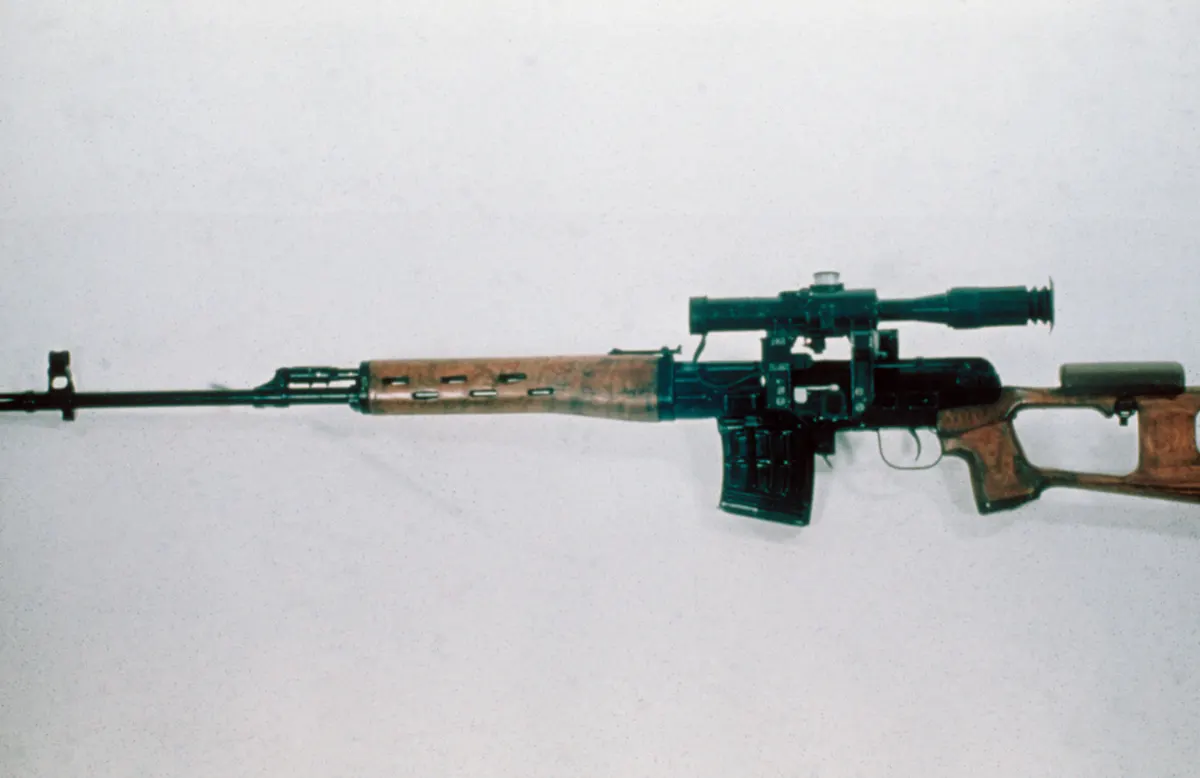
Because the Zastava M76 and the SVD Dragunov fill the identical squad designated marksman role, reviewers frequently note how little the two rifles actually have in common mechanically. The Dragunov uses a short-stroke gas piston system built specifically for its own role, a skeletonized thumbhole stock, and a 7.62x54mmR cartridge, while one specialist reviewer described the M76 as closer to a lengthened AK-47 with a heavier barrel than any kind of Dragunov clone.2
- Mekanizma TipiGazlı
- Atış Modlarısemi-automatic only
- Seçmeli AtışHayır
- Besleme SistemiÇıkarılabilir Şarjör
- Şarjör Kapasitesi10
- Emniyet TipiKalashnikov-pattern lever safety
Muzzle velocity for the standard 7.92x57mm Mauser service load is approximately 730 m/s (2,395 ft/s), and effective range against man-sized targets runs to about 800 meters under normal field conditions, with exceptionally skilled marksmen able to stretch hits to roughly 1,000 meters.1,2 The rifle has wood furniture rather than a synthetic stock, retains the Kalashnikov-style safety lever, and mounts its scope on the same side rail used across the Zastava rifle line.
- Namlu Çıkış Hızı730 m/sn
- Etkili Menzil (nokta)800 m
- Nişan Menzili1.200 m
- İsabet1,5
- Namlu Uzunluğu550 mm
- Nişangah TipiZRAK ON-M76 4x telescopic sight with adjustable iron sights as backup
- Optik RayıEvet
- Açık NişangahEvet
- Toplam Uzunluk1.135 mm
- Gövde Malzemesi (Receiver)machined/milled steel
- Kabza/Dipçik Malzemesiwood
- Katlanır / Toplanır DipçikHayır
- Bullpup DüzeniHayır
- Çift Yönlü KumandalarHayır
- Susturucuya HazırHayır
- Entegre BipodHayır
- Bombaatar KabiliyetliHayır
- Gaz PistonluEvet
- Üretim Başlangıcı1976
From the M70 Rifle Line to a Dedicated JNA Marksman Rifle
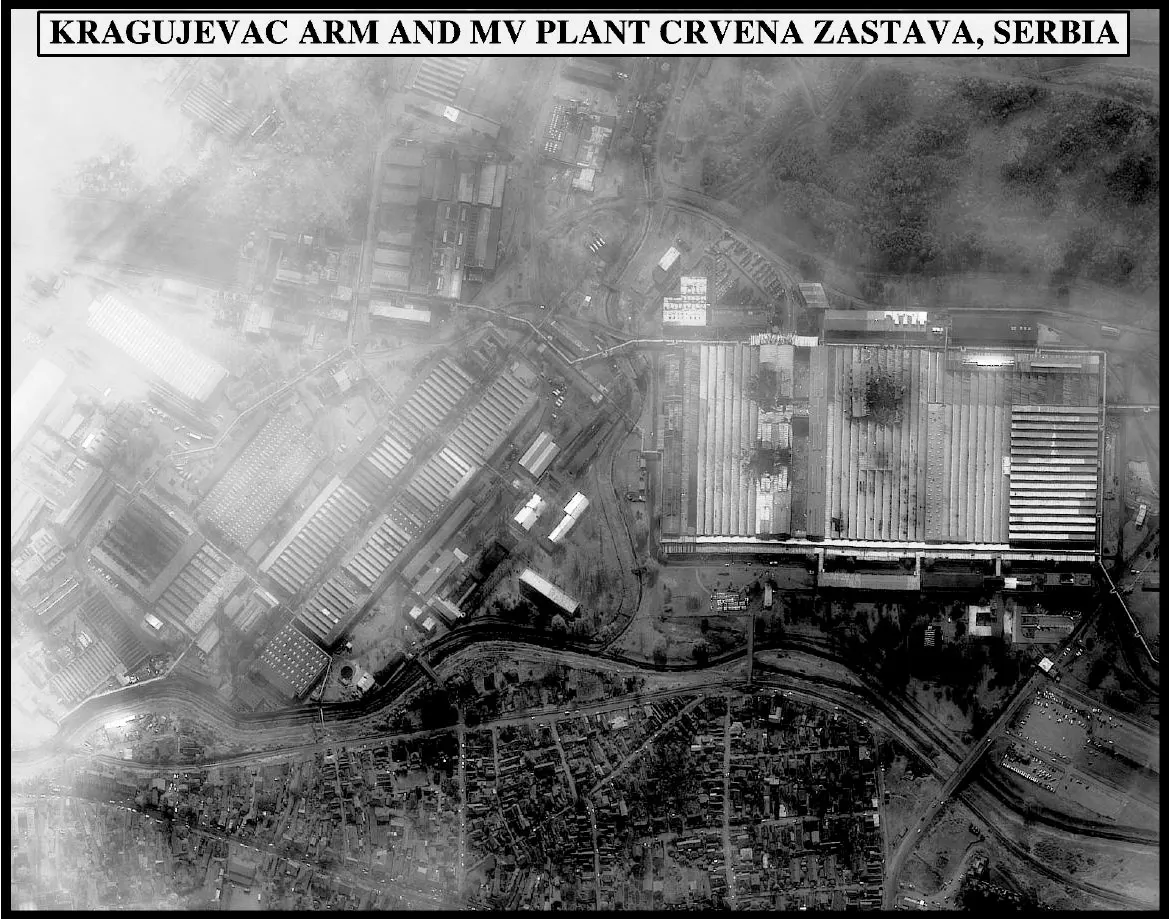
The Yugoslav People's Army commissioned a semi-automatic marksman's rifle in the early 1970s that could match what the Romanian PSL and the Soviet SVD Dragunov already gave their own infantry.2 Rather than license or reverse-engineer the Dragunov, Zastava Arms proposed scaling up its existing Zastava M70 design, and by the mid-1970s the resulting rifle, designated M76, entered production at the Crvena Zastava arms factory in Kragujevac.1,2 It served as the JNA's standard squad marksman rifle for roughly 15 years before the Zastava M91, chambered in the more common 7.62x54mmR cartridge, began replacing it in small numbers around 1990.2 The M91 never fully displaced the older rifle, and M76 production reportedly continued into the late 1990s even as M91 deliveries trickled out.2
Zastava Arms, founded in Kragujevac in 1853, is a state-owned Serbian arms manufacturer and the sole producer of the M76 across its entire production history.1 The rifle's civilian export story since the Yugoslav Wars has been almost as eventful as its military one. American importer Mitchell Arms brought in roughly 400 surplus M76 rifles in 1986, and by 2000 a second importer, PW Arms, had sold roughly 2,000 more.6 That second batch triggered a serious regulatory problem.
The PW Arms Recall and a Rifle the ATF Reclassified as a Machine Gun
The military-pattern M76 receiver retained a third pin hole for a safety sear, a feature the original Yugoslav design used only in full military configuration. When the US Bureau of Alcohol, Tobacco, Firearms and Explosives examined the PW Arms import batch, it ruled that the retained hole and sear location legally qualified the rifles as machine guns under American law, despite the rifles never having been configured to fire automatically for the civilian market.6 Every one of the roughly 2,000 imported rifles was tracked down, torch-cut to ATF specification, and destroyed, with customers refunded.6
American gunsmiths later rebuilt the M76 from parts kits into fully compliant semi-automatic rifles. Ohio Rapid Fire, under owner Todd Grove, machined new receivers from solid 4140 steel billet for its early builds, pairing them with adjustable two-stage triggers sourced from Red Star Arms, and Assault Weapons of Ohio later offered similar builds chambered in .30-06 Springfield and 8mm Mauser.3 Zastava Arms itself now markets a factory civilian variant, the LKP M76, chambered in .308 Winchester for the American sporting market.7
Used by Every Side in the Yugoslav Wars
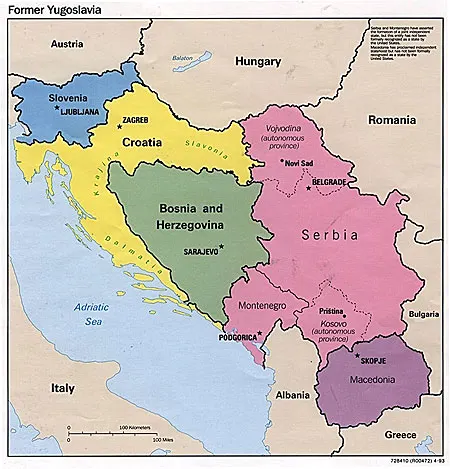
No conflict shaped the M76's reputation more than the collapse of Yugoslavia itself. During the Yugoslav Wars of the 1990s, Serb, Croat, Bosniak and Macedonian forces all fielded the same M76 rifles inherited from JNA armories, since the rifle had been standard issue across the unified Yugoslav military before the country split apart.8 The rifle saw sustained combat during the Croatian War of Independence, the Croat-Bosniak War, and later the Kosovo War, fought across Croatia, Bosnia and Herzegovina, and the disputed province of Kosovo.8
Nowhere did the M76 earn a darker reputation than during the Siege of Sarajevo, where it and other scoped rifles were used from the hills above the city against a largely civilian population for close to four years.9 Bosnian Serb commander Stanislav Galic, who led the Sarajevo-Romanija Corps for much of the siege, was later convicted by the International Criminal Tribunal for the former Yugoslavia over the campaign of sniping and shelling directed at the city's residents, a case that placed weapons like the M76 at the center of the war crimes record from that conflict.9
The tribunal's findings tied the M76 directly to a deliberate campaign of sniping against civilians, a grim legacy that sets its Yugoslav Wars record apart from the more conventional battlefield service most other rifles in its class saw elsewhere in the same decade.
Export Service From the Iran-Iraq War to Post-2003 Iraq
Beyond the former Yugoslavia, the M76 found a long export career through arms deals that non-aligned Yugoslavia struck across the Middle East and Africa during the Cold War.10 Iraq was the most consequential customer. Baathist Iraq obtained manufacturing machinery from Zastava Arms and began building its own derivative at the Al-Qadissiya State Establishment starting in 1978, marketed as the Tabuk rifle family and rechambered for the more common 7.62x39mm cartridge used across other assault rifles.11 The Iraqi Tabuk derivative fought through the Iran-Iraq War, the 1991 Gulf War, and the post-2003 Iraq War, and remains the primary rifle of Iraqi security forces today.11 Iraq additionally imported original M76 rifles from former Yugoslav republics as late as 2005.1
The M76 also equipped combatants during the Lebanese Civil War, where it circulated among the era's various militia arsenals alongside the wide mix of Eastern Bloc and Warsaw Pact small arms common to that conflict.12 Yugoslav-era exports and later proliferation put the rifle into the hands of forces across a wider stretch of Middle Eastern and African conflicts through the 2010s, alongside its continuing service with North Macedonia, Saudi Arabia, Rwanda and Myanmar, the last of which manufactures its own unlicensed copy locally.10
The Unproven 7.62x51mm NATO Export Claim
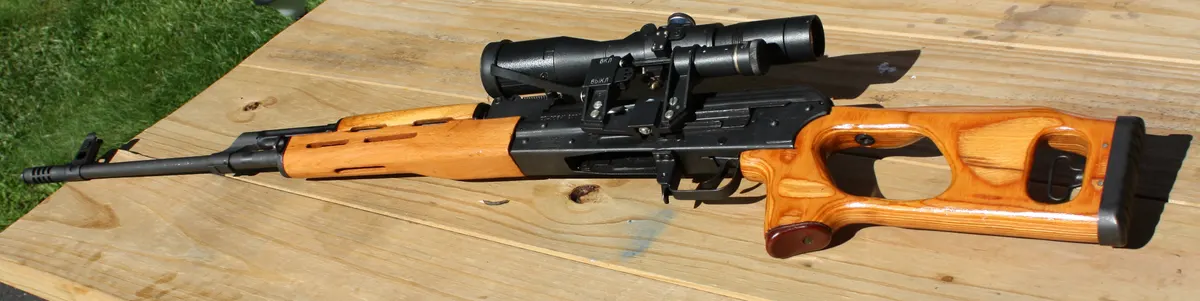
Persistent claims describe Zastava offering export versions of the M76 in 7.62x51mm NATO and 7.62x54mmR to widen its customer base beyond the uncommon 7.92x57mm Mauser round, but no verified example or contract has surfaced to confirm either chambering was ever actually produced for sale.13 What is documented is the Zastava M77, an export-marketed variant, and the eventual replacement design, the Zastava M91, which switched to the more widely available 7.62x54mmR cartridge for the post-Yugoslav Serbian armed forces.13
Foreign Derivatives, From Iraq's Tabuk to North Korea's Disputed Clone
Iraq's Tabuk rifle family is the M76's most consequential foreign derivative, built domestically from Zastava-supplied tooling and still in frontline Iraqi service.11 Further afield, North Korea is reported to produce a rifle known as the Jeogyeok-Bochong, which some sources describe as a direct M76 clone and others attribute instead to the Romanian PSL, a disagreement that has not been conclusively settled in open-source reporting.10 Myanmar manufactures its own copy domestically under the designation MAS-1 Mk I.10 On the civilian side, Zastava Arms currently sells the LKP M76 in .308 Winchester, while American builders including Ohio Rapid Fire and Assault Weapons of Ohio have produced parts-kit rebuilds in .30-06 Springfield and the original 8mm Mauser chambering.3,7


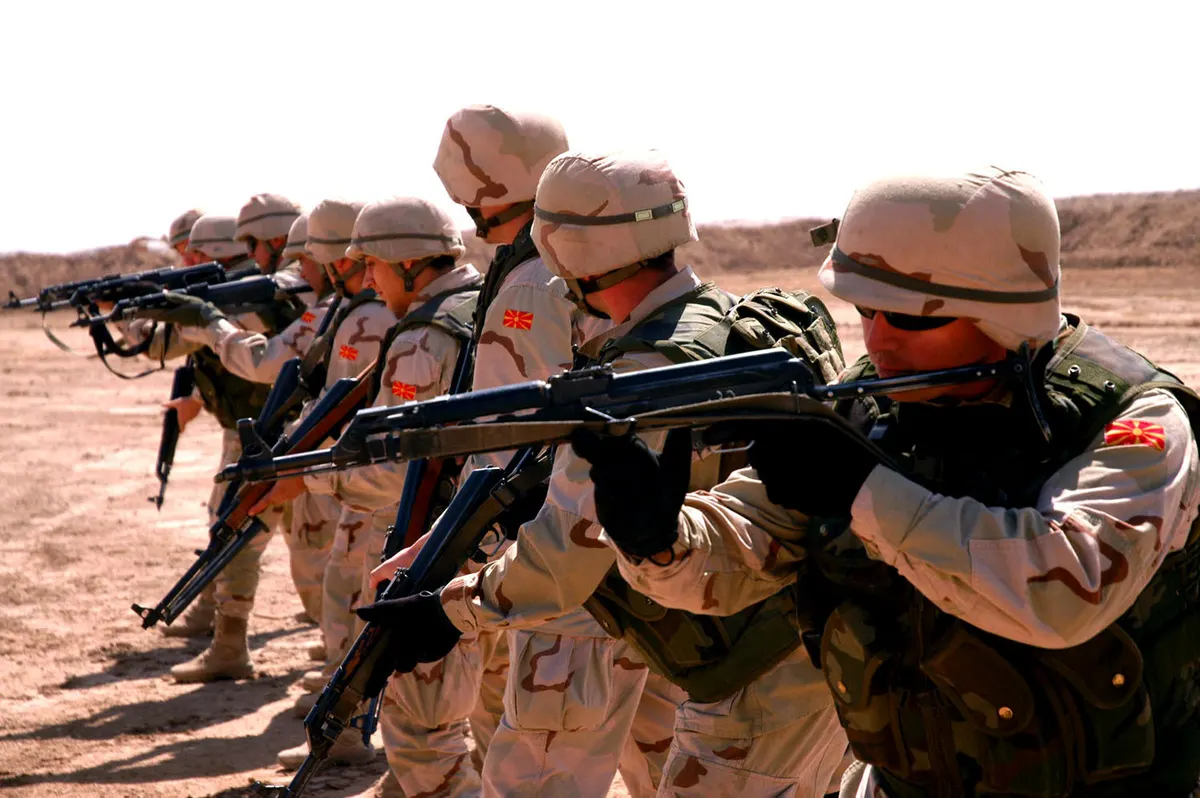
Serbia still lists the M76 as standard issue, even as the Zastava M91 is gradually phased in as its intended replacement.10 North Macedonia, Saudi Arabia, Rwanda and Iraq all continue to field the rifle, and Myanmar fields its own domestically produced MAS-1 Mk I copy rather than imported Zastava-built examples.10
Former operators include the Socialist Federal Republic of Yugoslavia itself, whose breakup distributed M76 rifles across every successor state's armed forces. Croatia fielded the rifle through its war of independence before eventually replacing it with the Finnish Sako TRG for dedicated sniper roles.10 Slovenia used the M76 during its brief Ten-Day War in 1991 before the country's small armed forces re-equipped along NATO lines in later decades.10
Sharing an identical squad designated marksman role does not make the Zastava M76 and the SVD Dragunov related designs. The Dragunov's short-stroke gas piston and skeletonized stock were engineered from scratch for the marksman role in the late 1950s, while the M76 is a reinforced, scaled-up Zastava M70 built to survive a cartridge the Dragunov never fires. That distinction matters more than the raw numbers below suggest, because a shooter comparing Zastava M76 vs SVD Dragunov is really choosing between two different design approaches pointed at the same battlefield problem, not two variations on one rifle.
| Spec | Zastava M76 | SVD Dragunov |
|---|---|---|
| Cartridge | 7.92x57mm Mauser1 | 7.62x54mmR2 |
| Weight (empty) | 4.2 kg1 | 4.3 kg2 |
| Magazine capacity | 10 rounds1 | 10 rounds2 |
| Effective range | 800 m1 | 800-1,000 m2 |
| Accuracy | 1.5 MOA1,5 | approx. 1-1.5 MOA2 |
The Zastava M76's 7.92x57mm Mauser round hits harder at typical designated marksman engagement distances than the Dragunov's 7.62x54mmR, reflecting the abundant WWII-era Mauser ammunition stockpiles Yugoslavia was working from rather than any deliberate ballistic advantage. Against the Romanian PSL, the comparison runs closer to a mirror image. Both rifles took the identical approach of scaling a Kalashnikov action to a full-power cartridge rather than building a bespoke marksman action, and both ended up heavier and less refined than the purpose-built Dragunov as a direct result, trading precision-rifle elegance for the AK family's reputation for reliability and simple field maintenance.


What caliber does the Zastava M76 use? The Zastava M76 fires the 7.92x57mm Mauser cartridge (also called 8x57mm IS), the same full-power round Yugoslavia inherited in large stockpiles after the Second World War.1
Is the Zastava M76 still in service? Yes. Serbia continues to list the M76 as standard issue alongside its intended replacement, the Zastava M91, and it also remains in active use with North Macedonia, Saudi Arabia, Rwanda, Iraq and Myanmar.10
How does the Zastava M76 compare to the SVD Dragunov? The two rifles fill the identical designated marksman role but share no common operating mechanism. The M76 is a scaled-up Kalashnikov-pattern rifle, while the SVD Dragunov uses a dedicated short-stroke gas system unique to its own design.2
What is the effective range of the Zastava M76? Official figures put the effective range against man-sized targets at approximately 800 meters, with skilled marksmen able to stretch confirmed hits out toward 1,000 meters under good conditions.1,2
How much does a Zastava M76 cost? No confirmed current military unit price has been published. On the American civilian market, parts-kit rebuilds and the factory LKP M76 in .308 Winchester have historically sold in the low thousands of dollars, well below purpose-built Western precision rifles of similar role.3,7
- "Zastava M76", Wikipedia — en.wikipedia.org ↩
- "Zastava's Heavy Hitter: The Yugoslav M76 DMR", Forgotten Weapons — forgottenweapons.com ↩
- "Zastava M76 from Ohio Rapid Fire", Small Arms Review — smallarmsreview.com ↩
- "Zastava M76", Modern Firearms — modernfirearms.net ↩
- "Zastava M76 Sniper Rifle", Military Factory — militaryfactory.com ↩
- "M76 Zastava import by PW Arms", The AK Forum — theakforum.net ↩
- "Gun Review: The M76 Sporter, Century Arms' Updated Yugo 8x57mm AK", Athlon Outdoors — athlonoutdoors.com ↩
- "Zastava M76 | The Yugoslav Semi-Automatic Sniper Rifle", NextGun — nextgun.ch ↩
- "Siege of Sarajevo", Wikipedia — en.wikipedia.org ↩
- "Zastava M76 - Sniper rifle", Global Military — globalmilitary.net ↩
- "Tabuk Sniper Rifle", Wikipedia — en.wikipedia.org ↩
- "List of weapons of the Lebanese Civil War", Wikipedia — en.wikipedia.org ↩
- "Zastava M76 - Design Details", Liquisearch — liquisearch.com ↩
- "Team America: World Police", Internet Movie Firearms Database — imfdb.org ↩