


China's People's Liberation Army adopted the Type 79 Sniper Rifle in 1979, the same year Chinese troops crossed into Vietnam and came home with captured Soviet SVD Dragunov rifles that state arsenal engineers used as the blueprint for the new gun.1 The Type 79 Sniper Rifle is China's first indigenously produced semi-automatic sniper rifle, a direct copy of the Soviet SVD Dragunov chambered in the same 7.62x54mmR cartridge, and it remains the starting point for every Chinese designated marksman rifle that followed it, including the improved Type 85 Sniper Rifle that replaced it in the 1980s.
- Cheap, fast route to an indigenous sniper rifle capability
- Long 620mm barrel and full-power 7.62x54mmR cartridge shared with the SVD Dragunov
- Side-rail mount compatible with a locally produced PSO-1 pattern scope
- Simple gas-operated action familiar to any SVD-trained armorer
- Early firing pins were prone to breaking under normal use
- No dedicated sniper cartridge, issued machine-gun ball degraded accuracy
- Dimensional tolerances looser than Soviet production, parts not fully interchangeable
- Superseded within China's own military within a few years of adoption
Outwardly the Type 79 Sniper Rifle is difficult to tell apart from the rifle it copied. It kept the SVD's skeletonized wood stock, its long 620mm barrel and its side-mounted optical rail for a locally made copy of the Soviet PSO-1 scope.2 The quality of the factories that built the Type 79 Sniper Rifle, far more than its outward shape, is what actually separated it from its Soviet parent. Early production rifles suffered from brittle firing pins and were issued with ordinary machine-gun ball ammunition instead of dedicated sniper-grade rounds, a combination that blunted the accuracy the design was supposed to deliver.1,3 Those problems, more than any dimensional change, are what actually separate the Type 79 Sniper Rifle's reputation from the Soviet original's.
Because it was reverse-engineered rather than built under license, the Type 79 Sniper Rifle also carries a quirk that keeps coming up among collectors and researchers. Its barrel twist rate copies the original Soviet Dragunov pattern used before 1975, the pattern still current when the captured rifles were built, rather than the faster twist the Soviet Union adopted afterward.1 That single detail means a rifle that was, in almost every other respect, a step down from the SVD Dragunov it copied, ended up more consistent with certain older ammunition lots than late-production Soviet rifles were. The Norinco trading arm that eventually marketed the design abroad was not even formally established until 1980, a year after the Type 79 Sniper Rifle's own adoption, underlining how much of its early history belongs to Chinese state arsenals rather than to Norinco as a company.4
The 7.62x54mmR Cartridge and a Reused Soviet Twist Rate
The Type 79 Sniper Rifle fires the 7.62x54mmR cartridge from a 10-round detachable magazine, the identical setup used by the Soviet SVD Dragunov and by nearly every Russian-pattern designated marksman rifle built since.2 Sourcing on the Type 79 Sniper Rifle's exact muzzle velocity and unloaded weight is inconsistent. Some older technical directories list a lighter unloaded weight near 3.7 kilograms and a muzzle velocity close to 710 m/s.5 Sources describing the rifle's direct Soviet ancestry put it closer to the SVD Dragunov's own 4.3 kilograms and 830 m/s, which fits better given how closely the two designs share tooling, barrel length and receiver dimensions.1,2 Effective range is usually quoted around 800 meters for a point target, matching the SVD Dragunov's own figure, though at least one specialist reference reverses the numbers and gives the Type 79 Sniper Rifle a longer 1,000 meter figure and the later Type 85 a shorter 800 meter one, a discrepancy that has never been fully resolved in English-language sources.6
- İlk Üretim Yılı1979
- Hizmete Giriş Yılı1979
- Ağırlık (Boş)4,3 kg
- Halen HizmetteEvet
- Önemli KullanıcılarChina (People's Liberation Army, largely superseded domestically), Bolivia, reportedly Myanmar
The barrel's rifling twist is where the Type 79 Sniper Rifle's copied origin shows up most clearly. It uses roughly a 1 in 315mm twist, the original Soviet specification from before 1975, rather than the faster 1 in 240mm twist the Soviet Union adopted afterward for newer ammunition.1 Chinese engineers were not choosing this twist rate on purpose, they inherited it because the SVD Dragunov samples captured in 1979 were themselves older-pattern rifles.
- Fişek7.62x54mmR
- Çap7,62 mm
- Kovan Uzunluğu53,72 mm
- Çap SınıfıFull-power rifle cartridge
- Kenar AteşlemeliHayır
- Kovansız MühimmatHayır
Forged Receiver, Wood Furniture and a Cloned PSO-1 Scope
The Type 79 Sniper Rifle uses a forged steel receiver, a short-stroke gas piston system and a rotating bolt with three locking lugs, all copied directly from the gas-operated SVD Dragunov action.1 Furniture is wood, matching the Soviet rifle's own skeletonized stock and ventilated handguard rather than the polymer furniture later Soviet-pattern rifles adopted. Sights combine an adjustable iron sight with a locally produced 4x24 copy of the Soviet PSO-1 telescopic sight, mounted on a side rail rather than a top-mounted Picatinny pattern.2,5 The Type 79 Sniper Rifle keeps the SVD Dragunov's bayonet lug, a feature retained across the whole Soviet-pattern family even though a semi-automatic sniper rifle rarely sees bayonet use in practice.
- Mekanizma TipiGazlı
- Atış ModlarıSemi-automatic only
- Seçmeli AtışHayır
- Besleme SistemiÇıkarılabilir Şarjör
- Şarjör Kapasitesi10
- Tetik TipiHammer-fired single action
- Emniyet TipiManual lever safety/selector on right side of receiver
Weight, Length and How the Type 79 Sniper Rifle Compares to the SVD Dragunov
At roughly 4.3 kilograms unloaded and 1,225mm overall, the Type 79 Sniper Rifle sits within a few grams and millimeters of the Soviet original it copied, since the two rifles share the same barrel length, receiver footprint and stock profile.1,2 The practical difference reported by armorers and collectors comes down to fit rather than raw dimensions. Chinese production tolerances in the early 1980s were looser than Soviet ones of the same period, so some small parts do not interchange cleanly between an original SVD Dragunov and a Type 79 Sniper Rifle, even though the blueprints were nominally identical.1
- Namlu Çıkış Hızı830 m/sn
- Etkili Menzil (nokta)800 m
- Nişan Menzili1.300 m
- Namlu Uzunluğu620 mm
- Yiv Adımı315mm (1:12.4in), copies the pre-1975 Soviet SVD pattern rather than the later 240mm twist
- Nişangah TipiAdjustable tangent iron sight plus a Chinese-made 4x24 copy of the Soviet PSO-1 telescopic sight
- Optik RayıEvet
- Açık NişangahEvet
- Toplam Uzunluk1.225 mm
- Gövde Malzemesi (Receiver)Forged steel
- Kabza/Dipçik MalzemesiWood (skeletonized stock and ventilated handguard, Soviet SVD pattern)
- Katlanır / Toplanır DipçikHayır
- Bullpup DüzeniHayır
- Çift Yönlü KumandalarHayır
- Süngü TakozuEvet
- Entegre BipodHayır
- Bombaatar KabiliyetliHayır
- Gaz PistonluEvet
- Üretim Başlangıcı1979
- Varyantlar3
Reverse-Engineering the SVD Dragunov After the Sino-Vietnamese War
China's route to its own designated marksman rifle began with a very short, very bloody war. On 17 February 1979, roughly 200,000 Chinese troops crossed into Vietnam in what China called a punitive campaign against its former ally, the Sino-Vietnamese War.7 Chinese forces made capturing intact Vietnamese-held SVD Dragunov rifles a priority during that fighting. The captured rifles were shipped back to Chinese state arsenals, where engineers began a rapid reverse-engineering program rather than waiting for a Soviet license that, given the state of Sino-Soviet relations at the time, was never going to be offered.1 The result, adopted the same year, was the Type 79 Sniper Rifle, China's first mass-produced semi-automatic sniper rifle and its first serious attempt at a purpose-built designated marksman rifle of any kind.

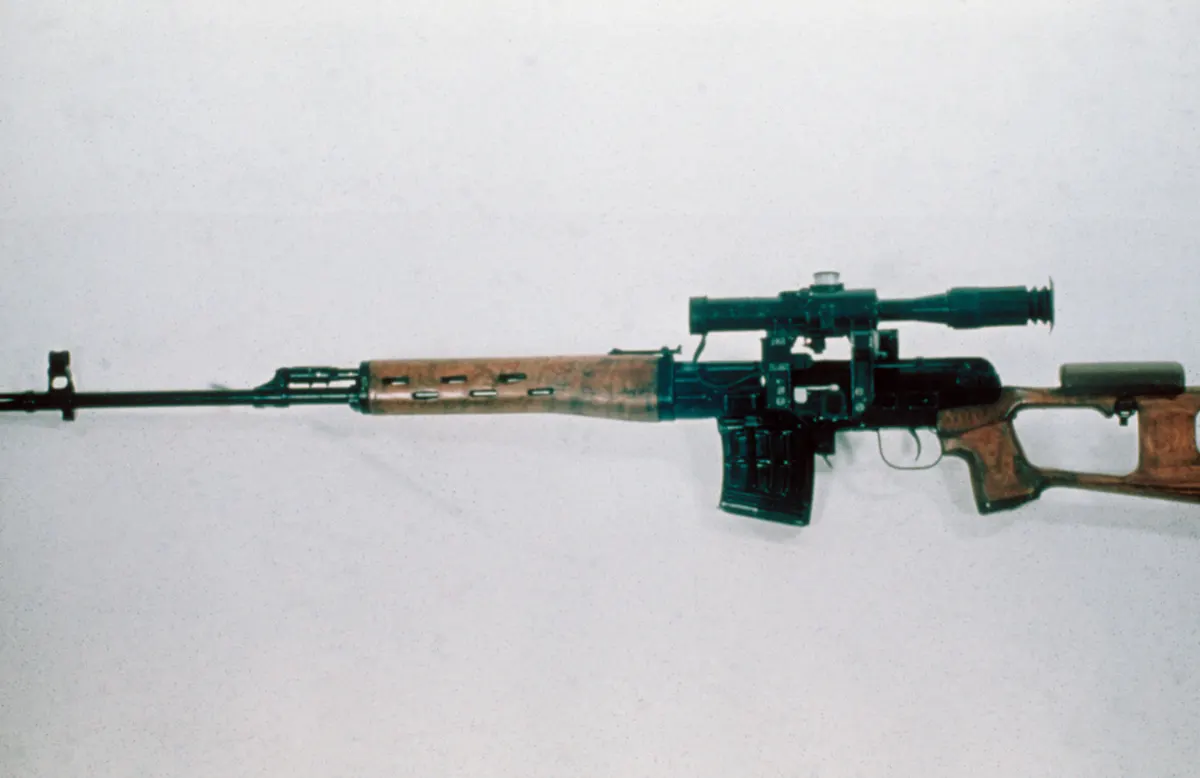
Reverse-engineering a precision rifle from a handful of captured examples, without the original production drawings, tooling specifications or Soviet metallurgical data, proved harder than Chinese planners expected. The earliest Type 79 Sniper Rifle production batches suffered from firing pins that broke under normal use, a direct consequence of getting the steel's heat treatment wrong rather than a design flaw copied from the Soviet original.1,3 China also never developed a dedicated sniper cartridge to go with the rifle. Standard-issue machine-gun ball ammunition was issued instead, which measurably hurt accuracy compared with the specially manufactured sniper-grade 7.62x54mmR ammunition the Soviet Union produced for its own SVD Dragunov rifles.1,3
Firing Pin Failures and the Path to the Type 85 Sniper Rifle
China corrected most of the Type 79 Sniper Rifle's early defects within a few years. Improved heat-treatment processes, tighter machining tolerances and a reinforced optical sight mount went into a refined rifle adopted in the early 1980s and eventually standardized as the Type 85 Sniper Rifle.1 The Type 85 Sniper Rifle kept the same basic layout, cartridge and operating system as the Type 79 Sniper Rifle, and the two are frequently confused with each other in reference works precisely because the external differences are so small.3,6 Some Chinese defense-industry summaries even credit the Type 85 Sniper Rifle with a shorter maximum effective range than the Type 79 Sniper Rifle, a genuinely counterintuitive claim for a supposedly improved design that has not been independently confirmed elsewhere.6
Norinco, the NDM-86 and a Brief Window of US Imports
Norinco, whose full name is China North Industries Corporation, marketed a commercial export version of the improved Chinese Dragunov clone in the United States under the name NDM-86 during the 1980s, imported by firms including Navy Arms and China Sports International.3 The NDM-86 kept the 7.62x54mmR chambering of the military Type 79 Sniper Rifle and Type 85 Sniper Rifle in one commercial variant, badged EM-351, while a second commercial variant, the EM-352, was rechambered to .308 Winchester for the American civilian ammunition market.1 Import-friendly changes were made for the US market too. The rifle's Soviet-style second sear, a feature United States regulators considered too close to a full-automatic trigger mechanism, was removed and replaced with a redundant disconnector for compliance reasons.3
That window did not stay open long. Rising American concern over so-called military-style imported rifles led the George H.W. Bush administration to enact sweeping import restrictions in 1989 targeting firearms with features like flash hiders and bayonet lugs, restrictions the Type 79 Sniper Rifle's own SVD-pattern design fell squarely within.1 Chinese firearm imports of every kind were later blocked outright by further legislation in the 1990s, permanently ending new supply and turning the roughly 500 NDM-86 rifles that had already reached the United States into a scarce collector's item.1
The 1979 Sino-Vietnamese War and the Long Border Standoff That Followed
The Type 79 Sniper Rifle owes its existence to the Sino-Vietnamese War, but the rifle's own combat record inside that specific month-long invasion is thin. China's reverse-engineering program only began once captured SVD Dragunov rifles reached state arsenals, meaning finished Type 79 Sniper Rifles most likely reached Chinese units only after the main 1979 fighting had already ended.1 What is better documented is that Chinese infantry fielded the newly reverse-engineered rifle, alongside the improved Type 85 Sniper Rifle once it appeared, during the sustained border skirmishing between China and Vietnam that continued through the 1980s as part of the wider Third Indochina War.7

Unlike the Soviet SVD Dragunov, which saw extensive documented combat use in Afghanistan and across multiple Middle Eastern and African conflicts, the Type 79 Sniper Rifle was never issued widely to regular Chinese infantry. Chinese planners kept it, and later the Type 85 Sniper Rifle, largely within special operations troops, border guard units and paramilitary police formations rather than distributing it army-wide the way the Soviet Union fielded its own SVD Dragunov.3,6 That narrower issuing pattern is a large part of why verified combat accounts specifically naming the Type 79 Sniper Rifle, rather than the broader family of Chinese-issued small arms, are hard to find in English-language sources.
NDM-86, EM-351 and EM-352, the Commercial Export Models
Beyond the base military Type 79 Sniper Rifle, Norinco produced three commercial variants aimed at export markets. The NDM-86 was the general commercial designation applied to the improved, export-cleaned-up Chinese Dragunov clone. The EM-351 kept the original 7.62x54mmR chambering, while the EM-352 was rechambered to .308 Winchester specifically for American buyers who could not easily source Russian-pattern ammunition.1,3 All three shared the Type 79 Sniper Rifle's forged receiver and gas system, differing mainly in cosmetic finish, English-language markings and a handful of BATFE-mandated internal changes to the trigger group.
Domestically, the Type 79 Sniper Rifle's real successor was the Type 85 Sniper Rifle, adopted in the early 1980s to fix the firing pin and metallurgy failures that plagued the original. China's military sniper rifle family moved on again decades later. The bullpup Type 88, chambered in a Chinese 5.8mm cartridge rather than 7.62x54mmR, represented a completely separate indigenous design rather than a Type 79 Sniper Rifle derivative, and the People's Liberation Army adopted a further modernized rifle, sometimes referred to as the CS/LR19 or NSG-85, in 2014 to finally replace the whole SVD-pattern lineup in frontline units.2 None of those later designs share parts with the original Type 79 Sniper Rifle, which by the 2010s had been relegated to reserve stocks, police inventories and a handful of overseas users.
The Chinese Dragunov clone shows up in Battlefield Bad Company 2, where the commercial NDM-86 variant of the Type 79 Sniper Rifle equips the Recon class with a stronger default scope than any other sniper rifle in the game, though the in-game labeling mistakenly calls it an SVD.8


China's People's Liberation Army and a Small Set of Overseas Users
China fielded the Type 79 Sniper Rifle from 1979 onward through the People's Republic of China's People's Liberation Army and, later, its paramilitary People's Armed Police, though frontline PLA units had largely moved on to the improved Type 85 Sniper Rifle and subsequent designs well before the 2010s.1,2 Outside China, confirmed users of the Type 79 Sniper Rifle specifically (as opposed to the more widely exported Type 85 Sniper Rifle) are harder to pin down in available sourcing. Bolivia is identified in reference material as a Type 79 Sniper Rifle operator, and Myanmar appears in at least one arms-trade directory as a customer, though the second claim rests on thinner sourcing than the first.2
Several other countries, including Bangladesh and the Philippines, are documented users of Chinese SVD-pattern sniper rifles, but the sourcing for those specifically ties them to the later Type 85 Sniper Rifle rather than the original Type 79 Sniper Rifle, so they are not listed here as confirmed Type 79 Sniper Rifle operators.2
Type 79 Sniper Rifle vs. the SVD Dragunov It Copied
The most useful comparison for the Type 79 Sniper Rifle is the SVD Dragunov it was reverse-engineered from, rather than any separate rival design. Both rifles share the same 7.62x54mmR cartridge, the same 620mm barrel, the same gas-operated action and, on paper, nearly identical weight and dimensions. What actually separated them in service was manufacturing quality rather than any deliberate Chinese redesign. Where the Soviet Union built the SVD Dragunov to tight tolerances with purpose-made sniper-grade ammunition, early Type 79 Sniper Rifle production shipped with fragile firing pins and ordinary machine-gun ball, a gap in execution rather than in blueprint.1,3
That gap narrowed once China fixed those problems in the follow-on Type 85 Sniper Rifle, but the underlying question that keeps coming up whenever someone asks whether the Type 79 Sniper Rifle is still worth using today is really a question about which specific production batch is being discussed, since quality varied more across Chinese production runs than it ever did across Soviet ones. In price terms, the comparison flips entirely. A functioning original SVD Dragunov is relatively easy to find, while a genuine imported NDM-86 export version of the Type 79 Sniper Rifle now commands collector prices of 5,000 to 10,000 US dollars in the United States precisely because so few ever got in before the 1989 import restrictions closed that door.1


Is the Type 79 Sniper Rifle still in service? Frontline Chinese forces moved to the improved Type 85 Sniper Rifle in the 1980s and later to newer designs, while the base Type 79 Sniper Rifle and its Type 85 Sniper Rifle derivative reportedly remain in limited use with police, paramilitary and a small number of overseas militaries.2,6
What caliber does the Type 79 Sniper Rifle use? The Type 79 Sniper Rifle is chambered in 7.62x54mmR, the same rimmed cartridge used by the Soviet SVD Dragunov and the PK series of machine guns, fed from a 10-round detachable box magazine.2
How is the Type 79 Sniper Rifle different from the SVD Dragunov? The two are built to nearly the same specifications, but the Type 79 Sniper Rifle used Chinese state-arsenal production with looser tolerances, an older Soviet-pattern barrel twist rate, and no dedicated sniper ammunition, all of which hurt its practical accuracy compared with the Soviet original.1,2
Was the Type 79 Sniper Rifle ever exported to the United States? Yes, as the commercial NDM-86, imported in small numbers (roughly 500 rifles) during the 1980s before the 1989 Bush administration import restrictions and later 1990s legislation blocked further Chinese firearm imports.1,3
What replaced the Type 79 Sniper Rifle in Chinese service? The Type 85 Sniper Rifle replaced it directly in the early 1980s, and China's military moved on again decades later to newer designs including the bullpup Type 88 and a modernized rifle adopted around 2014.2
- "Norinco NDM-86, A Historical Analysis of the Dragunov Clone", Ronin's Grips — blog.roninsgrips.com ↩
- "SVD (rifle)", Wikipedia — en.wikipedia.org) ↩
- "NDM-86, The Chinese Dragon Of Dragunovs", Recoil Magazine — recoilweb.com ↩
- Norinco company profile, military-archive database entry ↩
- "NORINCO Type 79 (SVD) Semi-Automatic Sniper Rifle", Military Factory — militaryfactory.com ↩
- "Type 79/85, 7.62mm Sniper Rifle", Chinese Defence Today — purefixion.com ↩
- "Chinese Sniper Rifles, A Brief Introduction", The National Interest — nationalinterest.org ↩
- "Battlefield: Bad Company 2", Internet Movie Firearms Database — imfdb.org ↩