


A gas-piston operated rifle taps propellant gas from a fired cartridge and routes it into a separate cylinder, where it drives a piston that pushes the bolt carrier rearward to cycle the action. This is one of two dominant ways to build a gas-operated rifle. The rival approach, direct gas impingement, skips the piston entirely and vents propellant gas through a tube straight into the bolt carrier itself, using the gas pressure directly as the driving force. The AR-15 and M16 family popularized direct impingement, and it remains the default layout across most rifles descended from Eugene Stoner's original design.5 A rifle without a piston has nothing to interrupt that gas flow before it reaches the bolt carrier group, so every firing cycle deposits carbon fouling and heat onto the surfaces that must move freely for the next round.
Piston-driven rifles trade a little extra weight and a more complex parts list for keeping that same gas, and the fouling and heat it carries, away from the bolt carrier and receiver walls. The piston absorbs the combustion byproducts inside its own cylinder while the bolt carrier only receives a mechanical push. That distinction became the central argument European small arms makers used when designing new battle rifles and designated marksman rifles after the Cold War, and it still shapes how a given military weighs a piston gun against a direct impingement gun for a specific climate or duty cycle.
01Origins in the Cei-Rigotti and the Mondragón Rifle
Patent filings for gas-driven rifle actions predate any working piston gun by decades. Edward Lindner patented a gas-operated action for single-shot rifles in the United States in 1856, and William Curtis filed the first patent for a gas-operated repeating rifle in 1866, though neither reached production.11 Hiram Maxim, better known for the recoil-operated machine gun that carries his name, filed several competing gas-operation patents between 1883 and 1885, describing a piston tapping muzzle gas to cycle the action, again without a fielded weapon following.11 Those patents established the basic gas-piston principle, a cylinder, a piston, and a mechanical link back to the bolt, on paper roughly forty years before Cei-Rigotti built a working rifle around it.
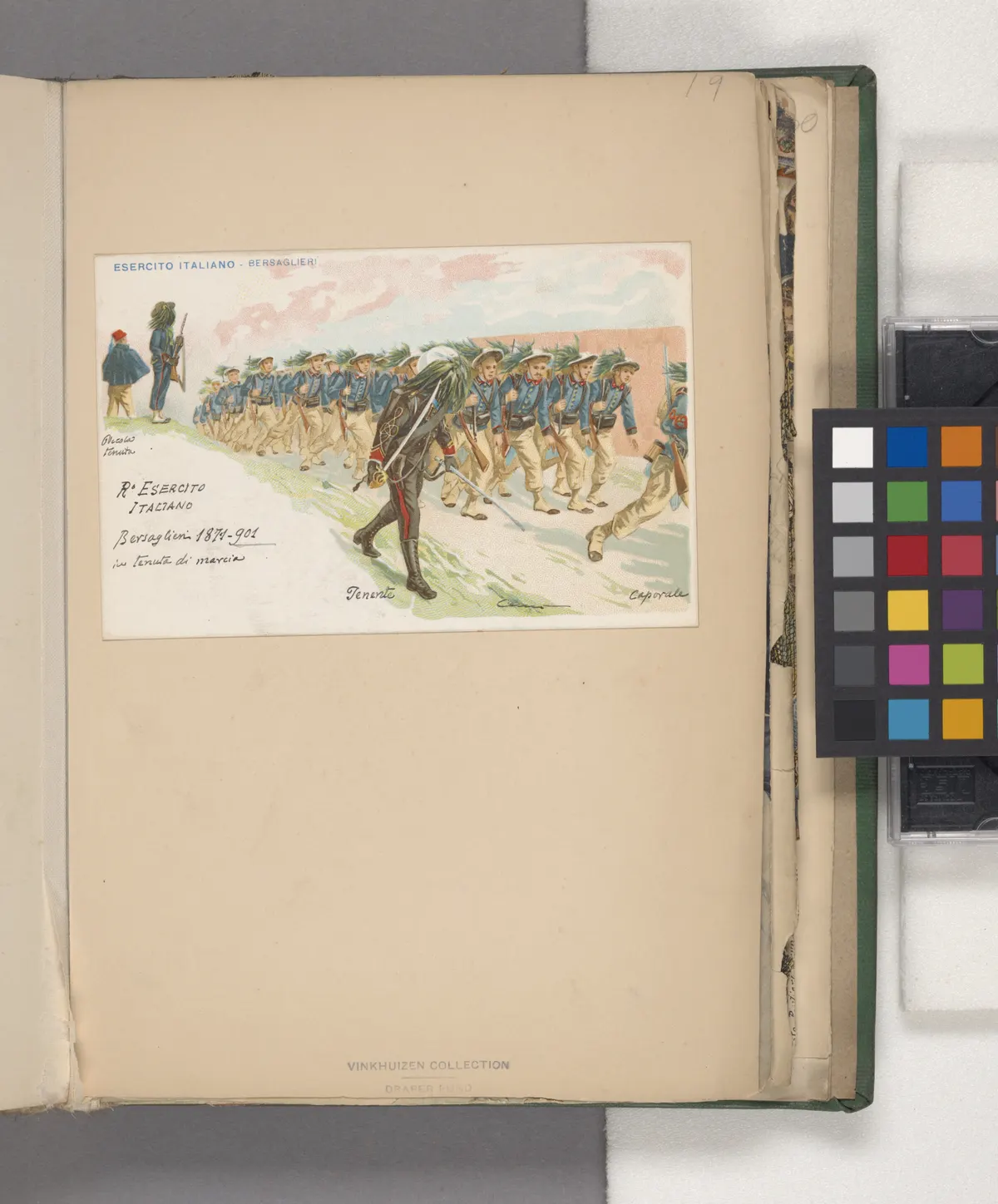
The earliest gas-piston rifles predate the assault rifle era by half a century. Amerigo Cei-Rigotti, an officer in the Italian Bersaglieri, built a select-fire, piston-driven self-loader around 1900. Gas tapped near the muzzle drove a piston running alongside the barrel, unlocking a rotating bolt through a spiral cut in the bolt body.1 The Cei-Rigotti never reached production in Italy, but it proved a piston-and-rotating-bolt layout could work years before any government fielded a comparable weapon.
That formal adoption went to Mexico. General Manuel Mondragón patented a long-stroke gas-piston rifle in 1887 and refined it into the Modelo 1908, which Mexico's army adopted, making it the first gas-operated rifle formally issued by a national military.2
Belgium's own piston tradition arrived decades later. Fabrique Nationale built the FN Model 1949 around a short-stroke piston with its own dedicated return spring, adopted across armies from Belgium to Argentina before it gave way to the FAL.3 FN Herstal carried that same short-stroke approach forward into nearly every rifle it built afterward.
01Short-Stroke and Long-Stroke Piston Layouts
Piston rifles split into two further mechanical families. A long-stroke piston rides on the same rod as the bolt carrier through the entire cycle, so the piston and bolt carrier move as one heavy assembly from the instant of firing until the bolt locks again. Both the Cei-Rigotti and the Mondragón rifle used this long-stroke layout, and so does the Kalashnikov family it influenced. The SIG AK53, an AK-pattern rifle built under license in Switzerland, kept that same long-stroke arrangement decades later.4 John Garand reached the same long-stroke conclusion independently while designing the M1 Garand for the United States Army in the 1930s, running a gas piston on a rod beneath the barrel to cycle the rifle that became America's standard infantry rifle through the Second World War.12 Israel Weapon Industries carried the same long-stroke principle into the IWI Tavor bullpup, which the Israeli military adopted in 2009 to replace the M16 and M4, proof the layout still had a place decades after most Western militaries had settled on Stoner's direct impingement pattern.13

A short-stroke piston works differently. It delivers one brief shove to the bolt carrier early in the cycle, then stops and returns forward on its own spring, while the bolt carrier coasts the rest of the way on its own momentum.4 The shorter piston travel keeps the reciprocating mass smaller, which softens the felt recoil impulse and lets engineers package the whole gas system as a self-contained module bolted above the barrel rather than running the length of it. Fabrique Nationale used exactly this short-stroke layout on the FN Model 1949, giving its own dedicated return spring to a piston that only needed to travel a few centimeters before disengaging.3

Short-stroke conversions kept appearing outside Fabrique Nationale long after 1949. Steyr Arms reached a similar solution in Austria with the Steyr AUG, adopted by the Bundesheer in 1977 with its short-stroke piston built directly into the same bullpup receiver as the trigger group and magazine well.14 Nearly four decades later, Česká zbrojovka Uherský Brod applied the identical short-stroke principle to the CZ 806 BREN 2, the current-issue service rifle of the Czech Republic.15
Short-stroke systems are not without a cost. Because the operating rod strikes the bolt carrier off axis instead of pushing it in a straight line the way a full-length piston does, the bolt carrier can rock slightly inside the receiver, a behavior gunsmiths call carrier tilt.4 Long-stroke systems avoid that problem because the piston stays attached to the carrier for the full stroke and keeps it aligned, at the cost of a heavier, slower-cycling action.
That off-axis strike carries its own name beyond carrier tilt. Gunsmiths call the impact itself piston slap, the abrupt push delivered the instant a short-stroke piston reaches the end of its brief travel and drives the operating rod into the carrier's gas key area in one sharp blow, rather than the smoother, sustained pressure a direct impingement gas tube applies along the carrier's own centerline.16 The two effects compound each other in service. Carrier tilt lets the carrier tip fractionally inside the receiver as it absorbs that blow, wearing a shallow gouge into the aluminum receiver wall or buffer tube over thousands of rounds, while piston slap changes the felt recoil impulse enough that shooters moving from a direct impingement upper to a piston-driven one often describe the piston gun as sharper-recoiling at an identical caliber and barrel length.17,18 Manufacturers who design a rifle as a piston gun from its first prototype, rather than converting an existing direct impingement receiver afterward, size the carrier's rails and the receiver extension specifically to absorb that off-axis load, which is one reason the FN SCAR-H shows less of this wear pattern over a long service life than a piston conversion kit bolted onto a receiver originally drawn for direct impingement.18
Neither layout is exclusive to select-fire weapons. Many piston designs, including the Cei-Rigotti and later civilian and service rifles built on the same principle, ran the identical gas-piston cycle without a selector switch, which is why the mechanism appears across the semi-automatic rifle category as often as it does in fully automatic arms.
01Erik Eklund's Ljungman and the Rifle It Inspired at ArmaLite
Direct impingement is not a modern shortcut invented alongside the AR-15. Swedish engineer Erik Eklund, working for AB C.J. Ljungmans Verkstäder, designed the Ag m/42 rifle around a plain gas tube that vented propellant gas straight onto the bolt carrier's face, using the expanding gas itself as the piston with no separate cylinder or moving parts to service.19 Sweden adopted Eklund's rifle in 1942, loosely following the rotating-bolt mechanics of the Soviet SVT-40 while discarding its piston entirely, and fielded it as the first production rifle built around direct gas impingement, four decades after Amerigo Cei-Rigotti and Manuel Mondragón had already proven the rival piston approach could work.19
Eugene Stoner drew on that same open-tube principle when he engineered the AR-10 for ArmaLite in the mid-1950s. He combined the Ag m/42's direct gas system with a lightweight aluminum receiver and a rotating multi-lug bolt adapted from designer Melvin Johnson's earlier service rifle, then filed his own patent on the layout in August 1956.20 Colt's later 5.56mm derivative of Stoner's design became the M16 and eventually the M4 carbine. That decision by Stoner, more than the already-proven piston layout, explains why direct impingement became the default across the Colt AR-15 pattern and every rifle built on it since.20
02Why FN, Heckler & Koch and ArmaLite Chose Pistons Over Direct Impingement
By the 2000s the argument had shifted onto modern battle rifles and designated marksman rifles built to replace older service arms. FN Herstal engineered the FN SCAR-H around a short-stroke piston specifically so that combustion gas, carbon and heat stayed out of the bolt carrier group, arguing the rifle would run cooler and cleaner through sustained fire than a direct impingement design.6 Heckler & Koch, based in Germany, reached the same conclusion independently when it built the HK417 as a successor to the G3, adapting a short-stroke piston from its earlier G36 to keep carbon and heat away from the bolt and extend the interval between stoppages.7
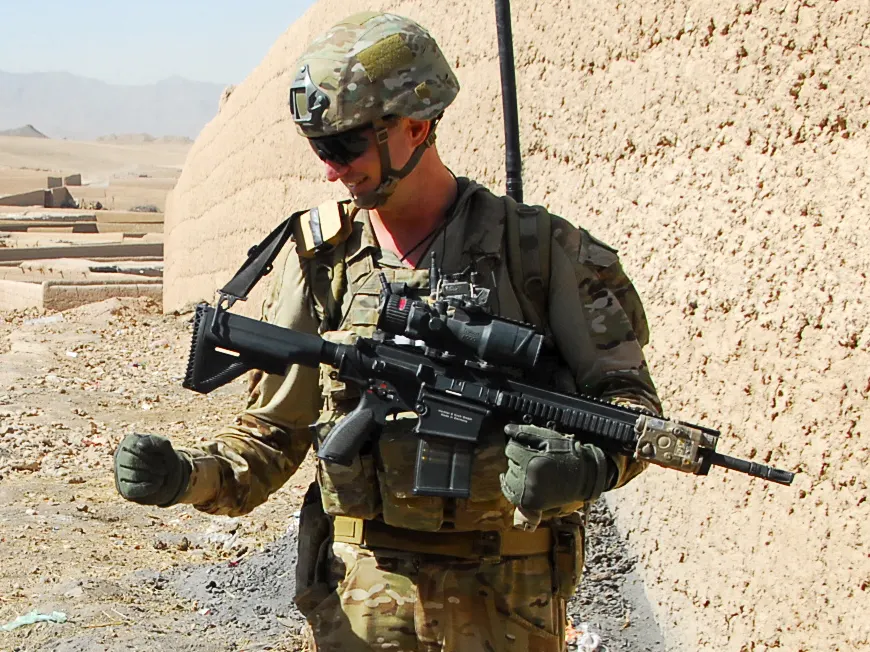
Turkey's state arms industry followed the identical reasoning with the MPT-76, designed as Turkey's successor to the G3 with a short-stroke piston suited to sub-zero winters and dusty terrain, where carbon buildup on an unshielded bolt carrier drives stoppages.8 Sako, in Finland, took the piston conversion further with the Sako M23. Built on the same AR-10 and AR-15 architecture that made direct impingement famous, the M23 replaces Stoner's gas tube with a self-regulating short-stroke piston for its designated marksman rifle variant, adopted by the Finnish Defence Forces from 2022.10
Even inside the company that built the direct impingement AR-15 in the United States, engineers explored the opposite choice. ArmaLite's own AR-16 used a short-stroke piston loosely inspired by the Soviet Tokarev SVT-40, built to sidestep Eugene Stoner's direct impingement patents after Colt licensed the AR-15.9 The AR-16 never reached production in numbers, but its short-stroke system fed directly into the later AR-18, built once patents, not physics, forced ArmaLite's choice.
01The US Army's Own Return to the Piston with the M7
The direct impingement legacy Stoner built into the AR-15 held for the United States military for six decades, through the M16 and the M4 carbine and every service rifle variant descended from Stoner's original patent. The Next Generation Squad Weapon program that replaced the M4 as the US Army's standard infantry rifle broke with that legacy directly. SIG Sauer's M7 rifle, developed from the company's MCX Spear design and fielded from March 2024, runs a short-stroke gas piston chambered for the 6.8x51mm Common Cartridge, the same mechanical layout FN Herstal, Heckler & Koch and Turkey's state arms industry had already adopted for their own G3 successors decades earlier.21 The US Army's reasoning echoed those manufacturers almost exactly. A short-stroke piston keeps combustion gas and carbon out of the bolt carrier group, which matters more once a rifle fires a higher-pressure cartridge than the 5.56mm NATO round the M16 and M4 were built around, and matters again when a suppressor is attached routinely, a use case that pushes extra gas and heat back toward the receiver every time a direct impingement rifle fires.21

The result reverses the exact argument that made direct impingement attractive to Stoner in 1956. Where the Ag m/42 and the AR-10 skipped the piston to save weight and simplify the parts list, the M7's designers accepted the piston's extra weight and complexity as the cost of running a hotter cartridge reliably, the identical tradeoff FN Herstal, Heckler & Koch and Sako had already made for their own designated marksman rifles and battle rifles built after the Cold War.
The switch has drawn real criticism inside the Army itself. Soldiers testing the M7 in early fielding reported it running heavier and delivering sharper felt recoil than the M4 it replaced, with one infantry officer publicly calling the rifle unfit for use as a modern service rifle over its weight, recoil and reduced 20-round magazine capacity compared to the M4's 30.22 The complaint traces back to the same tradeoff documented in civilian AR-pattern piston conversions, more reciprocating mass and a sharper piston slap impulse, now carried into a service rifle firing a more powerful cartridge than the M16 or M4 ever chambered. The US Army's own procurement decision mirrors the tradeoff every piston manufacturer from Fabrique Nationale to Sako has accepted since the FN Model 1949, more weight and moving parts in exchange for a bolt carrier that runs cooler and cleaner through sustained fire.
01Notes and Sources
- "Italian Cei-Rigotti Self-loading Rifle", Forgotten Weapons — forgottenweapons.com ↩
- "1887 CE: The Mondragón rifle, a Mexican battle rifle", History Atlas — historyatlas.com ↩
- "I Have This Old Gun: FN Model 1949", American Rifleman — americanrifleman.org ↩
- "Short-Stroke vs Long-Stroke Gas Systems Explained", Redacted Arms — redactedarmsllc.com ↩
- "Direct Impingement vs. Gas Piston: Settling the Debate", Silencer Central — silencercentral.com ↩
- "Why the FN SCAR", FN America — fnamerica.com ↩
- "Heckler & Koch HK417", Wikipedia — en.wikipedia.org ↩
- "MKEK MPT-76", Modern Firearms — modernfirearms.net ↩
- "AR-16: ArmaLite's Lost Battle Rifle", Forgotten Weapons — forgottenweapons.com ↩
- "Sako M23", Wikipedia — en.wikipedia.org ↩
- "Gas-operated reloading", Wikipedia — en.wikipedia.org ↩
- "M1 Garand", Wikipedia — en.wikipedia.org ↩
- "IWI Tavor", Wikipedia — en.wikipedia.org ↩
- "Steyr AUG", Wikipedia — en.wikipedia.org ↩
- "CZ-806 BREN-2 assault rifle", Modern Firearms — modernfirearms.net ↩
- "Gas Vs. Piston", GUNS Magazine — gunsmagazine.com ↩
- "AR Operating Systems: Gas Impingement vs. Piston", American Rifleman — americanrifleman.org ↩
- "AR-15: Direct Impingement Vs Gas Piston", Gun Digest — gundigest.com ↩
- "Automatgevär m/42", Wikipedia — en.wikipedia.org ↩
- "AR-10 Origin Story", The Armory Life — thearmorylife.com ↩
- "SIG Sauer NGSW-R M7 assault rifle (USA)", Modern Firearms — modernfirearms.net ↩
- "Army infantry officer calls new XM7 'unfit for use as a modern service rifle'", Task & Purpose — taskandpurpose.com ↩


