

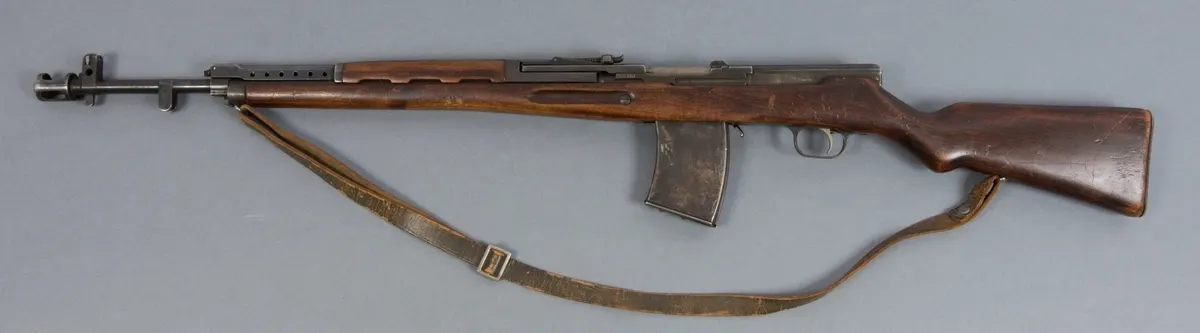

The AVS-36 is a Soviet select-fire automatic rifle designed by Sergei Simonov that beat a rival submission from Fedor Tokarev in a 1935 service-rifle trial, only to lose a rematch against the same designer three years later.1,2 Formally the Avtomaticheskaya Vintovka Simonova (Simonov's automatic rifle), it entered Red Army service in 1936 as one of the first select-fire infantry rifles any army adopted for general issue, chambered for the standard 7.62x54mmR rifle cartridge and firing from a 15-round detachable magazine.1 It belongs to the same broad class of self-loading and select-fire battle rifles, a category the Soviet Union entered earlier than most of its contemporaries.
- among the first select-fire rifles adopted by any army for general service
- lighter and mechanically simpler than the rifle that replaced it
- bayonet-lug monopod helped steady automatic fire
- direct design ancestor of lessons carried into the PTRS-41 and SKS
- vertically sliding locking block was fragile and never reused by its own designer
- severe dirt and dust sensitivity in field conditions
- muzzle brake reduced recoil geometrically but the rifle stayed close to uncontrollable on full-auto
- lost the 1938 rematch to Tokarev after firing-pin breakages in testing
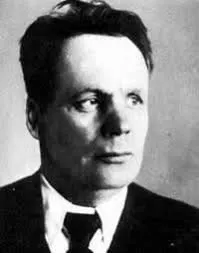
Sergei Gavrilovich Simonov began work on a gas-operated self-loading rifle in 1930, drawing on experience gained a decade earlier as an assistant on Vladimir Fyodorov's pioneering Fyodorov Avtomat program at the Kovrov arms plant.3,4 The first AVS prototype was ready in 1931 and showed enough promise to carry Simonov through several more years of development before the design faced Tokarev's rifle head-on in the 1935 trial.4,2 The rifle made its public debut at the May Day parade in Moscow in 1938, carried by marching soldiers of the 1st Rifle Division, by which point its field reputation among troops was already souring.1
The Vertically Sliding Locking Block Simonov Never Used Again
The AVS-36 is gas-operated, using a short-stroke gas piston mounted above the barrel with its own return spring.5 Where it departs from most contemporary rifles is in how the bolt locks. A vertically sliding locking block sits in the receiver between the magazine and the breech face, an unusual arrangement Simonov designed for this rifle alone and abandoned for every design that followed.5,6 The mechanism forced a long, heavy receiver and bolt assembly, and the bolt group also carried a complicated anti-bounce device that added parts and cost without a corresponding gain in reliability.5
- İlk Üretim Yılı1936
- Hizmete Giriş Yılı1936
- TasarımcıSergei Simonov
- Ağırlık (Boş)4,3 kg
- Önemli KullanıcılarSovyetler Birliği, Finlandiya, Nazi Almanyası, İspanyol Cumhuriyeti, Suriye Sosyal Milliyetçi Partisi
The rifle loads from a 15-round detachable box magazine and ejects spent cases upward out of the top of the receiver, an unusual choice that had a direct downside for the sniper variant. Its PE 4x scope had to be offset to the left of the receiver rather than mounted centrally, since a top-mounted scope would have sat directly in the path of ejecting brass.1,5 Iron sights were graduated to an optimistic 1,500 meters, well beyond any realistic point-target range for the cartridge.1
- Fişek7.62x54mmR
- Çap7,62 mm
- Kovan Uzunluğu54 mm
- Çap SınıfıTam güçlü
- Mermi Ağırlığı9,6 g

A large, visually distinctive muzzle brake dominates the front of the barrel, but Forgotten Weapons' assessment of an original example is blunt that it was not all that effective.5 The brake reduced recoil geometrically, yet the intense recoil impulse and violent report still made the rifle punishing and loud to fire, and cycling at roughly 800 rounds per minute in full-auto it remained basically uncontrollable off-hand.5 Soviet designers built a tacit admission of that problem into the rifle itself. The bayonet lug doubled as a folding monopod, usable horizontally or dropped down vertically to give the shooter a forward rest during automatic fire.5
- Mekanizma TipiGazlı
- Atış Modlarıyarı ve tam otomatik
- Seçmeli AtışEvet
- Besleme SistemiÇıkarılabilir Şarjör
- Şarjör Kapasitesi15
- Teorik Atış Hızı800
The cartridge feed path from magazine into chamber was long and steep, a geometry Modern Firearms identifies as the direct cause of numerous stoppages in service.5 A later United States Ordnance evaluation, conducted in the 1950s on captured and Lend-Lease-adjacent examples, found a separate longevity flaw. The gas-system sleeve riding around the rear sight base had a habit of loosening the rear sight over time, degrading accuracy independent of the dirt-sensitivity problems reported from the field.1
- Namlu Çıkış Hızı840 m/sn
- Namlu Enerjisi3.387
- Etkili Menzil (nokta)600 m
- Nişan Menzili1.500 m
- Namlu Uzunluğu612 mm
- Açık NişangahEvet
- Süngü TakozuEvet
- Bombaatar KabiliyetliEvet
- Gaz PistonluEvet
- Toplam Üretim65.800
- Üretim Başlangıcı1936
- Üretim Bitişi1940
Simonov Beats Tokarev, 1935
In 1935 a Soviet service-rifle competition pitted Simonov's design directly against a submission from designer Fedor Tokarev.1,2 Simonov won, and his rifle entered service the following year as the AVS-36, Model of 1936.1 It stood among the first select-fire (semi and full automatic) infantry rifles formally adopted by any army for general issue, a genuine technical milestone that the rifle's subsequent field record did not live up to.1,2
Small pilot batches were built during the trial and pre-adoption period, only 106 rifles in 1934 and 286 in 1935, before series production ramped up after formal 1936 adoption.1 Once fielded, the rifle's problems surfaced quickly. Wikipedia and War History Online independently describe the same pattern in nearly identical terms. The operating mechanism was overcomplicated, and the design's construction let dirt get inside the action easily, so that seemingly small amounts of dust would stop the gun from firing until it was field stripped and cleaned.1,2 The AVS-36 was also unusually particular about ammunition quality, and inconsistent Soviet wartime-production 7.62x54mmR ammunition made the stoppage problem worse.1
The 1938 Rematch and the Firing-Pin Breakages That Ended It
Despite winning the first trial, the AVS-36's field problems by 1938 prompted a second competition, this time a three-way contest between an improved AVS variant from Simonov, a new rifle from Tokarev, and a submission from designer Rukavishnikov.2 Tokarev won, and his design was adopted as the SVT-38.2
Simonov's rifle was lighter than Tokarev's and used fewer parts, yet Tokarev's design was judged sturdier where it mattered most. Testing exposed firing-pin breakages in Simonov's improved AVS submission, a durability failure against an otherwise more elegant design.2 The AVS-36's accumulated bad reputation from two years of troop-level stoppages almost certainly weighed on the judges as much as the specific trial results. Forgotten Weapons notes that political intrigue may also have shaped the outcome, and a stronger, more specifically attributed version of that claim holds that Stalin personally favored Tokarev's submission because of a good personal relationship with the designer, a claim worth treating as attributed rather than settled fact given its thinner sourcing than the technical trial record.5,1
The rifle that replaced the AVS-36 was deliberately built semi-automatic only, a direct engineering lesson drawn from the AVS-36's uncontrollable full-auto fire.5 Select fire returned to Tokarev's rifle family only later in the war with the AVT-40, a full-auto-capable variant of the refined SVT-40, and that later rifle inherited some of the same muzzle-climb and control criticism that had doomed the AVS-36 in the first place, a rivalry that effectively spans Simonov's original design and its eventual successor's own successor.5
Legacy, the Mechanism Simonov Never Repeated
Simonov abandoned the vertically sliding locking block entirely after the AVS-36, switching to simpler tilting-bolt mechanisms for every design that followed.3,6 That later work included the PTRS-41 anti-tank rifle in 1941 and, most consequentially, the SKS carbine adopted in 1949, one of the most widely produced rifles of the twentieth century.3,6 The mechanical lesson it taught its own designer is arguably the AVS-36's most important legacy, more lasting than the rifle itself.
Combat Debut at Khalkhin Gol, 1939
The AVS-36 saw its combat debut during the Battles of Khalkhin Gol, the 1939 border fighting between Soviet and Japanese forces on the Mongolian frontier, ahead of its far better documented service in the Winter War that followed the same year.1,2 Small-arms-level detail on the rifle's specific performance at Khalkhin Gol is thin in available sources beyond the fact of its presence there, a genuine research gap rather than an omission.
Dirt, Frozen Grease, and the Winter War
The Winter War against Finland (1939-1940) is the AVS-36's best documented combat record, and it is not a flattering one. Many rifles reportedly went into combat still coated in thick Soviet storage grease that had never been cleaned off, and in sub-zero temperatures that grease froze solid inside the action, rendering affected rifles inoperable before dirt sensitivity even entered into it.1,2 It was a maintenance and logistics failure layered directly on top of the rifle's inherent design fragility.
Finnish forces captured hundreds of AVS-36s during the Winter War and into the early Continuation War, and some captured rifles were issued to Finnish troops. The type never became popular there either. Finland's own 1940 Sako evaluation found the rifle pleasant to shoot with good inherent accuracy, but flagged thin barrels prone to overheating and an exposed recoil spring vulnerable to contamination, a separate dirt-ingress weakness from the action itself.7 Finnish forces experienced the same jamming and control problems Soviet troops did, and by the Continuation War, unreliability and a shortage of spare parts were judged serious enough that the rifles were gathered from troops and warehoused for repairs that never came. Most were scrapped around 1943-44.7 Finland's capture haul illustrates just how much smaller AVS-36 production was than its successor's. Finnish forces took roughly 20,000 captured SVT rifles against only hundreds of AVS-36s.7
Eastern Front Phase-Out and German Capture
By the German invasion of the Soviet Union in June 1941, the AVS-36 was already being phased out in favor of the SVT-38 and SVT-40, and it was largely withdrawn from service during 1941 itself.1 It had not fully vanished, however. Photographic evidence shows isolated examples still in Soviet hands as late as 1944.1 Nazi Germany captured AVS-36 rifles as part of the general seizure of Soviet small arms during and after Operation Barbarossa and catalogued them for potential second-line or police issue.8,9
A Korean War Capture and a Lebanese Militia's Arsenal
The AVS-36's afterlife extended far beyond the Soviet Union's own use of it. A small number of pre-war-vintage rifles turned up in Communist hands during the Korean War (1950-1953), captured and examined by United Nations forces as documented in contemporary American press coverage.1,10 Far more striking is the rifle's documented presence decades later in Lebanon. During the Lebanese Civil War (1975-1990), the Syrian Social Nationalist Party fielded roughly 60 AVS-36 rifles as part of an otherwise antiquated militia arsenal, presumably acquired through arms-market leakage from older Warsaw Pact or Middle Eastern surplus channels rather than any direct Soviet transfer.1 A rifle designed in the early 1930s and retired from Soviet front-line service by 1941 was still arming a Lebanese militia forty years after Moscow moved on.
A separate, more weakly sourced claim holds that a small batch of AVS-36s reportedly reached Republican forces during the Spanish Civil War (1936-1939) for field trials, an assertion made by Spanish historians Lucas Molina and José María Manrique García but not confirmed in Russian-language primary sources.5 That use should be treated as reported rather than settled.
The standard infantry pattern is the gas-operated, select-fire rifle described above, fed from a 15-round detachable magazine. A dedicated sniper variant fitted a PE 4x telescopic sight offset to the left of the receiver, the direct consequence of the rifle's top ejection pattern discussed above.1,5 No other major production variant is documented. Simonov's follow-on designs, the PTRS-41 and the SKS, are properly understood as separate weapons built around a different locking mechanism rather than AVS-36 derivatives, even though they share the same designer and the same lesson learned from this rifle's failure.3,6


The Soviet Union was the AVS-36's primary operator from 1936 adoption until effective retirement during 1941, with production estimates diverging between roughly 33,000 to 34,500 rifles by most accounts and a higher figure of 65,800 sourced to D.N. Bolotin's history of Soviet small arms, which has production trailing into 1940.1 The itemized year-by-year figures available (106 in 1934, 286 in 1935, 10,280 in 1937, and 24,401 in 1938) already sum to over 35,000 without counting 1936 or 1939 output, which is consistent with either estimate depending on how much additional production those two unreported years actually carried.1
Finland operated captured examples from the Winter War through the early Continuation War before withdrawing and largely scrapping them by 1943-44. Nazi Germany captured and catalogued stocks from 1941 onward for potential second-line issue. Small numbers reached Communist forces in the Korean War, and the Syrian Social Nationalist Party fielded roughly 60 examples during the Lebanese Civil War. A reported, unconfirmed batch may have reached Republican Spain during the Spanish Civil War.
The AVS-36's defining rivalry comes down to a procurement decision more than a design difference. Both it and the SVT-38 that replaced it were built by the same two competing designers, Simonov and Tokarev, chasing the same requirement in successive Soviet trials three years apart. The AVS-36 won the first round on a design that was lighter and used fewer parts. The SVT-38 won the second on durability, after Simonov's revised entry suffered firing-pin breakages that the judges could not overlook given the AVS-36's already troubled field record.2
The practical difference between the two rifles matters as much as the trial result. The SVT-38, and its refined 1940 revision the SVT-40, was deliberately built semi-automatic only, a direct response to how uncontrollable the AVS-36 had proven in full-auto fire.5 Select fire only returned to Tokarev's rifles later in the war with the AVT-40, which inherited some of the same muzzle-climb complaints that had originally doomed the AVS-36, closing a loop between Simonov's 1936 design and Tokarev's own attempt at the same select-fire concept years afterward.
| Spec | AVS-36 | SVT-40 |
|---|---|---|
| Adopted | 1936 | 1940 (as SVT-38 in 1938) |
| Fire modes | Select-fire | Semi-automatic (AVT-40 variant select-fire) |
| Magazine | 15-round detachable | 10-round detachable |
| Cyclic rate | ~800 rds/min | N/A (semi-auto) |
| Locking method | Vertically sliding block | Tilting bolt |
Against the earlier Fyodorov Avtomat that Simonov had helped build two decades earlier as a young Kovrov engineer, the AVS-36 represents a generational jump in intent rather than a direct successor relationship. The Avtomat solved a wartime ammunition-supply problem with a foreign cartridge. The AVS-36 was a purpose-built domestic select-fire rifle around the Soviet Union's own standard round, aimed at fully replacing the bolt-action Mosin-Nagant rather than merely supplementing it. Both rifles nonetheless share the same fundamental weakness that ended their frontline careers, an uncontrollable or logistically unsustainable automatic-fire capability that Soviet designers only solved properly with the semi-automatic SVT line and, later, genuine intermediate-cartridge assault rifles.


What replaced the AVS-36? The SVT-38, and its refined 1940 revision the SVT-40, replaced the AVS-36 after winning a 1938 Soviet trial against an improved AVS variant and a separate submission from designer Rukavishnikov. A 17 July 1939 Defense Committee decision formally directed production toward the SVT-38.1,2
Is the AVS-36 still in service anywhere? No. Soviet forces withdrew it from front-line use during 1941, and no state operator has fielded it since. Its last confirmed users were non-state actors, a Lebanese militia carrying roughly 60 examples decades after Soviet retirement.1
How many AVS-36 rifles were produced? Estimates diverge. Most sources converge on roughly 33,000 to 34,500 rifles by the time production effectively ended around mid-1939, while a higher figure of 65,800, sourced to D.N. Bolotin's history of Soviet small arms and reflected in some infobox summaries, has output continuing into 1940.1
Why was the AVS-36's automatic fire considered uncontrollable? Cycling at roughly 800 rounds per minute in a 4.3-kilogram rifle chambered for a full-power 7.62x54mmR cartridge produced heavy recoil impulses that its large muzzle brake reduced only geometrically, not in felt effect, and Soviet designers added a folding monopod off the bayonet lug specifically to help shooters control it.5
How does the AVS-36 compare to the SVT-40? The AVS-36 offered select fire the SVT-40 lacked, but at the cost of reliability and control that the SVT line's designers deliberately traded away for a simpler, semi-automatic-only action once the AVS-36's field record made the tradeoff obvious.5
- "AVS-36", Wikipedia — en.wikipedia.org ↩
- "AVS-36: The Worst Rifle Ever Developed By the Soviet Union", War History Online — warhistoryonline.com ↩
- "Sergei Simonov", Wikipedia — en.wikipedia.org) ↩
- "Russian AVS-36 Rifle", Forgotten Weapons — forgottenweapons.com ↩
- "Simonov AVS-36", Forgotten Weapons — forgottenweapons.com ↩
- "Simonov AVS-36", Modern Firearms — modernfirearms.net ↩
- "Finnish Army 1918-1945: Rifles Part 4", Jaegerplatoon.net — jaegerplatoon.net ↩
- "German captured weapons designations", Gunboards forum — gunboards.com ↩
- "Simonow AWS-36", Wikipedia (German) — de.wikipedia.org ↩
- "List of Korean War weapons", Wikipedia — en.wikipedia.org ↩