

The Farquhar-Hill rifle was one of the earliest semi-automatic rifles developed anywhere for military service, patented in Britain in 1908, and it still never issued to a single front-line infantry battalion. Colonel Moubray Gore Farquhar and gunsmith Arthur Henry Hill spent a decade reworking the design before the War Office finally gave it an official service designation, Rifle .303 inch, Pattern 1918, in August 1918.1 An order for 100,000 rifles followed almost immediately, and then the entire program collapsed within a year once the war it was built to fight had already ended.1,2
- high-capacity 19 to 65-round drum magazine, unmatched by any rifle of its generation
- genuinely gentle recoil and consistent ejection reported by period testers
- multi-spring gas system tolerant of variable ammunition quality
- direct design influence on the Lewis Gun's pan magazine
- a decade of prototypes before reaching an acceptable, reliable configuration
- heavier and mechanically more complex than the bolt-action rifles it would have replaced
- production cancelled in 1919 before a single service rifle reached a unit
- drum magazine required a fiddly feed-lip switch to load correctly
Chambered for the .303 British cartridge, the Farquhar-Hill rifle fed from a distinctive rotary drum magazine rather than a conventional box, with production-pattern guns using a 19-round drum and trial examples tested with drums holding up to 65 rounds.2,3 That magazine, patented separately by Farquhar and Hill in 1915, is widely credited as a direct design influence on the pan magazine later fitted to the Lewis Gun, one of the war's most important light machine guns.2 A small number of Farquhar-Hill rifles saw genuine field use with the Royal Flying Corps, whose observers valued a self-loading weapon in the cramped rear seat of a two-man aircraft, but the rifle never reached mass production, and surviving documentation of its trials remains genuinely thinner than for better-recorded semi-automatic rifles of the same era.4
The rifle's history is really a story of two different mechanisms wearing the same name. Farquhar and Hill's original 1908 patent used a long-recoil action with a rotary-locking bolt, and by 1911 they had reworked the design into a gas-operated system with a stationary barrel, the configuration that carried through to the 1918 military pattern.1,3
Farquhar-Hill rifle specifications, how the Farquhar-Hill rifle's gas system worked, and why the Farquhar-Hill rifle was never adopted despite an official 1918 order are all questions that come up repeatedly among collectors and WWI small-arms researchers. The honest answer to most of them is that the design simply arrived too late and too complicated for a war that was already ending.
From Long Recoil to Gas Operation, Two Mechanisms Under One Name
The Farquhar-Hill rifle that Colonel Farquhar and Arthur Hill first tested in May 1908 used long-recoil operation, in which the barrel and bolt recoiled together fully to the rear before the bolt cycled independently.1 That early gun failed repeatedly in testing.2 By 1911 the pair had redesigned it around a gas-operated system instead, tapping propellant gas to drive a piston rearward against an intermediate spring while the barrel itself stayed fixed in place, a layout closer to later 20th-century semi-automatic rifles than to their own first attempt.1,3
- İlk Üretim Yılı1908
- TasarımcıMoubray Gore Farquhar and Arthur Henry Hill
- Ağırlık (Boş)6,6 kg
- Halen HizmetteHayır
The long-recoil label describes only the abandoned 1908 to 1911 prototype, while the gas-operated system is the configuration that every published specification sheet, trial report, and surviving museum example associates with the actual Pattern 1918 rifle Britain nearly adopted. Both mechanisms genuinely carried the Farquhar-Hill name at different points, which is why sources describing the weapon sometimes disagree on a single label for its action type.
- Fişek.303 British
- Çap7,7 mm
- Mermi Ağırlığı11,3 g
Both versions relied on an unusual multi-spring layout, a mainspring and a separate piston spring working through a pair of latches so that recoil energy stored during one shot released smoothly to cycle the next.3 Testers who fired surviving examples in later decades described the recoil as surprisingly gentle and the ejection pattern as unusually consistent, dropping spent cases into a tight area rather than scattering them, a trait firearms researchers generally treat as a sign of sound mechanical design regardless of a weapon's service history.2
- Mekanizma TipiGazlı
- Seçmeli AtışHayır
- Besleme SistemiTambur
- Şarjör Kapasitesi5
- Tambur / Şerit Kapasitesi19
The Drum Magazine and Its Documented Influence on the Lewis Gun
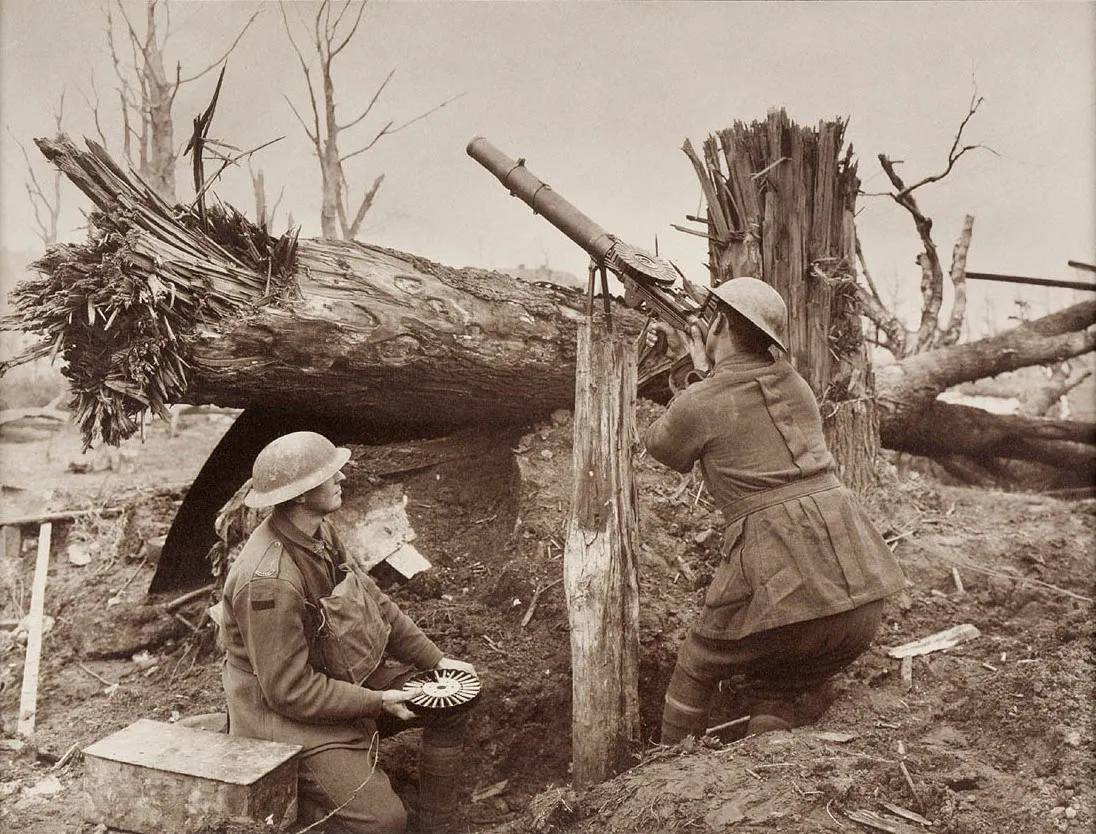
Farquhar and Hill filed a British patent titled A New or Improved Cartridge Magazine for Small Arms and Machine Guns in 1915, covering the rotary drum magazine fitted to their rifle, and the patent was formally accepted in 1919.2 The production Pattern 1918 rifle used a 19-round drum, while trial variants were tested with drums holding as many as 65 rounds, a striking capacity for an infantry rifle of any era, let alone one designed before the First World War began.3 Loading the drum required repeatedly working a small feed-lip switch as each round went in, a fiddly step that period accounts single out as one of the design's real practical drawbacks.2
- Namlu Çıkış Hızı732 m/sn
- Nişan Menzili1.372 m
The rotary-magazine principle behind the Farquhar-Hill drum is widely cited as a direct influence on the top-mounted pan magazine of the Lewis Gun, Britain's standard light machine gun of the war.2 The two mechanisms differ in one technical respect (a true pan magazine stores cartridges pointed inward toward the center rather than parallel to the axis of rotation, the way a drum does). Farquhar and Hill's patented rotary feed is still well documented as the direct conceptual source for the light machine gun that ultimately outfitted far more British soldiers than their own rifle ever did.2
- Nişangah Tipiladder iron sights
- Açık NişangahEvet
Ballistically, the Farquhar-Hill rifle fired the standard .303 British round at a muzzle velocity of roughly 732 meters per second (2,400 feet per second), with a rear ladder iron sight graduated out to about 1,370 meters, in line with contemporary British service-rifle sighting practice.1,3 The rifle weighed 6.6 kilograms unloaded, notably heavier than the bolt-action Lee-Enfield it would have supplemented rather than replaced outright, and mounted a bayonet lug beneath the barrel for a standard knife-type bayonet.3 Published sources disagree on the rifle's precise overall length, with figures ranging from roughly 1.04 to 1.25 meters depending on the source and exact configuration measured, a discrepancy worth flagging honestly rather than picking one number and presenting it as settled.1,3
- Kabza/Dipçik Malzemesiwood
- Süngü TakozuEvet
- Gaz PistonluEvet
- Üretim Bitişi1919
A Decade of Trials Before a War Ended Them
Farquhar and Hill patented their original long-recoil rifle in the United Kingdom in 1908 and in the United States the following year, and the first test that May exposed enough faults that the Small Arms Committee never approved that version for service.1,2 The two men kept refining the design through the early 1910s, arriving at the gas-operated layout by 1911, and continued submitting improved prototypes for trial through the middle years of the First World War.1

From around 1916 onward, a limited number of Farquhar-Hill rifles reached observers and gunners in the Royal Flying Corps, who valued a self-loading weapon they could fire quickly from a cramped, exposed rear cockpit seat before dedicated aircraft machine guns became standard.2 Troop trials on the Western Front followed, and by 1917 and 1918 the design had improved enough that the War Office judged it fit for wider issue.1
In June 1918, the National Rifle Factory No. 1 (formerly Standard Small Arms) was ordered to begin preparing component manufacture for the Pattern 1918 rifle, with Standard Small Arms separately tasked to produce barrels.5 Neither production line ever started. Both plans were abandoned in October 1918, weeks before the Armistice, and the full order for 100,000 rifles was cancelled outright in 1919 once it was clear no wartime need remained.1,5
The Farquhar-Hill rifle's real obscurity has not stopped it from turning up in period-accurate WWI video games, where its 19-round drum magazine and comparatively fast semi-automatic fire rate stand out against the bolt-action rifles that made up most of a WWI infantryman's actual loadout. Battlefield 1's Turning Tides expansion gives the rifle to the Medic class specifically, trading on that drum-magazine capacity advantage over the bolt-action rifles most other classes carry.10
After the Rifle, the Beardmore-Farquhar Machine Gun
Farquhar carried the rifle's multi-spring operating principle forward into a new project during the 1920s and early 1930s, developing it into the Beardmore-Farquhar light machine gun, manufactured by William Beardmore and Company and fed from a top-mounted 77-round drum rather than the rifle's 19-round version.6 The British Army tested the Beardmore-Farquhar repeatedly over more than a decade, with the last recorded trial in 1931, and ultimately rejected it, adopting the Czech-derived Bren gun instead later in the decade.6
Britain would not field a standard self-loading service rifle at all until 1957, when the L1A1 finally entered service, nearly four decades after the Farquhar-Hill Pattern 1918 order fell through.4 That gap is a useful measure of just how far ahead of its time Farquhar and Hill's original 1908 concept genuinely was, even though the specific rifle they built never got the reliable, mass-producible form the idea eventually needed.
Limited Field Use in the First World War
The Farquhar-Hill rifle's combat history amounts to a narrow slice of the First World War rather than any sustained front-line service. Aside from Royal Flying Corps observers and a small number of troop trials at the Western Front, no British infantry unit ever carried the rifle as its standard weapon, because the Pattern 1918 order was cancelled before delivery could begin.1,2 That puts the Farquhar-Hill rifle in a genuinely different category from other contemporary self-loading rifle attempts, France's Meunier rifle reached roughly 1,000 units produced and 843 actually issued to front-line troops for raiding by 1916, a real, if small, combat deployment that the Farquhar-Hill rifle never matched.7
The rifle's actual wartime footprint is best understood as a research and trials program that ran the length of the war rather than a fielded weapon, useful mainly as a case study in how close a genuinely promising self-loading rifle design could come to adoption and still fail to arrive in time.
The Long-Recoil Prototype and the Gas-Operated Production Pattern
The two major Farquhar-Hill rifle variants correspond to the design's own history, the original 1908 to 1911 long-recoil prototype with rotary bolt locking, and the gas-operated redesign that carried through to the definitive Rifle .303 inch, Pattern 1918.1,3 A civilian sporting variant fed from a conventional 5-round internal magazine rather than the drum, and separate trial rifles were built and tested with oversized 65-round drums alongside the standard 19-round production magazine.3
Surviving examples of the Farquhar-Hill rifle are held today by the Royal Armouries and the Imperial War Museums in the United Kingdom, both institutions that preserve firearms tied to Britain's WWI-era small-arms trials rather than weapons that ever saw standard issue.8,9 The Royal Armouries collection includes both an experimental example from around 1914 and a definitive Pattern 1918 pattern rifle, illustrating the design's decade-long path from an unreliable prototype to a nearly-adopted service rifle.8,9

The United Kingdom is the only confirmed operator of the Farquhar-Hill rifle, and even that use was limited to Royal Flying Corps observers, Western Front trial units, and the small number of prototype and pre-production examples built for testing between 1916 and 1918.1,2 No production-pattern Rifle .303 inch Pattern 1918 rifles were ever formally issued to a standing British Army unit, since the 100,000-rifle contract was cancelled before manufacturing began.1,5
The Farquhar-Hill Rifle and the Meunier Rifle, Two Self-Loading Rifles That Arrived Too Late
Britain's Farquhar-Hill rifle and France's Meunier rifle grew out of strikingly similar prewar ambitions, both were long-recoil, rotary-bolt self-loading rifle programs started well before 1914, and both were still unfinished, unreliable designs when the First World War actually began.1,7 The two programs diverged sharply once the war forced a choice between finishing a promising design and simply arming troops with what already worked. France pushed roughly 1,000 Meunier rifles into limited production by 1916 and issued 843 of them to front-line units for trench raiding, accepting real reliability and overheating problems in exchange for at least some combat feedback.7 Britain, by contrast, kept refining the Farquhar-Hill rifle through gas-operation, drum-magazine redesigns, and repeated trials without ever committing to limited field production, and only received an approved Pattern 1918 designation in the war's final months, too late for any meaningful production run.1
| Spec | Farquhar-Hill Rifle | Meunier Rifle |
|---|---|---|
| Action | Gas-operated (Pattern 1918), long-recoil (1908 prototype) | Long-recoil, rotating bolt |
| Cartridge | .303 British | 7mm Meunier |
| Magazine | 19-round drum (65-round trial) | Fixed internal box |
| Units issued to front-line troops | 0 (order cancelled 1919) | Approximately 843 (1916) |
Both rifles ultimately failed to establish self-loading infantry rifles as a mainstream weapon for their respective armies in the First World War, and both nations returned to bolt-action rifles as their primary infantry arm for another two decades. The real difference between them is that the Meunier rifle's troubled but real combat issue in 1916 gives France's program a documented field record, while the Farquhar-Hill rifle's story is almost entirely one of trials, patents, and a cancelled 1918 contract, illustrating just how close a rifle could get to full adoption and still never reach a soldier's hands in numbers.


What action does the Farquhar-Hill rifle use? The definitive Pattern 1918 Farquhar-Hill rifle used a gas-operated action with a stationary barrel, adopted in 1911 to replace the original 1908 long-recoil prototype, which recoiled the barrel and bolt together before cycling.1,3
Was the Farquhar-Hill rifle ever adopted by the British Army? The War Office assigned it the official designation Rifle .303 inch, Pattern 1918 and ordered 100,000 units in August 1918, but the order was cancelled in 1919 before any production rifles were delivered, so it was approved on paper without ever entering formal service.1
How many rounds does the Farquhar-Hill rifle's drum magazine hold? The standard Pattern 1918 magazine held 19 rounds, while separate trial drums tested during development held as many as 65 rounds, an unusually high capacity for a rifle of its period.3
Why was the Farquhar-Hill rifle never mass produced? The rifle took a decade to reach a reliable configuration, and by the time the War Office approved it for production in 1918, the war it was designed for was ending. Both production lines assigned to build it were abandoned in October 1918, weeks before the Armistice.1,5
Is the Farquhar-Hill rifle still in service anywhere today? No. It never reached standard service in the first place, and surviving examples today exist only as museum pieces and private collector's items, chiefly at the Royal Armouries and the Imperial War Museums.8,9
- "Farquhar–Hill rifle", Wikipedia — en.wikipedia.org ↩
- "Farquhar-Hill Rifle", Forgotten Weapons — forgottenweapons.com ↩
- "Farquhar-Hill", Modern Firearms — modernfirearms.net ↩
- "Farquhar-Hill self-loading rifle, Pattern 1918", Royal Armouries Collections — collections.royalarmouries.org ↩
- "National Rifle Factories", Graces Guide — gracesguide.co.uk ↩
- "Beardmore-Farquhar machine gun", Forgotten Weapons — forgottenweapons.com ↩
- "French A6 Meunier M1916", Forgotten Weapons — forgottenweapons.com ↩
- "Experimental Farquhar Hill, about 1914", Royal Armouries Collections — royalarmouries.org ↩
- "Farquhar-Hill", Imperial War Museums — iwm.org.uk ↩
- "Farquhar-Hill", Battlefield Wiki — battlefield.fandom.com ↩