


Sweden fielded almost no self-loading rifles before December 1941, when the army's board of examiners chose a design from a Malmö company that had never built a firearm before. That design became the Automatgevär m/42, commonly called the Ag m/42 or the Ljungman rifle, and it went on to earn a place in firearms history that has little to do with Sweden itself. Chambered for the 6.5x55mm Swedish service cartridge, the Automatgevär m/42 was one of the earliest semi-automatic rifles to reach mass production using a direct gas impingement system, tapping propellant gas straight onto the bolt carrier through a tube instead of driving a separate piston. That single mechanical choice is the reason the rifle still gets discussed today, because the same operating principle later reappeared, independently, in the French MAS-49 rifle, and was licensed wholesale to Egypt as the basis for the Hakim Rifle.
- mechanically simple, few moving parts
- direct gas impingement, no separate piston to fit or lose
- tilting-bolt lockup shared with later, more famous rifles
- light for a full-power battle rifle at under 4.8 kg
- interchangeable rear-sight cams for two different loads
- gas tube prone to rusting in early production rifles
- fixed gas port, no way to tune for different ammunition
- 10-round magazine, modest by later standards
- never issued widely enough to fully replace the bolt-action Mauser
The designer was Erik Eklund, an engineer at AB C.J. Ljungmans Verkstäder, a firm in Sweden that until then had built pumps and fuel dispensers, not weapons. His prototype beat a rival Finnish submission in trials and was adopted as the Automatgevär m/42 on 5 December 1941, with production starting the following year at the state-owned Carl Gustafs Stads Gevärsfaktori in Eskilstuna. Roughly 30,000 examples were built. The rifle never replaced Sweden's bolt-action m/96 Mauser as the standard infantry weapon, it supplemented squad firepower instead, and it stayed in reserve and Home Guard hands well into the Cold War before the Ak 4, a licensed Heckler and Koch G3, took over front-line service in the mid-1960s.
Anyone searching for Automatgevär m/42 specifications, or asking how the Ljungman rifle's gas system works, is usually trying to place it next to the two rifles it is genuinely connected to. This article covers the m/42's design, its adoption story, its thin combat record, its variants, and how it compares to the MAS-49 and the Hakim, the two designs that carried its mechanism forward.
The Direct Gas Impingement System That Predates the AR-15
The core of the Automatgevär m/42's design is a length of tubing running above the barrel. Propellant gas bleeds off through a port, travels down that tube, and strikes a cup on the front of the bolt carrier directly, driving it rearward to cycle the action. There is no piston rod and no separate operating slide, which is what makes it a gas-operated rifle of the impingement type rather than a gas-piston-operated one like the contemporary Soviet SKS or the later AK-pattern rifles. Fewer moving parts meant a simpler, lighter action, which was exactly what Eklund had prioritized when the Swedish army asked for a semi-automatic rifle in the late 1930s.2
- İlk Üretim Yılı1942
- Hizmete Giriş Yılı1942
- TasarımcıErik Eklund
- Ağırlık (Boş)4,71 kg
- Halen HizmetteEvet
- Önemli Kullanıcılarİsveç Ordusu, Norveç polis birlikleri, UNFICYP, Resmi İrlanda Cumhuriyet Ordusu
The classification is not entirely uncontested among collectors. Eklund's own 1945 United States patent describes the gas tube assembly using the language of a rigid piston cooperating with the end portion of the lock piece, which some firearms historians read as evidence the Ag m/42 is closer to a very short-stroke piston design than to pure impingement. In practice the tube carries no separate piston part that detaches from the bolt carrier, so most modern references still classify it alongside the MAS-49 and the M16 as a direct impingement design. The disagreement is worth noting, it shows the direct gas impingement label was contested from the very patent that first described it.2
- Fişek6.5×55mm
- Çap6,5 mm
- Kovan Uzunluğu55 mm
- Çap Sınıfı6.5mm
- Kenar AteşlemeliHayır
- Kovansız MühimmatHayır
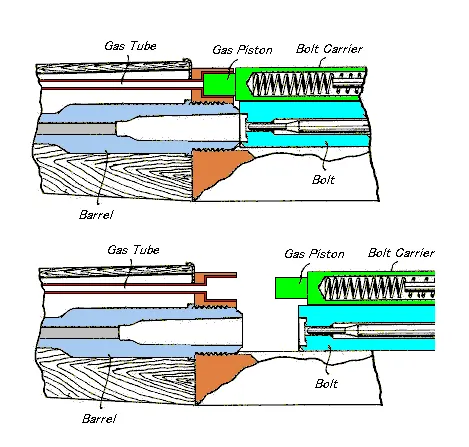
Locking is handled by a tilting bolt, the rear of the bolt body drops into a recess milled into the receiver floor, the same basic principle later used by the Soviet SVT rifles, the MAS-49 rifle, and the FN FAL. Eklund had studied captured Soviet SVT-38 rifles taken during the Winter War of 1939 to 1940, and the Automatgevär m/42's layout loosely follows SVT mechanics, though the gas system itself is a genuinely different, simpler solution.3 The rifle feeds from a 10-round detachable box magazine, normally reloaded from the top with two 5-round stripper clips rather than by swapping magazines in the field, a compromise typical of self-loading rifles designed before detachable magazines were trusted as the primary feed method.
- Mekanizma TipiGazlı
- Atış Modlarıyarı otomatik
- Seçmeli AtışHayır
- Besleme SistemiÇıkarılabilir Şarjör
- Şarjör Kapasitesi10
- Pratik Atış Hızı40
A 6.5x55mm Cartridge Shared With the Rifle It Was Meant to Replace
The Automatgevär m/42 fires the same 6.5x55mm cartridge as the bolt-action m/96 Mauser it was meant to eventually supersede, which simplified Swedish army logistics considerably since both rifles could draw from the same ammunition stocks. The rear sight carries interchangeable elevation cams, one calibrated for the older m/94 round-nose load out to 600 meters, the other for the flatter-shooting m/41 spitzer load out to 800 meters, letting the same rifle be re-zeroed for whichever ammunition a unit was issued.1 Barrel length runs 622mm, overall length is roughly 1,214mm, and an empty rifle weighs 4.71 kg, light for a full-power semi-automatic battle rifle of its era and noticeably lighter than the SVT-40 or the M1 Garand.
- Etkili Menzil (nokta)600 m
- Etkili Menzil (alan)800 m
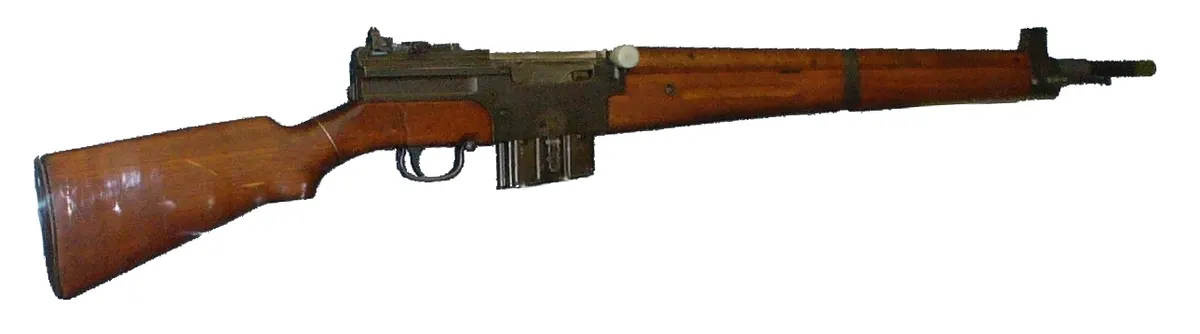
That gas-tube-to-bolt-carrier layout is the detail that gives the Automatgevär m/42 its lasting reputation, because the MAS-49 rifle, adopted by France in 1949, ended up mechanically very close to it. French engineers at Manufacture d'Armes de Saint-Etienne had actually been experimenting with direct impingement gas systems since 1901, long before Eklund's rifle existed, so the resemblance is convergent design rather than direct copying, two engineering teams solving the same problem the same way roughly forty years apart.4 The Automatgevär m/42's own fixed, non-adjustable gas port was a known weak point, since it could not be tuned for different ammunition or fouling conditions, unlike some later gas-operated designs.
- Namlu Uzunluğu622 mm
- Nişangah TipiBDC kamlı ayarlanabilir arka gez
- Optik RayıHayır
- Açık NişangahEvet
- Dişli NamluHayır
Ag m/42B, the Fix for a Rifle That Rusted From the Inside
Early production Automatgevär m/42 rifles suffered a genuine reliability problem, their gas tubes rusted internally, sometimes badly enough to affect cycling. Between 1953 and 1956 the Swedish army reworked existing stocks into the Ag m/42B standard, fitting a stainless-steel gas tube, adding two gripping knobs to the breech cover, revising the manual safety after reports of hand injuries from the original design, and adding a rubber case deflector and a new elevation knob for the rear sight.1 Norwegian-issued rifles, handed over in 1945 before the B-standard existed, were never retrofitted and remained in original configuration.
- Toplam Uzunluk1.214 mm
- Katlanır / Toplanır DipçikHayır
- Bullpup DüzeniHayır
- Çift Yönlü KumandalarHayır
- Susturucuya HazırHayır
- Süngü TakozuEvet
- Entegre BipodHayır
- Bombaatar KabiliyetliHayır
- Gaz PistonluHayır
- Toplam Üretim30.000
- Üretim Başlangıcı1942
- Varyantlar1
From a Pump Manufacturer's Workshop to the Swedish Army
Sweden's search for a self-loading rifle began in 1938, when early attempts to convert existing bolt-action Mauser rifles to semi-automatic fire failed to satisfy the army. A formal trial followed, pitting a Finnish Pelo design against a submission from Erik Eklund, an engineer at AB C.J. Ljungmans Verkstäder of Malmö, a company whose actual business was hydraulic pumps and fuel-station dispensers rather than firearms.2 Eklund had examined captured Soviet SVT-38 rifles taken during the 1939 to 1940 Winter War, and his design borrowed the tilting-bolt principle while replacing the SVT's more complex gas system with his own simpler direct impingement tube. The board of examiners picked Eklund's rifle in August 1941 because it was lighter and used fewer parts than the alternative, and it was formally adopted as the Automatgevär m/42 on 5 December 1941.1
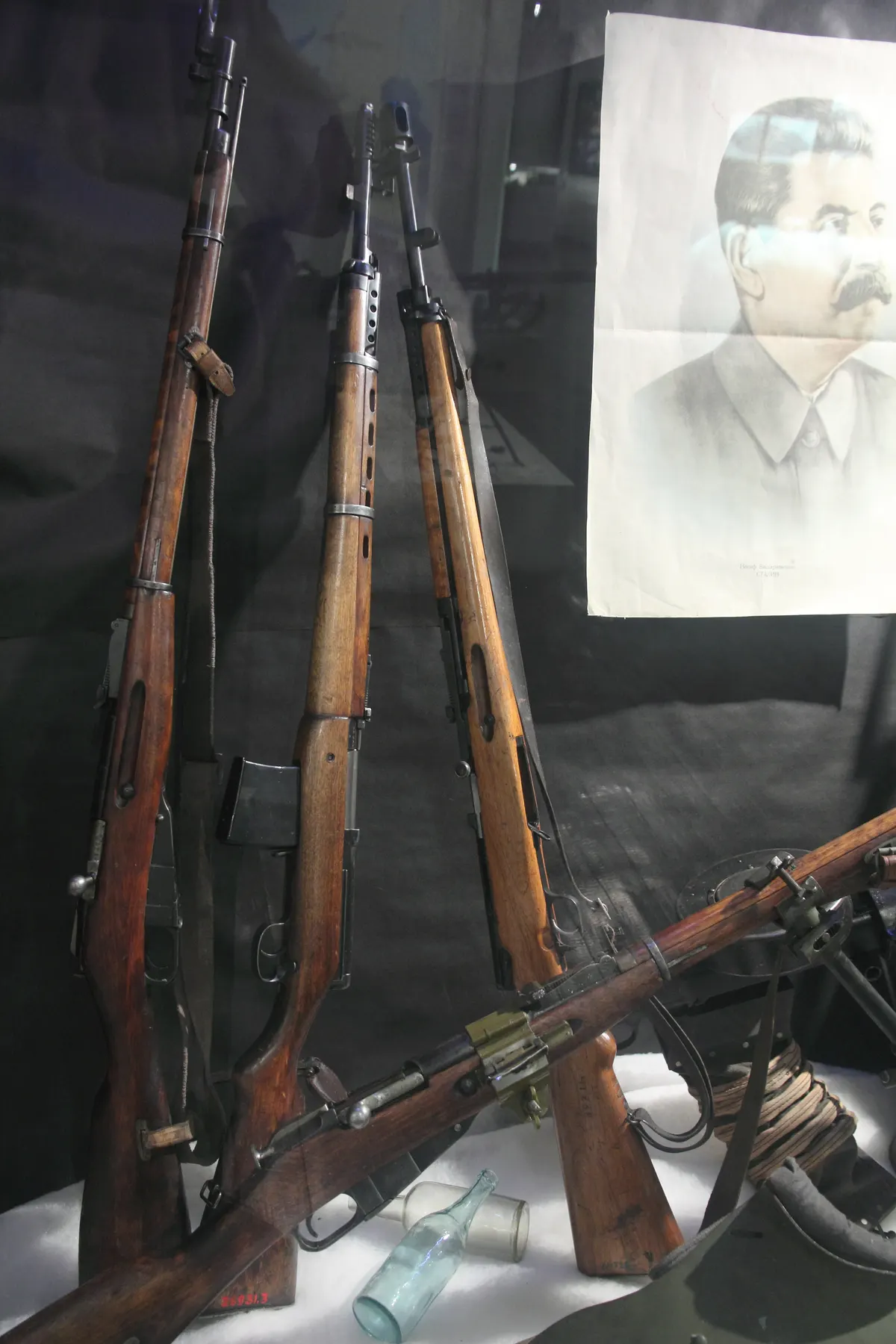
Production began in 1942 at the government-owned Carl Gustafs Stads Gevärsfaktori in Eskilstuna, with rifles reaching army units from 1944 onward. Around 30,000 Automatgevär m/42 rifles were built in total, a modest run for a weapon meant to eventually replace the bolt-action m/96 Mauser across the whole Swedish army. That replacement never fully happened. Instead the m/42 supplemented existing bolt-action rifles within infantry squads, and it earned an early reputation for a genuine flaw, rusting inside the gas tube that could interfere with cycling in humid or poorly maintained rifles, a problem the army did not fully address until the Ag m/42B modernization of 1953 to 1956.1
Neutral Sweden, the Home Guard, and a Handover to Norway
Sweden stayed formally neutral through the Second World War, and the Automatgevär m/42 never saw the wartime combat that shaped the reputations of contemporaries like the American M1 Garand or the Soviet SVT-40. Its role instead was to reinforce a national defense posture built around deterrence and rapid mobilization, issued to regular army units and, later, the Hemvärnet Home Guard reserve. A curious wartime footnote involves neighboring Norway, where police troops, in reality Norwegian resistance personnel trained clandestinely in Sweden during the German occupation, were issued Automatgevär m/42 rifles and carried them across the border when German forces surrendered in May 1945.1 Those Norwegian-issued rifles were never modernized to Ag m/42B specification and remain identifiable today by their original, corrosion-prone gas tubes.
By the mid-1960s the Automatgevär m/42B was being phased out of first-line Swedish service in favor of the Ak 4, a license-built derivative of the West German Heckler and Koch G3 battle rifle chambered for 7.62x51mm NATO.5 The Ag m/42B lingered longer in Hemvärnet stocks than in the regular army, and surplus rifles eventually found their way onto the international collector market, where original, unmodified examples now command noticeably higher prices than the more common B-standard rework. A used Ljungman rifle today typically sells in the $2,000 to $3,250 range depending on condition and configuration, a market that collector demand has pushed steadily upward over the past several years.6
The Automatgevär m/42 has an unusually thin combat record for a weapon its age, a direct consequence of Sweden's wartime neutrality and Cold War non-alignment. It was never issued in numbers large enough, or to forces engaged in large-scale fighting, to accumulate the kind of battlefield history that shaped the M1 Garand or the SVT-40. Its most documented deployment abroad came through UNFICYP, the United Nations peacekeeping force on Cyprus, where Swedish contingents carried the Automatgevär m/42 as their service rifle during rotations that began in 1964.1
Some sources also list the Official wing of the Irish Republican Army among the rifle's users, though the documentation behind that claim is thin compared to the well-recorded arms shipments, largely M1 carbines, Armalite rifles, and later Libyan-supplied AK-pattern weapons, that dominate published accounts of Irish paramilitary arsenals. Where the record is this sparse, it should be treated as unconfirmed rather than repeated as settled fact. The stronger, better-documented combat history attached to this mechanism belongs to Egypt's Hakim Rifle, the direct licensed derivative covered in Variants below, which fought in both the 1956 Suez Crisis and the 1967 Six-Day War under Egyptian colors.7
Ag m/42B is the definitive Swedish rework, applied to existing rifles between 1953 and 1956 to fix the rusting gas tube and several ergonomic complaints, described in Specs and Design above. A far more specialized variant, the Inskjutningsgevär 5110, rechambered a small number of Automatgevär m/42 actions to 7.62mm NATO for use as a ranging or spotting rifle paired with the Swedish Pansarvärnspjäs recoilless anti-tank gun, letting a gunner fire a cheaper spotting round before committing an expensive anti-tank round to a target.1
The most significant variant by far was never issued to Sweden at all. In late 1952, shortly after the Egyptian revolution, Egypt approached Sweden about acquiring the Automatgevär m/42's design and production tooling outright. Carl Gustafs helped establish a new arms plant, Factory 54, at Maadi south of Cairo, training roughly forty Egyptian engineers in Sweden during 1953 before the line began producing what Egypt designated the Hakim Rifle.8 The Hakim kept the Automatgevär m/42's direct gas impingement mechanism and tilting bolt almost unchanged but rechambered it for the heavier 7.92x57mm Mauser cartridge already standard in Egyptian service, and Egyptian engineers added a manually adjustable gas regulator valve, a refinement the original Swedish design never received, to compensate for ammunition and fouling variation.9 Roughly 70,000 Hakim rifles were built, more than double the entire Swedish production run of the parent design, and a shortened, intermediate-cartridge derivative, the Rasheed Carbine, followed from the same factory.


| Yıl | Alıcı | Adet | Tutar | Bugünkü Değer (2025) |
|---|---|---|---|---|
| 1952 |  Mısır | — | — | — |
Sweden was the only nation to operate the Automatgevär m/42 as a standard-issue service rifle, from its December 1941 adoption through frontline use into the 1960s and continued Hemvärnet reserve use for years afterward. Norway received a smaller number of original-specification rifles in 1945, issued to resistance-trained police troops rather than through any formal export contract, and those rifles stayed in Norwegian hands after the war rather than returning to Swedish stocks.1 Reports of Official Irish Republican Army use exist but rest on thin sourcing rather than confirmed documentation, and are noted here for completeness rather than certainty.
Egypt never operated the Automatgevär m/42 itself, it operated the Hakim Rifle instead, the 7.92x57mm derivative built on the same tooling, listed separately here given its different chambering, gas regulator, and dedicated production run.
The Automatgevär m/42 and the MAS-49 rifle reached the same direct gas impingement solution from opposite directions. Eklund built his rifle to be as mechanically simple as possible, working essentially alone at a company with no firearms background, and reached impingement almost by accident while stripping down the SVT-38's more complex system. French engineers at Saint-Etienne had been chasing a working direct impingement rifle since 1901, through decades of prototypes, before the MAS-49 finally reached service in 1949, seven years after the Swedish rifle. Despite the near-identical gas systems, the two rifles are not mechanically descended from one another. They are parallel solutions to the same engineering problem, separated by national arms programs that had little contact with each other. Chambering tells the rest of the story, the Automatgevär m/42's 6.5x55mm is a lighter-recoiling, flatter-shooting cartridge than the MAS-49's 7.5x54mm French, and the Swedish rifle is roughly half a kilogram lighter unloaded, trade-offs that reflect two different national doctrines rather than one weapon copying the other.
The comparison with the Hakim Rifle is far more direct, since Egypt's rifle is a licensed derivative built on Swedish-supplied machinery rather than an independent design. The Hakim is heavier, chambered for the more powerful 7.92x57mm Mauser cartridge rather than 6.5x55mm, and it added the adjustable gas regulator the Automatgevär m/42 always lacked, at the cost of a noticeably harsher recoil impulse that Egyptian conscripts reportedly disliked. Where the Automatgevär m/42 spent its service life almost entirely away from combat, the Hakim fought in the 1956 Suez Crisis and the 1967 Six-Day War, giving the derivative a far more extensive record than the Swedish original it was built from.
| Spec | Automatgevär m/42 | MAS-49 | Hakim |
|---|---|---|---|
| Cartridge | 6.5x55mm | 7.5x54mm French | 7.92x57mm Mauser |
| Operating system | direct gas impingement | direct gas impingement | direct gas impingement (adjustable) |
| Weight (empty) | 4.71 kg | approx. 5.9 kg | approx. 4.7 kg |
| Magazine | 10-round detachable | 10-round detachable | 10-round detachable |
| Adopted | 1941/1942 | 1949 | 1954 |


What is the Automatgevär m/42? The Automatgevär m/42, also called the Ag m/42 or the Ljungman rifle, is a Swedish semi-automatic rifle adopted in December 1941 and chambered for the 6.5x55mm cartridge, notable as an early production rifle using a direct gas impingement operating system.1
How does the Automatgevär m/42's direct gas impingement system work? Propellant gas bleeds from a port near the muzzle end of the barrel, travels back through a tube, and strikes the bolt carrier directly to cycle the action, with no separate piston rod involved.2
Is the Automatgevär m/42 still in service? No, not as a front-line rifle. Sweden withdrew it from first-line units by the mid-1960s in favor of the Ak 4, though B-standard examples lingered in Hemvärnet Home Guard stocks for years afterward.5
What replaced the Automatgevär m/42 in Swedish service? The Ak 4, a license-built version of the West German Heckler and Koch G3 battle rifle chambered for 7.62x51mm NATO, replaced the Automatgevär m/42 through the 1960s.5
Is the Automatgevär m/42 the same rifle as the MAS-49? No, they are separate designs that independently arrived at a very similar direct gas impingement mechanism. The Automatgevär m/42 was adopted in Sweden in 1941, while France's MAS-49 followed in 1949 after French engineers had pursued their own impingement designs since 1901.4
What is the connection between the Automatgevär m/42 and the Hakim Rifle? Egypt purchased the Automatgevär m/42's production tooling and design rights from Sweden in the early 1950s and built the Hakim Rifle on the same machinery at a new factory near Cairo, rechambering it for 7.92x57mm Mauser and adding an adjustable gas regulator.8
How much does an original Automatgevär m/42 (Ljungman rifle) cost today? Collector prices for a used Ljungman rifle currently run roughly $2,000 to $3,250 depending on condition and whether it retains its original, unmodified configuration.6
- "Automatgevär m/42", Wikipedia — en.wikipedia.org ↩
- "AG42 Ljungman: Sweden Adopts a Battle Rifle in WWII", Forgotten Weapons — forgottenweapons.com ↩
- "The Swedish Automatgevär m/42 Ljungman", Small Arms Review — smallarmsreview.com ↩
- "MAS-49 rifle", Wikipedia — en.wikipedia.org ↩
- "Automatkarbin 4", Wikipedia — en.wikipedia.org ↩
- "LJUNGMAN AG 42 rifle Price and Historical Value", TrueGunValue — truegunvalue.com ↩
- "Hakim rifle", Wikipedia — en.wikipedia.org ↩
- "Egyptian Service Firearms, The Hakim and the Helwan", Small Arms Review — archive.smallarmsreview.com ↩
- "Egypt's Iconic Weapon", State and Barracks — barracks.substack.com ↩