

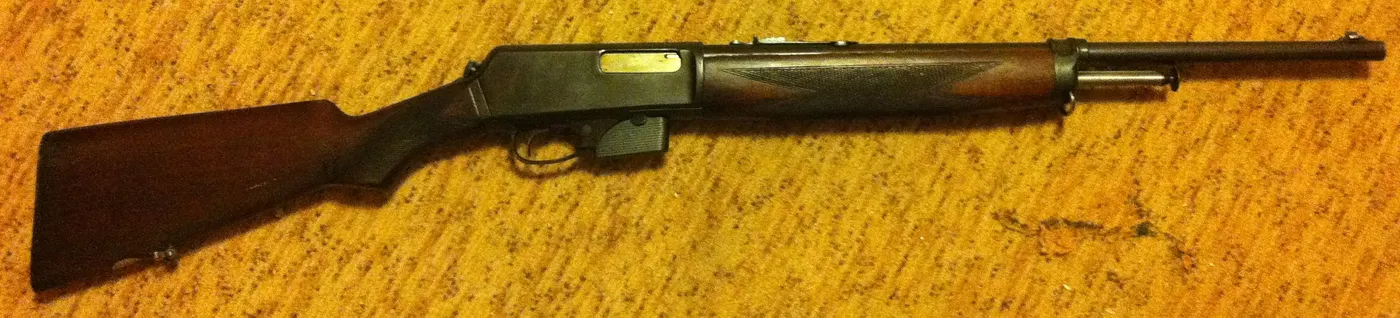

Of the four self-loading rifles Winchester Repeating Arms Company built on Thomas Crossley Johnson's single 1901 blowback patent, the Winchester Model 1910 fired the most powerful cartridge of the group and sold the fewest copies, just 20,787 rifles across a twenty-six year run from 1910 to 19361. It chambered one round only, the proprietary .401 Winchester Self-Loading (.401 WSL), a big-bore hunting cartridge built specifically to give an unlocked blowback action enough knockdown power for deer, black bear, and other medium to large North American game at short range1,2. Where the earlier Winchester Model 1907 had already fixed the underpowered Winchester Model 1905's biggest complaint with the .351 Winchester Self-Loading cartridge, the Winchester Model 1910 pushed that same idea as far as a blowback breech could safely go.
- Most powerful cartridge of Winchester's entire self-loading rifle family
- Genuine deer and black-bear stopping power from an unlocked blowback action
- Fast, single-screw takedown shared across the whole self-loading line
- Detachable box magazine gave quicker reloads than a tubular-fed lever gun
- Only 4-round magazine capacity, the smallest of the four self-loading models
- Heaviest rifle in the family, both in the receiver and in felt recoil
- Proprietary .401 WSL cartridge never caught on outside Winchester's own catalog
- Lowest production total and shortest sales life of the four Johnson self-loaders
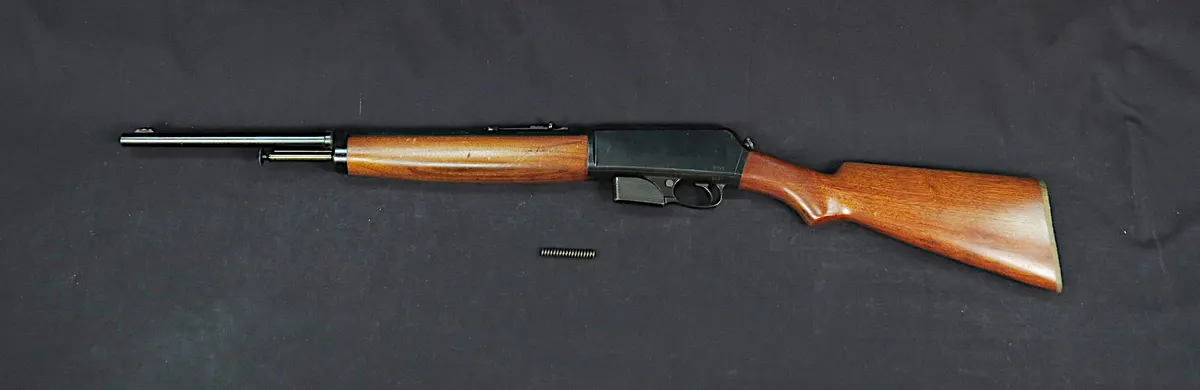
The Winchester Model 1910's .401 WSL cartridge pushed a 200-grain (about 13 grams) soft-point bullet to roughly 650 meters per second for close to 2,750 joules of muzzle energy, figures that put it well above both the .30-30 Winchester and the Winchester Model 1907's .351 WSL in raw stopping power2,8. Winchester's own advertising leaned hard on that power, marketing copy for the round claimed it hits like the hammer of Thor7. The rifle's action needed no locking lugs to handle that pressure, relying instead on an unusually heavy reciprocating bolt and spring tension alone, and it fed from a 4-round detachable-magazine box set forward of the trigger guard1,3.
France and Imperial Russia both placed confirmed wartime purchase orders for the Winchester Model 1910 during the First World War, but neither order amounts to the kind of broad military adoption the phrase can imply. France's Ministry of War ordered 150 rifles, spare magazines, and 25,000 rounds of .401SL ammunition through the arms agents Andre, Schaub and Pioso in October 1915, intended chiefly to arm aircraft observers1. Imperial Russia followed with orders for roughly 500 rifles across 1915 and 19161. Both purchases were modest, specialist, aviation-and-security buys rather than standard-issue infantry contracts, and the Winchester Model 1910 never approached the scale of government business the Winchester Model 1907 later attracted from the same two buyers1,9. The Winchester Model 1910 belongs to the same semi-automatic rifles category its own siblings helped establish commercially in the United States, and its story runs almost entirely through the American civilian market rather than any battlefield.
Winchester never expected a broad market for a rifle this specialized, even though period advertising pushed the .401 WSL's power hard1. The United States buying public that actually kept the Winchester Model 1910 in the catalog for twenty-six years skewed toward serious big-game hunters and a handful of private security buyers rather than the police departments and railway guards that sustained the milder Winchester Model 19071,7. A modern retrospective on the rifle half-jokingly labeled it the Ford Edsel of Winchester rifles, though the same piece concedes the Winchester Model 1910 was never an actual commercial failure, it filled a real niche and sold steadily before quietly fading from public memory once production ended6.
The Heaviest Blowback Winchester Ever Built Around a Single Cartridge
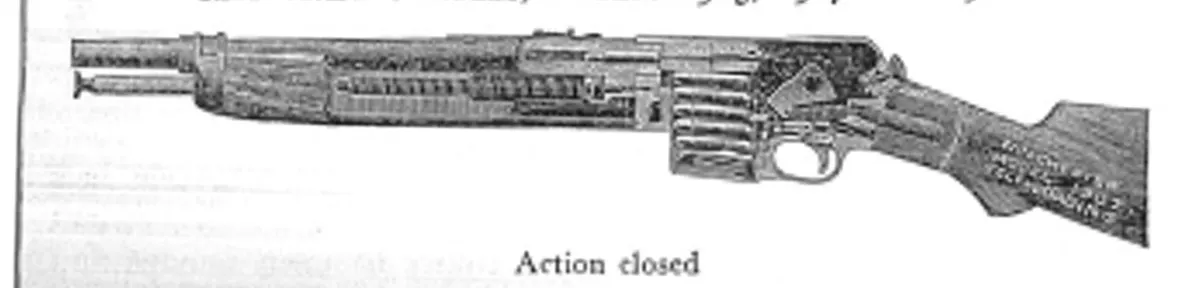
The Winchester Model 1910's action is a direct blowback design with no rotating bolt, no locking lugs, and no gas system, the same basic principle T.C. Johnson first patented for the rimfire Winchester Model 1903 in 19011,4. What changed for the Winchester Model 1910 was scale. Its reciprocating bolt is the heaviest of the whole self-loading family, sized specifically to absorb the .401 WSL's pressure through mass and spring tension alone rather than through any mechanical lock3. A forward charging plunger below the barrel cycles the action by hand, the same flat-sided, snag-free layout Johnson carried through the Winchester Model 1905 and Winchester Model 1907 before it1,9.
- İlk Üretim Yılı1910
- TasarımcıT.C. Johnson
- Ağırlık (Boş)3,6 kg
- Önemli KullanıcılarFransız Üçüncü Cumhuriyeti, Rus İmparatorluğu
The Winchester Model 1910 weighed roughly 3.6 to 4.1 kilograms unloaded depending on stock and finish, and it carried a 508mm (20-inch) barrel, identical in length to the lighter Winchester Model 1907's1. It used plain iron-sights as standard, with an optional tang or receiver-mounted aperture sight cataloged for shooters who wanted finer precision on game at distance1. The rifle came apart via the same single cross-screw takedown Winchester built into the entire self-loading line, a genuine convenience feature for a hunting rifle meant to travel1,3.
- Fişek.401 Winchester Self-Loading
- Çap10,3 mm
- Kovan Uzunluğu38,1 mm
- Mermi Ağırlığı13 g
A Deliberately Overbuilt Big-Bore Hunting Cartridge
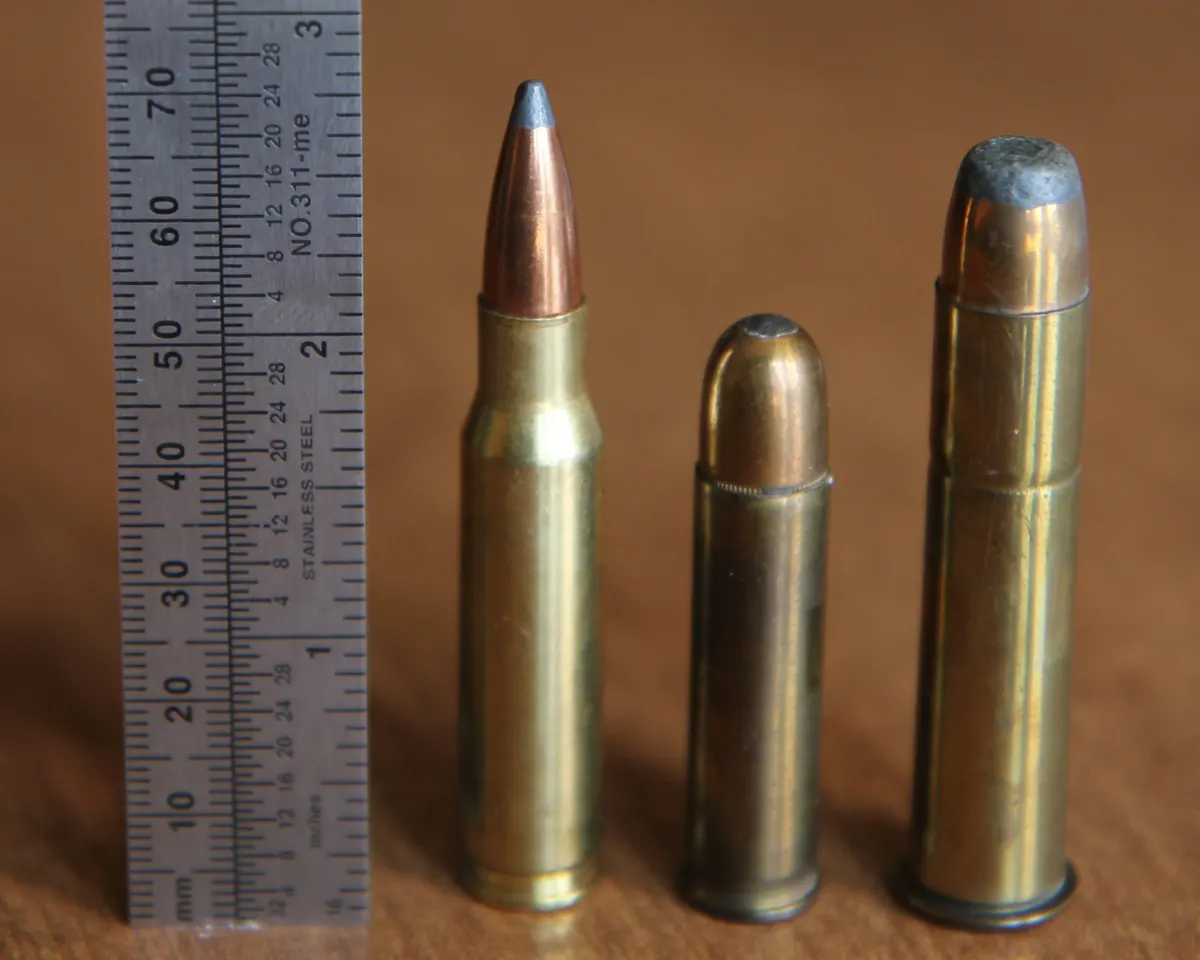
Johnson's .401 Winchester Self-Loading was a semi-rimmed, straight-walled centerfire round with a case roughly 38mm long and an overall cartridge length near 51mm, running at pressures up to about 39,000 psi, high for an unlocked blowback breech of the period2. Winchester's standard factory loading sent a 200-grain (about 13-gram) soft-point bullet out of the 20-inch barrel at roughly 650 meters per second for close to 2,750 joules of muzzle energy, and the company also cataloged a slower, heavier 250-grain (about 16-gram) load at around 570 meters per second for similar total energy but deeper penetration2,8. Both loadings were built for deer and black bear-sized game inside roughly 150 yards (about 137 meters), and period writers rated the .401 WSL as genuinely adequate for that role, though weak bullet expansion technology of the era limited its performance against tougher animals like moose or grizzly5. The bullet itself measured 0.406 inches (about 10.3mm) across, a nonstandard bore diameter that did not interchange with the more common .40-caliber projectiles sold elsewhere in the American market2.
- Mekanizma TipiBlowback (Geri İtmeli)
- Atış ModlarıYarı otomatik
- Besleme SistemiÇıkarılabilir Şarjör
- Şarjör Kapasitesi4
Winchester built the Winchester Model 1910 in two production grades sharing the identical action and chambering. The plain-finish rifle was the standard commercial configuration, and a checkered, semi-pistol-grip fancy-finish grade cost more and accounts for only a small share of total production, making surviving fancy-grade examples the rarer and more collectible of the two today7. Collectors generally rate the Winchester Model 1910 as the scarcest of Winchester's four early self-loading rifles on the used market, a direct consequence of its comparatively small 20,787-unit total run7.
- Namlu Çıkış Hızı653 m/sn
- Namlu Enerjisi2.760
- Etkili Menzil (nokta)200 m
- Azami Menzil300 m
- Namlu Uzunluğu508 mm
- Nişangah TipiAçık demir nişangah ve opsiyonel halka nişangah
- Açık NişangahEvet
- Toplam Üretim20.787
- Üretim Başlangıcı1910
- Üretim Bitişi1936
- Varyantlar2
T.C. Johnson joined Winchester as a draftsman in 1885 and became the company's chief designer by 1907, the same year the Winchester Model 1907 reached dealers4. His original blowback patent, US 681,481, filed in April 1901 and granted that August, protected the rimfire Winchester Model 1903 first before Winchester extended the same basic mechanism to progressively larger centerfire cartridges, the Winchester Model 1905, the Winchester Model 1907, and finally the Winchester Model 1910 in 19101,4. Each step up the family scaled the bolt mass and spring tension to match a more powerful round, and the Winchester Model 1910 represented the practical ceiling of what an unlocked blowback breech could safely contain3.
Winchester introduced the .401 WSL and the Winchester Model 1910 together in 1910, aiming squarely at hunters who found the Winchester Model 1907's .351 Winchester Self-Loading cartridge too mild for large game1,5. The rifle sold steadily rather than spectacularly across its production run, and Winchester officially dropped it from the catalog in 1935 with the last parts-built examples completed in 1936, closing out the entire Johnson-patent self-loading family a year after ending the milder Winchester Model 1907's own separate production run decades later1.
France's only confirmed wartime purchase came through the arms agents Andre, Schaub and Pioso, acting for the French government, who ordered 150 Winchester Model 1910 rifles, spare magazines, and 25,000 rounds of .401SL ammunition in October 19151. A further French order for 400,000 cartridges placed in December 1917 suggests additional rifles reached French hands through channels Winchester's surviving factory records do not fully document1. France used its Winchester Model 1910 rifles to arm aircraft observers, a stopgap role between a sidearm and a dedicated aircraft machine gun, and gradually shifted new orders toward the lighter, more successful Winchester Model 1907 from 1916 onward1,9. Imperial Russia ordered roughly 500 Winchester Model 1910 rifles across 1915 and 1916, intended for aircrew and rear-area troops facing German and Austro-Hungarian forces on the Eastern Front1.
Domestically, the Winchester Model 1910 stayed almost entirely a civilian hunting rifle. The Baldwin Locomotive Works purchase of a dozen short-barreled examples for wartime plant security in 1917 stands out precisely because it was unusual, most Winchester Model 1910 buyers were individual sportsmen rather than institutions7. That narrower customer base, big-game hunters willing to pay a premium for genuine stopping power in a self-loading rifle, is the main reason the Winchester Model 1910 never came close to matching the Winchester Model 1907's production numbers or its wartime government business1.
The Winchester Model 1910's clearest conflict connection runs through the First World War's aviation and Eastern Front, and it stayed a secondary, specialist weapon there rather than a frontline infantry arm. France issued its 150-rifle 1915 order specifically to arm aircraft observers during World War I, before belt-fed aircraft machine guns became standard equipment and made a shoulder-fired auxiliary weapon obsolete in the air1. Imperial Russia's roughly 500 rifles were bought for the same general purpose, arming aircrew and rear-echelon troops against Germany and Austria-Hungary on the war's Eastern Front1.
Russia's connection to the Winchester Model 1910 did not end with the war against the Central Powers. Secondary accounts place surviving Imperial-purchased rifles in the hands of White Army units during the Russian Civil War of 1919 to 1922, carried over from the original 1915 to 1916 government order rather than from any fresh wartime purchase7. That later use is not confirmed by the primary Winchester shipping records available today, and it should be read as a plausible continuation of existing stock rather than a documented, separately sourced military contract1,7.
Outside those two government orders, the Winchester Model 1910's only other documented conflict-adjacent use was private rather than military, the Baldwin Locomotive Works' 1917 purchase of a dozen short-barreled examples for plant security during wartime labor unrest, a domestic security role rather than a combat one7. Compared to the Winchester Model 1907's genuine multi-country wartime footprint, including Britain's Royal Flying Corps and the United States' own Pancho Villa Expedition and Border Patrol service, the Winchester Model 1910's conflict history stayed narrow, concentrated almost entirely in France and Russia's 1915 to 1916 aviation-observer purchases1,9.
Winchester cataloged the Winchester Model 1910 in two production grades built on the identical blowback action and .401 WSL chambering. The plain-finish rifle was the standard commercial configuration sold from 1910 onward at a $30 list price, and it made up the large majority of the 20,787 total units built1,7. The fancy-finish grade added checkering on the forearm and a semi-pistol-grip stock for buyers willing to pay a premium, and it survives today in far smaller numbers, making it the harder of the two grades for collectors to find7.
Within the broader four-rifle self-loading family, the Winchester Model 1910 sat at the top of the power scale. The rimfire Winchester Model 1903 came first in 1903, aimed at plinking rather than serious hunting, and the underpowered Winchester Model 1905 followed it into centerfire cartridges that never satisfied big-game hunters1. The Winchester Model 1907 fixed that power problem for most buyers and became by far the most successful of the three centerfire models, and the Winchester Model 1910 rounded out the family in 1910 for the smaller group of hunters who wanted more power still than even the .351 WSL delivered1,9. No dedicated military-pattern variant of the Winchester Model 1910 was ever built, unlike the Winchester Model 1907's later 1935 police configuration, the Winchester Model 1910 stayed a purely commercial sporting rifle across its entire production run9.


 Rusya
 Fransa
France was a confirmed but modest wartime buyer of the Winchester Model 1910, ordering 150 rifles in October 1915 through commercial arms agents acting for the French government, with a follow-on 1917 ammunition order suggesting further rifles reached French service by less well documented channels1. Imperial Russia ordered roughly 500 Winchester Model 1910 rifles across 1915 and 1916, the largest single confirmed government purchase of the model, intended for aircrew and rear-area troops on the Eastern Front1. Neither country adopted the Winchester Model 1910 as a standard-issue infantry arm, both purchases were specialist, aviation-focused buys on a scale far smaller than either country's ordinary rifle procurement of the period1.
The Winchester Model 1910's largest true customer base was never a government at all. The United States civilian hunting market, individual sportsmen buying through Winchester's dealer network, sustained the Winchester Model 1910's twenty-six year catalog run far more than any military contract did, and the rifle's one documented American institutional buyer, the Baldwin Locomotive Works, bought its dozen short-barreled examples in 1917 as a private company rather than as a government agency1,7.
The Winchester Model 1910's most direct point of comparison sits inside Winchester's own catalog rather than at a rival company. Both the Winchester Model 1910 and the Winchester Model 1907 share Johnson's identical blowback patent, the same 20-inch barrel length, and the same single-screw takedown, and the split between them comes down almost entirely to how much cartridge that shared action could safely hold. The Winchester Model 1907's .351 WSL gave up outright power for a lighter, faster-cycling rifle with a 5-round magazine that sold 58,733 units over fifty years, while the Winchester Model 1910's .401 WSL delivered close to double the muzzle energy from a heavier bolt and a smaller 4-round magazine that sold barely a third as many rifles across a shorter run1,9.
| Rifle | Cartridge | Muzzle energy | Magazine | Production total |
|---|---|---|---|---|
| Winchester Model 1910 | .401 WSL | ~2,750 J | 4 rounds | 20,787 |
| Winchester Model 1907 | .351 WSL | ~1,850 J | 5 rounds | 58,733 |
| Remington Model 8 | .30/.32/.35 Remington | ~2,650 J (.35 Rem) | 5 rounds | ~80,000 |
Outside Winchester's own lineup, the Winchester Model 1910's closest rival in spirit was John Browning's Remington Model 8, a long-recoil design Remington Arms brought to market in 1906, several years before the Winchester Model 1910 arrived1. The Remington Model 8's locked, recoiling barrel let it chamber several different rimless centerfire rounds up to the .35 Remington at energy levels close to the Winchester Model 1910's own .401 WSL, without the case-taper and pressure limits an unlocked blowback breech imposed5. That single design choice explains why the Remington Model 8 comfortably outsold the Winchester Model 1910, Remington's buyers could pick a caliber to match the game they hunted from one rifle platform, while Winchester Model 1910 buyers committed to one fixed, proprietary cartridge the moment they bought the rifle5. The Winchester Model 1910's real advantage was never long-term sales, it was raw power from the simplest possible self-loading mechanism, a genuinely different engineering answer to the same big-game hunting problem Remington solved with a locked action instead.
What caliber does the Winchester Model 1910 use The Winchester Model 1910 was chambered only in the proprietary .401 Winchester Self-Loading cartridge, a big-bore round Winchester introduced alongside the rifle in 1910 and never offered in any other production model1,2.
How many Winchester Model 1910 rifles were made Winchester built 20,787 Model 1910 rifles between 1910 and 1936, the smallest production total of the company's four early self-loading rifles1.
Is the Winchester Model 1910 still in service today No. The Winchester Model 1910 has not been in production since 1936 and no current military or police force issues it. Surviving examples, including former French and Russian military contract rifles, are now collector pieces valued mostly under $2,0001,6.
Was the Winchester Model 1910 used in World War I Yes, in small numbers. France ordered 150 rifles in 1915 and Imperial Russia ordered roughly 500 across 1915 and 1916, both purchases meant chiefly to arm aircraft observers rather than frontline infantry1.
What was the Winchester Model 1910's unit cost The Winchester Model 1910 sold new for around $30 in its plain-finish configuration, a 1910-era retail price rather than a modern valuation, with the checkered fancy-finish grade costing more1.
How does the Winchester Model 1910 compare to the Winchester Model 1907 The Winchester Model 1910 fired a substantially more powerful cartridge, the .401 WSL versus the Winchester Model 1907's .351 WSL, but it carried a smaller 4-round magazine, weighed more, and sold barely a third as many rifles over a shorter production run1,9.
- "Winchester Model 1910", Wikipedia — en.wikipedia.org ↩
- ".401 Winchester Self-Loading", Wikipedia — en.wikipedia.org ↩
- "Winchester Model 1905, Model 1907 and Model 1910 SL rifles (USA)", Modern Firearms — modernfirearms.net ↩
- "T. C. Johnson", Wikipedia — en.wikipedia.org ↩
- "351 Winchester and 401 Winchester: Auto-Loading Pioneers", The Big Game Hunting Blog — thebiggamehuntingblog.com ↩
- "Guns of our Fathers: The Winchester Self-Loading Model 1910, The Ford Edsel of Winchester Rifles", American Shooting Journal — americanshootingjournal.com ↩
- "Winchester Model 1910", Grokipedia — grokipedia.com ↩
- ".401 Winchester Self-Loading / .401 WSL (Cartridges of the World)", loaddata.com — loaddata.com ↩
- "Winchester Model 1907", Wikipedia — en.wikipedia.org ↩