
01 / Overview
ASELSAN is Turkey's largest defense electronics manufacturer and, by recent Defense News rankings, the world's 48th largest defense company by revenue.1 Its full legal name, Askerî Elektronik Sanayi A.Ş. (Military Electronic Industries), points to its founding purpose. The company was created in 1975 by the Turkish Army Foundation, the predecessor of today's Turkish Armed Forces Foundation, after the United States imposed an arms embargo on Turkey over the 1974 intervention in Cyprus.1,2 That embargo cut Ankara off from imported radios, sights and fire-control gear it depended on, and ASELSAN was set up to build that hardware domestically rather than leave the Turkish Armed Forces exposed to a foreign supplier's politics again.2 Five decades later the company designs and manufactures radar, electro-optics, electronic warfare, command and control, and communications systems across land, air and naval domains, headquartered in Ankara.1
The company's growth has tracked Turkey's own push for an indigenous defense industry. Revenue reached 180.4 billion Turkish lira (about $4.11 billion) in 2025, a 15 percent real-terms increase over the prior year, closing out ASELSAN's 50th anniversary with the strongest results in its history.8,9 It now employs roughly 14,000 people, after adding more than 2,000 positions in a single year.9 Its products range from a shoulder-fired remote weapon station costing a few thousand dollars to a national ballistic and cruise-missile shield built with two other Turkish state-linked contractors.
- deep bench across radar, electro-optics, EW and comms in one company
- state-backed order flow from Turkey's own rearmament programs
- export flexibility not bound to Western end-user restrictions
- five decades of accumulated indigenous know-how since the 1975 embargo
- still catching up to Western/Israeli firms on some high-end AESA/VLO-band work
- revenue concentrated in a single home market and its close allies
- reliant on partners like Roketsan and TÜBİTAK SAGE for propulsion/warheads it does not build itself
- exposed to Turkish lira volatility despite reporting in real terms
02 / Company Profile
The Turkish Armed Forces Foundation (Türk Silahlı Kuvvetlerini Güçlendirme Vakfı, TSKGV) holds about 74.2 percent of ASELSAN's shares, with the remaining 25.8 percent free float trading on Borsa Istanbul under the ticker ASELS, where the company listed in 1990.3,4 That structure makes ASELSAN state-controlled in practice while still subject to public disclosure and market discipline, a hybrid model shared by sister TSKGV firms like Roketsan. Ahmet Akyol, previously head of ASELSAN's microelectronics and electro-optics division, became CEO after Haluk Görgün left in 2023 to head Turkey's Presidency of Defence Industries (SSB), the government body that oversees ASELSAN's largest contracts.5
Internally, ASELSAN organizes around five business sectors. Communication and Information Technologies (HBT) covers radios and networked comms. Microelectronics, Guidance and Electro-Optics (MGEO) covers chips, thermal imagers and precision-guided munitions. Radar and Electronic Warfare Systems (REHIS) covers the radar and jamming lines. Defense Systems Technologies (SST) covers weapon stations and gun systems. Transportation, Security, Energy and Automation Systems (UGES) covers civilian and dual-use electronics.1 Production is spread across Ankara. The Macunköy facility hosts the CEO's office and the communications sector on roughly 187,000 square meters.6 Akyurt, at over 300,000 square meters, houses microelectronics, night-vision, laser rangefinder/designator and inertial-navigation production.6,7 Gölbaşı, completed in 2015 for about $157 million, houses radar, electronic-warfare and unmanned-systems engineering across 666,000 square meters.6 A new Oğulbey Technology Base, a roughly $1.5 billion project on some 6,500 acres, broke ground in August 2025 to expand capacity further.9
R&D spending reached $1.36 billion in 2025, a 40 percent jump, funding both the new radar/EW facilities and expansion abroad through subsidiaries in Azerbaijan (opened 1998), Jordan (2012), Ukraine (2020) and Kazakhstan.9,1 The company's order backlog stood at a historic $20.4 billion at the end of 2025, a scale of forward revenue visibility that few mid-tier defense electronics firms outside the largest Western primes can claim.9
 Ankara, Turkey · Stock: ASELS
(12 products)
(13517 products)
03 / Products & Production · 15 platforms
Air Defense Guns and Weapon Stations
KORKUT is ASELSAN's tracked, all-weather 35mm self-propelled anti-aircraft gun, built to replace Turkey's aging M42 Duster fleet.10 Each KORKUT battery pairs a command vehicle with weapon platforms mounted on the FNSS Company ACV-30 chassis, each carrying a twin 35mm Oerlikon-pattern KDC-02 cannon license-built in Turkey, firing up to 1,100 rounds a minute out to 4 kilometers under guidance from a radar with roughly 70 kilometers of coverage.10 It sits within the broader anti-aircraft artillery category that Turkey has worked to keep indigenous rather than import.
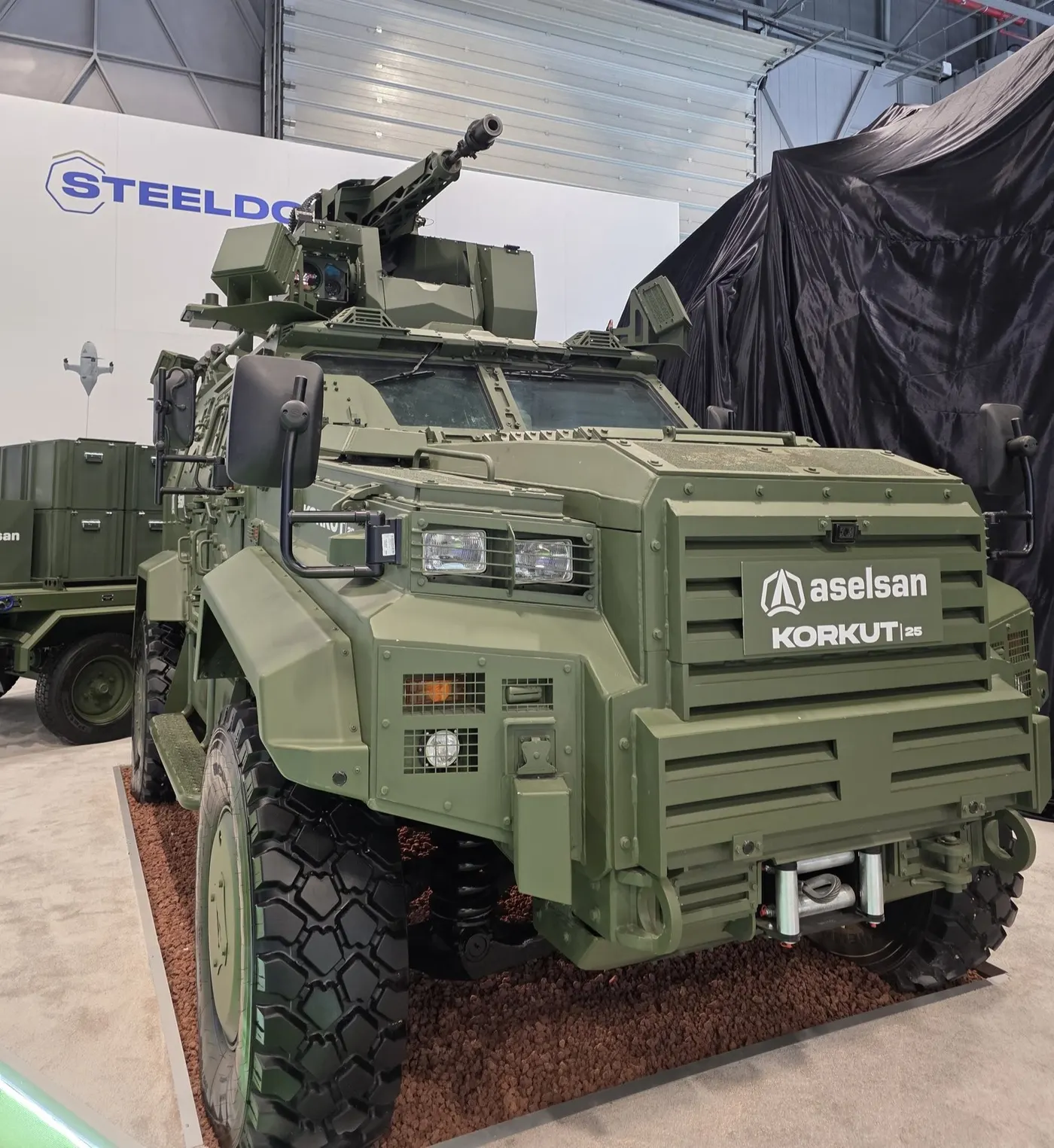
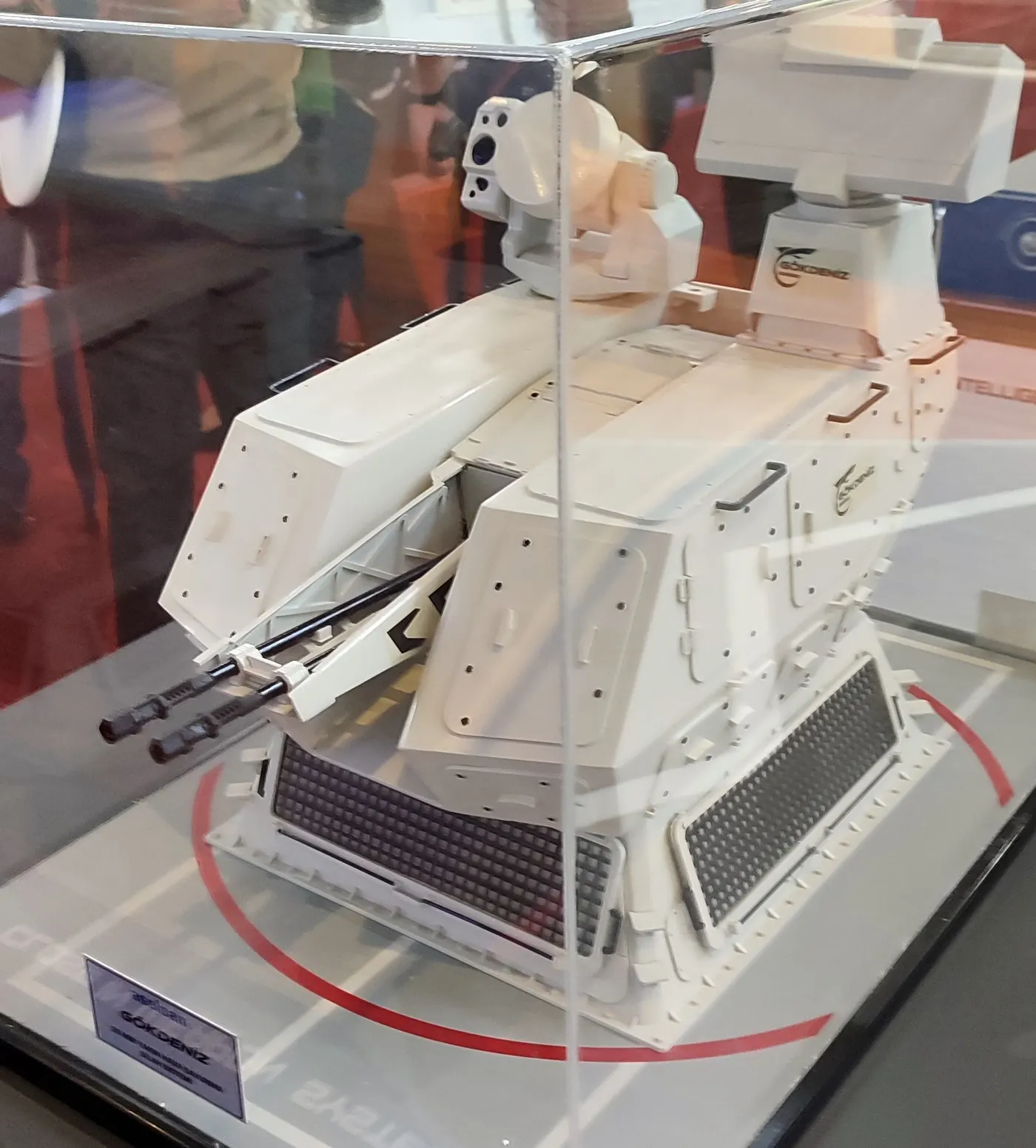
ASELSAN adapted the same twin-35mm turret for naval use as GÖKDENİZ, a close-in weapon system meant to shoot down anti-ship missiles, aircraft, helicopters and drones at the same 1,100-round-per-minute, 4-kilometer envelope as its land-based sibling.11 ASELSAN GOKDENIZ equips Turkish Naval Forces frigates alongside other indigenous systems and is reported in service or on order with three countries.11 A newer KORKUT derivative, the Aselsan Korkut 100/25 SB, trades the original 35mm cannon for a 25mm autocannon firing programmable ATOM 25 airburst rounds, repurposing the KORKUT family specifically for the counter-UAS mission against drone swarms rather than crewed aircraft.12
Beyond the KORKUT line, ASELSAN's STAMP family of remote-controlled weapon stations mounts anything from a 7.62mm machine gun to a 40mm grenade launcher on a stabilized, non-penetrating turret that can be bolted onto vehicles or ships without major structural changes.13 More than 3,000 units across the wider remote-weapon-station family are reported in service with 19 countries, making it one of ASELSAN's highest-volume export lines even though it rarely makes headlines the way a fighter radar does.13 The STAMP system's embedded training simulator and touchscreen interface reflect a deliberate push to make gunnery training cheaper than live-fire qualification.13
Together, KORKUT, GÖKDENİZ and the STAMP family give ASELSAN a full spread of gun-based weapon platforms, from tracked SPAAG to ship CIWS to individual remote-controlled turrets, built around shared fire-control and stabilization electronics rather than one-off designs for each customer.
Radars and Sensors
ASELSAN's radar catalogue spans ground surveillance to mobile air defense. The KALKAN Air Defence Radar family is a mobile, trailer-towed X-band phased-array 3D search-and-track radar with an instrumented range around 120 kilometers, covering a full 360-degree azimuth and elevation from -10 to +55 degrees, and it doubles as the launcher-mounted sensor for the medium-range Hisar-O missile described below.14 It sits inside the air defense radar category alongside the newer KALKAN II variant.14
At shorter range, the ACAR Ground Surveillance Radar is a Ku-band, low-probability-of-intercept 2D radar built for detecting, tracking and classifying moving targets on land and sea out to roughly 10 kilometers, with a use case that extends to spotting the fall of shot for artillery adjustment.15 It belongs functionally with the ground-based surveillance family rather than the aircraft-sensor category, a distinction worth noting because ACAR is a vehicle-portable ground radar, not an airborne system. ASELSAN also builds the Koral electronic-warfare radar system, part of a wider land-based ground-based electronic warfare and jamming suite that combines electronic support and electronic attack functions on mobile platforms.
For airborne applications, ASELSAN developed the MURAD family of solid-state active electronically scanned array (AESA) nose radars, using gallium nitride transmit/receive modules for better power efficiency than older gallium-arsenide designs.19 The baseline MURAD 100-A/110-A has flown on Turkish F-16s and on Baykar's Bayraktar Akıncı and Bayraktar Kızılelma unmanned platforms, combining simultaneous air-to-air and air-to-ground modes with beyond-visual-range missile guidance.19,20
Air and Missile Defense Missiles
ASELSAN's role in Turkey's air-defense missile programs runs through sensors and electronics rather than the missiles themselves, making it the essential partner behind two of Turkey's most important air-defense missile programs. The Hisar family of short and medium-range surface-to-air missiles was launched in 2007 as a three-way project between Roketsan, ASELSAN and TÜBİTAK SAGE, splitting responsibility respectively for missile propulsion and structure, radar and electronics, and warhead design.16 The tracked short-range Hisar-A carries its own mast-mounted MAR radar and electro-optical sensor built by ASELSAN, letting it fight independently of outside cueing, while the medium-range Hisar-O variant mounts ASELSAN's own KALKAN phased-array radar on its launcher vehicle.16,17 The HISAR system falls within the short-range air defense and medium-range surface-to-air missile categories depending on variant, and the three partners signed a contract worth more than $1.5 billion in December 2023 to mass-produce it alongside the newer SİPER system.16
SİPER is the longer-range companion to Hisar, a long-range surface-to-air missile system launched by Turkey's defense procurement authority in 2018, with Roketsan again as prime missile developer and ASELSAN supplying most of the sensors and fire-control electronics.18 Successive SİPER blocks have stretched engagement range past 150 kilometers, and the system entered Turkish Land Forces and Air Force inventory from 2024 as part of the wider Çelik Kubbe (Steel Dome) layered air-defense network that also draws on KORKUT, Hisar and shorter-range systems.18
Electronic Warfare and Counter-UAS
ASELSAN's counter-drone lineup has expanded quickly as small commercial and military drones became a battlefield staple. Aselsan Gökberk pairs a high-energy laser with the İHTAR jamming and detection suite on a 6x6 mobile platform, giving operators both a soft-kill jamming option and a hard-kill laser against mini and micro drones and IEDs, guided by AI-assisted tracking algorithms.21 Aselsan İHTAR itself has been upgraded with a fixed AESA radar and programmable FPV-jamming logic, folding radar detection and electronic attack into one box rather than requiring separate systems.22 Aselsan ŞAHİN takes the opposite approach, using programmable airburst ammunition for a purely kinetic, low-cost interception of rotary and fixed-wing drones at very close range, and it has been fielded by Pakistan as part of that country's push against drone incursions.23 All three sit within the counter-UAS category, alongside the KORKUT 100/25 SB gun system described above, illustrating how ASELSAN now attacks the drone problem from several angles rather than betting on one interceptor type.
Precision Munitions, Fire Control and Communications
ASELSAN's TOLUN family of precision-guided munitions started as a roughly 136-kilogram GPS/INS-guided bunker-buster carried on the SADAK-4T quad launcher, capable of punching through more than a meter of reinforced concrete before detonating, and has since branched into laser-guided (Tolun-L), fragmentation (Tolun-F) and electronic-warfare (Tolun-EW) variants plus an imaging-infrared version for man-in-the-loop strikes.24 The family has been cleared to fire from Turkish F-16s and integrated onto Baykar's Bayraktar TB2 and Akıncı drones, giving Turkey an indigenous precision-strike option that does not depend on imported munitions.24
On the ground, ASELSAN's role is less about the platform than the electronics riding inside it. The T-155 Fırtına self-propelled howitzer license-builds its chassis, 155mm/52-caliber gun and automatic loading system from South Korea's K9 Thunder, originally a Samsung Group design now produced by Hanwha Group, with the gun itself manufactured under license by the Mechanical and Chemical Industry Corporation (MKE). ASELSAN's own contribution is the inertial navigation system and fire-control computer, giving the self-propelled artillery platform target-coordinate accuracy to about 17.5 meters. A 2018 contract worth $194.6 million covered new-generation fire-control systems for 140 Fırtına-II howitzers.25

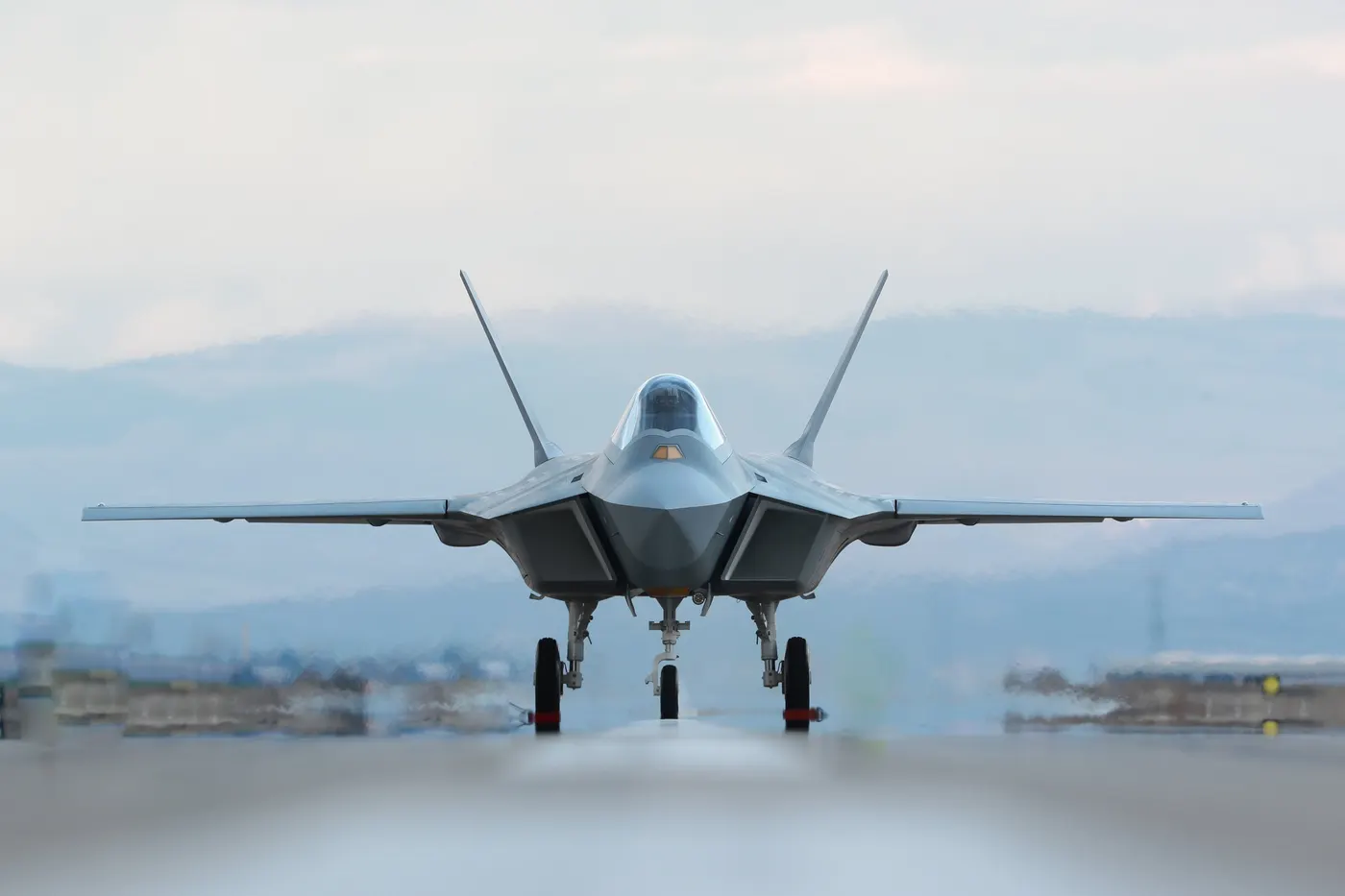
The same electronics-not-airframe role applies to Turkish Aerospace Industries' fifth-generation TAI Kaan fighter, where ASELSAN acts as prime avionics contractor rather than aircraft manufacturer. Its sensor suite for Kaan includes the MURAD 600-A AESA radar, the TOYGUN 100 electro-optical targeting system, the KARAT 100 infrared search-and-track sensor, a laser warning system and a missile warning system, integrated into an electronic-warfare-capable radio-frequency architecture rather than sold as standalone boxes.20 That makes ASELSAN as central to Kaan's combat capability as any single subsystem supplier on the program, even though TAI remains the airframe's prime contractor within the air superiority fighter category.
ASELSAN's original business, tactical radios, remains a steady export line. Its software-defined radios and encrypted communications equipment are used in more than 20 countries across roughly 100 platform types, spanning man-portable squad radios up to vehicle and command-post terminals.28 Half a century after the 1975 embargo that created the company specifically to build such radios domestically, communications equipment is still one of the product lines ASELSAN sells most widely abroad.
04 / Trade & Deals
Export growth has been one of ASELSAN's headline 2025 results. Direct and indirect exports rose 89 percent to $958 million, while new export contracts signed during the year topped $2 billion, more than double the prior year.9 A $410 million contract with Poland for electronic-warfare and counter-drone systems, signed in December 2025, stands out as one of the largest single export deals in the company's history and a rare instance of a NATO member west of Turkey buying a full indigenous EW package rather than a single subsystem.27
In the Gulf, ASELSAN has deepened a long-running partnership with Qatar's Barzan Holdings through the BARQ joint venture, expanding the arrangement at successive DIMDEX naval exhibitions in Doha to cover new high-technology product lines and local production in Qatar itself, alongside a dedicated ASELSAN branch office there.26 That kind of joint-venture structure, sharing intellectual property and production locally rather than exporting finished kits, has become ASELSAN's preferred model for markets it considers strategically important rather than one-off sales.
On the supply side, ASELSAN depends on other manufacturers for components it does not build itself. The 35mm cannons on both KORKUT and GÖKDENİZ trace their design to Oerlikon Rheinmetall Air Defence's KDC-02 gun, license-manufactured in Turkey by MKE, the same state ordnance maker that produces the T-155 Fırtına's gun.10 The KORKUT vehicle chassis itself comes from FNSS Company's ACV-30 armored vehicle line. Those dependencies show that even a company as vertically integrated as ASELSAN still leans on Turkey's wider defense-industrial base for guns, armor and propulsion, reserving its own manufacturing for sensors, electronics and fire control.
05 / Global Reach · 8 countries · 1 conflicts
ASELSAN's most important customer by far remains the Turkish Armed Forces, which fields the bulk of its radar, electronic-warfare, air-defense and communications output as part of Turkey's layered Çelik Kubbe air-defense network built around KORKUT, Hisar and SİPER.18 Beyond Turkey, Pakistan's adoption of the ŞAHİN counter-UAS system reflects a defense-industrial relationship between the two countries that has grown well beyond this single system, part of a broader pattern of Turkish systems finding early export traction in South Asia and the Gulf before reaching further markets.23 Subsidiaries and joint ventures in Azerbaijan, Jordan, Ukraine, Kazakhstan and now Qatar give ASELSAN a physical footprint across the Caucasus, the Levant, Central Asia and the Gulf, markets where Turkey's own diplomatic and military relationships tend to open doors that pure product quality would not on its own.1,9 The Poland contract signals an attempt to break into NATO Europe on the strength of counter-drone and electronic-warfare technology honed in real combat use, a harder market to crack given the entrenched positions of Thales, Leonardo and Rheinmetall's electronics divisions there.


06 / Competition
Inside Turkey, ASELSAN has no true domestic peer at its own scale or breadth. Roketsan builds the missiles that ASELSAN's radars guide rather than competing with it directly, and other Turkish firms tend to specialize narrowly (vehicles, software, drones) rather than covering ASELSAN's full radar-to-communications range. Internationally, ASELSAN competes on individual product lines against much larger, longer-established electronics primes. Thales and Leonardo dominate the higher end of European radar and EW work and carry decades more flight-hours of qualification on NATO platforms. Rafael Advanced Defense Systems and Elbit Systems Ltd. compete most directly in counter-UAS, remote weapon stations and precision munitions, the same categories where ASELSAN's STAMP and TOLUN families operate. Rheinmetall's electronics and air-defense arm overlaps with ASELSAN in gun-based air-defense systems, the segment KORKUT and GÖKDENİZ occupy.
ASELSAN's edge against all of them is largely political and economic rather than technical. Turkey's defense-export posture carries far fewer end-user restrictions than the ITAR-governed US industry or many EU suppliers, letting ASELSAN sell systems like ŞAHİN or STAMP into markets that Western competitors sometimes cannot service quickly. Pricing tends to undercut Western equivalents, a genuine advantage for buyers in the Gulf, South Asia and parts of Africa who need functional hardware rather than the last percentage point of performance. Turkey's own indigenous-industry politics, the standing preference for buying ASELSAN over an import wherever a domestic option exists, also guarantees a captive home-market order book that most of its rivals in this comparison do not enjoy to the same degree, but it leaves ASELSAN more exposed than Thales or Leonardo to the fortunes of a single national defense budget.
 Elbit Systems Ltd.
 LeonardoRafael Advanced Defense Systems
 Rheinmetall
 Thales
Company website: https://www.aselsan.com/en
- "Aselsan", Wikipedia — en.wikipedia.org ↩
- "ASELSAN, Turkish Defence Corporation Marks 50 Years", Grey Dynamics — greydynamics.com ↩
- "Shareholder Structure", ASELSAN Investor Relations — aselsan.com ↩
- "ASELSAN becomes Turkey's most valuable listed company amid defense export boom", Turkish Minute — turkishminute.com ↩
- "Ahmet AKYOL Appointed as the New CEO of ASELSAN", Defence Turkey — defenceturkey.com ↩
- "Our Facilities", ASELSAN — aselsan.com ↩
- "Inauguration of the Aselsan Akyurt Guidance & Unmanned Systems Serial Production Facility", Defence Turkey — defenceturkey.com ↩
- "Turkey's Aselsan sees over $4 billion in revenue, up 15% from last year", Breaking Defense — breakingdefense.com ↩
- "ASELSAN Concludes 50th Anniversary Year with Record-Breaking Financial and Export Performance", West Asia Watch — westasiawatch.com ↩
- "KORKUT", Wikipedia — en.wikipedia.org ↩
- "Aselsan GOKDENIZ", Wikipedia — en.wikipedia.org ↩
- "DSEI 2025, Aselsan's KORKUT 100/25 SB Reshapes Close-Range Air Defense With Mobile Counter-Drone Capabilities", Army Recognition — armyrecognition.com ↩
- "IDEF 2019, Aselsan exhibits remotely controlled weapon system STAMP-2", Army Recognition — armyrecognition.com ↩
- "Kalkan (radar)", Wikipedia — en.wikipedia.org) ↩
- "ACAR Ground Surveillance Radar", Wikipedia — en.wikipedia.org ↩
- "Aselsan, Roketsan & TÜBİTAK SAGE sign onto Turkey's air defence program", Quwa — quwa.org ↩
- "Hisar (missile family)", Wikipedia — en.wikipedia.org) ↩
- "Aselsan and Roketsan's SIPER 1 marks major success with autonomous hit", Türkiye Today — turkiyetoday.com ↩
- "MURAD AESA Radar", Wikipedia — en.wikipedia.org ↩
- "ASELSAN Displays Its Payloads for TUSAŞ's KAAN Fighter", TURDEF — turdef.com ↩
- "ASELSAN tests GÖKBERK laser weapon against FPV drones", CUAS Hub — cuashub.com ↩
- "ASELSAN Tests GÖKBERK, Upgraded İHTAR and EJDERHA/AD 210", TURDEF — turdef.com ↩
- "Pakistan Deploys Turkish Drone Killer as ASELSAN ŞAHİN Counter-UAS System Reshapes South Asia Air Defence Balance", Defence Security Asia — defencesecurityasia.com ↩
- "Türkiye Successfully Tests Aselsan Tolun Bunker Buster Guided Munition from F-16 Fighter Jet", Army Recognition — armyrecognition.com ↩
- "T-155 Fırtına", Wikipedia — en.wikipedia.org ↩
- "ASELSAN and Barzan Holdings to expand BARQ Joint Venture with multiple agreements", ASELSAN — aselsan.com ↩
- "Poland Chooses Türkiye's ASELSAN in $410M Pact for Electronic Warfare and Counter-Drone Shielding", Army Recognition — armyrecognition.com ↩
- "ASELSAN, A Front Runner in the Tactical Communication Field", Asian Military Review — asianmilitaryreview.com ↩