
01 / Overview
A Ukrainian soldier's rap song about a Turkish drone became one of the most-streamed protest anthems of the Russo-Ukrainian War in 2022, and the drone it praised, the Bayraktar TB2, is the product that turned a family auto-parts workshop into the world's most exported combat drone manufacturer.1 Baykar (formally Baykar Savunma, trading internationally as Baykar Technologies) is a privately held Turkish aerospace and defense company based in Istanbul, built around unmanned combat aircraft, loitering munitions, and precision strike missiles.2 It was founded in 1986 as Baykar Makina, a precision-machining subcontractor supplying engine and pump components to Turkey's automotive industry, by mechanical engineer Özdemir Bayraktar.3 The company only entered aviation in the 2000s, and it now claims roughly 60 percent of the global market for armed unmanned combat aerial vehicles by unit exports, a scale unmatched by any other privately owned drone maker.4
- Lowest unit cost in its combat drone class, undercutting Western rivals several times over
- Combat-proven across Karabakh, Libya, Ethiopia, and Ukraine, a rare export résumé
- Deep vertical integration, own airframes, engines, munitions, and AI targeting software
- Fast, low-condition export approvals versus Western ITAR-style controls
- Rapidly expanding naval and carrier-launch capability via the TB3 and TCG Anadolu
- No audited public financial disclosure, revenue and headcount are estimates, not filings
- Ownership and leadership concentrated in one family across three generations of control
- Export policy criticized for civilian casualties and absence of human-rights vetting
- Exposed to foreign sensor and component embargoes, as the Canadian Wescam episode showed
- Facing intensifying price competition from Chinese systems in the same export markets
Turkey's own state-owned aerospace champion, Turkish Aerospace Industries, builds larger reconnaissance and strike drones domestically, but Baykar remains the only Turkish company that sells attack drones abroad at true mass-production scale, and it does so as a fully private enterprise with no stock listing and no state ownership stake.2
02 / Company Profile
Özdemir Bayraktar founded Baykar Makina in 1986 after graduating in mechanical engineering from Istanbul Technical University, initially producing precision automotive components such as engine and hydraulic-pump parts for Turkish manufacturers seeking to reduce import dependence.3 The company's current name is a contraction of Bayraktar Kardeşler (Bayraktar Brothers), reflecting the family firm it has remained ever since.2 Baykar began unmanned-aircraft research and development in 2000, achieved its first fully autonomous flight test in 2004, and delivered its first Bayraktar Mini UAV reconnaissance system in 2007, work led by Özdemir's son Selçuk Bayraktar, who joined as chief technology officer that same year after graduate study in engineering at the University of Pennsylvania, the Massachusetts Institute of Technology, and a doctorate from Georgia Institute of Technology.3,5 Selçuk Bayraktar is now Baykar's chairman and CTO, credited as the lead designer of the Bayraktar TB2 and the Bayraktar Kızılelma.5 His brother Haluk Bayraktar serves as chief executive. Özdemir Bayraktar died in 2021, leaving operational control fully with his sons.3 Selçuk Bayraktar married Sümeyye Erdoğan, daughter of Turkish president Recep Tayyip Erdoğan, in 2016, a relationship widely noted in Turkish and international press given Baykar's simultaneous rise as a state-favored strategic exporter.6
Baykar remains entirely privately held by the Bayraktar family, with no shares traded on Borsa Istanbul and no ticker symbol, and it receives no state ownership stake despite its close alignment with Turkish defense policy.2 The company does not publish full audited financial statements, but its own 2024 export announcement stated that international sales of $1.8 billion represented 90 percent of total revenue that year, implying total 2024 revenue of roughly $2 billion, a figure independently echoed by other secondary estimates.4 Employee counts are similarly estimated rather than officially disclosed in detail. Workforce-tracking data placed headcount at approximately 4,577 in 2024 and 4,828 in 2025, broadly consistent with Baykar's own general statements about rapid hiring.7 Baykar's founders have also topped Turkey's individual income-tax rankings in recent years on the strength of that export income, with Selçuk and Haluk Bayraktar again finishing first and second among all Turkish taxpayers for the 2024 tax year.8
Baykar's main campus, the Özdemir Bayraktar National Technology Center, sits on roughly 200,000 square meters near Istanbul's western periphery, combining a 58,000 square meter research and design center with around 100,000 square meters of production and systems-integration floor space.9 A dedicated Akıncı Flight Training and Test Center near Çorlu handles heavy-platform testing and customer flight training, and Baykar has announced its first mainland Anatolian production hub in Samsun, on the Black Sea coast, to expand capacity beyond Istanbul.9,10 The company has pushed hard on vertical integration of its supply chain, developing an indigenous BM100 piston aviation engine with more than 40 domestic subcontractors supplying components such as crankshafts and connecting rods, part of a stated 93 percent localization rate across its production.11
Haluk Bayraktar has framed the Piaggio deal as an effort to preserve Italian jobs and expand production capacity rather than simply absorb a distressed competitor, and Piaggio Aerospace now operates as a Baykar subsidiary based in Genoa, Italy.12
 Bahçeşehir, Turkey
(10 products)
(13517 products)
03 / Products & Production · 11 platforms
Baykar's product line is organized around three families, unmanned combat aircraft, reconnaissance drones, and precision munitions, with the aircraft family generating the overwhelming share of its revenue and global reputation.
The Bayraktar TB2 is Baykar's flagship product and the best-known combat strike drone in the world, a twin-boom, propeller-driven tactical unmanned combat aerial vehicle that entered Turkish military service in 2014 after its first fully autonomous flight test that year.9 It carries laser-guided munitions on external hardpoints and has become the reference point for affordable armed drones internationally, priced at roughly $5 million per system against tens of millions of dollars for a comparable American platform.13

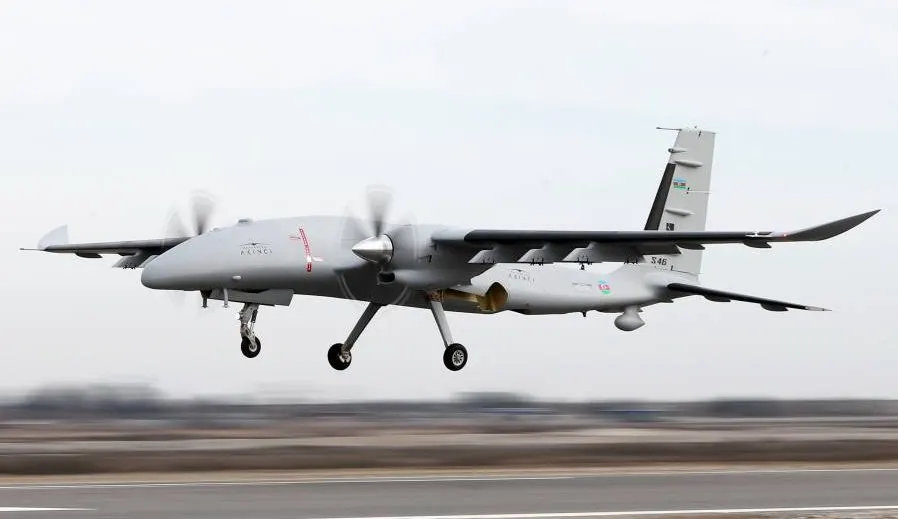
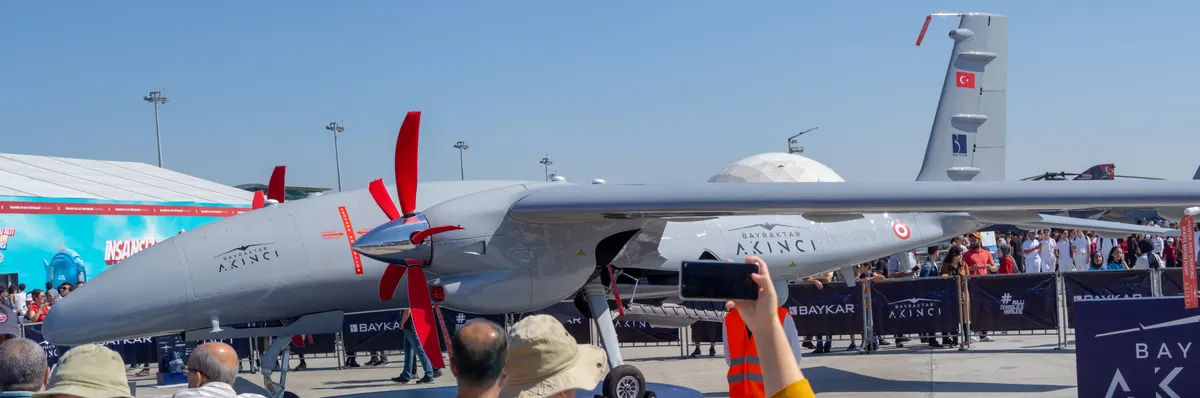
The heavier Baykar Bayraktar Akıncı, first flown in 2019 and delivered to Turkish forces from 2021, is a twin-turboprop high-altitude long-endurance strike drone built to carry stand-off missiles and heavier precision munitions than the TB2 can lift, and it comes in progressively more powerful A, B, and C engine configurations depending on customer requirements.14 Export customers for the Akıncı now include Pakistan, which took the first Akıncı-B configuration, Azerbaijan, Kyrgyzstan, and Mali, while Saudi Arabia signed a reported $3 billion Akıncı deal and has already begun training operator crews.15,16
The Baykar Bayraktar TB3 is a navalized evolution of the TB2 with folding wings and reinforced landing gear, developed specifically to operate from Turkey's short-runway amphibious assault ship TCG Anadolu. It first flew in 2023 and, on 19 November 2024, became the first fixed-wing unmanned aircraft of its size to take off from and land on that ship's ski-jump deck, a milestone Baykar and Turkish officials described as a first for any navy operating a drone of this class from a non-catapult carrier.17

Baykar's most ambitious current program is the Baykar Bayraktar Kızılelma, a jet-powered, low-observable unmanned fighter developed under Turkey's MIUS (Muharip İnsansız Uçak Sistemi, Combatant Unmanned Aircraft System) project. Kızılelma first flew on 14 December 2022, its production-representative prototype flew again in September 2024, and Baykar began serial production in 2025 ahead of planned Turkish Armed Forces deliveries. In 2026, Indonesia signed the type's first export framework agreement, covering an initial 12 aircraft with options for up to 60.18,19

Beyond the strike-aircraft family, Baykar's earliest product, the Bayraktar Mini UAV, remains in production as a small hand-launched reconnaissance and surveillance drone, first delivered to Turkish forces in 2007 and still used for close-range battlefield observation where a larger platform is unnecessary.9
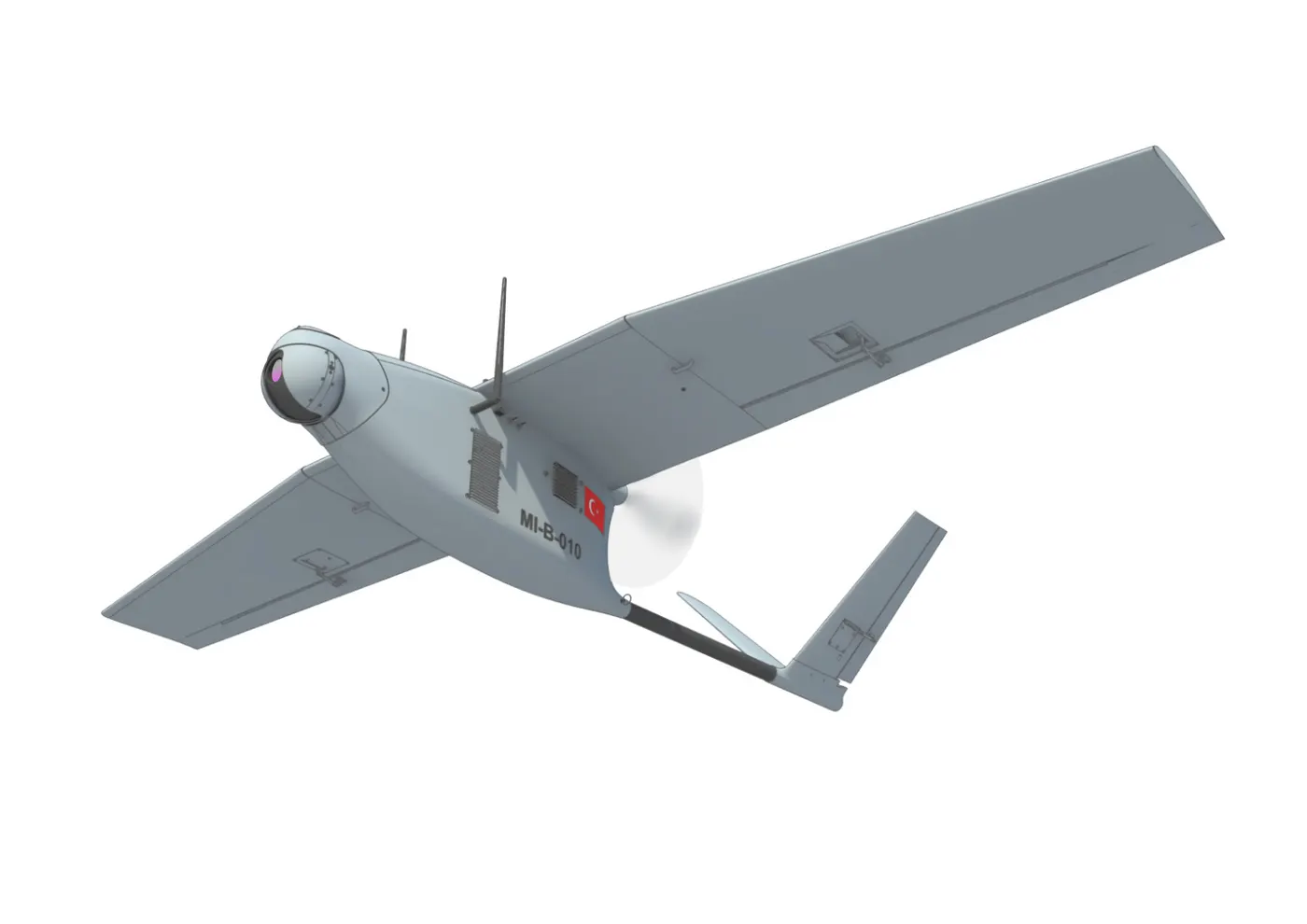
The Malazgirt UAV occupies a similar tactical reconnaissance niche within Baykar's smaller-airframe catalog, giving the company a full spread of unmanned platforms from close-range surveillance up to the carrier-capable Kızılelma.
Baykar's munitions family has expanded quickly since 2023. The Baykar Kemankes 1, first shown publicly at Teknofest in 2023, is a jet-powered, AI-assisted mini cruise missile weighing about 45 kilograms that can be launched from the Akıncı, TB2, and TB3 to strike both ground and aerial targets using optical recognition guidance, and it completed live-fire tests against airborne targets in mid-2025.20,21 A larger successor, Kemankeş 2, extends that same air-launched precision-strike concept. Baykar has also unveiled the Mızrak stand-off munition and, in 2026, a new swarm-capable family consisting of the smaller K2 Kamikaze and Sivrisinek loitering munitions, launched together from Akıncı, TB2, and TB3 platforms with AI-coordinated target sharing between individual rounds rather than a single centrally piloted weapon.22,23
Baykar's engine and localization push, anchored by the indigenous BM100 program described above, feeds directly into this product catalog, since every current airframe and the newer Kemankeş missile family depend on components Baykar increasingly builds in-house rather than importing.11
04 / Trade & Deals · 4 deals
Baykar's own reporting put 2024 exports at $1.8 billion, delivered to customers across roughly 35 countries that year alone, spanning six NATO members and four European Union states among the Bayraktar TB2's operators.4,24 Notable 2024 deliveries named in Baykar's own year-end summary included Croatia's first Bayraktar Akıncı shipment, an Akıncı delivery to the United Arab Emirates, and TB2 deliveries to Romania, Albania, the Maldives, Poland, Mali, Kenya, Pakistan, Morocco, and Azerbaijan.4 Qatar placed the TB2's first export order in March 2018, while Ukraine became its first major combat-tested export customer after a January 2019 contract for six systems worth $69 million.25
Baykar's supply chain has itself become a point of geopolitical friction. Turkish TB2s historically relied on Canadian-made L3Harris Technologies Wescam electro-optical and infrared targeting sensors, and in October 2020 Canada suspended export permits after finding credible evidence the sensors had reached Azerbaijan's TB2s during the Second Nagorno-Karabakh War, a suspension made permanent in April 2021.26,27 Baykar and Turkish officials responded by asserting the country no longer needed the Canadian technology, accelerating domestic sensor and engine substitution work that now underpins Baykar's stated localization push.27 The December 2024 acquisition of Piaggio Aerospace extends that same self-sufficiency logic into turboprop engine manufacturing, an area Baykar previously sourced from foreign suppliers for its larger airframes.12
| Year | Buyer | Product / Service | Quantity | Amount | Type | Status | |
|---|---|---|---|---|---|---|---|
| 2024 |  Azerbaijan | Kemankeş-1 loitering munition (bundled with TOLUN glide bomb) | — | — | Sale | Delivered | |
| 2022 |  Ukraine | Bayraktar Mini UAV | — | — | new-build | Delivered | |
| 2020 |  Libya | Bayraktar Mini UAV | — | — | new-build | Delivered | |
| 2012 |  Qatar | Bayraktar Mini UAV | — | — | new-build | Delivered |
05 / Global Reach · 36 countries · 3 conflicts
Baykar's drones operate across an unusually wide geographic spread for a single privately owned manufacturer, from NATO's eastern flank and Gulf monarchies to conflict zones across sub-Saharan Africa. The Second Nagorno-Karabakh War of 2020 first demonstrated the TB2's battlefield effectiveness at scale, when Azerbaijan's drone-heavy campaign against Armenian-backed forces drew global attention to Baykar's products.9 The Libyan Civil War saw TB2s flown in support of Libya's UN-recognized government against forces led by Khalifa Haftar in 2019 and 2020, and the Russo-Ukrainian War, especially since the full-scale invasion launched in February 2022, turned the TB2 into arguably the most famous weapon system of the war's opening months, credited with strikes on Russian armor and logistics columns even after Russian air-defense adaptation reduced its later effectiveness.25
Ukrainian soldier Taras Borovok wrote Bayraktar, a tribute song to the TB2, within hours of the February 2022 invasion, and it went viral within days, drawing over a million views and spawning covers across multiple genres before becoming an unofficial anthem of Ukrainian resistance.28 Ukrainian civil-society donors ran a parallel People's Bayraktar crowdfunding drive to buy additional TB2 systems, with Baykar reportedly donating some units rather than accepting payment.28
Africa has become an increasingly important market segment, with the TB2 exported to Ethiopia, Mali, Niger, Nigeria, Somalia, Burkina Faso, Togo, Djibouti, Angola, Morocco, and Tunisia, largely for counter-insurgency operations against irregular armed groups.24 That expansion has drawn sustained human-rights criticism.
Ethiopian forces used TB2s during the Siege of Tigray, including a January 2022 strike widely reported to have killed dozens of civilians at a school compound, and a senior Turkish official later acknowledged in closed parliamentary testimony that Turkey had authorized Ethiopia's drone use despite the toll.29,30 Separately, a Turkish defense-linked shipment was alleged in 2025 to have breached international sanctions by supplying arms, reportedly including Kemankeş-family munitions, to combatants in Sudan's civil war.22,31
Turkey Azerbaijan Libya  Pakistan
 Burkina Faso
 Ethiopia
 Indonesia
 Kyrgyzstan
 Mali
 Morocco Qatar
 Somalia Ukraine
 United Arab Emirates
 Albania
 Bangladesh
 Croatia
 Djibouti
 Iraq
 Italy
 Japan
 Kenya
 Kosovo
 Kuwait
 Maldives
 Niger
 Nigeria
 Poland
 Romania
 Rwanda
 Saudi Arabia
 Spain
 Sudan
 Togo
 Tunisia
 Turkmenistan
06 / Competition
Domestically, Baykar's closest peer is the state-owned Turkish Aerospace Industries, whose TAI Anka and larger Aksungur drones compete for some of the same medium-altitude reconnaissance-strike roles, though the two companies have historically split the export market more than clashed directly on price, with Baykar dominant in the lighter tactical-strike segment TAI has been slower to export at comparable volume.2
Internationally, Baykar's most direct competitor is the American General Atomics Aeronautical Systems, maker of the MQ-9 Reaper and MQ-1 Predator families. The MQ-9 carries a far heavier payload at longer range, but its roughly $30 million unit price, against the TB2's roughly $5 million, together with strict American export controls under the Missile Technology Control Regime, has left General Atomics largely absent from the price-sensitive markets across Africa, Central Asia, and the Middle East where Baykar sells most aggressively.13 Chinese manufacturers, principally China Aerospace Science and Technology Corporation with its CH-4 Rainbow drone and Chengdu Aircraft Industry Group with the Wing Loong family, compete on similarly low pricing and equally light export restrictions, making China rather than the United States Baykar's most direct rival for future African and Middle Eastern contracts. Elbit Systems, based in Israel, whose Elbit Hermes 900 occupies a similar medium-altitude tactical niche, competes more on sensor and electronic-warfare sophistication than on price, targeting customers willing to pay a premium over Baykar's offering. Baykar's core advantage across all of these rivalries is less raw technology than combined cost and political flexibility, a lower price than any Western competitor, a shorter and less restrictive export approval process than either the United States or Israel, and a growing combat record that most of its price-competitive Chinese rivals still lack.
 Chengdu Aircraft Industry GroupChina Aerospace Science and Technology Corporation
 Elbit Systems Ltd.
 General Atomics Aeronautical SystemsTurkish Aerospace Industries
Company website: https://www.baykartech.com/en/
- "Bayraktar (song)", Wikipedia — en.wikipedia.org) ↩
- "Baykar", Wikipedia — en.wikipedia.org ↩
- "History", BAYKAR Technology — baykartech.com ↩
- "BAYKAR, THE GLOBAL LEADER IN UCAV EXPORTS, ACHIEVES $1.8 BILLION IN EXPORTS IN 2024", BAYKAR Technology — baykartech.com ↩
- "Selçuk Bayraktar", Wikipedia — en.wikipedia.org ↩
- "Erdoğan's daughter Sümeyye ties the knot with Selçuk Bayraktar in Istanbul", Daily Sabah — dailysabah.com ↩
- "How many employees work at Baykar?", Revelio Labs — reveliolabs.com ↩
- "Turkish UAV maker Baykar's exports put executives at top of taxpayers list", Anadolu Agency — aa.com.tr ↩
- "Baykar Bayraktar TB2", Wikipedia — en.wikipedia.org ↩
- "Turkish drone giant Baykar picks Samsun for first Anatolian factory", Daily Sabah — dailysabah.com ↩
- "Baykar Tech to produce its first turbine engine called BM100", Straturka — straturka.com ↩
- "Italy sells Piaggio Aerospace to Turkish drone maker Baykar", Defense News — defensenews.com ↩
- "MQ-9 Reaper vs Bayraktar TB2 Comparison", TheDefenseWatch — thedefensewatch.com ↩
- "Baykar Bayraktar Akinci", Wikipedia — en.wikipedia.org ↩
- "Kyrgyzstan To Procure AKINCI Drones From Turkey After Purchasing Bayraktar TB2s", Overt Defense — overtdefense.com ↩
- "Saudi Operators Graduate on Baykar's Bayraktar AKINCI Drone, $3 Billion Deal Signals Gulf's Drone Warfare Revolution", Defence Security Asia — defencesecurityasia.com ↩
- "Turkey joins drone-carrier operations club with first takeoff and landing from Turkish ship", Breaking Defense — breakingdefense.com ↩
- "Turkey's Baykar Begins Serial Production of Kızılelma Combat Drone", The Defense Post — thedefensepost.com ↩
- "Stealth Revolution, Indonesia Shakes Indo-Pacific Power Balance with Landmark Bayraktar KIZILELMA Unmanned Fighter Deal", Defence Security Asia — defencesecurityasia.com ↩
- "Baykar Bayraktar Kemankeş 1", Wikipedia — en.wikipedia.org ↩
- "Turkish Baykar KEMANKEŞ-1 Mini Cruise Missile Hits Airborne Targets in First Live-Fire from Akinci Drone", Army Recognition — armyrecognition.com ↩
- "Baykar unveils K2 kamikaze drone, 'Sivrisinek' loitering munition", Türkiye Today — turkiyetoday.com ↩
- "YIHA-III", Wikipedia — en.wikipedia.org ↩
- "Key programmes bolster Türkiye's defence-export boom", European Security & Defence — euro-sd.com ↩
- "Turkey's Bayraktar TB2, its use over Ukraine and Azerbaijan", Key.Aero — key.aero ↩
- "Canadian block on drone parts shows Turkey's defense industry still not independent", Defense News — defensenews.com ↩
- "Turkey claims it no longer needs Canadian military drone tech", RCI — rcinet.ca ↩
- "Ukrainians love the Turkish combat drone Bayraktar so much they wrote a song about it", Euromaidan Press — euromaidanpress.com ↩
- "Turkey admits to allowing Ethiopia to deploy drones involved in mass civilian casualties", Nordic Monitor — nordicmonitor.com ↩
- "A human rights perspective on Turkey's drone exports", LSE Human Rights — blogs.lse.ac.uk ↩
- "Turkish defence firm linked to Sudan's devastating civil war after alleged secret arms ship", Euronews — euronews.com ↩