
01 / Overview
In August 2025 Indonesia signed a $10 billion order for 48 TAI Kaan jets, the largest single defense export contract in Turkey's history and the first confirmed foreign customer for a Turkish-designed fifth-generation fighter.7 The company behind that aircraft, Turkish Aerospace Industries, known domestically by its Turkish acronym TUSAŞ (Türk Havacılık ve Uzay Sanayii), is Turkey's flagship aerospace and defense manufacturer, a state-controlled group spanning fighter and trainer jets, attack and utility helicopters, unmanned aircraft and satellites. Turkish Aerospace was founded in 1973 and is headquartered in Ankara, and the company's roots run through one relationship more than any other, licensed assembly of the General Dynamics F-16 Fighting Falcon for the Turkish Air Force starting in the 1980s.1 TAI reported $2.16 billion in arms revenue for 2024, up 11.3 percent year on year, placing it 65th on the Stockholm International Peace Research Institute's ranking of the world's largest arms-producing firms, up from 75th the year before.3 The company is wholly state controlled, split between the Turkish Armed Forces Foundation (54.49 percent) and the government's Defence Industry Agency (45.45 percent), with the Turkish Aeronautical Association holding the small remainder.1 It is not publicly traded and carries no stock ticker.
- Full portfolio across fighters, trainers, helicopters, drones and satellites
- Indigenous fifth-generation fighter (KAAN) already has a record export order
- Five-decade production relationship with the Turkish Air Force
- Fast-growing export book across Africa, South Asia and Southeast Asia
- KAAN still flies on an imported General Electric engine pending a domestic one
- Some export licenses (T129 to Pakistan) blocked outright by U.S. sanctions law
- Far shorter combat track record than the Western primes it now competes against
- Domestic rival Baykar, not TAI, dominates the export market for armed drones
02 / Company Profile
Turkish Aerospace traces its founding to June 28, 1973, when it was incorporated under Turkey's Ministry of Industry and Technology as an indigenous aviation venture, originally called Turkish Aircraft Industries Corporation.1 Its defining early expansion came in 1984, when it was reorganized as a 25-year joint investment company with the American firm General Dynamics to co-produce the F-16 for the Turkish Air Force under the Peace Onyx program.2 Under Peace Onyx I (1987 to 1995), TAI built and delivered 152 F-16C/D Fighting Falcon aircraft in Block 30 and 40 configuration, followed by 80 more F-16CG/DG Fighting Falcon jets in Block 50 configuration under Peace Onyx II between 1995 and 1999.2 Separately, under the Peace Vector IV program, TAI produced 46 F-16s for the Egyptian Air Force between 1993 and 1995, the first time a foreign-assembled F-16 had ever been resold to a third country outside the original co-production partner.2
By 2005, as the 25-year joint venture neared its end, Turkish shareholders bought out the American and other foreign stakes in the company. The original TAI then merged with its sister firm TUSAŞ under the single name Turkish Aerospace Inc, the structure that persists today.1 From a single program at founding, licensed F-16 assembly, the company now runs more than 50 concurrent military and commercial programs across six internal business groups covering aircraft, helicopters, unmanned systems, aviation structures, space systems and the National Combat Aircraft effort behind KAAN.1
Leadership changed in June 2024, when Mehmet Demiroğlu, previously head of TAI's helicopter programs, became President and CEO, succeeding Temel Kotil, who had run the company for eight years.1 Ownership is split between the Turkish Armed Forces Foundation (54.49 percent) and the Defence Industry Agency (45.45 percent), with the Turkish Aeronautical Association holding a residual 0.06 percent.1
Financially, TAI's $2.16 billion in 2024 arms revenue (up 11.3 percent) placed it 65th in SIPRI's ranking of the world's 100 largest arms-producing companies, an improvement from 75th the year before.3 Under a different, broader methodology covering total aerospace sales rather than defense-only revenue, FlightGlobal's Top 100 ranked TAI 38th among the world's largest aerospace companies as of November 2024, with domestic rival Baykar debuting on the same list at 49th.4 TAI's workforce stood at roughly 17,000 people as of January 2024, including some 7,000 engineers and 6,000 technicians, a figure that has grown sharply from earlier in the decade as KAAN and Hürjet production ramped up.1
The company's main campus covers roughly 4 million square meters in Kahramankazan, on the outskirts of Ankara.5 Its newest major facility there, a $181 million composite-parts plant covering 95,000 square meters, opened as the fourth-largest facility of its kind in the world, supplying structural composite parts for TAI's own aircraft as well as commercial subcontracting work for Airbus and Boeing.5
 Ankara, Turkey
(11 products)
(13517 products)
03 / Products & Production · 17 platforms
TAI's current flagship program is the TAI Kaan (formerly TF-X), a twin-engine air-superiority fighter developed as Turkey's answer to the fifth-generation program it was excluded from. The first prototype flew on 21 February 2024, currently powered by an imported General Electric F110 engine rated around 29,000 lbf with afterburner.6 TAI is developing an indigenous replacement, the TF35000 turbofan, through its TEI joint venture, targeting integration around 2032 and full independence from U.S. engine export controls.8 The Indonesia order, 48 aircraft valued at roughly $10 billion, made KAAN's first confirmed export customer before the fighter had even entered serial production for Turkey itself.7
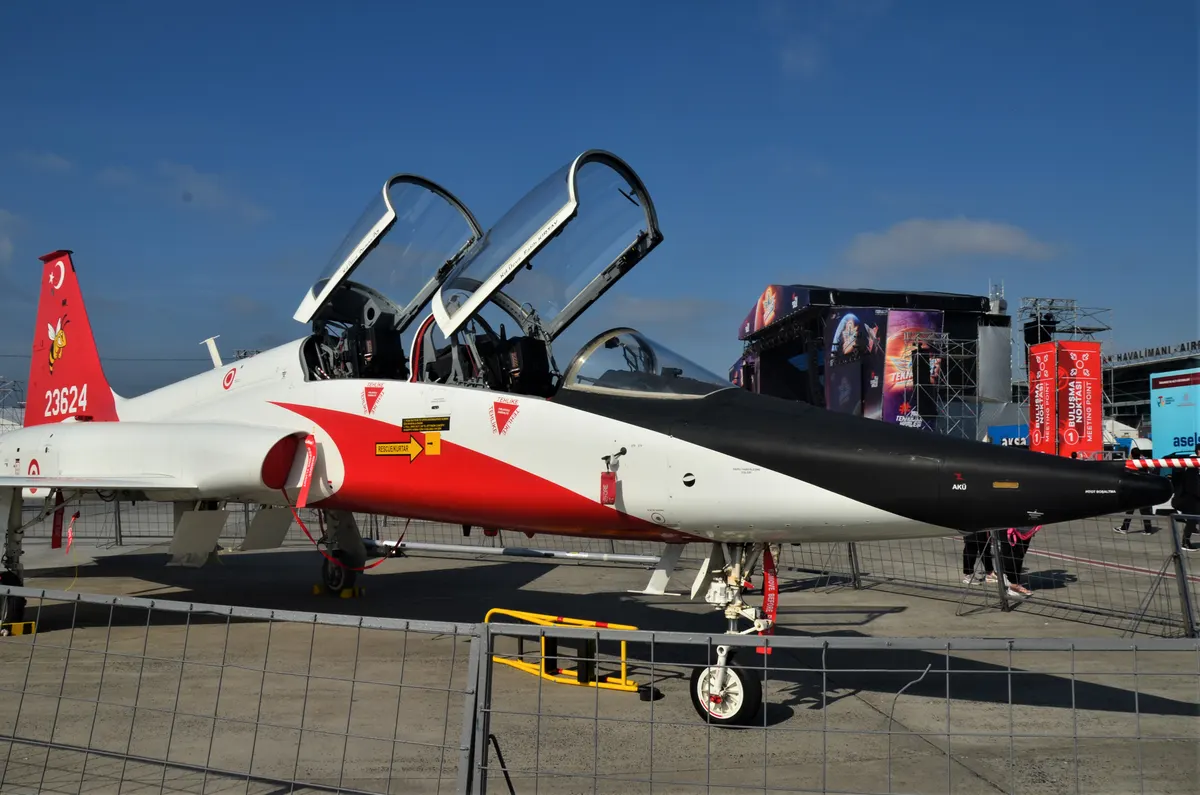
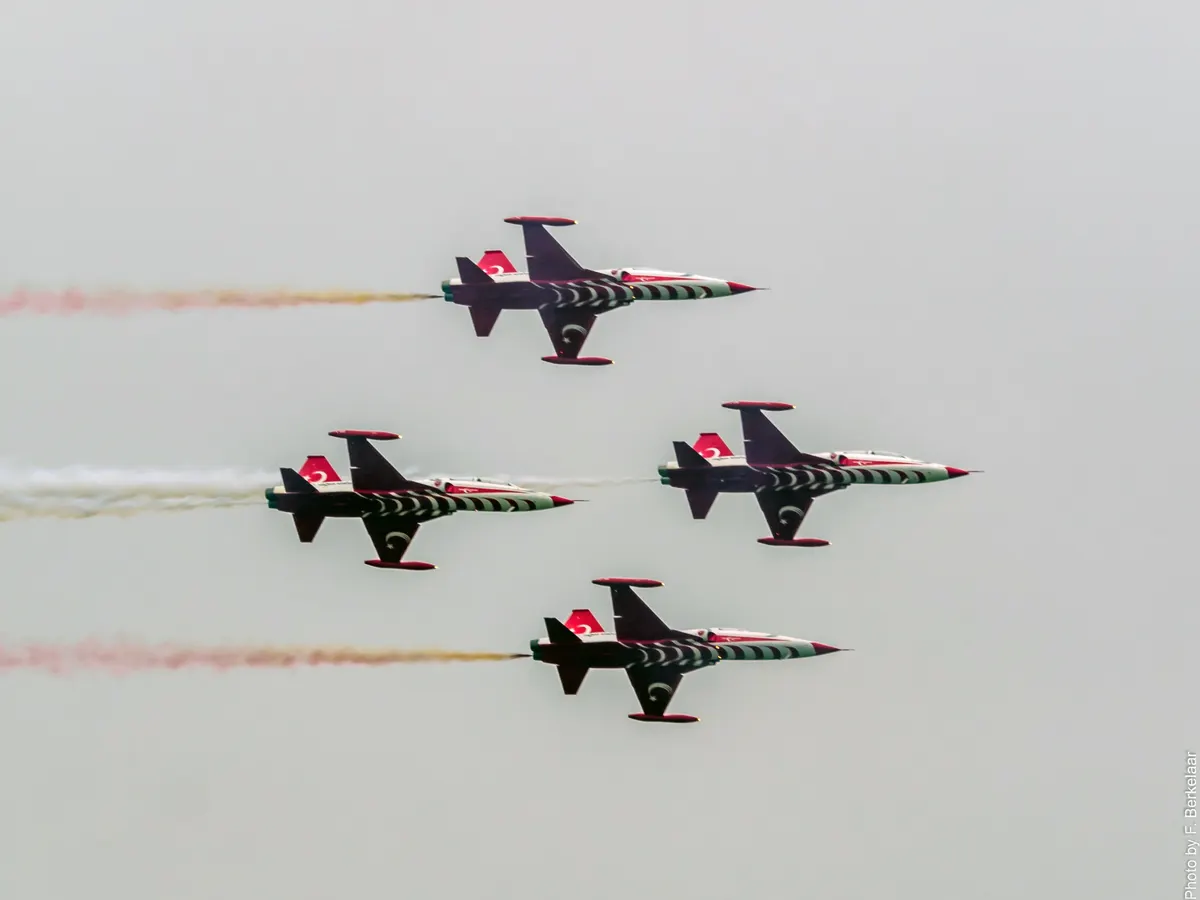
Below KAAN sits TUSAŞ Hürjet, a single-engine, tandem-seat supersonic jet trainer and light attack aircraft, TAI's first clean-sheet aircraft design rather than a licensed derivative. The first prototype flew on 25 April 2023, and the Turkish Air Force plans to use Hürjet to replace its aging Northrop T-38 trainers while also handing the type to its Turkish Stars aerobatic display team.9
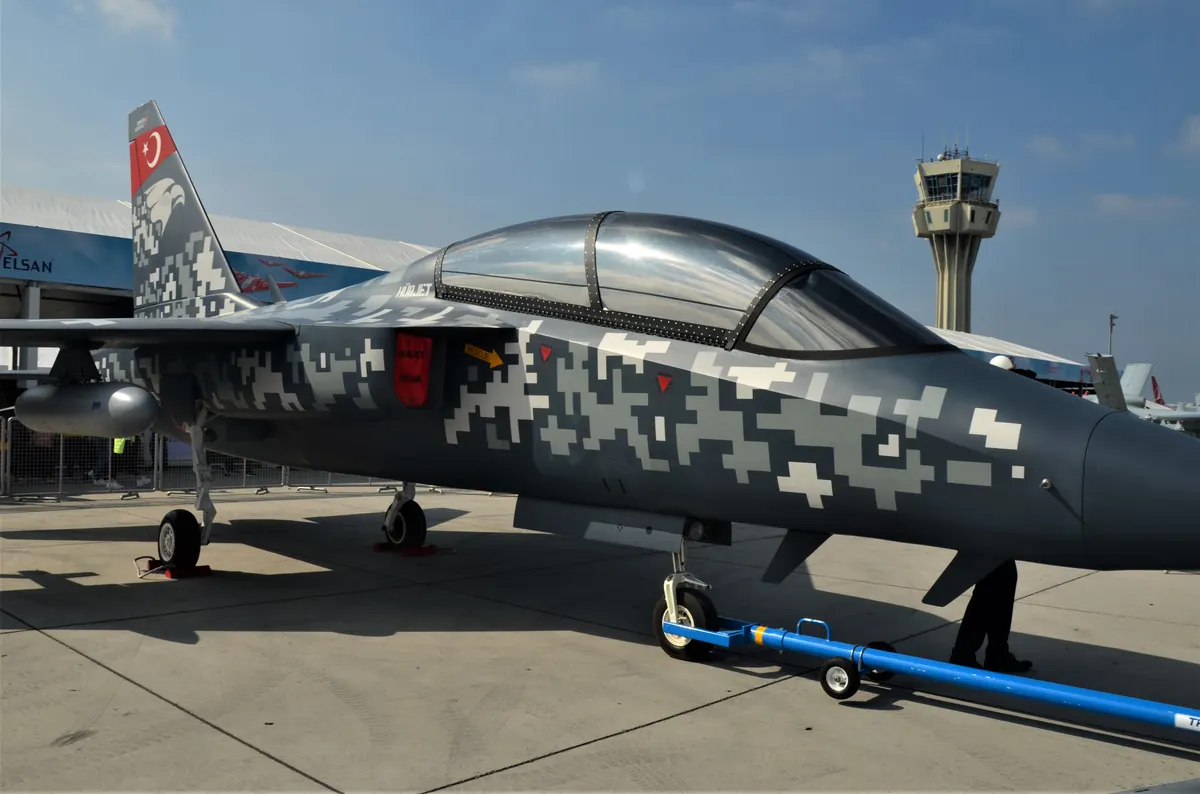
Hürjet lost its first export competition, an 18-aircraft Malaysian tender won by South Korea's Korea Aerospace Industries with its FA-50, but recovered with a much larger win. In October 2025 Spain approved a 3.1 billion euro contract for 45 Hürjet aircraft, with the first batch to be assembled in Turkey from 2028 and the remainder finished domestically by Spanish industry.10 For basic and armed training below Hürjet, TAI also builds TAI Hürkuş, a propeller-driven trainer that first flew in 2013 and has since been developed into armed light-attack variants for both the Turkish Air Force and export customers.1
In helicopters, TAI's main combat type is the TAI/Leonardo T129 ATAK, a licensed and heavily modified derivative of the A129 Mangusta built under an agreement with Italy's Leonardo, formerly AgustaWestland.1 TAI has also flown two heavier, fully indigenous attack helicopter prototypes, the twin-engine T929 ATAK-2, which first flew on 28 April 2023, and the smaller T629, which has not yet flown. In July 2025 TAI placed the T929 program on temporary hold, citing a shift in Turkish Armed Forces priorities toward utility helicopters instead of additional attack types, leaving both heavier programs without a confirmed production date.22
For utility and transport work, TAI builds the TAI T925, a heavier twin-engine utility helicopter, alongside the lighter twin-engine T625 Gökbey, which first flew in September 2018 and began deliveries to Turkish security forces in October 2024.19
TAI's unmanned aircraft line runs from the TAI Anka, a medium-altitude long-endurance reconnaissance drone in service since 2010, up to the larger, twin-engine Aksungur, an enlarged Anka derivative that entered service in 2019 and has since been fielded carrying two smaller Süper Şimşek strike drones under its wings, an armed evolution of TAI's original Şimşek target drone family.18 TAI Şimşek itself began life as a turbojet-powered target drone for anti-aircraft gunnery and missile training, developed between 2009 and 2012.1 TAI is also developing the Anka-3, a stealthy, jet-powered flying-wing unmanned combat aircraft, and continues to build the older Turna Drone, a smaller target drone used for live-fire training.20 Beyond weapons platforms, TAI's space division has built the Göktürk-1 and Göktürk-2 earth-observation satellites and is developing the Türksat 6A communications satellite, work that sits outside this catalog of tracked weapon systems but draws on the same engineering base.1
04 / Trade & Deals · 4 deals
TAI's export book has grown quickly and unevenly across programs. The Indonesia Kaan order, 48 aircraft for roughly $10 billion signed in 2025, is by far its largest, and is planned for delivery with Turkish-built engines roughly a decade after the contract takes effect.7 The Hürjet deal with Spain, 3.1 billion euros for 45 aircraft, is TAI's first trainer export and its first major sale into a NATO ally with its own aerospace industry, with Airbus and other Spanish firms handling final assembly and additional local manufacture of later-batch aircraft.10
The T129 ATAK helicopter carries TAI's most geographically varied export record. The Philippines ordered six T129s under a $269 million government-to-government deal signed in 2020, with deliveries completed by 2024.15 Nigeria ordered six more in 2022, receiving its first pair in November 2023.14 Pakistan's 2018 order for 30 T129s, worth roughly $1.5 billion and intended to replace Pakistan's AH-1F Cobra fleet, was never delivered. The United States refused to license the helicopter's engines after Turkey's purchase of Russian S-400 air defense systems triggered CAATSA sanctions, and the contract has sat blocked ever since. It is the clearest example of how U.S. engine controls can override an otherwise completed TAI export contract.16
On the supply side, TAI depends heavily on foreign propulsion. General Electric supplies the F110 engines powering both Turkish F-16s and early KAAN prototypes through the TEI joint venture, and GE Aerospace and TAI extended that partnership for another 25 years in 2024.17 TAI has also begun exporting the relationship the other direction, supplying composite aircraft structures to Airbus and Boeing commercial programs from its Kahramankazan composite plant.5 In November 2025 TAI signed a memorandum of understanding with the United Kingdom's BAE Systems to pursue joint opportunities in future uncrewed aircraft systems, TAI's first substantial cooperation agreement with a British prime.23
| Year | Buyer | Product / Service | Quantity | Amount | Type | Status | |
|---|---|---|---|---|---|---|---|
| 2024 |  Indonesia | TAI Anka | 6 | — | new-build | ordered | |
| 2023 |  Algeria | TAI Anka | 10 | — | new-build | ordered | |
| 2022 |  Kazakhstan | TAI Anka | 3 | — | new-build | Delivered | |
| — | Turkey | TAI Hürkuş | 55 | — | new-build | ordered |
05 / Global Reach · 18 countries · 2 conflicts

TAI's export reach clusters around three regions rather than a single global footprint. The T129 ATAK helicopter has the broadest spread, in service with Turkey, Iraq, Pakistan, Bangladesh, the Philippines, Nigeria and Somalia, giving TAI a genuine foothold in South Asian, Southeast Asian and African attack-helicopter markets that Western primes have been slower to contest on price.1 The Anka drone family has a similar African and Central Asian tilt, operated by Algeria, Tunisia, Kazakhstan, Uzbekistan, Pakistan, Malaysia and Indonesia alongside Turkey, and has seen use in the war on terrorism, the Kivu conflict, the war in the Sahel and Libya's overlapping Libyan Crisis and Western Libya campaign.1 TAI Hürkuş trainers, meanwhile, operate in Chad, Niger and Libya alongside Turkey, reflecting TAI's deliberate push into African security partnerships for lower-cost, propeller-driven platforms.1
Fighter and trainer exports remain much narrower for now. Turkey itself is still Kaan's only confirmed operator ahead of Indonesian deliveries roughly a decade out, and Hürjet has yet to fly for any export customer while its own Turkish Air Force deliveries and Spanish production ramp-up proceed in parallel.9 That narrower footprint is itself instructive. TAI's rotary-wing and unmanned lines are years ahead of its fixed-wing combat aircraft in actual export deployment, even though KAAN and Hürjet draw most of the public attention.


06 / Competition
TAI's most direct rival is domestic. Baykar, maker of the Bayraktar TB2 and Akıncı drones, is the world's largest exporter of large military drones by volume, a title TAI has never held despite building its own Anka and Aksungur lines.24 The two are frequently grouped together in industry rankings, both companies made FlightGlobal's Top 100 aerospace list in 2024, TAI at 38th and Baykar at 49th, yet they compete for very different customers.4 The rivalry sharpened in March 2025 when Leonardo, TAI's own helicopter-program partner on the T129 ATAK, agreed to a separate joint venture with Baykar to build drones for the European market, putting TAI's licensor into direct competition with TAI's biggest domestic rival.24
Internationally, KAAN competes for long-term influence against the American fifth-generation programs built by Lockheed Martin and Boeing, the same primes that originally supplied and still license the F-16 technology TAI's own industrial base was built on. Hürjet competes directly against Korea Aerospace Industries's FA-50 family, which beat Hürjet to Malaysia's trainer contract in 2023 before TAI recovered with the Spanish order, and against Leonardo's M-346 in the broader advanced jet trainer market. In the propeller-driven trainer and light attack segment, TAI Hürkuş competes with Embraer's A-29 Super Tucano for many of the same African and Latin American customers. TAI's core competitive advantage across these contests is price and state-backed financing rather than combat pedigree. Most of its platforms are recent designs, without the decades of combat use that its Western and Korean rivals can point to.
Baykar Boeing
 Embraer
 Korea Aerospace Industries
 LeonardoLockheed Martin
Company website: https://www.tusas.com
- "Turkish Aerospace Industries", Wikipedia — en.wikipedia.org ↩
- "Turkey - F-16 Peace Onyx", GlobalSecurity.org — globalsecurity.org ↩
- "5 Turkish companies among world's Top 100 defense firms", Hürriyet Daily News — hurriyetdailynews.com ↩
- "Türkiye's TAI and Baykar join global elite in aerospace, ranked among top 50", Anadolu Agency — aa.com.tr ↩
- "Turkish aerospace giant TAI to soon open world's 4th largest composite factory", Daily Sabah — dailysabah.com ↩
- "TAI TF Kaan", Wikipedia — en.wikipedia.org ↩
- "Breaking News, Türkiye secures $10 Billion KAAN Stealth Fighter Jet export to Indonesia in largest defense deal ever", Army Recognition — armyrecognition.com ↩
- "Indigenous Turkish TF35000 Engine To Power Kaan Fifth-Generation Stealth Fighter", Army Recognition — armyrecognition.com ↩
- "TAI Hürjet", Wikipedia — en.wikipedia.org ↩
- "Big Victory For Turkey's Hurjet Aircraft, After Malaysian Setback, TAI Wins Maiden Export Order From Spain", The EurAsian Times — eurasiantimes.com ↩
- "Turkish Aerospace Industries (TAI) To Supply Six T-129 ATAK Helicopters To Nigeria", Overt Defense — overtdefense.com ↩
- "Philippine Air Force Receives Last Two of Six Turkish T129 Attack Helicopters", The Aviationist — theaviationist.com ↩
- "Denied To Pakistan, PAF Receives Last Set Of 'State-Of-Art' T-129 ATAK Helicopters From Turkey", The EurAsian Times — eurasiantimes.com ↩
- "GE and TAI Extend Tusas Engine Industries, Inc. Joint Venture for Another 25 Years", GE Aerospace — geaerospace.com ↩
- "TAI Aksungur", Wikipedia — en.wikipedia.org ↩
- "TAI T625 Gökbey", Wikipedia — en.wikipedia.org ↩
- "TAI Anka-3", Wikipedia — en.wikipedia.org ↩
- "Our First Clear Look At Turkey's New T929 Heavy Attack Helicopter", The War Zone — twz.com ↩
- "Turkey's TAI, UK's BAE Systems join forces for collaborative drone 'opportunities'", Breaking Defense — breakingdefense.com ↩
- "Italy's Leonardo and Turkey's Baykar ink agreement for UAV joint venture", Breaking Defense — breakingdefense.com ↩