

01The Problem the Jet Age Created
When the first operational jet fighters entered service in the closing months of the Second World War, air forces discovered a training gap that piston-engine instruction had never had to address. A pilot who had learned to fly on a propeller-driven primary trainer and then advanced through a propeller-driven advanced type arrived at his first jet fighter having never experienced the aircraft's basic handling characteristics: none of the propeller torque he had learned to counter on takeoff, but an unfamiliar high-speed stall and stability regime, and — critically — a turbojet that spooled up and down far more slowly than a piston engine's throttle response, punishing any pilot who added power late on approach. Lockheed's P-80 Shooting Star, the United States' first operational jet fighter, ran up a jet-transition accident rate serious enough that Lockheed stretched the P-80C's fuselage by 38.5 inches to add a second cockpit and an instructor, producing the aircraft that opens the next section of this article and effectively created the jet trainer as a distinct category of military aircraft.1

That single decision, convert an existing fighter rather than design something new, established one of two philosophies that recur throughout this article. The other, building a docile aircraft from a clean sheet with no fighter ancestry at all, would not appear until a French manufacturer flew its own butterfly-tailed design in the early 1950s, discussed below. Every jet trainer this article surveys descends from one of those two decisions, and the tension between them, cost and parts commonality favoring a fighter conversion, safety margin and syllabus control favoring a clean-sheet design, shaped procurement choices on every continent for the next seven decades.
The jet trainer's place in the training pipeline is best understood as the middle rung of a three-step ladder. A student begins on a propeller-driven aircraft, the propeller trainers class, learning basic airmanship, aerobatics, and instrument flying at low speed and low cost. The jet trainer then introduces the handling qualities, cockpit workload, and approach-and-landing discipline of a jet without the expense of an operational combat type; it is typically where a student first flies with an ejection seat, first manages an engine's spool-up lag on approach, and first meets transonic compressibility effects at altitude. Above the jet trainer sits the advanced (lead-in) jet trainer class, supersonic aircraft fitted with radar and simulated weapons systems that bridge the gap to a genuine fighter type. The aircraft covered here occupy the middle of that ladder, and have historically been asked to do two additional jobs beyond training: serve as light-attack aircraft when a nation cannot afford a dedicated strike type, and serve as the airframe on which a nation's own aerospace industry cuts its teeth.
The scale of the resulting fleet is difficult to overstate. Well over ten thousand jet trainers of the types surveyed here were built across four decades of peak production, from the mid-1950s through the late 1980s, by manufacturers on every side of the Cold War divide and by nations that aligned with neither bloc. Some of those designs became the most numerous jet aircraft of any type their respective blocs ever fielded. Others, covered in the later sections of this article, never left the prototype stage at all, killed by a competitor, a cancelled requirement, or a war that ended before the aircraft was ready. The sections that follow trace both outcomes, in roughly the order the underlying engineering and political choices actually occurred.
01The First Answer: A Second Seat in a Fighter
Lockheed's solution to the P-80's accident problem, the Lockheed T-33 Shooting Star, first flew on 22 March 1948 and became, by any measure, the most successful jet trainer conversion in history. Fitted with a single Allison J33-A-35 turbojet rated at roughly 5,400 pounds of thrust, it reached a total production run of 6,557 airframes, 5,691 built by Lockheed itself, 656 built under licence by Canadair, and 210 by Kawasaki, and it went on to serve with twenty-five to thirty air forces on every inhabited continent.1 Bolivia flew its last examples in active military service to 31 July 2017, a sixty-nine-year type career. The airframe saw combat in markedly different contexts: Cuban-flown T-33s took part in the defense against the Bay of Pigs invasion in April 1961, and Indonesian T-33s flew counter-insurgency missions over East Timor between 1976 and 1980.1
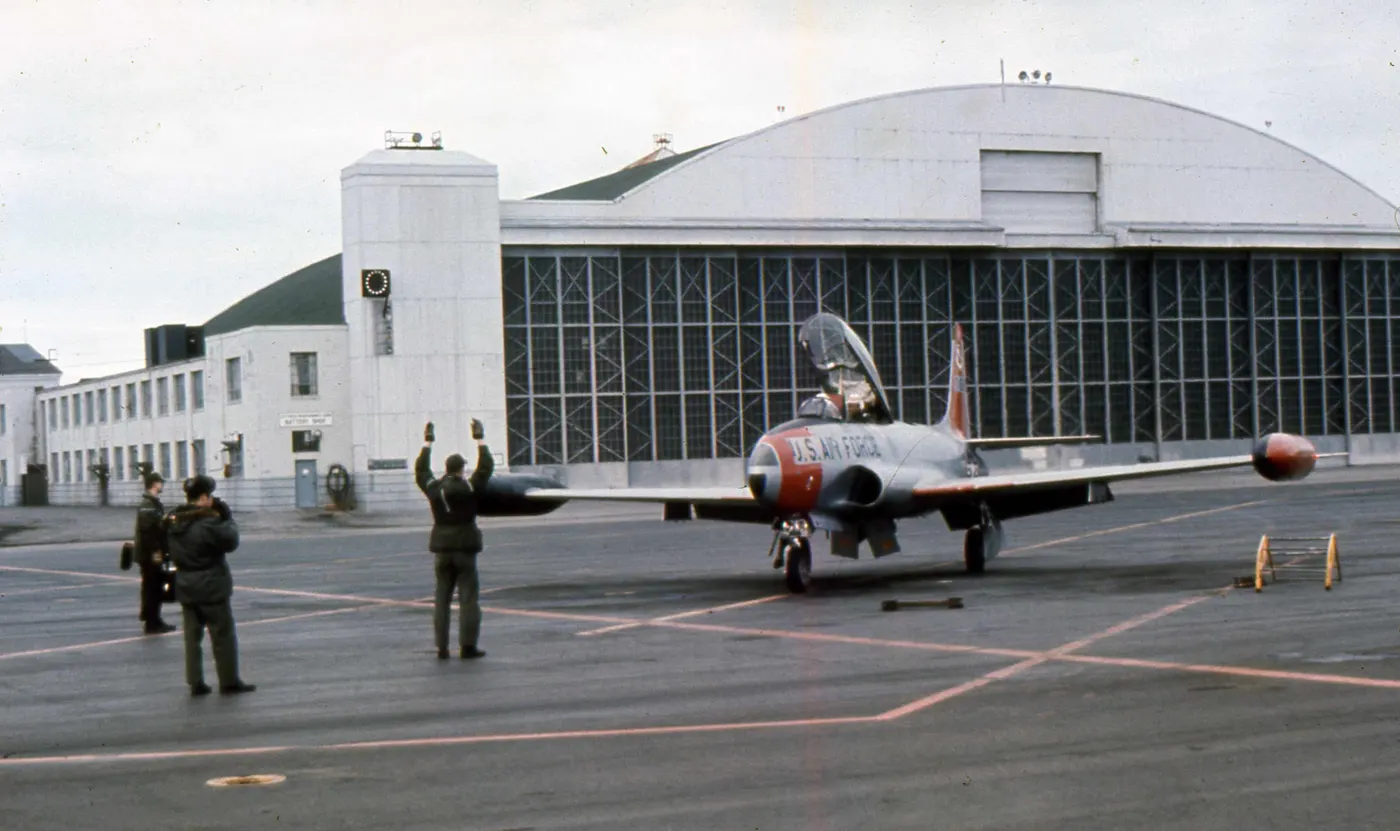
The airframe's success generated a family of specialised derivatives, each answering a need the basic T-33A could not. The US Navy's T-33B was simply 649 Burbank-line airframes diverted to naval instrument training and redesignated three times, TO-2, then TV-2, then T-33B, over fourteen years without any real change to the aircraft, since it was never made carrier-capable. The genuine naval redesign was the T2V-1 SeaStar, which added an arrestor hook, catapult fittings, boundary-layer control over the flaps, and leading-edge slats, at the cost of a roughly 43 percent increase in empty weight; only 150 of an intended 390 were built before the type, redesignated T-1A SeaStar in 1962, left service by 1970. At the other end of the airframe's career, surplus T-33As were converted from the 1960s into the full-scale unmanned QT-33A target drone, flown from Point Mugu and China Lake; the type's best-documented moment came on 21 November 1973, when a single F-14 fired all six of its Phoenix missiles at three QT-33A drones and three BQM-34 Firebee targets in a "six-on-six" test, destroying two of the three QT-33As outright. Canada's own line produced 656 airframes as the CT-133 Silver Star, built with a licence-manufactured Rolls-Royce Nene engine from Orenda Engines of Ontario; one Silver Star, converted into an ejection-seat testbed, remained in Canadian service until 26 April 2005, outlasting every other T-33 variant the Royal Canadian Air Force flew.2
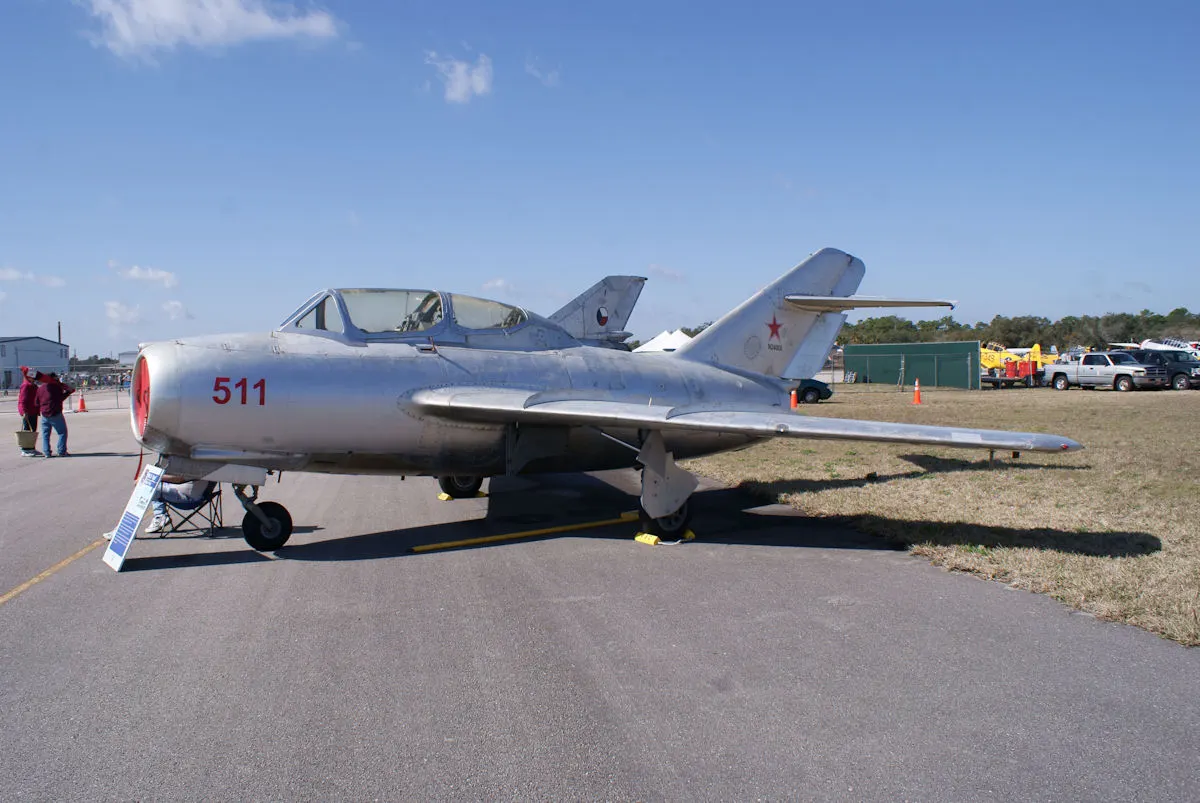
The Eastern bloc answered the identical requirement at comparable scale. The MiG-15UTI, first flown in January 1949 and built to at least 5,446 examples across Soviet and Czechoslovak production lines, became the Warsaw Pact's sole advanced jet trainer for two full decades, because no factory-built two-seat trainer version of the later MiG-17 or MiG-19 was ever produced.3 Its most consequential flight had nothing to do with training doctrine: Yuri Gagarin, the first human to fly in space, died in a MiG-15UTI crash near Moscow on 27 March 1968.
China's Guizhou JJ-5 took fighter-conversion logic to its extreme: rather than modify one existing airframe, Chengdu Aircraft Factory combined a MiG-15UTI-derived cockpit, a MiG-17-derived fuselage, and a de-rated fighter engine into a single new trainer, fielding 1,061 examples from 1967 and exporting the type as the FT-5 to roughly a dozen air forces, including Pakistan, which flew it for thirty-six years.4
01The Clean Sheet and the Cockpit Argument
The clean-sheet philosophy produced its first, and most influential, expression in France. The Fouga CM.170 Magister first flew on 23 July 1952, entered French Air Force service in 1956, and eventually reached 868 airframes: 576 for France, 194 for West Germany, 62 for Finland, and 36 assembled in Israel as the IAI Tzukit.5 Its distinctive butterfly-shaped V-tail was inherited directly from an earlier Fouga glider design rather than developed for the trainer itself. The type saw genuine combat far more often than a pure trainer typically does: a single Katangese Magister, nicknamed the "Lone Ranger," flew ground-attack missions during the 1961 Congo Crisis, and Israel committed roughly forty-four Magisters to Operation Focus on 6 June 1967, the opening strike of the Six-Day War, in which the type was credited with destroying more than fifty tanks while losing seven aircraft and six pilots.5 El Salvador flew a dozen armed Magisters through its civil war between 1979 and 1992. The design spawned two direct derivatives: the CM.175 Zéphyr, a carrier-capable naval version of which only thirty-two were built, and which the French Navy had to qualify aboard borrowed Royal Navy carriers because no French carrier was yet available; and the CM.173 Super Magister, a single privately funded prototype with a pressurised cockpit and standard ejection seats that no air force ever ordered, losing what export market existed to the rival Aermacchi MB-326.5
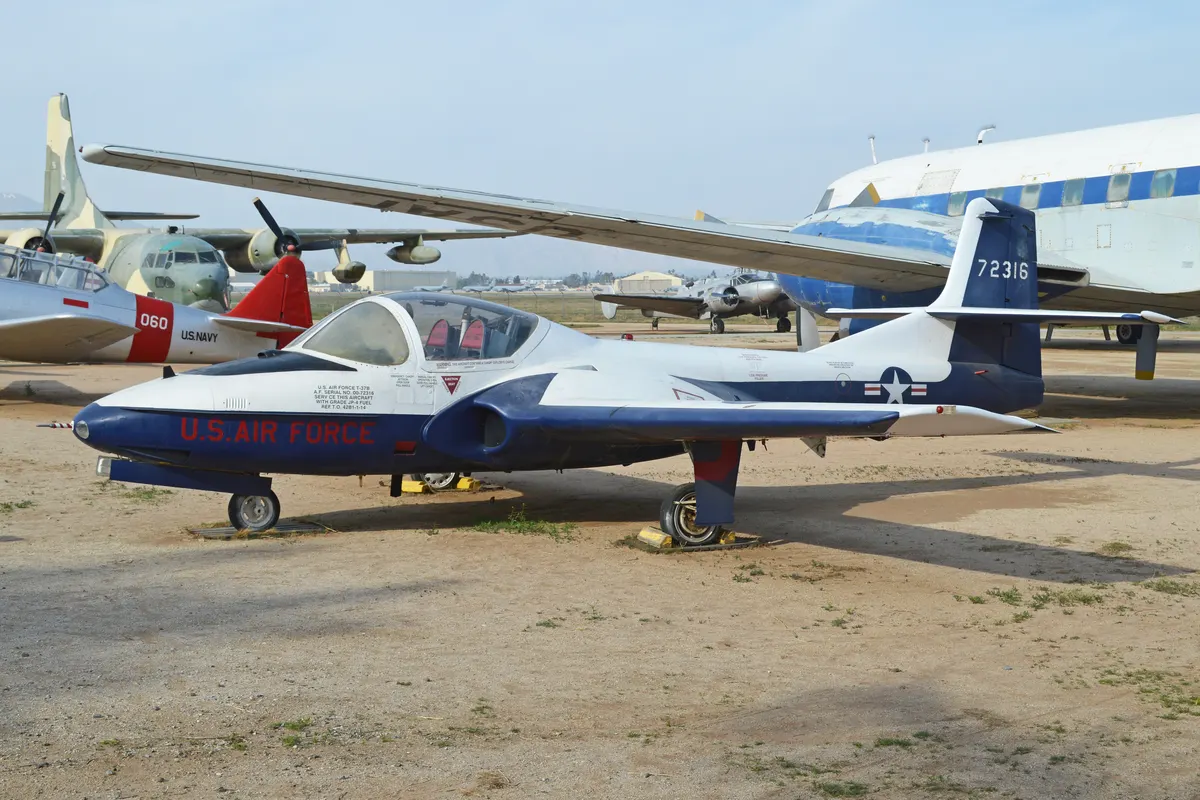
The clean-sheet path also forced a cockpit-layout argument that recurs across the whole class: tandem seating, mirroring an operational fighter's cockpit, against side-by-side seating, which lets an instructor watch a student's hands directly but sacrifices the fighter-like sight picture. The American answer was the Cessna T-37 Tweet, whose prototype, the XT-37A, first flew on 12 October 1954 after Cessna won a 1953 Air Force competition largely on the strength of its side-by-side layout; one prototype was lost to an unrecoverable flat spin that forced a tail redesign before production could proceed.6 The production T-37, nicknamed the "6,000-pound dog whistle" for the shriek of its twin Continental-Teledyne J69 engines, reached 1,269 airframes and flew alongside the Northrop T-38 Talon as the USAF's two-stage pipeline for four decades; its armed export derivative, the T-37C, added underwing pylons to 273 airframes and equipped Turkey and Brazil most heavily, with Chile pushing part of its fleet toward attack standard during the 1978 Beagle Channel crisis with Argentina, a dispute papal mediation defused before any T-37C fired a shot.6
Britain and Canada reached the same side-by-side conclusion independently. The BAC Jet Provost first flew on 26 June 1954 and reused the wings, tail, and undercarriage of the existing propeller-driven Percival Provost to hold down cost; its Viper engine had begun life as a disposable powerplant for the Jindivik target drone before Armstrong Siddeley adapted it for sustained use. Roughly seven hundred were built, and the type's 1955–56 trials with No. 2 Flying Training School are credited as the world's first complete ab-initio jet training syllabus.7 Canada's Canadair CT-114 Tutor, a self-funded private venture first flown on 13 January 1960, likewise chose side-by-side seating and went on to a long second career, discussed later in this article, as one of the world's longest-serving aerobatic display aircraft.10 Two smaller American experiments never reached production: the Temco TT Pinto, which briefly demonstrated all-through jet training with no prior propeller time before the Navy shut the trial down after fifteen airframes, and the Peregrine 600, a later Gulfstream design that lost the Air Force's Next Generation Trainer competition to a rival that itself never reached squadron service.11
01The Eastern Standard
Where NATO air forces tolerated national variety, the Warsaw Pact ran a formal, centrally judged competition, and the result shaped Eastern-bloc training for the rest of the Cold War. The Aero L-29 Delfín, designed in Czechoslovakia and first flown in 1959, won the 1961 Warsaw Pact trainer trials over Poland's own PZL TS-11 Iskra and the Soviet Yak-30, and the decision made it the standard jet trainer of the entire alliance: roughly 3,665 were built between 1963 and 1974, more than 2,000 of them delivered to the Soviet Union alone, with Iraq taking 78 for its own air force.12

The L-29 fought more wars than its role suggests. Nigeria pressed the type into improvised strike missions during its 1967–70 civil war, Egypt used it against Israeli armor in 1973, and Azerbaijan lost fourteen of eighteen L-29s in the Nagorno-Karabakh conflict. Iraq later converted surplus airframes into unmanned drones under its Al Bay'ah program during the UN sanctions period, a conversion Western intelligence assessed as a possible means of dispersing chemical or biological agents.12 Poland accepted its trials defeat but never stopped building its own design: the PZL TS-11 Iskra, first flown 5 February 1960, remained in production to 1987 across 424 airframes and became the only self-designed jet aircraft Poland ever built in quantity, flying in Polish service until December 2020. Its sole export customer, India, flew fifty from 1975 and used armed examples over Srinagar during the 1999 Kargil War to intercept slow-moving reconnaissance drones.13
The L-29's eventual successor became the most numerous jet trainer ever built. The Aero L-39 Albatros first flew on 4 November 1968 and entered production in 1971, fitted with the Ivchenko AI-25TL, the first turbofan engine used on any jet trainer, which cut fuel burn roughly 30 percent and noise roughly 15 decibels against the L-29.14 Aero Vodochody built approximately 2,900 of them for more than forty-four countries, including over 2,000 for the Soviet Union alone, and the type never received a NATO reporting name because Western intelligence classified it purely as an unarmed trainer rather than a combat aircraft. Roughly 300 L-39s now fly on the United States civil register, more than any other jet warbird type, forming the backbone of the Reno Jet Class since 2002; a re-engined L-39NG variant with a Western Williams FJ44 turbofan led the Czech Air Force to order eight examples in November 2022. An armed derivative, the L-39ZO Albatros, added two extra hardpoints and found buyers in Libya, Syria, and East Germany; Libya lost more than a dozen at Ouadi Doum during the 1987 Chadian-Libyan War, and a Turkish F-16 shot down a Syrian L-39ZO over Idlib on 3 March 2020, a rare instance of an air-to-air kill against a jet trainer.14 A stretched, more heavily armed development, the L-59 Super Albatros, sold in smaller numbers to Egypt and Tunisia; Tunisia's fleet flew border patrols during the 2011 Libyan war and struck militants at Mount Chaambi in April 2014 before retiring in favor of the Beechcraft T-6C Texan II.14
China filled the same market niche outside the Warsaw Pact framework. The Hongdu JL-8 / K-8 Karakorum, developed jointly with Pakistan and first flown 21 November 1990, was forced through a mid-program engine swap from an American Garrett TFE731 to a Ukrainian Ivchenko-Progress AI-25TLK after the post-Tiananmen US arms embargo cut off the original supplier; more than 735 have been built for roughly fifteen air forces, and China states that the type equips roughly 80 percent of Africa's jet trainer fleets.15
01One Airframe, Two Jobs: The Armed Trainer
The trainer/light-attack crossover exploited a simple economic logic: an air force that could not afford a dedicated strike aircraft could arm its existing trainer fleet instead, accepting reduced payload and speed in exchange for avoiding a second procurement program entirely. Aermacchi's MB-326, first flown 10 December 1957 and named in part for its designer Ermanno Bazzocchi, became the clearest test of that logic: roughly 800 were built across Italian and licensed production, and a single-seat attack derivative carried twin 30mm cannon and six hardpoints.16 Australia built ninety-seven as the MB-326H, flying them without ever developing an armed variant of its own, until a wing separated in flight during a 1990 high-g manoeuvre and forced the fleet to be re-winged. Brazil's Embraer built 182 as the EMB-326 Xavante, the company's first jet aircraft, logging more than 500,000 flight hours over roughly thirty-eight years before transferring eleven surplus airframes to Argentina after the 1982 Falklands War, to help rebuild a squadron that had fought in that conflict.16
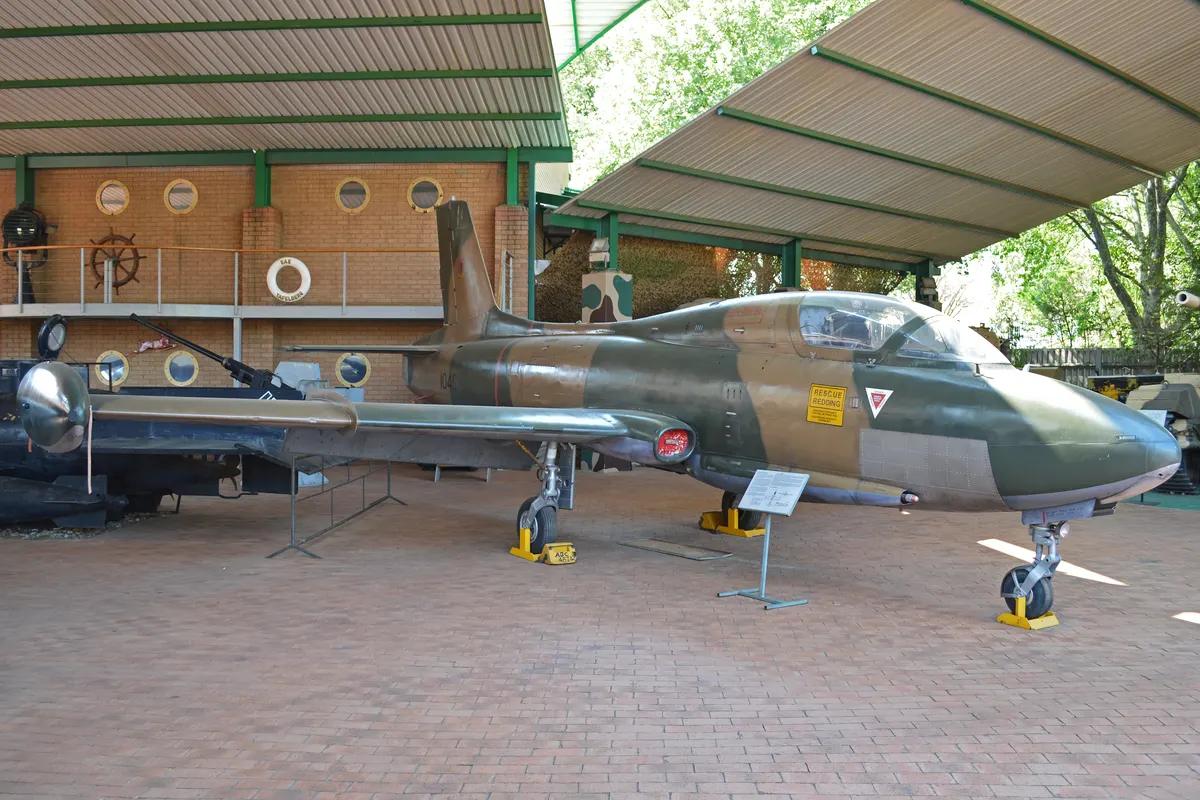
South Africa's licence-built line produced the class's most consequential combat record. The two-seat Impala Mk I, based on the MB-326M, fed pilots toward South Africa's Mirage fleet and toward the single-seat Atlas Impala Mk II attack version, armed with twin 30mm DEFA cannon and, later, a locally developed helmet-cued infrared missile. South Africa had signed its production licence in 1964, three years before a 1977 United Nations arms embargo made the domestic line essential rather than merely convenient. In September 1985, during the South African Border War, Impala Mk IIs shot down six Angolan and Cuban helicopters near Mavinga using cannon fire alone in two separate engagements, though South African authorities publicly credited the kills to missiles instead, to obscure how far from base the aircraft had actually ranged.17 At least one Impala survived a direct hit from an SA-7 missile that lodged, unexploded, in its jetpipe and still made it home.
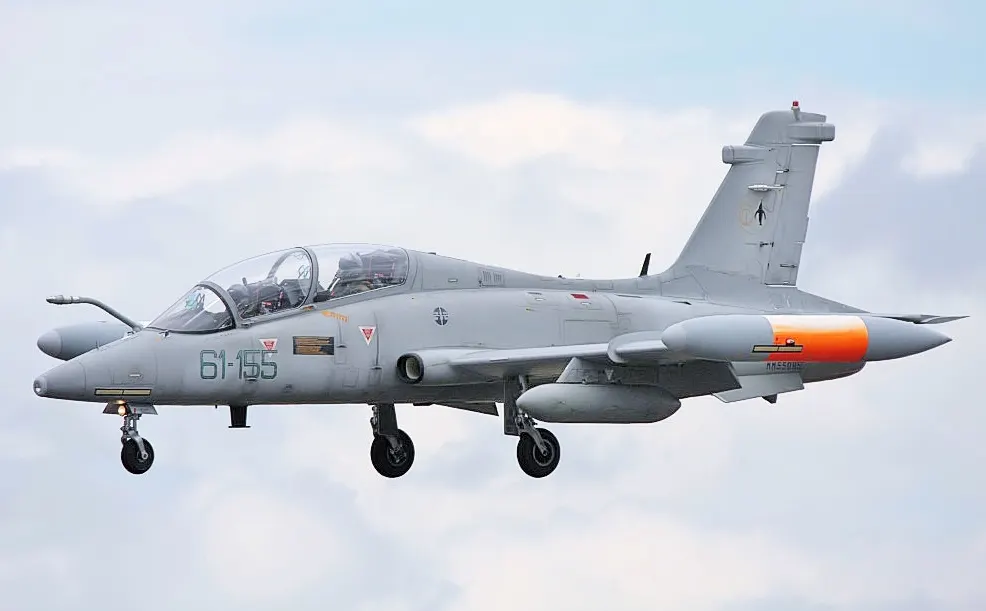
Aermacchi's follow-on design, the MB-339, first flown 12 August 1976, raised the rear cockpit to fix the MB-326's poor aft visibility and reached roughly 230 airframes. Argentine Naval Aviation flew ten of them in the 1982 Falklands War; an MB-339A strafed the frigate HMS Argonaut on 21 May 1982, and a British Blowpipe missile downed one at Goose Green, the war's only confirmed Blowpipe kill.18 Britain answered the same armed-trainer logic with the BAC Strikemaster, an armed development of the Jet Provost fitted with a more powerful Viper engine, four hardpoints, and twin machine guns; 146 were built for eleven air forces, and Strikemaster strafing runs are credited with breaking a several-hundred-strong guerrilla assault on a thirty-man garrison at the Battle of Mirbat, Oman, on 19 July 1972.8
Yugoslavia pursued the same crossover under nonalignment rather than bloc discipline. The Soko G-2 Galeb, Yugoslavia's first mass-produced jet, reached 248 airframes built around a licensed Viper engine and found its largest export customer in Libya, which sent Galebs alongside Jastrebs and MiG-21s flown by Serbian contract pilots to support Mobutu's government in the First Congo War of 1996–97; a French Rafale destroyed a Libyan Galeb near Misrata on 24 March 2011, one of NATO's earliest kills of that intervention.19 Its swept-wing successor, the Soko G-4 Super Galeb, reached only 85 airframes before the Mostar plant closed amid Yugoslavia's breakup; NATO's 1999 Kosovo bombing campaign destroyed roughly half the pre-war fleet on the ground within weeks.19
India, Italy, Taiwan, and Sweden each built their own entry into this category. India's HAL Kiran reached roughly 250 airframes from 1964 and remains, in 2026, the longest-serving jet in the Indian Air Force's training fleet, more than sixty years after its first flight.20 Italy's SIAI-Marchetti S.211, a private-venture design powered by a lightly militarised business-jet turbofan, found only three military customers and lost the 1995 US JPATS competition to the T-6 Texan II. Taiwan's AIDC AT-3 Tzu Chung, built with Northrop technology transfer, kept two single-seat attack prototypes armed with anti-ship missiles on alert during the 1995–96 Third Taiwan Strait Crisis. Sweden's Saab 105, flown as the Sk 60 with side-by-side seating and twin-engine redundancy, achieved a roughly 95 percent pilot graduation rate and flew for both Sweden and Austria into the 2020s without ever seeing combat.21
01The Display Circuit
Jet trainers dominate the world's aerobatic display teams for a straightforward reason: a team needs an aircraft cheap enough to fly hundreds of display sorties a year, docile enough for close-formation work, and available in a fleet large enough that losing one airframe to an accident does not end the program. France's Fouga Magister flew with the Patrouille de France from 1964 until 1980, when the team transitioned to the twin-engine Alpha Jet, a French-German joint design first flown on 26 October 1973 whose two-engine layout was a deliberate German requirement imposed after a wave of single-engine Lockheed F-104 Starfighter losses. Two Patrouille de France Alpha Jets collided during a display rehearsal on 25 March 2025; all four crew ejected safely.22 Canada's Canadair CT-114 Tutor has flown with the Snowbirds since 1971, completing more than 2,700 displays before an estimated 140 million spectators ahead of a planned retirement after the 2026 season, the aircraft's sixty-third year of service.10
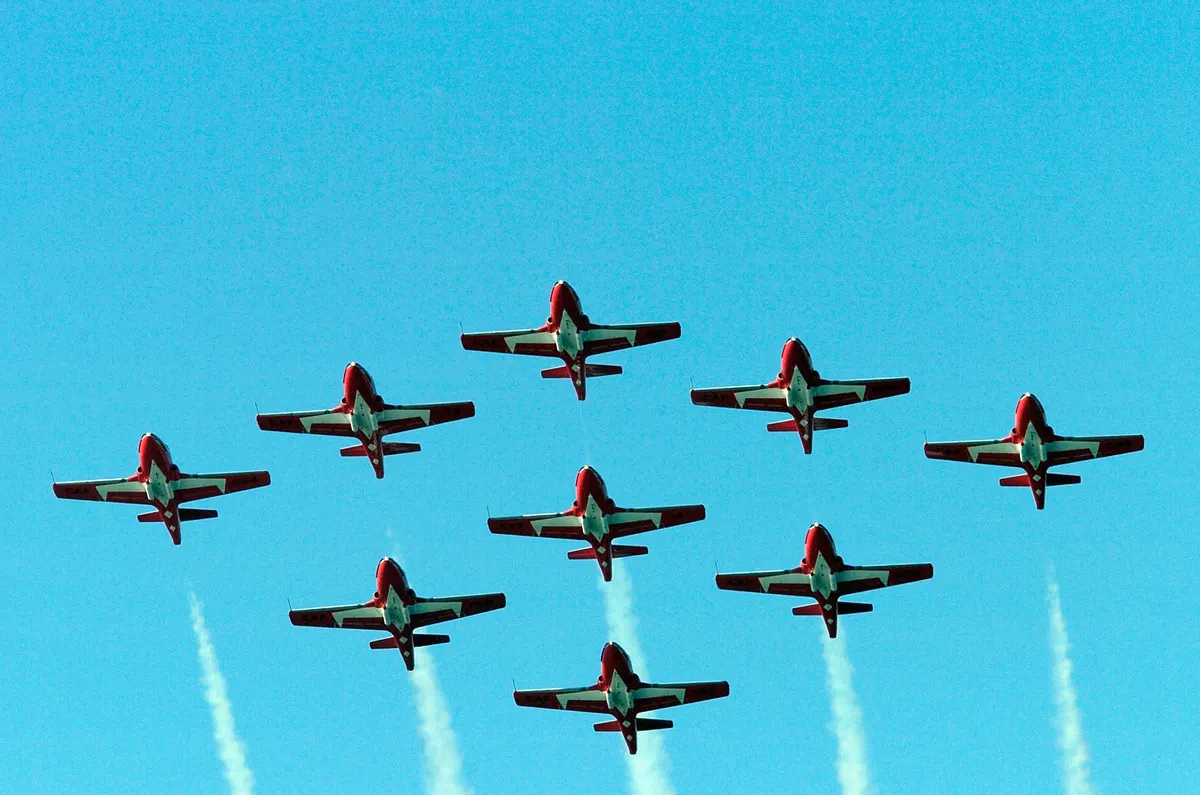
Italy's MB-339 has equipped the Frecce Tricolori, whose worst accident, a mid-air collision of three aircraft during a display at Ramstein, Germany, on 28 August 1988, killed seventy people on the ground and remained the deadliest airshow accident in history until 2002.18 Britain's team took a different path: the Folland Gnat, a lightweight fighter design the RAF adopted only in its two-seat T.1 trainer form, flew with the Red Arrows from 1965 to 1979, prized for a roll rate reportedly exceeding 360 degrees per second. India separately licence-built more than two hundred Gnats at Bangalore from 1962 and flew them in combat against Pakistani F-86 Sabres in the 1965 and 1971 wars, earning the nickname "Sabre Slayer"; an independent postwar review confirmed six of ten claimed 1965 kills, and Flight Officer Nirmal Jit Singh Sekhon earned India's only airman Param Vir Chakra flying a Gnat in the defense of Srinagar on 14 December 1971.9
Spain's CASA C-101 Aviojet, first flown 27 June 1977 with West Germany's MBB and the United States' Northrop contributing the tail and wing respectively, flew with the Patrulla Águila display team from 1985 until a final display in June 2025, having trained roughly a thousand Spanish pilots over some 285,000 flight hours.23 Taiwan's AIDC AT-3 Tzu Chung flew with the Thunder Tigers display team from November 1988 until its retirement in August 2025. Poland's PZL TS-11 Iskra flew with the Biało-Czerwone Iskry team for decades of its own six-decade domestic service life, and China's Hongdu JL-8 / K-8 Karakorum equips Pakistan's Sherdils. Across every one of these programs the calculation is identical: a jet trainer fleet large enough, and cheap enough per flight hour, to absorb a full display season's wear is also, by definition, an air force's most visible recruiting and diplomatic asset.
01From Turbojet to Turbofan, and Onto the Boat
Engine technology, not airframe design, drove the jet trainer's next major transition. The Alpha Jet's twin SNECMA/Turbomeca Larzac turbofans, each rated at 13.24 kilonewtons, gave the type better thrust-to-weight and a higher operating ceiling than the rival BAE Hawk, even though the Hawk eventually outsold it, 730-plus airframes to somewhere between 480 and 512 depending on the source.22 Japan pursued turbofan-era performance even more aggressively: the Mitsubishi T-2, first flown 20 July 1971 and powered by two licence-built Rolls-Royce Adour turbofans, became the first Japanese-designed aircraft to exceed Mach 1 in level flight, reaching a top speed of roughly Mach 1.6 across ninety production airframes before its 2006 retirement.24 The design directly spawned the single-seat Mitsubishi F-1 strike fighter, and a single T-2 airframe was later converted into Japan's fly-by-wire, canard-equipped control-configured-vehicle testbed, seeding digital flight-control technology that eventually reached the Mitsubishi F-2. Its successor, the Kawasaki T-4, first flown 29 July 1985, was fitted with the Ishikawajima-Harima F3-IHI-30, one of the few complete jet engines ever designed and built entirely in Japan; 212 were produced, none exported and none armed, reflecting Japan's constitutional and export-policy constraints rather than any technical limitation. Kawasaki's own test pilots judged the subsonic T-4 more agile than the far heavier Mitsubishi F-15J it shared a flight line with.24
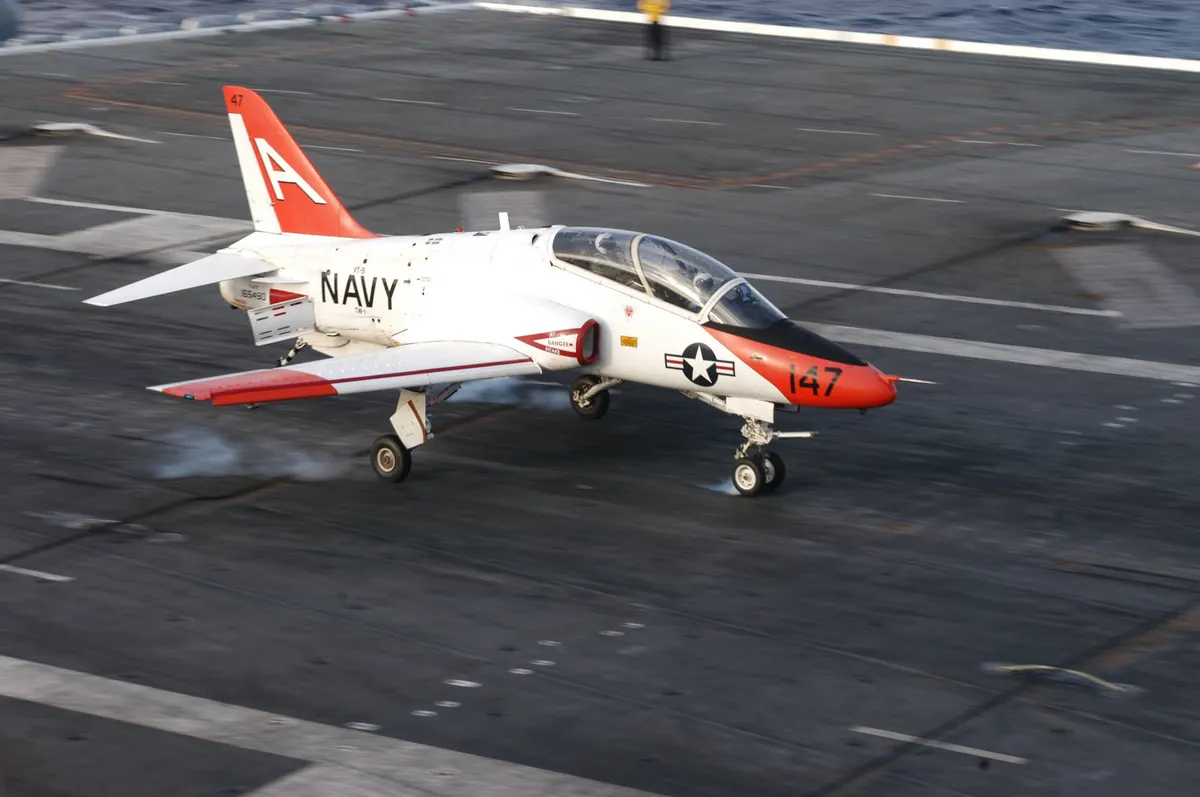
The same turbofan generation reopened the question of training pilots for carrier operations specifically, a mission distinct enough from land-based training that navies built dedicated types for it. The US Navy's North American T-2 Buckeye, first flown as the YT2J-1 on 31 January 1958, trained roughly eleven thousand naval aviators across 3.4 million flight hours and 609 airframes; its uncushioned ejection seat could not be padded at all, because any cushioning risked spinal injury during an ejection, meaning generations of instructors flew with chronic back strain as an accepted cost of the job.25 The Buckeye's replacement, the McDonnell Douglas T-45 Goshawk, adapted the British Aerospace Hawk for carrier operations, winning the 1981 VTX-TS competition over an Alpha Jet bid and entering service in 1991 as the only aircraft in the entire US inventory dedicated to carrier qualification; 221 were built. A 2017 crisis over the type's onboard oxygen-generating system saw more than a hundred instructor pilots refuse to fly until fleet restrictions were resolved, and by 2025 the Navy had begun shifting most strike-pipeline students' full carrier qualifications later in training, onto the operational F/A-18 rather than the T-45 itself, ahead of a planned 2026 replacement competition.25
Britain's Folland Gnat, covered above for its combat and display record, belongs in this technical lineage too: the RAF's decision to adopt only its two-seat trainer form, never the single-seat fighter, previewed exactly the fighter-derived-trainer logic that reappears in the Goshawk's Hawk ancestry decades later. What all of these turbofan-era designs share is a role this article has not yet fully addressed: each sits at the top edge of the class covered here, immediately below the advanced (lead-in) jet trainer category, supersonic types fitted with radar and simulated weapons systems that the next tier of pilot training actually requires.
01The Sovereign Trainer
For a number of nations, building a jet trainer domestically has mattered as much for what it proves about a national aerospace industry as for what the aircraft actually does. Japan's Fuji T-1, first flown 19 January 1958, was the first Japanese-designed jet aircraft built since the Second World War; test pilot Susumu Takaoka, who flew the T-1's first flight, had also flown the first flight of Japan's first-ever jet, the wartime Nakajima Kikka, in 1945, personally bridging Japan's pre-war and post-war jet aviation.24 The larger T-1A Hatsutaka sub-variant used an imported Bristol Siddeley Orpheus engine and outperformed its domestically-engined T-1B sibling in every respect, from top speed to climb rate, an outcome that traced entirely to the single engine substitution between otherwise identical airframes. Only sixty-six T-1s were built in total, far short of a planned two hundred, because the Japan Air Self-Defense Force chose to import Lockheed T-33s instead, but the type still trained more than 33,000 jet pilots over more than forty years and directly preceded the Mitsubishi T-2 described above.24

Argentina's FMA IA-63 Pampa, first flown 6 October 1984 with West Germany's Dornier as a technical partner in the same design lineage as the Alpha Jet, never approached its planned production run of roughly 300 airframes; economic crises limited the country to an initial batch of eighteen and a second batch of only six, sixteen years later. Like Italy's S.211 and Spain's C-101, it lost the 1990s US JPATS competition, entered jointly with Vought as the "Pampa 2000," to the T-6 Texan II. A 2013 political dispute with Britain over the Falklands forced Argentina to switch the type's ejection seats from British Martin-Baker to Russian Zvezda hardware, a rare case of a geopolitical dispute reaching directly into a trainer's safety equipment.22
India's HAL Kiran, covered above for its combat-free six-decade service life, and Spain's CASA C-101 Aviojet, covered above for its display and export record, both belong to this same category of industrial coming-of-age aircraft, built domestically or under licence specifically so the sponsoring country's own aerospace sector would gain the design, production, and support experience that only a full aircraft program provides.
The most recent entrants show that the sovereign-trainer logic has not disappeared in the supersonic era. Turkey's TUSAŞ Hürjet, first flown 25 April 2023 and fitted with a single General Electric F404 engine, is supersonic, reaching Mach 1.2 in April 2025 testing, a rare capability among jet trainers, and grew directly out of a cancelled joint Turkish-American "Freedom Trainer" bid for the US Air Force's T-X competition. Spain signed a firm contract worth roughly 2.4 to 2.6 billion euros for thirty Hürjets on 28 December 2025, becoming the type's first export customer ahead of established rivals including the Leonardo M-346 and the Boeing/Saab T-7, even though, as of mid-2026, not a single Hürjet has yet entered operational squadron service anywhere.26
Iran's HESA Yasin, first flown 17 October 2019 under the earlier name "Kowsar-88" and intended to replace aging F-5B and Chengdu FT-7N trainers, remains represented by only two confirmed prototypes, one of them destroyed in a fatal crash near Firouzabad in December 2024; Iran separately imported Russian Yak-130 trainers in September 2023, a hedge widely read as a response to the Yasin's slow progress toward service.26
01The Ones That Didn't Make It
Not every jet trainer program reached production, and the reasons those programs failed are as informative as the reasons dozens of others succeeded. The Boeing Skyfox, first flown 23 August 1983, converted a surplus Canadian CT-133 airframe by replacing its single turbojet with two Garrett TFE731 turbofans, cutting fuel burn by roughly 45 percent; the project's founders included Irvin Culver, the T-33's original designer, working through a small startup, Flight Concepts Inc. The aircraft never secured a single firm order — Portugal signed only a non-binding letter of intent for twenty kits that never became a contract — because air forces by the mid-1980s preferred purpose-built new designs like the BAE Hawk or the Pilatus PC-9 over a rebuilt 1950s airframe, however re-engined. Boeing, which had taken on marketing rights in 1986, terminated the arrangement in 1987, and Flight Concepts sued Boeing for fraud and lost.11
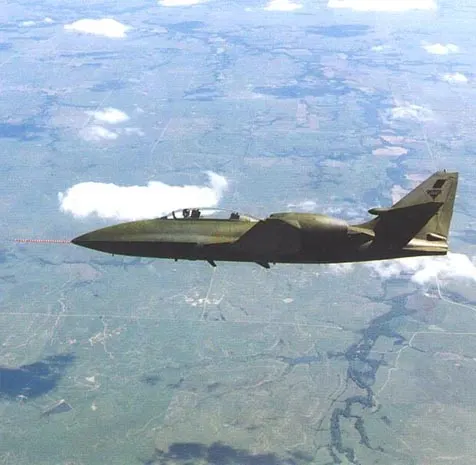
France's Microjet 200 began life not as a trainer program at all but as a flight-test demonstrator for a pair of tiny Microturbo TRS 18 turbojets originally designed for motor gliders; only four airframes were ever built, one of wood and three of metal-composite construction, and their combined thrust proved too marginal for realistic combat-representative training. France stuck with the existing Magister instead, one of the crashed 200B prototypes killed its pilot off Brittany in March 1985, and no export customer ever appeared.11 The American Gulfstream Peregrine 600 had already flown, in May 1981, before the US Air Force's Next Generation Trainer requirement was even issued, giving it real flight-test data against paper competitors — and it still lost the 1982 competition to the Fairchild T-46 Eaglet, whose own program was cancelled after only three airframes in 1986, meaning neither Next Generation Trainer contender ever equipped a single squadron. The sole Peregrine prototype crashed in November 1983, and with no order and no flying prototype left, the program was formally suspended in March 1985.11
Two designs covered earlier in this article belong in this same category of programs that solved a real engineering problem but found no buyer. The Temco TT Pinto proved, in March 1959, that a US Navy cadet could solo a jet with no prior propeller training at all, yet its roughly one-hour endurance and marginal go-around power ended the trial after only fifteen airframes — a concept the US Air Force's twin-engine T-37, with far more fuel reserve, would go on to run successfully for five decades.6 France's CM.173 Super Magister, a single privately-funded prototype with a pressurised cockpit and standard ejection seats, was in every technical respect a better aircraft than the standard production Magister, yet nobody ordered it, because the cheaper production CM.170-2 covered the same market at lower cost.5
The most recent addition to this list shows the pattern still operating in the twenty-first century. Spain's Airbus Future Jet Trainer, unveiled in October 2020 with a reconfigurable glass cockpit meant to digitally emulate the handling of the EF-18, Eurofighter, or a future Spanish combat aircraft, never advanced past a July 2020 study agreement; by March 2021 Spain admitted it had not budgeted procurement funding, and European co-funding never materialised. Airbus itself effectively abandoned the concept, signing a June 2023 memorandum with Leonardo to market the already-flying M-346 for the same Spanish requirement instead, and by December 2025 Airbus was leading a Spanish training program built around Turkey's Hürjet — meaning Airbus ended up marketing its own program's direct competitors for the exact requirement the Future Jet Trainer had been designed to fill.11 Across all of these cancelled programs, the underlying pattern is consistent: none died from an unsolved engineering problem, and every one died because the mission or the market it was built for shifted, or vanished outright, before the airframe could mature.
01What Comes Next
The jet trainer class this article has traced is, in 2026, entering its most consequential transition since the shift from turbojet to turbofan power in the 1970s. Fifth-generation fighters demand a training pipeline built around sensor fusion, data-linked situational awareness, and high sustained g-loading that none of the airframes surveyed above, designed across four decades from the 1950s through the 1980s, were built to teach. Air forces that once accepted a docile subsonic trainer as an adequate bridge to an operational fighter increasingly expect the top of the jet trainer ladder to already resemble the cockpit workload of the fighter that follows it, which is precisely the gap the advanced (lead-in) jet trainer category, covered separately, exists to close.
Turkey's TUSAŞ Hürjet illustrates both the opportunity and the risk in that transition. Its supersonic performance and its firm Spanish export order make it, on paper, the clearest example yet of a nation using a jet trainer program to establish itself as a serious combat-aircraft exporter rather than merely a training-aircraft supplier, and a carrier-capable variant reportedly in design for Turkey's planned aircraft carrier would extend that ambition further still. But the fact that the aircraft had, as of mid-2026, not yet entered operational squadron service with any customer, including Turkey's own air force, is a reminder of how much distance still separates a first flight and an export contract from a mature training fleet, a distance several of the cancelled programs traced in the previous section never managed to cross at all.
What should endure, whatever specific airframes eventually replace the Cold War-era fleet still flying today, is the underlying logic that has justified this aircraft class since the Lockheed T-33 first flew in 1948. A jet trainer exists because flight hours in an operational fighter cost far more per hour than flight hours in a purpose-built or converted trainer, and because a training accident in a cheaper, more forgiving airframe costs an air force far less, in aircraft, in trained pilots, and in political capital, than the same accident in a frontline fighter. It exists because a domestic trainer program, as the Fuji T-1, the HAL Kiran, the FMA IA-63 Pampa, and now the Hürjet each demonstrate in their own national context, lets an aspiring aerospace industry build design, production, and support experience on a lower-stakes airframe before attempting a full combat aircraft. And it exists because, as the armed trainers of the 1960s through the 1980s demonstrated from Oman to Angola to the Falklands, an air force too poor to buy a dedicated attack aircraft can still put a modestly armed trainer into a real war and change its outcome.
Those three justifications, cheap flight hours, sovereign industrial capability, and genuine dual-use combat value, have outlived every specific engine, every specific seating arrangement, and every specific procurement competition traced across the sections above. They are also, on the evidence of this article's final two sections, exactly the justifications a cancelled program has always lacked: no Skyfox, Peregrine 600, or Airbus Future Jet Trainer failed to solve its engineering problem, but each one failed the market's version of that same three-part test, at the exact moment a customer needed a trainer to actually be cheap, sovereign, or combat-useful enough to justify buying it. The next generation of the class, whether built around the Hürjet, its established rivals, or an airframe not yet flown, will be judged by the same three measures its predecessors always were.
02Notes and Sources
- Jet Trainers archive — Lockheed T-33 Shooting Star, Military Archive — /en/weapons/lockheed-t-33-shooting-star ↩
- Jet Trainers archive — Lockheed T-33B, T2V-1 SeaStar, QT-33A, Canadair CT-133 Silver Star, Military Archive — /en/weapons/lockheed-t-33b, /en/weapons/lockheed-t2v-1-seastar, /en/weapons/lockheed-qt-33a, /en/weapons/ct-133-silver-star ↩
- Jet Trainers archive — MiG-15UTI, Military Archive — /en/weapons/mig-15uti ↩
- Jet Trainers archive — Guizhou JJ-5, Military Archive — /en/weapons/guizhou-jj-5 ↩
- Jet Trainers archive — Fouga CM.170 Magister, CM.175 Zéphyr, CM.173 Super Magister, Military Archive — /en/weapons/fouga-cm-170-magister, /en/weapons/cm-175-zephyr, /en/weapons/cm-173-super-magister ↩
- Jet Trainers archive — Cessna T-37 Tweet, XT-37A Tweet, T-37C Tweet, Military Archive — /en/weapons/cessna-t-37-tweet, /en/weapons/xt-37a-tweet, /en/weapons/t-37c-tweet ↩
- Jet Trainers archive — BAC Jet Provost, Military Archive — /en/weapons/bac-jet-provost ↩
- Jet Trainers archive — BAC Strikemaster, Military Archive — /en/weapons/bac-strikemaster ↩
- Jet Trainers archive — Folland Gnat, Military Archive — /en/weapons/folland-gnat ↩
- Jet Trainers archive — Canadair CT-114 Tutor, Military Archive — /en/weapons/canadair-ct-114-tutor ↩
- Jet Trainers archive — Temco TT Pinto, Gulfstream Peregrine 600, Boeing Skyfox, Microjet 200, Airbus Future Jet Trainer, Military Archive — /en/weapons/temco-tt-pinto, /en/weapons/peregrine-600, /en/weapons/skyfox, /en/weapons/microjet-200, /en/weapons/airbus-future-jet-trainer ↩
- Jet Trainers archive — Aero L-29 Delfín, Military Archive — /en/weapons/aero-l-29-delfin ↩
- Jet Trainers archive — PZL TS-11 Iskra, Military Archive — /en/weapons/pzl-ts-11-iskra ↩
- Jet Trainers archive — Aero L-39 Albatros, L-39ZO Albatros, L-59 Super Albatros, Military Archive — /en/weapons/aero-l-39-albatros, /en/weapons/l-39zo-albatros, /en/weapons/l-59-super-albatros ↩
- Jet Trainers archive — Hongdu JL-8 / K-8 Karakorum, Military Archive — /en/weapons/hongdu-jl-8-k-8-karakorum ↩
- Jet Trainers archive — Aermacchi MB-326, MB-326H, EMB-326 Xavante, Military Archive — /en/weapons/aermacchi-mb-326, /en/weapons/mb-326h, /en/weapons/emb-326-xavante ↩
- Jet Trainers archive — Impala Mk I, Atlas Impala, Military Archive — /en/weapons/impala-mk-i, /en/weapons/atlas-impala ↩
- Jet Trainers archive — MB-339, Military Archive — /en/weapons/mb-339 ↩
- Jet Trainers archive — Soko G-2 Galeb, Soko G-4 Super Galeb, Military Archive — /en/weapons/soko-g-2-galeb, /en/weapons/soko-g-4-super-galeb ↩
- Jet Trainers archive — HAL Kiran, Military Archive — /en/weapons/hal-kiran ↩
- Jet Trainers archive — SIAI-Marchetti S.211, AIDC AT-3 Tzu Chung, Saab 105, Military Archive — /en/weapons/siai-marchetti-s-211, /en/weapons/aidc-at-3-tzu-chung, /en/weapons/saab-105 ↩
- Jet Trainers archive — Alpha Jet, FMA IA-63 Pampa, Military Archive — /en/weapons/alpha-jet, /en/weapons/fma-ia-63-pampa ↩
- Jet Trainers archive — CASA C-101 Aviojet, Military Archive — /en/weapons/casa-c-101-aviojet ↩
- Jet Trainers archive — Mitsubishi T-2, Kawasaki T-4, Fuji T-1, T-1A Hatsutaka, Military Archive — /en/weapons/t-2, /en/weapons/t-4, /en/weapons/fuji-t-1, /en/weapons/t-1a-hatsutaka ↩
- Jet Trainers archive — North American T-2 Buckeye, McDonnell Douglas T-45 Goshawk, Military Archive — /en/weapons/north-american-t-2-buckeye, /en/weapons/mcdonnell-douglas-t-45-goshawk ↩
- Jet Trainers archive — TUSAŞ Hürjet, HESA Yasin, Military Archive — /en/weapons/tusas-hurjet, /en/weapons/hesa-yasin ↩


