

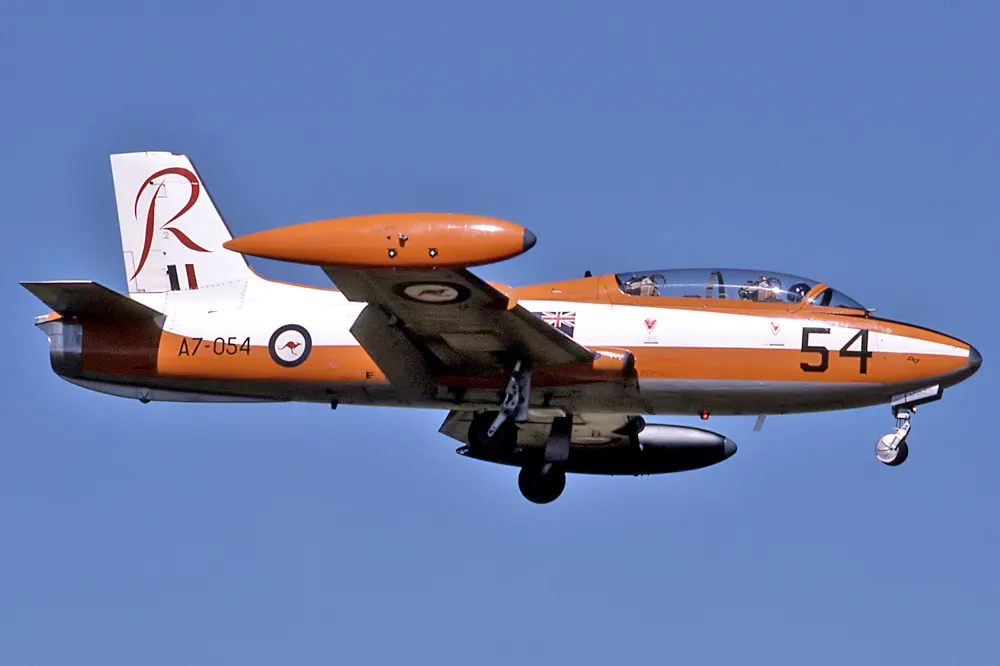

The Aermacchi MB-326 is an Italian jet trainer designed by Ermanno Bazzocchi and built by Aeronautica Macchi (Aermacchi) of Varese. It first flew on 10 December 1957, entered service with the Italian Air Force (Aeronautica Militare) in February 1962, and went on to become one of the most widely licence-built military aircraft of the postwar era. Roughly 800 airframes were produced between 1961 and 1975, spread across Italy, Australia, Brazil, South Africa, Argentina, Tunisia, Ghana, Zaire, Zambia, Paraguay and beyond.1,2
- Simple, rugged, low-maintenance airframe
- Docile, forgiving handling for early jet students
- Single-seat armed variant added genuine strike capability
- Cheap to buy, fly and maintain versus rivals
- Long production run enabled deep spares commonality
- Underpowered by later-generation trainer standards
- Limited useful load and range without a light attack fit
- Poor cockpit visibility for the front-seat instructor role
- Vulnerable to shoulder-fired SAMs in low-level attack use
- Airframe fatigue and fuel-system issues shortened some fleets' lives
What set the MB-326 apart from contemporaries such as the BAC Jet Provost or the Fouga Magister was not any single technical breakthrough but its adaptability. The tandem-seat trainer airframe proved robust enough to be re-engineered into a single-seat, six-hardpoint light attack aircraft (the MB-326K), and the whole family was cheap enough, and simple enough to maintain, that air forces with modest budgets and limited technical infrastructure kept flying it for decades after larger air arms had moved on. South Africa's Atlas Impala Mk II variant went on to fight a real counter-insurgency war over Angola and Namibia, a role its designers in 1950s Varese never anticipated.3
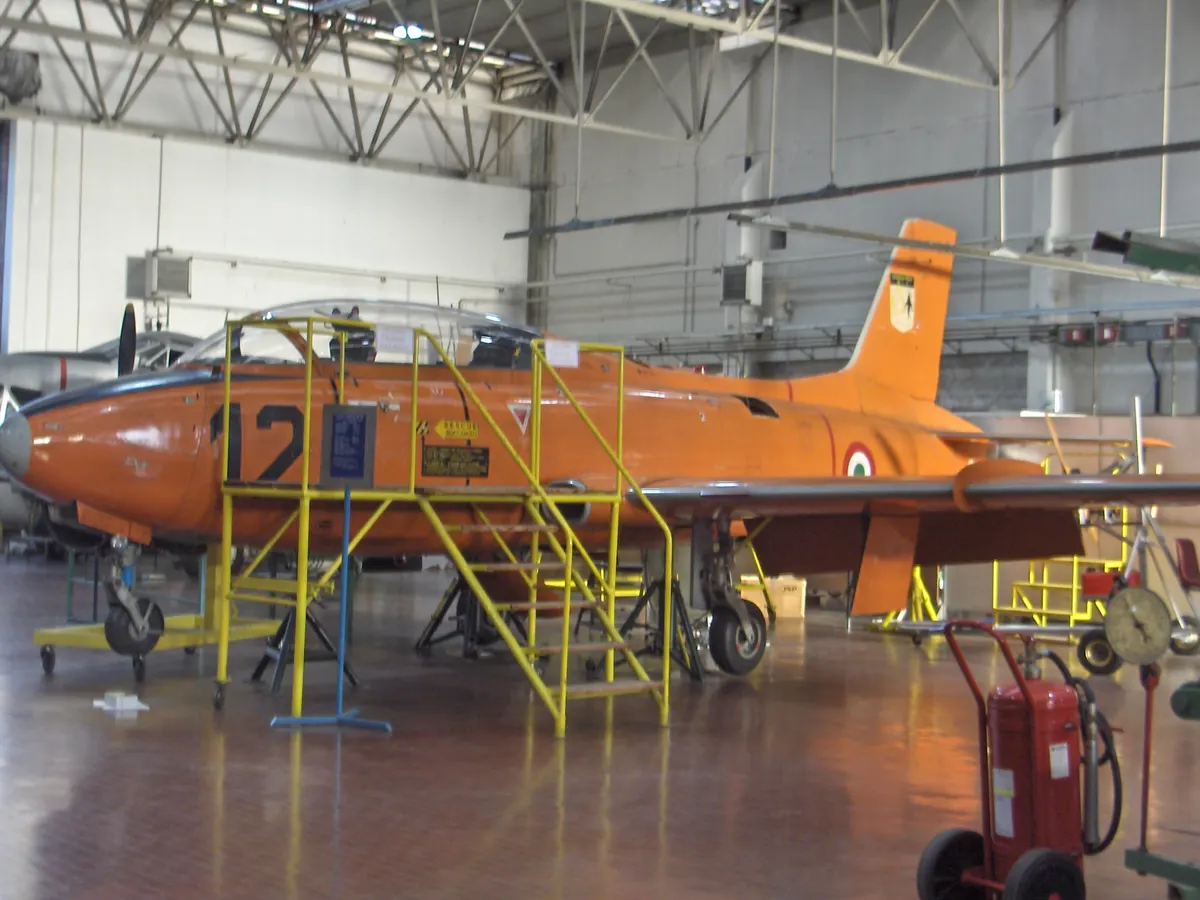
The aircraft's designation reflects its lineage in a way few type numbers do: "M" for Macchi, "B" for Bazzocchi, and "326" for the internal project number. It was, from the outset, a private-venture design, conceived by Bazzocchi's team before the Italian Air Ministry had even issued a formal requirement, and only afterward pitched to Rome as the answer to a competition for a jet-trainer successor to the piston-engined Macchi MB.308 and the earlier de Havilland Vampire trainers still in Italian service.1
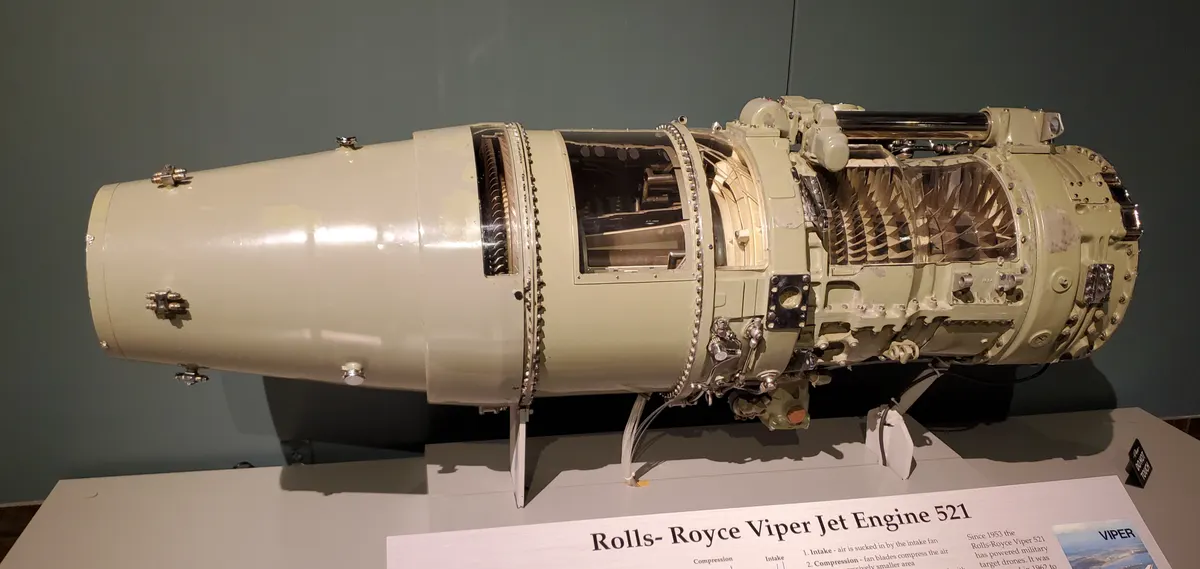
The MB-326 is a low-wing monoplane of conventional all-metal construction, powered by a single non-afterburning Bristol Siddeley (later Rolls-Royce) Viper turbojet fed by wing-root intakes. Early production aircraft for the Italian Air Force used the Viper Mk 11, rated at 2,500 lbf (11.1 kN) of static thrust; later export and armed variants (the MB-326G, K and M family) moved to the more powerful Viper Mk 20 and Mk 540/632 series, delivering up to 3,410-4,000 lbf (15.2-17.8 kN).4,5 That upgrade path matters for reading any single spec sheet on the type: a basic 1962-vintage Italian Air Force MB-326 and a 1970s South African Impala Mk II share an airframe silhouette but not a power plant, and figures for speed, climb and payload differ meaningfully between them.
- First Flight1957
- Service Entry Year1962
- Crew (seats)2
- Trainer TypeAdvanced trainer
- In ServiceYes
The Bristol Siddeley Viper and Its Unlikely Origin Story
The Viper's design lineage is one of the type's more surprising footnotes: the engine began life as an expendable powerplant intended for target drones such as the Jindivik, built to run for a short service life at low cost.6 Bristol Siddeley (absorbed by Rolls-Royce in 1966) reworked it into a durable, low-maintenance turbojet that ended up powering not only the MB-326 but the Jet Provost, Strikemaster, HAL Kiran and the MB-326's own successor, the MB-339. In Italy, the Viper was built under licence by Piaggio from 1959; other operators built or overhauled the engine locally too, including the Commonwealth Aircraft Corporation in Australia.7,8
- Engine TypeBristol Siddeley Viper 20
- Thrust11.12
With the Viper 20/632 fit, the MB-326G/K series reaches a maximum speed of approximately 867 km/h (540 mph, Mach 0.72) at altitude, a service ceiling around 14,000 m, and an initial rate of climb close to 30 m/s.4,9 Standard internal-fuel range is about 1,800-1,850 km, extendable to roughly 2,445 km ferry range with underwing tanks; sortie radius on a low-level strike profile with a war load was considerably shorter, which is one reason armed Impala Mk IIs over Angola typically operated well within a few hundred kilometres of their forward bases.4,10 The airframe is stressed to +7g, and the design brief called for a minimum three-hour endurance at altitude, both figures the production aircraft met.9
- Top Speed867 km/h
- Service Ceiling14,325 m
- Range970 km
- Rate of Climb30.733 m/s
- G-Limit7
- Endurance3
Armament and stores capacity varied by role. The unarmed early trainer had no combat fit; export and attack-configured variants (326B/F/G/K/M and derivatives) carried up to six underwing hardpoints for a combined external load of around 1,800 kg (4,000 lb) — bombs up to 250 kg, 68 mm SNEB rocket pods, gun pods, and, on the single-seat MB-326K/Impala Mk II, a pair of internal 30 mm cannon plus, in South African service, Matra R550 Magic air-to-air missiles carried for self-defence rather than as a primary role.3,10 Crew sit in tandem under a single long canopy, with the student normally forward, on Martin-Baker ejection seats.4
- Cockpit ConfigurationTandem two-seat
- Glass CockpitNo
- Embedded SimulationNo
- Light Attack CapableYes
- Hardpoints2
- Ejection SeatsYes
Cockpit Layout and the Tandem Trainer Formula
The tandem, non-staggered seating arrangement was standard for the era but became the aircraft's most criticised feature: the rear instructor's view over the front-seat student's head was poor, a complaint serious enough that when Aermacchi developed the MB-326's successor, the MB-339, in the 1970s, the single biggest structural change was a redesigned, raised forward fuselage specifically to fix this sightline problem.11 On the MB-326 itself, no such fix was applied across the production run; instructors simply worked around it, and pilot accounts from several air forces cite instrument scanning and peripheral cues rather than direct forward vision during formation and approach work in the back seat.
- Length10.65 m
- Wingspan10.85 m
- Height3.72 m
- Max Takeoff Weight4.58 kg
For the baseline Italian production the airframe, avionics and systems were built in Varese by Aermacchi itself, with the Viper turbojet produced under licence in Italy by Piaggio from 1959 — giving the home-market aircraft a genuinely high proportion of domestic value.7 Export licence-production told a different story: Australia's Commonwealth Aircraft Corporation built airframes locally (and the Viper engine under licence) for the RAAF/RAN order, while South Africa's Atlas Aircraft Corporation manufactured Impala Mk I/II airframes domestically but imported Viper engines through a sub-licence arrangement rooted in the Italian Piaggio production, since Pretoria never established indigenous turbojet manufacture.12,13 Brazil's Embraer-built EMB-326GB Xavante followed the same pattern: local airframe assembly, imported British-designed powerplant. Across the whole programme, the single largest recurring foreign-content item, regardless of final-assembly country, was the Viper engine and its associated systems.
- Total Built800
- Operators10
- Retirement Year2010
- Production Start1961
- Production End1975
- Operational StatusLimited service
Aermacchi's design team began serious work on what would become the MB-326 in 1953, aiming at a private-venture jet trainer rather than waiting for an official specification.1 Bazzocchi's approach to the Italian Air Ministry followed in 1954, and the AMI's formal interest crystallised in 1956 when it authorised construction of two flying prototypes (MM.571 and MM.572) plus a static-test airframe, evaluating the design against a stated requirement for a Vampire and MB.308 replacement.1,14
Test pilot Guido Carestiato flew the first prototype, registered I-MAKI, on 10 December 1957; it was shown publicly in France shortly afterward.1,15 Flight testing surfaced the usual first-of-type problems — most notably a weight growth of roughly 400 kg over the original design estimate, driven by structural and equipment changes made in response to AMI feedback — but the flying qualities were judged good enough that the type cleared its competition and entered production. The AMI placed its first order for 15 aircraft in 1958, service deliveries followed, and the type was declared operational with the Italian Air Force in February 1962, initially at the Flying School in Lecce.1,14
Export success came quickly and on a scale few European trainers of the period matched. Tunisia and Ghana bought armed export variants (MB-326B and MB-326F respectively) in the early-to-mid 1960s; South Africa signed a manufacturing licence in 1964 and began Atlas Aircraft Corporation production of the Impala Mk I in 1966, eventually building around 125 locally on top of 40 Italian-built airframes.3,16 Zaire, Zambia, Argentina and Paraguay followed with the more powerful MB-326G/GB variant through the late 1960s and 1970s.
The two biggest single production runs outside Italy were in Australia and Brazil. The Royal Australian Air Force ordered the type as the MB-326H in 1965 to replace its Vampire trainer fleet, ultimately taking 97 aircraft — 12 delivered complete from Italy, 18 assembled locally from kits, and 67 built from Australian-made components by the Commonwealth Aircraft Corporation (with Hawker de Havilland as a major subcontractor) under the local designation CA-30. The first RAAF MB-326H arrived in October 1967 and the final delivery came in September 1972; No. 2 Flying Training School flew the type continuously from 1970 until its last course in 1991.17,18
Brazil's Embraer, still a young state-backed manufacturer at the time, signed a licence agreement with Aermacchi in 1970 to build the MB-326G as the EMB-326GB Xavante — the AT-26 in Força Aérea Brasileira service and the first jet aircraft ever built in Brazil. The Xavante prototype flew on 3 September 1971; Embraer went on to deliver 182 Xavantes between 1971 and 1981, of which 167 went to the FAB, 9 to Paraguay and 6 to Togo, cementing Embraer's move from piston agricultural aircraft into jets.19,20
By the mid-1970s, production had shifted almost entirely to licensees; Aermacchi itself wound down MB-326 final assembly around 1975, focusing new-build effort on the MB-339 successor programme, even as Atlas and Embraer kept their own lines running into the early 1980s.
The MB-326's only sustained combat use came in Africa, principally in South African Air Force hands during the South African Border War (roughly 1966-1989), fought across northern Namibia and southern Angola against SWAPO's People's Liberation Army of Namibia and, from the mid-1970s, Angolan (FAPLA) and Cuban forces.3 The armed single-seat MB-326K, built and known locally as the Atlas Impala Mk II, entered SAAF service from the mid-1970s and became a mainstay light-attack type for the theatre, valued for its ability to operate from short, unimproved airstrips close to the front.
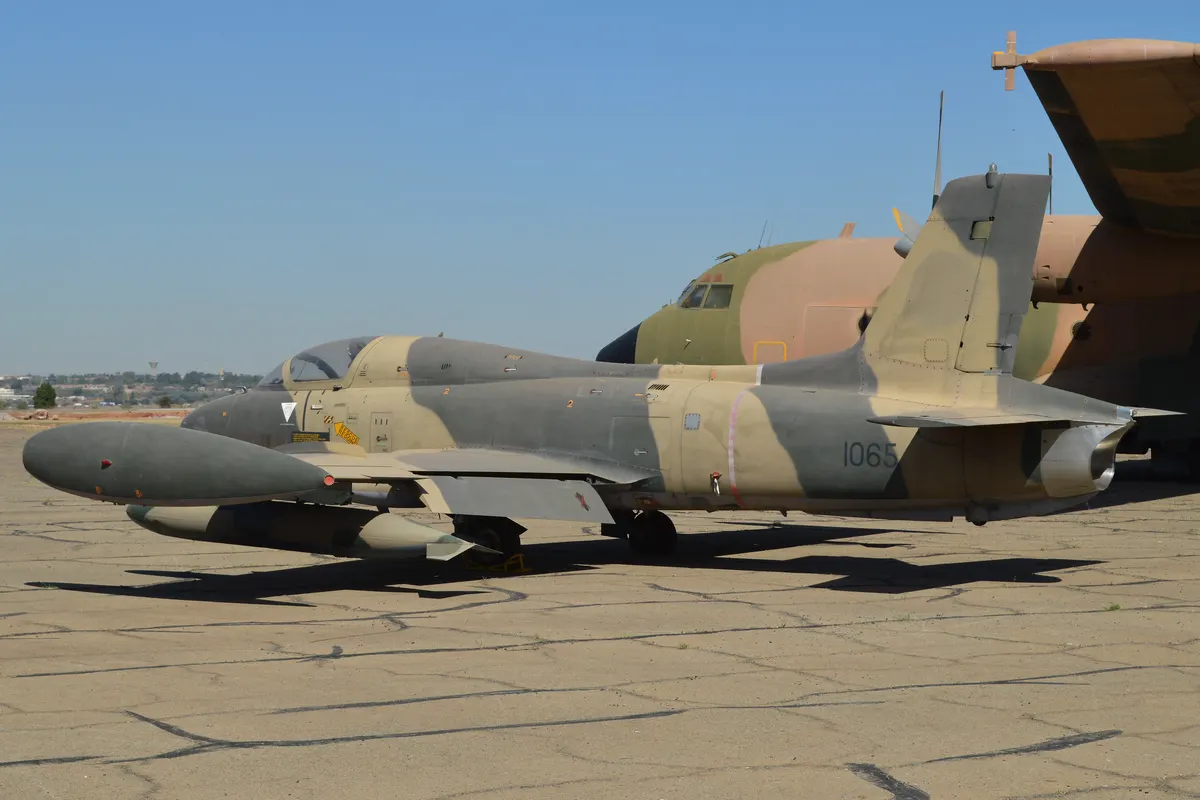
SAAF Impala pilots flew a deliberately aggressive low-level profile — typically 550-650 km/h at around 15 m above the ground — to stay under the radar and reaction time of Angolan and Cuban air defences, a tactic that traded exposure to small-arms and shoulder-fired-missile fire for reduced exposure to radar-guided systems.3 It worked most of the time but not always: at least one Impala was shot down by an SA-7 (Strela) infrared missile during the Border War, and a separate aircraft returned to base with an unexploded man-portable missile still lodged in its jetpipe.3,24
Argentina's naval MB-326GBs, operated by the Comando de Aviación Naval, were mobilised and placed on the Argentine order of battle during the 1982 Falklands War, but they remained on the mainland at their training bases rather than deploying to the islands or flying combat sorties against British forces — their role in the conflict was logistical and as a reserve strike asset rather than an active one.25 Tunisia's MB-326B/KT force, and the single-seat armed export variants sold to Ghana (MB-326F/KG) and Zaire (MB-326G/KB), saw intermittent use in internal security and border-skirmish roles typical of African air arms of the period, though these are far less documented than the South African campaign.16
The basic MB-326 evolved along two parallel tracks: unarmed/lightly armed two-seat trainers for air forces that wanted a jet-transition aircraft, and increasingly capable armed derivatives, culminating in a dedicated single-seat attack aircraft.
The original MB-326 covered the two flying prototypes and 125 production trainers built for the Italian Air Force, unarmed apart from underwing practice-weapon capability.9 The MB-326B was the first armed two-seat export model, built for Tunisia; the MB-326D was a small batch of unarmed trainers delivered to Alitalia for pilot training rather than military use; the MB-326E re-equipped a batch of Italian Air Force aircraft with a weapons-training fit.9,21
The MB-326F (Ghana), MB-326G (demonstrator and the basis for most later export sales, with the uprated Viper 20), and MB-326GB (Argentina, Zaire, Zambia) progressively added underwing hardpoints, more powerful engines and structural strengthening for the light-attack role, while retaining the tandem two-seat trainer layout.9 Brazil's locally built MB-326GC, known there as the EMB-326GB/AT-26 Xavante, followed the G-series standard; a small reconnaissance sub-variant, the RT-26, was also fielded by the Brazilian Air Force.19
Australia's locally assembled and built aircraft were designated MB-326H, with the fully Australian-manufactured examples carrying the local type number CA-30.17 South Africa's programme produced the MB-326M, known in service as the Impala Mk I — a two-seat armed trainer broadly equivalent to the G-series — and the definitive single-seat attack aircraft, the MB-326K, built locally as the Impala Mk II with a strengthened wing, six hardpoints, twin 30 mm cannon and the more powerful Viper 632 engine.3,13 A handful of Italian Air Force MB-326s were later converted into electronic-countermeasures trainers under the designation MB-326RM.9 An advanced-trainer development, the MB-326L, was offered for export alongside the K but sold in smaller numbers.
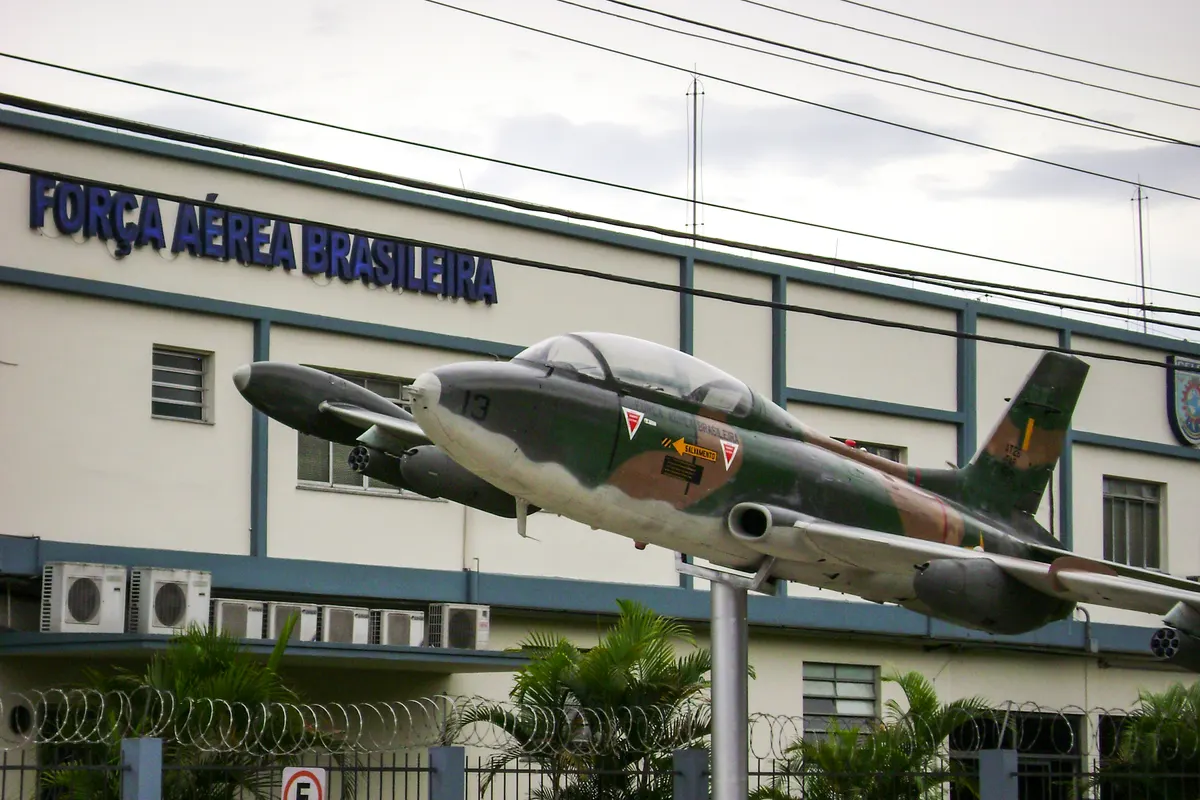
The line's logical endpoint was the Aermacchi MB-339, developed through the 1970s specifically to fix the MB-326's poor instructor sightline with a raised, redesigned forward fuselage and a larger tailfin, while reusing the MB-326K's wing, powerplant family and much of its systems architecture — a derivative rather than a clean-sheet aircraft, and cheaper to certify and buy for exactly that reason.11


At least thirteen air arms operated some version of the MB-326 family, well beyond the ten currently catalogued for this aircraft. Italy's Aeronautica Militare was the launch customer and largest single-country user through its own production run of roughly 135-137 aircraft.9 Australia (97, as the MB-326H/CA-30) and Brazil (182, as the EMB-326GB/AT-26 Xavante) were the two largest export/licence programmes.17,19 South Africa fielded the largest combined two-seat/single-seat fleet outside Italy: roughly 40 imported plus about 125 locally built Impala Mk I trainers, and around 78-100 Impala Mk II attack aircraft, in SAAF service from 1966 into the early 2000s.3,13
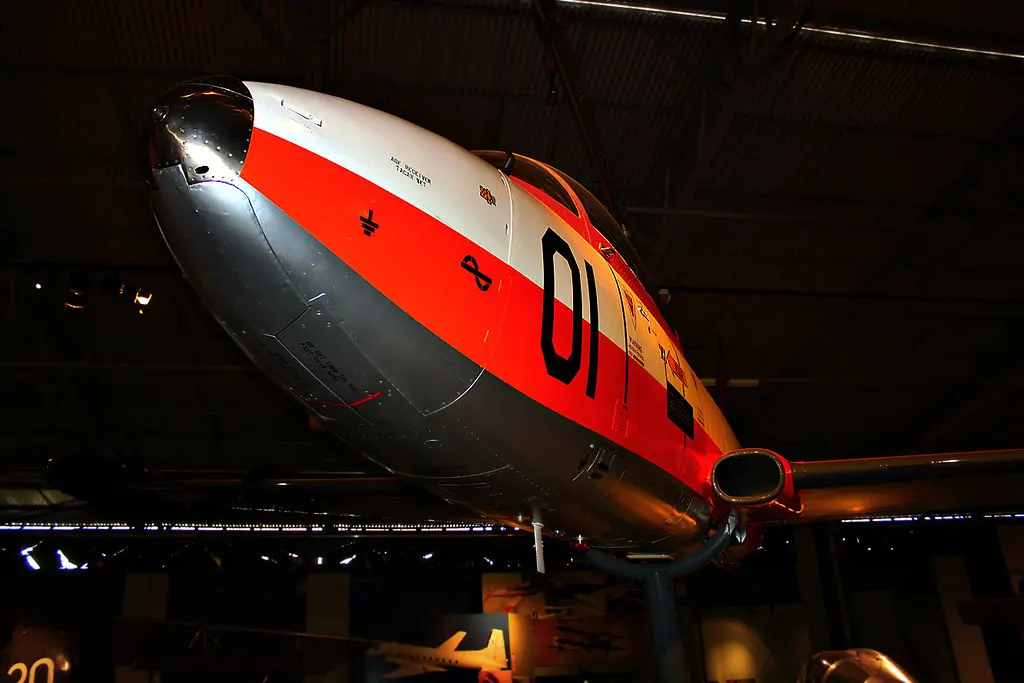
Smaller air forces operating armed or trainer versions included Argentina's Naval Aviation (MB-326GB, from the late 1960s), Tunisia (MB-326B and armed MB-326KT), Ghana (MB-326F and armed MB-326KG), Zaire (MB-326G and armed MB-326KB), Zambia (MB-326GB), Paraguay (via Embraer-built AT-26s), Togo (six Xavantes from Embraer) and Dubai/the UAE (a small MB-326KD batch).9,16,19 A handful of surplus airframes also flew in the United States in civilian hands, most notably with the National Test Pilot School.21
By the mid-2000s the type had left front-line military service almost everywhere: South Africa retired its last Impalas around 2005, replaced by the BAE Systems Hawk 120, and Italy's own MB-326s were gone by 2010.13,26 A few operators, including Paraguay and Tunisia, kept small numbers flying in reserve or basic-training roles well into the 2010s and 2020s, and the Zambian Air Force reportedly retired its remaining MB-326GBs only at the end of 2025 — nearly seven decades after the type's first flight.27
The MB-326's closest direct competitor through the 1960s and 70s export market was the British BAC Jet Provost and its armed derivative, the BAC 167 Strikemaster, itself another Viper-powered design. Both aircraft chased the same customers — mid-tier and smaller air forces wanting an affordable jet trainer with a genuine attack option bolted on — and both undercut $500,000 per unit in period pricing, but they solved the trainer-to-attacker problem differently. The Strikemaster kept the Jet Provost's side-by-side cockpit and pressurised fuselage, useful for instructor visibility and student comfort, whereas the MB-326 kept the more conventional tandem layout and instead built a dedicated single-seat attack variant (the MB-326K/Impala Mk II) rather than simply arming the trainer. That divergence shows up directly in export numbers and roles: the Provost/Strikemaster family sold about 741 Jet Provosts plus 146 Strikemasters, a smaller combined run than the MB-326's roughly 800, and Strikemasters saw combat in Oman, Ecuador, Yemen and elsewhere, but nowhere did they generate a purpose-built, six-hardpoint single-seat attacker as capable as the Impala Mk II.28,29
Performance-wise the two families are close enough that engine generation, not airframe, decided most contests: a Viper 11-powered early MB-326 and a Viper 8-powered Jet Provost T5 are both around 700-750 km/h aircraft, while the later Viper 20/632-powered MB-326G/K and the Strikemaster (Viper 535) both push toward 800-870 km/h and comparable service ceilings near 12,000-14,000 m. Where the MB-326 pulled ahead was payload flexibility on the K model — six hardpoints and a genuine 30 mm cannon fit gave South Africa's Impala Mk II a heavier and more varied strike load than the Strikemaster's typical light-attack configuration, which mattered directly in the Border War's low-level rocket-and-cannon missions.3,28
Against the French/German Fouga CM.170 Magister, the other mass-exported Western trainer of the era, the comparison tilts the other way on raw numbers — the Magister was built in broadly similar quantities and flew combat in Algeria, the Six-Day War (Israel) and Biafra — but the MB-326 was consistently the faster, higher-ceiling aircraft thanks to its single, more powerful Viper against the Magister's twin, weaker Turbomeca Marboré turbojets, at some cost in single-engine redundancy.


How many Aermacchi MB-326s were built? Roughly 800 were built in total across Italy and licensees between 1961 and 1975, including Australian, Brazilian and South African production.9
What engine did the MB-326 use? A single non-afterburning Bristol Siddeley (later Rolls-Royce) Viper turbojet. Early Italian production used the Viper Mk 11 (2,500 lbf/11.1 kN); later export and armed variants used the more powerful Viper Mk 20 or 632 series, up to around 4,000 lbf/17.8 kN.4,5
What is the MB-326's top speed? Depending on variant and engine, roughly 800-870 km/h (500-540 mph) at altitude — about Mach 0.7-0.8.4,9
Is the MB-326 still in service? Not in significant numbers. Most large operators (South Africa, Italy, Australia, Brazil) retired the type between the 1990s and 2010; small reserve or training fleets persisted in a few countries, including Paraguay and Tunisia, into the 2010s and 2020s, with Zambia reportedly the last to stand its fleet down, at the end of 2025.13,26,27
MB-326 vs Strikemaster: which was the better light-attack aircraft? They were close contemporaries built around the same Viper engine family, but the MB-326's dedicated single-seat attack derivative, the MB-326K/Impala Mk II, carried more hardpoints and a heavier built-in gun armament than the Strikemaster, which stayed closer to its trainer roots. The MB-326K also has a genuine combat record — the Border War — that the Strikemaster's export combat use (Oman, Yemen, Ecuador) roughly parallels but does not clearly exceed.3,28
Did the MB-326 see real combat? Yes, principally with South Africa's Atlas Impala Mk II during the Border War in Angola and Namibia from the mid-1970s to 1989, including at least one confirmed air-to-air helicopter kill campaign in 1985, plus more limited use by other African operators.3,24
- "Aermacchi MB-326", Wikipedia — en.wikipedia.org ↩
- "Today in Aviation History: First Flight of the Aermacchi MB-326", Vintage Aviation News — vintageaviationnews.com ↩
- "Aermacchi MB-326 — Operational History: South Africa", Wikipedia (via Liquisearch mirror) — liquisearch.com ↩
- "Aermacchi M.B.326 — Specifications", flugzeuginfo.net — flugzeuginfo.net ↩
- "Aermacchi MB.339 Series", Forecast International (archived report) — forecastinternational.com ↩
- "Armstrong Siddeley Viper", Wikipedia — en.wikipedia.org ↩
- "Bristol Siddeley", Wikipedia — en.wikipedia.org ↩
- "CAC Aermacchi MB-326H (Macchi)", Sea Power Centre Australia — seapower.navy.gov.au ↩
- "Aermacchi MB-326", Wikipedia (Variants and Specifications sections) — en.wikipedia.org ↩
- "Aermacchi MB.326 Advanced Jet Trainer / Light Attack Aircraft", MilitaryFactory — militaryfactory.com ↩
- "Aermacchi MB-339", Wikipedia — en.wikipedia.org ↩
- "Bristol Siddeley — Grokipedia", Grokipedia — grokipedia.com ↩
- "Atlas Aircraft Corporation", Wikipedia — en.wikipedia.org ↩
- "December 10 / Aermacchi MB-326 first flight", European Airshows — europeanairshows.co.uk ↩
- "Accident Aermacchi MB.326 I-MAKI, 22 Apr 1959", Aviation Safety Network — aviation-safety.net ↩
- "Aermacchi MB-326K: Military Training Aircraft Specs & Operators", GlobalMilitary.net — globalmilitary.net ↩
- "CAC Aermacchi MB-326H (Macchi)", Sea Power Centre Australia — seapower.navy.gov.au ↩
- "Aermacchi MB-326H brought on charge with the RAAF", Royal Australian Air Force — airforce.gov.au ↩
- "EMB 326 AT-26 Xavante", GlobalSecurity.org — globalsecurity.org ↩
- "EMB 326 Xavante", Embraer Historical Center — historicalcenter.embraer.com ↩
- "Aermacchi MB 326 Impala", Estrella Warbird Museum — ewarbirds.org ↩
- "Macchi MB-326K Flies Again in Italy", Vintage Aviation News — vintageaviationnews.com ↩
- "Silver Falcons aerobatic team", Aerobatic Teams Resource — aerobaticteams.net ↩
- "Impala Mk II", The African War Stories Archive — africanwars.org ↩
- "Falklands War order of battle: Argentine naval forces", Wikipedia — en.wikipedia.org ↩
- "1990 Italian Air Force MB-326 crash", Wikipedia — en.wikipedia.org ↩
- "Zambian Air Force", Wikipedia — en.wikipedia.org ↩
- "BAC Strikemaster", Wikipedia — en.wikipedia.org ↩
- "BAC Jet Provost", Wikipedia — en.wikipedia.org ↩