


The Atlas Impala Mk I is the two-seat trainer version of the Italian Aermacchi MB-326, built under licence in South Africa as the MB-326M. It shares an airframe lineage with the single-seat Impala Mk II attack aircraft, but its role differs: the Mk II was built to carry a war load, while the Mk I existed to put South African Air Force pilots through jet training before they moved to the Mirage III, Mirage F1, or the Mk II itself.1,2
- docile, forgiving handling well suited to student pilots
- shared airframe and engine family with the Mk II simplified spares and maintenance
- bridged basic piston training directly to supersonic Mirage conversion
- simple, rugged construction kept airframes flying into the 2000s
- underpowered and subsonic even by 1970s trainer standards
- rear-seat instructor visibility over the student was poor
- ejection seats dated by the 1990s, with no zero-zero capability
- decades of hard use produced a string of fatigue-related accidents
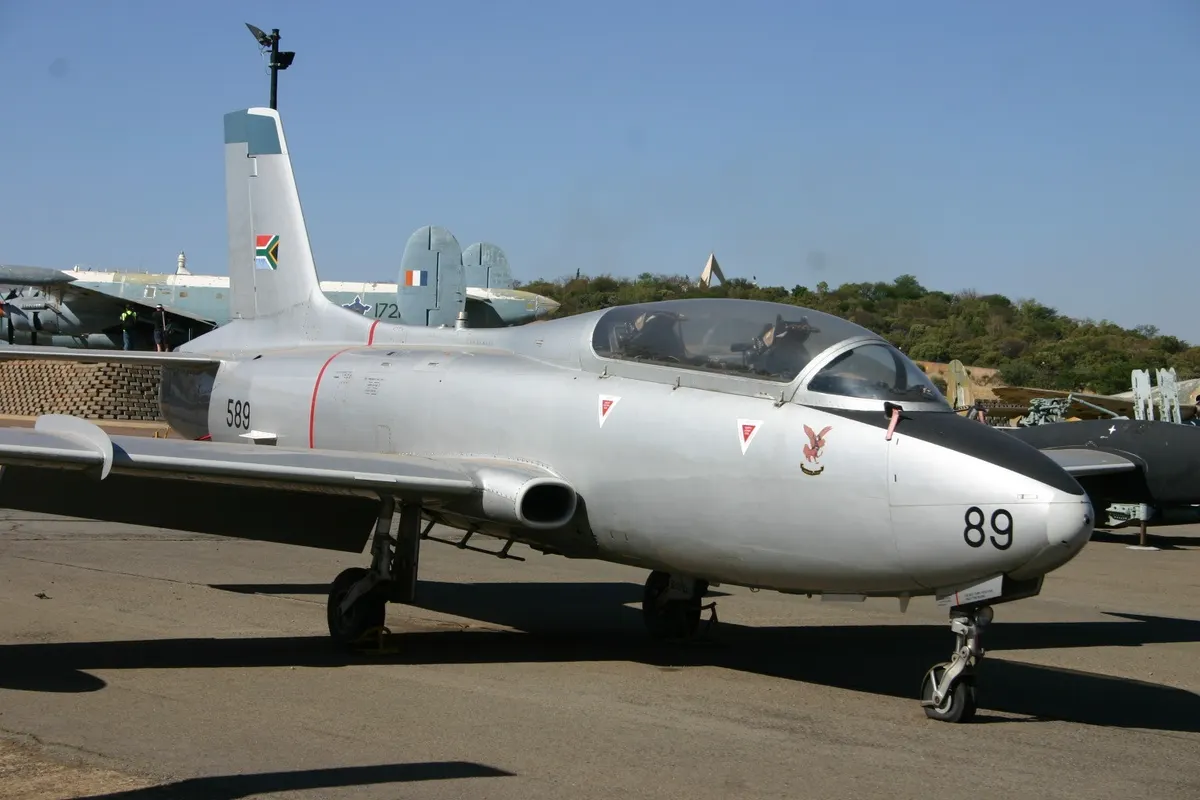
South Africa signed the MB-326 production licence with Aermacchi in 1964; forty Italian-built airframes, the first delivered on 3 June 1966, arrived before Atlas Aircraft Corporation's own line at Kempton Park was ready.1,3 The first Atlas-assembled Mk I flew on 8 November 1966, and roughly 125 more followed, all to the two-seat MB-326M standard rather than the armed configuration Atlas later built for the Mk II, which only entered production in the mid-1970s once the arms embargo made local attack manufacture a necessity.3,4,1 For most of its three-decade career the Mk I was simply the SAAF's standard jet trainer, docile enough that pilot accounts compare its handling favourably to the piston-engined Harvard used earlier in the same syllabus.4 That reputation, not any combat record, defines this variant: the Mk II fought the Border War, but the Mk I trained the pilots who flew it.
The Rolls-Royce Viper 20 and a Trainer Built Lighter Than the Attack Version
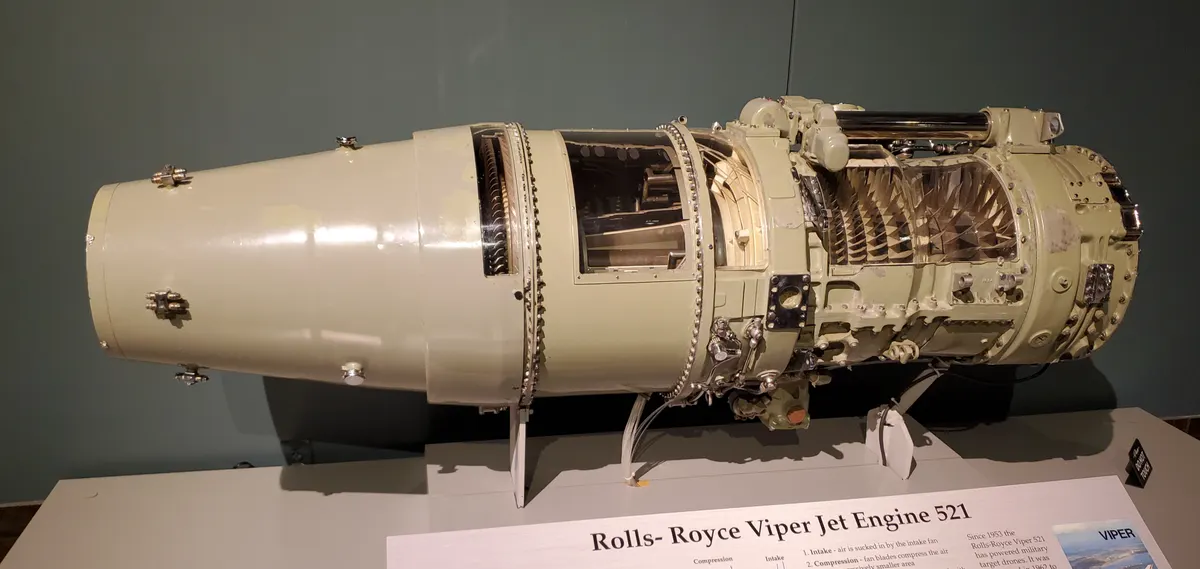
The Mk I is powered by a single non-afterburning Rolls-Royce (originally Bristol Siddeley) Viper 20 turbojet, rated at approximately 15.2 kN (3,410 lbf) — notably less powerful than the Viper 632-43 fitted to the Mk II, which needed the extra thrust for cannon, rockets and bombs.5,6 The lighter fit gives a maximum speed of roughly 750-770 km/h at low level, a service ceiling near 12,500 m, and a range of about 1,665 km, below the unarmed Italian MB-326G's 867 km/h since the Mk I still carries underwing stores the pure trainer never had.6,7 Sources consistently put the airframe at 10.65 m long, with a 10.56 m wingspan and 3.72 m height.6,7
- First Flight1957
- Service Entry Year1962
- Crew (seats)2
- Trainer TypeAdvanced trainer
Tandem Cockpit and the Martin-Baker Ejection Seats
Crew sit in tandem under a single canopy, student forward and instructor behind, each on a Martin-Baker ejection seat common to the wider MB-326 family.2 The rear seat's view over the student's helmet was a persistent complaint, the same problem that later drove Aermacchi to redesign the fuselage for the MB-339 successor.8 Armament differs sharply from the Mk II's: the trainer carries no internal cannon, relying on light underwing gun pods, while the Mk II's twin 30 mm DEFA cannon are built into the fuselage.9
- Engine Typeturbojet
- Thrust17.6
Atlas Aircraft Corporation assembled the Mk I's airframe at Kempton Park from South African-fabricated structure and Italian-supplied subassemblies, but its Viper 20 turbojet, the single most valuable component, was never built domestically; it was Bristol Siddeley's design, produced under licence in Italy by Piaggio and imported complete.5,10 The Martin-Baker ejection seats were a further British import standard across the MB-326 family.2 Unlike the later Mk II, the trainer never received the Kukri missile wiring or locally developed electronic countermeasures that pushed some attack airframes toward self-sufficiency, so its import dependence, concentrated in the engine and cockpit safety systems, changed little across its service life.
- Top Speed750 km/h
- Cruise Speed650 km/h
- Service Ceiling11,000 m
- Range1,200 km
- Rate of Climb15 m/s
- G-Limit7
- Endurance3
- Cockpit Configurationtandem
- Light Attack CapableYes
- Ejection SeatsYes
- Length10.3 m
- Wingspan9.3 m
- Height2.8 m
- Max Takeoff Weight3,800 kg
- Total Built125
- Operators15
Atlas Aircraft Corporation was established in 1965 to build the aircraft the SAAF could no longer be guaranteed to buy abroad, and the Impala Mk I was its first production type, entering the line a decade before the 1977 UN arms embargo forced the same approach onto the Mk II.1,10 The type became standard equipment at the Flying Training School at Langebaanweg, with smaller numbers held by operational squadrons and 85 Combat Flying School to supplement Mirage conversion training.4
The Mk I gained its most public identity in 1966, when the SAAF reinstated its aerobatic display team on brand-new Impalas; the team was formally named the Silver Falcons in November 1967 and gave its first display at Atlas Aircraft Corporation's opening ceremony that same month.12 The Falcons flew the type for three decades, before their last Impala display in September 1997 and re-forming on the PC-7 Mk II Astra in 1999.12
Training built around the Mk I fed Harvard graduates into jet handling before Mirage conversion, and later into the Mk II itself, a pipeline that ran largely unchanged through the Border War.4 By the early 1990s, with Atlas absorbed into Denel in 1992, the Mk I's role had narrowed to training; the SAAF retired it in the early 2000s, replacing its training function with the Hawk Mk 120 and PC-7 Mk II.10,18
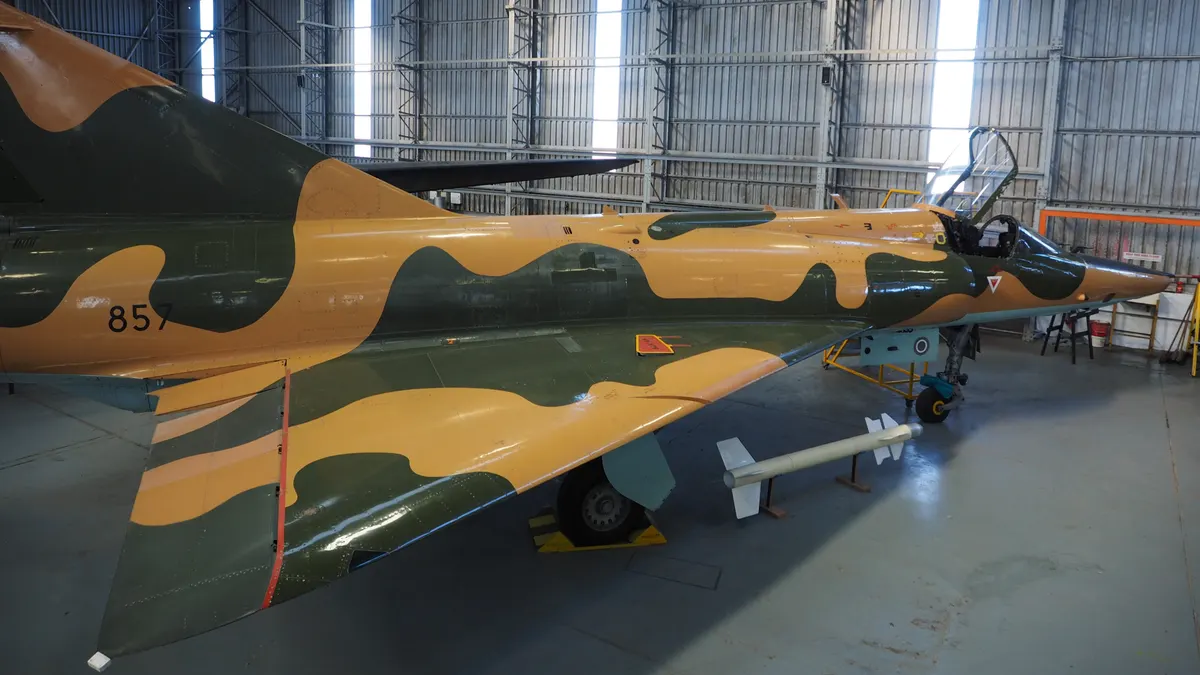
The Impala Mk I had no significant combat record of its own; that fell to the Mk II over Angola and Namibia during the Border War. Its contribution was indirect: every SAAF pilot who later flew the Mk II, Mirage III, or Mirage F1 in that war had first trained on the Mk I, and its underwing gun pods meant a handful of airframes could, in principle, fly light forward-support sorties.9,4 Documented instances of armed Mk I operational sorties are thin; most Border War histories treat the two-seater as a training type that stayed close to home bases.2
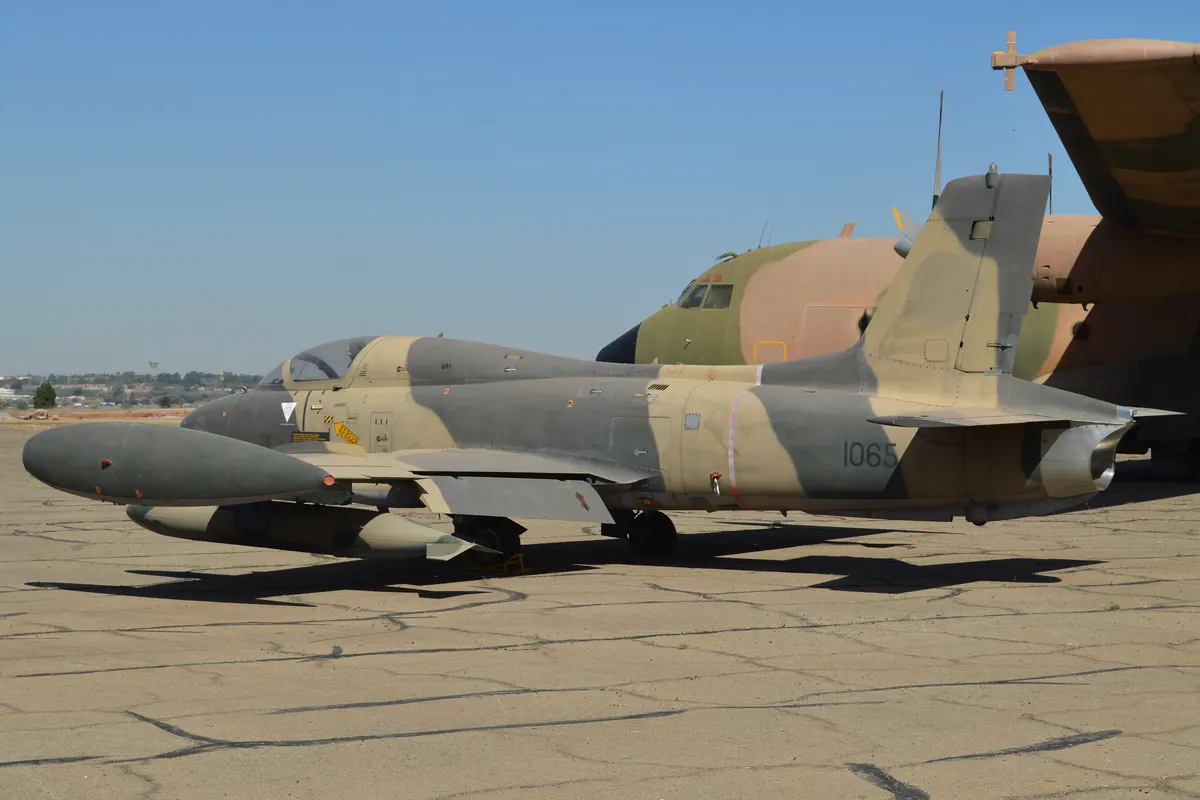
The Impala Mk I designation covers the Aermacchi MB-326M standard: a two-seat tandem trainer with light underwing stores capability, powered by the Viper 20 and built as forty complete Italian imports plus roughly 125 locally assembled examples from Kempton Park starting in 1966.1,3 Do not confuse it with the single-seat Impala Mk II, built to the MB-326K standard from the mid-1970s with the more powerful Viper 632-43, twin internal 30 mm cannon, and six weapons hardpoints, nor with the baseline Italian MB-326, which never carried the "Impala" name.9,1
No further trainer-specific production mark followed the Mk I in South African service; when the SAAF eventually needed a modern jet trainer, it bought the imported BAE Systems Hawk Mk 120 rather than developing a further Impala derivative.18


The South African Air Force was overwhelmingly the type's main operator, flying the Mk I from Langebaanweg and other home bases for close to forty years across training squadrons and the Silver Falcons.4 Export sales were limited: Cameroon received six ex-SAAF Impalas covering both marks, one of the few instances of the trainer leaving South African service.16,17
Civilian ownership has kept a small number of Mk Is flying well past their military retirement, mostly within South Africa's active warbird and display-flying community; the fatal loss of ZU-IMP at the 2025 West Coast Air Show was treated within that community as a significant event precisely because so few flying examples remain.15
The Impala Mk I's closest Western equivalent is the British BAC Jet Provost; the comparison is useful mainly for how differently the two trainers' graduates went on to fly. Both are Viper-powered, but the Jet Provost T5 used the smaller Viper 202 of about 11.1 kN (2,500 lbf) against the Mk I's 15.2 kN, giving the South African trainer a power margin despite a similar top speed, around 750-770 km/h against about 708 km/h (440 mph) for the T5.19,6 The deeper difference is downstream of the cockpit: RAF Jet Provost graduates moved to a separate advanced trainer, the Gnat and later the Hawk, whereas Impala Mk I graduates could convert onto the Mirage III or F1 directly, or onto the closely related Mk II, reusing the trainer's own engine family. That followed from the embargo: South Africa could not always assume it could buy a separate advanced trainer when needed, so building trainer and attacker from the same airframe cut the pipeline's dependence on outside suppliers.1


What are the Impala Mk I's specifications? A Rolls-Royce Viper 20 turbojet of about 15.2 kN (3,410 lbf) thrust, a top speed of roughly 750-770 km/h, a range near 1,665 km, and a service ceiling around 12,500 m; 10.65 m long with a 10.56 m wingspan and 3.72 m height.6,7
How many Impala Mk Is were built? South Africa received 40 complete Italian-built MB-326M airframes from 1965-66, followed by roughly 125 more assembled locally by Atlas from November 1966.1,3
Is the Impala Mk I still in service? No. The SAAF retired the type in the early 2000s, replacing its training role with the Hawk Mk 120 and PC-7 Mk II. A small number remain airworthy in civilian hands in South Africa.18,15
Impala Mk I vs Impala Mk II: what's the difference? The Mk I is a two-seat trainer with a less powerful Viper 20 engine, light underwing gun-pod capability, and no internal cannon; the Mk II is a single-seat attacker with the Viper 632-43, twin internal 30 mm cannon, and six hardpoints, and it, not the trainer, fought the Border War.9,1
Did the Impala Mk I ever see combat? Not in any well-documented way. Its role was training the pilots who flew the Mk II, Mirage III, and Mirage F1 in the Border War, rather than flying combat sorties itself.2,4
- "Atlas Aircraft Corporation", Wikipedia — en.wikipedia.org ↩
- "Aermacchi MB-326", Wikipedia — en.wikipedia.org ↩
- "ESCI 1/48 Atlas Impala Mk.1", iModeler — imodeler.com ↩
- "Military equipment named after animals: The Atlas (Aermacchi) Impala Aircraft", Ditsong Museums of South Africa — ditsong.org.za ↩
- "The Aermacchi MB-326 - Atlas Impala", Flightline Weekly — flightlineweekly.com ↩
- "Aeromacchi Atlas MB326M Impala Mark I and Mark II", South African Aviation Foundation Museum — saafmuseum.org.za ↩
- "Aermacchi MB.326 Advanced Jet Trainer / Light Attack Aircraft", MilitaryFactory — militaryfactory.com ↩
- "Aermacchi MB-339", Wikipedia — en.wikipedia.org ↩
- "Impala Mk II", The African War Stories Archive — africanwars.org ↩
- "Bristol Siddeley", Wikipedia — en.wikipedia.org ↩
- "Today in Aviation History: First Flight of the Aermacchi MB-326", Vintage Aviation News — vintageaviationnews.com ↩
- "Silver Falcons aerobatic team history", Aerobatic Teams Resource — aerobaticteams.net ↩
- "Fighter jet crashes into highway", Mail & Guardian — mg.co.za ↩
- "Impala jets' wings clipped", News24 — news24.com ↩
- "West Coast Air Show ends in tragedy after fatal Impala crash", DefenceWeb — defenceweb.co.za ↩
- "Aermacchi MB-326", Wikipedia (export operators section) — en.wikipedia.org ↩
- "Aermacchi MB-326K: Military Training Aircraft Specs & Operators", GlobalMilitary.net — globalmilitary.net ↩
- "History and final phasing-out of the Impala MK I & MK II", South African Air Force — af.mil.za ↩
- "BAC Jet Provost", Wikipedia — en.wikipedia.org ↩