

The CASA C-101 Aviojet is a single-engine jet trainer and light-attack aircraft designed by the Spanish manufacturer Construcciones Aeronáuticas SA (CASA), now part of Airbus. It was conceived in 1975 to replace the Spanish Air Force's piston- and early jet-era trainers with a single type that could carry a student from first jet flight through weapons training.1,2 CASA did not design it alone: Germany's Messerschmitt-Bölkow-Blohm (MBB) contributed the rear fuselage and tail, and the United States' Northrop shaped the wing and engine air intakes, reflecting CASA's ties to both companies at the time.1
- Simple, low-cost single-engine design
- Deep ventral bay allows gun, sensor, or other mission payloads
- Six underwing hardpoints for a light-attack role most trainers lack
- Forgiving handling suited to basic-to-advanced student progression
- Single engine offers no redundancy for combat missions
- Modest thrust limited genuine air-to-air capability
- Never won a major export order beyond three small air forces
- Late-model avionics upgrade (C-101DD) attracted zero buyers
The aircraft first flew on 27 June 1977, entered Spanish Air Force service on 17 March 1980, and went on to be built or assembled in three more countries.1,2 Its defining feature is not high performance but adaptability: a plain, unswept low wing, a simple tandem cockpit, and a deep, reconfigurable ventral bay behind the main gear that let the same basic airframe serve as an unarmed trainer, a gun-armed light-attack jet, or an aircraft carrying reconnaissance equipment, depending on what a customer air force could afford.3 Roughly 150 airframes were built at CASA's Getafe plant near Madrid, with dozens more assembled from kits by Chile's ENAER, for a combined production run that different sources round to between 149 and 166 aircraft.2,4
The C-101's shape was set by its training mission first: a low, unswept wing for stable handling at the low speeds a student pilot flies, a tandem two-seat cockpit with the rear (instructor's) seat raised for forward visibility, and reinforced landing gear built to absorb repeated hard training landings.5,1 Early C-101EB trainers used a Garrett (later Honeywell) TFE731-2 turbofan rated around 15.6 kN (3,500 lbf), a modest powerplant chosen for economy rather than speed; the export-oriented C-101BB and the dedicated attack C-101CC switched to the more powerful TFE731-5-1J, rated at about 19.1 kN (4,300 lbf) continuous and 20.9 kN (4,700 lbf) in a short military-power setting, which is the engine most associated with the aircraft's combat variants.1

Reported top speeds vary by variant and altitude: specification sheets for the original TFE731-2-powered C-101EB credit it with roughly 685 km/h (370 kn) at low level, while the more powerful C-101CC is credited elsewhere with up to 834 km/h (450 kn) at altitude.4,1 Service ceiling is around 12,500–12,800 m (41,000–42,000 ft), and ferry range on internal and auxiliary fuel is quoted as high as 3,800 km (2,050 nmi), though combat radius on internal fuel alone is far shorter.4
What sets the C-101 apart structurally is a large bay under the rear fuselage, ahead of the six underwing hardpoints, that can take a detachable pod holding either a single 30 mm DEFA 553 cannon with 130 rounds or twin 12.7 mm M3 machine guns with 440 rounds — a feature that let the trainer become a genuine strafing platform without touching the wing stations, which remained free for bombs, rocket pods, or, on the A-36 Halcón, air-to-air missiles.3,6
The C-101's airframe, final assembly, and tooling were Spanish, built by CASA at its Getafe plant near Madrid, but the two most safety-critical foreign inputs were the engine and part of the structural design.1 The Garrett/Honeywell TFE731 turbofan came from the United States and was never license-built in Spain, and the rear fuselage, tail, and wing/intake aerodynamics were engineered by West Germany's MBB and America's Northrop under contract rather than in-house.1 Export production compounded the foreign share: Chile's ENAER assembled roughly two dozen airframes from CASA-supplied kits, and Chile's later "Halcón II" avionics and radar upgrade brought in French systems house SAGEM as prime contractor.7 Domestic Spanish content, airframe structure, final assembly, and integration, likely accounts for well under half the aircraft's value once the imported engine and foreign-designed subsystems are counted.
CASA received its development contract for the new trainer in October 1975, valued at 1,297 million pesetas, and pushed the first of four prototypes into the air on 27 June 1977 from Getafe. Formal flight testing, including vibration, flutter, and spin trials, did not begin until April 1978, but pilots reportedly found the aircraft's handling better than the design team had expected, and CASA showed a prototype at that year's Farnborough International Airshow.1
The Spanish Air Force ordered 88 production aircraft as the C-101EB-01, and the type entered service on 17 March 1980 under the air force designation E.25 Mirlo ("Blackbird"), replacing the elderly T-33, T-6, and Hispano HA-200 Saeta trainers in one stroke.1,2
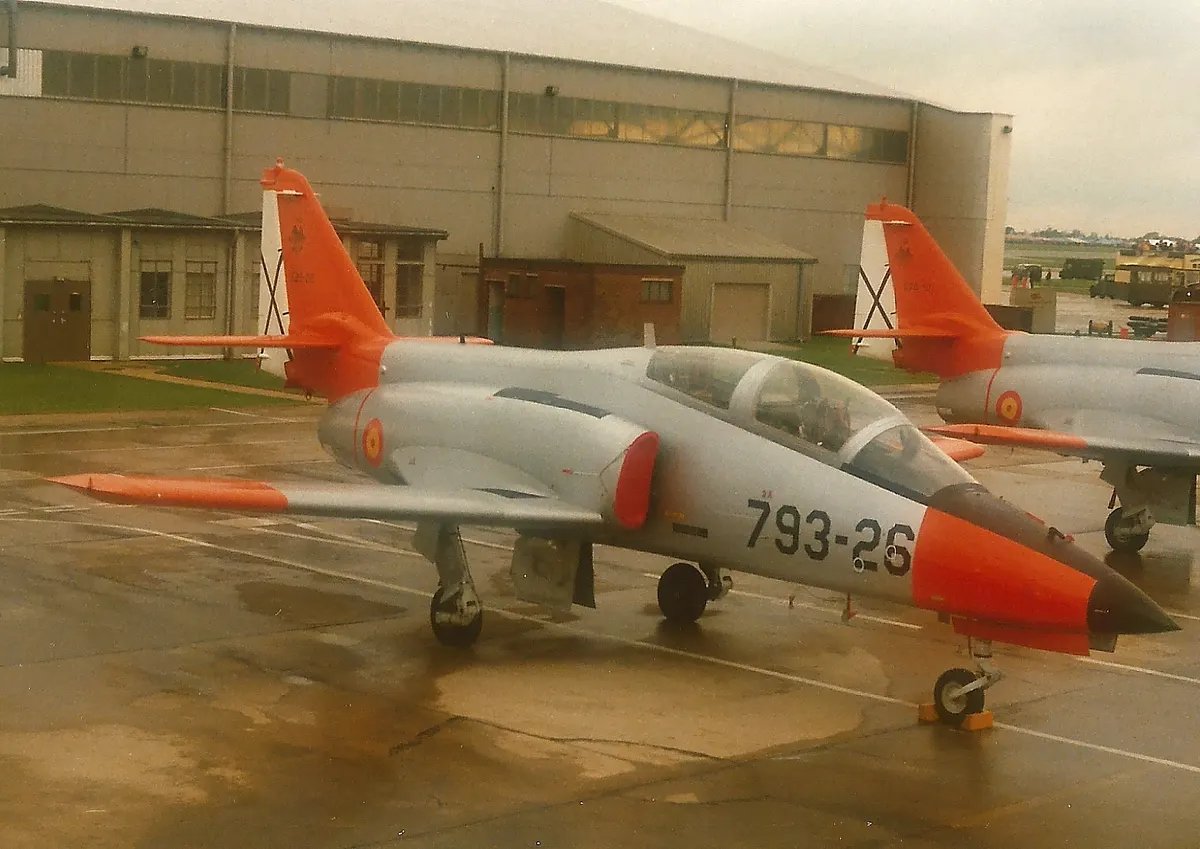
CASA marketed an uprated-engine export version, the C-101BB, through the early 1980s, and Honduras and Chile both bought small batches; Chile also arranged for ENAER to assemble additional airframes locally under license, the first time the type was built outside Spain.1,2 Northrop's contribution to the original wing and intake design was no accident of convenience: the American company was, at the same time, refining similar low-drag inlet and wing concepts on its own T-38 Talon trainer family, and CASA leaned on that expertise rather than developing the aerodynamics from scratch.1
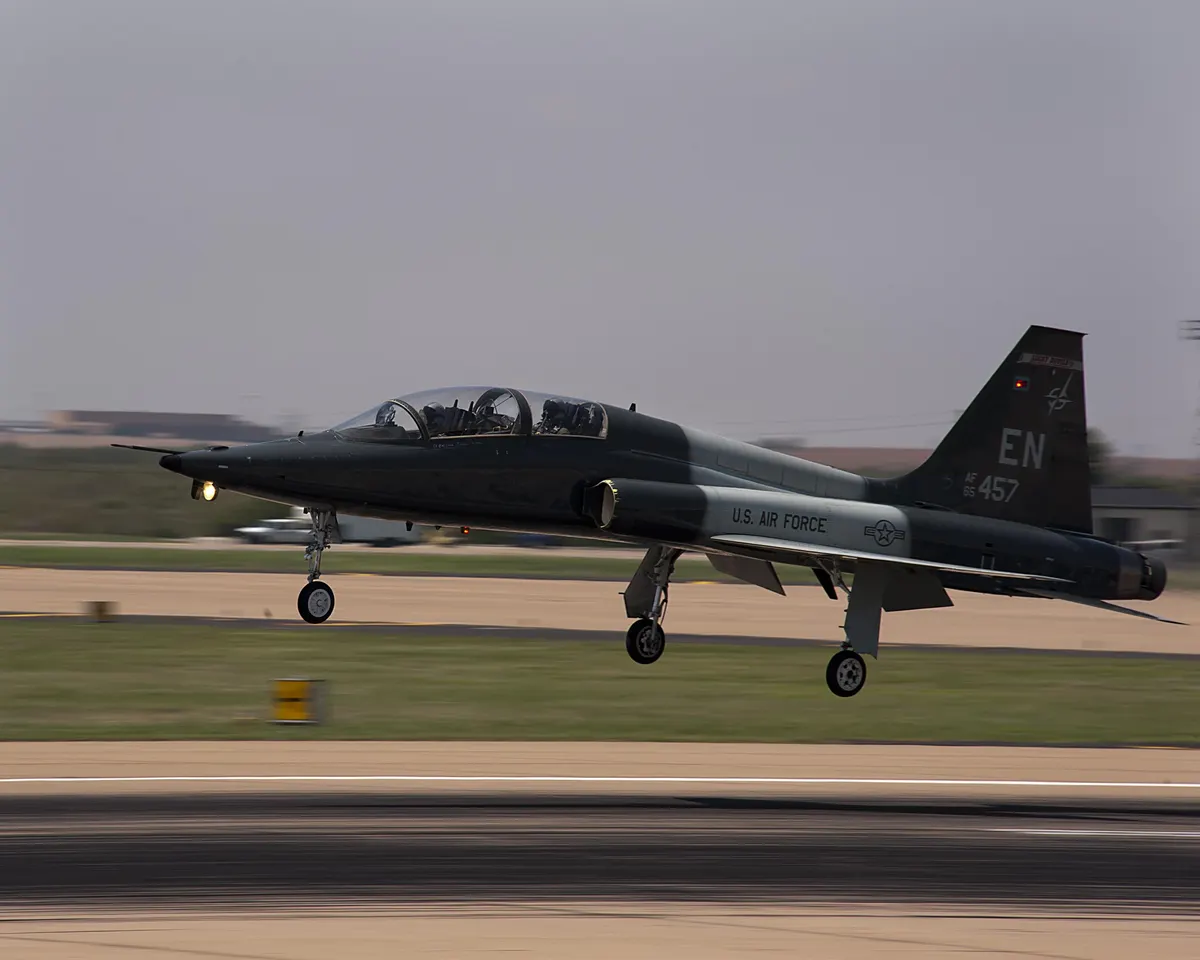
A dedicated attack derivative, the C-101CC, flew in 1983 with a bigger fuel load and the stronger TFE731-5-1J engine; only the prototype came from Getafe, with the following 22 aircraft for Chile built by ENAER and locally named A-36 Halcón ("Falcon"). Jordan separately bought 16 C-101CC-04s from 1987 to replace its T-37s in the advanced-training role at the King Hussein Air College.1,8
The final derivative, the C-101DD, appeared in 1985 with that head-up display, HOTAS cockpit controls, an AN/ALR-66 radar warning receiver, chaff/flare dispensers, and AGM-65 Maverick compatibility, but CASA never found a buyer for it and it remained a one-off demonstrator.1 Across the whole program, CASA and Airbus estimate that over 1,000 military pilots trained on the type, logging some 285,000 flight hours and more than 500 public aerobatic displays by the time Spain began retiring the design in the early 2020s in favor of the Pilatus PC-21.2
The C-101's combat record is thin and mostly undocumented in open, primary sources, which is itself notable for an aircraft marketed from the start as a light-attack jet. Honduras bought four C-101BBs in the early 1980s and operated them through a period of acute regional tension along the Nicaraguan border tied to the Contra war; the type's official DCS World flight-simulator module, built by AvioDev with input from period documentation, describes the Honduran C-101 as having "seen combat," but independent, dated accounts of specific Honduran sorties are not readily available, and the claim should be treated as plausible rather than confirmed.11
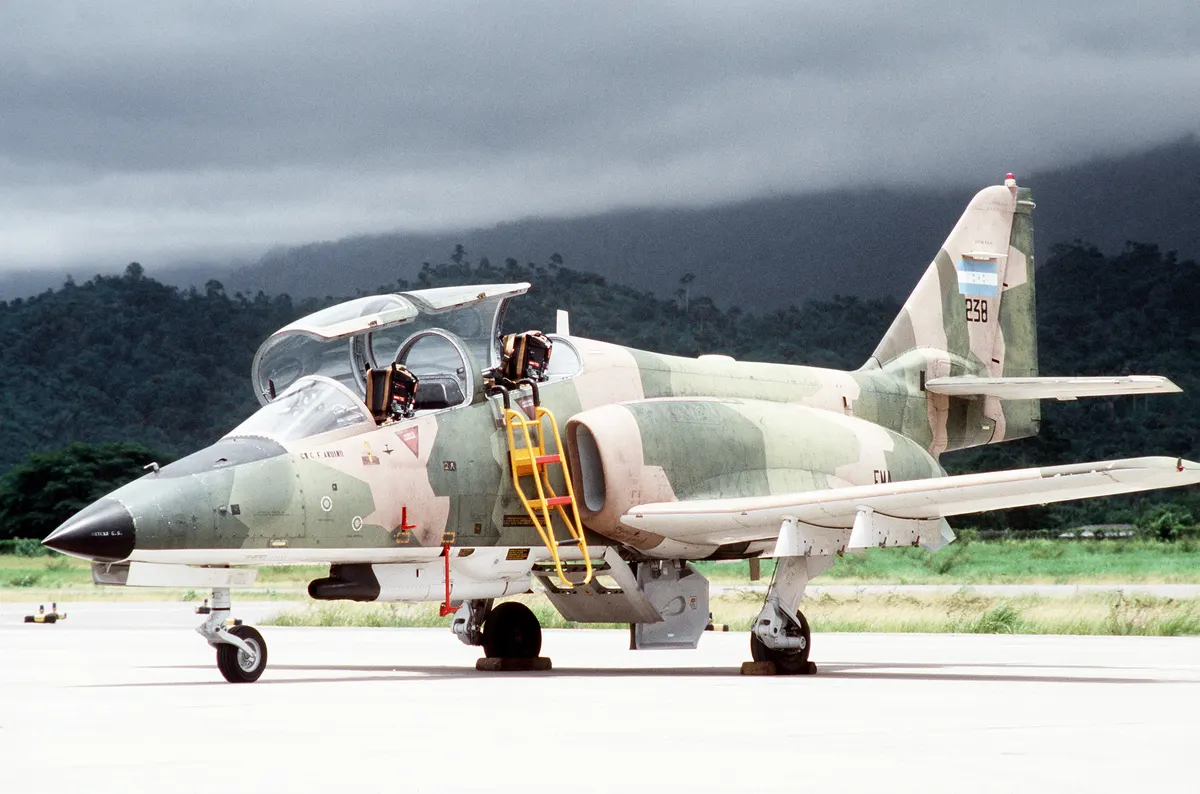
Chile's case is better documented on the equipment side, even if confirmed shooting incidents are scarce in public sources. The A-36 Halcón entered Chilean Air Force service from 1983 with Grupo de Aviación 3 at Maquehue Air Base near Temuco, tasked with close air support, ground attack, and counter-insurgency duties.12
In the mid-1990s Chile funded a major modernization, contracting French avionics house SAGEM as prime contractor with ENAER as subcontractor to fit a new navigation and attack system, a domestically developed ranging radar named "Toqui," a head-up display, and underwing rails for Rafael Shafrir II air-to-air missiles, while retaining the ventral 30 mm cannon pod; the upgraded jets, unveiled in 1996, became known as the Halcón II or simply Toqui. By the time the type was withdrawn in December 2022, Chile's Halcón/Toqui fleet had logged over 40,000 flight hours since 1983 and trained more than 260 Chilean combat pilots.7,13
The C-101EB was the baseline Spanish Air Force trainer, built as the C-101EB-01 (later upgraded EB-02) with the lower-powered TFE731-2 engine and no attack role beyond light gunnery practice; 88 were delivered starting in 1980, and it remains the version flown for four decades by the Patrulla Águila display team. The C-101BB added the option of the stronger engine and a genuine light-attack fit for export customers, becoming the basis for Honduras's and Chile's initial purchases and for Chile's first locally assembled batch.1,2
The C-101CC was the purpose-built attack version, with increased internal fuel and the full-power TFE731-5-1J; in Spanish Air Force service it remained simply a more capable trainer, but in Chile it became the ENAER-built A-36 Halcón, and in Jordan the C-101CC-04, of which 16 were delivered from 1987 for advanced training.1,8
The one-off C-101DD demonstrator represented CASA's attempt to sell a genuinely modern light-attack avionics suite on the existing airframe; despite offering a head-up display and Maverick-missile compatibility years ahead of the standard CC, it never reached production and no operator ever fielded it.1
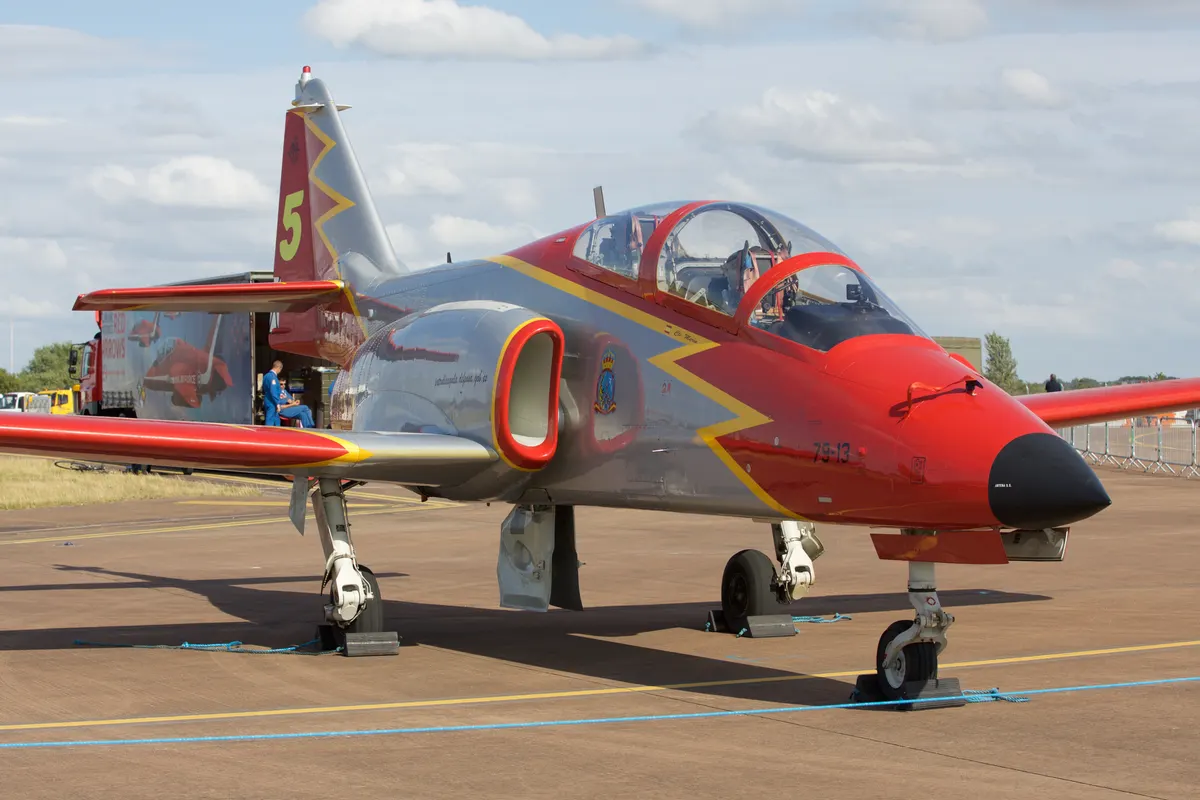
Spain remains the type's largest and longest-serving operator, having taken delivery of 88 C-101EBs from 1980; the Spanish Air and Space Force used them both as its standard advanced trainer at the Academia General del Aire and as the mount of its aerobatic demonstration team, the Patrulla Águila, from the team's formation on 4 July 1985 until its final C-101 display at the Aire25 airshow in Murcia on 14–15 June 2025, after which the team transitioned to the Pilatus PC-21.14,2
Chile was the largest export customer by volume once local assembly is counted, with roughly 35 airframes across the BB and CC/A-36 standards, most of them built or finished by ENAER; the type flew from Maquehue Air Base until final retirement in December 2022.12,13
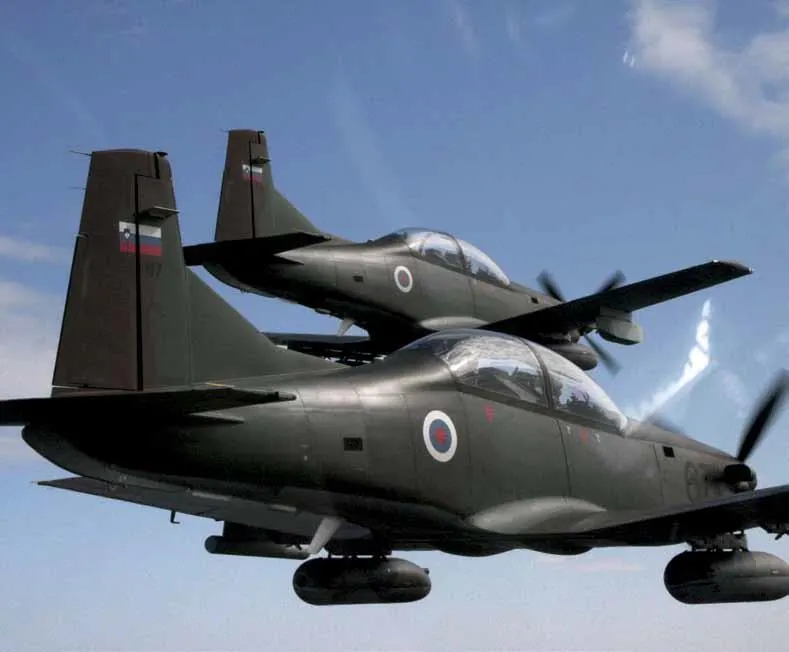
Honduras flew four C-101BBs from the early 1980s in the light-attack role, and Jordan's Royal Jordanian Air Force operated 16 C-101CC-04s from 1987 at the King Hussein Air College, phasing out the last of them by 2018 in favor of the Pilatus PC-9M.8 Collectively, the four operators flew a combined fleet of roughly 145 airframes, a modest number by trainer-market standards, but enough to make the C-101 one of the few Western jet trainers exported into both Central America and the Middle East during the Cold War's final decade.1,2,8
The C-101's closest Western contemporary is the Dassault/Dornier Alpha Jet, a Franco-German jet trainer and light-attack aircraft that first flew four years earlier, in 1973, and reached squadron service in 1979, a year ahead of the C-101.15 The comparison highlights a genuine design fork rather than a simple better/worse gap. CASA built the Aviojet around a single TFE731 turbofan to keep unit and running costs down, at the cost of having no engine-out redundancy on a combat mission; Dassault and Dornier gave the Alpha Jet two Turbomeca Larzac turbofans buried in the rear fuselage, adding weight and cost but letting a damaged aircraft limp home on one engine, a meaningful difference for the light-attack role both types were sold into.15 The Alpha Jet is also the faster and higher-flying of the two on paper, with a listed top speed near 1,000 km/h (620 mph) at sea level and a service ceiling around 14,600 m (48,000 ft), against the C-101's roughly 685–834 km/h and 12,500–12,800 m depending on variant, though neither aircraft was ever intended to out-fly a dedicated fighter.15,4,1 Production numbers tell the rest of the story: France and West Germany alone ordered the Alpha Jet in the hundreds, and it went on to serve with a longer list of export operators than the C-101 ever attracted, which stayed a niche type built for one home air force and three small export customers.
| Spec | CASA C-101 (CC) | Dassault/Dornier Alpha Jet |
|---|---|---|
| Engines | 1 × TFE731-5-1J turbofan | 2 × Larzac 04 turbofans |
| Top speed | ~834 km/h (450 kn)1 | ~1,000 km/h (540 kn)15 |
| Service ceiling | ~12,800 m (42,000 ft)1 | ~14,600 m (48,000 ft)15 |
| Total built (approx.) | 150–1662,4 | ~500 |
Against the Eastern Bloc's equivalent, the Aero L-39 Albatros, the contrast is less about performance than scale: the Czechoslovak-built L-39 was the first turbofan-powered jet trainer in the world and went on to sell over 2,800 units to more than 30 air forces, an order of magnitude beyond the C-101's total production, largely because Comecon customers had no domestic alternative and the L-39 undercut Western trainers on price.16 The C-101 never competed for that volume market; its niche was air forces, mostly Spanish-speaking, that wanted a single airframe covering both training and a credible secondary attack role without buying two separate fleets.
What are the CASA C-101 Aviojet's specifications? Depending on variant, the C-101 is about 12.25–12.5 m long with a 10.6 m wingspan, an empty weight near 3,350 kg and a maximum takeoff weight around 5,600 kg, powered by a single Garrett/Honeywell TFE731 turbofan of 3,500–4,700 lbf depending on model.4,1
How many CASA C-101s were built? Roughly 150 aircraft were built at CASA's Getafe plant in Spain, plus a further batch assembled from kits by ENAER in Chile; sources differ on the combined total, with figures ranging from about 149 to 166.2,4
What is the C-101's top speed? The original, lower-powered C-101EB trainer is rated around 685 km/h (370 kn) at low level; the more powerful C-101CC attack version, with the uprated engine, is credited with up to 834 km/h (450 kn) at altitude.4,1
Is the CASA C-101 still in service? Spain retired the type from its aerobatic display role in June 2025 and has been replacing it in the training fleet with the Pilatus PC-21 since 2022; Jordan retired its last examples in 2018, and Chile withdrew its A-36/Toqui fleet in December 2022, leaving the type largely out of frontline service, though some airframes likely remain in reserve or ground-instruction roles.2,8,13
Did the CASA C-101 see real combat? Documentation is thin. Honduras is described in some secondary and enthusiast sources as having flown the C-101 operationally during the tense Contra-war period on its border with Nicaragua, and Chile's A-36 Halcón held a light-attack and counter-insurgency brief for decades, but neither case is backed by a well-sourced account of a specific engagement.11,12
CASA C-101 vs Alpha Jet: which was better? Neither aircraft is simply "better." The Alpha Jet's two engines and higher speed and ceiling made it the more capable combat platform and the bigger export success, while the C-101's single-engine simplicity kept its price and operating cost lower for air forces that mainly needed a trainer with an occasional light-attack option.15,1
- "CASA C-101 Aviojet", Wikipedia — en.wikipedia.org ↩
- "Aire25: the enduring legacy of the Airbus C-101 and Spain's Patrulla Águila", Airbus — airbus.com ↩
- "CASA C-101 Aviojet Advanced Jet Trainer / Light Strike Aircraft", MilitaryFactory — militaryfactory.com ↩
- "CASA C-101 Aviojet - Specifications", flugzeuginfo.net — flugzeuginfo.net ↩
- "DCS: C-101 Aviojet by AvioDev", Digital Combat Simulator — digitalcombatsimulator.com ↩
- "CASA C-101", Encyclopedia MDPI — encyclopedia.pub ↩
- "T-36 Halcón / A-36 Halcon", GlobalSecurity.org — globalsecurity.org ↩
- "Royal Jordanian Air Force", Wikipedia — en.wikipedia.org ↩
- "Aire25: the enduring legacy of the Airbus C-101 and Spain's Patrulla Águila", Airbus — airbus.com ↩
- "Sea Eagle (missile)", Wikipedia — en.wikipedia.org) ↩
- "DCS: C-101 Aviojet by AvioDev", Digital Combat Simulator — digitalcombatsimulator.com ↩
- "T-36 Halcón / A-36 Halcon", GlobalSecurity.org — globalsecurity.org ↩
- "La Fuerza Aérea de Chile efectuó el último vuelo de un A-36 Toqui", Zona Militar — zona-militar.com ↩
- "Patrulla Águila History", Aerobatic Teams — aerobaticteams.net ↩
- "Dassault/Dornier Alpha Jet", Wikipedia — en.wikipedia.org ↩
- "Aero L-39 Albatros", Wikipedia — en.wikipedia.org ↩
- "DCS C-101 Aviojet is now available for download!", Digital Combat Simulator — digitalcombatsimulator.com ↩