

The Soko G-2 Galeb ("Seagull") is a two-seat, single-engine jet trainer designed in Yugoslavia in the late 1950s to replace the Lockheed T-33 Shooting Star in the Yugoslav Air Force's pilot pipeline.1 Design work began in 1957 at the Vazduhoplovno-tehnički institut (Aeronautical Technical Institute) at Žarkovo, and the first of two prototypes flew on 3 July 1961 with test pilot Ljubomir Zekavica at the controls.1 Series production started at the Soko factory in Mostar in 1965 and continued, with an export-oriented update, until 1985; total output reached 248 airframes, making the Galeb the first mass-produced jet aircraft built in socialist Yugoslavia.1,2
- Simple, rugged Viper turbojet, easy to maintain
- Docile handling, forgiving stall behavior for cadets
- Dual trainer/light-attack role from one airframe
- Short grass-strip takeoff and landing runs
- Unpressurized cockpit limits practical altitude
- Modest weapons load next to purpose-built attack jets
- No self-protection systems, vulnerable to infrared MANPADS
- Small export footprint next to Warsaw Pact and Western rivals
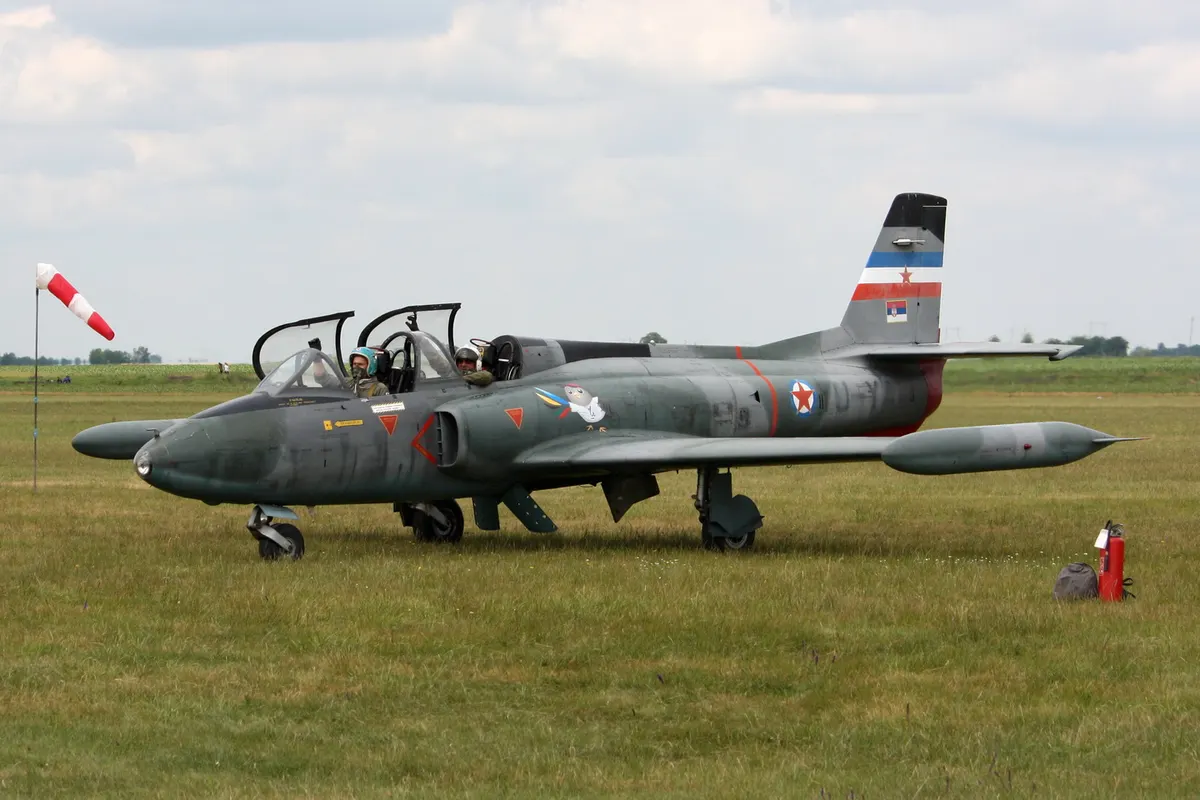
The design leaned heavily on British hardware. A licence-built Rolls-Royce (originally Armstrong Siddeley) Viper turbojet, Folland lightweight ejection seats, and British navigation equipment gave the Galeb a Western technical core even as it was developed and marketed by a nonaligned state that belonged to neither NATO nor the Warsaw Pact.3 That mixed parentage also kept the Galeb out of the 1959 to 1961 Warsaw Pact trainer competition eventually won by the Czechoslovak Aero L-29 Delfín, since Yugoslavia was not a bloc member and never submitted the type for evaluation.4
Beyond training Yugoslav cadets at the Vazduhoplovna vojna akademija (Air Force Academy), the G-2 spawned a single-seat, gun-heavy attack derivative, the J-21 Jastreb, and was exported in an upgraded G-2A-E version to Libya and Zambia.1,5 Production aircraft carried two 12.7 mm machine guns in the nose and four underwing hardpoints rated for a combined 300 kg of bombs, rockets, or a reconnaissance pod, enough for the light-attack role that Yugoslav and export doctrine assigned to it alongside pure training.1
By the time the type entered widespread service in the late 1960s, it had already become the aircraft most Yugoslav Air Force pilots met early in their careers, and it stayed in that role for three decades before the wars of the 1990s and, later, NATO's 1999 bombing campaign thinned the Serbian fleet to almost nothing.1 Libya remained the largest foreign user, and a residual number of Galebs were reportedly still airworthy there past 2011; Serbia has retained at least one example for engineering trials, and a dozen or more ended up on Western civil registers as warbirds.1,6
The Licence-Built Rolls-Royce Viper and Why Yugoslavia Chose It
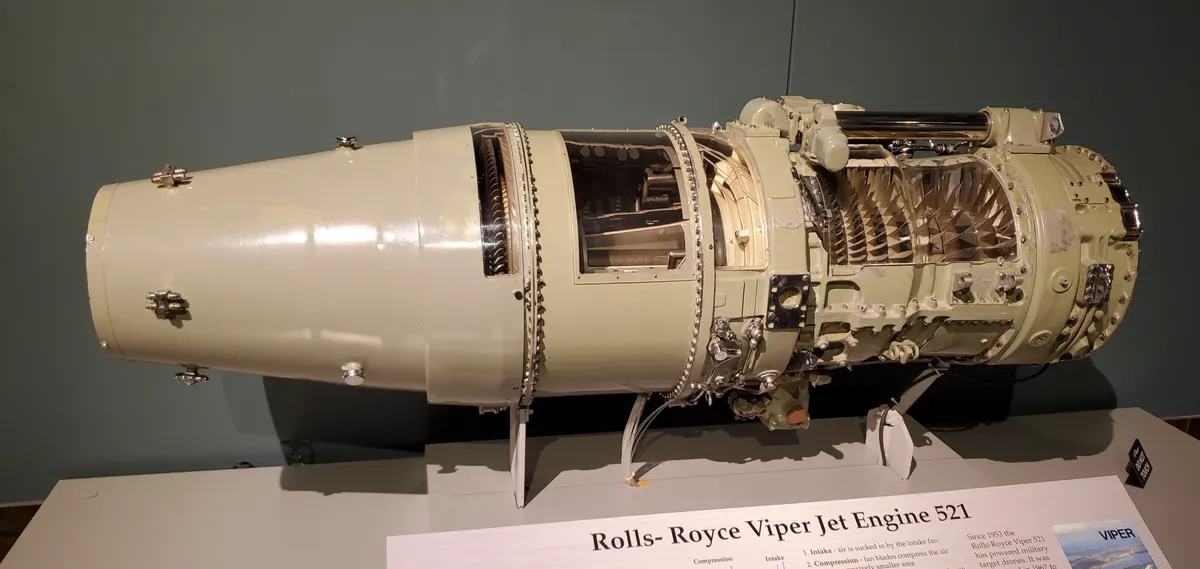
The Galeb's single Viper 22-6 turbojet produced roughly 11.1 kN (2,500 lbf) of thrust, a modest figure even by early-1960s trainer standards, but the engine's simplicity was the point.3,1 The Viper family used low turbine inlet temperatures and a straightforward centrifugal-then-axial layout that tolerated the rough handling of student pilots and needed comparatively little specialist maintenance, which mattered for an air force building its jet infrastructure from a limited industrial base.3
Yugoslavia licence-built the engine domestically, with the Rakovica engine works (later part of the "21. maj" combine) machining Viper components and complete units for both the Galeb and the more powerful Viper 531 fitted to the J-21 Jastreb.7 Rolls-Royce (the engine had passed from Armstrong Siddeley through Bristol Siddeley to Rolls-Royce by the mid-1960s) effectively sponsored the aircraft's development by supplying the powerplant on favorable terms, a fact Flight International cited as the reason the heavily British-equipped Galeb was invited to the 1968 Farnborough air show.3
The airframe, an all-metal stressed-skin structure with a straight wing carrying detachable tip tanks, was designed and built entirely by Soko in Mostar.1 The single largest imported element by value was the powerplant: the Viper turbojet originated as a British Armstrong Siddeley (later Rolls-Royce) design, though Yugoslavia acquired a manufacturing licence and machined engines domestically at the Rakovica works rather than importing complete units after the initial batches.7,3 Folland lightweight ejection seats, radios, and some navigation instruments were sourced from or built to British designs, leaving cockpit displays, guns, and structural fittings as Yugoslav content.3 Overall the type sat roughly in the middle of the domestic-content scale for a 1960s nonaligned air force: airframe and assembly fully local, propulsion and safety-critical avionics dependent on a licensed Western design.
Tandem Cockpit, Ejection Seats, and Handling Qualities
Both crew stations used Folland Type 1-B lightweight ejection seats, and the instructor sat behind and slightly above the student in a stepped tandem arrangement typical of the era.1 Soko's designers deliberately aimed for docile stall behavior and low touchdown speeds rather than outright performance, producing an aircraft description sources repeatedly call "unfatiguing and easy to fly," with a landing run of around 400 m on grass.1
The tradeoff was a practical operating ceiling well below the airframe's rated 12,000 m service ceiling, since the unpressurized cabin limited comfortable cruise to roughly 7,000 to 9,000 m, and a top speed of 812 km/h at altitude (756 km/h at sea level) that was adequate for basic jet conversion but unremarkable next to contemporary attack aircraft.1,4
Yugoslavia's push for an indigenous jet trainer reflected a broader postwar effort to reduce dependence on both NATO and Soviet-bloc suppliers after the 1948 Tito-Stalin split. The T-33s Yugoslavia operated through the Mutual Defense Assistance Program were adequate but foreign, and the Aeronautical Technical Institute's Galeb design, drawn up from 1957, was meant to put a Yugoslav-built jet into cadet training for the first time.1
The first prototype's maiden flight came on 3 July 1961, and a second prototype followed to refine the production configuration; series deliveries to the Yugoslav Air Force began on 30 July 1965.1 By 1968 the type had become the aircraft on which most Yugoslav Air Force pilots took their first jet hours, and that same year a four-ship (later five-ship) Galeb aerobatic team, based at Zemunik near Zadar, gave its first public display at Ljubljana; the team flew the G-2A without tip tanks in standard camouflage before switching to a white-and-red display scheme.8 That formation was eventually superseded by a Jastreb-equipped team and, decades later, by the "Leteće zvezde" (Flying Stars), which flew the G-4 Super Galeb, a separate and later Soko design that shares only lineage and a name with the G-2.8,9

Directly derived from the Galeb, the single-seat J-21 Jastreb ("Hawk") first flew in 1965 as a dedicated ground-attack aircraft: it kept the Galeb's wing and Viper-based propulsion (an uprated Viper 531 with roughly 500 lbf more thrust) but deleted the rear cockpit for fuel and avionics space and added a third 12.7 mm gun, entering service as a Republic F-84 Thunderjet replacement.5 A further derivative, the G-3 Galeb-3 prototype flown in August 1970, tested an even more powerful Viper 532 (borrowed from the Jastreb), a modernized cockpit, tip-tank cameras, doubled weapons capacity, and JATO bottles for short-field operation, but it did not proceed to volume production and remained an export demonstrator.1
Export orders followed from the mid-1970s: a dedicated G-2A-E variant went to Libya from 1974, with deliveries and later refurbishment work continuing there until roughly 1983, and a small batch reached Zambia, where it served as a low-cost jet-conversion type alongside Soviet-supplied MiG-17s.6,13 Sources differ on the exact size of the Zambian order, with figures ranging from two to six aircraft depending on whether later attrition replacements are counted, a discrepancy that has not been resolved in available open literature.
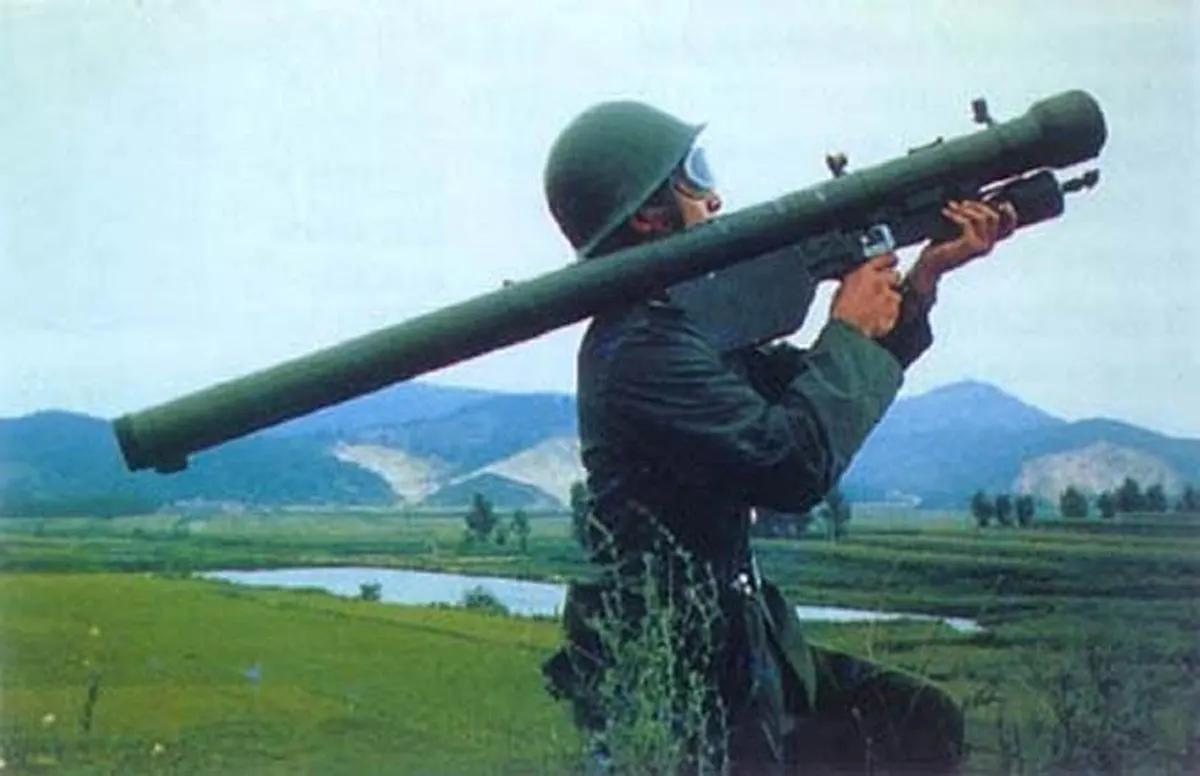
The Galeb's only large-scale combat use by its original operator came during the breakup of Yugoslavia. Aircraft of the Yugoslav People's Army's (JNA) 105th Fighter-Bomber Regiment flew low-level strike sorties with unguided bombs and rockets in support of ground operations in Croatia in 1991, including around Vukovar.14 The tactic exposed a design weakness the trainer role had never had to address: on 23 August 1991, Croatian forces shot down at least one Galeb with a man-portable infrared-guided missile during the fighting at Vukovar, and a further loss to a similar weapon was reported near Zagreb on 20 September 1991.14 Those losses, against an airframe with no radar warning receiver or countermeasures, pushed the JNA toward more cautious employment of the type for the remainder of the war.
Surviving Serbian- and Yugoslav-flagged Galebs relocated to bases in Serbia through 1992 and were folded into Federal Republic of Yugoslavia and, indirectly, Republika Srpska Air Force operations during the Bosnian War, again in the light-strike role.14 Croatia captured at least three examples during its 1995 Operation Storm offensive against Republika Srpska Krajina, and remnants of the type based in Serbia were largely destroyed on the ground during NATO's 1999 air campaign, effectively ending the Galeb's frontline career in the region it was built for.1
Well outside the Balkans, Yugoslavia reportedly sent a small detachment, one G-2, three J-21 Jastrebs, and four MiG-21s, flown by Serbian contract pilots, to support Mobutu Sese Seko's government during the First Congo War in 1996-97; the aircraft operated from Gbadolite and were largely abandoned once the mercenary contingent was expelled as Mobutu's position collapsed.1
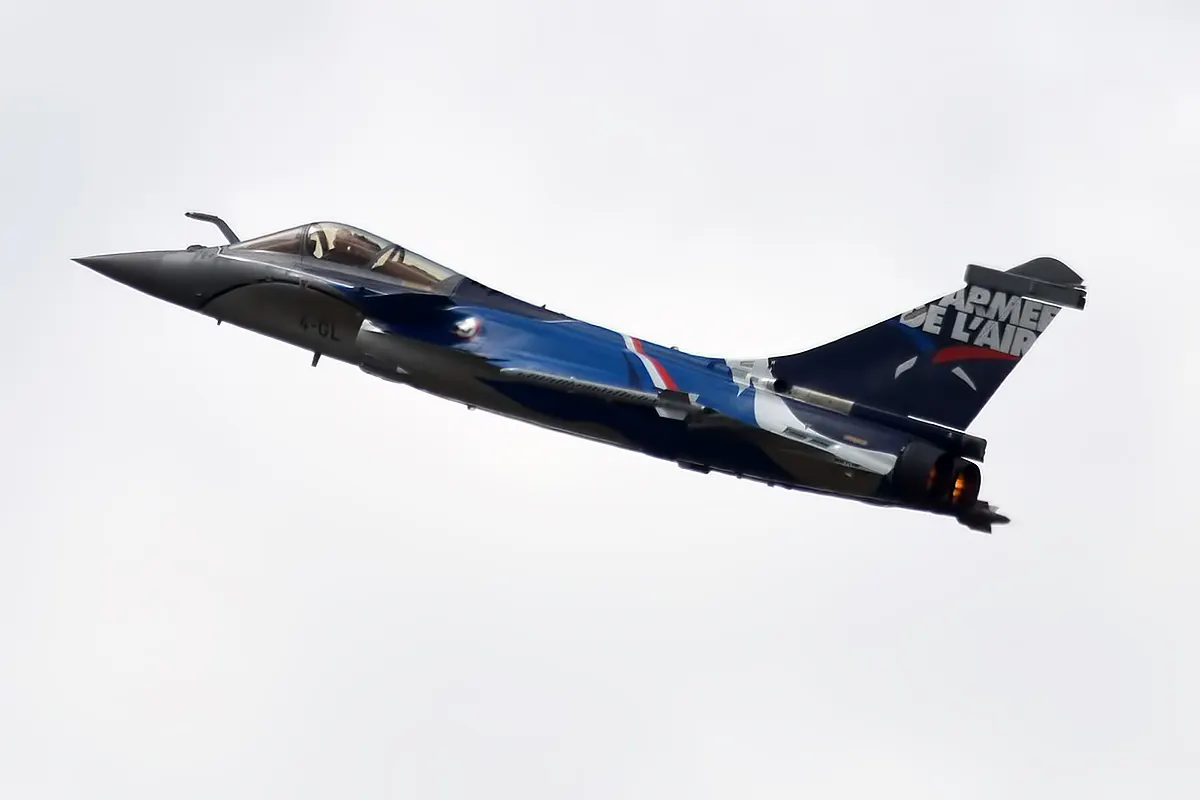
Libya's much larger Galeb fleet saw its own combat during the 2011 civil war, flown by forces loyal to Muammar Gaddafi against the rebel uprising in the country's east.1,6 On 24 March 2011, a French Air Force Dassault Rafale destroyed a Libyan Galeb near Misrata after it was judged to have violated the UN-mandated no-fly zone, one of the first air-to-air kills of that intervention.1 Additional Libyan aircraft reported destroyed the following day were later identified via satellite imagery as MiG-23s rather than Galebs, a correction that illustrates how easily older Soko types were misidentified amid the wider Libyan jet inventory.1 During the later Second Libyan Civil War, factions aligned with Libya Dawn were reported to hold two to four Galebs, though their operational status has been difficult to verify.1
These conflicts, layered on top of three decades of hard training and light-attack use, help explain why so few Galebs remained airworthy in military service by the 2010s: combat attrition, ground losses to Croatian and NATO airstrikes, and simple airframe age removed most of the type from active inventories well before it became primarily a civilian warbird.1
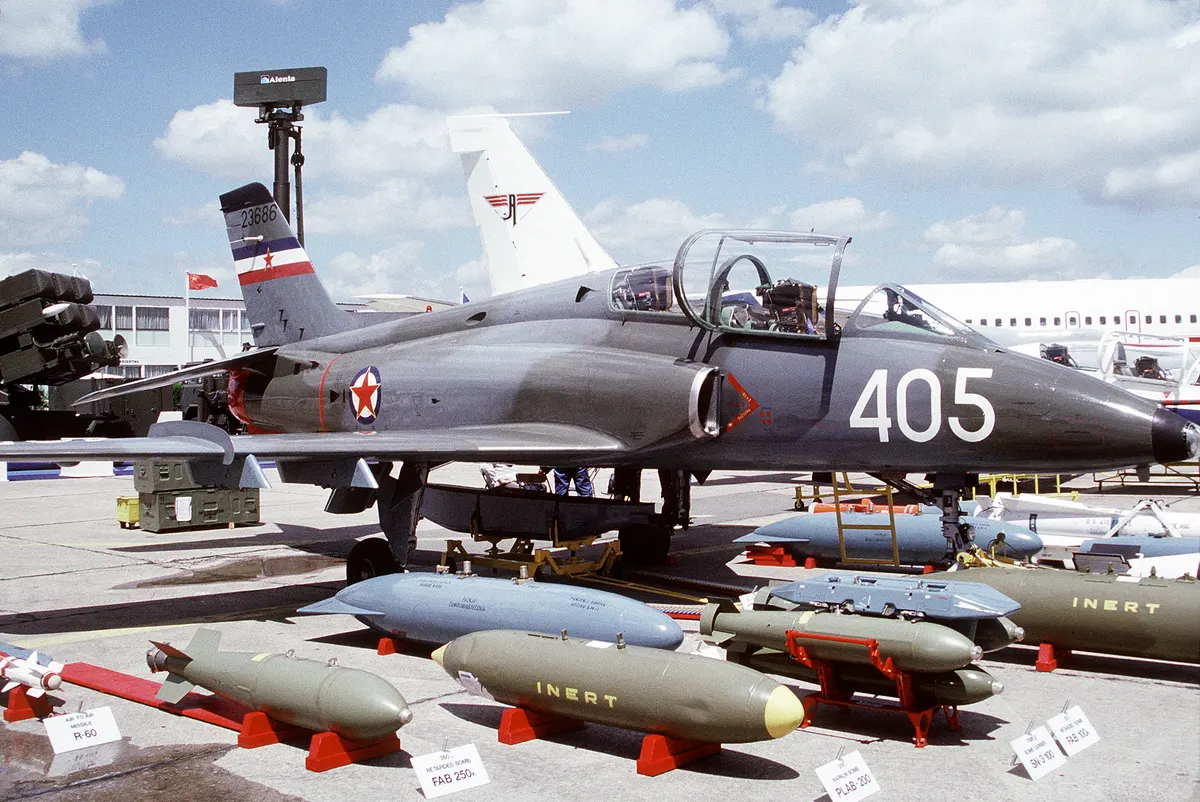
The baseline production standard, the G-2-A, equipped the Yugoslav Air Force from 1965 with the 22-6 Viper, twin nose guns, and four weapons pylons.1 An unarmed pilot-training version, the G-2Š, stripped the combat fit for pure flying instruction. The export-focused G-2A-E added minor equipment changes for Libya and Zambia from 1974, and it was this version, not the original Yugoslav standard, that saw the type's only real combat exposure by a Galeb operator outside the former Yugoslavia.6,13 The one-off G-3 Galeb-3 prototype of 1970 previewed a more ambitious, more heavily armed derivative, but Soko's export energy went instead into the single-seat J-21 Jastreb, which used the same wing and fuselage concept but was a distinct, purpose-built attack aircraft rather than a Galeb sub-variant.1,5
It is worth separating the G-2 firmly from the later G-4 Super Galeb, a swept-tailplane, more powerful Yugoslav trainer that entered service in the mid-1980s. The two share a manufacturer, a market segment, and a name, but the G-4 is a new airframe developed roughly two decades later and is covered as its own type; it did not replace G-2s on a one-for-one basis, and both flew in parallel for the Yugoslav Air Force through the late 1980s.15
The Yugoslav Air Force was the type's principal user, operating roughly 128 to 132 aircraft at peak strength for basic and advanced jet training plus light-attack duties.1 After Yugoslavia's dissolution, the successor Federal Republic of Yugoslavia and later Serbia inherited the bulk of the surviving fleet; Serbia retains at least one example with its Technical Test Center rather than in a training squadron.1 Bosnia and Herzegovina used Galebs during its civil war as part of contending factions' scavenged air assets, and Croatia holds a small number captured in 1995.1
Libya was comfortably the largest foreign customer, taking a reported 116 G-2A-E aircraft from 1974, of which a residual number, roughly a dozen by some post-2011 counts, remained nominally in service into the 2010s.1,6 Zambia operated a small batch delivered from the early-to-late 1970s as a MiG-17 alternative for advanced training, and a single aircraft reportedly reached what was then Zaire around 1997 under a French-Yugoslav arrangement, separate from the mercenary detachment sent during the Congo war.1,13 Indonesia's aerospace industry, IPTN, kept at least one Galeb (registered PK-XGS) flying as a chase aircraft for its N-250 turboprop program, an unusual second career for a 1960s Yugoslav trainer.1
A dozen or more Galebs migrated to Western civil registers beginning before the Yugoslav wars, and the type remains active today on the warbird circuit in the United States, New Zealand, Slovenia, and Serbia, appearing at air shows and, occasionally, in period-war film productions.1,11
The Galeb's closest conceptual rival is the Czechoslovak Aero L-29 Delfín, and the comparison is really a story about market access more than raw capability. Both aircraft reached prototype stage within a few years of each other in the late 1950s as candidates to standardize jet training across their respective political blocs; the L-29 competed formally against the Polish TS-11 Iskra and Soviet Yak-30 in Warsaw Pact trials, while the nonaligned Galeb was never eligible to enter that specific competition.4 The L-29 was announced the winner in 1961 despite the TS-11 reportedly performing better in flight testing, and the aircraft that followed the decision went on to remarkably wide production: more than 3,600 built and sold in fifteen-plus countries, versus 248 Galebs sold to essentially three operators outside Yugoslavia.4 Technically the two aircraft are close cousins: single-engine, tandem two-seat, straight-wing, unpressurized, subsonic trainers built around a low-bypass turbojet in the 800 to 900 km/h class. The Delfín's Motorlet M701 engine produced somewhat more thrust than the Galeb's Viper 22-6, giving it a slight edge in climb, but the Galeb's licence-built Western engine gave Yugoslavia and its customers an easier maintenance and spares relationship with non-Soviet suppliers, a genuine consideration for buyers like Libya and Zambia trying to diversify away from a single bloc's supply chain.3,4
| Spec | Soko G-2 Galeb | Aero L-29 Delfín |
|---|---|---|
| First flight | 1961 | 1959 |
| Engine | Viper 22-6, 11.1 kN | Motorlet M701c 500, 8.7 kN |
| Max speed | 812 km/h | 655 km/h |
| Units built | 248 | over 3,600 |
The two aircraft never competed head to head in combat or in a shared export market, so the comparison stays one of industrial reach rather than operational superiority: the Delfín's numbers reflect a captive Warsaw Pact market Yugoslavia was structurally excluded from, not a decisive technical gap. Where the Galeb clearly outperforms its Czechoslovak counterpart on paper is straight-line speed, helped by a lighter airframe and a Viper engine, developed originally for larger British jets, running at a favorable thrust-to-weight ratio in the smaller Yugoslav design.1,4
How many Soko G-2 Galebs were built? Soko built 248 examples at Mostar between 1965 and 1985, including the domestic G-2-A and the export G-2A-E.1,2
What engine does the Soko G-2 Galeb use? A single licence-built Rolls-Royce (originally Armstrong Siddeley) Viper 22-6 turbojet producing about 11.1 kN (2,500 lbf) of thrust, manufactured in Yugoslavia at the Rakovica engine works.3,7
What is the Soko G-2 Galeb's top speed? 812 km/h at altitude (around 6,200 m) and 756 km/h at sea level, with a dive limit around Mach 0.81.1
Is the Soko G-2 Galeb still in service? Not as a frontline trainer. Libya retained a small residual number into the 2010s, Serbia keeps at least one for technical trials, and a dozen-plus fly as civilian warbirds, but no air force uses it for primary pilot training today.1,6
What is the difference between the Galeb and the Jastreb? The J-21 Jastreb is a single-seat, gun-heavy ground-attack derivative of the two-seat Galeb trainer, with the rear cockpit deleted for fuel and equipment and a more powerful Viper 531 engine.5
How does the Galeb compare to the Aero L-29 Delfín? Similar concept and era, but very different production scale: the L-29 won the Warsaw Pact's trainer competition and sold over 3,600 units, while the nonaligned Galeb, never eligible for that contest, sold 248 mostly to Yugoslavia, Libya, and Zambia.4
- "Soko G-2 Galeb", Wikipedia — en.wikipedia.org ↩
- "SOKO G-2 Galeb (Seagull) Two-Seat Jet Trainer / Light Attack Aircraft", Military Factory — militaryfactory.com ↩
- "SOKO G-2 Galeb: A Yugoslav Jet Trainer and Light Ground-Attack Aircraft", Combat Operators — combatoperators.com ↩
- "Aero L-29 Delfín", Afterburner Aviation Magazine — afterburner.com.pl ↩
- "Soko J-21 Jastreb", Wikipedia — en.wikipedia.org ↩
- "SOKO G-2 Galeb: Military Training Aircraft Specs & Operators", Global Military — globalmilitary.net ↩
- "Aircraft industry of Serbia", Wikipedia — en.wikipedia.org ↩
- "Yugoslavian Past Aerobatic Display Teams", Aerobatic Teams — aerobaticteams.net ↩
- "Leteće zvezde", Wikipedia — en.wikipedia.org ↩
- "Aces: Iron Eagle III", Wikipedia — en.wikipedia.org ↩
- "SOKO G-2 Galeb: A Yugoslav Jet Trainer and Light Ground-Attack Aircraft", Combat Operators — combatoperators.com ↩
- "Soko Galeb G-2, N90SR: Accident occurred February 21, 2018 at Elko Regional Airport, Nevada", Kathryn's Report — kathrynsreport.com ↩
- "Zambian Air Force", Wikipedia — en.wikipedia.org ↩
- "Soko G-2 Galeb", Grokipedia — grokipedia.com ↩
- "G-2 Galeb vs Soko G-4 Super Galeb: Aircraft Full Comparison", Global Military — globalmilitary.net ↩