

The BAC Strikemaster is a two-seat, single-engine jet aircraft built by the British Aircraft Corporation between 1967 and 1983 for training and light attack. It is an armed derivative of the Jet Provost T Mk 5, itself the turbojet descendant of the piston-engined Percival Provost trainer, and BAC gave it the internal designation BAC 167.1 Earlier attempts to sell a lightly armed Jet Provost had been turned down by potential buyers who judged its firepower too modest for counter-insurgency work, so BAC built a purpose-strengthened version with a more powerful engine, four wing hardpoints, and a pair of fixed machine guns, then pitched it directly at small air forces that could not afford separate trainer and attack fleets.1
- Simple, low-cost single-engine operation
- Rugged airframe, tolerant of rough strips and small-arms damage
- Zero-altitude-capable Martin-Baker ejection seats for both crew
- Dual role removed the need for separate trainer and attack types
- Modest speed and payload next to purpose-built COIN jets like the A-37
- Only two rifle-caliber machine guns as fixed armament
- Shrinking spares pool (starter generators, brakes) since the 1990s
- Documented wing-root fatigue cracking limited later military use
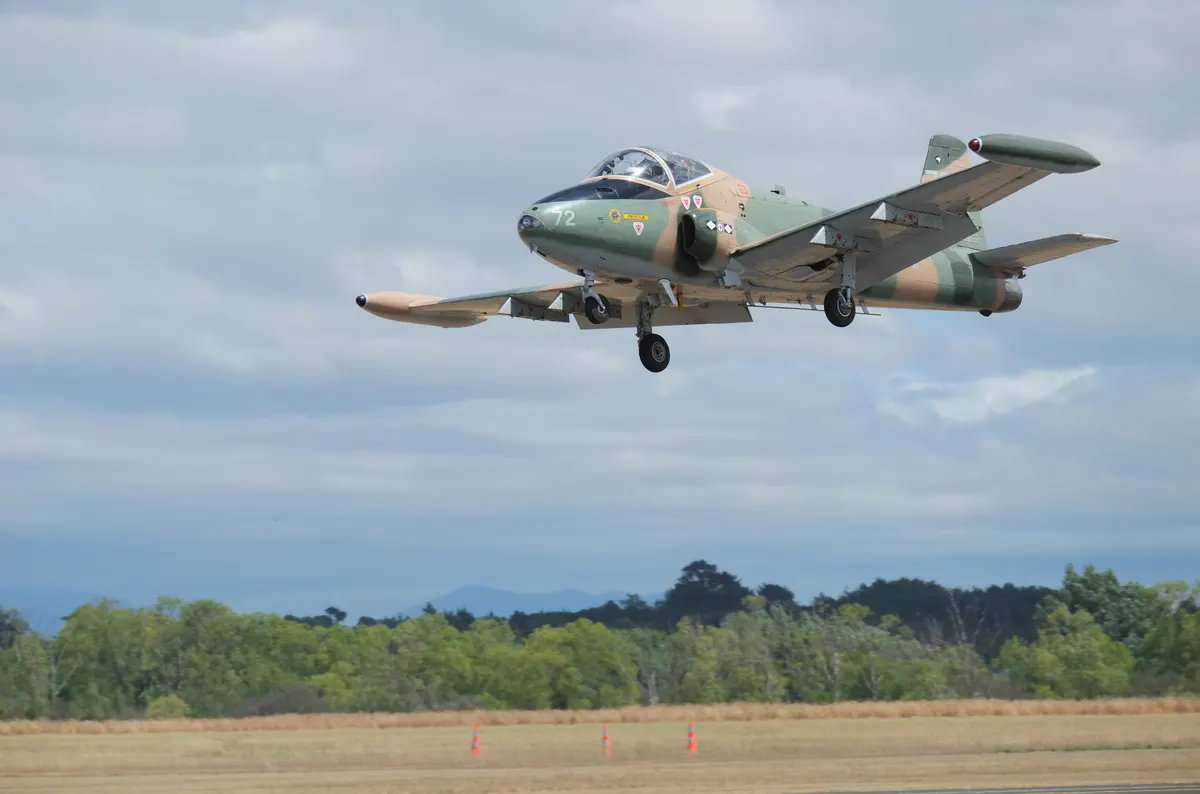
The first of two prototypes flew from Warton on 26 October 1967, and the name Strikemaster received formal approval a year later, in October 1968.1 Saudi Arabia had already committed to an order in May 1966, before the prototype had even flown, making it the type's first and largest customer.1 BAC ultimately built 146 aircraft for eleven original air forces, plus a scatter of secondhand transfers, before ending production in 1983 as sales slowed and Hawker Siddeley's own designs took over the same market niche.1
Despite the attack-aircraft marketing, most buyers used the Strikemaster primarily as an advanced jet trainer with a genuine ground-attack option held in reserve, and several of them eventually exercised that option in earnest. Omani Strikemasters flew close air support at the Battle of Mirbat in 1972, Ecuador used its fleet against Peru in 1995, and both Yemeni states operated the type through their own internal conflicts.1,2,5 The airframe proved rugged and forgiving for pilots converting from piston trainers, and a Martin-Baker ejection seat gave crews a chance most contemporaries in this class lacked at low altitude.8
The Rolls-Royce Viper Turbojet and a Modest but Reliable Powerplant
Production Strikemasters were fitted with a single Rolls-Royce (originally Armstrong Siddeley-designed, later Bristol Siddeley-built) Viper Mk 535 turbojet, rated at around 3,410 lbf (15.2 kN) of thrust, a useful jump over the roughly 2,500 lbf Viper fitted to the unarmed Jet Provost T Mk 5.1,3 It was a simple single-shaft centrifugal-flow engine, easy to maintain in the field and already familiar to export customers through licensed Viper production elsewhere, which mattered to air forces with limited technical infrastructure.3

That thrust gave the Strikemaster a maximum speed of about 481 mph (774 km/h) at 18,000 ft, a service ceiling of 40,000 ft, and a climb rate near 5,250 ft per minute, figures that were adequate for a light COIN jet but well short of contemporary fighters.1,3 Range on internal and tip-tank fuel reached roughly 1,382 miles (2,224 km) ferry, though a fully loaded low-level strike sortie cut the useful radius to around 145 miles.1 Empty weight was about 6,195 lb (2,810 kg) against a maximum takeoff weight of 11,500 lb (5,216 kg), leaving a generous margin for weapons and fuel on an airframe that started life as a trainer.1
Hardpoints, Twin Machine Guns, and a Trainer Built to Take a Beating
The airframe changes that separated the Strikemaster from the Jet Provost were mostly structural: reinforced wings carrying four hardpoints, a strengthened flap system with twin jacks, larger airbrake actuators, and a pair of fixed 7.62mm FN machine guns with 550 rounds each, mounted under the intake lips.1 The hardpoints could carry up to 3,000 lb (1,360 kg) of stores in combination, including 500 lb bombs, SNEB 68mm rocket pods, SURA R80 rockets, practice and fragmentation bombs, and 0.5-inch gun pods, giving instructors a real weapons envelope to train against rather than a token gesture.1
Martin-Baker Ejection Seats and an Almost Entirely British Aircraft
Both crew positions carried Martin-Baker Mk4 ejection seats, fitted with canopy breakers so the seat could fire straight through the acrylic canopy rather than waiting on a jettison sequence, a real advantage during the low-level strafing runs the type was designed for.1,8 The Mk4 could not guarantee a safe ejection at zero altitude and zero airspeed the way later Martin-Baker seats could, but it still gave Strikemaster crews an escape option that some rival COIN jets of the era did not offer as standard.8
The Strikemaster was, with only minor exception, a wholly British product. The British Aircraft Corporation built the airframe at Warton and, from the late 1970s, at Hurn Airport near Bournemouth, while the Viper turbojet came from Rolls-Royce's Small Engine Division in Coventry (inheriting Armstrong Siddeley and Bristol Siddeley Viper production).1,3 Radios, gunsights, and the Martin-Baker ejection seats were likewise sourced from UK suppliers, and no export customer assembled the type under license; every one of the 146 airframes was completed in England before delivery.1 The closest thing to an imported component was the FN machine guns, of Belgian origin, a minor exception on an otherwise domestically produced aircraft.1
From a Rejected Sales Pitch to the BAC 167

The Jet Provost had been in RAF service since the mid-1950s as an unarmed basic and advanced trainer, and Hunting (later absorbed into BAC) had tried more than once to interest export customers in a lightly armed version for counter-insurgency work. Those pitches were turned down largely because buyers judged the available armament too light to be useful in a real shooting war.1 BAC's answer in the 1960s was to design a genuinely strengthened aircraft around the same basic airframe rather than simply bolt on a gun pod, producing the BAC 167 with reinforced wings, a bigger engine, and enough hardpoints to matter operationally.
Saudi Arabia's Early Bet and a Production Run That Outlived Its Market
Saudi Arabia placed an order in May 1966, well before either prototype had flown, and went on to take delivery of 47 aircraft across the Mk 80 and Mk 80A batches, making it by far the largest single customer.1,4 Oman, Kuwait, Singapore, Kenya, New Zealand, Ecuador, South Yemen, and Sudan followed with their own mark numbers between 1969 and 1983, each batch tailored slightly for the buyer's climate, avionics preference, or budget.1,4 Total production settled at 146 airframes: 136 in the original Strikemaster 80 series and a final ten-aircraft Strikemaster 90 series delivered to Sudan in 1983, by which point BAC (by then folded into British Aerospace) was already steering export customers toward the jet-powered Hawk instead.1
Retirement, Fatigue Cracking, and a Fleet That Outlived Its Spares
Most air forces retired the Strikemaster through the 1980s and 1990s as jet trainers like the Hawk and Pilatus PC-9 matured, with the last official military retirement occurring in the early 1990s.1 Its decline owed less to obsolescence than to two practical problems: the Royal New Zealand Air Force discovered fatigue cracking around the wing root that forced inspection regimes and flight restrictions on other operators' fleets, and BAC's 1977 merger into British Aerospace gradually cut off dedicated manufacturer support, leaving starter generators and brakes in particularly short supply by the end of the 2010s.1
The Dhofar Rebellion and the Battle of Mirbat
The Sultan of Oman's Air Force flew Strikemasters against Dhofari insurgents from October 1969, and the type's best-known action came on 19 July 1972 at Mirbat, where a small British Army Training Team and Omani gendarmerie garrison of around three dozen men held off an assault by several hundred Popular Front for the Liberation of Oman fighters.1,2 Two Strikemasters scrambled from Salalah and reached Mirbat within minutes, followed later by a second pair; low cloud forced the pilots down to strafing altitude, where they used machine-gun fire and light rockets rather than bombs.2 One aircraft took enough ground fire that it broke off before expending its full weapons load, but the sustained strafing runs, combined with reinforcements flown in by helicopter, broke the assault and are generally credited with turning the battle.2
Over the wider Dhofar campaign, which ran into the mid-1970s, Oman lost three Strikemasters; at least one loss is attributed by some accounts to a shoulder-fired surface-to-air missile, though the precise cause is not consistently confirmed across sources.1
Yemen's Civil Wars, North and South
Both Yemeni states operated the Strikemaster and both used it in anger. Saudi-backed royalist forces used the type against Egyptian-supported republicans during the later stages of the North Yemen Civil War around 1969, while the Marxist government of South Yemen took delivery of four Mk 81s in 1970 and flew them in internal security operations.1 Sourcing on the scale and dates of Strikemaster sorties inside Yemen is thinner than for the Dhofar campaign, and loss figures there are not well documented in English-language accounts.
The Cenepa War: Ecuador Against Peru, 1995
Ecuador's Strikemasters saw their most significant action during the brief Cenepa War of January to February 1995, a border conflict with Peru fought largely in the upper Cenepa valley. On 3 February 1995, Ecuadorian Strikemasters flew alongside Ecuadorian A-37 Dragonflies to bomb Peruvian positions, one of the only documented cases of the Strikemaster and its closest rival operating side by side in the same campaign.5 Peruvian EMB-312 Tucanos struck back at Ecuadorian positions the following day, and the war ended within weeks under diplomatic pressure, with both air forces having flown ground-attack sorties but neither losing aircraft to the other in air-to-air combat.5
The Strikemaster 80 series covered most production and was structurally uniform from customer to customer, the mark number changing mainly with avionics standard, cockpit instrumentation, and minor equipment fit rather than the airframe itself: Mk 80 and Mk 80A for Saudi Arabia, Mk 81 for South Yemen, Mk 82 and Mk 82A for Oman, Mk 83 for Kuwait, Mk 84 for Singapore, Mk 87 for Kenya, Mk 88 for New Zealand, and Mk 89 plus Mk 89A for Ecuador.1,4 A final, distinct Strikemaster 90 series, ten aircraft built for Sudan in 1983, closed out production after a multi-year gap and was the last variant off the line.1
Beyond the original customers, airframes changed hands twice more: nine refurbished ex-Kenyan and ex-Kuwaiti aircraft went to the newly formed Botswana Defence Force Air Wing in 1977, and two of those later passed to the Ivory Coast, where local fighting destroyed one in 2004.1 Bolivia evaluated a batch of 12 to 16 new-build aircraft in the early 1970s but did not proceed with an order, one of the type's few near-sales that never converted.1
Saudi Arabia's Royal Saudi Air Force was the largest and earliest customer, flying its Strikemasters with No. 9 Squadron in a combined training and light-attack role from August 1968 until retirement around 1978.1 Oman's air force, first as the Royal Air Force of Oman and later the Sultan of Oman's Air Force, used its fleet the longest and most intensively of any operator, flying it in actual combat throughout the Dhofar Rebellion into the mid-1970s.1,2
Kuwait, Singapore, and Kenya each operated smaller, training-oriented fleets, all retired by the mid-1980s, with Kenya's Strikemasters serving alongside its Hawker Hunter fighters.1 The Royal New Zealand Air Force flew its Mk 88s with No. 14 Squadron from 1972 as the RNZAF's principal jet trainer for two decades, retiring the type in the early 1990s.1
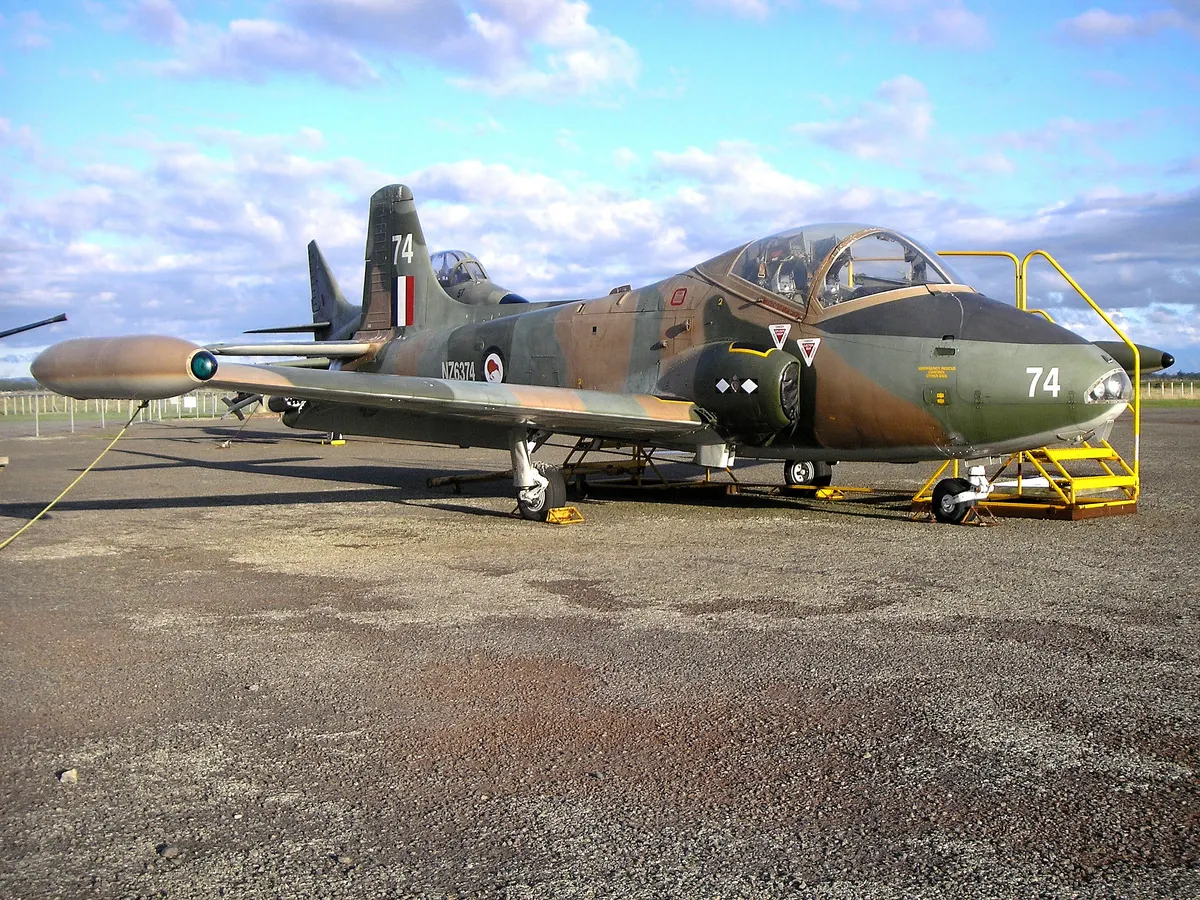
Ecuador's air force flew the type longest of any operator in the Western Hemisphere and was the last original military customer to use it in actual combat, during the 1995 Cenepa War.1,5 Sudan's Mk 90s, delivered in 1983, were the final Strikemasters built for any air force, and Botswana and the Ivory Coast later flew small secondhand fleets rather than new-build aircraft. No air force flies the Strikemaster in military service today; surviving airframes fly mainly in civilian and warbird hands.1
The Strikemaster's closest counterpart is the Cessna A-37 Dragonfly, an American COIN jet developed on a similar timeline from the T-37 trainer rather than the Jet Provost, and the two aircraft were built to answer the same basic requirement from opposite sides of the Atlantic.1,6 The A-37B is faster, with a top speed of about 507 mph (816 km/h) against the Strikemaster's 481 mph, and it carries far more ordnance, up to 5,800 lb across eight hardpoints compared with the Strikemaster's 3,000 lb on four, plus a single 7.62mm minigun with 1,500 rounds against the Strikemaster's two fixed guns with 550 rounds each.6 Ferry range tells a different story: the Strikemaster's wingtip tanks give it roughly 1,382 miles against the A-37B's 1,012-mile ferry figure, a point in the British aircraft's favor for air forces operating over long distances between bases.1,6
The more consequential difference is economic rather than tactical. The Dragonfly runs on two General Electric J85 turbojets, giving it redundancy and more thrust overall but also twice the engine maintenance burden of the Strikemaster's single Rolls-Royce Viper.6 For the small air forces that bought both types, that single-engine simplicity mattered as much as any performance figure, meaning fewer spare engines, fewer technicians, and a lower cost per flying hour, which is why several Strikemaster customers chose it explicitly as the more affordable option even where the objectively more capable A-37 was on offer.1,6
| Spec | BAC Strikemaster | Cessna A-37B Dragonfly |
|---|---|---|
| Engine(s) | 1x Rolls-Royce Viper 535, ~3,410 lbf | 2x GE J85-GE-17A, 2,850 lbf each |
| Max speed | 481 mph (774 km/h) | 507 mph (816 km/h) |
| Ferry range | 1,382 mi (2,224 km) | 1,012 mi (1,629 km) |
| Max external stores | 3,000 lb (4 hardpoints) | 5,800 lb (8 hardpoints) |
| Fixed guns | 2x 7.62mm, 550 rounds each | 1x 7.62mm minigun, 1,500 rounds |
Where the Strikemaster does have a clear edge is survivability equipment: both crew positions had Martin-Baker ejection seats from the outset, while the Dragonfly's lineage from the unarmed T-37 trainer meant its own ejection provisions arrived later in the program's life, a detail COIN pilots flying low-level strafing runs cared about a great deal.6,8
How many BAC Strikemasters were built? BAC built 146 Strikemasters between 1967 and 1983 for eleven original military customers, with Saudi Arabia (47 aircraft) the largest single buyer.1
What engine powers the BAC Strikemaster? A single Rolls-Royce Viper Mk 535 turbojet, rated at roughly 3,410 lbf (15.2 kN) of thrust, an uprated version of the Viper fitted to the unarmed Jet Provost trainer.1,3
What is the BAC Strikemaster's top speed? About 481 mph (774 km/h) at 18,000 ft, with a never-exceed speed of 518 mph (834 km/h).1,3
Is the BAC Strikemaster still in service with any air force? No. Every original military operator had retired it by the 1990s, and the last secondhand military examples, in Botswana, followed by the late 1990s. Surviving airframes fly mainly in civilian and warbird hands today, notably in New Zealand.1,7
BAC Strikemaster vs Cessna A-37 Dragonfly: which was better? The A-37B was faster and carried more ordnance and ammunition, but the Strikemaster's single engine made it cheaper to operate, which is why several air forces chose it over the more capable A-37.6
What was the Strikemaster's role at the Battle of Mirbat? Four Sultan of Oman's Air Force Strikemasters provided close air support to a badly outnumbered garrison on 19 July 1972, strafing attacking insurgents at low level until reinforcements arrived; the action is widely credited as decisive in breaking the assault.2
- "BAC Strikemaster", Wikipedia — en.wikipedia.org ↩
- "Battle of Mirbat", Wikipedia — en.wikipedia.org ↩
- "PROFILE: BAC 167 Strikemaster", Courtesy Aircraft Sales — courtesyaircraft.com ↩
- "BAC 167 Strikemaster", GlobalSecurity.org — globalsecurity.org ↩
- "Cenepa War", Wikipedia — en.wikipedia.org ↩
- "Cessna A-37 Dragonfly", Wikipedia — en.wikipedia.org ↩
- "BAC 167 Strikemaster Mk.88", New Zealand Warbirds Association — nzwarbirds.org.nz ↩
- "MK4 Ejection Seat", Martin-Baker — martin-baker.com ↩