

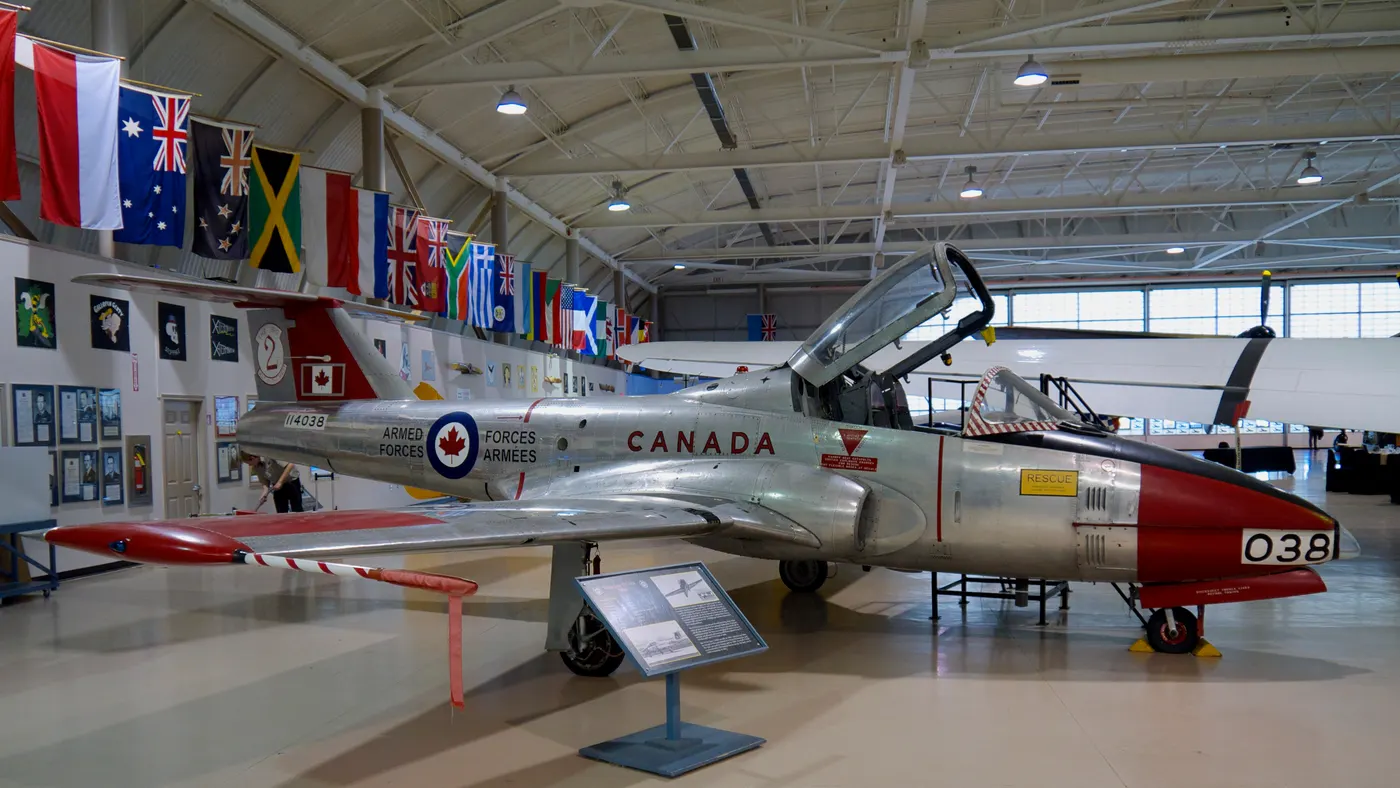

The Canadair CT-114 Tutor, company designation CL-41, is a two-seat jet trainer designed and built in Canada, first flown on 13 January 1960 and in Royal Canadian Air Force service from 29 October 1963.1 Canadair developed it as an in-house private venture starting in 1956, before the government had committed to buying anything, betting that the RCAF would eventually need a domestic replacement for its imported Meteor and T-33 jet trainers.2,1 The bet paid off: Ottawa ordered 190 production CL-41As in September 1961, and Canadair built 212 airframes in total between 1963 and 1966, including two prototypes and 20 armed export aircraft for Malaysia.1
- Simple, forgiving side-by-side layout well suited to student pilots and instructor coaching
- Docile handling and a strong safety-through-simplicity reputation for most of its career
- Genuinely indigenous Canadian design and engineering achievement for a small aerospace industry
- Armed CL-41G derivative proved durable enough for two decades of counter-insurgency flying
- Iconic display-team airframe with rare longevity and public visibility
- Ejection seat and cockpit systems are decades behind current safety standards
- Airframe age has made spare parts and structural fatigue management increasingly difficult
- Subsonic performance and 1950s-era avionics limit any remaining training relevance
- Restraint-system and ejection-seat malfunctions have contributed to fatal Snowbirds accidents
Structurally the Tutor is unremarkable for its category, a low-wing, single-engine, tricycle-gear jet with side-by-side seating rather than the tandem layout used by most fighter-track trainers of the era.1 What has kept it in public view long after most 1960s trainers were scrapped is the Canadian Forces Snowbirds, 431 Air Demonstration Squadron, which adopted the type in 1971 and is still flying it in 2026, more than six decades after the prototype's first flight.3 A smaller, armed derivative, the CL-41G Tebuan, gave Canada's only real combat export of the airframe, flying counter-insurgency strikes for Malaysia against communist guerrillas from 1967 into the late 1980s.4
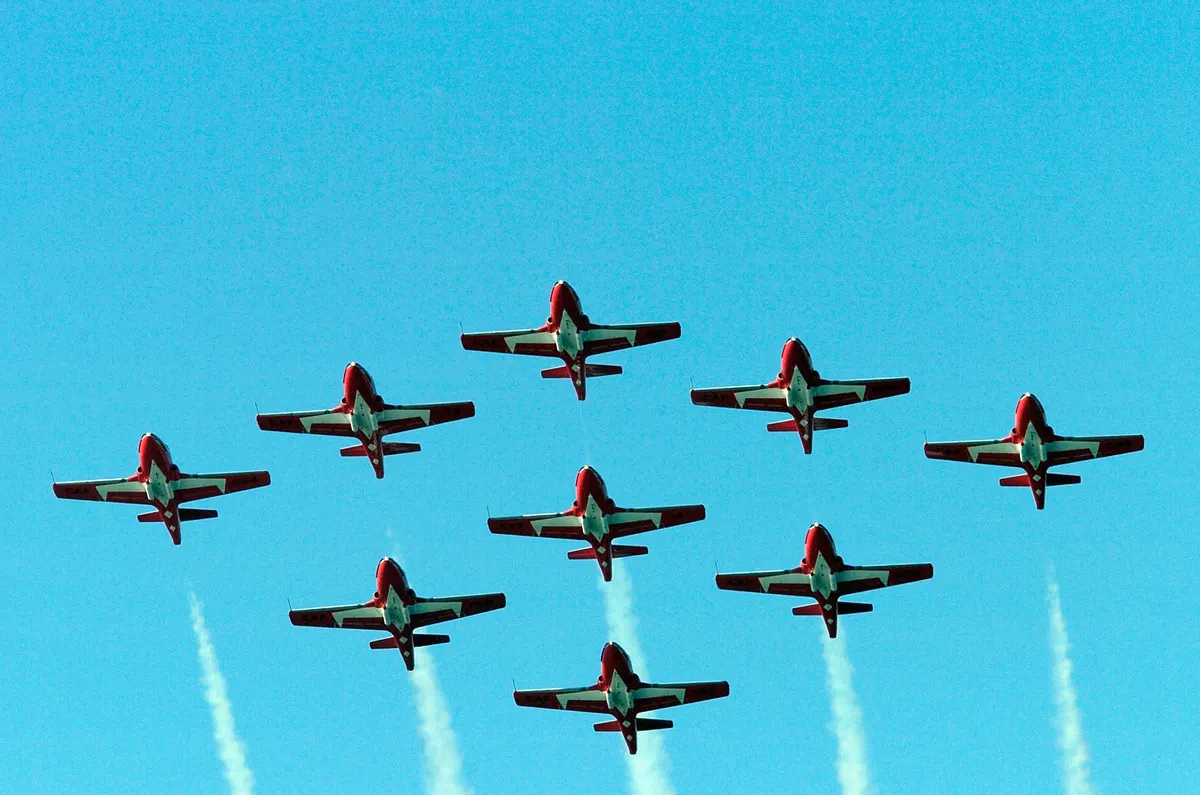
That longevity is now ending on a fixed date. In May 2026 the Canadian government confirmed that the Tutor's 2026 airshow season would be its last, with the Snowbirds standing down afterward until the early 2030s while they convert to a new aircraft, the CT-157 Siskin II, a variant of the Swiss Pilatus PC-21 turboprop.2 Prime Minister Mark Carney framed the decision around the airframe having "reached the end of their safe operational lifespan," citing obsolete engines, worn ejection seats, and a shrinking pool of spare parts for an aircraft whose production line closed sixty years earlier.5,2 The retirement closes out a service life that, by one museum's count, logged more than a million flight hours across the RCAF and Canadian Armed Forces.6
A Company Gamble Built Around Side-by-Side Seating
Canadair's Preliminary Design department settled on the CL-41's basic configuration, low-wing, turbojet, tricycle undercarriage, side-by-side cockpit, by August 1957, before an engine had even been finalized.1 The side-by-side arrangement let an instructor sit next to the student rather than behind, watching hand and eye movements directly instead of relying on a mirror, and it required duplicated flight controls and instrumentation on both sides so either occupant could fly the aircraft.7 It is a choice the Tutor shares with two of its closest foreign contemporaries, the British BAC Jet Provost and the American Cessna T-37 Tweet, even though tandem seating was far more common among jet trainers built to lead into single-seat fighters.7
- First Flight1960
- Service Entry Year1963
- Crew (seats)2
- Trainer Typejet trainer
- In ServiceYes

Canadair's design team kept engine options unusually open: the fuselage was built to accept several different powerplants without structural change, and the company studied the Armstrong-Siddeley Viper, the Continental Gabizo, the Rolls-Royce RB.108, and the Fairchild J83-R-1 alongside its eventual choices.1 The two prototypes flew instead on a Pratt & Whitney JT12A-5 turbojet, chosen mainly because it was available when rival programs were being cancelled, before production aircraft switched to the General Electric J85, built under license in Canada as the Orenda J85-CAN-40.1,8 Rated thrust for that engine is around 2,650 lbf (11.8 kN), a modest figure that nonetheless gave the Tutor a top speed of roughly 774 to 785 km/h (about 486 mph) at altitude, a service ceiling near 13,600 m (44,500 ft), and a range of about 1,520 km (820 nautical miles).1,6
- Engine TypeOrenda J85-CAN-40
- Thrust13.1
The Weber Ejection Seat and a Recurring Restraint Problem
Crew escape relies on a Weber Aircraft-built seat unique to the type, sometimes referred to as the Weber CL-41 seat, fitted with an automatic escape sequence usable down to zero altitude above roughly 90 knots of airspeed, well short of the true zero-airspeed "zero-zero" capability that later Western seats achieved.9 That seat and its lap-belt restraint system have been directly implicated in some of the type's worst accidents: in January 2002 a Snowbirds pilot, Captain Robert Reichert, fell partway out of his seat while flying inverted after his lap belt released, and although he recovered the aircraft, the incident triggered a week-long grounding, laboratory analysis of the belt, and a mandated visual pre-flight check of the buckle.10 Five years later, on 18 May 2007, a nearly identical restraint failure during an inverted pass at Malmstrom Air Force Base near Great Falls, Montana, killed Captain Shawn McCaughey when he fell from his seat and could not recover the aircraft in time.11,12
- Top Speed774 km/h
- G-Limit7
Domestic Content
The Tutor's airframe, tooling, and final assembly were entirely Canadian, carried out by Canadair at its Cartierville, Quebec plant as a company-funded venture before any government contract existed.1,2 The production engine was a General Electric J85 turbojet, an American design, but it was manufactured domestically in Canada under license by Orenda Engines as the J85-CAN-40, so the physical engines installed in RCAF aircraft were Canadian-built even though the underlying design originated with GE in the United States.1,8 The ejection seat was the most significant fully imported component: sourced from the American firm Weber Aircraft rather than built in Canada, reflecting how few countries at the time had the specialized industrial base to produce ejection seats domestically.9
- Cockpit Configurationside-by-side
- Glass CockpitNo
- Embedded SimulationNo
- Light Attack CapableYes
- Hardpoints2
- Ejection SeatsYes
- Length9.754 m
- Wingspan11.13 m
- Height2.76 m
- Max Takeoff Weight3.333 kg
- Total Built212
- Operators2
- Retirement Year2000
- Production Start1963
- Production End1966
- Operational Statuslimited use for testing and aerobatics
From a Private Venture to RCAF Service
Canadair began CL-41 development in 1956 on its own initiative, financing the design work itself because the Canadian government had not yet expressed interest in a jet primary trainer.2,1 The gamble worked: after the prototype's 13 January 1960 first flight, an RCAF evaluation team put the aircraft through preliminary trials that March and came away, in the words of one account, having "universally praised" its handling, and the government placed its order for 190 CL-41As in September 1961.6,1 The type entered squadron service on 29 October 1963, replacing the RCAF's Canadair-built T-33 Silver Stars and de Havilland Vampires in the primary and basic jet training role, with deliveries and training buildup continuing at 2 Canadian Forces Flying Training School at Moose Jaw, Saskatchewan through the mid-1960s.1,6
The Golden Centennaires and the Birth of the Snowbirds
For Canada's 1967 centennial year, the RCAF pulled ten Tutors from the training fleet, repainted them gold and blue, and formed the Golden Centennaires display team, which flew an eight-jet formation (six aircraft plus two soloists) through 121 shows across Canada, the United States, and the Bahamas, including the opening and closing ceremonies of Expo 67 in Montreal, before disbanding at the end of the season.13,1
The idea did not stay dormant. In 1971 a new formation team formed at 2 Canadian Forces Flying Training School, adopted the name Snowbirds the following year, and was granted formal squadron status as 431 Air Demonstration Squadron in 1978.1 The team has since flown more than 2,700 displays for an estimated 140 million spectators, including the annual Canada Day flypast over Parliament Hill in Ottawa, making it one of the world's longest-running military aerobatic teams flying its original aircraft type.3
Six Decades On, and a Fixed Retirement Date
The Tutor's front-line training career ended around 2000, when the RCAF phased it out of primary and basic jet instruction in favor of the turboprop CT-156 Harvard II and the British Aerospace CT-155 Hawk, even as roughly 120 Tutors remained on strength as late as 1998.1 The Snowbirds, however, kept flying the type continuously through the 2000s and 2010s, and in 2001 the squadron replaced its lap-belt restraint hardware following the earlier incidents, part of a broader pattern of incremental safety modification rather than wholesale replacement.10
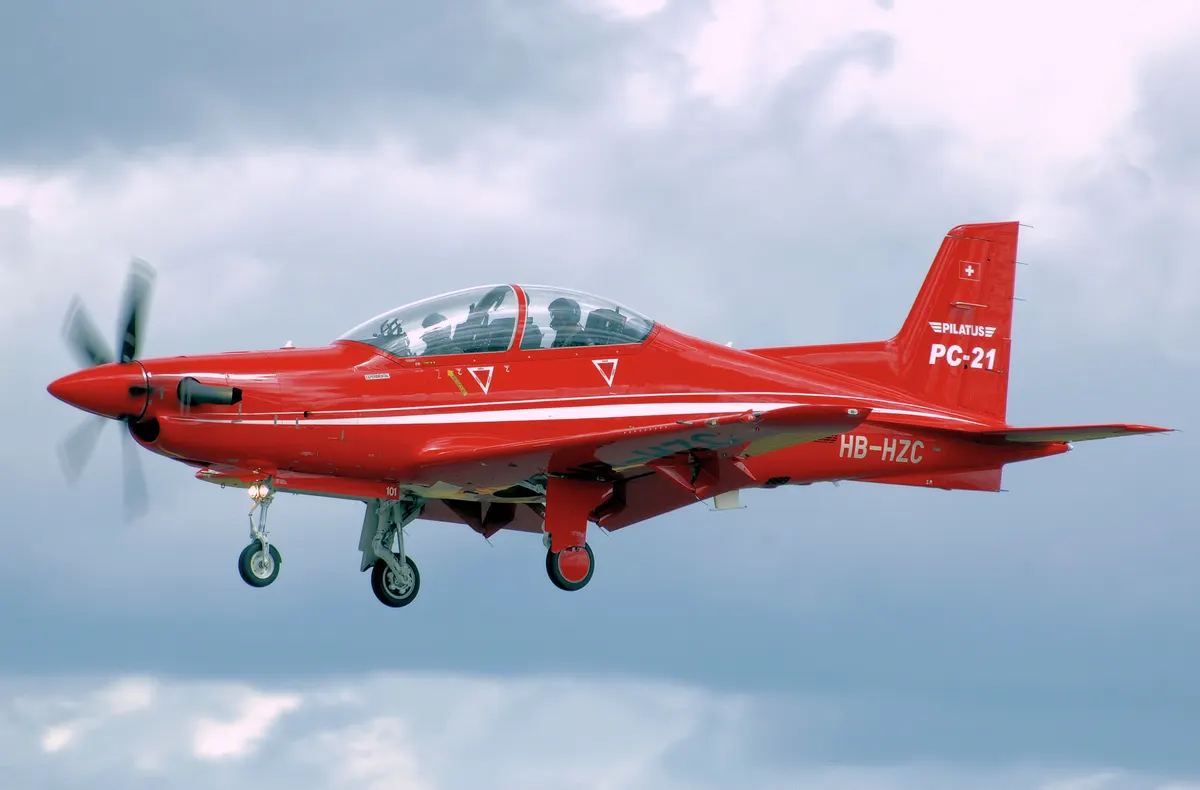
That pattern reached its limit in the mid-2020s. An internal Department of National Defence review had already warned as early as 2003 of escalating technical, safety, and financial risk and urged immediate replacement, a recommendation the government did not act on for another two decades.5 In May 2026 Canada formally selected the CT-157 Siskin II, based on the Pilatus PC-21 turboprop, to succeed the Tutor, with the new aircraft to be based at 15 Wing Moose Jaw and expected to reach operational status in the early 2030s.2 The Snowbirds will fly their final Tutor season through 2026, then stand down entirely rather than perform on any interim aircraft while the transition takes place.3
The CL-41G Tebuan and Malaysia's Second Emergency
Twenty Tutors were built to a distinct, armed export standard for the Royal Malaysian Air Force, designated CL-41G and nicknamed Tebuan, meaning "wasp" in Malay, under a sale finalized in March 1966.15,1 The Tebuan added underwing hardpoints stressed for bombs, napalm, and rocket pods, plus an uprated engine, giving Malaysia a light-attack aircraft built on the same airframe Canada was buying purely as a trainer.15 The timing meant the type arrived too late for the confrontation with Indonesia it was originally considered for, that dispute was settled within months of the deal closing, but Malaysia found a use for it almost immediately in a different, longer-running fight.15
From 1967 the Tebuan flew strike sorties against Communist Party of Malaya camps near the Thai border during the Second Malayan Emergency, an insurgency that dragged on until the party's formal 1989 surrender, dropping bombs and firing rockets and gun pods in support of Malaysian army, police field force, and commando units on the ground.4,15 The RMAF flew the type in that role for close to two decades before retiring it in June 1986 in favor of the Aermacchi MB-339, one of the longer operational careers any Tutor-family airframe achieved anywhere.1 The baseline Canadian CT-114, by contrast, never flew a combat sortie in RCAF or Canadian Armed Forces hands; its entire operational history outside Canada runs through the Tebuan and the pilots it helped train elsewhere.1
The two CL-41 prototypes, CF-LTW-X and CF-LTX-X, were company-funded engineering aircraft used to prove the airframe and to test candidate engines before the RCAF placed any order.1 The CL-41A was the production standard bought by Canada, 190 examples built as pure unarmed trainers, some later modified with smoke generators for Golden Centennaires and Snowbirds display duty.1
The CL-41G Tebuan, covered in detail above, was the armed export version built for Malaysia, fitted with underwing hardpoints and an uprated engine for the ground-attack and counter-insurgency role rather than pure instruction.15,1 The CL-41R was a one-off experimental conversion of the second prototype, fitted with the radar nose of a CF-104 Starfighter to serve as a proposed electronic-systems trainer for future Starfighter pilots; it never attracted an order and never entered production.1


Canada was the type's principal operator, flying the CL-41A first as the RCAF's standard jet trainer from 1963 and, after the 1968 unification of Canada's armed services, as the Canadian Armed Forces' trainer into 2000.1 Since 1971 the Canadian Forces Snowbirds, 431 Air Demonstration Squadron, have kept a small dedicated fleet flying in the aerobatic role, the aircraft's only remaining Canadian military function and the reason it is still in the air in 2026 rather than in a museum.3,1

Malaysia was the only export customer, flying the armed CL-41G Tebuan from 1967 until June 1986, when the Aermacchi MB-339A took over the light-attack role.1 Outside military service, a handful of Tutors have reached private civilian hands, mostly in North America, where scarce spare parts and the cost of maintaining ejection seats and other life-limited components make sustained flying operations a persistent challenge; at least twenty retired airframes are preserved in Canadian museums or as static gate guards, including the Canadian Warplane Heritage Museum, the Canada Aviation and Space Museum, and the National Air Force Museum of Canada.16,6
The Tutor Versus the BAC Jet Provost: Parallel Trainers, Parallel Armed Offspring
The Tutor's closest conceptual match is the British BAC Jet Provost, and the resemblance is not superficial. Both aircraft chose side-by-side seating with duplicated controls, both were built primarily as basic jet trainers for their home air forces, and both then spawned an armed export derivative used almost exclusively for counter-insurgency, the Jet Provost's became the BAC Strikemaster while the Tutor's became the CL-41G Tebuan.17,7 The Jet Provost used a single Armstrong-Siddeley Viper turbojet against the Tutor's General Electric J85, and it was a considerably larger program: 734 to 741 Jet Provosts were built for the Royal Air Force and export customers between 1954 and the early 1970s, more than three times the Tutor's 212, reflecting the size difference between the British and Canadian training establishments of the era rather than any technical shortfall on Canadair's side.17 Both airframes also proved unusually durable in their armed forms: Strikemasters flew in conflicts from Oman to South America for decades, while the Tebuan's roughly twenty years fighting the Communist Party of Malaya is a comparable stretch for a light-attack derivative of a basic trainer.
The Tutor Versus the Cessna T-37 Tweet: One Engine Against Two
The Tutor's most direct North American contemporary is the Cessna T-37 Tweet, and the comparison turns almost entirely on engine count. Cessna gave the T-37 two small Continental-Teledyne J69 turbojets rather than one larger engine, partly for genuine engine-out safety margin during early jet training, while Canadair built the Tutor around a single, more powerful General Electric J85.7 The single-engine Tutor came out faster in the exchange, with a top speed around 486 mph against the T-37's roughly 425 mph, and a slightly longer range as well, even though the T-37 had a five-year production head start and the much larger order book of 1,269 airframes against the Tutor's 212.18 Both aircraft nonetheless converged on the same side-by-side layout for the same reason, and both outlived their training careers through an armed derivative: the T-37 through the Vietnam-era A-37 Dragonfly, the Tutor through the Tebuan, though the American aircraft's combat career was fought at a far larger scale.
| Aircraft | First flight | Engine(s) | Top speed | Seating | Total built |
|---|---|---|---|---|---|
| CT-114 Tutor | 1960 | 1 × Orenda J85-CAN-40 | ~486 mph (782 km/h) | Side-by-side | 212 |
| BAC Jet Provost | 1954 | 1 × Armstrong-Siddeley Viper | ~440 mph (708 km/h) | Side-by-side | ~734–741 |
| Cessna T-37 Tweet | 1954 | 2 × Continental-Teledyne J69 | ~425 mph (684 km/h) | Side-by-side | 1,269 |


What are the Canadair CT-114 Tutor's specifications? The Tutor is a two-seat jet trainer about 9.75 m (32 ft) long with an 11.13 m (36 ft 6 in) wingspan, weighing roughly 2,195 kg (4,840 lb) empty and about 3,333 kg (7,348 lb) at normal gross weight, powered by a single Orenda J85-CAN-40 turbojet producing around 2,650 lbf (11.8 kN) of thrust.1,6 Commonly cited performance figures put top speed near 774 to 785 km/h (about 486 mph), service ceiling around 13,600 m (44,500 ft), and range close to 1,520 km (820 nautical miles).1,6
How many CT-114 Tutors were built? Canadair built 212 airframes between 1963 and 1966: two prototypes, 190 CL-41A trainers for the Royal Canadian Air Force, and 20 armed CL-41G Tebuans for Malaysia.1
What is the CT-114 Tutor's top speed? Sources give a maximum speed at altitude of roughly 774 to 785 km/h, or about 486 mph, with dive speeds documented up to around 885 km/h (478 knots); this makes it modestly faster than either of its closest contemporaries, the BAC Jet Provost and the Cessna T-37 Tweet.1,6,18
Is the CT-114 Tutor still in service? Yes, but only in a narrow role and only through 2026. The Canadian Forces Snowbirds have flown a dedicated fleet since 1971 for aerobatic display, but the government confirmed in May 2026 that the 2026 airshow season will be the type's last, after which the squadron stands down until a Pilatus PC-21-based replacement, the CT-157 Siskin II, becomes operational in the early 2030s.2,3
How does the CT-114 Tutor compare with the BAC Jet Provost or T-37 Tweet? All three chose side-by-side seating for the same instructional reason, but differ in scale and engine layout: the Jet Provost and Tweet were both built and exported in far larger numbers than the Tutor, and the Tweet is unique among the three in using two engines rather than one.17,7 Each also spawned an armed light-attack derivative, the Strikemaster, the A-37 Dragonfly, and the Tebuan, that ended up fighting counter-insurgency wars its trainer parent never did.
Did the CT-114 Tutor ever see combat? The Canadian-flown trainer version did not. Its armed Malaysian export derivative, the CL-41G Tebuan, flew counter-insurgency strikes against Communist Party of Malaya camps from 1967 until the party's 1989 surrender, remaining in RMAF service until 1986.4,15
- "Canadair CT-114 Tutor", Wikipedia — en.wikipedia.org ↩
- "Government of Canada to procure new aircraft for the iconic Canadian Forces Snowbirds", Government of Canada — canada.ca ↩
- "Snowbirds Mark Final Season Of CT-114 Tutor", AVweb — avweb.com ↩
- "Canada's Counter-Insurgency Fighter Jet", The Devil of History — devilofhistory.wordpress.com ↩
- "Canada to Replace Snowbirds' CT-114 Tutor with CT-157 Siskin II", Aviation News — aviationnews.eu ↩
- "Canadair CT-114 Tutor", Canadian Warplane Heritage Museum — warplane.com ↩
- "CT-114 Tutor", Detail and Scale — detailandscale.com ↩
- "Canadair CT-114 Tutor Advanced Jet Trainer / Light Ground Attack Aircraft", MilitaryFactory — militaryfactory.com ↩
- "Weber CL-41 seat with AERO Drogue System", The Ejection Site — ejectionsite.com ↩
- "Ejection system to be overhauled in Snowbirds aircraft", CBC News — cbc.ca ↩
- "A timeline of Canadian Snowbirds fatalities since 1972", Global News — globalnews.ca ↩
- "Missing webbing and Snowbird's fatal flight", The Globe and Mail — theglobeandmail.com ↩
- "Golden Centennaires Tutor Jet Display", Let's Talk Creston — letstalk.creston.ca ↩
- "Actor John Travolta Donates A Canadair CL41 Tutor To Embry-Riddle", Aviation Week Network — aviationweek.com ↩
- "CL-41G Tebuan", geocities.ws (archived RMAF history page) — geocities.ws ↩
- "CT-114 Tutor", National Air Force Museum of Canada — airforcemuseum.ca ↩
- "BAC Jet Provost", Wikipedia — en.wikipedia.org ↩
- "Canada built this trainer just to tutor its jet pilots", We Are The Mighty — wearethemighty.com ↩
- "Ejection seat tangled with parachute in October Snowbirds crash: Investigators", CBC News — cbc.ca ↩