


The JJ-5 (Jianjiji Jiaolianji, "fighter-trainer," export designation FT-5) is a two-seat jet trainer China assembled out of three different aircraft. The tandem cockpit came from the JJ-2, China's copy of the Soviet MiG-15UTI; the fuselage and airbrakes came from the J-5A, a locally built MiG-17F derivative; and the engine was a non-afterburning version of the turbojet fitted to the single-seat J-5 fighter.1,2 It first flew on 8 May 1966, was cleared for series production before the year was out, and entered People's Liberation Army Air Force service in November 1967.1,3 It was built by the Chengdu Aircraft Factory, which had taken over two-seat trainer production while Shenyang continued building single-seat fighters.3
- simple, rugged airframe shared spares with J-5/F-6 fleets
- handling closely matched subsonic fighters students would fly next
- cheap to buy, fly, and maintain versus Western equivalents
- widely exported, so instructor and parts pipelines were well established
- non-afterburning engine gave weak thrust-to-weight and long runway rolls
- no radar, no ejection-seat automation improvements added over decades
- airframe obsolescent by the 1980s next to jet-powered basic trainers like the K-8
- limited by 1966-era avionics with no serious upgrade program
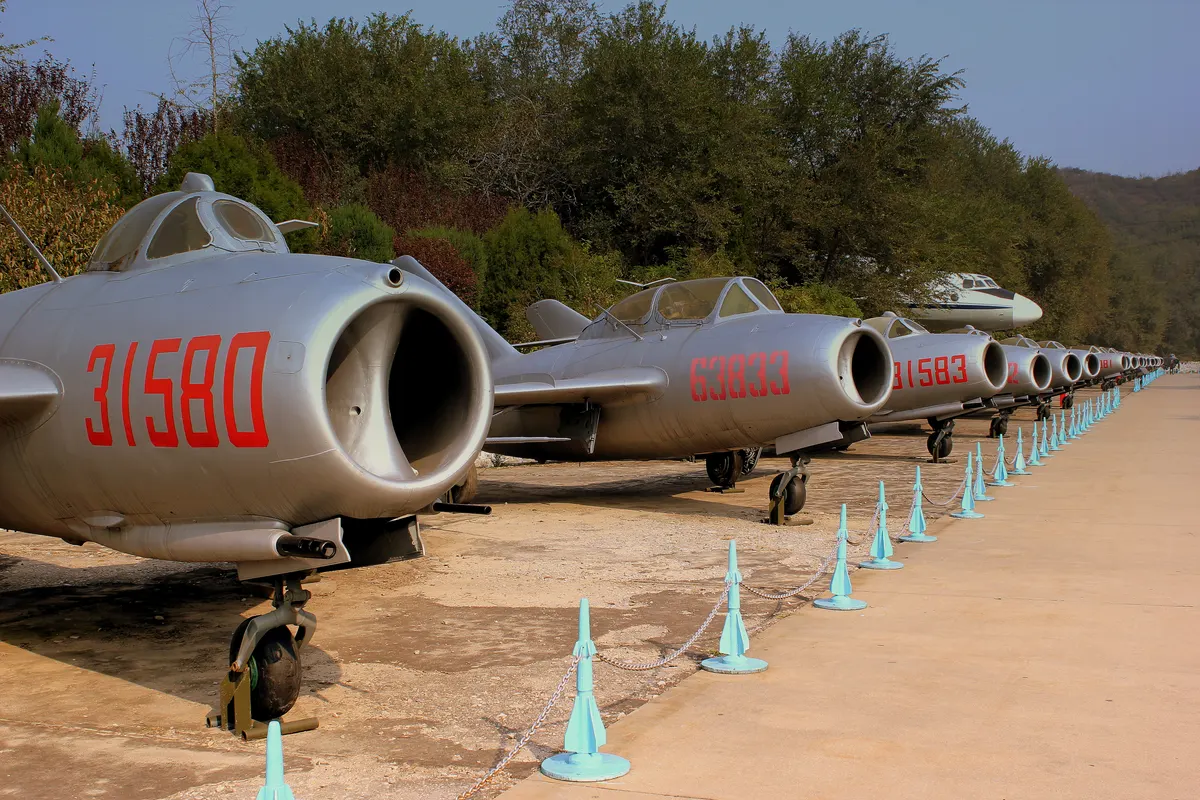
For nearly two decades the JJ-5 was the standard bridge between basic training and supersonic combat aircraft in both the PLAAF and the PLA Naval Air Force: a student who had soloed on a propeller trainer moved to the JJ-5 to learn jet handling, gunnery, and instrument flying before converting onto the J-6 (a Chinese MiG-19) or J-7 (a Chinese MiG-21).1 Production ran until 1986, by which point 1,061 had been built, a number several independent sources agree on.1,2,3 Exports under the FT-5 name went to at least a dozen air forces, including Pakistan, Albania, Bangladesh, North Korea, Tanzania, and Zimbabwe, several of which flew the type for over thirty years.6,7,8
Despite the borrowed parts, the JJ-5 was not a stopgap. It stayed in first-line training service into the 1990s in China and considerably longer in export air forces, because its handling closely matched the subsonic MiG-17-derived fighters many customers still flew as their frontline type.
A MiG-15UTI Cockpit Grafted Onto a MiG-17 Fuselage
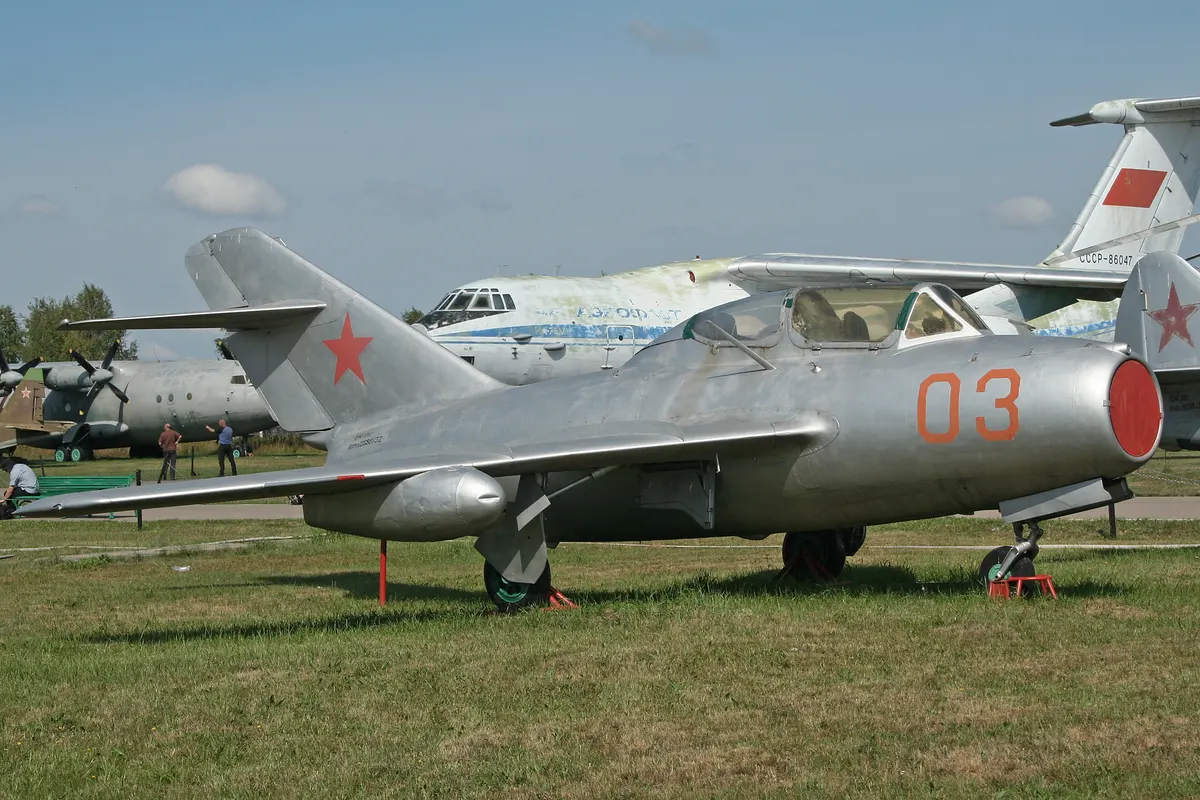
The JJ-5's tandem cockpit, with the instructor seated behind and slightly above the student, was carried over almost unchanged from the JJ-2, itself a Chinese-built copy of the Soviet MiG-15UTI.2 Behind it sat the fuselage of the J-5A, the radar-equipped, all-weather derivative of China's licence-built MiG-17F, stretched slightly and fitted with revised nose and tail cowling shapes.4 Wingspan (about 9.6 m), length (about 11.5 m), and height (around 3.8 m) are essentially those of the single-seat J-5 family, since the wings, tail, and undercarriage were unmodified.1 Both crew sat under separate canopies with Chinese-built ejection seats, a step up over the JJ-2 they replaced.2
- First Flight1966
- Service Entry Year1968
- Crew (seats)2
- Trainer TypeAdvanced jet trainer
- In ServiceYes
The WP-5D Turbojet and Its Non-Afterburning Trade-Off
Power came from a single WP-5D turbojet, a de-rated, non-afterburning version of the WP-5 that powered the single-seat J-5.1,2 The WP-5 lineage traces to the Soviet Klimov VK-1, and it was China's first domestically produced jet engine, entering production at the Shenyang Aero-Engine Factory in 1956.5,6 The trainer variant gave up the fighter's afterburner for durability and lower fuel burn, producing roughly 22 kN (about 5,010 lbf) of dry thrust — noticeably less than the afterburning WP-6 fitted to the later, unrelated JJ-6 trainer, a distinction worth keeping straight since the two are sometimes conflated in secondary listings.1,6 With that powerplant the JJ-5 reached a top speed of roughly 1,040-1,050 km/h at altitude, a service ceiling near 14,300 m, and a climb rate around 27 m/s — comfortably below the single-seat fighters it prepared students for, which was the point: a trainer with more performance headroom than its output aircraft teaches bad habits.1
- Engine TypeLiyang Wopen-6A turbojet
- Thrust31.8
Armament Retained for Light Attack, Not Air Combat
Unlike the single-seat J-5, which carried three cannon, the JJ-5 kept only a single Chinese-built Type 23-1 cannon (a licence-descendant of the Soviet Nudelman-Rikhter NR-23, 23 mm) in a semi-recessed ventral pack, mainly for gunnery training.1,4 Underwing stations allowed bombs, rocket pods, or drop tanks for weapons training and, in at least one export operator, missiles (see Variants).7
- Top Speed1,040 km/h
- Cruise Speed800 km/h
- Service Ceiling15,500 m
- Range1,320 km
- Rate of Climb39.6 m/s
- G-Limit8
- Endurance2.5
Domestic Content
By the time it entered production the JJ-5 was an almost entirely Chinese-manufactured aircraft: the airframe from the Chengdu Aircraft Factory, the WP-5D engine from the Shenyang Aero-Engine Factory (producing engines independently well before JJ-5 production began), and the Type 23-1 cannon from domestic plants copying the earlier Soviet-supplied NR-23.1,4,5,6 The only foreign lineage is the original 1950s Soviet technology transfer behind the WP-5/VK-1 engine and the MiG-15/MiG-17 airframe design, ended by the Sino-Soviet split. No component in an actual production airframe was imported.
- Cockpit ConfigurationTandem
- Glass CockpitNo
- Embedded SimulationNo
- Light Attack CapableYes
- Hardpoints4
- Ejection SeatsYes
- Length11.53 m
- Wingspan9.6 m
- Height3.84 m
- Max Takeoff Weight7,400 kg
- Total Built1,061
- Production Start1966
- Production End1986
- Operational StatusLimited service
Replacing an Inadequate Trainer as China Went Supersonic
By the mid-1960s the PLAAF's existing advanced trainer, the JJ-2 (the MiG-15UTI copy), could not adequately prepare pilots for the newer, considerably faster J-6 and J-7 fighters.2 Chinese engineers needed a step that flew like the subsonic fighters already in mass service (J-5/J-5A) while improving on the ageing JJ-2. Rather than design a new airframe, they combined existing, already-certified components: JJ-2 cockpit, J-5A fuselage, de-rated J-5 engine.1,2 The approach cut development risk and cost, at the price of an aircraft built, from the outset, mostly from ten-year-old technology.
The prototype flew on 8 May 1966; the State Certification Group cleared it for mass production before the end of that year, and it reached PLAAF training regiments by November 1967.1,2,3 Production continued for two decades, an unusually long run for a trainer of its generation, closing out in 1986 with 1,061 airframes completed.1,2,3
A Long Export Career on a Modest Budget
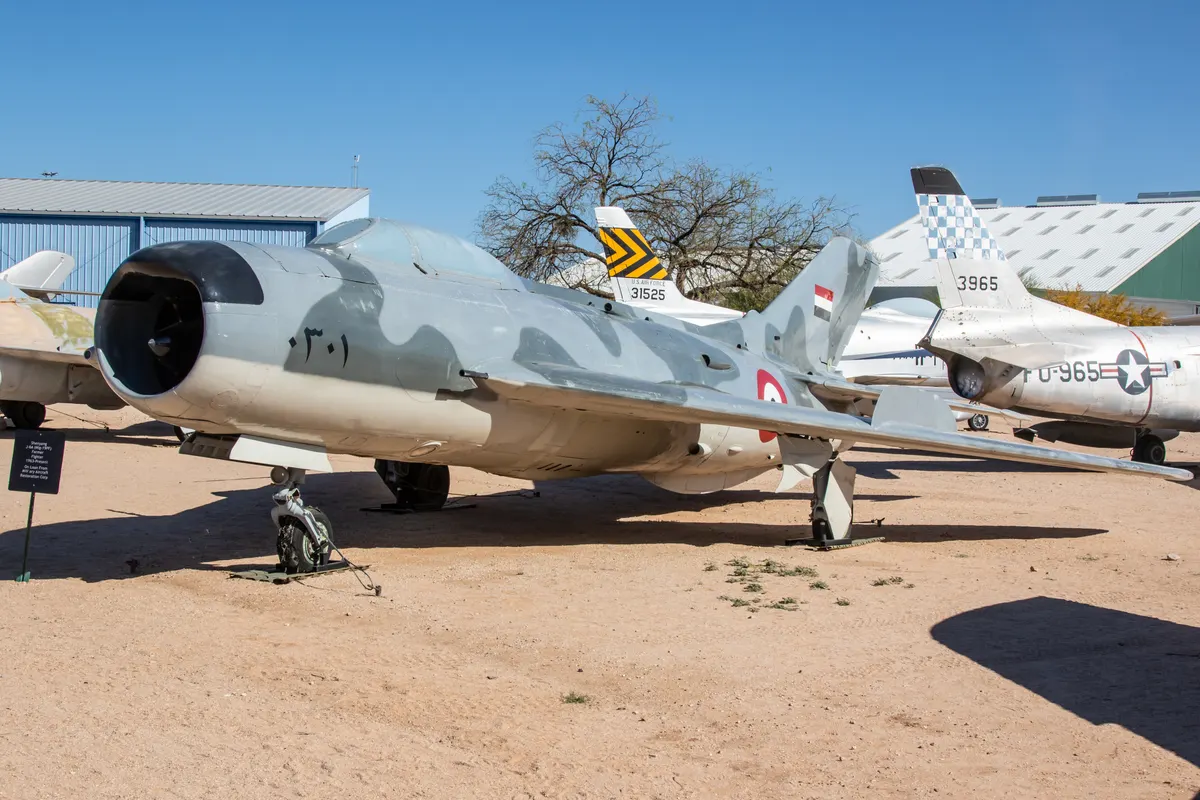
The FT-5 export version was, mechanically, the same aircraft sold under a different name, and it moved in large numbers to air forces that already flew Chinese-built fighters. Pakistan took delivery of six FT-5s in April 1975 to stand up a dedicated Fighter Conversion Unit, replacing ageing Lockheed T-33s that had become a poor bridge to the Chinese-built F-6 (J-6/MiG-19) fighters the air force was adopting.7 The unit soon expanded to fifty aircraft and kept flying FT-5s for 36 years before converting to the Pakistan-built K-8 in January 2012.7
Albania received 22 FT-5s alongside 13 single-seat F-5 fighters from the mid-1970s until the whole Soviet/Chinese-era fighter fleet was retired in 2004 following a fatal crash at Tirana's main airport.8 Tanzania's air wing took delivery from the early 1970s and, by the late 1970s, fielded a substantial mixed fleet of Chinese- and Soviet-built types, though chronic spares shortages later meant its Shenyang fighters and trainers flew only rarely.9 Zimbabwe took a much smaller slice: two FT-5s on loan from China around 1986 to transition pilots onto newly delivered F-7 fighters, returned once dedicated FT-7 two-seaters arrived in the 1990s.3 Bangladesh flew FT-5s from the late 1970s for fighter-conversion training; individual airframes there had short careers, with at least one delivered in mid-1979 and withdrawn by January 1985.14 North Korea's air force is recorded with a notably large FT-5 fleet, on paper around 135 airframes, though independent assessments describe serviceability as poor given the difficulty of sourcing spares for a type out of production since 1986.10
The JJ-5/FT-5 was designed and used as a trainer, and there is no well-documented case of it flying an armed combat sortie. Its combat-adjacent history instead runs through air forces that flew it behind aircraft that did fight. Tanzania's single-seat Shenyang F-5s took part in the 1978-79 war against Idi Amin's Uganda after Ugandan forces annexed the Kagera Salient; the same air wing's FT-5 trainers, procured alongside the fighters from the early 1970s, would have supplied at least some of the pilots flying those missions, though the trainer variant itself is not recorded flying into Ugandan airspace.9
Pakistan's case is the clearest brush with a wartime role for the trainer itself, rather than for pilots it produced. Its Sidewinder-armed FT-5s (see Variants) were meant, in a general war with India, to be scrambled for local air defence around Mianwali, filling in for a fighter force stretched across other fronts — no public record shows the modification used in anger, but it shows air forces treating the FT-5 as more than a classroom aircraft when the order of battle demanded it.7
Albania's FT-5s flew through the country's long isolation without external conflict, part of a fighter force effectively frozen in 1960s technology for four decades; North Korea's large but poorly maintained fleet is best understood the same way — a training backbone kept nominally in service well past the point its air force could resource it properly.10
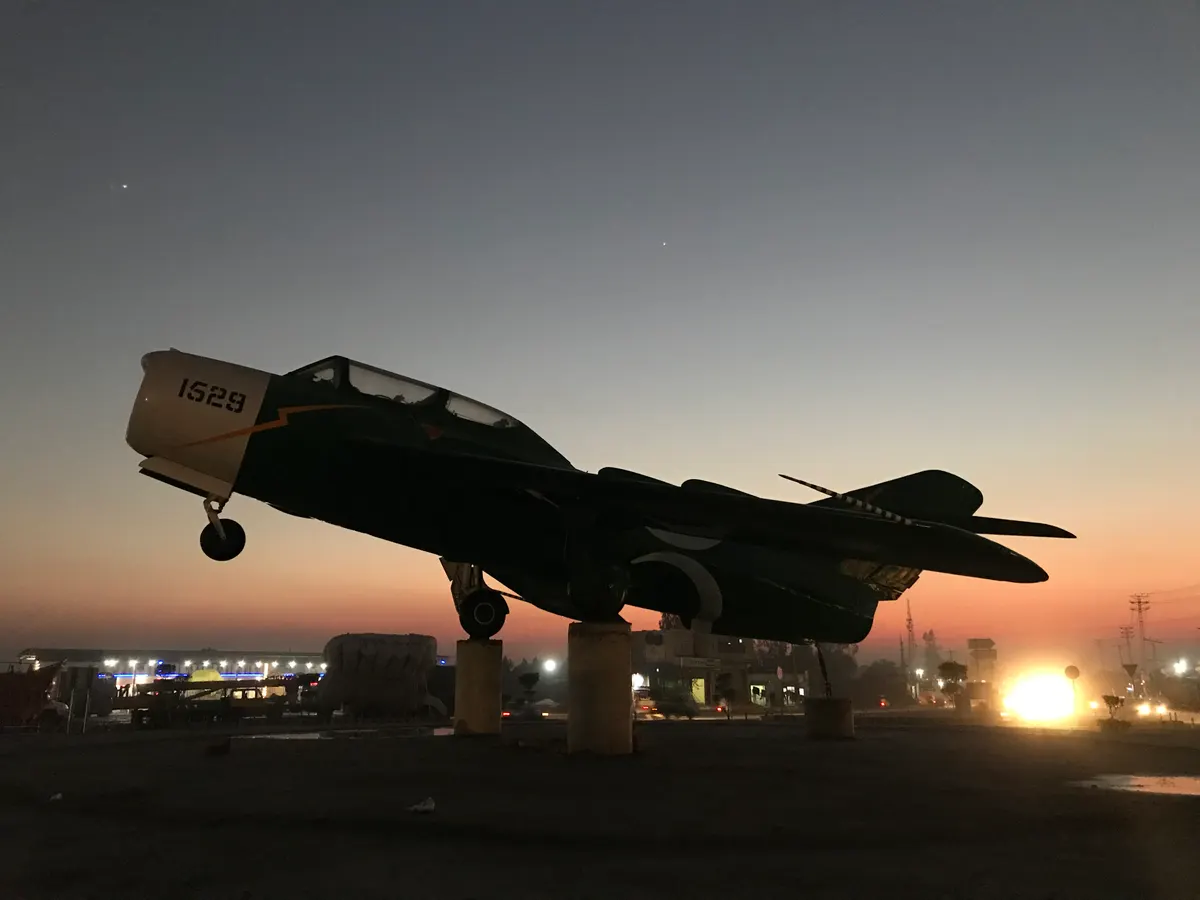
There is essentially one production standard: the JJ-2/J-5A/de-rated-engine combination frozen at the 1966 design, built domestically as the JJ-5 and sold abroad as the FT-5.1,2 No distinct "A" or upgraded avionics variant reached significant production; where sources describe changes, they are field modifications made by operators rather than factory sub-types. Pakistan's 1987 modification, adding a pair of AIM-9P Sidewinders to its No. 1 Fighter Conversion Unit's FT-5s, is the best-documented example: a squadron-level integration rather than a new factory variant, giving otherwise unarmed trainers a genuine, if rarely tested, air-to-air capability.7
The JJ-5's own lineage is itself best described as a variant by assembly rather than a modification of one prior aircraft: a deliberate splice of three separate type-certified components, unusual even by Cold War-era trainer standards, and the reason it reached service so quickly after its first flight.1,2


China flew the JJ-5 in both the PLAAF and the PLA Naval Air Force as the standard advanced jet trainer for roughly three decades, retiring it as jet-powered trainers such as the Hongdu JL-8 (K-8) entered service from the late 1990s onward.15 Export customers under the FT-5 name included Pakistan (1975-2012, the longest-documented run), Albania (1970s-2004), Tanzania (from the early 1970s), Bangladesh (from the late 1970s), Zimbabwe (a short lease around 1986), and North Korea, which still lists a large nominal fleet.6,7,8,9,10,14 Sri Lanka appears in some secondary lists of FT-5 recipients around 1991, though its own service history records the acquisition as single-seat J-5s alongside FT-7 two-seaters — a distinction this article does not resolve definitively.13
The closest contemporary rival is the Czechoslovak Aero L-29 Delfín, which entered production a few years earlier (1963) and was built in far greater numbers — about 3,600 aircraft against the JJ-5's 1,061 — after winning a Warsaw Pact-wide trainer competition that made it the standard jet trainer across most of the Soviet bloc.16 The two solved the same problem, an affordable bridge from piston trainers to supersonic fighters, in almost opposite ways. The L-29 was a clean-sheet design built around a single Motorlet M-701 turbojet of only about 8.7 kN thrust, optimized for docile, forgiving handling and low operating cost; the JJ-5 was a composite of three already-existing, combat-lineage components, giving it a heavier, faster, less forgiving airframe that more closely resembled the fighters students would fly next, at the cost of being a less purpose-built trainer.16,1
That difference shows in their export footprints. The L-29 went overwhelmingly to Warsaw Pact and other Soviet-aligned states, riding on the USSR's own bulk orders (some 2,000 to the Soviet Air Force alone); the JJ-5/FT-5 went almost exclusively to air forces already flying Chinese-built fighters, since its handling was tuned to match them.16,7 Neither aircraft was meaningfully upgraded after its design freeze, and both were eventually displaced by similar successors: the L-29 by the L-39 Albatros, the JJ-5 by the JL-8/K-8.15 The JJ-5 has a reputation as the more physically demanding of the two to fly well, consistent with its fighter-derived airframe, against the L-29's reputation as an easier, more tolerant first jet trainer.


What are the Guizhou/Chengdu JJ-5 specifications? A tandem two-seat jet trainer powered by a single WP-5D turbojet of roughly 22 kN (about 5,010 lbf) non-afterburning thrust, giving a top speed near 1,040-1,050 km/h, a service ceiling around 14,300 m, and a range of roughly 1,220-1,230 km on internal fuel.1,12
How many JJ-5/FT-5 aircraft were built? 1,061, between the type's late-1966 mass-production clearance and the closure of the line in 1986.1,2,3
How does the FT-5 compare to the Aero L-29 Delfín? The L-29 was purpose-designed and far more numerous (about 3,600 built against 1,061), while the JJ-5/FT-5 was assembled from existing fighter and trainer components and flew closer to the handling of the fighters its graduates would move on to.16,1
Is the JJ-5/FT-5 still in service anywhere? China retired it decades ago for jet-powered successors like the K-8/JL-8.15 North Korea still lists a large nominal FT-5 fleet, though assessments question how many remain airworthy given the lack of spares for a type out of production since 1986.10
What was the JJ-5's top speed? Approximately 1,040-1,050 km/h (roughly 560-570 knots) at altitude, noticeably slower than the single-seat J-5 fighter it derived from because of its non-afterburning engine and added weight.1
- "Chengdu JJ-5", AeroCorner — aerocorner.com ↩
- "Shenyang JJ-5", History of War — historyofwar.org ↩
- "Shenyang J-5", Wikipedia — en.wikipedia.org ↩
- "J-5 (Jianjiji-5 Fighter Aircraft 5)", GlobalSecurity.org — globalsecurity.org ↩
- "Shenyang Liming Aero Engine", GlobalSecurity.org — globalsecurity.org ↩
- "WP5 First Turbojet Engine", GlobalSecurity.org — globalsecurity.org ↩
- "No. 1 Squadron PAF", Wikipedia — en.wikipedia.org ↩
- "Albanian Air Force", Wikipedia — en.wikipedia.org ↩
- "Tanzania Air Force Command", Wikipedia — en.wikipedia.org ↩
- "Korean People's Army Air Force (KPAAF)", WarPowerNorthKorea — warpowernorthkorea.com ↩
- "August 1st (aerobatic team)", Wikipedia — en.wikipedia.org) ↩
- "Shenyang (AVIC) J-5 (Fresco)", Military Factory — militaryfactory.com ↩
- "History of the Sri Lanka Air Force", Wikipedia — en.wikipedia.org ↩
- "Shenyang FT-5, Bangladesh Air Force (723)", AirHistory.net — airhistory.net ↩
- "Hongdu JL-8", Wikipedia — en.wikipedia.org ↩
- "Aero L-29 Delfín", Wikipedia — en.wikipedia.org ↩