

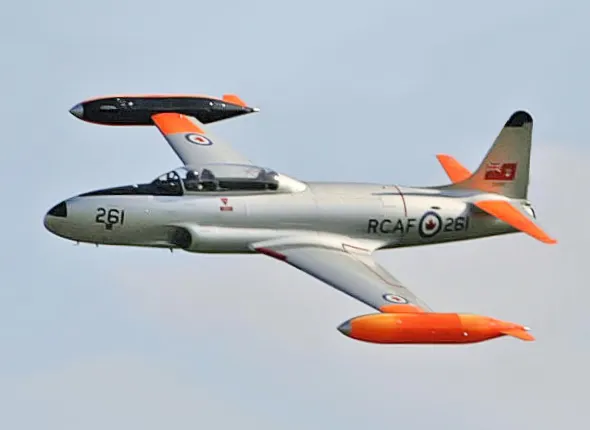

The Canadair CT-133 Silver Star is the Canadian licence-built version of the Lockheed T-33 jet trainer, produced by Canadair in Montreal under a 1951 Royal Canadian Air Force contract and known internally as the CL-30.1 Canadair completed 656 airframes between 1952 and 1958, second only to Lockheed's own American production run.1,2 The airframe, cockpit, and training mission match the T-33 closely, that story belongs to the parent aircraft's own article, but Canadair made one change that defined the Canadian jet's whole career: a Rolls-Royce Nene 10 turbojet, built under licence in Ontario, in place of the American Allison J33.1,10
- More powerful Nene 10 turbojet than the standard Allison J33
- Domestically built engine reduced dependence on US supply lines
- Exceptionally durable airframe, some flew past 11,000 hours
- Readily adapted to target-tow, ECM, and testbed roles late in life
- Same subsonic performance ceiling as the base T-33 design
- Small production run limited spares commonality with US fleets
- Standard wingtip tanks added drag and weight versus a clean T-33
- Long service life left an aging, increasingly costly fleet by the 1990s

That substitution shaped an unusually long career. Canada flew the Silver Star as a primary trainer only until 1976, then kept rebuilding surviving airframes into target tugs, electronic-warfare aggressors, and finally an ejection-seat testbed that flew until 2005.1,11 Few licence-built trainers anywhere combined such a modest production run with such a stretched-out operational life.
The Rolls-Royce Nene 10 and What It Changed Onboard
Re-engining the T-33 was an industrial decision as much as a technical one. The Nene had already been chosen for Canada's Avro CF-100 interceptor, and Orenda Engines of Malton, Ontario, was already tooled to build it under licence from Rolls-Royce, so fitting it to the new trainer let the RCAF share spares and maintenance training across two front-line programs instead of importing a second engine line.1,10
- First Flight1952
- Service Entry Year1953
- Crew (seats)2
- Trainer TypeMilitary trainer aircraft
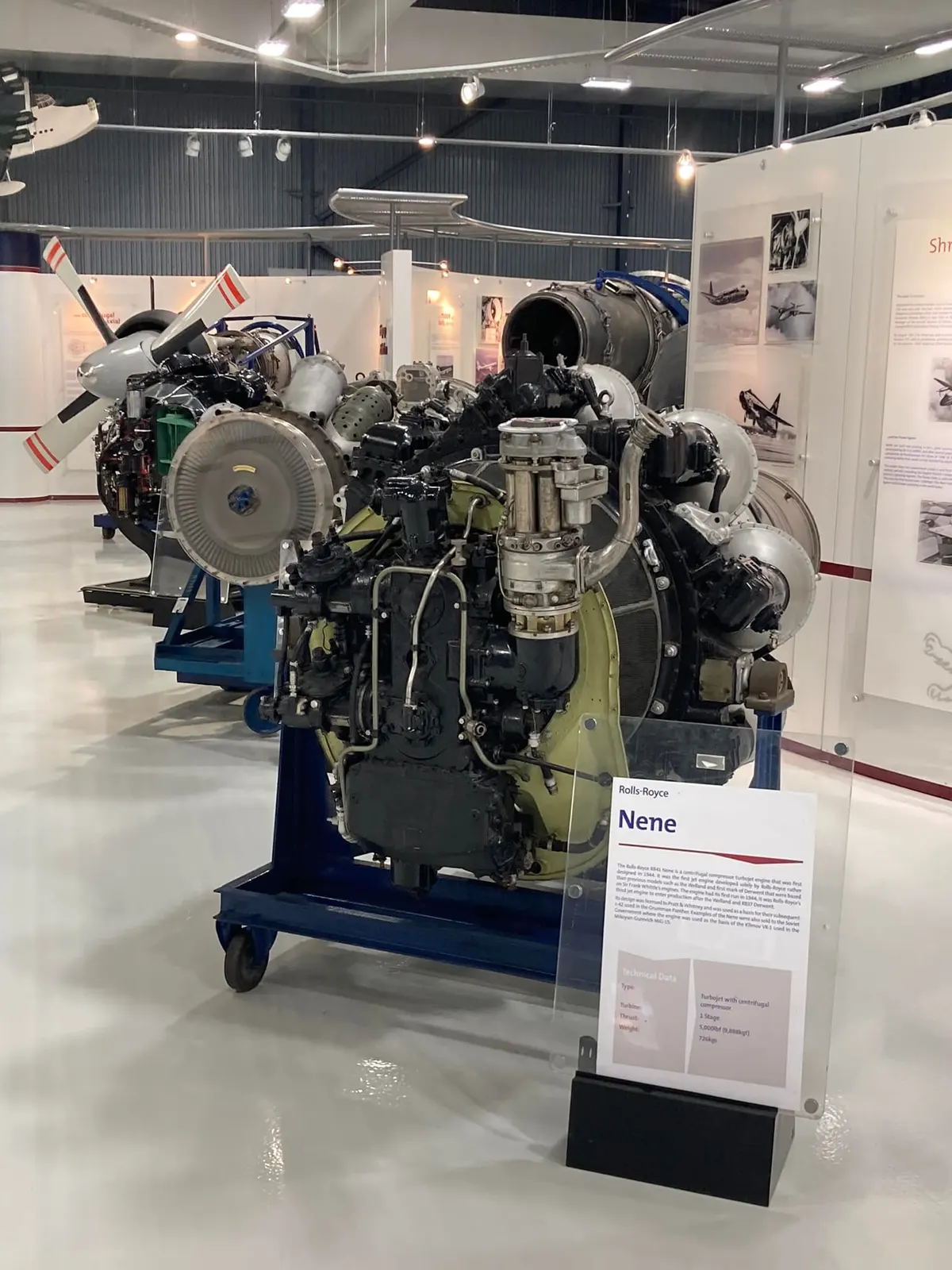
The Nene 10 was rated at 22 kN (about 5,000 lbf), a similar thrust class to the J33 but of separate British lineage.3,4 Independent specification sheets converge on a top speed of 920 km/h and a service ceiling of 14,000 m, both measurably different from figures previously recorded for this aircraft.1,3,4 Length, height, and maximum takeoff weight likewise settle at 11.48 m, 3.55 m, and 7,630 kg across multiple sources, again modestly higher than earlier recorded values, most plausibly a rounding or conversion issue rather than a design change.1,3,4
- Engine Typeturbojet
- Thrust22
Canadair built the CT-133's airframe entirely in Montreal under licence from Lockheed, and Orenda Engines of Malton, Ontario built its Rolls-Royce Nene 10 engine domestically rather than importing it from Britain.1,10 Cockpit instruments, ejection seats, and much of the avionics fit remained American- or British-sourced equipment common across the wider T-33 family, and the aerodynamic design itself, wing, tail, and fuselage, originated with Lockheed in California.1 The airframe and engine, the two largest and most visible cost items, were genuinely Canadian-built; the underlying intellectual property was not.
- Top Speed960 km/h
- Service Ceiling13,000 m
- Range1,600 km
- Cockpit ConfigurationTwo-seat
- Light Attack CapableYes
- Ejection SeatsYes
- Length11.2 m
- Wingspan11.9 m
- Height3.8 m
- Max Takeoff Weight7,500 kg
- Total Built656
- Operators6
- Retirement Year2005
- Production Start1952
A 1951 Contract and Three Decades as a Trainer
The RCAF contracted Canadair to build T-33s in 1951; the first Canadian example flew from Cartierville, near Montreal, on 22 December 1952 with test pilot W. S. Longhurst at the controls, entering RCAF service the next year.1,11 Production ran through 1958 across three marks: 30 interim Lockheed-built loaners (Mk 1), a single CL-30 prototype (Mk 2), and 656 production Mk 3s split into unarmed, gun-armed, and photo-reconnaissance sub-variants.1,11
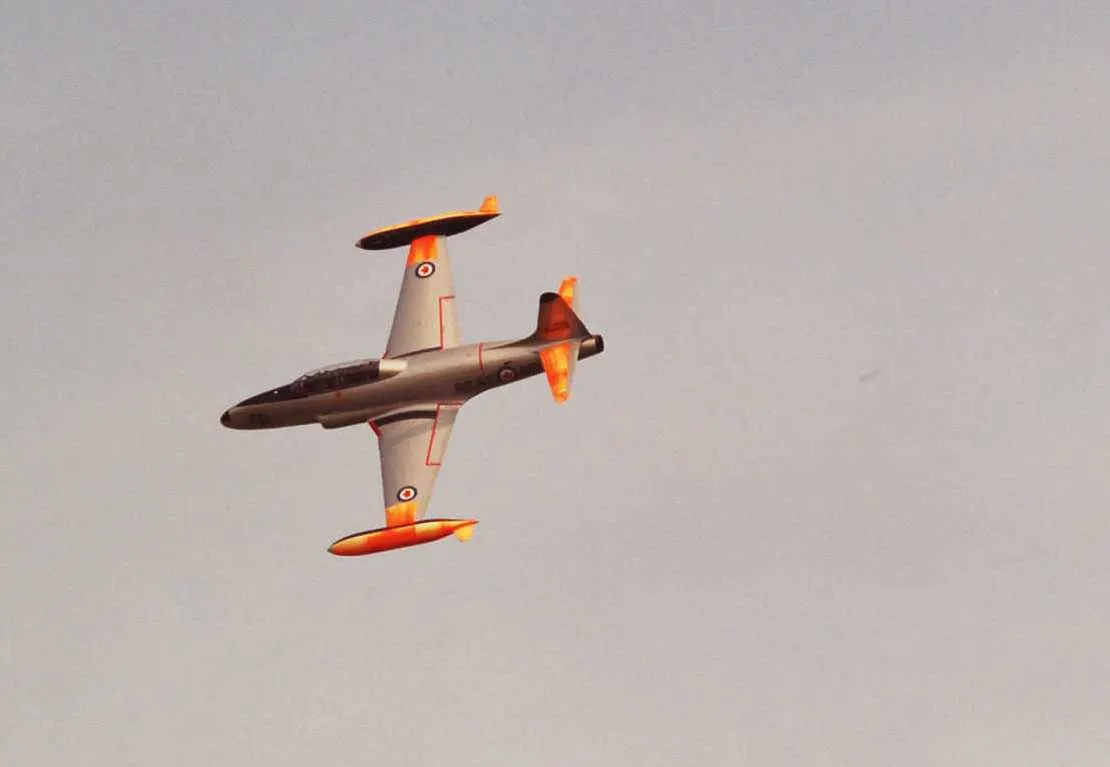
Student pilots passed through the Silver Star at flying schools in Portage la Prairie and Macdonald, Manitoba, and at the operational training unit at Chatham, New Brunswick, before the RCAF stood the type down from primary training in 1976.11 What followed was a second career: airframes converted to CE-133, ET-133, and TE-133 configurations simulated jamming, hostile aircraft, and anti-ship threats for air defence crews, while others carried Del Mar target-tow gear for gunnery practice, roles flown for another three decades.1,5,11
The Red Knight and a Silver Star That Flew Until 2005
From 1958 to 1969, a single Day-Glo red Silver Star flew as the Red Knight, the RCAF's solo aerobatic act, an idea championed by instructor Roy Windover after he watched an American exchange pilot fly the solo slot at a 1957 Canadian air show.7,11 Built to work small airfields rather than a formation team's larger show circuit, it flew more than 600 displays across twelve seasons with seventeen different pilots.7
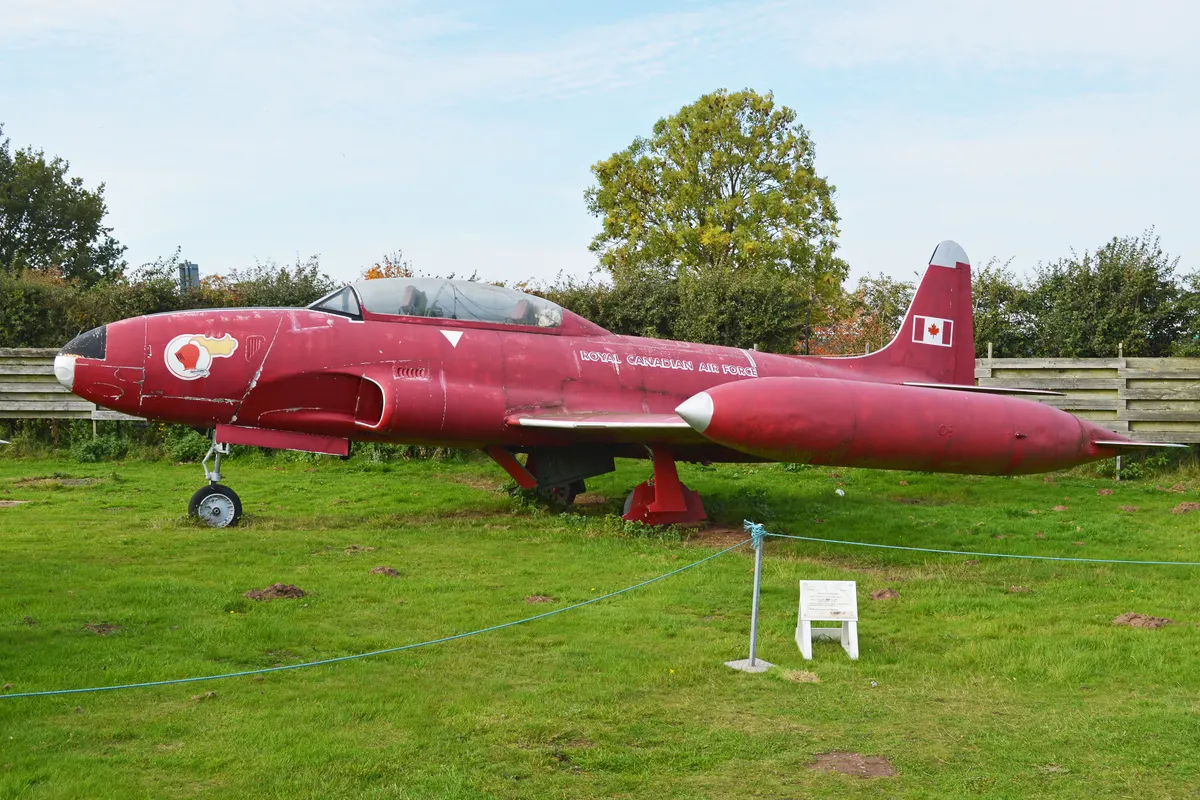
Three fatal accidents, including F/L James "Bud" Morin's crash at Gimli in August 1963, ended the program in early 1970.7,11 One Silver Star far outlasted it: converted to CX-133 configuration, it flew as an ejection-seat testbed at the Aerospace Engineering Test Establishment, CFB Cold Lake, for 46 years, logging 11,394.6 hours before its retirement on 26 April 2005, the last Silver Star in Canadian service.1,11
The Silver Star never flew a shooting war, but its Cold War work went beyond the classroom. Canada's air division in Europe flew the type at Baden-Söllingen, Marville, and Zweibrücken from 1953 into the early 1990s, with detachments south to the NATO weapons range at Decimomannu, Sardinia, towing targets and flying camera-gun sorties for the fighter squadrons that carried Canada's NATO commitment.11
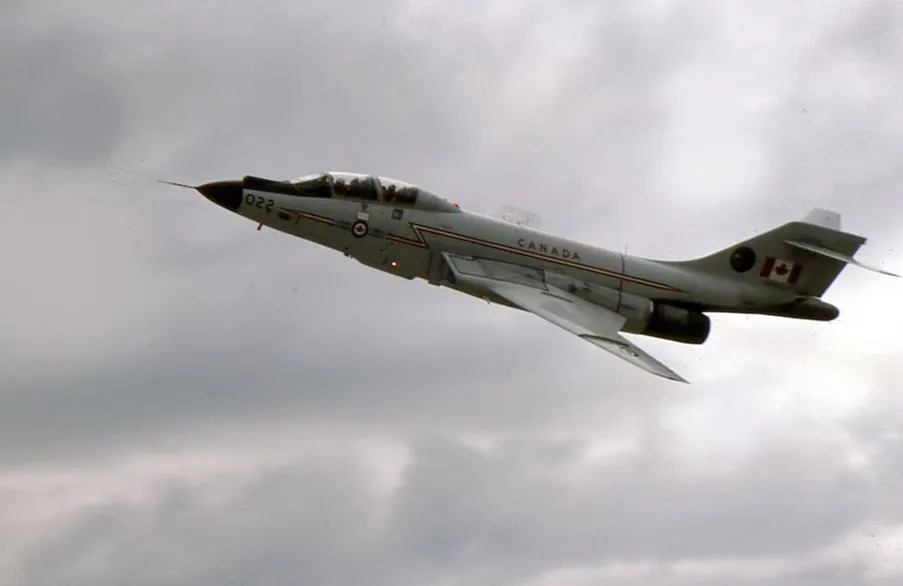
At home, ECM-converted Silver Stars gave North American Air Defence Command crews flying the CF-100 and later CF-101 Voodoo realistic jamming and simulated-threat practice for intercepts they might otherwise have flown against Soviet long-range bombers.5,6 The trainer itself never fired a shot; Canada's actual interceptors handled any real scrambles, while the Silver Star supplied the rehearsal.
Canadair's marks ran from the interim Lockheed-built Mk 1 loaners through the single CL-30 prototype Mk 2 to the definitive Mk 3, split into unarmed, gun- and rocket-armed, and photo-reconnaissance sub-variants.1,11 Later second-line conversions, CE-133 and ET-133/TE-133 threat simulators and the long-serving CX-133 ejection-seat testbed, gave individual airframes new roles without any new production.1,5 Exported airframes carried the separate designation T-33AN, the label foreign customers used to distinguish the Nene-engined Canadian jet from Lockheed's Allison-powered original.2,9

Canada was the only operator to fly the Silver Star from its 1953 introduction to its 2005 retirement, but roughly 20 surplus airframes went to Bolivia in the 1970s as part of an export pipeline that also reached France, Greece, Portugal, and Turkey, several under NATO mutual aid rather than commercial sale.1,2,11
Bolivia's Silver Stars, sold on with help from demonstration tours like Haydon-Baillie's, remained in service long after Canada's own fleet had moved to secondary duties.11 France, Greece, Portugal, and Turkey flew their smaller batches alongside Lockheed-built T-33s already on strength, using the Canadian jets mainly for advanced training rather than as a distinct fleet.1,2
CT-133 vs Lockheed T-33: One Engine, Two Careers
Set against its own parent, the Silver Star's story comes down to a single substitution. Airframe, cockpit, tail, and landing gear were shared with the American T-33A almost unchanged; the practical difference was Orenda's Nene 10 in place of the Allison J33, plus standard wingtip tanks.1,3 That did not make the Canadian jet meaningfully faster, both were subsonic trainers of similar top speed, but it gave Canada an engine supply independent of Allison and an airframe robust enough that the RCAF kept converting surplus examples into new roles for three decades after most American T-33s had been retired or exported.1
CT-133 vs Canadair CT-114 Tutor: Licence-Built Predecessor, Domestic Successor
A closer-to-home comparison is Canadair's own CT-114 Tutor, a clean-sheet Canadian design powered by a single Orenda-built General Electric J85, which entered RCAF service in 1963 and gradually took over primary jet training from the Silver Star.9 The contrast marks a shift in ambition: the Silver Star was an American design re-engined domestically, while the Tutor was designed by Canadair from scratch, and its simpler, purpose-built airframe made it markedly cheaper to fly, which is why it displaced the older jet from front-line training even as Canada kept the Silver Star flying secondary roles for four more decades.9,11
| Aircraft | Engine | Top speed | Retired (Canada) |
|---|---|---|---|
| CT-133 Silver Star | 1 × Rolls-Royce Nene 10 | ~920 km/h | 2005 |
| Lockheed T-33 | 1 × Allison J33 | ~965 km/h | n/a (US) |
| Canadair CT-114 Tutor | 1 × Orenda J85 | ~816 km/h | 2000 |


What is the Canadair CT-133 Silver Star?
The Canadian licence-built version of the Lockheed T-33 jet trainer, built by Canadair in Montreal from 1952 to 1958 as the CL-30 and named Silver Star in RCAF service.1
How is the CT-133 different from the Lockheed T-33?
Mainly the engine: a Rolls-Royce Nene 10, built under licence by Orenda in Ontario, replaced the American Allison J33, and the Canadian jet carried standard wingtip tanks.1,10
How many CT-133 Silver Stars were built?
Canadair built 656 between 1952 and 1958, plus 30 interim Lockheed-built T-33As loaned to the RCAF before Canadian production ramped up.1,11
What was the CT-133's top speed and specifications?
About 920 km/h, a service ceiling near 14,000 m, a length of 11.48 m, and a maximum takeoff weight near 7,630 kg.1,3,4
Is the CT-133 Silver Star still in service?
No. Canada retired its last Silver Star, a converted ejection-seat testbed, on 26 April 2005, though several remain airworthy in private and museum hands.1,11
- "Canadair CT-133 Silver Star", Wikipedia — en.wikipedia.org ↩
- "Canadair T-33AN Silver Star 3", Ingenium (Canada Aviation and Space Museum) — ingenium.ca ↩
- "Canadair CT-133 Silver Star, Single-engine Two-seat Jet Trainer, Canada", Skytamer — skytamer.com ↩
- "Canadair CT-133 Silver Star Jet Trainer", MilitaryFactory — militaryfactory.com ↩
- "No. 414 Squadron RCAF", Wikipedia — en.wikipedia.org ↩
- "414 Electronic Warfare Support Squadron", Royal Canadian Air Force / Canada.ca — canada.ca ↩
- "The Red Knight", Canada's Aviation Hall of Fame — cahf.ca ↩
- "Canadair CT-114 Tutor", Wikipedia — en.wikipedia.org ↩
- "Orenda Engines", Wikipedia — en.wikipedia.org ↩
- "Canadian Warplanes 6: Canadair CT-133A Silver Star, RCAF, RCN, Canadian Forces", SilverHawkAuthor — silverhawkauthor.com ↩